Testicular pain that starts suddenly and severely is a medical emergency until proven otherwise: it can be testicular torsion, a twisting of the spermatic cord that cuts off the testicle’s blood supply, and the testicle can be lost within hours. Go to the emergency department or call an ambulance now, and do not wait to see if it settles. Most other causes, such as epididymitis, injury, a varicocele or a hydrocele, are less urgent but still deserve a proper examination.
Sources: NHS — Testicle pain; MedlinePlus — Testicular torsion
- Sudden, severe pain in a testicle, especially with nausea, vomiting or belly pain, needs emergency care immediately because it may be testicular torsion.
- When torsion is operated on within about 6 hours, the testicle is saved in roughly 90–100 percent of cases; after 24 hours, typically fewer than 10% survive.
- Epididymitis (infection of the tube behind the testicle) is a common cause of gradual pain and is treated with antibiotics.
- Testicular cancer is usually painless; a lump, swelling or heaviness should be checked by a doctor even without pain.
- Long-lasting (chronic) pain in the testicles often has no single cause and is managed step by step, from medicines to nerve-targeted procedures.
- What is testicular pain?
- Sudden testicular pain: testicular torsion is an emergency
- Common causes of testicular pain
- Sudden vs gradual testicular pain: how the causes compare
- Epididymitis and orchitis
- Chronic testicular pain
- How doctors find the cause
- Treatment and home care for testicular pain
- When to see a doctor
- FAQs about testicular pain
What is testicular pain?
Testicular pain is pain felt in one or both testicles or in the scrotum around them. It can be sharp or dull, constant or coming in waves, and it may spread into the groin or lower abdomen. The testicles contain many sensitive nerves, which is why even a minor knock can hurt badly.
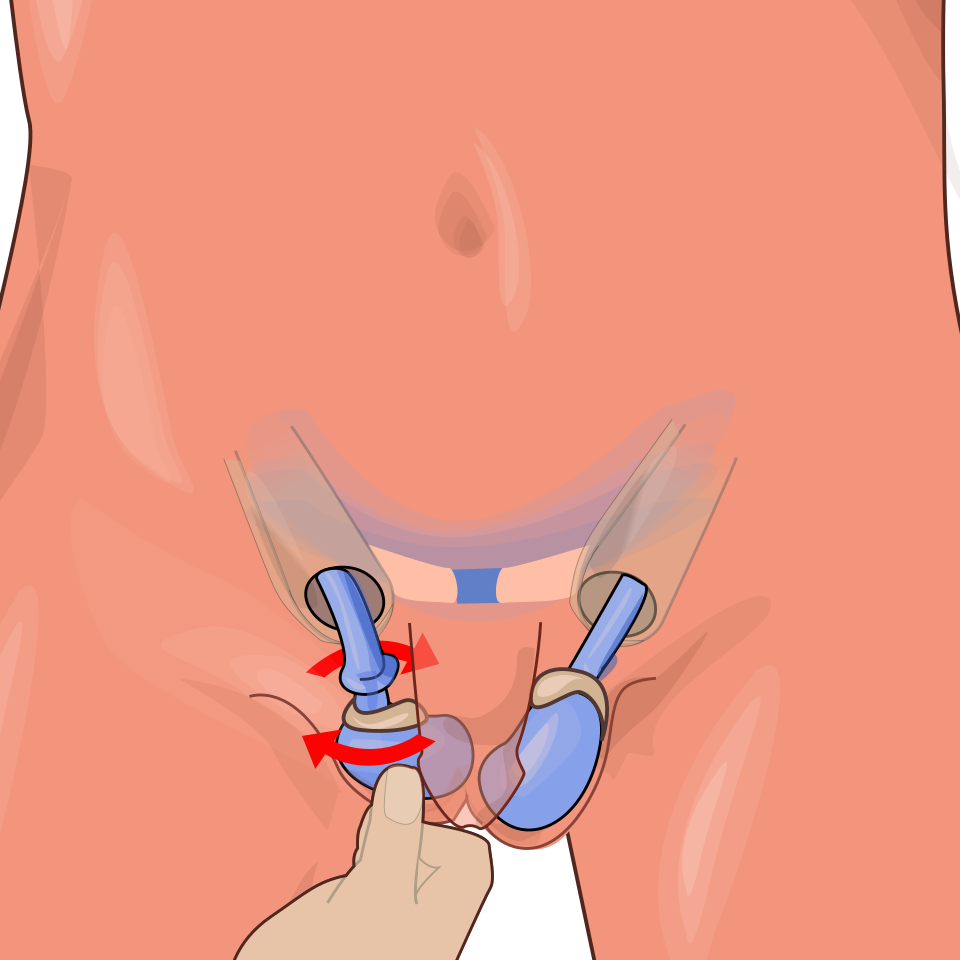
Testicular pain does not always start in the testicle itself. The epididymis (a coiled tube on the back of each testicle that stores sperm), the spermatic cord (which carries blood vessels, nerves and the vas deferens), the scrotal skin and the nerves of the groin can all be the source. Problems further away, such as a kidney stone or an inguinal hernia, can also be felt in the scrotum.
Sources: Cleveland Clinic — Testicular Pain; MedlinePlus — Testicle pain
The European Association of Urology (EAU) notes that the scrotum is supplied by the ilioinguinal, genitofemoral and pudendal nerves, so irritation anywhere along these nerves, for example after groin surgery, can produce pain that feels as if it comes from the testicle. This explains why a normal-looking testicle can still be painful.
Source: EAU Guidelines — Chronic Pelvic Pain — Epidemiology, Aetiology and Pathophysiology
Sudden testicular pain: testicular torsion is an emergency
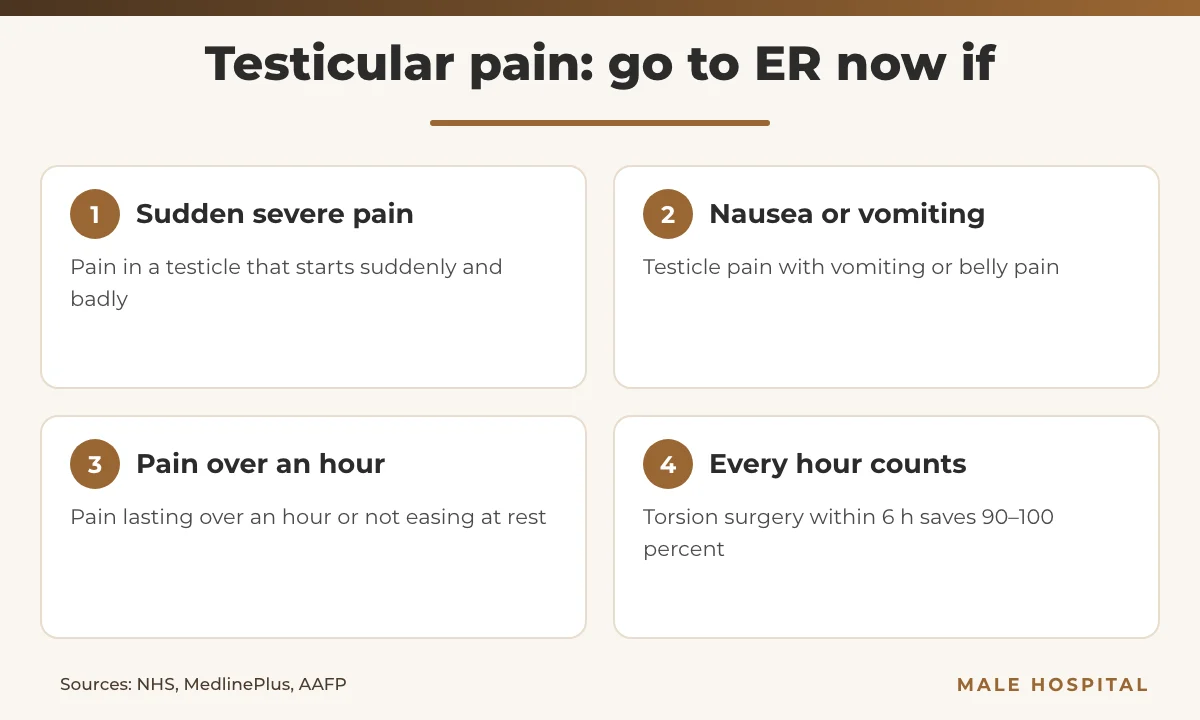
If you have sudden, severe testicular pain, stop reading and get emergency care now. The NHS advises going to the emergency department (A&E) or calling an ambulance immediately for sudden severe pain in a testicle, testicle pain with nausea, vomiting or stomach pain, or pain that lasts more than an hour or continues while you are resting. Do not drive yourself; ask someone to take you or call an ambulance.
Source: NHS — Testicle pain
What happens in testicular torsion
In torsion, the spermatic cord twists and cuts off blood flow to the testicle and nearby tissue. Typical symptoms are sudden, severe testicular pain on one side, often with no clear trigger, swelling on one side of the scrotum, and nausea or vomiting. The testicle may sit higher than normal. It is most common in the first year of life and around puberty, but adult men can have it too. Some men are more prone because of how the testicle is attached inside the scrotum; it can also follow an injury or heavy exercise.
Sources: MedlinePlus — Testicular torsion; EAU Guidelines — Paediatric Urology — Acute Scrotum
Why every hour counts
The testicle can only survive a limited time without blood. According to a review in American Family Physician, the testicle is saved in about 90–100 percent of cases when surgery happens within 6 hours of symptom onset, about 50% after more than 12 hours, and typically fewer than 10% after 24 hours or more. The EAU puts the critical window for irreversible damage at about four to six hours, and severe shrinkage has been seen after as little as four hours when the cord is twisted more than 360 degrees.
Sources: American Family Physician (AAFP) — Sharp et al. 2013 — Testicular Torsion: Diagnosis, Evaluation, and Management; EAU Guidelines — Paediatric Urology — Acute Scrotum
Because time matters so much, guidelines say that when torsion is strongly suspected, doctors should go straight to surgical exploration rather than delay for scans. Doppler ultrasound is helpful but should not hold up the operation. MedlinePlus recommends going to an emergency department rather than an urgent care clinic, because surgery may be needed right away. Never try to “wait it out” overnight, even if the testicular pain eases for a while: the cord can twist and untwist, and pain relief does not prove that blood flow is back.
Sources: American Family Physician (AAFP) — Sharp et al. 2013 — Testicular Torsion: Diagnosis, Evaluation, and Management; MedlinePlus — Testicular torsion
What surgery for torsion involves
The surgeon untwists the cord and stitches the testicle to the inside wall of the scrotum (orchiopexy). The other testicle is usually fixed at the same time, because it is also at risk of twisting in the future. If the testicle has already died, it is removed (orchiectomy). Even after a successful repair, up to half of patients may later develop some shrinkage of the affected testicle, and reduced fertility has been reported in 36–39% of patients after torsion, which is why fast treatment matters. If you have concerns about fertility afterwards, our guide to male infertility explains the tests involved.
Sources: MedlinePlus — Testicular torsion; EAU Guidelines — Paediatric Urology — Acute Scrotum
Common causes of testicular pain
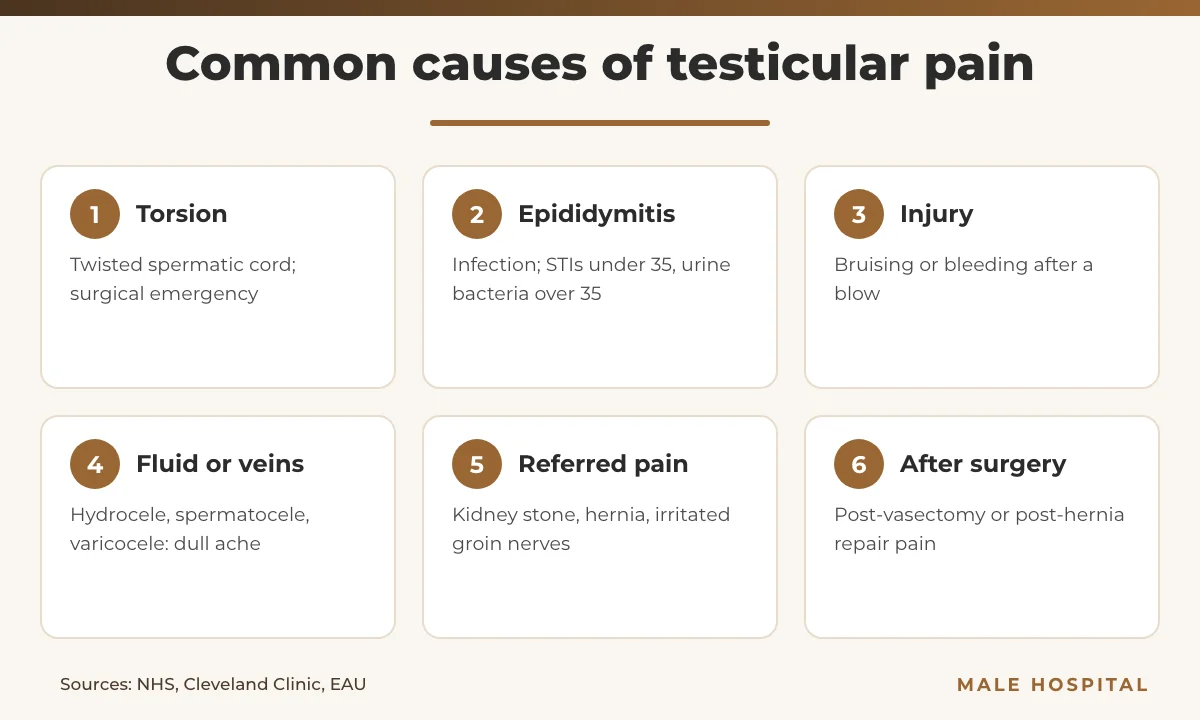
Many different conditions can cause testicular pain. In boys and young men with an acutely painful scrotum, the most common causes are torsion of the testicle, torsion of a small tissue appendage on the testicle, and epididymitis or epididymo-orchitis. In adults, infection, injury, fluid collections, varicose veins and hernias are frequent explanations.
Sources: EAU Guidelines — Paediatric Urology — Acute Scrotum; NHS — Testicle pain
- Testicular torsion: sudden severe pain from a twisted spermatic cord; a surgical emergency.
- Torsion of the appendix testis: a tiny tag of tissue on the testicle twists. It mainly affects boys, sometimes shows as a “blue dot” under the skin, and is usually managed with anti-inflammatory painkillers once torsion of the testicle itself is excluded.
- Epididymitis and orchitis: infection or inflammation of the epididymis or testicle, usually with gradual pain, swelling and warmth.
- Injury: a blow to the scrotum can cause bruising, bleeding or, rarely, rupture of the testicle.
- Fluid and vein problems: a hydrocele (fluid around the testicle), a spermatocele (cyst in the epididymis) or a varicocele (enlarged veins) usually cause a dull ache or heaviness rather than sharp pain.
- Inguinal hernia: part of the intestine pushes through a weak area in the groin and can cause groin and scrotal pain.
- Kidney stone: pain from a kidney stone can be felt in the testicle.
- After surgery: pain after vasectomy or hernia repair.
- Testicular cancer: usually painless, but some tumors cause an ache or heaviness.
Sources: Cleveland Clinic — Testicular Pain; MedlinePlus — Testicle pain; EAU Guidelines — Paediatric Urology — Acute Scrotum
Is testicular pain a sign of cancer?
Testicular pain alone is not usually a sign of testicular cancer. The American Cancer Society notes that some testicular tumors cause pain, but most of the time they do not. The more typical warning signs listed by the NHS are a lump or swelling in a testicle, a testicle getting bigger, a scrotum that feels heavy, firm or hard, and sometimes an ache in the testicle, scrotum, back or lower tummy. These symptoms have many harmless causes, but they should still be checked, because cancer is easier to treat when found early.
Sources: American Cancer Society — Signs and Symptoms of Testicular Cancer; NHS — Symptoms of testicular cancer
Sudden vs gradual testicular pain: how the causes compare
How the testicular pain started is one of the most useful clues. Pain that comes on within minutes points toward torsion, while pain that builds over hours to days, especially with fever or burning on urination, points toward infection. The table below summarizes typical features, but none of them is reliable enough to rule out torsion at home. Only an examination, and often an ultrasound or surgery, can do that.
| Cause | Typical onset | Typical features | Urgency |
|---|---|---|---|
| Testicular torsion | Sudden (minutes) | Severe one-sided pain, nausea or vomiting, high-riding testicle, cremasteric reflex often absent | Emergency now |
| Torsion of appendix testis | Sudden or gradual | Common in boys; sometimes a “blue dot” under the skin | Same day (torsion must be excluded) |
| Epididymitis / orchitis | Gradual (hours to days) | Warm, red, swollen scrotum; fever; urinary symptoms or discharge | Urgent, same day |
| Injury | After a blow | Bruising and swelling | Emergency if pain or swelling lasts over an hour |
| Varicocele / hydrocele | Slow (weeks to months) | Dull ache, heaviness, soft swelling | Routine appointment |
| Testicular cancer | Slow | Usually painless lump, swelling or heaviness | Prompt appointment |
Sources: American Family Physician (AAFP) — Sharp et al. 2013 — Testicular Torsion: Diagnosis, Evaluation, and Management; MedlinePlus — Testicle pain; CDC — Epididymitis: STI Treatment Guidelines
A word of caution: epididymitis can also start suddenly, and torsion can occasionally build more slowly or come and go. The US Centers for Disease Control and Prevention (CDC) advises that torsion, a surgical emergency, should be considered in every man with suspected epididymitis, and that sudden severe one-sided testicular pain needs immediate urology assessment.
Sources: CDC — Epididymitis: STI Treatment Guidelines; NHS — Epididymitis
Epididymitis and orchitis
Epididymitis is swelling and pain in the epididymis, the tube behind the testicle, usually caused by infection. When the testicle is involved too, it is called epididymo-orchitis. Symptoms include testicular pain on one or both sides, a tender, warm and swollen scrotum, sometimes fluid around the testicle, and in some men difficulty urinating or a discharge from the penis.
Source: NHS — Epididymitis
Causes by age and risk
In men under 35, epididymitis is usually caused by a sexually transmitted infection (STI) such as chlamydia or gonorrhea. In men over 35, it is more often due to a urinary infection, which becomes more likely with an enlarged prostate, a urinary catheter or recent surgery on the bladder, prostate or groin. Less common causes include mumps, tuberculosis and the heart medicine amiodarone. Infection of the prostate can be linked; see our guide to prostatitis.
Sources: NHS — Epididymitis; CDC — Epididymitis: STI Treatment Guidelines
Treatment
Antibiotics are started at the first visit, before lab results come back. The choice depends on the likely germ: for a suspected STI, CDC guidelines recommend a single ceftriaxone injection plus 10 days of doxycycline tablets; for suspected urinary bacteria, a 10-day course of levofloxacin is an option. Rest, raising the scrotum and anti-inflammatory painkillers help while the inflammation settles. Most men improve within a few days, but full recovery can take up to 3 months. You should be reviewed if there is no improvement within 72 hours, and recent sexual partners may need testing and treatment.
Sources: CDC — Epididymitis: STI Treatment Guidelines; NHS — Epididymitis
Chronic testicular pain
Some men have testicular pain that lingers or keeps returning for months. The EAU describes a scrotal pain syndrome in which pain is felt in the testicle, epididymis or vas deferens without any specific underlying disease being found. Pain after surgery is generally called chronic when it persists at least three months after the operation, beyond normal healing.
Source: EAU Guidelines — Chronic Pelvic Pain — Epidemiology, Aetiology and Pathophysiology
Pain after vasectomy or hernia repair
Two well-known forms follow surgery. Post-vasectomy pain affects an estimated 2–20% of men who have had a vasectomy, and in one cohort of 625 men, 14.7% had some scrotal pain six months later, although it was mostly mild and only 0.9% had pain that noticeably affected daily life. Inguinal hernia repair can lead to chronic pain in up to 10% of patients at six months, sometimes felt in the scrotum.
Source: EAU Guidelines — Chronic Pelvic Pain — Epidemiology, Aetiology and Pathophysiology
How chronic pain is treated
Treatment follows the general principles of managing chronic pain: simple painkillers first, then nerve-pain medicines if these are not enough. Cleveland Clinic mentions tricyclic antidepressants such as amitriptyline for nerve-related pain. When a numbing injection into the spermatic cord (a cord block) relieves the pain, the EAU suggests that microsurgical denervation of the spermatic cord, which cuts the small nerves around the cord, can be offered. For post-vasectomy pain, vasectomy reversal can relieve symptoms in some men. The evidence for removing the epididymis is poor.
Sources: EAU Guidelines — Chronic Pelvic Pain — Management; Cleveland Clinic — Testicular Pain
How doctors find the cause
The diagnosis starts with questions about when and how the testicular pain began, where it is, how severe it is, whether it comes and goes, and whether there was an injury, a recent infection, discharge, urinary symptoms or sexual exposure. The doctor then examines the groin, testicles and abdomen.
Source: MedlinePlus — Testicle pain
Physical examination signs
A testicle that sits high or lies horizontally suggests torsion. The cremasteric reflex, in which stroking the inner thigh makes the testicle rise, is usually absent in torsion: the EAU reports 100 percent sensitivity but only 66% specificity for an absent reflex, so a present reflex makes torsion less likely without ruling it out. A tender, swollen epididymis (often starting at its lower end), fever and urinary findings suggest epididymitis. Scoring tools such as TWIST help estimate risk but cannot confirm or exclude torsion on their own.
Sources: EAU Guidelines — Paediatric Urology — Acute Scrotum; American Family Physician (AAFP) — Sharp et al. 2013 — Testicular Torsion: Diagnosis, Evaluation, and Management
Tests
- Doppler ultrasound: checks blood flow to the testicle and is the first-line scan. One study cited by AAFP reported 88.9% sensitivity and 98.8% specificity for torsion, but a normal scan does not fully exclude it.
- Urine tests: urinalysis, urine culture and a first-void urine test for chlamydia and gonorrhea.
- Other tests: HIV and syphilis testing in men with epididymitis, and CT or other imaging if a kidney stone or hernia is suspected.
Sources: American Family Physician (AAFP) — Sharp et al. 2013 — Testicular Torsion: Diagnosis, Evaluation, and Management; CDC — Epididymitis: STI Treatment Guidelines; MedlinePlus — Testicle pain
Treatment and home care for testicular pain
Treatment of testicular pain depends entirely on the cause: emergency surgery for torsion, antibiotics for bacterial infection, observation or surgery for a hernia, hydrocele or varicocele, and a staged pain plan for chronic pain. Do not try to diagnose yourself; the NHS specifically advises against it.
Sources: NHS — Testicle pain; Cleveland Clinic — Testicular Pain
Home measures for mild pain (after serious causes are excluded)
- Wear supportive underwear or an athletic supporter.
- Apply ice wrapped in a cloth, or a cold pack, to the scrotum.
- Lie down with a rolled towel under the scrotum.
- Take a warm bath if there is swelling.
- Use over-the-counter pain relievers such as acetaminophen (paracetamol) or ibuprofen; do not give aspirin to children.
- If an infection was diagnosed, finish the full antibiotic course.
Sources: MedlinePlus — Testicle pain; Cleveland Clinic — Testicular Pain
Prevention
Not every case can be prevented, but some steps lower the risk: wear a protective cup or supporter during contact sports, practice safer sex and use condoms to reduce the risk of STI-related epididymitis, and make sure children are vaccinated against mumps. If you are planning a vasectomy, ask your urologist about the risk of long-term testicular pain; the EAU recommends that men are told about it beforehand.
Sources: MedlinePlus — Testicle pain; EAU Guidelines — Chronic Pelvic Pain — Management
When to see a doctor
Go to the emergency department or call an ambulance immediately if you have:
- sudden, severe pain in a testicle;
- pain in a testicle with nausea, vomiting or stomach pain;
- pain that lasts more than an hour or does not ease while resting or lying down;
- pain or swelling that persists an hour after an injury to the scrotum.
Book an urgent appointment (same day if possible) if you have: a fever with a warm, red or tender scrotum, a discharge from the penis or burning on urination, or recent exposure to mumps. See a doctor promptly for a lump, swelling, a change in the shape or feel of a testicle, one testicle becoming larger than the other, or an ache that will not go away.
Sources: NHS — Testicle pain; MedlinePlus — Testicle pain; Cleveland Clinic — Testicular Pain
For non-emergency, recurring or chronic testicular pain, you can arrange a confidential consultation with our urologist-andrologist, Assoc. Prof. Dr. Zülfü Sertkaya, by sending a message on WhatsApp. If your pain is sudden and severe, do not message us first: go to your nearest emergency department now.
FAQs about testicular pain
Can testicular pain go away on its own?
Brief testicular pain after a minor knock may settle, but pain or swelling that persists an hour after an injury needs emergency care. Pain from epididymitis needs antibiotics, and torsion never resolves safely without treatment, even if the pain briefly eases. The NHS says pain lasting over an hour, or continuing while you rest, needs emergency assessment, so do not wait for sudden or severe pain to fade.
Source: NHS — Testicle pain
How long can a testicle survive torsion?
Damage can begin within about four to six hours. Salvage rates reported in American Family Physician are about 90–100 percent when surgery happens within 6 hours, about 50% after 12 hours and typically under 10% after 24 hours. That is why sudden severe testicular pain means going to the emergency department immediately, at any time of day or night.
Sources: American Family Physician (AAFP) — Sharp et al. 2013 — Testicular Torsion: Diagnosis, Evaluation, and Management; EAU Guidelines — Paediatric Urology — Acute Scrotum
Can adult men get testicular torsion?
Yes. Torsion is most common in the first year of life and around puberty, but it can happen to older men too. Age should never be the reason to ignore sudden, severe one-sided scrotal pain. The CDC notes that torsion should be considered in every man thought to have epididymitis, especially when there are no signs of infection.
Sources: MedlinePlus — Testicular torsion; CDC — Epididymitis: STI Treatment Guidelines
Why does my testicle hurt without any swelling?
Testicular pain without swelling can come from irritated groin nerves, a kidney stone, a hernia, early epididymitis, pain after vasectomy or hernia surgery, or a chronic scrotal pain syndrome where no specific disease is found. Because early torsion can also look normal from the outside, sudden pain still needs urgent care even if nothing looks swollen.
Sources: EAU Guidelines — Chronic Pelvic Pain — Epidemiology, Aetiology and Pathophysiology; MedlinePlus — Testicle pain
Can an STI cause pain in the testicles?
Yes. Chlamydia and gonorrhea are the usual causes of epididymitis in men under 35, and Mycoplasma genitalium can also be responsible. The infection may cause little or no discharge. Testing is done on a urine sample, both partners should be treated, and sex should be avoided until treatment is finished and symptoms have settled.
Sources: CDC — Epididymitis: STI Treatment Guidelines; NHS — Epididymitis
Is a dull ache in one testicle serious?
A dull ache or heavy feeling is often caused by a varicocele or hydrocele and is rarely an emergency. However, testicular cancer can also cause heaviness or aching in the scrotum or lower belly, usually together with a lump or swelling. Any ache that does not go away, or any change in size or feel, should be examined by a doctor.
Sources: American Cancer Society — Signs and Symptoms of Testicular Cancer; NHS — Symptoms of testicular cancer
Can I try to untwist a testicle myself?
No. Doctors sometimes attempt manual detorsion in hospital, but the EAU warns it must not delay surgery, and in one series 17 of 53 patients still had residual twisting afterwards, including 11 whose pain had improved. Pain relief alone does not prove that blood flow has returned, so surgical exploration is still needed.
Source: EAU Guidelines — Paediatric Urology — Acute Scrotum
How long does pain from epididymitis last?
Most men feel better within a few days of starting antibiotics, but complete recovery can take up to three months, and some tenderness may persist for weeks after the course ends. If there is no improvement within 72 hours, return for review, because another cause such as an abscess, tumor or loss of blood supply may need to be excluded.
Sources: NHS — Epididymitis; CDC — Epididymitis: STI Treatment Guidelines
Medically reviewed by Assoc. Prof. Dr. Zülfü Sertkaya, urologist and andrologist (FEBU), Istanbul. Last reviewed: November 2026.
This article is for general information and does not replace an individual consultation with a qualified doctor.
- NHS — Testicle pain
- MedlinePlus — Testicular torsion
- MedlinePlus — Testicle pain
- Cleveland Clinic — Testicular Pain
- EAU Guidelines — Paediatric Urology — Acute Scrotum
- EAU Guidelines — Chronic Pelvic Pain — Epidemiology, Aetiology and Pathophysiology
- EAU Guidelines — Chronic Pelvic Pain — Management
- American Family Physician (AAFP) — Sharp et al. 2013 — Testicular Torsion: Diagnosis, Evaluation, and Management
- CDC — Epididymitis: STI Treatment Guidelines
- NHS — Epididymitis
- American Cancer Society — Signs and Symptoms of Testicular Cancer
- NHS — Symptoms of testicular cancer