Prostatitis is inflammation of the prostate gland, the walnut-sized gland below the bladder that makes part of the semen. It can be a sudden bacterial infection that needs antibiotics straight away, a slower bacterial infection that keeps coming back, or, most often, a long-lasting pelvic pain condition in which no infection is found. Besides pain and urinary problems, it can affect sex life through painful ejaculation, erectile dysfunction (ED) and premature ejaculation (PE), so sexual symptoms should be assessed and treated alongside the prostate condition.
Source: NIDDK — Prostatitis: Inflammation of the Prostate; NHS — Prostatitis
- Doctors use the four NIH categories: I acute bacterial, II chronic bacterial, III chronic pelvic pain syndrome (CP/CPPS) and IV asymptomatic inflammation.
- Fewer than 10% of diagnosed men have a proven bacterial infection; most have CP/CPPS.
- Acute bacterial infection causes fever, chills and painful urination and needs prompt antibiotics; it can lead to urinary retention, abscess or sepsis.
- CP/CPPS is treated with a combination approach: alpha-blockers, anti-inflammatories, a trial of antibiotics in selected men, pelvic floor therapy, acupuncture and psychological support.
- Sexual problems are common: pooled studies report ED in about a third and PE in about a third of men with CP/CPPS, and the EAU advises treating the prostate first in men with acquired PE.
What is prostatitis?
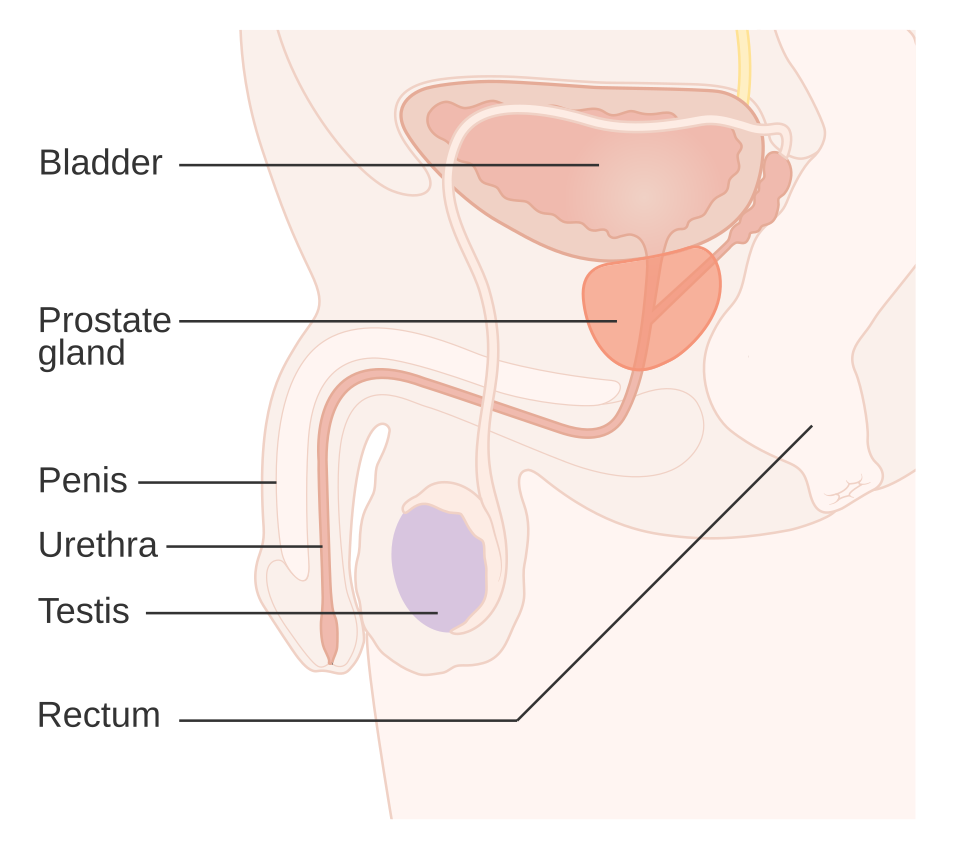
The prostate sits just below the bladder and in front of the rectum, wrapped around the urethra, the tube that carries urine and semen out through the penis. Because of this position, inflammation of the gland can cause pain deep in the pelvis, changes in urination and discomfort during or after ejaculation. Doctors can feel the back of the gland through the rectum, so a gentle digital rectal exam is part of the assessment.
Prostatitis is very common. It is the most common urinary tract problem in men younger than 50 and the third most common in men older than 50, and it accounts for about two million healthcare visits a year in the United States. Population studies summarised by the European Association of Urology (EAU) report these symptoms in 2.2–14.2% of men, with men aged 50–59 at about three times the risk of men aged 20–39.
Source: NIDDK — Prostatitis: Inflammation of the Prostate; EAU Guidelines — Chronic Pelvic Pain: Epidemiology, aetiology and pathophysiology
Types of prostatitis: the NIH categories I–IV
Urologists use the classification system developed by the US National Institutes of Health (NIH), which the EAU recommends. The category matters because treatment is very different for each one. Antibiotics are essential for bacterial infection, have a limited role in CP/CPPS and are not needed at all for category IV.
| NIH category | Name | Key features |
|---|---|---|
| I | Acute bacterial prostatitis | Sudden infection with fever, chills, painful urination and pelvic pain; a medical emergency in some men |
| II | Chronic bacterial prostatitis | Milder symptoms lasting 3 months or more, often with recurring urinary tract infections with the same bacteria |
| IIIA | Inflammatory CP/CPPS | Pelvic pain for 3 months or more, no infection, white blood cells in semen or prostatic fluid |
| IIIB | Non-inflammatory CP/CPPS | Same pain pattern, no infection and no white blood cells |
| IV | Asymptomatic inflammatory prostatitis | No symptoms; found by chance on tests for another problem; no treatment needed |
Source: EAU Guidelines — Urological Infections; NIDDK — Prostatitis: Inflammation of the Prostate
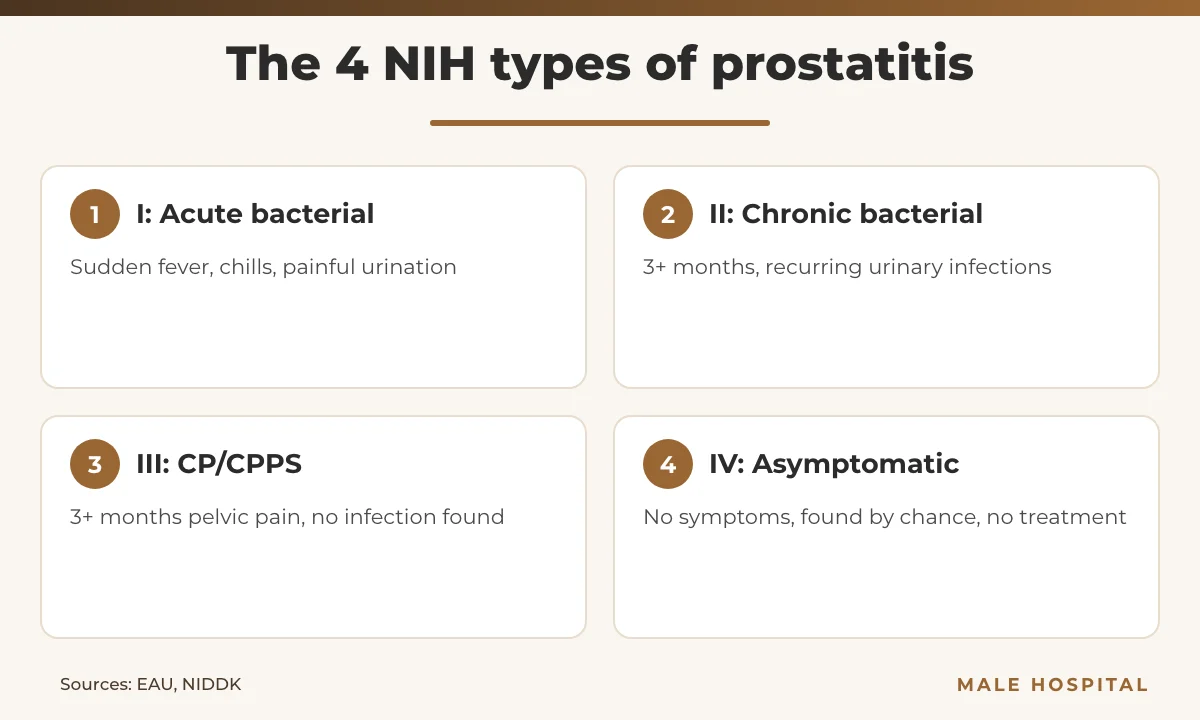
Bacterial infection is actually the minority. According to the EAU, fewer than 10% of diagnosed men have a proven bacterial infection. The EAU’s chronic pelvic pain guideline now calls category III “primary prostate pain syndrome” (PPPS), a name that reflects how the problem behaves: as a chronic pain condition involving nerves and pelvic muscles rather than an ongoing infection.
Source: EAU Guidelines — Urological Infections; EAU Guidelines — Chronic Pelvic Pain: Diagnostic evaluation
Prostatitis symptoms
Symptoms depend on the type, but most men notice a mix of pain, urinary changes and sexual discomfort. The NHS lists pain or burning when urinating, difficulty or straining to urinate, needing to urinate more often, pain in the penis, testicles, scrotum or bottom, and pain when ejaculating.
Acute bacterial type (category I)
In acute bacterial prostatitis (ABP), symptoms start suddenly and can be severe: fever, chills, body aches, nausea or vomiting, painful urination, pain in the pelvis, lower back or perineum (the area between the scrotum and anus), and sometimes being unable to pass urine at all. About 10% of men with ABP develop urinary retention.
Chronic bacterial type (category II)
Symptoms are similar but milder and develop slowly over 3 months or more. They may come and go, and some men have no symptoms between flares. Repeated urinary tract infections are a typical clue.
CP/CPPS (category III)
Pain or discomfort lasting at least 3 months in the perineum, lower abdomen, penis, scrotum or lower back is the main feature. Pain during or after ejaculation is common, as are frequent urination (8 or more times a day), urgency and a weak or interrupted stream.
Source: NHS — Prostatitis; NIDDK — Prostatitis: Inflammation of the Prostate; EAU Guidelines — Urological Infections
Other possible symptoms include blood in the urine or semen, foul-smelling urine and pain with bowel movements. Category IV causes no symptoms and is usually discovered on a biopsy or semen test done for another reason.
Source: MedlinePlus — Prostatitis, bacterial
Causes and risk factors
Bacterial prostatitis
Any bacteria that cause urinary tract infections can reach the prostate, usually from the urethra or bladder. In ABP, gut bacteria such as E. coli are the most common cause, especially in men over 35. In younger, sexually active men, sexually transmitted infections such as chlamydia and gonorrhea can be responsible. Chronic bacterial prostatitis (CBP) involves a wider range of germs, including atypical organisms such as Chlamydia trachomatis, Trichomonas vaginalis and mycoplasmas.
Risk factors include a urinary catheter, cystoscopy or prostate biopsy, blockage of urine flow, an enlarged prostate in men over 50, injury to the perineum and a tight foreskin (phimosis). The EAU notes that transrectal prostate biopsy raises the risk of ABP despite preventive antibiotics.
Source: MedlinePlus — Prostatitis, bacterial; EAU Guidelines — Urological Infections
Chronic prostatitis/chronic pelvic pain syndrome
No single cause has been found for CP/CPPS. The EAU describes it as a pain syndrome that probably develops in susceptible men, with changes in how nerves process pain (neuroplasticity) playing a central role. Possible contributors include a past bacterial infection, pelvic floor muscle tension, nerve irritation, urine backing up into the prostate, chemical irritation and stress. Depression and catastrophic thinking about pain are linked with more severe pain and poorer coping.
Source: EAU Guidelines — Chronic Pelvic Pain: Diagnostic evaluation; MedlinePlus — Prostatitis, nonbacterial
How it is diagnosed
Diagnosis starts with a detailed history and a physical examination, including a digital rectal exam. In ABP the gland is usually swollen and tender. The EAU strongly advises against prostatic massage in ABP because it can push bacteria into the bloodstream and trigger sepsis.
Tests for bacterial prostatitis
- Urine dipstick and midstream urine culture: the key tests in ABP; the culture identifies the bacteria and guides antibiotic choice.
- Blood tests and blood culture: recommended by the EAU in ABP.
- Meares–Stamey 2- or 4-glass test: urine samples taken before and after prostate massage to locate infection in the prostate; the EAU strongly recommends it for suspected CBP.
- Tests for atypical germs and STIs: first-void urine testing for chlamydia and checks for mycoplasma in chronic bacterial cases.
- Transrectal ultrasound: used only in selected men to rule out a prostatic abscess; it is unreliable as a diagnostic test on its own.
The EAU also advises against using PSA for diagnosis. PSA rises in about 60% of men with ABP and 20% of men with CBP and usually falls after treatment, so it adds confusion rather than useful information. A prostate biopsy is not part of the routine work-up and is avoided during untreated bacterial infection because of the sepsis risk.
Source: EAU Guidelines — Urological Infections
Assessment of CP/CPPS
CP/CPPS is diagnosed when pain felt in the region of the prostate lasts at least 3 months and other urinary tract problems have been ruled out. The EAU strongly recommends a validated questionnaire, the NIH Chronic Prostatitis Symptom Index (NIH-CPSI), at the start and during follow-up, and a structured check of urinary, sexual, emotional and behavioural effects. Depending on symptoms, a doctor may also arrange a flow test, bladder scan, cystoscopy or semen analysis.
Source: EAU Guidelines — Chronic Pelvic Pain: Diagnostic evaluation; NIDDK — Prostatitis: Inflammation of the Prostate
Prostatitis treatment by type
Acute bacterial type (ABP)
Antibiotics are started promptly, ideally after a urine sample has been sent for culture, and are adjusted once results are back. Men who are very unwell are treated in hospital with intravenous antibiotics, then switched to tablets once the infection settles; the EAU advises a total course of two to four weeks. NICE in the UK recommends oral antibiotics first when the patient can take them, plus paracetamol or ibuprofen for pain and enough fluids. If urine cannot pass, a catheter drains the bladder, and a prostatic abscess may need drainage.
Source: EAU Guidelines — Urological Infections; NICE NG110 — Prostatitis (acute): antimicrobial prescribing
Chronic bacterial type (CBP)
The EAU strongly recommends a fluoroquinolone such as ciprofloxacin or levofloxacin as first-line treatment, usually for four to six weeks. If chlamydia or mycoplasma is found, doxycycline or azithromycin is used instead, and metronidazole is used for trichomonas. Partners may need screening when a sexually transmitted germ is involved. Some men need repeated or longer courses, and low-dose antibiotics may be used to prevent recurrences.
Source: EAU Guidelines — Urological Infections; NIDDK — Prostatitis: Inflammation of the Prostate
CP/CPPS (primary prostate pain syndrome)
Because CP/CPPS has several drivers, the EAU recommends multimodal treatment tailored to each man’s symptom profile (phenotype). Cleveland Clinic describes this approach as the UPOINT system and reports that about 80% of men with CPPS improve with it. Options include:
- Alpha-blockers (such as tamsulosin or silodosin) to relax the bladder neck and prostate; strongly recommended by the EAU when symptoms have lasted less than a year.
- Antibiotics (a quinolone or tetracycline) for at least six weeks in men who have not been treated before and have had symptoms for less than a year; antibiotics do not help once a non-bacterial cause is clear.
- Anti-inflammatory drugs, with attention to long-term side effects.
- Acupuncture, strongly recommended by the EAU, and pentosan polysulfate in selected men.
- Pelvic floor physical therapy, heat, sitz baths and relaxation techniques.
- Cognitive behavioural therapy (CBT) or counselling for pain coping and stress.
The EAU found that pregabalin does not work for this condition and that there is no evidence to support surgery such as prostate resection or removal for chronic pain. Shockwave therapy may help in the short term, but longer-term evidence is limited.
Source: EAU Guidelines — Chronic Pelvic Pain: Management; Cleveland Clinic — Prostatitis; NHS — Prostatitis
Asymptomatic inflammatory prostatitis
Category IV needs no treatment. It is usually found by chance during tests for another urinary or reproductive problem, such as a prostate biopsy or semen test.
Source: NIDDK — Prostatitis: Inflammation of the Prostate
How prostatitis affects sexual function
Sexual problems are among the most distressing parts of CP/CPPS, yet they are often overlooked. The EAU recommends that every man with CP/CPPS is asked about sexual function, and that erectile and ejaculatory problems are assessed with questionnaires such as the IIEF (erectile function) and PEDT (premature ejaculation).
Source: EAU Guidelines — Chronic Pelvic Pain: Diagnostic evaluation
Painful ejaculation
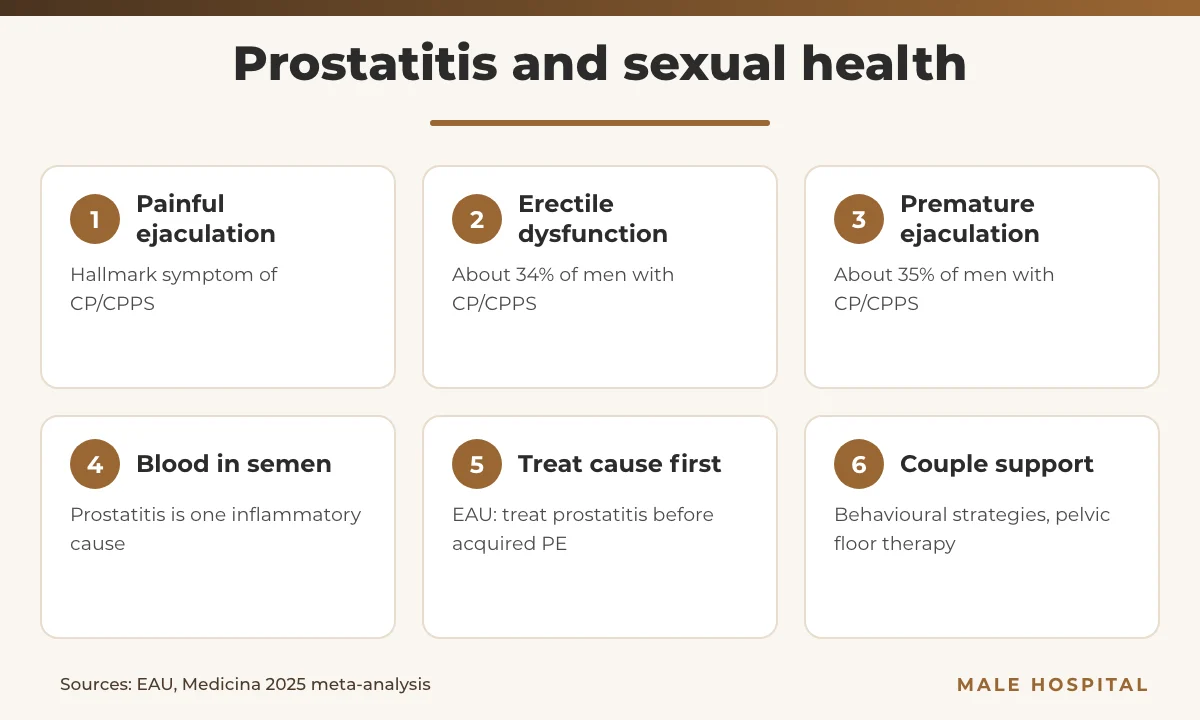
Pain during or after ejaculation, felt in the penis, scrotum or perineum, is one of the hallmark symptoms of CP/CPPS and can also occur in CBP. The EAU lists inflammation of the prostate among the recognised causes of painful ejaculation and advises treating the underlying cause, for example with antibiotics, alpha-blockers or anti-inflammatory drugs. Many men start avoiding sex because of this pain, which can strain relationships.
Source: EAU Guidelines — Sexual and Reproductive Health: Disorders of ejaculation; NIDDK — Prostatitis: Inflammation of the Prostate
Erectile dysfunction
Men with CP/CPPS are more likely to have erectile dysfunction. A 2025 meta-analysis of 24 studies with more than 20,000 men found ED in about 34% of men with CP/CPPS, and an earlier meta-analysis found roughly three times higher odds of ED compared with men without the condition. The EAU notes that ED is more common in young men with prostate pain than in the general population. Pain, fatigue, anxiety, depression and some pain medicines all contribute, and the stress of repeated “failures” can add a psychological component.
Source: Alshahrani et al., Medicina 2025 (PMC) — Prevalence of sexual dysfunction with CP/CPPS; Chen et al., PLoS One 2015 (PMC) — Effect of CP/CPPS on erectile function; EAU Guidelines — Chronic Pelvic Pain: Epidemiology
Premature ejaculation
Prostatitis is a recognised cause of acquired premature ejaculation, meaning PE that appears after years of normal control. The same 2025 meta-analysis found PE in about 35% of men with CP/CPPS. For acquired PE, the EAU strongly recommends treating ED, prostate inflammation or other genitourinary infection first, before starting PE medicines such as dapoxetine or a numbing spray.
Source: EAU Guidelines — Sexual and Reproductive Health: Disorders of ejaculation; Alshahrani et al., Medicina 2025 (PMC)
Blood in semen and partner effects
Prostatitis is one of the inflammatory causes of blood in the semen (haematospermia). The EAU also notes that partners of men with chronic pelvic pain and sexual dysfunction often report their own distress, and it recommends behavioural strategies for the couple and pelvic floor muscle therapy to improve sexual function.
Source: EAU Guidelines — Sexual and Reproductive Health: Disorders of ejaculation; EAU Guidelines — Chronic Pelvic Pain: Management
The practical message is that treating the prostate and treating the sexual problem go together. A man with pelvic pain and ED may still benefit from standard erectile dysfunction treatment, while for acquired PE the EAU advises dealing with the prostate problem first.
Self-care and outlook
With the right treatment, most men with a bacterial infection feel better. The NHS says men usually notice improvement within 2 weeks of starting antibiotics, although it can take several weeks for all symptoms to settle. It is important to finish the full course even if you feel better.
Self-care measures that may ease symptoms, ideally agreed with your doctor, include:
- Drinking enough fluids and urinating often and completely.
- Warm baths (sitz baths) or a heating pad for pelvic pain.
- Limiting bladder irritants such as alcohol, caffeine, citrus juices and spicy food.
- Stool softeners if bowel movements are painful.
- Paracetamol or ibuprofen for pain, if suitable for you.
Source: NHS — Prostatitis; MedlinePlus — Prostatitis, bacterial
CP/CPPS tends to follow a longer course with ups and downs. Symptoms can settle on their own over time, and the EAU suggests that a plan tailored to each man’s symptom profile may improve results. Untreated symptoms can wear down urinary and sexual function and emotional well-being, so it is worth persisting with a specialist rather than repeating antibiotic courses without a clear benefit.
Source: Cleveland Clinic — Prostatitis; MedlinePlus — Prostatitis, nonbacterial
When to see a doctor
See a doctor if you have symptoms such as pelvic pain, burning urination or pain on ejaculation. Get urgent medical help if:
- You cannot pass urine at all.
- You have a high fever, shaking chills or feel very unwell.
- Symptoms have not started to improve, or have worsened, 48 hours after starting antibiotics.
- You develop signs of sepsis: confusion, slurred speech, pale, blue or blotchy skin or lips, a rash that does not fade under a glass, or severe breathlessness. Call emergency services.
Source: NHS — Prostatitis; NICE NG110 — Prostatitis (acute): antimicrobial prescribing
If prostatitis is affecting your erections or ejaculation, you can book a confidential consultation with our urologist-andrologist, Assoc. Prof. Dr. Zülfü Sertkaya, by WhatsApp. He can review your tests and plan care for both the prostate symptoms and the sexual problem, including premature ejaculation treatment when needed.
FAQs about prostatitis
Is prostatitis a sexually transmitted infection?
Not usually. Most cases are the non-bacterial CP/CPPS type, which is not contagious. The bacterial type is usually caused by urinary bacteria such as E. coli, but in younger sexually active men chlamydia or gonorrhea can be responsible. If a sexually transmitted germ is found, partners should be tested and treated too.
Source: MedlinePlus — Prostatitis, bacterial; EAU Guidelines — Urological Infections
Can prostatitis go away on its own?
Bacterial prostatitis does not clear without antibiotics, and acute cases can become dangerous if untreated. CP/CPPS and asymptomatic inflammation, on the other hand, may settle over time without specific treatment, although many men need a combination of therapies to control flares and get back to normal activity and sex.
Source: Cleveland Clinic — Prostatitis
How long do antibiotics for prostatitis take to work?
Most men with ABP feel better within 2 weeks, but full recovery can take several weeks. The EAU suggests two to four weeks of treatment for acute infection and four to six weeks of a fluoroquinolone for CBP. Contact a doctor if there is no improvement after 48 hours.
Source: NHS — Prostatitis; EAU Guidelines — Urological Infections
Can prostatitis cause erectile dysfunction?
Yes, it is linked. Pooled studies report ED in roughly a third of men with CP/CPPS, and an earlier meta-analysis found about three times higher odds of ED. Pain, anxiety and low mood all play a part. ED can be assessed and treated alongside the pelvic pain.
Source: Alshahrani et al., Medicina 2025 (PMC); Chen et al., PLoS One 2015 (PMC)
Can prostatitis cause premature ejaculation?
Prostatitis is a recognised cause of acquired premature ejaculation, and studies find PE in around a third of men with CP/CPPS. European guidelines strongly recommend treating prostate inflammation or other genital tract infection first in men whose PE developed later in life, before relying on PE-specific medicines alone.
Source: EAU Guidelines — Sexual and Reproductive Health: Disorders of ejaculation
Does prostatitis increase the risk of prostate cancer?
No. Prostatitis is not cancer and does not increase prostate cancer risk. It can, however, push PSA levels up temporarily, so doctors usually avoid PSA testing during an active infection or repeat it after treatment. The EAU notes that PSA often falls once the infection has been treated.
Source: Cleveland Clinic — Prostatitis; EAU Guidelines — Urological Infections
Does ejaculating more often help prostatitis?
There is no good evidence for it. The EAU notes that cross-sectional data do not show an improvement in urinary symptoms with more frequent ejaculation. If a sexually transmitted germ is behind a bacterial infection, the EAU recommends screening of partners, so ask your doctor before resuming sex.
Source: EAU Guidelines — Chronic Pelvic Pain: Epidemiology, aetiology and pathophysiology; EAU Guidelines — Urological Infections
Do alpha-blockers help chronic prostatitis?
They can. European guidelines strongly recommend alpha-blockers for men whose CP/CPPS symptoms began less than a year ago, with moderate benefits for pain, urination and quality of life. They seem less helpful in long-standing cases, and MedlinePlus notes they often take about 6 weeks to start working.
Source: EAU Guidelines — Chronic Pelvic Pain: Management; MedlinePlus — Prostatitis, nonbacterial
Medically reviewed by Assoc. Prof. Dr. Zülfü Sertkaya, urologist and andrologist (FEBU), Istanbul. Last reviewed: October 2026.
This article is for general information and does not replace an individual consultation with a qualified doctor.
- EAU — Urological Infections Guidelines — Bacterial prostatitis
- EAU — Chronic Pelvic Pain Guidelines — Epidemiology, aetiology and pathophysiology
- EAU — Chronic Pelvic Pain Guidelines — Diagnostic evaluation
- EAU — Chronic Pelvic Pain Guidelines — Management
- EAU — Sexual and Reproductive Health Guidelines — Disorders of ejaculation
- NIDDK (NIH) — Prostatitis: Inflammation of the Prostate
- NHS — Prostatitis
- NICE — NG110 Prostatitis (acute): antimicrobial prescribing — Recommendations
- Cleveland Clinic — Prostatitis
- MedlinePlus — Prostatitis – bacterial
- MedlinePlus — Prostatitis – nonbacterial
- Medicina (PMC) — Alshahrani et al. 2025 — Prevalence of sexual dysfunction with CP/CPPS: updated systematic review and meta-analysis
- PLoS One (PMC) — Chen et al. 2015 — The effect of CP/CPPS on erectile function: systematic review and meta-analysis