Penile girth enhancement means making the penis thicker, not longer, using injectable fillers, the man’s own fat, tissue grafts or a silicone sleeve implant. Fillers such as hyaluronic acid (HA) and poly-L-lactic acid (PLLA/PLA) have the best short-term trial data and typically add about 1.5 to 2 cm of circumference, while grafts and the Penuma implant carry higher complication rates and are classed as experimental by European guidelines. For how the injection itself is done, see our penile filler treatment page; for length and all other options, see penis enlargement.
Sources: EAU Guidelines — Sexual and Reproductive Health — Penile size abnormalities and dysmorphophobia; Journal of Sexual Medicine (SMSNA) — Cosmetic penile enhancement procedures: an SMSNA position statement (2024)
- In randomized trials, HA and PLA fillers added roughly 1.9 to 2.3 cm of penile girth at about 6 months, with mostly mild side effects; part of the gain fades over 18 months.
- Fat injection can add about 2 to 3.5 cm, but resorption is unpredictable, lumps can form, and the AUA says it has not been shown to be safe or effective.
- Dermal-fat grafts and acellular dermal matrix (ADM) involve open surgery; one ADM series reported erectile discomfort in 47 of 78 men and 7 graft removals.
- The Penuma silicone sleeve increases flaccid penile girth, but removal rates ranged from 3% to 12% in published series, and the EAU and SMSNA treat it as experimental or investigational.
- Silicone, paraffin and petroleum jelly must never be injected into the penis.
- What is penile girth enhancement?
- Penile girth enhancement methods compared
- Injectable fillers: HA, PLLA and PMMA
- Fat grafting (autologous fat injection)
- Dermal-fat grafts and acellular dermal matrix
- The Penuma silicone implant
- What guidelines say about penile girth enhancement
- How to choose the right girth method
- When to see a doctor
- FAQs about penile girth enhancement
What is penile girth enhancement?
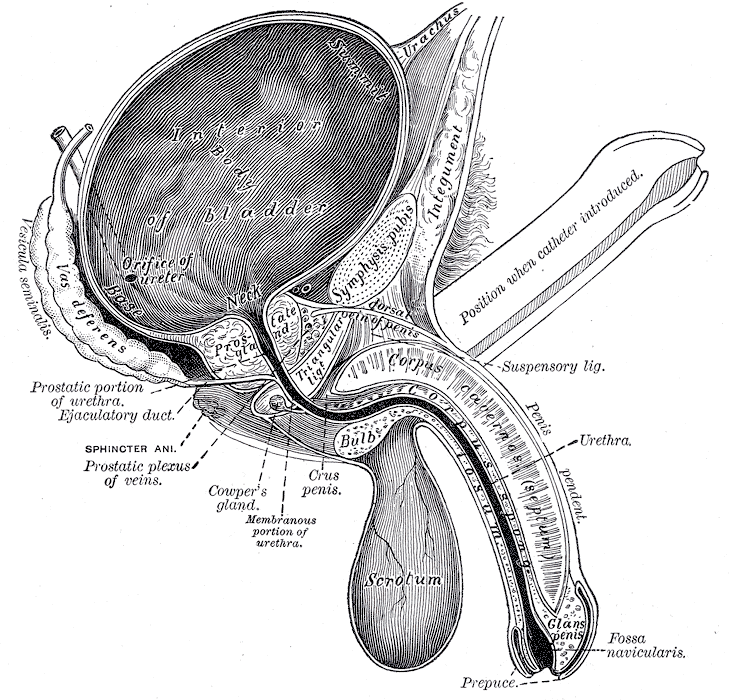
Penile girth is the circumference of the penis, usually measured around the mid-shaft. Every girth method works in the same place: it adds volume in the soft layer between the skin and the tough sheath (Buck’s fascia) that wraps the erectile bodies. None of them enlarges the erectile tissue itself, which is why the change is often more visible when the penis is soft than when it is erect.
Most men who ask about penile girth are within the normal range. The European Association of Urology (EAU) guideline gives average circumference figures of about 9.3 cm flaccid and 11.7 cm erect, and it notes that there is no agreed definition of when girth enlargement is medically indicated. Our article on average penis size explains how these numbers were measured.
Source: EAU Guidelines — Sexual and Reproductive Health — Penile size abnormalities and dysmorphophobia
Because worry about size can be driven by penile dysmorphic disorder (a form of body dysmorphic disorder), the EAU strongly recommends screening for it first and advises against fillers or fat injection in men who have it. Counseling, and sometimes cognitive behavioral therapy, often helps more than any procedure.
Sources: EAU Guidelines — Sexual and Reproductive Health — Penile size abnormalities and dysmorphophobia; ISSM — What are some penile augmentation procedures? Do they work?
Penile girth enhancement methods compared
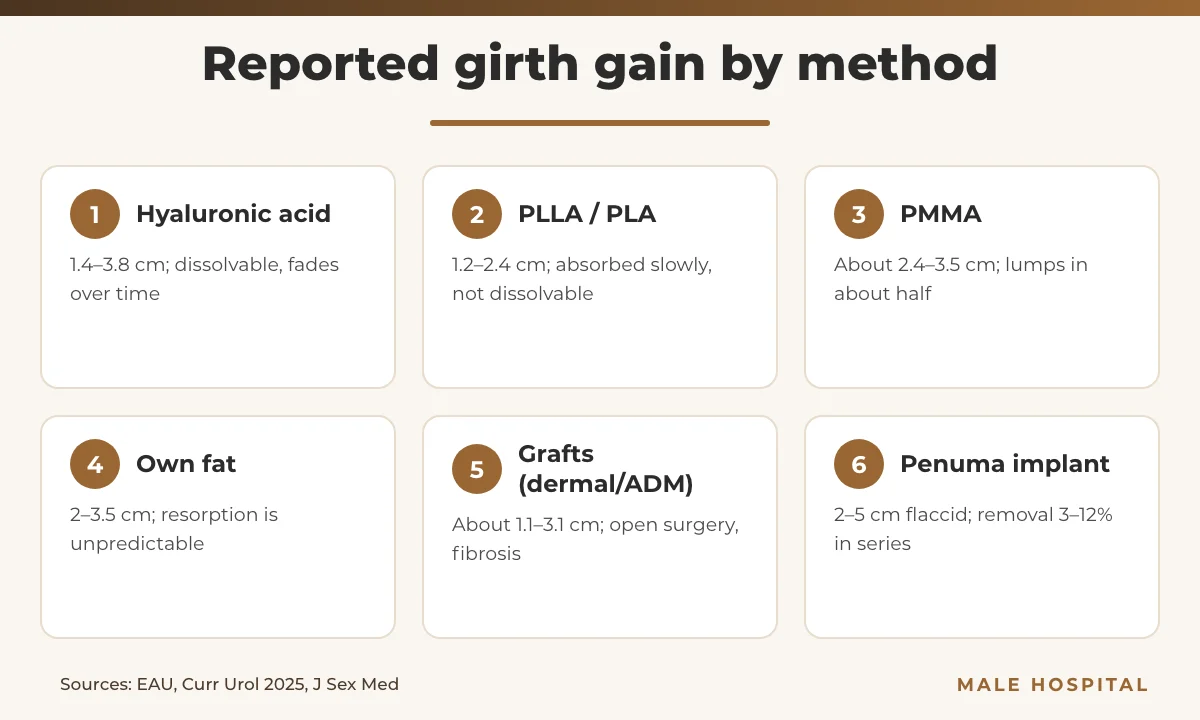
The penile girth figures below come from small, mostly uncontrolled studies with different measuring methods, so they are not directly comparable. Treat them as rough ranges rather than promises.
| Method | Type | Reported girth gain | Main risks | EAU position |
|---|---|---|---|---|
| Hyaluronic acid filler | Injection, temporary, dissolvable | 1.4–3.8 cm | Nodules, migration, bleeding, infection | May be used after counseling (weak) |
| PLLA / PLA filler | Injection, slowly absorbed | 1.2–2.4 cm | Pain, swelling, granulomas; cannot be dissolved | May be used after counseling (weak) |
| PMMA microspheres | Injection, long-lasting | About 2.4–3.5 cm | Palpable irregularities in about half | Covered by soft-tissue filler advice (weak) |
| Autologous fat | Liposuction + injection | 2–3.5 cm | Unpredictable resorption, lumps, asymmetry | May be used after counseling (weak) |
| Dermal-fat graft / ADM | Open surgery | About 1.1–3.1 cm | Swelling, painful erections, fibrosis, curvature | Do not use; experimental (strong) |
| Penuma silicone sleeve | Open surgery, implant | 2–5 cm (flaccid) | Seroma, infection, erosion, removal | Do not use; experimental (strong) |
Sources: EAU Guidelines — Sexual and Reproductive Health — Penile size abnormalities and dysmorphophobia; PMC (Current Urology) — Chen et al. Penile enhancement: a comprehensive and current perspective (2025)
Injectable fillers: HA, PLLA and PMMA
Fillers are the least invasive form of penile girth enhancement and the only one tested in randomized trials. All of them are off-label: the US Food and Drug Administration (FDA) has approved dermal fillers only for areas such as facial folds, lips, cheeks, chin and the back of the hand, and it recommends against using any injectable filler for body contouring or enhancement. Step-by-step details of the procedure and aftercare are on the penile filler page linked above, so this section focuses on how the materials compare.
Source: FDA — Dermal Fillers (Soft Tissue Fillers)
Hyaluronic acid vs poly-L-lactic acid
Hyaluronic acid is a gel that adds volume directly and can be dissolved with an enzyme (hyaluronidase) if a lump or complication develops. PLLA (often written PLA in trials) works differently: it is absorbed more slowly and cannot be dissolved with an enzyme.
The two have been compared head to head. In a Korean multicenter trial (J Clin Med, 2020) of 67 men randomized to HA or PLA, mean penile girth rose by about 1.9 cm in both groups at 6 months. At 18 months the gain was 1.41 cm for HA and 1.79 cm for PLA, with no significant difference between groups; HA lost more volume over time but felt softer. Injection-related side effects occurred in 9.1% (HA) and 5.9% (PLA) and were all mild.
A second blinded randomized trial (World Journal of Men’s Health, 2022) followed 64 men for 24 weeks and found penile girth gains of 22.7 mm with HA and 20.2 mm with PLA, again without a significant difference. Filler-related side effects, mostly mild inflammation at the injection site, occurred in 6.3% and 9.4% of men, and no serious events were recorded. Neither trial can tell us what happens after several years.
PMMA and other long-lasting fillers
Polymethyl methacrylate (PMMA) microspheres stay in the tissue much longer. In the largest series, reported by Casavantes and colleagues in several hundred men followed for years, mean penile girth at mid-shaft rose by about 2.4 cm, but roughly 52% had palpable irregularities such as nodules or ridges, and 0.4% needed nodules removed. Unlike HA, PMMA and PLA cannot be broken down with an enzyme, so granulomas or tissue damage may need surgical excision.
Sources: PMC (Medicina) — Falagario et al. Techniques for penile augmentation surgery: a systematic review (2024); PMC (Translational Andrology and Urology) — Pignanelli et al. Complications and management of penile enhancement procedures (2025)
Permanent liquid materials are a different category altogether. The EAU strongly recommends never using silicone, paraffin or petroleum jelly for penile girth, because they cause sclerosing lipogranulomas (paraffinomas) that can lead to infection, tissue loss and reconstructive surgery. The FDA warns that injectable silicone is not approved for any body contouring and can cause scarring, tissue death and permanent disfigurement.
Sources: EAU Guidelines — Sexual and Reproductive Health — Penile size abnormalities and dysmorphophobia; FDA — FDA warns about illegal use of injectable silicone for body contouring and associated health risks
Fat grafting (autologous fat injection)
Fat grafting takes fat from elsewhere in the body by liposuction, processes it and injects it under the penile skin. Because it is the man’s own tissue, no foreign material is left behind, but it needs a liposuction step and a much larger injected volume than fillers.
In one Korean series of 52 men (Aesthetic Plastic Surgery, 2012), an average of about 38.5 mL of fat raised penile girth at mid-shaft from about 7.0 cm to 9.3 cm at 6 months, and one man developed a fat nodule. The EAU summarizes retrospective studies as showing gains of about 2 to 3.5 cm with satisfaction above 75%, but it notes that long-term data are lacking.
Sources: PubMed (Aesthetic Plastic Surgery) — Kang et al. Penile girth enhancement by autologous fat injection for patients with thin penises (2012); EAU Guidelines — Sexual and Reproductive Health — Penile size abnormalities and dysmorphophobia
The main problem with fat for penile girth is durability. Reviews describe fat resorption as unpredictable, from months to years, leaving irregular lumps, skin deformity, scarring or uneven thickness. Fat embolism has been described after high-volume injections, including one fatal case. The American Urological Association (AUA) states that subcutaneous fat injection to increase penile girth has not been shown to be safe or efficacious.
Sources: PMC (Current Urology) — Chen et al. Penile enhancement: a comprehensive and current perspective (2025); PMC (Translational Andrology and Urology) — Pignanelli et al. Complications and management of penile enhancement procedures (2025); AUA — Penile Augmentation Surgery — policy statement
Dermal-fat grafts and acellular dermal matrix
Graft techniques for penile girth place a sheet of tissue around the shaft through an incision. The material can be the patient’s own skin and fat (dermal-fat graft), donated human dermis or animal dermis processed to remove cells (acellular dermal matrix, ADM), or a vein. These are true operations with an incision and stitches; in the porcine graft series below, men resumed sex after 1 to 2 months. Our overview of penis enlargement surgery describes the operations themselves.
What the results show
The EAU reports girth gains of 1.67 to 2.3 cm with dermal-fat grafts, but also penile swelling and painful erections in up to 27% of men and curvature from scarring in up to 9%. In an Italian series of 69 men given porcine ADM grafts (J Sex Med, 2012), flaccid penile girth rose by 3.1 cm and erect girth by 2.4 cm at one year; the EAU notes graft fibrosis in up to 13%, with some shortening in those men.
Sources: EAU Guidelines — Sexual and Reproductive Health — Penile size abnormalities and dysmorphophobia; PubMed (Journal of Sexual Medicine) — Alei et al. Penile girth augmentation through porcine dermal acellular grafts: 69-patient series (2012)
Results with human ADM have been less reassuring. A Chinese review of 78 men (J Sex Med, 2019) found an average gain of only 1.1 cm at 3 months, with erectile discomfort in 47 men, delayed healing in 12, a barely noticeable effect in 10, hematoma in 8 and skin necrosis in 3; seven men had the graft removed. The authors concluded that ADM is not an ideal or safe method. Vein grafts have encouraging early reports, but the EAU says better trials are needed.
Sources: PubMed (Journal of Sexual Medicine) — Xu et al. Complications and management of penile girth enhancement with acellular dermal matrix (2019); EAU Guidelines — Sexual and Reproductive Health — Penile size abnormalities and dysmorphophobia
The Penuma silicone implant
The Penuma is a soft silicone sleeve implanted under the skin of the shaft. It holds FDA 510(k) clearance as a cosmetic device and is meant to correct the appearance of the flaccid penis. It is different from a penile prosthesis, which sits inside the erectile bodies to treat erectile dysfunction.
Sources: PMC (Medicina) — Falagario et al. Techniques for penile augmentation surgery: a systematic review (2024); PubMed (Journal of Sexual Medicine) — Elist et al. Safety and effectiveness of the Penuma silicone sleeve implant: single-surgeon retrospective series (2018)
The inventor’s retrospective series of 400 men (J Sex Med, 2018) reported mid-shaft circumference rising from 8.5 cm to 13.4 cm, with seroma in 4.8%, scarring in 4.5%, infection in 3.3% and device removal in 3%. Independent data are less favorable. A single-surgeon series of 92 men (Ther Adv Urol, 2024) found a flaccid penile girth gain of 3.1 cm and 82% satisfaction among survey responders, but 12% needed drainage of a seroma and 12% had the implant removed.
Sources: PubMed (Journal of Sexual Medicine) — Elist et al. Safety and effectiveness of the Penuma silicone sleeve implant: single-surgeon retrospective series (2018); PMC (Therapeutic Advances in Urology) — Salkowski and Levine. Outcomes and patient satisfaction after Penuma silicone implant surgery (2024)
Serious problems can persist after removal. A review in Translational Andrology and Urology (2025) describes a series of 13 men treated for implant complications in which 69% had disabling curvature and 62% had penile shortening. The Sexual Medicine Society of North America (SMSNA) calls Penuma-type devices investigational, cites severe persistent problems in roughly 60% to 80% of men after removal, and asked the FDA to re-evaluate their clearance.
Sources: PMC (Translational Andrology and Urology) — Pignanelli et al. Complications and management of penile enhancement procedures (2025); Journal of Sexual Medicine (SMSNA) — Cosmetic penile enhancement procedures: an SMSNA position statement (2024)
What guidelines say about penile girth enhancement
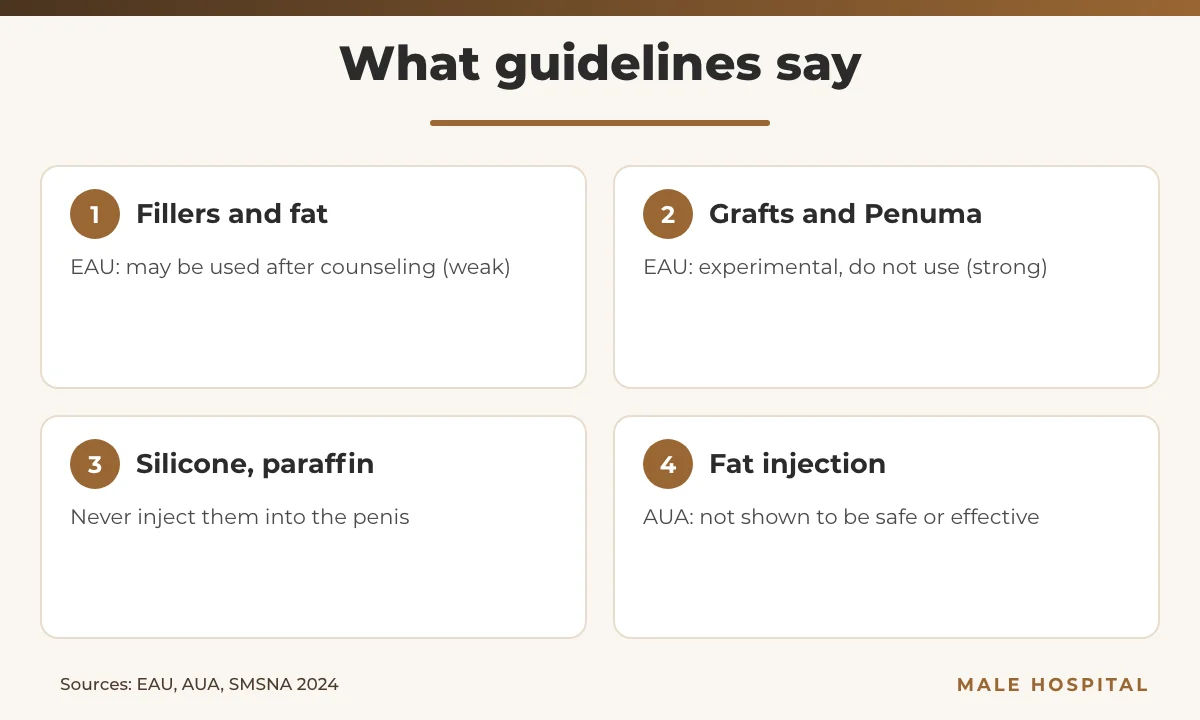
Professional societies agree on more than they disagree. All of them say that penile girth enhancement is a cosmetic choice with limited evidence, that men need thorough counseling, and that permanent liquid injections are dangerous.
- EAU (Europe): HA, soft-tissue fillers and autologous fat may be used after extensive counseling (weak recommendation); never in men with penile dysmorphic disorder. Grafts, biodegradable scaffolds and the Penuma are experimental and should not be used (strong).
- SMSNA (North America, 2024): limited data suggest temporary HA and PLA fillers have acceptable safety; clinicians should study them under research protocols. It recommends against graft-and-flap operations outside research and considers Penuma-type devices investigational.
- AUA (USA): fat injection for girth has not been shown to be safe or effective.
- ISSM: almost none of the proposed enlargement methods work, many carry serious risks, and men with a normal penis may be better helped by therapy.
Sources: EAU Guidelines — Sexual and Reproductive Health — Penile size abnormalities and dysmorphophobia; Journal of Sexual Medicine (SMSNA) — Cosmetic penile enhancement procedures: an SMSNA position statement (2024); AUA — Penile Augmentation Surgery — policy statement; ISSM — What are some penile augmentation procedures? Do they work?
How to choose the right girth method
For most men who still want a change after an honest assessment, the trade-off is simple: the safer and more reversible the method, the smaller and more temporary the gain. A practical way to think about it:
- Want a trial with an exit route: HA filler, because it can be dissolved with hyaluronidase if lumps or migration occur.
- Want a longer-lasting filler: in one trial PLA kept slightly more penile girth at 18 months (not a significant difference), but problems cannot be dissolved.
- Considering fat: expect some of it to disappear, possibly unevenly, and know that the AUA does not endorse it.
- Considering grafts or Penuma: understand that guidelines class them as experimental, and ask about removal rates, curvature and shortening before you decide.
Sources: PMC (Translational Andrology and Urology) — Pignanelli et al. Complications and management of penile enhancement procedures (2025); PMC (Journal of Clinical Medicine) — Yang et al. Hyaluronic vs polylactic acid filler injections for penile augmentation: 18-month randomized trial (2020); EAU Guidelines — Sexual and Reproductive Health — Penile size abnormalities and dysmorphophobia
Before any procedure, a urologist should measure your penile girth at the mid-shaft and under the glans, check erections and skin health, and look for conditions that girth work will not fix, such as a buried penis, micropenis or curvature. If length is the real concern, traction may be the more relevant option; our article on the penis extender covers what it can and cannot do.
Source: EAU Guidelines — Sexual and Reproductive Health — Penile size abnormalities and dysmorphophobia
If you are weighing penile girth enhancement, you can get a confidential, no-pressure assessment from our urologist-andrologist Assoc. Prof. Dr. Zülfü Sertkaya on WhatsApp. The cost depends on the method and the assessment, and we will explain the realistic options before you commit to anything.
When to see a doctor
Mild swelling and bruising are common for a few days after any penile girth procedure. Contact a doctor urgently, or go to an emergency department, if you notice any of the following after an injection, graft or implant:
- Skin that turns pale, gray, dusky or black, or severe pain that keeps getting worse, which can signal blocked blood supply.
- Fever, spreading redness, warmth, pus or a foul smell, which suggest infection.
- A rapidly growing, tense swelling (possible hematoma or seroma).
- Foreskin swelling that stops it from moving back over the glans.
- An implant edge pushing through the skin, a new bend during erection, or painful erections that persist.
- Hard lumps that keep growing, or any problem after an injection whose material you do not know.
Sources: FDA — Dermal Fillers (Soft Tissue Fillers); PMC (Translational Andrology and Urology) — Pignanelli et al. Complications and management of penile enhancement procedures (2025)
Men who had silicone, paraffin or another unknown substance injected should see a urologist even without symptoms, because complications can appear months or years later.
FAQs about penile girth enhancement
How much girth can a filler add?
In randomized trials, HA and PLA fillers raised penile girth at mid-shaft by roughly 1.9 to 2.3 cm at about 6 months. At 18 months, one trial measured about 1.4 cm remaining with HA and 1.8 cm with PLA. Larger figures come from uncontrolled series and should be read with caution, because measuring techniques differ between studies.
Sources: PMC (Journal of Clinical Medicine) — Yang et al. Hyaluronic vs polylactic acid filler injections for penile augmentation: 18-month randomized trial (2020); PMC (World Journal of Men’s Health) — Ahn et al. Penile girth enhancement using hyaluronic acid filler: randomized active-controlled trial (2022)
Is penile girth enhancement permanent?
No method can honestly be called permanent. HA and PLA are gradually absorbed and usually need top-ups, fat is resorbed unpredictably, and grafts can scar and contract. The Penuma implant stays in place but may need removal for infection, erosion or dissatisfaction, with removal rates of 3% to 12% in the series cited here.
Sources: PubMed (Journal of Sexual Medicine) — Elist et al. Safety and effectiveness of the Penuma silicone sleeve implant: single-surgeon retrospective series (2018); PMC (Medicina) — Falagario et al. Techniques for penile augmentation surgery: a systematic review (2024); PMC (Therapeutic Advances in Urology) — Salkowski and Levine. Outcomes and patient satisfaction after Penuma silicone implant surgery (2024)
Does girth enhancement increase erect size?
Partly. Fillers and grafts add tissue around the shaft, so they change both states, but the effect is usually more visible when flaccid. In a porcine ADM series, penile girth rose 3.1 cm flaccid but 2.4 cm erect. The Penuma is designed for flaccid appearance, and men with erectile problems need a different treatment.
Sources: PubMed (Journal of Sexual Medicine) — Alei et al. Penile girth augmentation through porcine dermal acellular grafts: 69-patient series (2012); PMC (Medicina) — Falagario et al. Techniques for penile augmentation surgery: a systematic review (2024)
Which is safer, fillers or fat grafting?
Temporary fillers have the better safety data, coming from randomized trials with mostly mild side effects, and HA can be dissolved if needed. Fat grafting avoids foreign material but needs liposuction, resorbs unevenly and can leave lumps. The AUA states fat injection for penile girth has not been shown to be safe or effective.
Sources: PMC (Journal of Clinical Medicine) — Yang et al. Hyaluronic vs polylactic acid filler injections for penile augmentation: 18-month randomized trial (2020); AUA — Penile Augmentation Surgery — policy statement
Can a penile filler be reversed?
Hyaluronic acid can usually be broken down with low-dose hyaluronidase injections, after checking that the filler is HA and that there is no infection. PLA and PMMA cannot be dissolved with an enzyme, so persistent lumps or granulomas may need steroid injection or surgical removal, sometimes with skin reconstruction.
Is the Penuma FDA approved?
The Penuma has FDA 510(k) clearance as a cosmetic device. The SMSNA considers it investigational and has asked the FDA to re-evaluate the clearance and treat such devices as new (de novo) therapies. The EAU classes it as experimental and strongly advises against its use until long-term data exist.
Sources: PMC (Medicina) — Falagario et al. Techniques for penile augmentation surgery: a systematic review (2024); Journal of Sexual Medicine (SMSNA) — Cosmetic penile enhancement procedures: an SMSNA position statement (2024); EAU Guidelines — Sexual and Reproductive Health — Penile size abnormalities and dysmorphophobia
Do girth procedures affect erections or sensation?
In fat injection and PMMA studies, erectile function did not worsen. Grafts are different: painful erections were reported in up to 27% of dermal-fat graft patients and erectile discomfort in 47 of 78 ADM patients. Implant complications can include curvature, shortening and, less often, erectile dysfunction.
Sources: EAU Guidelines — Sexual and Reproductive Health — Penile size abnormalities and dysmorphophobia; PMC (Current Urology) — Chen et al. Penile enhancement: a comprehensive and current perspective (2025); PubMed (Journal of Sexual Medicine) — Xu et al. Complications and management of penile girth enhancement with acellular dermal matrix (2019); PMC (Translational Andrology and Urology) — Pignanelli et al. Complications and management of penile enhancement procedures (2025)
Who should not have a girth procedure?
Men with penile dysmorphic disorder, active genital infection or skin disease, and anyone expecting a dramatic change should not proceed. The EAU strongly advises against fillers or fat injection in men with dysmorphic disorder and recommends counseling instead, while the ISSM notes that therapy often helps men with a normal penis.
Sources: EAU Guidelines — Sexual and Reproductive Health — Penile size abnormalities and dysmorphophobia; ISSM — What are some penile augmentation procedures? Do they work?
Medically reviewed by Assoc. Prof. Dr. Zülfü Sertkaya, urologist and andrologist (FEBU), Istanbul. Last reviewed: November 2026.
This article is for general information and does not replace an individual consultation with a qualified doctor.
- EAU Guidelines — Sexual and Reproductive Health — Penile size abnormalities and dysmorphophobia
- Journal of Sexual Medicine (SMSNA) — Cosmetic penile enhancement procedures: an SMSNA position statement (2024)
- AUA — Penile Augmentation Surgery — policy statement
- ISSM — What are some penile augmentation procedures? Do they work?
- FDA — Dermal Fillers (Soft Tissue Fillers)
- FDA — FDA warns about illegal use of injectable silicone for body contouring and associated health risks
- PMC (Current Urology) — Chen et al. Penile enhancement: a comprehensive and current perspective (2025)
- PMC (Medicina) — Falagario et al. Techniques for penile augmentation surgery: a systematic review (2024)
- PMC (Translational Andrology and Urology) — Pignanelli et al. Complications and management of penile enhancement procedures (2025)
- PMC (Journal of Clinical Medicine) — Yang et al. Hyaluronic vs polylactic acid filler injections for penile augmentation: 18-month randomized trial (2020)
- PMC (World Journal of Men's Health) — Ahn et al. Penile girth enhancement using hyaluronic acid filler: randomized active-controlled trial (2022)
- PMC (Therapeutic Advances in Urology) — Salkowski and Levine. Outcomes and patient satisfaction after Penuma silicone implant surgery (2024)
- PubMed (Journal of Sexual Medicine) — Elist et al. Safety and effectiveness of the Penuma silicone sleeve implant: single-surgeon retrospective series (2018)
- PubMed (Aesthetic Plastic Surgery) — Kang et al. Penile girth enhancement by autologous fat injection for patients with thin penises (2012)
- PubMed (Journal of Sexual Medicine) — Alei et al. Penile girth augmentation through porcine dermal acellular grafts: 69-patient series (2012)
- PubMed (Journal of Sexual Medicine) — Xu et al. Complications and management of penile girth enhancement with acellular dermal matrix (2019)