
Li-ESWT: Shockwave Therapy for ED in Istanbul
Li-ESWT (low-intensity extracorporeal shockwave therapy) is a non-invasive treatment for erectile dysfunction that sends low-energy acoustic pulses into the penis over a short course of sessions, with the aim of improving its blood supply. It suits mainly men with mild, blood-flow-related (vasculogenic) ED: the European Association of Urology gives Li-ESWT a weak recommendation, while the American Urological Association still classifies it as investigational. It can help some men, but it is not a cure and it does not replace proven treatments.
Source: EAU Guidelines — Sexual and Reproductive Health: Management of Erectile Dysfunction; AUA — Erectile Dysfunction: AUA Guideline (2018)
- Li-ESWT targets the blood vessels of the penis; the best candidates have mild vasculogenic ED, not nerve-related or purely psychological ED.
- The EAU (2026 edition) gives a weak recommendation; the AUA (2018) says it should be considered investigational (conditional recommendation, Grade C).
- A 2025 Cochrane review of 21 trials found a small short-term gain over sham, with low-certainty evidence and very few side effects.
- Courses in trials ranged from 4 to 12 sessions; any benefit appears one to three months later and tends to fade over time.
- In Peyronie’s disease, shockwave treatment may ease pain in the active phase but does not straighten the penis or shrink the plaque.
Not sure whether Li-ESWT fits your type of ED? Share your history and tests privately and get a personalised plan from our urologist-andrologist.
- What is Li-ESWT?
- How Li-ESWT is thought to work
- Who is a good candidate for Li-ESWT
- Li-ESWT evidence and guideline recommendations
- Li-ESWT vs other ED treatments compared
- The procedure step by step: protocols and sessions
- Combining Li-ESWT with PDE5 inhibitors
- Recovery and results timeline
- Risks and side effects
- Results, realistic expectations and what it cannot do
- Shockwave treatment in Peyronie’s disease: pain only
- Li-ESWT with Dr. Zülfü Sertkaya in Istanbul
- How to start
- When to see a doctor
- FAQs about Li-ESWT
What is Li-ESWT?
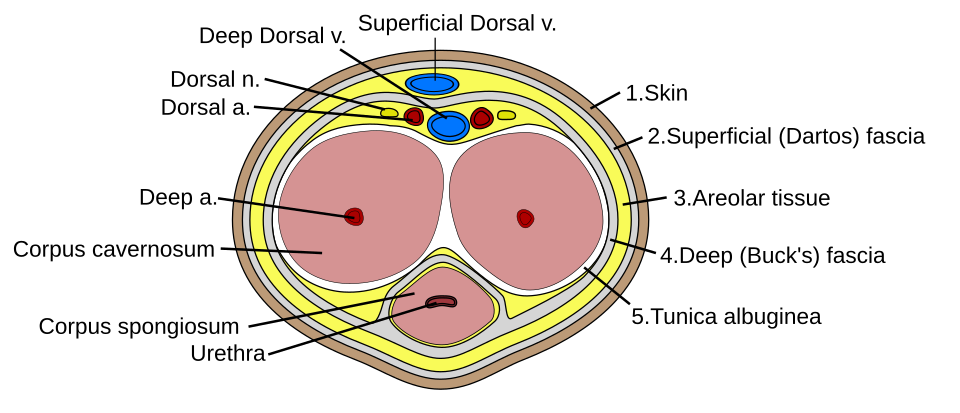
Li-ESWT uses a handheld applicator, similar to an ultrasound probe, to deliver short acoustic pulses to the shaft of the penis and to the crura, the deep roots of the erectile bodies near the perineum. The pulses travel through the skin into the corpora cavernosa, the spongy tissue that fills with blood during an erection. A session lasts about 15 minutes, is usually painless and needs no anesthesia.
Unlike tablets such as sildenafil or tadalafil, which help an erection only while the drug is active, this treatment aims to improve the underlying blood supply. This is why it is grouped with “restorative” therapies, alongside platelet-rich plasma (PRP) and stem cells. Of the three, it has by far the most research, but it is not approved by the US Food and Drug Administration (FDA) for erectile dysfunction.
Sources: Cleveland Clinic — Can Shockwave Therapy Treat Erectile Dysfunction?; SMSNA — Restorative Therapies for Erectile Dysfunction: Position Statement (2021)
This page is our treatment guide: who Li-ESWT is for, how a course works and how it fits into a full plan in Istanbul. For a deeper look at the individual trials, device types and commercial marketing, read our blog article on shockwave therapy for erectile dysfunction.
How Li-ESWT is thought to work
An erection depends on a healthy endothelium, the inner lining of the penile arteries and erectile tissue, which releases nitric oxide so that smooth muscle relaxes and blood flows in. In vasculogenic ED, this lining and the small vessels are damaged by ageing, smoking, high blood pressure, high cholesterol and diabetes.
A shockwave is a pressure pulse with a sharp peak followed by a brief negative-pressure phase. The leading theory, based mostly on animal and laboratory work, is that this controlled micro-stress triggers the growth of new small blood vessels (neo-angiogenesis), better microcirculation, recruitment of repair cells and less fibrosis. These effects are plausible, but they have not been consistently shown in men, and only a few studies have measured better penile blood flow after Li-ESWT.
Sources: World J Mens Health — Hayon et al. Variations in Low Intensity Shockwave Treatment Protocols for ED (2024); EAU Guidelines — Management of Erectile Dysfunction
Who is a good candidate for Li-ESWT
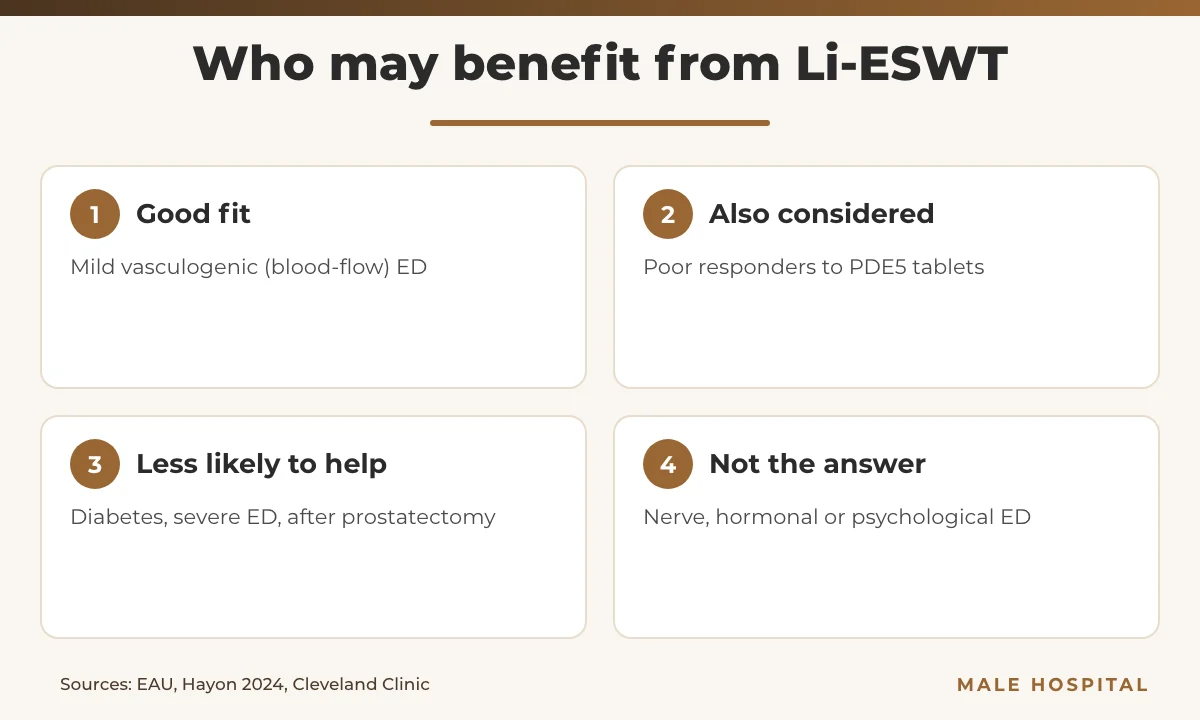
Because Li-ESWT targets blood vessels, the right patient has ED that is mainly vascular and not too advanced. The EAU recommends it, with or without PDE5 inhibitor tablets, in three groups:
- men with mild vasculogenic ED;
- well-informed men who do not wish to take, or are not suitable for, oral ED medicines;
- men with vasculogenic ED who respond poorly to PDE5 inhibitors.
Source: EAU Guidelines — Management of Erectile Dysfunction
In practice, specialists look for men with mild to moderate vascular ED who still get some response to tablets. Men with diabetes tend to respond less well, and response after radical prostatectomy may be weaker. It is unlikely to help when ED is caused mainly by nerve damage, is purely psychological, or is due to low testosterone or a medicine side effect, which need their own treatment.
Sources: Hayon et al. (2024); Cleveland Clinic — Can Shockwave Therapy Treat ED?
That is why a proper work-up comes first: history, examination, blood tests (glucose, lipids, testosterone) and, where needed, a penile Doppler scan. Our guide to the erectile dysfunction test explains what each check shows.
Li-ESWT evidence and guideline recommendations
The most reliable evidence comes from randomized trials that compare real treatment with a sham applicator that looks and sounds the same but delivers no energy. A 2025 Cochrane review pooled 21 such trials with 1,357 men. Up to three months after treatment, active shockwave raised the IIEF-EF erectile function score (6 to 30 points) by an average of 3.89 points more than sham, just below the 4-point change men usually notice. Over longer follow-up the difference was 5.25 points, and erection hardness also improved. All evidence was rated low certainty.
Earlier meta-analyses point the same way: seven trials with 607 men showed a 4.23-point gain over sham one month after treatment. Individual trials vary widely. A double-blind trial in moderate ED found that 79% of treated men reached a meaningful improvement at three months versus none on sham, while a Danish trial of linear shockwave found almost identical success with treatment (37.9%) and sham (38.3%).
Sources: Ther Adv Urol — Campbell et al. Meta-analysis of RCTs of low-intensity shockwave therapy for ED (2019); J Urol — Kalyvianakis et al. (2022); J Sex Med — Fojecki et al. (2017)
| Body | Position on Li-ESWT for ED | Strength |
|---|---|---|
| EAU Sexual and Reproductive Health Guidelines (2026) | Use with or without PDE5 inhibitors in mild vasculogenic ED, in men who cannot or will not take tablets, and in poor responders; improvement described as mild | Weak recommendation |
| AUA Erectile Dysfunction Guideline (2018, not yet updated) | Should be considered investigational | Conditional recommendation, evidence Grade C |
| Sexual Medicine Society of North America (2021) | Relatively safe, but robust efficacy data are lacking; restorative therapies best kept within clinical trials | Position statement |
Sources: EAU Guidelines — Management of Erectile Dysfunction; AUA — Erectile Dysfunction Guideline (2018); SMSNA Position Statement (2021)
Put simply, in Europe Li-ESWT is an acceptable option for carefully chosen men who understand its limits; in the United States it remains officially investigational. Neither guideline places it ahead of proven first-line treatments.
Li-ESWT vs other ED treatments compared
Li-ESWT is one option on a wider treatment ladder. The table shows where it sits next to treatments with stronger evidence; our erectile dysfunction treatment page explains each step in detail.
| Treatment | How it works | When it helps | Evidence |
|---|---|---|---|
| PDE5 inhibitor tablets | Boost the nitric oxide pathway on demand or daily | Within about an hour | Strong, first-line |
| Li-ESWT | Acoustic pulses aimed at penile blood vessels | 1–3 months after the course | Weak (EAU); investigational (AUA) |
| Vacuum erection device | Pulls blood into the penis; ring holds it | Almost immediately | Established |
| Alprostadil injections | Self-injection into the side of the penis | About 5–15 minutes | Strong |
| PRP / stem cells | Injected blood or cell products | Unproven | Clinical trials only |
| Penile prosthesis | Surgically implanted cylinders | After healing | Strong, for refractory ED |
Source: EAU Guidelines — Management of Erectile Dysfunction
Men who want to read more about the alternatives can see our guides to the vacuum erection device and to PRP for erectile dysfunction, and our penile prosthesis page for ED that does not respond to other options.
The procedure step by step: protocols and sessions
Before treatment
The urologist confirms the type and severity of ED, checks for heart and metabolic risk factors and decides whether shockwave treatment is a sensible choice or whether another treatment should come first. You agree a clear plan: number of sessions, timing of review and what happens if there is no benefit.
During each session
You lie on your back. Ultrasound gel is applied and the applicator is moved along the shaft, the base of the penis and the crura behind the scrotum. No needles, anesthesia or cuts are needed, and you can go back to normal activities straight away. If the pulses feel uncomfortable, the energy can be lowered.
Source: Cleveland Clinic — Can Shockwave Therapy Treat ED?
Typical Li-ESWT protocols
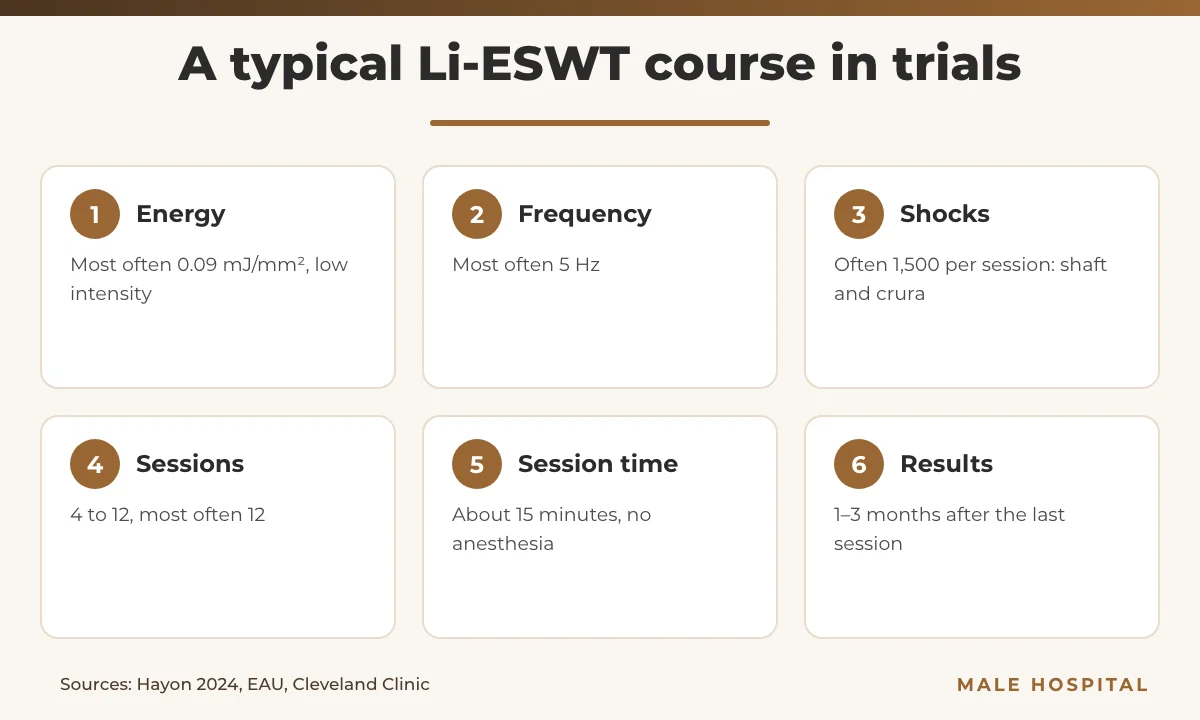
There is no single agreed protocol. A 2024 review of 14 sham-controlled trials found that the most common energy was 0.09 mJ/mm², the most common frequency 5 Hz, and the most common dose 1,500 shocks per session, about 900 to the penis and 600 to the crura. Courses ranged from 4 to 12 sessions, with 12 the most frequent. A US trial, for example, used six twice-weekly sessions of 3,000 shocks at 0.1 mJ/mm².
Sources: Hayon et al. (2024); Transl Androl Urol — Lange et al. Long-term outcomes of a randomized sham-controlled trial (2024)
The EAU found no clear difference between energy levels overall, though one study suggested 0.10 mJ/mm² performed slightly better. Device type matters more: a trial of radial wave therapy showed no benefit over placebo, and radial “acoustic wave” machines, including home devices, deliver much less energy than focused or linear Li-ESWT.
Sources: EAU Guidelines — Management of Erectile Dysfunction; Cleveland Clinic
Combining Li-ESWT with PDE5 inhibitors
Li-ESWT does not have to replace tablets. The EAU recommendation explicitly covers use “with or without” PDE5 inhibitors, and it notes that combining Li-ESWT with daily tadalafil, or with a vacuum device in men with type 2 diabetes, may give even better results. It also lists shockwave plus a vacuum device among strategies for men whose ED is hard to treat.
For many men the practical goal is therefore not to stop tablets for good, but to get firmer erections with the same dose, or a better response in men who were poor responders. Our guide to tadalafil daily dosing explains how the once-a-day option works. Always tell your doctor about nitrates or other heart medicines before any ED tablet is prescribed.
Source: EAU Guidelines — Management of Erectile Dysfunction
Recovery and results timeline
There is no surgical recovery after Li-ESWT. What takes time is the response of the tissue, so results are judged weeks to months after the course, not after each session.
| Time point | What to expect |
|---|---|
| Same day | Back to normal activities straight away |
| During the course (weeks) | Usually no noticeable change yet |
| 1–3 months after the last session | Any benefit becomes clinically evident |
| About 12 months | Peak effect in long-term follow-up |
| 2–3 years | Benefit often declines toward baseline |
Sources: EAU Guidelines — Management of Erectile Dysfunction; Lange et al. (2024)
In the US sham-controlled trial followed for three years, erectile scores were clearly better at 12 and 24 months but were no longer significantly different from baseline at 36 months. The EAU says the benefit gradually decreases over time, although some effect may still be detected up to five years later. Cleveland Clinic urologists describe a typical benefit lasting about one to two years.
Sources: Lange et al. (2024); Cleveland Clinic
Risks and side effects
Safety is the strongest part of the Li-ESWT evidence. The Cochrane review found little to no difference in treatment-related adverse events between real and sham treatment across 20 trials, and the three-year US trial recorded no adverse events. Mild discomfort during the session is possible and is managed by lowering the energy.
The real risks are practical ones:
- no meaningful benefit, especially with severe, diabetic or nerve-related ED;
- time and travel for repeated sessions;
- delay in diagnosing the cause of ED, which can be an early sign of heart disease;
- being sold weak radial devices, open-ended packages or unproven add-ons such as PRP.
Sources: Cochrane — Ergun et al. (2025); Lange et al. (2024); Cleveland Clinic
Results, realistic expectations and what it cannot do
A well-selected man with mild vascular ED may notice firmer, more reliable erections, sometimes with less need for tablets. Hayon and colleagues note that only about half of patients keep the benefit at two years, and they encourage trying PDE5 inhibitors first. It is a modest, low-risk option, not a breakthrough.
Source: Hayon et al. (2024)
What Li-ESWT cannot do:
- It cannot cure ED or reverse the artery disease, diabetes or smoking damage behind it.
- It does not increase penile length or girth.
- It does not straighten a curved penis or dissolve a Peyronie’s plaque.
- It does not treat low libido, low testosterone or premature ejaculation.
- It cannot restore erections in severe ED that needs injections or a penile implant.
Sources: EAU Guidelines — Management of Erectile Dysfunction; EAU Guidelines — Penile Curvature
Shockwave treatment in Peyronie’s disease: pain only
Shockwave treatment has also been studied in Peyronie’s disease, where a scar (plaque) bends the erect penis. The guidelines are clear and consistent. The EAU strongly recommends against using it to improve curvature, because trials showed no effect on the bend or on plaque size. It gives a weak recommendation for using it to treat penile pain in the acute phase, where trials showed pain relief.
The AUA says clinicians should not use shockwave therapy to reduce curvature or plaque size (moderate recommendation, Grade B), but may offer it to improve penile pain (conditional recommendation, Grade B). Pain in Peyronie’s disease often settles on its own as the disease stabilises, so this is a supportive option. Straightening options are covered on our Peyronie’s disease treatment page.
Sources: EAU Guidelines — Penile Curvature; AUA — Peyronie’s Disease Guideline
Li-ESWT with Dr. Zülfü Sertkaya in Istanbul
Your assessment is led by Assoc. Prof. Dr. Zülfü Sertkaya, a urologist and andrologist in Istanbul. He has been a urology specialist since 2014, became a Fellow of the European Board of Urology (FEBU) in 2017 and an Associate Professor of Urology in 2020. Since 2022 he has run his own men’s health and andrology clinic in Zeytinburnu, Istanbul.
He is a member of the European Association of Urology, the European Society for Sexual Medicine, the International Society for Sexual Medicine, the Turkish Urological Association and the Turkish Society of Andrology. His clinical focus includes erectile dysfunction surgery with penile prosthesis, Peyronie’s disease, premature ejaculation and male infertility. This matters here: if shockwave is not the right fit, the same specialist can discuss the full range of options, up to implant surgery.
For patients travelling to Istanbul, our team arranges reception and transport, translation, trip planning, hotel accommodation, the medical consultation and aftercare. Because a course involves several sessions, we plan the schedule with you before you travel. The price is given after a free assessment, because it depends on your diagnosis and on the protocol and number of sessions you need.
How to start
Start with a free, confidential WhatsApp consultation. Share your age, how long you have had erection problems, how you respond to tablets, your medical conditions and medicines, and any recent blood tests or Doppler results. Our urologist-andrologist reviews them and sends a personalised plan: whether shockwave treatment is reasonable for you, whether it should be combined with tablets, and which tests are still needed.
When to see a doctor
ED shares risk factors with heart disease and can be an early warning sign of it. See a doctor before any Li-ESWT course, and promptly if:
- ED is new, getting worse, or started after a new medicine;
- you also have chest pain, breathlessness on exertion or leg pain when walking;
- you have diabetes, high blood pressure, high cholesterol or smoke and have not had a recent check-up;
- you notice low libido, fatigue or loss of body hair, which may suggest low testosterone;
- you have penile pain, a new bend or a lump in the shaft.
Seek emergency care for an erection lasting more than four hours, or for chest pain during sex.
Sources: EAU Guidelines — Management of Erectile Dysfunction; Cleveland Clinic
Send us your history and test results for a confidential opinion on Li-ESWT and your other options in Istanbul.
Related men’s health guides
- Shockwave Therapy for Erectile Dysfunction: 7 Honest Facts
- Erectile Dysfunction and Diabetes: Causes & 5 Proven Fixes
- Venous Leak Erectile Dysfunction: 7 Honest Facts
- PRP for Erectile Dysfunction: 7 Honest Facts on the P-Shot
- Exercises for Erectile Dysfunction: 2 Proven Types
- Erectile Dysfunction in Young Men: 7 Causes & Treatments
FAQs about Li-ESWT
Is Li-ESWT FDA-approved for erectile dysfunction?
No. No restorative therapy, including Li-ESWT, is FDA-approved for ED, so treatment for this use is off-label in the United States and usually not covered by insurance. In Europe, the EAU guideline accepts it as a weakly recommended option for selected men with vasculogenic ED, while the AUA still calls it investigational.
Source: SMSNA Position Statement (2021); Cleveland Clinic
How many Li-ESWT sessions will I need?
Trials used between 4 and 12 sessions, with 12 the most common, usually once or twice a week. There is no proven best schedule. A clear plan with a fixed number of sessions and a review one to three months after the course is better than open-ended packages or repeated “maintenance” courses sold without reassessment.
Source: Hayon et al. (2024)
Does Li-ESWT hurt?
Usually not. Each session takes about 15 minutes and needs no anesthesia. If it becomes uncomfortable, the energy can be reduced. Randomized trials found no meaningful increase in side effects compared with sham treatment, and you can return to normal activities straight after each session.
Source: Cleveland Clinic; Cochrane (2025)
How soon after Li-ESWT will I see results?
Not straight away. Because the aim is to improve blood vessels, any benefit usually becomes noticeable one to three months after the last session, according to the EAU. If you notice no change after that period, more sessions are unlikely to be the answer, and other proven treatments should be discussed with your urologist.
Source: EAU Guidelines — Management of Erectile Dysfunction
Can I keep taking Viagra or Cialis during Li-ESWT?
In most cases, yes. The EAU recommendation covers its use with or without PDE5 inhibitors, and combining it with daily tadalafil may work better than either alone. Your urologist will check that tablets are safe for you, especially if you take nitrates or other heart medicines, and adjust the plan after the course.
Source: EAU Guidelines — Management of Erectile Dysfunction
Does Li-ESWT work after prostate cancer surgery?
The evidence is limited. The EAU notes a positive effect on early recovery of erections when it is used as part of penile rehabilitation after radical prostatectomy, but the level of evidence is low. Nerve damage is the main problem after this surgery, so tablets, injections or a vacuum device remain the mainstay.
Source: EAU Guidelines — Management of Erectile Dysfunction
Can Li-ESWT straighten a curved penis?
No. Both the EAU and the AUA advise against using shockwave treatment to reduce curvature or plaque size in Peyronie’s disease, because trials showed no effect on either. It may be used to ease penile pain during the active phase. A stable bend that affects sex needs other treatments, such as traction, injections or surgery.
Source: EAU Guidelines — Penile Curvature; AUA — Peyronie’s Disease Guideline
Do home shockwave devices work like Li-ESWT?
No good evidence shows that they do. Home and many direct-to-consumer devices use radial or acoustic waves that deliver much less energy than the focused or linear shockwaves used in most positive trials, and Cleveland Clinic urologists advise against them. A home gadget can also delay a proper check of the cause of your ED.
Source: Cleveland Clinic
Can Li-ESWT be repeated if the effect wears off?
Some men are offered a second course, but there is little trial evidence on repeat treatment. Long-term data show the effect often peaks around one year and fades over two to three years, while the causes of ED keep progressing unless treated. A review of risk factors and other options is sensible before any repeat course.
Source: Lange et al. (2024); Cochrane (2025)
Medically reviewed by Assoc. Prof. Dr. Zülfü Sertkaya, urologist and andrologist (FEBU), Istanbul. Last reviewed: October 2026.
This article is for general information and does not replace an individual consultation with a qualified doctor.
- EAU — Sexual and Reproductive Health Guidelines — Management of Erectile Dysfunction
- EAU — Sexual and Reproductive Health Guidelines — Penile Curvature
- AUA — Erectile Dysfunction: AUA Guideline (2018)
- AUA — Peyronie's Disease Guideline
- Cochrane Database Syst Rev 2025 (PMC) — Ergun et al. Low-intensity shockwave therapy for erectile dysfunction
- Ther Adv Urol 2019 (PMC) — Campbell et al. Meta-analysis of randomized controlled trials of low-intensity shockwave therapy for ED
- PubMed — J Urol 2022 — Kalyvianakis et al. Low-intensity shock wave therapy on moderate ED: double-blind, randomized, sham-controlled trial
- PubMed — J Sex Med 2017 — Fojecki et al. Low-energy linear shockwave therapy on ED: sham-controlled randomized trial
- World J Mens Health 2024 (PMC) — Hayon et al. Variations in low intensity shockwave treatment protocols for erectile dysfunction
- Transl Androl Urol 2024 (PMC) — Lange et al. Is low-intensity shockwave therapy for ED a durable treatment option?
- SMSNA — Sex Med 2021 (PMC) — Restorative Therapies for Erectile Dysfunction: Position Statement
- Cleveland Clinic — Can Shockwave Therapy Treat Erectile Dysfunction?