PRP for erectile dysfunction, often marketed as the “P-shot”, means injecting a concentrate of your own blood platelets into the erectile tissue of the penis in the hope of improving blood flow and tissue repair. Placebo-controlled trials disagree on whether it works: one Greek trial reported a clear benefit, while two later trials found no difference from a saltwater injection. The American Urological Association calls it experimental, and the European Association of Urology says it should be used only within clinical trials.
Source: AUA — Erectile Dysfunction: AUA Guideline (2018); EAU Guidelines — Management of erectile dysfunction
- PRP for erectile dysfunction is made by spinning a sample of your blood in a centrifuge and injecting the platelet-rich layer into the penis; there is no standard recipe, dose or schedule.
- Of the three best-known placebo-controlled trials, one (Poulios 2021) showed benefit and two (Masterson 2023, Ragheb 2024) did not.
- Meta-analyses published in 2026 reach different conclusions, and the evidence is described as low to moderate certainty.
- The AUA, the EAU and the Sexual Medicine Society of North America all say PRP for erectile dysfunction belongs in research studies, not routine care.
- Short-term side effects of PRP for erectile dysfunction in trials were minor, but long-term safety and effectiveness are unknown, and proven treatments exist.
- What is PRP for erectile dysfunction (the P-shot)?
- How PRP is supposed to work
- What happens during a P-shot session
- Does PRP for erectile dysfunction work? What randomized trials show
- What the AUA, EAU and expert societies say
- Side effects and risks of the P-shot
- Cost, insurance and clinic red flags
- Alternatives with stronger evidence
- When to see a doctor
- FAQs about PRP for erectile dysfunction
What is PRP for erectile dysfunction (the P-shot)?
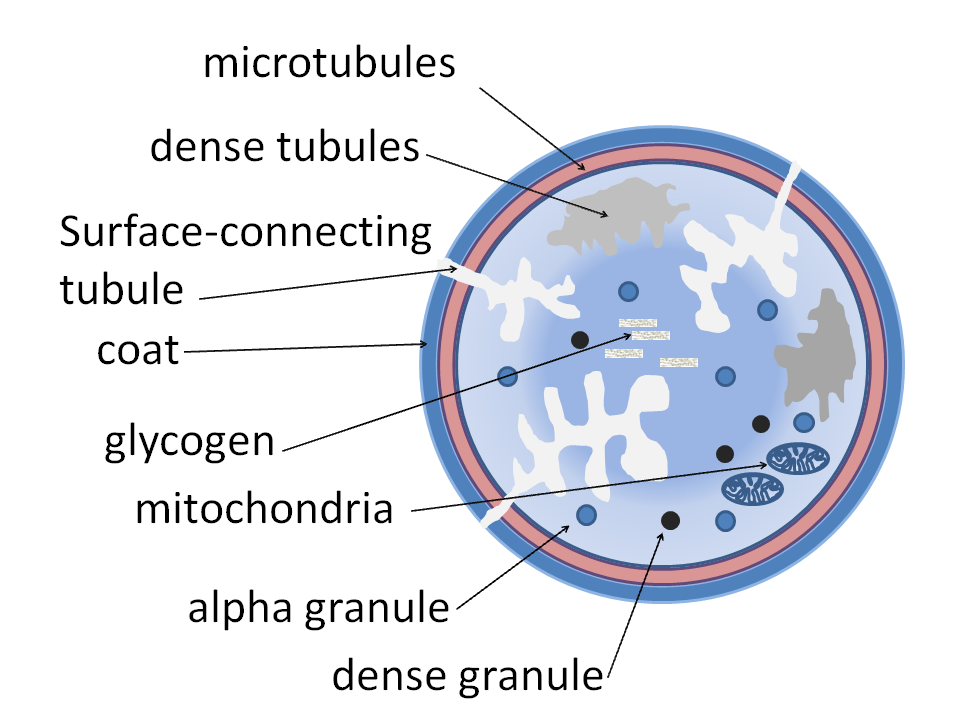
Platelet-rich plasma (PRP) is a small volume of your own blood plasma that contains a much higher concentration of platelets than normal blood. Platelets are the cell fragments that help blood clot, and they also carry growth factors involved in healing. When PRP for erectile dysfunction is used, it is injected directly into the penis.
“P-shot” and “Priapus Shot” are marketing names (Priapus Shot is a registered trademark) for this type of penile PRP injection. Cleveland Clinic describes the P-shot, its name for PRP for erectile dysfunction, as an experimental procedure with no standard process, which means two clinics using the same name may prepare and inject quite different products.
Source: Cleveland Clinic — P-Shot; ISSM — How Effective Is PRP Therapy for Treating Erectile Dysfunction?
Researchers group PRP for erectile dysfunction with low-intensity shockwave therapy and stem cell therapy under the label “restorative” or “regenerative” treatments. The idea behind all three is to repair the underlying tissue rather than produce an erection on demand, as tablets or injections of erection drugs do. That goal is attractive, but so far it is a goal rather than a proven result.
Source: SMSNA — Restorative Therapies for Erectile Dysfunction: Position Statement (2021)
How PRP is supposed to work
To make PRP for erectile dysfunction, whole blood is spun in a centrifuge so that red cells and platelet-poor plasma can be removed. Some protocols then add an activating agent such as thrombin or calcium chloride. The resulting concentrate is rich in growth factors, including platelet-derived, vascular endothelial, insulin-like, epidermal and fibroblast growth factors.
The theory is that, once injected into the corpora cavernosa (the two spongy erectile chambers of the penis), these growth factors encourage new blood vessel formation and repair of damaged tissue. In animal studies of PRP for erectile dysfunction, PRP improved erectile pressure after nerve injury and helped nerve fibers in the penis recover. However, the Sexual Medicine Society of North America (SMSNA) points out that those studies were small and used poorly standardized PRP, and it describes the biological basis of PRP as poorly understood.
Source: SMSNA — Restorative Therapies for Erectile Dysfunction: Position Statement (2021)
A 2023 systematic review by the Greek group that ran the first positive trial reached a similar conclusion: preclinical data support a regenerative role for PRP in erectile tissue, but the mechanism by which PRP for erectile dysfunction might restore erectile function in men remains undetermined, and the quality of PRP preparation needs standardizing.
What happens during a P-shot session
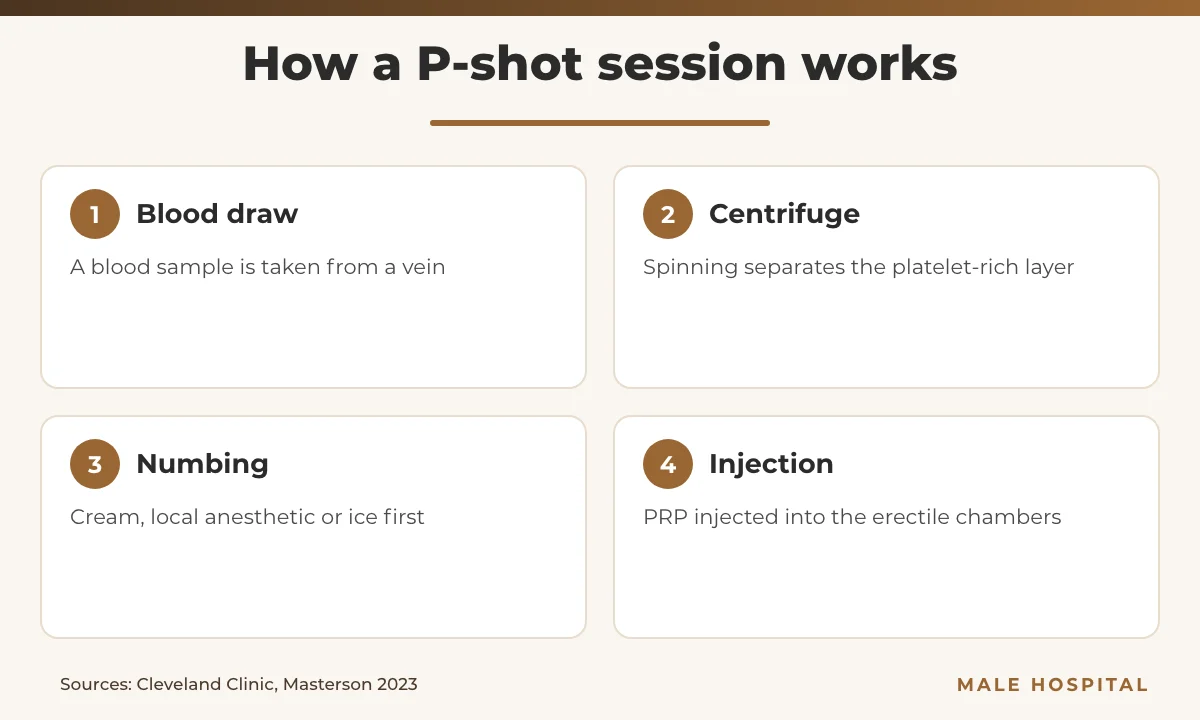
Because there is no standard protocol for PRP for erectile dysfunction, details vary. According to Cleveland Clinic, a typical session involves a blood draw from a vein, separation of the blood in a centrifuge, numbing cream or a local anesthetic injection, and then injections of PRP into different areas of the penis. The whole process usually takes less than 30 minutes, and most people return to normal activities quickly.
Source: Cleveland Clinic — P-Shot
Research protocols for PRP for erectile dysfunction show how much the “dose” can differ. In the University of Miami trial, about 120 mL of blood was processed to obtain roughly 5 mL of PRP; 2.5 mL was injected into each erectile chamber, twice, about four weeks apart, with a tourniquet at the base of the penis for 20 minutes. In the Greek trial, men received 10 mL of PRP per session in two sessions a month apart. An Egyptian trial used three sessions about 15 days apart.
Sources: Masterson et al. (J Urol 2023); Poulios et al. (J Sex Med 2021); Ragheb et al. (Basic Clin Androl 2024)
Does PRP for erectile dysfunction work? What randomized trials show
The strongest test of any treatment is a double-blind, randomized, placebo-controlled trial, in which neither patients nor assessors know who received the real treatment. This matters a lot in sexual medicine, because placebo responses are large: in one trial of PRP for erectile dysfunction, more than half of the men given saltwater reached a meaningful improvement in their erection score.
The positive trial: Poulios et al. (2021)
This Greek single-center trial randomized 60 men with mild to moderate ED to two PRP or placebo injections a month apart; all men stopped other ED treatment. At 6 months, 69% of the PRP group (20 of 29) reached the minimal clinically important difference in the erectile function score, compared with 27% (7 of 26) in the placebo group. No adverse events were reported. The authors noted that the single-center design limits how widely the results on PRP for erectile dysfunction apply and that they cannot be extended to other PRP preparation systems.
The negative trials: Masterson et al. (2023) and Ragheb et al. (2024)
The University of Miami trial randomized 61 men with mild to moderate ED. One month after the second injection, 58.3% of the PRP group and 53.6% of the placebo group had a clinically meaningful improvement, a difference that was not statistically significant. Penile Doppler blood-flow measurements did not change over 6 months. The authors concluded that PRP for erectile dysfunction was safe but no more effective than placebo. They suggested that differences from the Greek trial may reflect patient selection, the smaller PRP volume and the fact that their participants continued taking PDE5 inhibitor tablets.
An Egyptian double-blind trial of 52 men found no significant difference between PRP and saline at 1, 3 or 6 months, and its authors found no data to support PRP for erectile dysfunction of mild to moderate severity.
Sources: Masterson et al. PRP for ED: randomized, double-blind, placebo-controlled trial (J Urol 2023); Ragheb et al. Safety and efficacy of PRP injection for ED (Basic Clin Androl 2024)
| Trial | Men | Protocol | Main result vs placebo |
|---|---|---|---|
| Poulios 2021 (Greece) | 60 | 2 sessions of 10 mL, 1 month apart | Better: 69% vs 27% meaningful improvement at 6 months |
| Masterson 2023 (USA) | 61 | 2 sessions of 5 mL, about 4 weeks apart | No difference: 58.3% vs 53.6% at 1 month |
| Ragheb 2024 (Egypt) | 52 | 3 sessions of 10 mL, about 15 days apart | No difference at 1, 3 or 6 months |
Sources: Poulios et al. (2021); Masterson et al. (2023); Ragheb et al. (2024)
What meta-analyses conclude
Pooling small trials of PRP for erectile dysfunction has not settled the question. A 2026 meta-analysis in The Journal of Sexual Medicine (7 randomized trials, 479 men) found no difference between platelet-rich therapies and placebo in erectile function scores at 1, 3 or 6 months, and concluded with low-to-moderate certainty that they are not superior to placebo; a benefit at 6 months in one outcome rested on only three studies.
A 2026 meta-analysis in the Asian Journal of Andrology (6 trials) found higher scores with PRP at 6 months or later but warned about small samples and very different injection protocols. A 2024 analysis that also included non-placebo and single-arm studies was more positive, while still calling for larger, longer, higher-quality trials.
Sources: de Amorim et al. Platelet-rich therapies vs placebo for ED: meta-analysis (J Sex Med 2026); Savira et al. Autologous platelet concentrates for ED: meta-analysis (Asian J Androl 2026); Du et al. Efficacy of PRP in ED: meta-analysis (PLoS One 2024)
The honest summary: PRP for erectile dysfunction may help some men with mild to moderate ED, but the best-designed studies contradict each other, no trial has followed men beyond about 6 months, and nobody yet knows which preparation, dose or schedule would work best.
What the AUA, EAU and expert societies say
Every major professional body that has addressed PRP for erectile dysfunction treats it as unproven:
- American Urological Association (2018 guideline), Statement 25: “For men with ED, platelet-rich plasma therapy should be considered experimental.” The guideline adds that PRP should not be offered unless it is given within an institutional review board (IRB) approved research protocol.
- European Association of Urology: the evidence is insufficient to make a recommendation, and intracavernous PRP should be used only in a clinical trial setting. The guideline notes the 2023 placebo-controlled trial that found no difference from placebo.
- Sexual Medicine Society of North America (2021): restorative therapies, including PRP, should be reserved for clinical trials, ideally at little or no cost to patients, and it is not appropriate or ethical to advertise or imply efficacy.
- Global Andrology Forum (2026): a panel of 36 experts from 18 countries concluded that the efficacy of PRP remains uncertain and urged clinicians to avoid overclaiming benefits.
Sources: AUA — Erectile Dysfunction: AUA Guideline (2018); EAU Guidelines — Management of erectile dysfunction; SMSNA Position Statement (2021); Global Andrology Forum Position Statements on Regenerative Therapies for ED (World J Mens Health 2026)
The International Society for Sexual Medicine (ISSM), in a patient Q&A reviewed by its communication committee, describes the evidence on PRP for erectile dysfunction as mixed: PRP shows promise as a safe option, but more research is needed to confirm that it works.
Is PRP FDA-approved for ED?
No restorative therapy is FDA-approved for erectile dysfunction, and that includes PRP for erectile dysfunction. Because PRP is minimally manipulated tissue from your own body, it can be reinjected without FDA approval under an exemption for such products, which is why clinics can sell it. Any use for ED is off-label, meaning it has not been proven safe and effective for this purpose.
Sources: ISSM — How Effective Is PRP Therapy for Treating ED?; SMSNA Position Statement (2021)
Side effects and risks of the P-shot
Because PRP comes from your own blood, allergic reactions are not expected, and the trials of PRP for erectile dysfunction reported few problems. In the Miami trial there were no major adverse events; one man in the PRP group developed a new plaque (an area of scar tissue in the penis) and one man in the placebo group developed a hematoma (a collection of blood). Average injection pain was about 4 out of 10 in both groups. The Greek and Egyptian trials reported no adverse events.
Cleveland Clinic lists bruising, swelling, discoloration and infection as possible risks, along with discomfort as the numbing wears off. It advises seeking care promptly for signs of infection, pain that lasts more than a few days or gets worse, or numbness of the penis lasting more than a few hours.
Sources: Masterson et al. (J Urol 2023); Cleveland Clinic — P-Shot
The bigger risks of PRP for erectile dysfunction are indirect. Trials have been small and short, so rare or long-term harms would not have shown up yet. Time and money spent on an unproven therapy can also delay assessment of health problems that ED may signal, such as diabetes or heart disease, and delay treatments that are known to work.
Cost, insurance and clinic red flags
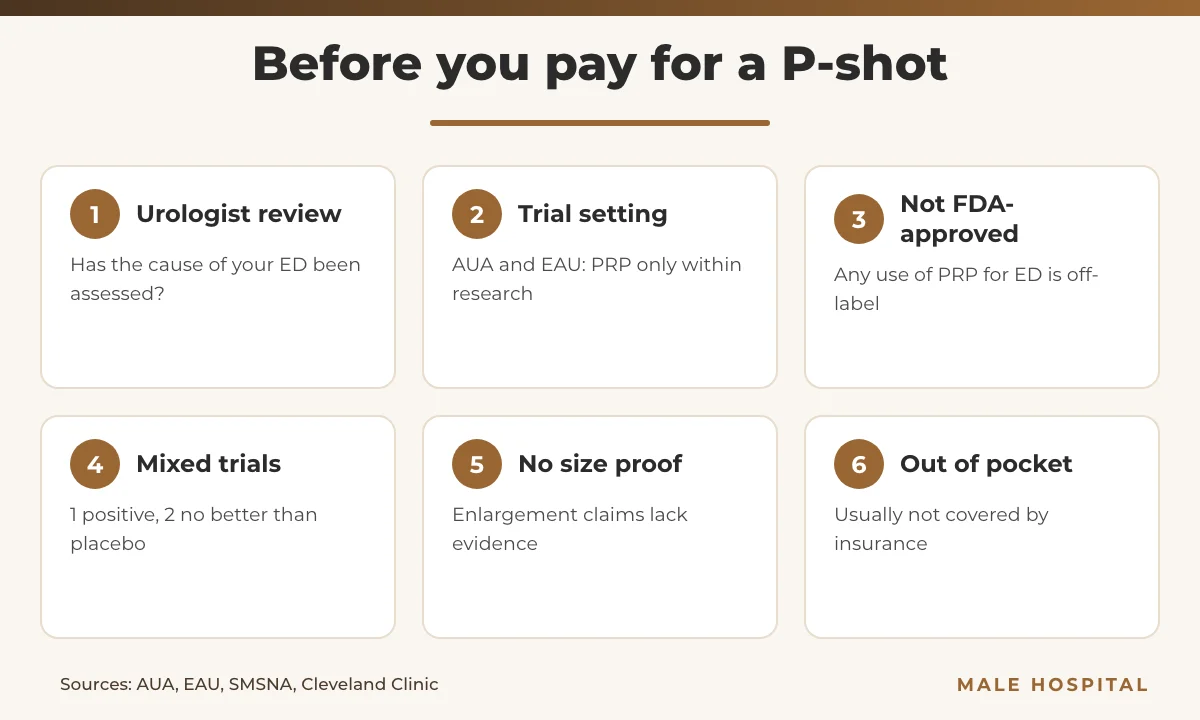
PRP for erectile dysfunction is generally paid out of pocket. Cleveland Clinic states that insurance does not cover the P-shot and estimates the cost at over $1,000 for one injection (page updated in 2024); ISSM also notes it is often not covered and that costs can be significant. Many protocols involve two or more sessions, so total cost multiplies.
Cleveland Clinic also warns that most people who advertise P-shots are not penile or sexual health experts, and that claims of bigger size, stronger sensation or better ejaculation control are not supported by scientific evidence. Expert societies say that, if PRP for erectile dysfunction is offered at all, it should be within a registered research study, ideally at little or no cost to the patient.
Sources: Cleveland Clinic — P-Shot; ISSM — PRP Therapy for ED; SMSNA Position Statement (2021)
Before paying for PRP for erectile dysfunction, it is reasonable to ask: Has a urologist assessed the cause of my ED? Is this part of an approved trial? What preparation system and dose are used? What results do the clinic’s claims rely on? Any promise of a “cure” goes beyond what the evidence shows.
Alternatives with stronger evidence
Unlike PRP for erectile dysfunction, most options for men with ED are backed by decades of research. The EAU recommends lifestyle and risk-factor changes before or alongside treatment, and phosphodiesterase type 5 (PDE5) inhibitors such as sildenafil and tadalafil as first-line therapy. The NIDDK also lists counseling, reviewing medicines that may cause ED, testosterone for men with low levels, urethral suppositories, vacuum devices and surgery. A specialist can match these to the cause, which is the focus of a full erectile dysfunction treatment plan.
Sources: EAU Guidelines — Management of erectile dysfunction; NIDDK — Treatment for Erectile Dysfunction
| Option | Guideline status | What the evidence shows |
|---|---|---|
| PDE5 inhibitor tablets | EAU first-line (strong) | Well established; first choice for most men |
| Penile injections (alprostadil, Bimix, Trimix) | EAU first- or second-line (strong) | About 70% or more with alprostadil; about 90% with Bimix/Trimix |
| Vacuum erection device | EAU weak recommendation | Satisfactory intercourse in up to about 90%; many stop using it over time |
| Penile prosthesis | EAU strong, if other options fail or by preference | Satisfaction reported in 92 to 100 percent of men |
| Low-intensity shockwave therapy | AUA: investigational | Restorative approach under study |
| PRP (P-shot) | AUA: experimental; EAU: trials only | Conflicting placebo-controlled trials |
Sources: EAU Guidelines — Management of erectile dysfunction; AUA — Erectile Dysfunction Guideline (2018)
If tablets do not work or are unsuitable, penile injections for erectile dysfunction and a vacuum erection device are well-studied next steps. If you are drawn to restorative treatments, our guide to shockwave therapy for erectile dysfunction explains that evidence, and our review of natural remedies for erectile dysfunction covers lifestyle steps that also protect your heart.
When to see a doctor
See a doctor if erection problems persist for several weeks, cause distress, or affect your relationship. ED may be a symptom of another health problem, such as diabetes, high blood pressure or heart and blood vessel disease, so a proper assessment matters more than any single treatment. After any penile injection, seek care promptly in these situations:
- Signs of infection, such as increasing redness, warmth or swelling.
- Pain that lasts more than a few days or gets worse.
- Numbness of the penis lasting more than a few hours.
- A new lump or hard area in the penis; a new plaque was reported after PRP in one trial.
Sources: Cleveland Clinic — P-Shot; NIDDK — Symptoms & Causes of Erectile Dysfunction; Masterson et al. (2023)
If you are weighing PRP for erectile dysfunction or any other ED treatment, you can arrange a confidential consultation with our urologist-andrologist via WhatsApp. The cost of treatment depends on your assessment, and the first discussion is free.
FAQs about PRP for erectile dysfunction
Does the P-shot really work for ED?
The evidence is conflicting. One double-blind trial found that more men improved with PRP for erectile dysfunction than with placebo at 6 months, but two other placebo-controlled trials found no difference. A 2026 meta-analysis of seven randomized trials concluded that platelet-rich therapies are not superior to placebo, with low-to-moderate certainty. Guidelines therefore treat it as experimental.
Source: de Amorim et al. (J Sex Med 2026)
Is PRP for ED approved by the FDA?
No. No restorative therapy is FDA-approved for erectile dysfunction. PRP can be given without approval because it is minimally processed tissue from your own blood, but that does not mean it has been shown to work for ED. Using it for this purpose is off-label, and the SMSNA recommends it only within research protocols.
Source: SMSNA Position Statement (2021)
How long do PRP results last?
Nobody knows yet. Placebo-controlled trials of PRP for erectile dysfunction have followed men for about 6 months at most, and expert reviews highlight the lack of long-term data. Researchers who ran the first positive trial have themselves called for high-quality studies with long-term follow-up before conclusions can be drawn about durability.
Source: Poulios et al. (Sex Med Rev 2023); Global Andrology Forum (2026)
Can the P-shot make the penis bigger?
There is no scientific evidence that PRP for erectile dysfunction increases penis length or girth. Cleveland Clinic states that size claims are not supported by any scientific evidence, and the same applies to claims about better sensation or ejaculation control. Be cautious with any clinic that advertises enlargement as a benefit of the P-shot.
Source: Cleveland Clinic — P-Shot
Is a PRP penile injection painful?
Most people feel some discomfort. Clinics usually apply numbing cream, a local anesthetic or ice first. In the Miami trial of PRP for erectile dysfunction, men rated injection pain at about 4 out of 10 on average, and the score was almost identical with saltwater injections, so much of the discomfort comes from the needle itself. Soreness may increase as numbing wears off.
Source: Masterson et al. (J Urol 2023)
How many PRP sessions are needed?
There is no agreed number. Published trials of PRP for erectile dysfunction used two sessions about a month apart or three sessions about two weeks apart, with PRP volumes ranging from 5 mL to 10 mL per session. Because the best protocol is unknown, any fixed package a clinic sells is based on its own choice rather than proven evidence.
Source: Ragheb et al. (2024); Poulios et al. (2021)
Does insurance cover the P-shot?
Usually not. Cleveland Clinic states that insurance does not cover the P-shot and estimates out-of-pocket costs at over $1,000 per injection, and ISSM notes that costs can be significant. Insurers typically do not pay for treatments that guidelines classify as experimental, which is the current status of PRP for erectile dysfunction.
Source: Cleveland Clinic — P-Shot; ISSM
Is PRP better than shockwave therapy for ED?
Neither is a proven standard treatment. The AUA guideline classes low-intensity shockwave therapy as investigational and PRP as experimental, a lower level of support. The Global Andrology Forum found modest short-term benefits for shockwave therapy in young and middle-aged men with mild to moderate blood-flow-related ED, while it judged the efficacy of PRP for erectile dysfunction uncertain.
Source: AUA Guideline (2018); Global Andrology Forum (2026)
Medically reviewed by Assoc. Prof. Dr. Zülfü Sertkaya, urologist and andrologist (FEBU), Istanbul. Last reviewed: October 2026.
This article is for general information and does not replace an individual consultation with a qualified doctor.
- AUA — Erectile Dysfunction: AUA Guideline (2018), J Urol
- EAU — Sexual and Reproductive Health Guidelines — Management of erectile dysfunction
- SMSNA — Sex Med 2021 (PMC) — Restorative Therapies for Erectile Dysfunction: Position Statement
- J Urol 2023 (PMC) — Masterson et al. Platelet-rich Plasma for the Treatment of ED: Randomized, Double-blind, Placebo-controlled Trial
- PubMed — J Sex Med 2021 — Poulios et al. PRP Improves Erectile Function: Double-Blind, Randomized, Placebo-Controlled Trial
- Basic Clin Androl 2024 (PMC) — Ragheb et al. Safety and efficacy of PRP injection for ED: prospective randomized controlled study
- PubMed — J Sex Med 2026 — de Amorim et al. Platelet-rich therapies vs placebo for ED: updated systematic review and meta-analysis of RCTs
- PubMed — Asian J Androl 2026 — Savira et al. Autologous platelet concentrates for ED: meta-analysis of randomized placebo-controlled trials
- PLoS One 2024 (PMC) — Du et al. Efficacy of platelet-rich plasma in the treatment of ED: meta-analysis
- PubMed — Sex Med Rev 2023 — Poulios et al. PRP for ED: systematic review of preclinical and clinical studies
- PubMed — World J Mens Health 2026 — Global Andrology Forum Position Statements on Regenerative Therapies for ED
- ISSM — How Effective Is PRP Therapy for Treating Erectile Dysfunction?
- Cleveland Clinic — P-Shot
- NIDDK — Treatment for Erectile Dysfunction
- NIDDK — Symptoms & Causes of Erectile Dysfunction