
Penile traction therapy for Peyronie’s disease uses a device that holds the penis under gentle, steady stretch to reduce the bend and recover some of the length that scar tissue (plaque) has taken away. In controlled studies, men who used traction daily for about 3 to 6 months reduced their curvature by roughly 12 to 30 degrees on average and gained around 1.5 to 2 cm in stretched length, with mostly mild side effects. European guidelines give it only a weak recommendation, so it is best seen as a low-risk option for motivated men, alone or alongside other Peyronie’s disease treatment, rather than a cure.
Source: EAU Guidelines — Penile curvature; Ziegelmann et al. — Novel penile traction device in Peyronie’s disease: randomized controlled trial (J Urol 2019)
- Two controlled trials found that penile traction reduced curvature (by about 12 degrees with RestoreX and 31 degrees with Penimaster PRO) while untreated men did not improve.
- Older devices needed 3 to 8 hours a day; the RestoreX trial showed benefit with 30 to 90 minutes a day, but its data come from the team that co-developed it.
- A 2023 meta-analysis confirmed a modest effect on curvature, while the 2023 Cochrane review rated the certainty of evidence as very low.
- The EAU offers traction with a weak recommendation; the ESSM says evidence is too limited for firm advice, and the AUA (2015) calls it unproven.
- Side effects are usually mild: discomfort, redness, bruising and temporary glans numbness.
- What is penile traction therapy for Peyronie’s?
- How traction may remodel Peyronie’s plaque
- Penile traction therapy for Peyronie’s: what the trials show
- RestoreX: shorter daily sessions
- Traction combined with injections or surgery
- What guidelines say about traction for Peyronie’s disease
- How traction is used: hours, months and side effects
- Who is a good candidate for penile traction therapy?
- When to see a doctor
- FAQs about penile traction therapy for Peyronie’s
What is penile traction therapy for Peyronie’s?
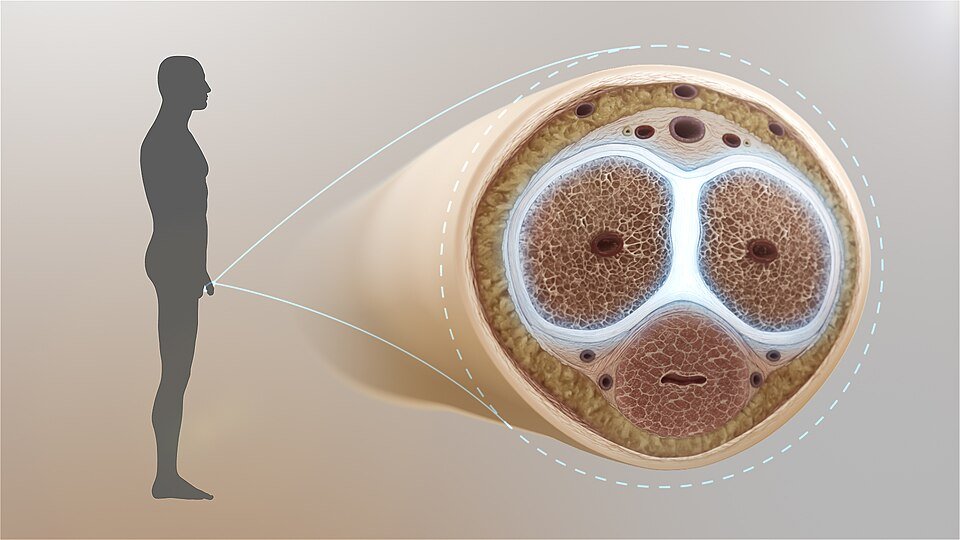
Peyronie’s disease is a scarring condition of the tunica albuginea, the tough sheath around the erection chambers. The scar, or plaque, does not stretch the way healthy tissue does, so the erect penis bends, shortens, or narrows (an “hourglass” or “hinge” deformity). Experts estimate it affects about 6% to 10% of men aged 40 to 70, and many more may not report it.
Penile traction therapy (PTT) applies a constant, controlled pulling force to the flaccid penis. A typical device has a ring at the base, a holder just below the head (glans), and adjustable rods or a spring between them. Some newer devices also push the shaft in the opposite direction of the curve. The general design, and its use for length in men without Peyronie’s, is covered in our penis extender guide; this article focuses only on the evidence in Peyronie’s disease.
Penile traction is different from a vacuum erection device, which draws blood into the penis by suction. The EAU discusses both as “mechanical” therapies, but most of the clinical data on straightening come from traction devices.
Source: Cleveland Clinic — Peyronie’s disease; Valenzuela et al. — Penile traction therapy in Peyronie’s disease: current evidence and future prospects (Ther Adv Urol 2019)
How traction may remodel Peyronie’s plaque
Peyronie’s disease is thought to be a problem of abnormal wound healing. After small injuries to the tunica, inflammation and growth signals push fibroblasts and myofibroblasts (scar-forming cells) to lay down excess collagen, and the enzymes that normally break collagen down, called matrix metalloproteinases (MMPs), become less active.
Mechanical stretch appears to push this process the other way. In laboratory work, cells taken from Peyronie’s tunica changed their collagen structure under strain and produced more MMP-8, an enzyme with anti-scarring activity. In Dupuytren’s contracture, a similar scarring disease of the hand, collagen fibers realign along the direction of pull. The EAU summarizes the proposed mechanism as reduced myofibroblast activity and increased MMP activity, which may remodel collagen. These are biological explanations, not proof that traction dissolves plaque.
Source: Valenzuela et al. — Penile traction therapy in Peyronie’s disease (Ther Adv Urol 2019); EAU Guidelines — Penile curvature
Penile traction therapy for Peyronie’s: what the trials show
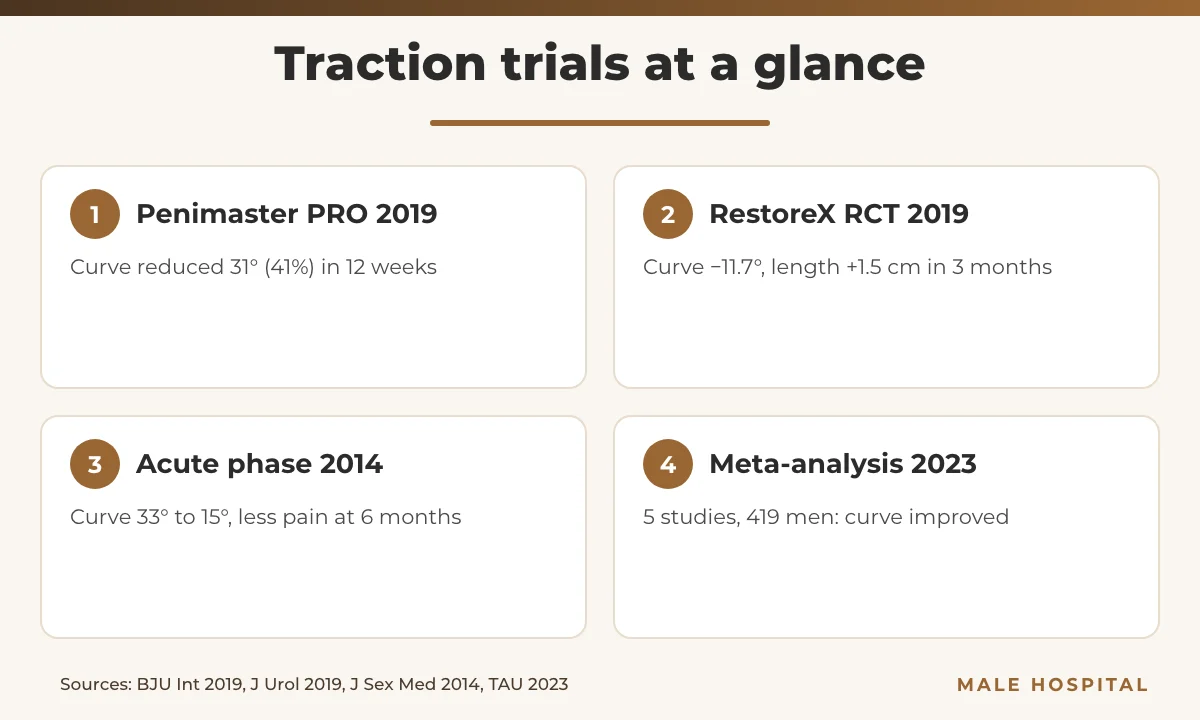
Research on penile traction therapy for Peyronie’s has moved from tiny pilot studies to a few controlled trials. The results are consistent in direction but modest in size, and most studies are small.
Early pilot studies (2008–2009)
In a 10-man pilot at Rush University, men wore a FastSize extender 2 to 8 hours a day for 6 months. All had less curvature, with an average reduction of 33% (from 51 to 34 degrees), stretched length rose by 0.5 to 2.0 cm, and no adverse events were seen. A larger Italian phase II study asked men to wear an extender at least 5 hours a day; curvature fell only from 31 to 27 degrees, which was not statistically significant, though stretched length rose by 1.3 cm and most men were satisfied.
Source: Levine et al. — Penile traction therapy for Peyronie’s disease: single-center pilot study (J Sex Med 2008); Gontero et al. — Penile extender in curvature from Peyronie’s disease: phase II study (J Sex Med 2009)
Controlled trials
The strongest data come from studies that compared penile traction with no treatment. Untreated men in these studies generally stayed the same or got worse, which matters because Peyronie’s disease does not reliably improve on its own.
| Study | Men and phase | Daily use | Main results |
|---|---|---|---|
| Martínez-Salamanca 2014 (non-randomized, controlled) | 55 treated vs 41 untreated; acute phase | 6 months of daily wear | Curve 33° to 15°; pain score 5.5 to 2.5; untreated men worsened |
| Moncada 2019, Penimaster PRO | 93 men; stable phase, curve ≥45° | 3–8 hours for 12 weeks | Curve −31.2° (41%); stretched length +1.8 cm; no change in controls |
| Ziegelmann 2019, RestoreX (randomized) | 110 men; curve ≥30°, all-comers | 30–90 minutes for 3 months | Curve −11.7° vs +1.3°; length +1.5 vs 0 cm |
| Almsaoud 2023 meta-analysis | 5 studies, 419 men | Varied | Significant curve reduction; no significant pooled effect on length or erections |
Source: Martínez-Salamanca et al. — Acute phase Peyronie’s disease management with traction device (J Sex Med 2014); Moncada et al. — Penimaster PRO in stable Peyronie’s disease (BJU Int 2019); Almsaoud et al. — Penile traction device in Peyronie’s disease: systematic review and meta-analysis (Transl Androl Urol 2023)
In the Penimaster PRO trial the benefit depended on wear time: men using the device under 4 hours a day improved by about 20 degrees, while those using it over 6 hours improved by about 38 degrees. In the acute-phase study, the share of men unable to have penetrative sex fell from 62% to 20%, and the authors reported that 40% of men who would otherwise have been surgical candidates no longer needed surgery.
The 2023 Cochrane review, which only accepted randomized trials against no treatment, found one eligible traction trial of about 90 men. It reported a curvature reduction of about 7.4 degrees but rated the certainty as very low and found no data on the ability to have intercourse.
Source: Moncada et al. (BJU Int 2019); Rosenberg et al. — Non-surgical therapies for Peyronie’s disease (Cochrane 2023)
RestoreX: shorter daily sessions
The biggest practical barrier with penile traction has always been wear time. RestoreX was designed with Mayo Clinic to shorten it: it has a different clamp, adjustable force, and a “counter-bending” feature that pushes the shaft against the direction of the curve.
In the randomized trial, 110 men with an average curve of 59 degrees and almost 50 months of disease were assigned 3:1 to RestoreX or no therapy. After 3 months of 30 to 90 minutes a day, 77% of treated men had less curvature and 94% had gained length. Men with erectile dysfunction also improved their erectile function score by 4.3 points compared with a slight decline in controls. Side effects were only mild and transient.
The follow-up phase reported that men who used the device at least 15 minutes a day gained 2.0 to 2.3 cm of length and 18% to 21% curve improvement, with an average daily use of about 31 minutes. After 6 months, 95% had length gains and 61% had curve improvements of roughly 17 to 21 degrees.
These are encouraging numbers, but keep two caveats in mind. The trials were run by the Mayo Clinic group that helped develop the device, and similar results have not yet been confirmed by independent randomized trials. Also, the average curve improvement in the randomized phase (about 12 degrees) is smaller than the headline figures for responders.
Source: Ziegelmann et al. — RestoreX randomized controlled trial (J Urol 2019); Joseph et al. — RestoreX open-label and follow-up phases (J Sex Med 2020)
Traction combined with injections or surgery
With collagenase injections
Collagenase (Xiaflex) is an enzyme injected into the plaque. Doctors often add “modeling” (gentle manual straightening) and traction between injection cycles. In a Mayo Clinic series using an older device (Andropenis), men averaged about 10 hours of traction a week, use dropped with each injection cycle, and traction made no significant difference to curvature or length. A later registry from the same center found that men who added RestoreX to collagenase improved their curve by about 34 degrees (49%) and gained 1.9 cm, compared with about 20 degrees and a small length loss with collagenase alone. That study was not randomized. Collagenase is no longer marketed in the EU; see our Xiaflex guide for its current status.
Source: Ziegelmann et al. — Penile traction among men undergoing collagenase (Urology 2017); Alom et al. — Combined collagenase and RestoreX traction (J Sex Med 2019)
With interferon injections
In 112 men treated with interferon alpha-2b injections, routine traction did not change curvature or girth. Men who wore the device 3 hours or more a day gained slightly more stretched length (about 4.4 mm versus 1.3 mm).
Source: Yafi et al. — Duration of penile traction during intralesional injection therapy (J Urol 2015)
After surgery
Surgery straightens the penis but can shorten it, especially plication on the long side. In a retrospective series, men who used traction for more than 2 hours a day for 3 months, starting 3 to 4 weeks after surgery, gained a mean 0.85 cm after plication, while men who did not use it lost 0.53 cm. A meta-analysis of 348 men found that traction after injection or surgery left stretched length about 1 cm greater than no traction. The ESSM, however, judged the data still insufficient to recommend routine traction after surgery. Our Peyronie’s disease surgery guide explains plication, grafting and implants.
Source: Rybak et al. — Traction vs no traction after plication or grafting (J Sex Med 2012); Haney et al. — Adjunct traction and penile length in Peyronie’s disease: meta-analysis (Urology 2018)
What guidelines say about traction for Peyronie’s disease
Professional societies agree that penile traction is safe but disagree on how strongly to support it, because the trials are small.
- EAU (European Association of Urology): offer penile traction and vacuum devices to reduce deformity or as part of multimodal therapy, noting that outcome data are limited. Strength: weak. The EAU adds that there is not enough evidence to recommend traction as monotherapy and that calcified plaques and hourglass or hinge deformities have not been studied.
- ESSM (European Society for Sexual Medicine, 2021): traction “shows promising results,” side effects are mild, but available data do not support routine use before or after surgery or together with oral or injection therapy.
- AUA (American Urological Association, 2015): listed traction under mechanical therapies based on three small observational studies and concluded the findings need replication in properly powered randomized trials. This guideline predates the controlled trials described above.
Source: EAU Guidelines — Penile curvature; García-Gómez et al. — Penile traction devices for Peyronie’s disease: ESSM position statements (Sex Med 2021); AUA — Peyronie’s Disease Guideline (2015)
How traction is used: hours, months and side effects
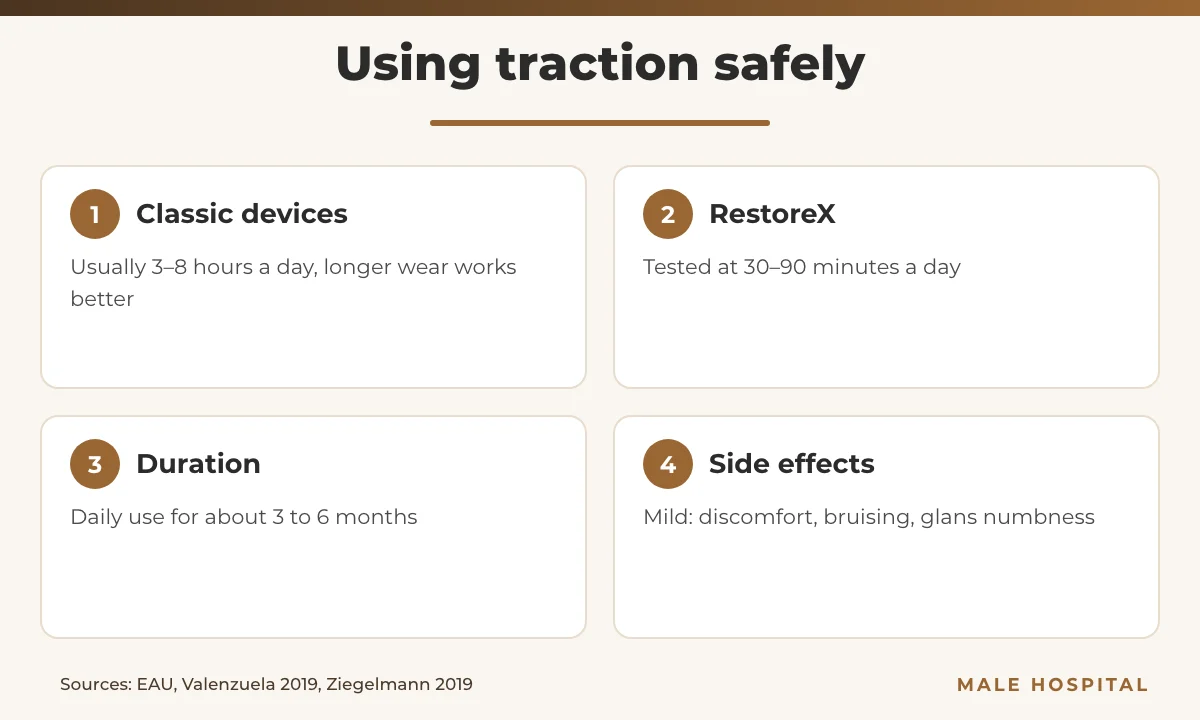
There is no single agreed protocol. Studies of conventional devices used 3 to 9 hours a day for 3 to 6 months, and the EAU describes typical wear as 2 to 8 hours daily. Review authors concluded that conventional devices work best when worn for more than 3 to 6 hours a day. RestoreX uses much shorter sessions. The NHS notes that such devices need to be used every day for several months and are usually not available on the NHS.
Adherence is the main weak point of penile traction. In one collagenase study, men averaged only 1.7 hours of traction a day, and just 37% reached 3 hours. The EAU describes long-wear traction as inconvenient and tolerated mainly by highly motivated men. If you start traction, your urologist will usually measure curvature (often with an injection-induced erection) and stretched length beforehand so progress can be judged objectively.
Side effects
Reported side effects are usually mild and short-lived: temporary pain or discomfort (up to about 25% of men in some studies), bruising, redness, itching, and changes in glans sensation or numbness. In the Penimaster PRO trial, 43% reported mild events such as discomfort or glans numbness. No serious adverse events were reported in the controlled trials. Stop and get checked if the glans turns dark or cold, or if you develop skin breakdown.
Source: Valenzuela et al. (Ther Adv Urol 2019); NHS — Peyronie’s disease; EAU Guidelines — Penile curvature
Who is a good candidate for penile traction therapy?
Traction has been studied in both phases of the disease. The acute phase is when the plaque is still forming, pain is common and the curve may be changing; Cleveland Clinic describes it as lasting about 6 to 12 months. The EAU defines the stable phase as no pain and a curve unchanged for at least 3 months.
| Situation | What the evidence suggests |
|---|---|
| Acute phase, painful erections, early curve | One controlled study showed less pain and curve; may prevent worsening |
| Stable phase, simple one-direction curve | Best-studied group; average curve gains of roughly 12 to 31 degrees |
| Main concern is lost length | Length gains of about 1 to 2 cm in several studies |
| Calcified plaque, hourglass or hinge deformity | Not well studied; theoretically less likely to respond |
| Severe curve that prevents sex, with poor erections | Surgery or a penile implant is usually more reliable |
In the acute-phase study, men more likely to respond were younger than 45, started within 3 months of onset, had a curve under 45 degrees, and had no plaque visible on ultrasound. Penile traction is a reasonable choice for men who want to avoid or delay surgery and can commit to daily use. It will not straighten a severe deformity on its own; for those men, see our page on penile curvature correction.
Source: Cleveland Clinic — Peyronie’s disease; ESSM position statements (Sex Med 2021); Valenzuela et al. (Ther Adv Urol 2019)
When to see a doctor
See a urologist before buying any device, so the diagnosis, phase and type of deformity are confirmed. Book an appointment if you notice:
- A hard lump or band on the shaft of the penis
- A new or worsening bend, indentation or narrowing during erections
- Painful erections or difficulty with penetration
- Erection problems alongside a curve
Seek urgent care if, while using a device, the glans becomes dark, blue, cold or numb and does not recover after removal, or if you develop blisters, open sores or severe pain.
Source: NHS — Peyronie’s disease; Valenzuela et al. (Ther Adv Urol 2019)
If you are considering traction, alone or with other treatments, you can arrange a confidential assessment with our urologist-andrologist, Assoc. Prof. Dr. Zülfü Sertkaya, whose clinical focus includes Peyronie’s disease. Message us on WhatsApp for a free initial consultation.
FAQs about penile traction therapy for Peyronie’s
Does penile traction therapy for Peyronie’s really work?
It helps many men, but the effect is usually partial. Controlled trials found average curve reductions of about 12 to 31 degrees and length gains of 1.5 to 1.8 cm, while untreated men did not improve. A 2023 meta-analysis confirmed a significant effect on curvature, but the Cochrane review rated the certainty of the evidence as very low.
Source: Almsaoud et al. (Transl Androl Urol 2023); Cochrane 2023
How many hours a day should I wear a traction device?
For conventional extenders, studies used 3 to 9 hours a day, and results improved with longer wear; men using a device over 6 hours a day improved most in one trial. RestoreX was tested with 30 to 90 minutes a day. Follow the schedule your urologist sets for your specific device rather than increasing force on your own.
Source: Moncada et al. (BJU Int 2019); Ziegelmann et al. (J Urol 2019)
How long until I see results?
Most trials measured outcomes after 3 to 6 months of daily use. In the Penimaster PRO study, curvature was already measured at 1, 2 and 3 months, with the full benefit at 12 weeks. Cleveland Clinic also notes that most men need several months of use before they notice improvement.
Source: Cleveland Clinic — Peyronie’s disease; Moncada et al. (BJU Int 2019)
Is RestoreX better than other traction devices?
RestoreX is the only device with a randomized trial showing benefit at under an hour a day, and in a registry it added more to collagenase results than older devices. However, all of these data come from the center that co-developed it, and no independent head-to-head randomized trial has compared it with other devices.
Source: Alom et al. (J Sex Med 2019); Joseph et al. (J Sex Med 2020)
Can traction help during the painful, early phase?
Yes, penile traction has been studied there. In an acute-phase study, 6 months of traction cut the average curve from 33 to 15 degrees and lowered pain scores, while untreated men got worse. The ESSM says data support traction in either the acute or chronic phase, though the evidence is limited.
Source: Martínez-Salamanca et al. (J Sex Med 2014); ESSM position statements (Sex Med 2021)
Should I use traction after Peyronie’s surgery?
Traction is often used to protect length, usually starting a few weeks after the operation. Studies suggest it leaves stretched length about 1 cm greater than no traction. The ESSM still considers the data insufficient for a firm recommendation, so timing and use should be agreed with your surgeon.
Source: Haney et al. (Urology 2018); Rybak et al. (J Sex Med 2012)
Is penile traction safe?
Controlled studies have reported no serious adverse events. Common effects are temporary discomfort, redness, bruising, itching and glans numbness, which usually settle after removing the device. Stop and contact your doctor if the glans becomes discolored or stays numb, or if the skin breaks down.
Source: Valenzuela et al. (Ther Adv Urol 2019); ESSM position statements (Sex Med 2021)
Can traction replace surgery?
For some men it can reduce the curve enough that surgery is no longer needed or becomes simpler; in one acute-phase study, 40% of surgical candidates avoided surgery. For severe, complex or calcified deformities, or when erections are also poor, surgery or an implant remains more reliable.
Source: Martínez-Salamanca et al. (J Sex Med 2014); EAU Guidelines — Penile curvature
Medically reviewed by Assoc. Prof. Dr. Zülfü Sertkaya, urologist and andrologist (FEBU), Istanbul. Last reviewed: November 2026.
This article is for general information and does not replace an individual consultation with a qualified doctor.
- EAU Guidelines — Sexual and Reproductive Health — Penile curvature
- AUA — Peyronie's Disease Guideline (2015)
- NHS — Peyronie's disease
- Cleveland Clinic — Peyronie's disease
- PMC (Sex Med) — García-Gómez et al., The use of penile traction devices for Peyronie's disease: ESSM position statements (2021)
- PMC (Ther Adv Urol) — Valenzuela et al., The use of penile traction therapy in the management of Peyronie's disease (2019)
- PubMed (J Urol) — Ziegelmann et al., Outcomes of a novel penile traction device in men with Peyronie's disease: randomized controlled trial (2019)
- PubMed (J Sex Med) — Joseph et al., Outcomes of RestoreX penile traction therapy: open label and follow-up phases (2020)
- PubMed (BJU Int) — Moncada et al., Penile traction therapy with Penimaster PRO in stable Peyronie's disease (2019)
- PubMed (J Sex Med) — Martínez-Salamanca et al., Acute phase Peyronie's disease management with traction device (2014)
- PubMed (J Sex Med) — Levine et al., Penile traction therapy for Peyronie's disease: single-center pilot study (2008)
- PubMed (J Sex Med) — Gontero et al., Penile extender device for curvature from Peyronie's disease: phase II study (2009)
- PubMed (Transl Androl Urol) — Almsaoud et al., Penile traction device in Peyronie's disease: systematic review and meta-analysis (2023)
- PubMed (Cochrane) — Rosenberg et al., Non-surgical therapies for Peyronie's disease (2023)
- PubMed (Urology) — Ziegelmann et al., Penile traction therapy among men undergoing collagenase for Peyronie disease (2017)
- PubMed (J Sex Med) — Alom et al., Combined collagenase and RestoreX penile traction therapy (2019)
- PubMed (J Urol) — Yafi et al., Duration of penile traction therapy during intralesional injection therapy (2015)
- PubMed (J Sex Med) — Rybak et al., Traction vs no traction after plication or grafting for Peyronie's disease (2012)
- PubMed (Urology) — Haney et al., Adjunct mechanical traction and penile length in Peyronie's disease: meta-analysis (2018)