The squeeze technique is a behavioral exercise for premature ejaculation: when you feel close to climax, you or your partner pause and gently squeeze the head of the penis until the urge fades, then carry on. Repeated over weeks, it teaches you to recognize the build-up of arousal early and bring it down on purpose. This guide goes deeper into the method itself: the grip, the timing, a step-by-step training plan, common mistakes and honest evidence. For a wider overview of every option, from condoms to sprays and pelvic floor work, see our guide on how to last longer in bed.
Sources: Cleveland Clinic — Premature Ejaculation: Causes, Diagnosis & Treatment; InformedHealth.org (IQWiG) — Premature ejaculation: What can I do on my own?
- Squeeze gently where the head of the penis joins the shaft, with the index finger underneath and the thumb on top, until the urge to ejaculate passes.
- Hold the squeeze for roughly 10–30 seconds, rest about 30 seconds, and repeat the cycle several times before allowing orgasm.
- Practice in stages: alone first, then with a partner’s hand, then during intercourse without movement, and finally with movement.
- Older reports of very high success have not been repeated; controlled evidence is limited, and many men drop out because the method interrupts sex.
- Urology guidelines favor combining behavioral methods with medical treatment, which works better than medicine alone.
- What is the squeeze technique?
- How to do the squeeze technique step by step
- A staged squeeze training plan
- Squeeze technique vs stop-start
- Does the squeeze technique work? What studies show
- Combining the squeeze technique with medical treatment
- Common mistakes and troubleshooting
- Involving your partner
- When to see a doctor
- FAQs about the squeeze technique
What is the squeeze technique?
The squeeze technique is one of the two classic behavioral treatments for rapid ejaculation. It was developed by the sex researchers William Masters and Virginia Johnson and published in 1970. It built on the “stop-and-start” method described by the urologist James Semans in 1956, in which a man simply pauses stimulation before the point of no return.
Both methods share one goal. They help a man notice the middle range of arousal, the stage where ejaculation can still be controlled, and practice lowering arousal before it tips into the reflex. The squeeze technique adds firm, brief pressure to speed up that drop in arousal, and the erection often softens slightly as a result.
Sources: PubMed — Effects of a new functional-sexological treatment for premature ejaculation (de Carufel & Trudel, 2006); PMC — An Update of the ISSM Guidelines for the Diagnosis and Treatment of Premature Ejaculation (Althof et al., 2014)
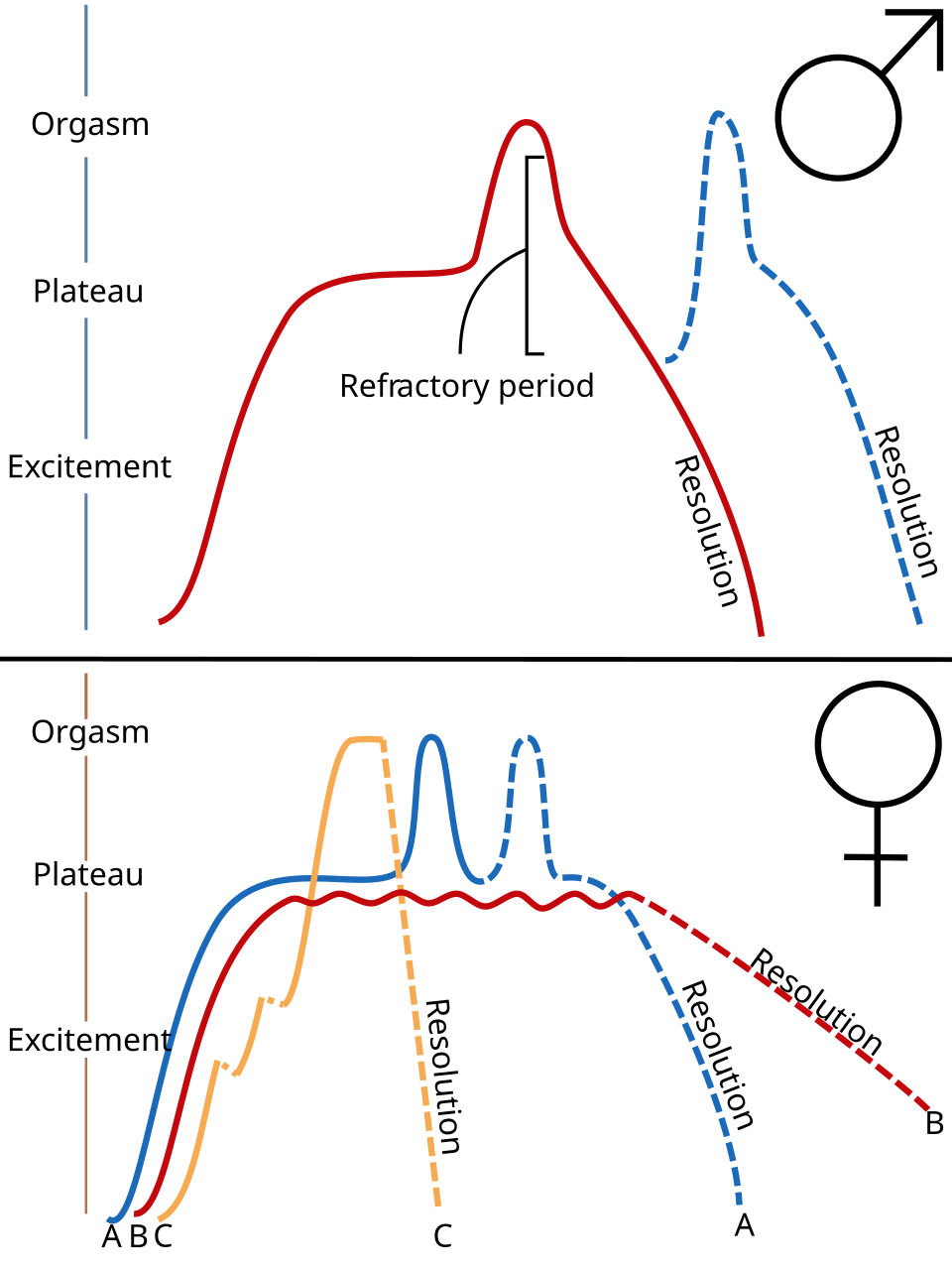
In sex research, the male arousal curve is often drawn in four phases: excitement, plateau, orgasm and resolution. The squeeze technique is used during the plateau, before arousal climbs into orgasm. The aim is not to stop sex for good, but to spend more time at a high but manageable level.
Premature ejaculation itself is common. Cleveland Clinic estimates that 30% to 40% of men experience it at some point, and about 1 in 5 men aged 18 to 59 report it. If you want to understand the condition, its types and its causes first, read our main guide to premature ejaculation.
Source: Cleveland Clinic — Premature Ejaculation: Causes, Diagnosis & Treatment
How to do the squeeze technique step by step
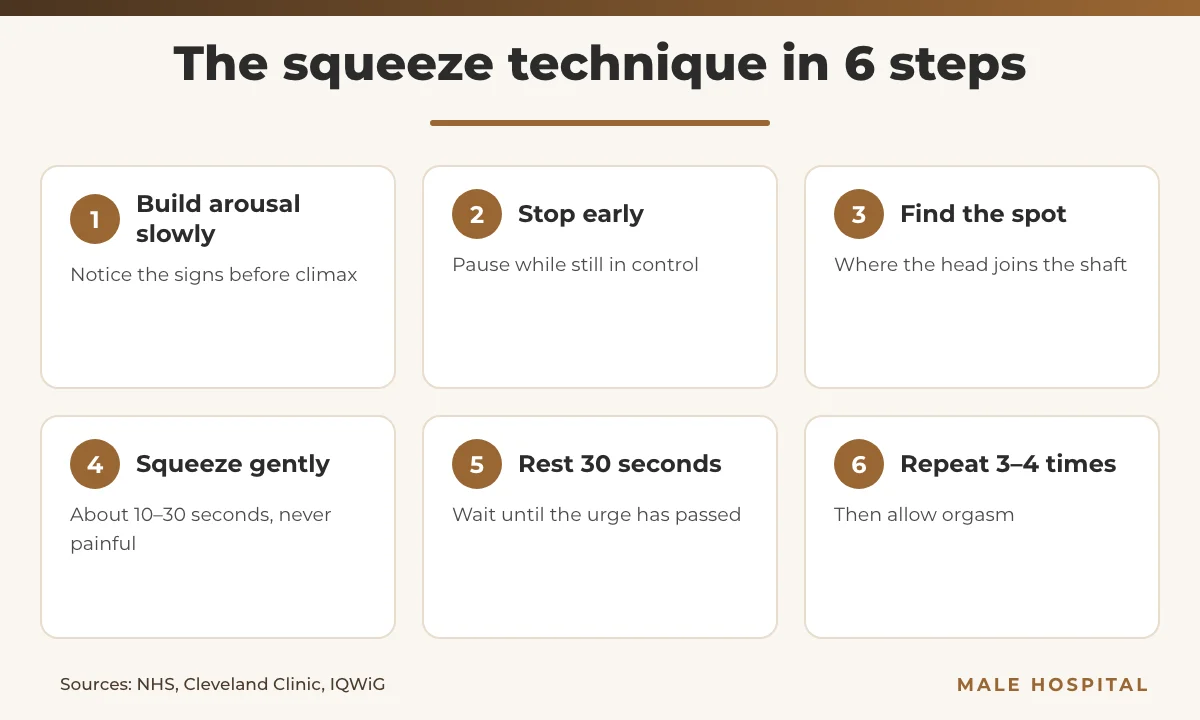
Health sources describe the same basic cycle, with small differences in timing. Plan your first sessions alone, with privacy and no time pressure.
1. Build arousal slowly
Begin stimulation and pay attention to how your arousal rises. Instead of focusing on pleasure alone, notice the body signals that come before the point of no return, such as faster breathing, tension in the thighs or pelvis, and a growing sense of urgency.
2. Stop just before the point of no return
The squeeze technique only works if you stop early enough. Once ejaculation feels inevitable, it is too late to hold it back. Stop when you feel close but are still clearly in control.
3. Apply the squeeze
Place your index finger on the underside of the penis, where the head joins the shaft, and your thumb on the opposite side. InformedHealth.org, run by Germany’s independent Institute for Quality and Efficiency in Health Care (IQWiG), describes this grip and advises squeezing gently. The pressure should be firm enough to reduce the urge, never painful.
4. Hold, then rest
The NHS suggests holding the squeeze for 10 to 20 seconds, letting go, and waiting about 30 seconds before continuing. Cleveland Clinic describes a squeeze of about 30 seconds, until the erection starts to soften slightly. In practice, hold it until the urgency clearly fades.
5. Repeat the cycle
Resume stimulation and repeat the build-up, stop and squeeze several times, typically three or four, before you allow yourself to ejaculate. Allowing orgasm at the end keeps the session relaxed rather than frustrating.
Sources: InformedHealth.org (IQWiG) — Premature ejaculation: What can I do on my own?; NHS — Ejaculation problems; Cleveland Clinic — Premature Ejaculation
A staged squeeze training plan
The squeeze technique is a skill, and like any skill it is learned in steps. The International Society for Sexual Medicine (ISSM) describes the usual sequence for behavioral training: start with self-stimulation, move to stimulation by a partner’s hand, then to intercourse without movement, and finally to intercourse with stop-and-start movement.
Source: PMC — ISSM Guidelines Update on Premature Ejaculation (Althof et al., 2014)
Stage 1: Solo practice
Practice alone, without a partner watching and without a deadline. This is where you learn your own early warning signs and how much pressure works. Move on only when you can complete several squeeze cycles in a session and feel you can choose when to finish.
Stage 2: Partner’s hand
Your partner provides the stimulation while you signal when you are close. Either of you can apply the squeeze technique; agree on a simple word or gesture in advance so the pause feels planned rather than awkward.
Stage 3: Intercourse without movement
Next, practice staying still after penetration, with your partner on top, and getting used to the sensation without thrusting. If arousal climbs too high, withdraw and use the squeeze, then resume. The NHS notes that having your partner on top can also make it easier to pull away when you are close.
Stage 4: Intercourse with movement
Finally, add slow movement, pausing or withdrawing for a squeeze whenever needed. Over time, many men need fewer pauses. The ISSM notes that this gradual process is thought to raise ejaculation time, sexual confidence and self-esteem, although few controlled studies confirm it.
Sources: PMC — ISSM Guidelines Update on Premature Ejaculation (Althof et al., 2014); NHS — Ejaculation problems
How long does each stage take? There is no fixed timetable. The NHS warns that these techniques “require lots of practice”, and Cleveland Clinic advises continuing until you have gained control. With the squeeze technique, think in weeks, not days, and expect setbacks when you are tired, stressed or after a long break from sex.
Sources: NHS — Ejaculation problems; Cleveland Clinic — Premature Ejaculation
Squeeze technique vs stop-start
The two methods are close relatives, and many therapists teach them together. The main difference is what you do at the pause: the stop-start method relies on waiting, while the squeeze technique adds pressure to bring arousal down faster. The table below summarizes how they compare.
| Feature | Squeeze technique | Stop-start technique |
|---|---|---|
| Origin | Masters and Johnson, 1970 | Semans, 1956 |
| What you do near climax | Pause and gently squeeze below the head of the penis | Pause all stimulation and wait |
| Typical pause | Squeeze about 10–30 seconds, then rest about 30 seconds | About 30 seconds, until control returns |
| Effect on erection | Often softens slightly | Usually less change |
| Main drawback | Some partners dislike doing the squeeze; interrupts sex | Interrupts sex; needs early recognition of arousal |
| Guideline position | Behavioral methods are best used with education and, often, medication (EAU, AUA) | |
Sources: PubMed — de Carufel & Trudel, 2006; Cleveland Clinic — Premature Ejaculation; NHS — Ejaculation problems
There is no head-to-head evidence that one is better. Many men start with stop-start, which is simpler, and add the squeeze technique if waiting alone does not bring the urge down quickly enough.
Does the squeeze technique work? What studies show
The honest answer is that the squeeze technique helps some men, but the evidence is weaker than its reputation suggests.
Early claims vs later research
Older uncontrolled reports on the squeeze technique described failure rates of only 2.2% right after therapy and 2.7% at five years. These results have never been reproduced. Other studies have found success rates between 60% and 90%. A Cochrane review concluded that the evidence for psychological and behavioral treatments is “weak and inconsistent”, noting that most trials were small and that Masters and Johnson’s early 97.8% success rate could not be replicated.
Sources: PMC — ISSM Guidelines Update on Premature Ejaculation (Althof et al., 2014); PubMed — Psychosocial interventions for premature ejaculation (Cochrane review, Melnik et al., 2011)
Controlled studies
In a Canadian trial of couples, a behavioral program that included the squeeze and stop-start techniques improved the duration of intercourse, sexual satisfaction and sexual functioning compared with a waiting list, and couples were satisfied with the treatment. InformedHealth.org adds an important caveat: the studies are small and the techniques were tested as part of sex therapy, so it is unclear how well they work when a man uses them on his own.
Sources: PubMed — de Carufel & Trudel, 2006; InformedHealth.org (IQWiG) — What can I do on my own?
Compared with medication
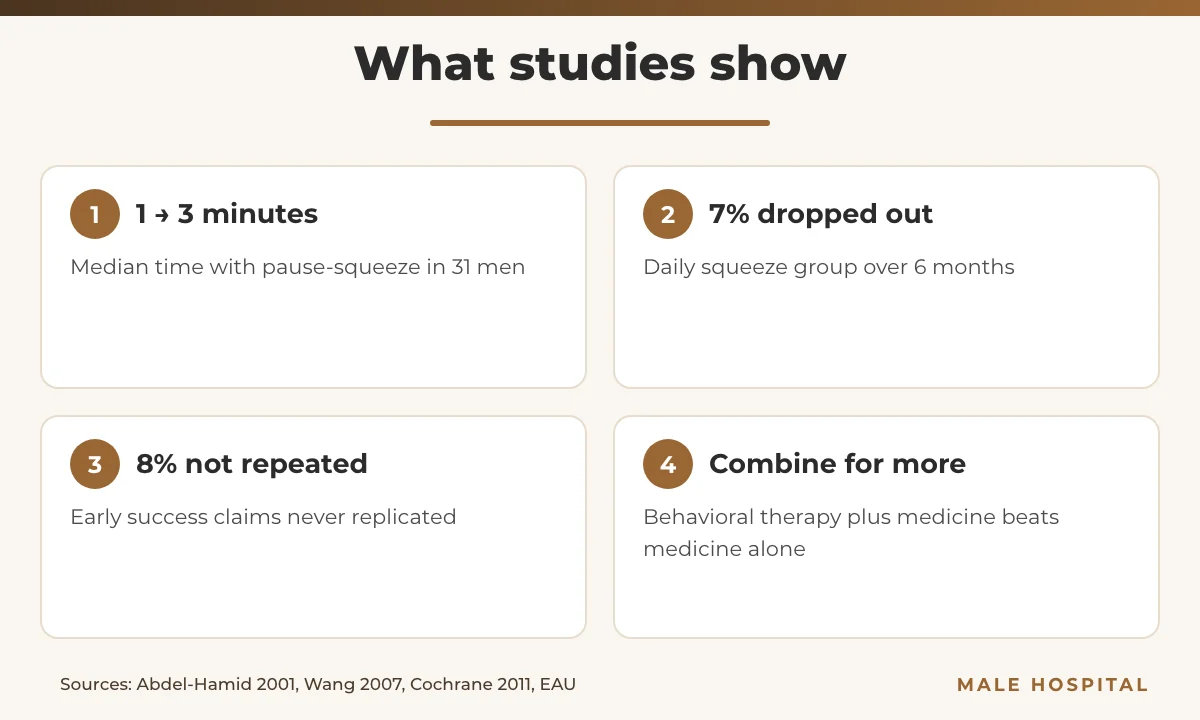
In a small Egyptian crossover study of 31 men with lifelong premature ejaculation, median ejaculation time rose from 1 minute before treatment to 3 minutes with the pause-squeeze technique. That was a real improvement, but paroxetine, an antidepressant used off-label, worked better than the squeeze technique.
A Chinese study randomized 180 men to sildenafil, daily paroxetine or daily squeeze practice for six months. All three groups improved, but sildenafil worked significantly better than both paroxetine and the squeeze. By six months, 36.7% of men in the squeeze group had dropped out and 45% wanted to continue the method, compared with 86.7% in the sildenafil group. These figures suggest the biggest weakness of the squeeze technique is not that it fails, but that many men find it hard to stick with.
Sources: PubMed — As-needed pharmacotherapy and the pause-squeeze technique in premature ejaculation (Abdel-Hamid et al., 2001); PubMed — Can sildenafil treat primary premature ejaculation? (Wang et al., 2007)
Combining the squeeze technique with medical treatment
Current guidelines do not treat behavioral methods as an either/or choice. The European Association of Urology (EAU) states that psychosexual approaches alone lack strong support, but that combining them with drug treatment gives better results than drugs alone. The American Urological Association (AUA) likewise advises clinicians to tell men that combining behavioral and pharmacological approaches may be more effective than either one alone.
Sources: EAU — Guidelines on Sexual and Reproductive Health: Disorders of Ejaculation; AUA/SMSNA — Disorders of Ejaculation Guideline
Two studies show what this can look like in practice:
- With dapoxetine: In an Italian study of 50 men with lifelong premature ejaculation, men who combined on-demand dapoxetine with sexual behavioral treatment reached a mean ejaculation time of about 371 seconds at 24 weeks, compared with about 160 seconds on dapoxetine alone. At that point, 80% of the combination group no longer met the questionnaire threshold for premature ejaculation, versus none of the dapoxetine-only group.
- With sildenafil: In a Chinese trial of 60 men, behavioral therapy alone raised mean ejaculation time from 0.80 to 1.82 minutes, while sildenafil plus behavioral therapy raised it from 0.73 to 3.63 minutes.
Sources: PubMed — Dapoxetine plus behavioral treatment vs dapoxetine alone in lifelong PE (Cormio et al., 2015); PubMed — Viagra with behavior therapy for premature ejaculation (Tang et al., 2004)
Medicine can take the pressure off early on, giving you enough time to practice noticing and lowering arousal. You can read more about how on-demand dapoxetine works and who it suits. The ISSM also notes that for lifelong premature ejaculation, which is likely to have a biological basis, medical treatment with basic education is usually the starting point, while for acquired premature ejaculation a combined medical and psychological approach is recommended where feasible.
Source: PMC — ISSM Guidelines Update on Premature Ejaculation (Althof et al., 2014)
Common mistakes and troubleshooting
Most frustration with the squeeze technique comes from a handful of predictable problems. Here is how to deal with them.
- Stopping too late. If you ejaculate during the squeeze, you waited too long. Stop earlier next time, even if it feels too soon. Early stopping is the core skill.
- Squeezing too hard. Pressure should be firm but comfortable. Pain is a sign to ease off, and it will make the experience something you avoid.
- Squeezing in the wrong place. The grip is at the point where the head meets the shaft, not at the base of the penis.
- Rushing through stages. Jumping straight to intercourse before you can manage solo sessions usually leads to disappointment.
- Treating every session as a test. Anxiety tends to speed ejaculation. Our article on sexual performance anxiety explains practical ways to calm that cycle.
- Losing the erection. Some softening is expected. If the erection often fades completely and does not return, mention it to a doctor, because erectile problems can coexist with premature ejaculation.
Some self-help tips can make practice easier. The NHS suggests masturbating an hour or two before sex and using a thick condom to reduce sensation. InformedHealth.org notes that masturbating beforehand only helps if a second erection is possible, and that distraction helps some men but weakens the erection in others.
Sources: NHS — Ejaculation problems; InformedHealth.org (IQWiG) — What can I do on my own?
Pelvic floor exercises are sometimes paired with the squeeze technique because they help you sense and relax the muscles involved in ejaculation. If you want to try them, our guide to Kegel exercises for men covers the technique.
Involving your partner
A partner can make the squeeze technique easier to learn, but it is not essential. The ISSM describes partner involvement as an important but not mandatory part of treatment, and notes that a cooperative partner can strengthen the results.
It also helps to be realistic about how a partner might feel. In the Canadian trial, the authors noted that some couples are reluctant to use these methods: some partners do not want to squeeze the penis, and some couples do not want to interrupt sex once it has started. Talking about this openly, outside the bedroom, usually works better than springing it on a partner mid-moment.
Sources: PMC — ISSM Guidelines Update on Premature Ejaculation (Althof et al., 2014); PubMed — de Carufel & Trudel, 2006
Practical ideas that help couples:
- Frame the practice as a shared project rather than “fixing” one person.
- Agree in advance who will do the squeeze and how you will signal a pause.
- Keep non-penetrative intimacy in the routine so the partner’s pleasure does not depend on timing alone.
- Consider a few sessions with a psychosexual therapist, who can coach both of you; the NHS suggests learning these techniques with a counselor.
Source: NHS — Ejaculation problems
When to see a doctor
Occasional rapid ejaculation is common and usually not a concern. The NHS advises seeing a doctor if the problem is persistent and bothers you, and the AUA suggests that clinicians consider referring men to a mental health professional with expertise in sexual health.
See a doctor sooner if you notice any of the following:
- Premature ejaculation that started suddenly after years of normal control (acquired premature ejaculation).
- Difficulty getting or keeping an erection, which is often treated first.
- Pain during ejaculation, pain in the pelvis or testicles, burning when urinating or blood in the semen.
- Low mood, relationship strain or anxiety that makes you avoid sex.
- No real progress after several weeks of consistent practice.
Sources: NHS — Ejaculation problems; AUA/SMSNA — Disorders of Ejaculation Guideline
If self-help is not enough, you can arrange a confidential consultation with our urologist-andrologist on WhatsApp to discuss a combined plan for premature ejaculation treatment.
FAQs about the squeeze technique
Where exactly do you squeeze?
Squeeze just below the head of the penis, where it joins the shaft. Put your index finger on the underside and your thumb on the top, then press gently. InformedHealth.org describes this placement. The pressure should reduce the urge to ejaculate without causing pain, and the erection may soften a little.
Source: InformedHealth.org (IQWiG) — What can I do on my own?
How long should I hold the squeeze?
The NHS suggests 10 to 20 seconds, followed by about 30 seconds of rest before you resume. Cleveland Clinic describes squeezing for about 30 seconds. The practical rule is to hold until the urgency clearly passes, then wait briefly before starting again. Repeat the cycle a few times before allowing orgasm.
Sources: NHS — Ejaculation problems; Cleveland Clinic — Premature Ejaculation
How long does it take to see results?
There is no fixed timeline, but expect weeks of regular practice rather than days. The NHS stresses that the method sounds simple but needs a lot of practice. Progress tends to come stage by stage, from solo practice to intercourse. In one six-month study, improvements seen at three months were maintained at six months.
Sources: NHS — Ejaculation problems; PubMed — Wang et al., 2007
Can I practice it on my own?
Yes. Solo practice is the recommended first step, and partner involvement is helpful but not required. Keep in mind that the studies tested these techniques within sex therapy, so how well they work entirely on your own is less certain. A therapist can help if you get stuck.
Sources: InformedHealth.org (IQWiG) — What can I do on my own?; PMC — ISSM Guidelines Update (Althof et al., 2014)
Is the squeeze technique better than stop-start?
No study has shown one to be clearly better. Both aim to teach control over mid-level arousal and are often taught together. The squeeze may lower arousal faster, while stop-start is simpler and does not need a partner to touch the penis. Choose the one you can practice consistently.
Source: PMC — ISSM Guidelines Update (Althof et al., 2014)
Is the squeeze safe?
The squeeze technique uses no drugs or devices, and the pressure is meant to be gentle. The drawbacks reported in studies are practical: it interrupts sex, some couples dislike it, and many men give up. The erection may soften during the squeeze. If you have pain, curvature or another penile condition, ask a doctor first, and never press hard enough to hurt.
Sources: PubMed — de Carufel & Trudel, 2006; PubMed — Wang et al., 2007
Can I combine the squeeze with medication?
Yes, and guidelines encourage it. The EAU and AUA both state that combining behavioral methods with medical treatment works better than medication alone. In one study, men who added behavioral therapy to dapoxetine lasted more than twice as long at 24 weeks as men on dapoxetine alone. A doctor should guide the choice of medicine.
Sources: EAU — Disorders of Ejaculation; PubMed — Cormio et al., 2015
Why is the squeeze not working for me?
The most common reasons are stopping too late, rushing to intercourse, practicing irregularly or high anxiety. Some men, especially those with lifelong premature ejaculation, need medical treatment alongside the technique. Studies show that many men drop out of squeeze practice, so asking for help early is reasonable, not a failure.
Sources: PubMed — Wang et al., 2007; PMC — ISSM Guidelines Update (Althof et al., 2014)
Medically reviewed by Assoc. Prof. Dr. Zülfü Sertkaya, urologist and andrologist (FEBU), Istanbul. Last reviewed: November 2026.
This article is for general information and does not replace an individual consultation with a qualified doctor.
- Cleveland Clinic — Premature Ejaculation: Causes, Diagnosis & Treatment
- InformedHealth.org (IQWiG) — Premature ejaculation: What can I do on my own?
- NHS — Ejaculation problems
- PMC / ISSM — An Update of the ISSM Guidelines for the Diagnosis and Treatment of Premature Ejaculation (Althof et al., 2014)
- EAU — Guidelines on Sexual and Reproductive Health: Disorders of Ejaculation
- AUA/SMSNA — Disorders of Ejaculation: AUA/SMSNA Guideline
- PubMed — Effects of a new functional-sexological treatment for premature ejaculation (de Carufel & Trudel, 2006)
- PubMed — Psychosocial interventions for premature ejaculation (Cochrane review, Melnik et al., 2011)
- PubMed — Assessment of as needed use of pharmacotherapy and the pause-squeeze technique in premature ejaculation (Abdel-Hamid et al., 2001)
- PubMed — Can sildenafil treat primary premature ejaculation? A prospective clinical study (Wang et al., 2007)
- PubMed — The combination of dapoxetine and behavioral treatment provides better results than dapoxetine alone in lifelong PE (Cormio et al., 2015)
- PubMed — Clinical efficacy of Viagra with behavior therapy against premature ejaculation (Tang et al., 2004)