
Can erectile dysfunction be cured? Often yes, when the cause is reversible: a medicine, stress or performance anxiety, excess weight, smoking, low testosterone or, in young men, an artery injured by pelvic trauma. When the cause is permanent damage to the penile blood vessels or nerves, as in long-standing diabetes or after prostate surgery, ED is usually controlled rather than cured, but treatment still restores reliable erections for most men.
Source: EAU — Sexual and Reproductive Health Guidelines: Management of Erectile Dysfunction; Cleveland Clinic — Erectile Dysfunction (ED)
- ED is a symptom with many causes, so whether it can be cured depends on finding the cause, not on the severity alone.
- In the Massachusetts Male Aging Study, 35% of men aged 40–70 with ED had remission by the follow-up survey without any special program.
- In a randomized trial of obese men, weight loss and exercise brought 17 of 55 men back to normal erectile function scores, against 3 of 55 controls.
- Medicine-induced, psychological, hormonal and some traumatic arterial ED are the forms most likely to resolve completely.
- Tablets, injections and implants do not cure ED, but they work even when the underlying damage cannot be reversed.
- What “cured” means for erectile dysfunction
- 6 causes of erectile dysfunction that can be cured
- When erectile dysfunction is harder to cure
- Can erectile dysfunction be cured or only controlled? What studies show
- Treatments that control erectile dysfunction
- Shockwave, PRP and stem cells: real cures or hype?
- How doctors find out whether your ED is curable
- When to see a doctor
- FAQs about whether erectile dysfunction can be cured
What “cured” means for erectile dysfunction

When asking can erectile dysfunction be cured, doctors use “cure” in a narrow sense: you get and keep erections firm enough for sex, without needing a tablet, injection or device each time. That is different from “treated”, where a medicine works only while you take it. Both outcomes count as success, but they lead to different plans.
The question “can erectile dysfunction be cured?” matters because ED is not one disease. Cleveland Clinic groups its causes into vascular (the most common), neurogenic, hormonal and psychogenic, plus medicines and substances such as alcohol, nicotine, opioids and cannabis. A cause that can be removed gives a realistic chance of cure; a cause that has destroyed tissue usually does not. Many men have a mix, for example a vascular problem made worse by anxiety, and fixing the reversible part can be enough to turn a failing erection into a usable one.
Source: Cleveland Clinic — Erectile Dysfunction (ED)
The complete guide to erectile dysfunction covers symptoms and the full treatment ladder; this article focuses only on the question can erectile dysfunction be cured: which causes go away, how often, and what to do when they do not.
6 causes of erectile dysfunction that can be cured
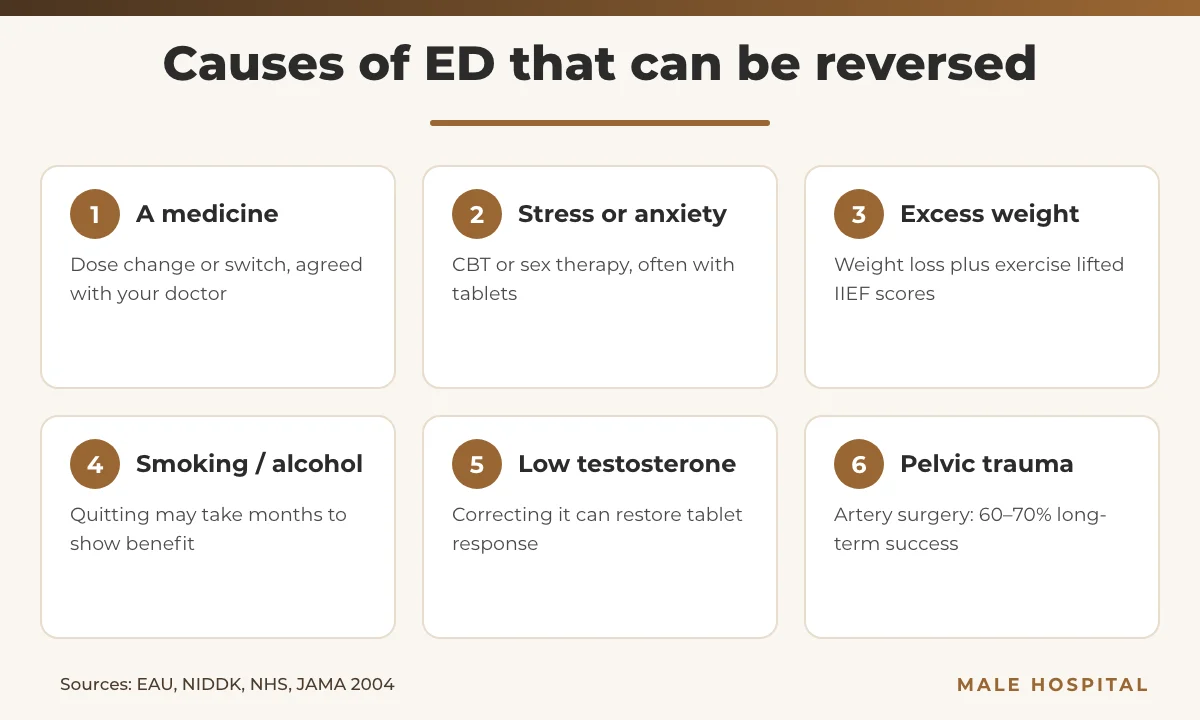
The following causes are the ones guidelines and trials show can be removed or corrected. If one of them is the main driver, erections often return without long-term medication.
1. A medicine you take for something else
Antidepressants, some blood pressure drugs and diuretics, antihistamines, anti-seizure drugs, sedatives and prostate cancer hormone therapy can all cause ED. NIDDK advises that a clinician may lower the dose or switch to another drug; the change in erections can then be quick. Never stop a prescribed medicine on your own, because the condition it treats is usually more dangerous than ED. Our guide to blood pressure medication and erectile dysfunction lists which classes are more and less likely to interfere.
Source: NIDDK — Treatment for Erectile Dysfunction; Cleveland Clinic — Erectile Dysfunction (ED)
2. Stress, anxiety and relationship problems
Psychogenic ED tends to start suddenly, comes and goes with situations, and leaves morning and self-stimulated erections intact. The EAU guideline reports that cognitive behavioral therapy combined with ED medicine has demonstrated efficacy, and NIDDK notes that a partner may join the sessions. Once performance anxiety settles, many men stop needing tablets. The approaches are explained in our article on psychological erectile dysfunction.
Source: EAU — Sexual and Reproductive Health Guidelines: Management of Erectile Dysfunction; NIDDK — Treatment for Erectile Dysfunction
3. Excess weight and inactivity
This is the best-tested lifestyle cure. In a 2004 JAMA trial, 110 obese men with ED were randomized to an intensive weight-loss and exercise program or general advice. After two years, the intervention group’s BMI fell from 36.9 to 31.2 and weekly exercise rose from 48 to 195 minutes. Their erectile function score (IIEF) improved from 13.9 to 17; 17 men in that group reached a normal score of 22 or more, compared with 3 in the control group. A cure was therefore possible for about one in three men who changed their habits, not for everyone.
Large cohort data point the same way. In the Health Professionals Follow-up Study of men over 50, the most active men had about 30% lower risk of ED than the least active (relative risk 0.7), and obesity raised the risk by about 30%.
4. Smoking, heavy drinking and recreational drugs
Nicotine, alcohol, amphetamines, cocaine, cannabis, methadone and opioids all appear on Cleveland Clinic’s list of substances linked to ED. Quitting smoking can improve mild ED, but Cleveland Clinic warns that the benefit may take several months to appear. The NHS advises keeping alcohol within 14 units a week. In the Health Professionals study, smoking and alcohol were both associated with more ED.
Source: Cleveland Clinic — Erectile Dysfunction (ED); NHS — Erection problems (erectile dysfunction); Ann Intern Med (PubMed) — Sexual function in men older than 50 years: Health Professionals Follow-up Study
5. Low testosterone and other hormone problems
True testosterone deficiency lowers desire and can blunt the response to tablets. The EAU guideline notes that hypogonadal men may respond better to PDE5 inhibitors after starting testosterone therapy. Testosterone alone rarely cures ED in men with normal levels, so it should only be given after two morning blood tests confirm a low value. Thyroid disease and high prolactin are rarer hormonal causes worth checking. More detail is in testosterone and erectile dysfunction.
Source: EAU — Sexual and Reproductive Health Guidelines: Management of Erectile Dysfunction
6. An artery damaged by pelvic or perineal trauma in a young man
A small group of young men develop ED after a fall astride a bar, a pelvic fracture or a perineal blow that narrows a single penile artery. For these men, the EAU guideline reports that surgical penile revascularization has a 60–70% long-term success rate. This is a specialist operation for carefully selected patients, not a treatment for age-related or diabetic vessel disease, and NIDDK notes that artery repair works best for younger men.
Source: EAU — Sexual and Reproductive Health Guidelines: Management of Erectile Dysfunction; NIDDK — Treatment for Erectile Dysfunction
When erectile dysfunction is harder to cure
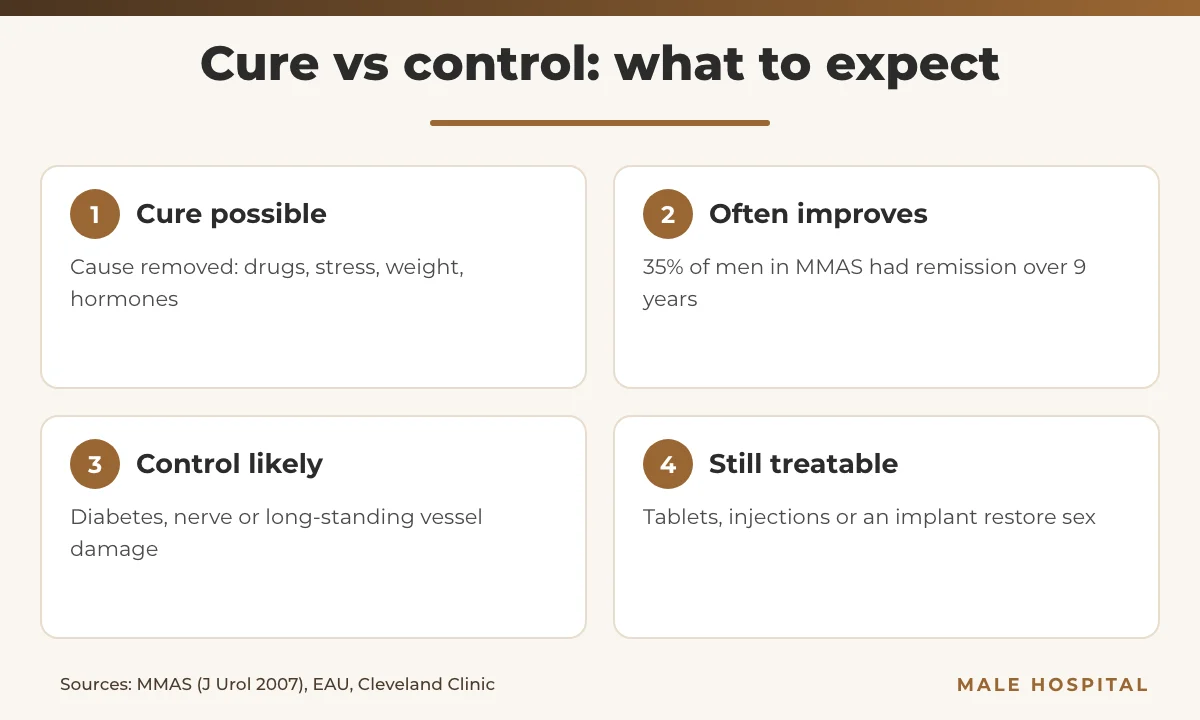
For some men, the answer to can erectile dysfunction be cured is no, because some causes damage tissue that does not fully recover. In these situations the honest goal is control, not cure:
- Long-standing diabetes: high blood sugar injures both the small vessels and the nerves of the penis. Good glucose control slows progression but does not usually reverse established damage; see erectile dysfunction and diabetes.
- Widespread atherosclerosis: the same plaque that narrows heart arteries narrows the smaller penile arteries, often years earlier.
- Pelvic surgery and radiotherapy: prostate, bladder and colon cancer treatment can injure the cavernous nerves; recovery, when it happens, can take a long time.
- Spinal cord injury, stroke, multiple sclerosis and epilepsy: nerve signals to the penis are interrupted.
- Peyronie’s disease and venous leak: scarring of the erectile tissue can stop it trapping blood.
Source: Cleveland Clinic — Erectile Dysfunction (ED)
Cleveland Clinic puts it plainly: there are no cures for some causes of ED, but the outlook is good because the condition is very treatable. Improving these men’s general health still matters, because better blood pressure, glucose and fitness make tablets work better.
Source: Cleveland Clinic — Erectile Dysfunction (ED)
Can erectile dysfunction be cured or only controlled? What studies show
Long-term population studies give the most realistic answer to whether ED goes away. The Massachusetts Male Aging Study (MMAS) followed 401 men aged 40–70 who had ED at the start. Between the baseline and follow-up surveys, 35% had remission, 33% of men with minimal or moderate ED got worse, and 58% of those with complete ED still had complete ED at follow-up.
A later analysis of 367 MMAS men and 617 men in the multinational MALES study found regression of ED in 21% and 25% respectively, while 51% and 28% progressed. In other words, ED is not a one-way street: a meaningful minority improve, but many do not, which is why waiting alone is a poor plan when risk factors are present.
| Cause | Chance of cure | Main approach |
|---|---|---|
| Medicine side effect | High once the drug is changed | Dose change or switch, agreed with your doctor |
| Performance anxiety, stress | High | CBT or sex therapy, often with short-term tablets |
| Obesity, inactivity, smoking | Moderate; about 1 in 3 in the JAMA trial | Weight loss, exercise, quitting |
| Confirmed low testosterone | Moderate | Testosterone therapy, often plus PDE5 inhibitor |
| Arterial injury after trauma (young men) | 60–70% long-term success with surgery | Penile revascularization in selected men |
| Diabetes, nerve damage, severe vessel disease | Low | Long-term control: tablets, injections, implant |
Source: EAU — Sexual and Reproductive Health Guidelines: Management of Erectile Dysfunction; JAMA (PubMed) — Effect of lifestyle changes on erectile dysfunction in obese men: a randomized controlled trial; J Urol (PubMed) — The natural progression and remission of erectile dysfunction: Massachusetts Male Aging Study
Treatments that control erectile dysfunction
When the cause cannot be removed, these options give reliable erections on demand. None changes the underlying disease, so stopping them usually brings the problem back.
- PDE5 inhibitor tablets (sildenafil, tadalafil, vardenafil, avanafil) are first-line. The EAU reports significant improvement in erectile function with a good safety profile, and that incorrect use is the main reason for an apparent failure.
- Penile injections and urethral alprostadil work directly on the erectile tissue and help many men who do not respond to tablets.
- Vacuum devices pull blood into the penis and need no medicine.
- Penile implants are the final option. NIDDK stresses that most men with ED never need surgery.
Source: EAU — Sexual and Reproductive Health Guidelines: Management of Erectile Dysfunction; NIDDK — Treatment for Erectile Dysfunction; NHS — Erection problems (erectile dysfunction)
Daily low-dose tadalafil is sometimes described as “curing” ED because erections become spontaneous. The EAU found no clinically significant difference between daily and on-demand tadalafil in effect; daily dosing simply removes the need to plan. If tablets fail, our erectile dysfunction treatment page explains the next steps.
Source: EAU — Sexual and Reproductive Health Guidelines: Management of Erectile Dysfunction
Shockwave, PRP and stem cells: real cures or hype?
Low-intensity shockwave therapy (Li-ESWT) is the only newer option that targets the blood vessels themselves. The EAU guideline says it might offer a cure, which makes it different from tablets, but the evidence is still developing and results vary between devices and protocols. It is most often considered for men with mild vascular ED; see our shockwave therapy (Li-ESWT) page for who is a candidate.
Source: EAU — Sexual and Reproductive Health Guidelines: Management of Erectile Dysfunction; Cleveland Clinic — Erectile Dysfunction (ED)
Platelet-rich plasma (PRP) injections and stem cell therapy are marketed as cures in many clinics. Guidelines still regard them as experimental and recommend them only inside clinical trials. Be wary of any provider that promises a permanent cure from a few injections.
Source: EAU — Sexual and Reproductive Health Guidelines: Management of Erectile Dysfunction
How doctors find out whether your ED is curable
Can erectile dysfunction be cured in your case? Because the answer depends entirely on the cause, a good assessment is the first step towards any cure. A urologist will usually:
- Take a detailed sexual history, including whether morning erections persist and whether the problem started suddenly or gradually.
- Review every medicine and supplement you take.
- Check blood pressure, weight and waist, and examine the penis and testicles.
- Order fasting glucose or HbA1c, a lipid profile and a morning testosterone level.
- In selected cases, perform a penile Doppler ultrasound to measure blood flow, especially in young men after trauma.
Source: EAU — Sexual and Reproductive Health Guidelines: Management of Erectile Dysfunction; NHS — Erection problems (erectile dysfunction)
Morning erections that come and go normally, a sudden start and problems only with a partner point toward a psychological cause and a good chance of cure. A gradual decline over years in a man with diabetes or heart risk factors points toward a vascular cause that will need ongoing treatment.
When to see a doctor
The NHS advises seeing a doctor if erection problems keep happening, because they can be the first sign of a treatable condition. Occasional failures linked to tiredness, stress or alcohol are common and usually harmless. Seek care promptly if:
- ED appears together with chest pain, breathlessness on exertion or leg pain on walking, which can signal artery disease.
- You also have excessive thirst, frequent urination or weight loss, which suggest diabetes.
- Erections stopped suddenly after a pelvic or perineal injury.
- You notice a new curve, lump or pain in the penis.
- An erection lasts more than four hours: this is priapism and needs emergency care.
Source: NHS — Erection problems (erectile dysfunction); Cleveland Clinic — Erectile Dysfunction (ED)
If you would like your cause assessed and a realistic answer to can erectile dysfunction be cured in your case, you can arrange a confidential consultation with our urologist-andrologist via WhatsApp.
FAQs about whether erectile dysfunction can be cured
Can erectile dysfunction be cured permanently?
Yes, in some men. When ED comes from a medicine, anxiety, excess weight, smoking or low testosterone, correcting the cause can end the problem for good, provided the cause does not return. When ED comes from established blood vessel or nerve damage, it is usually managed long-term rather than cured.
Source: EAU — Sexual and Reproductive Health Guidelines: Management of Erectile Dysfunction; Cleveland Clinic — Erectile Dysfunction (ED)
Can erectile dysfunction go away on its own?
Sometimes. In the Massachusetts Male Aging Study, 35% of men aged 40–70 with ED had remission by the follow-up survey. However, a third of men with mild or moderate ED got worse, so waiting is not a reliable strategy if you have risk factors.
Can losing weight cure erectile dysfunction?
It can for some men. In a randomized JAMA trial, obese men who lost weight and exercised more raised their erectile function scores, and 17 of 55 reached normal function, compared with 3 of 55 controls. Weight loss also improves how well ED tablets work.
Does Viagra cure erectile dysfunction?
No. Sildenafil and other PDE5 inhibitors improve blood flow for several hours after a dose, but they do not repair the cause. They are still the first-line treatment because they are effective and generally safe, and many men use them while lifestyle changes take effect.
Source: EAU — Sexual and Reproductive Health Guidelines: Management of Erectile Dysfunction; NIDDK — Treatment for Erectile Dysfunction
Can psychological erectile dysfunction be cured?
Usually, yes. Psychogenic ED often responds well to cognitive behavioral therapy or sex therapy, and the EAU guideline reports good results when therapy is combined with medication. Short-term tablets can break the cycle of anxiety while therapy addresses the underlying worry.
Source: EAU — Sexual and Reproductive Health Guidelines: Management of Erectile Dysfunction
Can erectile dysfunction from diabetes be reversed?
Rarely completely. Diabetes damages both the small arteries and the nerves of the penis, and established damage tends to persist. Tight glucose, blood pressure and cholesterol control can slow progression and improve the response to tablets, injections or other treatments.
Source: Cleveland Clinic — Erectile Dysfunction (ED)
Is shockwave therapy a cure for ED?
Possibly for some men. The EAU guideline says low-intensity shockwave therapy might offer a cure, unlike tablets, but the evidence is still limited and protocols vary. It is mainly offered to men with mild vascular ED after a proper assessment.
Source: EAU — Sexual and Reproductive Health Guidelines: Management of Erectile Dysfunction
How long does it take for ED to improve after quitting smoking?
Improvement is gradual. Cleveland Clinic notes that it may take several months after quitting before erections improve, and benefit is more likely in mild ED. Combining quitting with exercise and weight control gives the best chance.
Source: Cleveland Clinic — Erectile Dysfunction (ED)
Medically reviewed by Assoc. Prof. Dr. Zülfü Sertkaya, urologist and andrologist (FEBU), Istanbul. Last reviewed: November 2026.
This article is for general information and does not replace an individual consultation with a qualified doctor.
- EAU — Sexual and Reproductive Health Guidelines: Management of Erectile Dysfunction
- NHS — Erection problems (erectile dysfunction)
- Cleveland Clinic — Erectile Dysfunction (ED)
- NIDDK — Treatment for Erectile Dysfunction
- JAMA (PubMed) — Effect of lifestyle changes on erectile dysfunction in obese men: a randomized controlled trial
- J Urol (PubMed) — The natural progression and remission of erectile dysfunction: Massachusetts Male Aging Study
- J Sex Med (PubMed) — Natural progression and regression of erectile dysfunction: MMAS and MALES follow-up
- Ann Intern Med (PubMed) — Sexual function in men older than 50 years: Health Professionals Follow-up Study