
Erectile dysfunction by age follows a steep curve: in a large four-country survey, moderate or complete ED affected 9% of men aged 40–44, 29% at 55–59 and 54% at 65–70. The landmark Massachusetts Male Aging Study found some degree of ED in 52% of men aged 40–70, with complete ED tripling from 5% to 15% across those three decades. Age is the strongest single predictor, but it works mainly through blood vessel disease, diabetes and other conditions, so ED is common with age without being inevitable.
Source: Urology (PubMed) — Epidemiology of erectile dysfunction in four countries: cross-national study; J Urol (PubMed) — Impotence and its medical and psychosocial correlates: results of the Massachusetts Male Aging Study
- Erectile dysfunction by age: about half of men aged 40–70 report at least minimal ED; complete ED rises from about 5% at 40 to 15% at 70.
- Each extra year of age raised the risk of ED by about 10% in a cross-national study of men aged 40–70.
- In the US, 18.4% of all men aged 20 and over reported ED, but the figure was 51.3% among men with diabetes.
- Young men are not immune: 1 in 4 men seeking help for new ED at an Italian clinic was 40 or younger, and almost half of them had severe ED.
- In erectile dysfunction by age data, healthy, active men with no chronic illness had the lowest rates at every age, which means part of the age effect is modifiable.
- Why erectile dysfunction rises with age
- Erectile dysfunction by age: prevalence in each decade
- What the major studies say about erectile dysfunction by age
- Erectile dysfunction by age: men under 40
- ED in your 40s and 50s: the warning decade
- ED in your 60s, 70s and beyond
- Global numbers and future trends
- How to lower your risk at any age
- When to see a doctor
- FAQs about erectile dysfunction by age
Why erectile dysfunction rises with age

An erection is a blood-flow event. Nerve signals release nitric oxide, the smooth muscle in the penile arteries and erectile tissue relaxes, blood rushes in and the outflow veins are compressed. Every part of that chain changes with age: arteries stiffen and narrow, the lining of blood vessels makes less nitric oxide, nerve conduction slows and the erectile tissue gradually loses smooth muscle.
Age also brings the diseases that damage that chain. Cleveland Clinic lists age 40 and older as a risk factor and names diabetes, high blood pressure, high cholesterol, atherosclerosis, chronic kidney disease and low testosterone among the medical causes. NIDDK adds obesity, an enlarged prostate and nerve disorders. The longer a man lives, the more of these he tends to collect, and many of their treatments, such as some blood pressure medicines and antidepressants, can also affect erections.
Source: Cleveland Clinic — Erectile Dysfunction (ED); NIDDK — Symptoms and Causes of Erectile Dysfunction
That is why researchers describe age as the strongest predictor of ED, yet also note that it is partly explained by “para-aging” factors that can be changed. The MMAS authors concluded that ED may be due partly to modifiable conditions linked to vascular disease, not to the passage of time alone. For the full picture of the causes, see our guide to erectile dysfunction causes.
Erectile dysfunction by age: prevalence in each decade
Figures for erectile dysfunction by age differ between studies because they use different questionnaires and definitions; a 2019 review of population studies found reported prevalence ranging anywhere from 3% to 76.5%. The most useful way to read the data is to compare age groups within the same study.
Source: BJU Int (PubMed) — The global prevalence of erectile dysfunction: a review
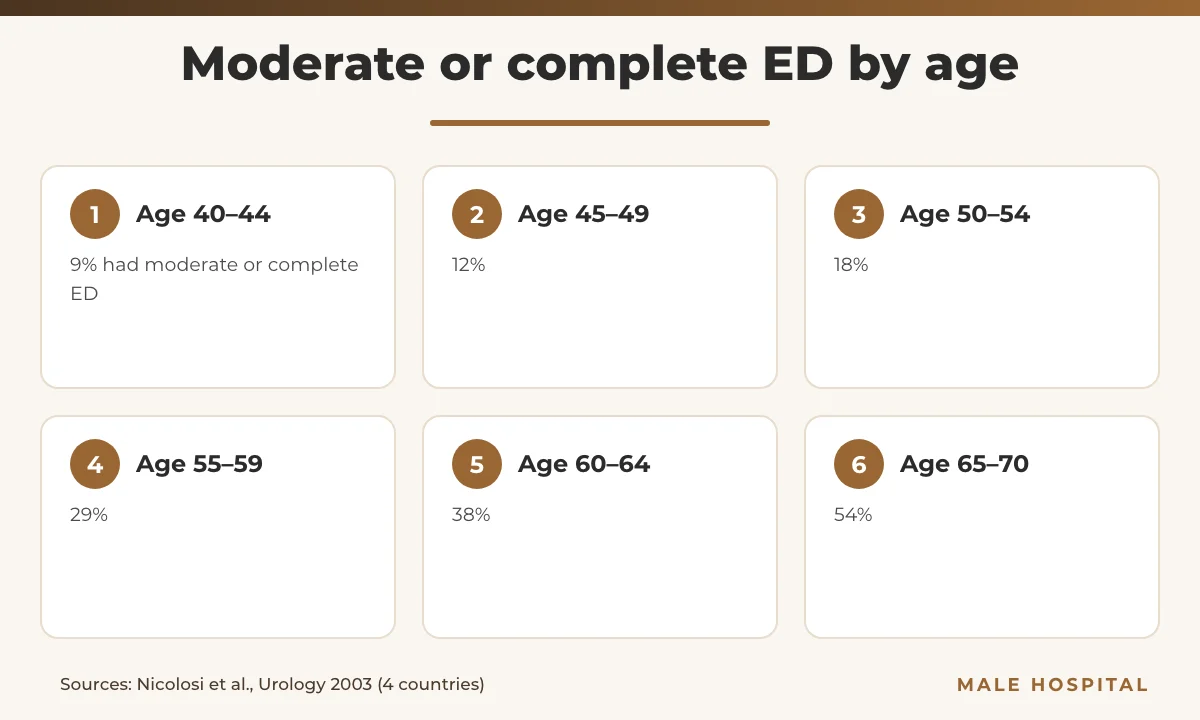
The cross-national study by Nicolosi and colleagues interviewed men aged 40–70 in Brazil, Italy, Japan and Malaysia using the same method in every country. Its age-specific rates for moderate or complete ED are among the clearest available:
| Age group | Moderate or complete ED |
|---|---|
| 40–44 years | 9% |
| 45–49 years | 12% |
| 50–54 years | 18% |
| 55–59 years | 29% |
| 60–64 years | 38% |
| 65–70 years | 54% |
Source: Urology (PubMed) — Epidemiology of erectile dysfunction in four countries: cross-national study
The same study found that risk climbed by about 10% per year of age and that age-adjusted rates differed between countries: 34% in Japan, 22% in Malaysia, 17% in Italy and 15% in Brazil. Diabetes, heart disease, urinary symptoms, heavy smoking and depression all raised the risk, while more education and physical activity lowered it.
Source: Urology (PubMed) — Epidemiology of erectile dysfunction in four countries: cross-national study
What the major studies say about erectile dysfunction by age
Each large study adds a different piece to the picture. The table summarizes the headline figures; the sections below explain them.
| Study | Men studied | Key finding |
|---|---|---|
| Massachusetts Male Aging Study (US) | Aged 40–70, community sample | 52% any ED; complete ED 5% at 40 to 15% at 70 |
| Cross-national study (4 countries) | Aged 40–70 | Moderate/complete ED 9% at 40–44 to 54% at 65–70 |
| NHANES 2001–2002 (US) | 2,126 men aged 20+ | 18.4% overall; 51.3% in men with diabetes |
| European Male Ageing Study | 3,369 men aged 40–79 | About 30% reported ED; only 38% of them were concerned |
| Health Professionals Follow-up Study (US) | Men over 50 | 33% age-standardized ED; lowest in healthy, active men |
| Brazilian young men survey | 1,947 men aged 18–40 | 35% reported ED, mostly mild |
Source: J Urol (PubMed) — Impotence and its medical and psychosocial correlates: results of the Massachusetts Male Aging Study; Am J Med (PubMed) — Prevalence and risk factors for erectile dysfunction in the US; J Sex Med (PubMed) — Age-related changes in general and sexual health: European Male Ageing Study; Ann Intern Med (PubMed) — Sexual function in men older than 50 years: Health Professionals Follow-up Study; J Sex Med (PubMed) — Erectile dysfunction and correlated factors in Brazilian men aged 18-40 years
Massachusetts Male Aging Study
MMAS surveyed a random sample of men aged 40–70 near Boston in 1987–1989. Combined minimal, moderate and complete ED affected 52%. Complete ED tripled from 5% to 15% between ages 40 and 70. After adjusting for age, heart disease, high blood pressure, diabetes, their medicines, anger and depression were linked to more ED, and higher HDL (“good”) cholesterol to less.
NHANES: the US population
A nationally representative US survey of 2,126 men aged 20 and older found ED in 18.4%, which the authors estimated at about 18 million men. Prevalence was strongly related to age, and particularly high in men with cardiovascular risk factors. Among men with diabetes the crude rate was 51.3%. Diabetes, lower education and physical inactivity were independent risk factors.
Source: Am J Med (PubMed) — Prevalence and risk factors for erectile dysfunction in the US
European Male Ageing Study
EMAS studied 3,369 men aged 40–79 in eight European cities. Around 30% reported ED, closely tied to age and other illnesses. Strikingly, only 38% of men with ED were worried about it; concern peaked at ages 50–59 and fell after that, which helps explain why many older men never seek treatment.
Source: J Sex Med (PubMed) — Age-related changes in general and sexual health: European Male Ageing Study
Health Professionals Follow-up Study
Among US health professionals over 50, the age-standardized prevalence of ED in the previous three months was 33%, and most aspects of sexual function fell sharply with each decade after 50. Physical activity lowered the risk by about 30%, while obesity, smoking, alcohol and television time raised it. Men with no chronic disease and healthy habits had the lowest rates.
Erectile dysfunction by age: men under 40
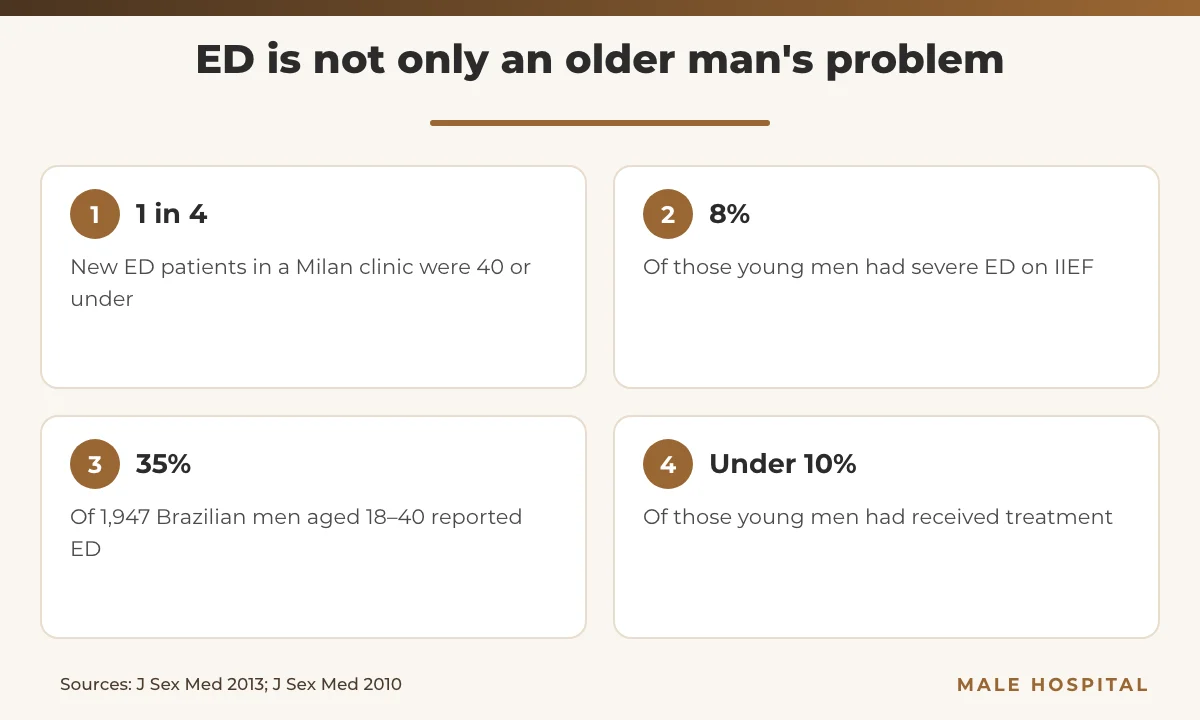
Erectile dysfunction by age starts early: ED in the 20s and 30s is less common than in later life, but it is not rare. At a Milan academic center, 114 of 439 consecutive men seeking first help for new ED (26%) were aged 40 or younger. Compared with older patients, they had fewer illnesses, a lower BMI and higher testosterone, but smoked and used illicit drugs more often. Severe ED was found in 48.8% of the younger group, a rate similar to the older men.
In a Brazilian survey of 1,947 men aged 18–40, 35% reported ED; 73.7% of cases were mild. Fewer than 10% of affected men had received medical treatment. A 2019 review also noted that validated questionnaires pick up a high prevalence of ED in young men. Causes and treatment at this age are covered in erectile dysfunction in young men.
Source: J Sex Med (PubMed) — Erectile dysfunction and correlated factors in Brazilian men aged 18-40 years; BJU Int (PubMed) — The global prevalence of erectile dysfunction: a review
ED in your 40s and 50s: the warning decade
In the cross-national data on erectile dysfunction by age, moderate or complete ED doubled from 9% in the early 40s to 18% in the early 50s. This is the decade when vascular causes take over from psychological ones, and it is the age at which ED matters most as a health signal.
Source: Urology (PubMed) — Epidemiology of erectile dysfunction in four countries: cross-national study
The EAU guideline states that ED should be considered a precursor of cardiovascular disease, with more severe and longer-standing ED carrying greater risk, and that asking about ED can improve screening for silent heart disease in men with or without diabetes. A 2019 review found men with ED had higher odds of all-cause death (odds ratio 1.26) and cardiovascular death (1.43). New ED in a man in his 40s or 50s is a good reason for a blood pressure, glucose and cholesterol check; read more in erectile dysfunction and heart disease.
Source: EAU — Sexual and Reproductive Health Guidelines: Management of Erectile Dysfunction; BJU Int (PubMed) — The global prevalence of erectile dysfunction: a review
Testosterone also declines gradually with age, but low testosterone explains only a minority of ED. Typical ranges are compared in normal testosterone levels by age.
ED in your 60s, 70s and beyond
By the late 60s, more than half of men in the cross-national study had moderate or complete ED, and MMAS showed complete ED reaching 15% by 70. Men in this age group often have several causes at once: atherosclerosis, diabetes, prostate enlargement or prostate cancer treatment, and multiple medicines.
Source: Urology (PubMed) — Epidemiology of erectile dysfunction in four countries: cross-national study; J Urol (PubMed) — Impotence and its medical and psychosocial correlates: results of the Massachusetts Male Aging Study
Whatever the figures for erectile dysfunction by age, older age does not make treatment pointless. PDE5 inhibitor tablets remain first-line at any age when they are safe with your heart medicines, and injections, vacuum devices and penile implants are options when tablets fail. The 2019 review also found men with ED were 1.33–6.24 times more likely to have benign prostatic hyperplasia and 1.68 times more likely to develop dementia, so a check-up covers more than erections. Options by stage are listed on our erectile dysfunction treatment page.
Source: EAU — Sexual and Reproductive Health Guidelines: Management of Erectile Dysfunction; BJU Int (PubMed) — The global prevalence of erectile dysfunction: a review
Global numbers and future trends
Using MMAS figures for erectile dysfunction by age and UN population forecasts, researchers estimated that over 152 million men worldwide had ED in 1995 and projected about 322 million by 2025, an increase of nearly 170 million. The largest rises were expected in Africa, Asia and South America, driven by ageing populations.
Source: BJU Int (PubMed) — The likely worldwide increase in erectile dysfunction between 1995 and 2025
Prevalence varies widely between countries and between studies, partly because of how ED is measured. The 2019 review concluded that non-validated questionnaires may undercount ED, which is why the most reliable comparisons come from studies that use the International Index of Erectile Function (IIEF) or the MMAS questionnaire.
Source: BJU Int (PubMed) — The global prevalence of erectile dysfunction: a review
How to lower your risk at any age
You cannot change your age, but studies of erectile dysfunction by age consistently point to the same modifiable factors:
- Move more: the most active men over 50 had about 30% lower risk of ED than the least active.
- Control weight: a BMI above 28.7 raised the risk by about 30% compared with a BMI below 23.2.
- Stop smoking and limit alcohol: both were linked to more ED; the NHS advises no more than 14 units a week.
- Treat diabetes, blood pressure and cholesterol: these were the strongest disease-related risk factors in MMAS, NHANES and the cross-national study.
- Look after mental health: depression was independently associated with ED in both MMAS and the cross-national study.
Source: Ann Intern Med (PubMed) — Sexual function in men older than 50 years: Health Professionals Follow-up Study; NHS — Erection problems (erectile dysfunction); J Urol (PubMed) — Impotence and its medical and psychosocial correlates: results of the Massachusetts Male Aging Study; Urology (PubMed) — Epidemiology of erectile dysfunction in four countries: cross-national study
Whether age-related ED can be reversed depends on its cause; we explain which causes respond in can erectile dysfunction be cured.
When to see a doctor
Occasional erection problems are common at every age and usually harmless. The NHS advises seeing a doctor when they keep happening, because they can signal an underlying condition. See a doctor sooner if:
- ED starts in your 30s, 40s or 50s without an obvious cause such as stress or alcohol.
- ED comes with chest pain, breathlessness on exertion or calf pain on walking.
- You also notice thirst, frequent urination, weight loss or very low energy and libido.
- You have a new penile curve, lump or pain.
- An erection lasts more than four hours, which is a medical emergency.
Source: NHS — Erection problems (erectile dysfunction); EAU — Sexual and Reproductive Health Guidelines: Management of Erectile Dysfunction
Whatever your age, you can discuss erection problems confidentially with our urologist-andrologist via WhatsApp.
FAQs about erectile dysfunction by age
At what age does erectile dysfunction usually start?
There is no fixed age. ED becomes noticeably more common from the 40s: in a four-country survey, moderate or complete ED affected 9% of men at 40–44 and 18% at 50–54. However, about a quarter of men seeking help for new ED in one clinic were 40 or younger.
Source: Urology (PubMed) — Epidemiology of erectile dysfunction in four countries: cross-national study; J Sex Med (PubMed) — One patient out of four with newly diagnosed erectile dysfunction is a young man
What percentage of 50-year-old men have ED?
In the cross-national study of men aged 40–70, 18% of men aged 50–54 and 29% of men aged 55–59 had moderate or complete ED. Including mild ED gives higher figures; MMAS found 52% of men aged 40–70 had at least minimal ED.
Source: Urology (PubMed) — Epidemiology of erectile dysfunction in four countries: cross-national study; J Urol (PubMed) — Impotence and its medical and psychosocial correlates: results of the Massachusetts Male Aging Study
Is erectile dysfunction a normal part of aging?
It is common with age but not inevitable. Age raises risk mainly through vascular disease, diabetes, medicines and inactivity. Healthy, physically active men over 50 had the lowest rates of ED in the Health Professionals study, and many older men keep good erections.
Source: Ann Intern Med (PubMed) — Sexual function in men older than 50 years: Health Professionals Follow-up Study; J Urol (PubMed) — Impotence and its medical and psychosocial correlates: results of the Massachusetts Male Aging Study
How common is ED in men in their 20s?
Reliable data for the 20s alone are limited. In a survey of Brazilian men aged 18–40, 35% reported some ED, but nearly three-quarters of cases were mild. Anxiety, drug use and smoking are typical drivers at this age.
Source: J Sex Med (PubMed) — Erectile dysfunction and correlated factors in Brazilian men aged 18-40 years; J Sex Med (PubMed) — One patient out of four with newly diagnosed erectile dysfunction is a young man
Is ED at 40 a sign of heart disease?
It can be. The EAU guideline considers ED a precursor of cardiovascular disease, with greater risk when ED is more severe or longer-standing. Men who develop ED in midlife without an obvious cause should have their heart risk factors checked.
Source: EAU — Sexual and Reproductive Health Guidelines: Management of Erectile Dysfunction
Do men over 70 still respond to ED treatment?
Many do. Tablets remain first-line when safe with heart medicines, and injections, vacuum devices and implants are effective alternatives. Age alone does not exclude any option; overall health and other medicines matter more.
Source: EAU — Sexual and Reproductive Health Guidelines: Management of Erectile Dysfunction
How many men have erectile dysfunction worldwide?
An analysis based on MMAS rates estimated more than 152 million men with ED in 1995 and projected about 322 million by 2025, mainly because populations are ageing, especially in Africa, Asia and South America.
Source: BJU Int (PubMed) — The likely worldwide increase in erectile dysfunction between 1995 and 2025
Medically reviewed by Assoc. Prof. Dr. Zülfü Sertkaya, urologist and andrologist (FEBU), Istanbul. Last reviewed: November 2026.
This article is for general information and does not replace an individual consultation with a qualified doctor.
- J Urol (PubMed) — Impotence and its medical and psychosocial correlates: results of the Massachusetts Male Aging Study
- Urology (PubMed) — Epidemiology of erectile dysfunction in four countries: cross-national study
- Am J Med (PubMed) — Prevalence and risk factors for erectile dysfunction in the US
- J Sex Med (PubMed) — One patient out of four with newly diagnosed erectile dysfunction is a young man
- J Sex Med (PubMed) — Age-related changes in general and sexual health: European Male Ageing Study
- BJU Int (PubMed) — The likely worldwide increase in erectile dysfunction between 1995 and 2025
- BJU Int (PubMed) — The global prevalence of erectile dysfunction: a review
- Cleveland Clinic — Erectile Dysfunction (ED)
- Ann Intern Med (PubMed) — Sexual function in men older than 50 years: Health Professionals Follow-up Study
- EAU — Sexual and Reproductive Health Guidelines: Management of Erectile Dysfunction
- NHS — Erection problems (erectile dysfunction)
- J Sex Med (PubMed) — Erectile dysfunction and correlated factors in Brazilian men aged 18-40 years
- NIDDK — Symptoms and Causes of Erectile Dysfunction