
A penile implant for Peyronie’s disease is the recommended treatment when the curvature comes with erectile dysfunction (ED) that tablets or injections no longer fix: one operation restores rigid erections and, with straightening manoeuvres such as modeling, corrects the bend. It does not restore length already lost to the disease, so it is best suited to men whose main problems are weak erections plus a curve that prevents sex.
Source: EAU Guidelines — Sexual and Reproductive Health: Penile curvature; Nehra A et al., J Urol 2015 (PMC) — Peyronie’s Disease: AUA Guideline
- A penile implant for Peyronie’s disease is the recommended treatment when the condition comes with erectile dysfunction that does not respond to tablets or injections.
- Inserting the cylinders alone straightens many penises; residual bends under 30° usually improve over 6–9 months of use.
- If more than 30° remains, the surgeon can model (manually bend) the inflated implant; in the original series this worked in 86% of men, with urethral injury in 3%.
- Persistent curvature is corrected with plication or plaque incision and grafting during the same operation.
- A penile implant for Peyronie’s disease does not restore lost length; the AUA recommends an inflatable rather than a malleable device for Peyronie’s surgery.
- When an implant is the right Peyronie’s operation
- Timing: wait until the disease is stable
- Inflatable or malleable implant?
- How a penile implant for Peyronie’s disease straightens the penis
- Results: how straight and how satisfied?
- Risks specific to Peyronie’s implant surgery
- Length: what an implant can and cannot do
- Recovery and home modeling
- When to see a doctor
- FAQs about penile implant for Peyronie’s disease
When an implant is the right Peyronie’s operation
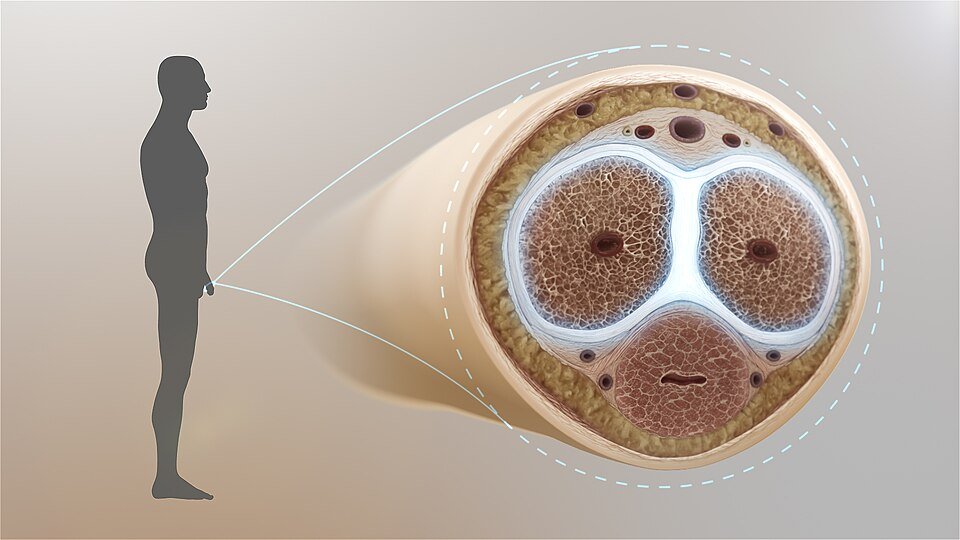
Peyronie’s disease is a scar (plaque) in the tunica albuginea, the tough sheath around the erection chambers, that bends, dents or shortens the erect penis. Our main guide to Peyronie’s disease treatment covers medicines, injections and traction; this article looks only at the penile implant for Peyronie’s disease.
Source: NHS — Peyronie’s disease
The European Association of Urology (EAU) groups Peyronie’s surgery into three families: shortening the long side (plication), lengthening the short side (plaque incision or excision with a graft), and implant surgery with or without straightening, which it reserves for men who also have ED not responding to drugs. In that situation the EAU gives a strong recommendation for a penile prosthesis, with or without modeling, plication or grafting, and calls it the technique of choice.
Source: EAU Guidelines — Sexual and Reproductive Health: Penile curvature
The American Urological Association (AUA) similarly says clinicians may offer a prosthesis to men with Peyronie’s disease and ED, or a deformity that prevents intercourse, despite drug or vacuum therapy. If erections are still good, plication or grafting without an implant is usually preferred; our comparison of Peyronie’s disease surgery options explains those operations.
Source: Nehra A et al., J Urol 2015 (PMC) — Peyronie’s Disease: AUA Guideline
Timing: wait until the disease is stable
Peyronie’s disease has an active phase, with pain and a changing curve, and a stable phase. EAU guidelines say surgery should be offered only when the disease has been stable for three to six months, or more than 9–12 months after onset, and when the deformity is bothersome. Signs of still-active disease include a short history, pain on erection and a recent change in the bend.
Source: EAU Guidelines — Sexual and Reproductive Health: Penile curvature
A 2024 review notes that some surgeons consider earlier implantation, because evidence suggests it may help preserve length lost to plaque formation, atrophy and fibrosis. After collagenase injections, most experts wait three to six months before surgery. These are decisions to make with the surgeon, not rules to apply alone.
Inflatable or malleable implant?
The AUA recommends an inflatable device as the penile implant for Peyronie’s disease, because the surgeon cannot know in advance whether modeling will be needed, and modeling requires a device that can be fully inflated. The EAU notes that some studies show similar satisfaction with malleable devices, and that the evidence shows no real difference between the available inflatable brands.
Source: Nehra A et al., J Urol 2015 (PMC) — Peyronie’s Disease: AUA Guideline; EAU Guidelines — Sexual and Reproductive Health: Penile curvature
In a review of modeling outcomes, manual modeling succeeded in 84% of men with an inflatable implant versus 54% with a malleable device. The EAU stresses that the surgeon should advise, but the patient should make the final choice of implant. Our guide to penile prosthesis surgery covers the devices in detail.
Source: Good J et al., Transl Androl Urol 2024 (PMC) — Inflatable penile prosthesis placement in Peyronie’s disease: a review of surgical considerations, approaches, and maneuvers; EAU Guidelines — Sexual and Reproductive Health: Penile curvature
How a penile implant for Peyronie’s disease straightens the penis
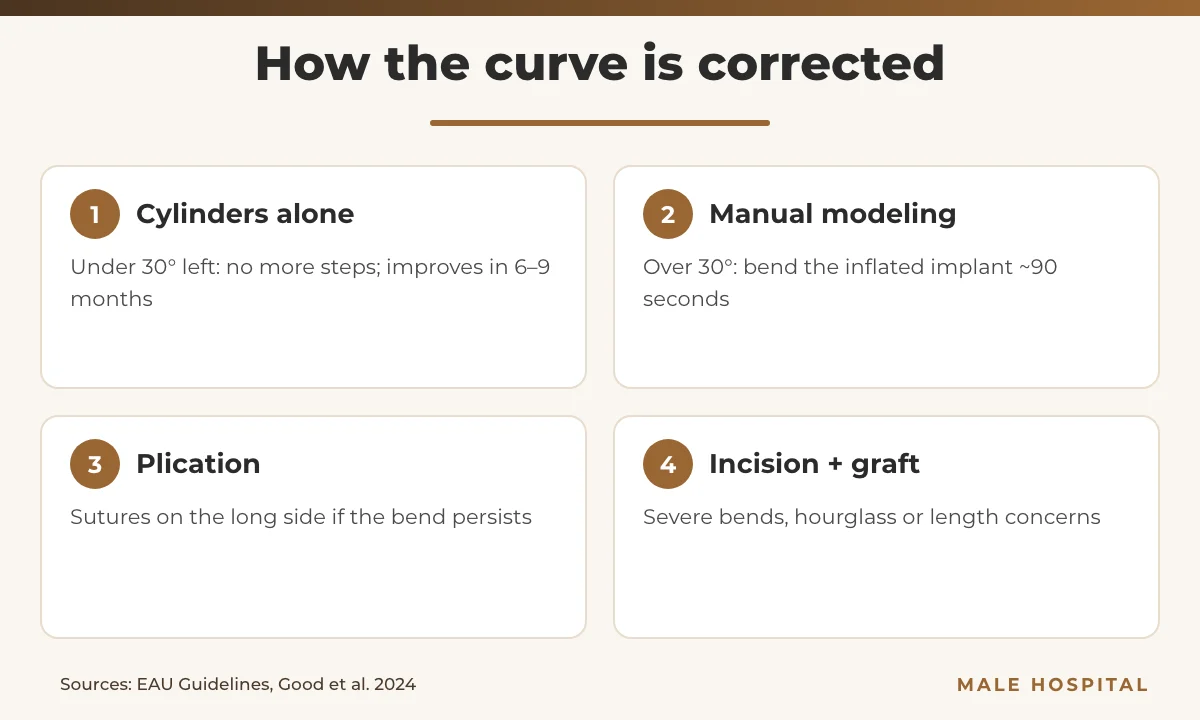
Surgeons use a stepwise approach during the same operation, moving to the next step only if a significant bend remains.
Step 1: the cylinders alone
With a penile implant for Peyronie’s disease, most men with mild-to-moderate curvature have an excellent result from cylinder insertion alone. In one study cited by a 2024 review, 61% of men with an average curve of 35° were straightened to under 10° by the implant alone; another series reported 91% with an average curve of 49°. If the curve left after inflation is under 30°, the EAU says nothing more is needed, because the implant acts as an internal tissue expander and corrects it over the following six to nine months.
Source: EAU Guidelines — Sexual and Reproductive Health: Penile curvature; Good J et al., Transl Androl Urol 2024 (PMC) — Inflatable penile prosthesis placement in Peyronie’s disease: a review of surgical considerations, approaches, and maneuvers
Step 2: manual modeling
If more than 30° remains, the surgeon inflates the implant fully and bends the penis firmly in the opposite direction of the curve for about 90 seconds, often with an audible crack as the plaque gives way. The EAU proposes this as the first-line manoeuvre while noting the supporting evidence is limited. The technique was first reported by Wilson and Delk in 1994.
Source: EAU Guidelines — Sexual and Reproductive Health: Penile curvature; Wilson SK, Delk JR., J Urol 1994 (PubMed) — A new treatment for Peyronie’s disease: modeling the penis over an inflatable penile prosthesis
Step 3: plication
If the bend persists, sutures are placed on the long (convex) side to straighten it, through the same incision. A small retrospective series cited in the 2024 review reduced average curvature from 38° to under 10° with plication plus an implant.
Step 4: plaque incision or excision with grafting
For severe bends (often over 60°), hourglass or hinge deformities, ventral curves, or men concerned about length, the plaque is cut or removed and the gap is covered with a graft, sometimes with lengthening techniques such as MoST or MuST. The EAU warns that these lengthening techniques should only be used by experienced high-volume surgeons after full counselling, and the original “sliding” technique is no longer recommended because of cases of glans necrosis.
Source: Good J et al., Transl Androl Urol 2024 (PMC) — Inflatable penile prosthesis placement in Peyronie’s disease: a review of surgical considerations, approaches, and maneuvers; EAU Guidelines — Sexual and Reproductive Health: Penile curvature
Results: how straight and how satisfied?
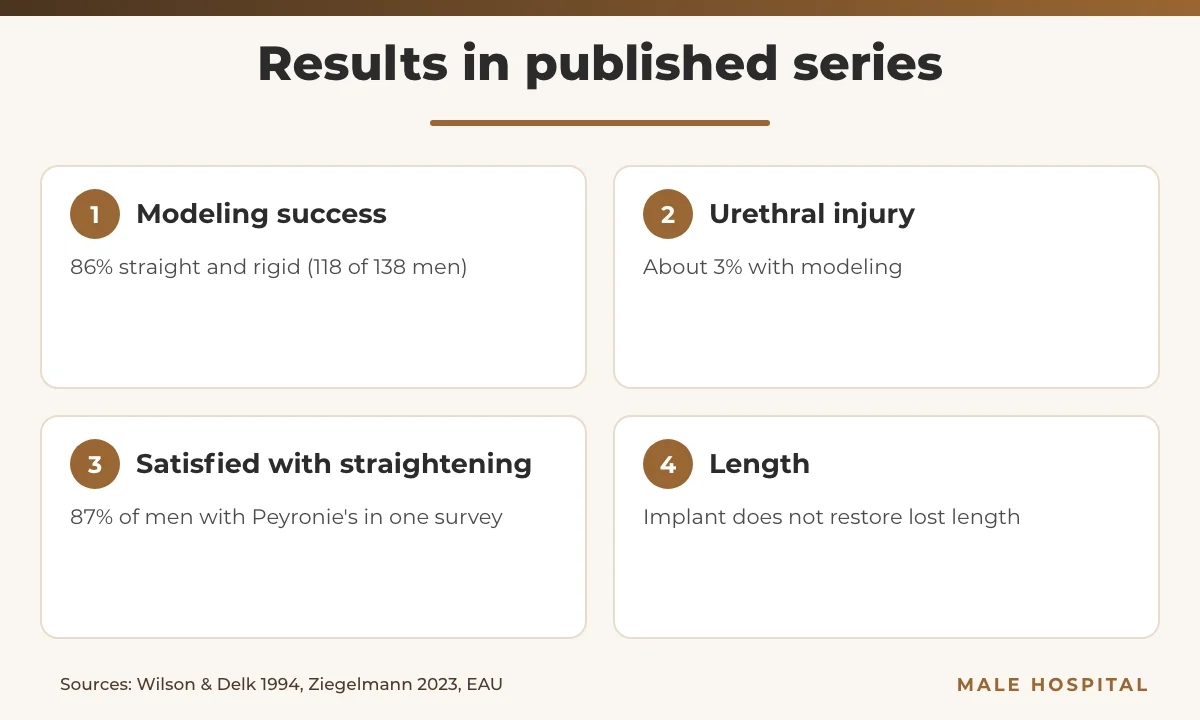
In Wilson and Delk’s original series of 138 men with severe Peyronie’s disease, modeling produced a straight, rigid erection in 118 (86%). Another 11 (8%) needed relaxing plaque incisions. At an average follow-up of 32 months, 90% were still using their implant.
In a 2023 survey of 79 implant patients, 87% of men with Peyronie’s disease were satisfied with their straightening, and overall satisfaction did not differ between men with and without Peyronie’s. However, men with severe deformity who needed plaque incision and grafting were less satisfied, including with their length.
The EAU is more cautious: satisfaction after inflatable implants is high in general but significantly lower in men with Peyronie’s disease, mainly because of shortening. On the positive side, depression rates fell after surgery in Peyronie’s patients, from 19.3% to 10.9%.
Source: EAU Guidelines — Sexual and Reproductive Health: Penile curvature
Risks specific to Peyronie’s implant surgery
The EAU states that the overall risk of complications such as infection with a penile implant for Peyronie’s disease is not higher than in men having an implant for ED alone. Two extra risks deserve mention:
- urethral perforation during modeling, reported in 3% of men in the original series;
- device problems after forceful modeling: a systematic review found implant malfunction in 3.3–11.1% and urethral injury in 2.9% in studies using intra-operative manual modeling.
Source: EAU Guidelines — Sexual and Reproductive Health: Penile curvature; Wilson SK, Delk JR., J Urol 1994 (PubMed) — A new treatment for Peyronie’s disease: modeling the penis over an inflatable penile prosthesis; Krishnappa P et al., Sex Med Rev 2022 (PubMed) — Penile modeling in Peyronie’s disease: a systematic review of the literature
Reassuringly, long-term follow-up of the original cohort found no significant difference in device survival between men who did and did not have modeling. The usual implant risks also apply, including infection (about 2–3% with first implants in low-risk men, lower with coated devices) and eventual mechanical failure.
Source: Good J et al., Transl Androl Urol 2024 (PMC) — Inflatable penile prosthesis placement in Peyronie’s disease: a review of surgical considerations, approaches, and maneuvers; EAU Guidelines — Sexual and Reproductive Health: Management of erectile dysfunction
| Technique | Typical use | Main trade-off | |
|---|---|---|---|
| Cylinders alone | Residual curve under 30° | None beyond standard implant risks | |
| Manual modeling | 30° or more after inflation | Urethral injury about 3%; limited evidence | |
| Plication | Persistent bend after modeling | Some shortening on the long side | |
| Incision or excision + graft | Severe curve, hourglass, length concerns | Longer surgery; lower satisfaction in severe cases | |
| Lengthening (MoST, MuST) | End-stage disease with major shortening | Experienced high-volume surgeons only |
Source: EAU Guidelines — Sexual and Reproductive Health: Penile curvature; Good J et al., Transl Androl Urol 2024 (PMC) — Inflatable penile prosthesis placement in Peyronie’s disease: a review of surgical considerations, approaches, and maneuvers
Length: what an implant can and cannot do
The EAU stresses that implants are not designed to restore previous penile length, and that shortening is the main cause of dissatisfaction. ISSM explains that Peyronie’s disease itself contributes to length loss, together with years of untreated ED, so a man should compare the result with his current stretched length, not with how he remembers his penis before the disease.
Source: EAU Guidelines — Sexual and Reproductive Health: Penile curvature; ISSM — Is it common to lose length after penile implant surgery?
Before a penile implant for Peyronie’s disease, some surgeons use penile traction or a vacuum device to maximise length. In one study cited by the 2024 review, daily traction for 2–4 hours for up to four months before implant surgery led to stretched-length gains of up to 1.5 cm in 70% of men. Our article on penile traction therapy for Peyronie’s looks at the wider evidence.
Recovery and home modeling
Recovery after a penile implant for Peyronie’s disease is similar to any implant operation. Because residual curves under 30° tend to improve with use over the following months, regular inflation once the device is activated helps. A 2024 review describes a home modeling programme for men with a residual curve under 45° after surgery: at three months 85.5% had a curve under 10°, rising to 94.7% at six months.
Source: Good J et al., Transl Androl Urol 2024 (PMC) — Inflatable penile prosthesis placement in Peyronie’s disease: a review of surgical considerations, approaches, and maneuvers; EAU Guidelines — Sexual and Reproductive Health: Penile curvature
When to see a doctor
See a urologist if you have a new curve, lump or painful erection, as early Peyronie’s disease is treated differently from stable disease. After implant surgery, seek urgent help for fever, spreading redness, discharge from the wound, increasing pain, blood in the urine or difficulty passing urine.
Source: NHS — Peyronie’s disease; EAU Guidelines — Sexual and Reproductive Health: Management of erectile dysfunction
If you have both curvature and weak erections, our urologist-andrologist, who focuses on penile prosthesis and Peyronie’s surgery, can assess whether you are among suitable penile implant candidates; you can reach us confidentially on WhatsApp.
FAQs about penile implant for Peyronie’s disease
Will a penile implant for Peyronie’s disease straighten my penis?
In most men, yes. Inserting the cylinders alone straightens many penises, and curves under 30° tend to improve over six to nine months. Larger residual curves are corrected with modeling, plication or grafting in the same operation. The aim is a functionally straight erection suitable for intercourse rather than a perfectly straight penis.
Source: EAU Guidelines — Sexual and Reproductive Health: Penile curvature
Do I need a penile implant for Peyronie’s disease if my erections are still good?
Usually not. If erections are firm enough for sex, plication or plaque incision with grafting can correct the curve without replacing natural erections. An implant is reserved for men whose Peyronie’s disease comes with ED that does not respond to tablets or injections.
Source: EAU Guidelines — Sexual and Reproductive Health: Penile curvature; Nehra A et al., J Urol 2015 (PMC) — Peyronie’s Disease: AUA Guideline
Is a malleable penile implant for Peyronie’s disease suitable?
It can be, and some studies show similar satisfaction, but the AUA recommends an inflatable device because modeling requires full inflation and the need for modeling is only clear during surgery. In one review modeling worked in 84% of men with inflatable implants versus 54% with malleable ones.
Source: Nehra A et al., J Urol 2015 (PMC) — Peyronie’s Disease: AUA Guideline; Good J et al., Transl Androl Urol 2024 (PMC) — Inflatable penile prosthesis placement in Peyronie’s disease: a review of surgical considerations, approaches, and maneuvers
Does modeling damage the implant?
Modeling is forceful, and studies using intra-operative manual modeling reported device malfunction in 3.3–11.1% and urethral injury in about 3%. However, long-term follow-up of the original cohort found no significant difference in implant survival between modelled and non-modelled devices. Experienced surgeons protect the urethra with glans pressure during the manoeuvre.
Source: Krishnappa P et al., Sex Med Rev 2022 (PubMed) — Penile modeling in Peyronie’s disease: a systematic review of the literature; Good J et al., Transl Androl Urol 2024 (PMC) — Inflatable penile prosthesis placement in Peyronie’s disease: a review of surgical considerations, approaches, and maneuvers
Will I get my length back with a penile implant for Peyronie’s disease?
No. Implants are not designed to restore length lost to Peyronie’s disease, and shortening is the main reason for dissatisfaction. Lengthening grafting techniques exist for severe cases but carry higher risks and should only be done by experienced surgeons. Pre-operative traction may modestly improve stretched length in some men.
Source: EAU Guidelines — Sexual and Reproductive Health: Penile curvature; Good J et al., Transl Androl Urol 2024 (PMC) — Inflatable penile prosthesis placement in Peyronie’s disease: a review of surgical considerations, approaches, and maneuvers
How long should I wait after diagnosis before implant surgery?
EAU guidelines advise surgery once the disease has been stable for three to six months, or more than 9–12 months after onset. Some surgeons consider earlier implantation in men with ED to limit length loss. After collagenase injections, most experts recommend waiting three to six months.
Source: EAU Guidelines — Sexual and Reproductive Health: Penile curvature; Good J et al., Transl Androl Urol 2024 (PMC) — Inflatable penile prosthesis placement in Peyronie’s disease: a review of surgical considerations, approaches, and maneuvers
Is infection more common in Peyronie’s implant surgery?
According to the EAU, the risk of complications such as infection is not higher than in men receiving an implant for ED alone. The AUA review found no link between the complexity of straightening procedures and infection or revision rates.
Source: EAU Guidelines — Sexual and Reproductive Health: Penile curvature; Nehra A et al., J Urol 2015 (PMC) — Peyronie’s Disease: AUA Guideline
Medically reviewed by Assoc. Prof. Dr. Zülfü Sertkaya, urologist and andrologist (FEBU), Istanbul. Last reviewed: November 2026.
This article is for general information and does not replace an individual consultation with a qualified doctor.
- EAU Guidelines — Sexual and Reproductive Health: Penile curvature
- EAU Guidelines — Sexual and Reproductive Health: Management of erectile dysfunction
- Nehra A et al., J Urol 2015 (PMC) — Peyronie's Disease: AUA Guideline
- Good J et al., Transl Androl Urol 2024 (PMC) — Inflatable penile prosthesis placement in Peyronie's disease: a review of surgical considerations, approaches, and maneuvers
- Wilson SK, Delk JR., J Urol 1994 (PubMed) — A new treatment for Peyronie's disease: modeling the penis over an inflatable penile prosthesis
- Krishnappa P et al., Sex Med Rev 2022 (PubMed) — Penile modeling in Peyronie's disease: a systematic review of the literature
- Ziegelmann MJ et al., Int J Impot Res 2023 (PubMed) — Comparison of patient-reported outcomes after penile prosthesis placement in men with and without Peyronie's disease
- NHS — Peyronie's disease
- ISSM — Is it common to lose length after penile implant surgery?