
Penis shrinkage is usually a small, gradual loss of erect or stretched length, most often linked to aging blood vessels, weight gain that hides the shaft, Peyronie’s disease or prostate cancer surgery. Short-term penis shrinkage from cold is normal and reverses, while true loss is typically measured in fractions of an inch to about 1 cm. Many causes are treatable or preventable, so new shortening deserves a check by a urologist rather than worry. For what normally changes across a lifetime, see our guide to penis size and age.
Source: Cleveland Clinic — Can your penis shrink?
- Cold, anxiety and a low-arousal flaccid state make the penis look smaller for a while; this is not penis shrinkage and size returns as you warm up.
- With age, erections may get shorter by fractions of an inch, a mild form of penis shrinkage, as arteries narrow and erectile tissue loses elasticity.
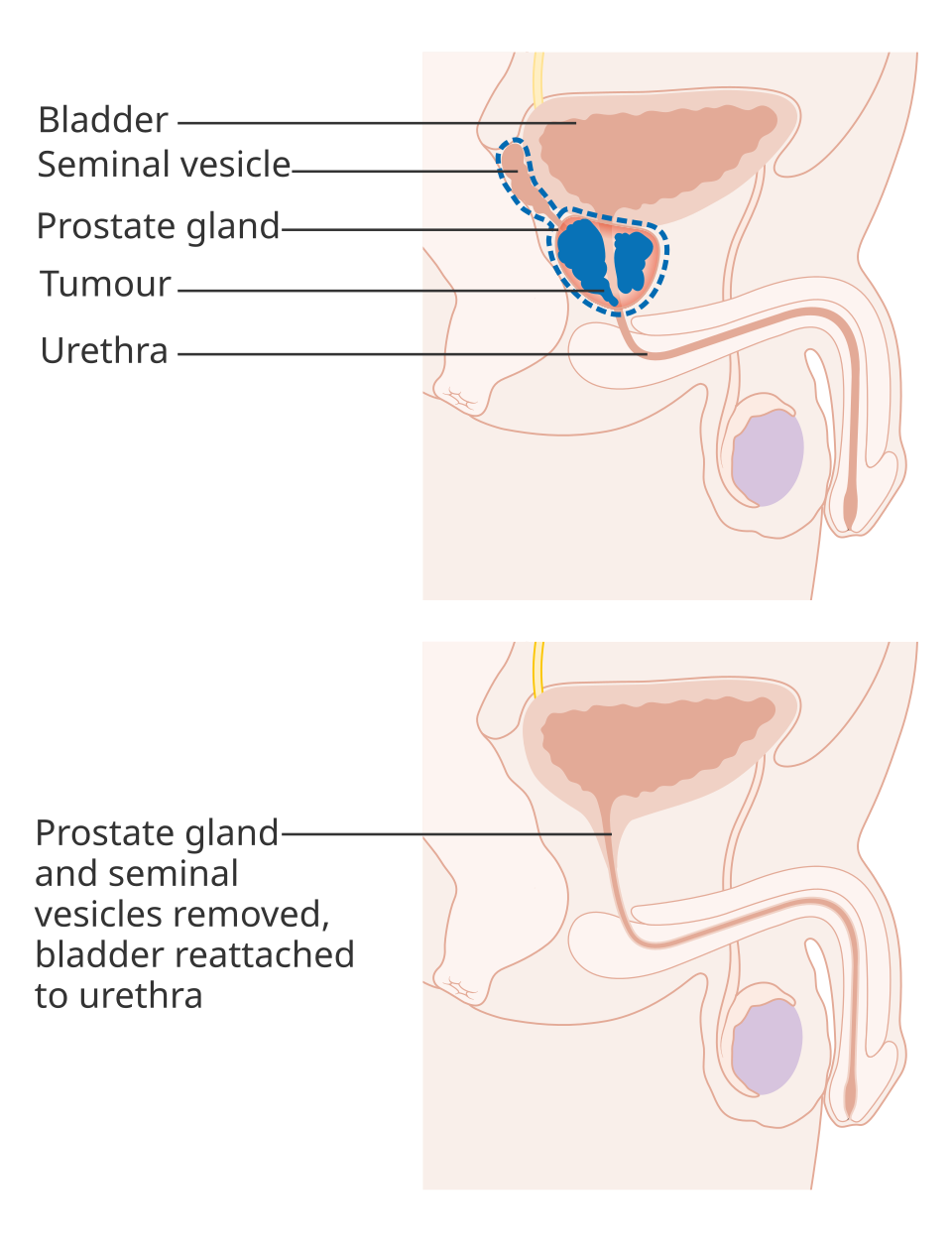
- After radical prostatectomy, the penis often shortens by about 1 cm early on; in one 5-year study length had largely recovered by 48 months.
- Peyronie’s disease can shorten and narrow the penis through scar tissue (plaque) in the tunica albuginea.
- Weight gain can bury the shaft in pubic fat; this apparent loss often improves with weight loss.
- What penis shrinkage really means
- 7 causes of penis shrinkage
- Aging, blood vessels and erectile function
- Penis shrinkage after prostate surgery
- Peyronie’s disease and shortening
- Weight, buried penis and smoking
- Can you prevent or reverse penis shrinkage?
- How to tell if shrinkage is real
- When to see a doctor
- FAQs about penis shrinkage
What penis shrinkage really means
Doctors separate two things. Apparent penis shrinkage is when the penis looks shorter because it is retracted (cold water, stress) or partly hidden by fat. True shortening is a measurable loss of stretched or erect length, caused by changes in the erectile tissue or the tunica albuginea, the tough sheath around the erection chambers.
The distinction matters because the fixes are completely different. Apparent loss may need nothing more than warming up or losing weight, while true loss calls for treating the underlying condition, ideally early. Flaccid size also varies a lot from hour to hour, so it is a poor guide to whether anything has really changed.
Source: Cleveland Clinic — Can your penis shrink?
7 causes of penis shrinkage
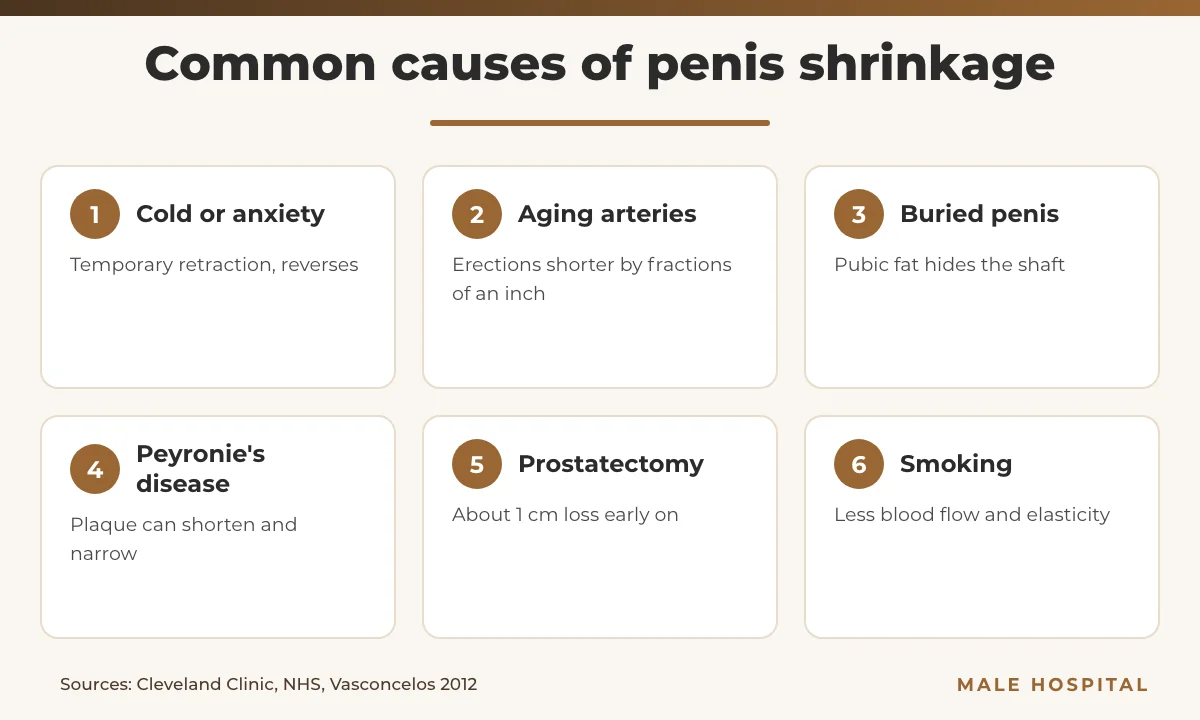
Most cases have one of a short list of explanations. The table below summarizes them; the sections that follow explain the evidence for each.
| Cause | Type of loss | Typical size of change | Reversible? |
|---|---|---|---|
| Cold or anxiety | Apparent (retraction) | Varies; temporary | Yes, within minutes to hours |
| Aging and narrowed arteries | True, erect length | Fractions of an inch | Partly, by protecting vascular health |
| Weight gain / buried penis | Apparent (hidden shaft) | Can be large at very high BMI | Often, with weight loss or surgery |
| Peyronie’s disease | True, length and girth | Varies with plaque | Partly, with treatment |
| Radical prostatectomy | True, stretched length | About 1 cm early on | Often recovers over 2–4 years |
| Penile injury / scarring | True | Varies | Depends on scarring |
| Smoking | True, via blood flow and elasticity | Not precisely measured | Partly, after quitting |
Source: Cleveland Clinic — Can your penis shrink?; Vasconcelos et al., Urology 2012 (PubMed) — The natural history of penile length after radical prostatectomy
Aging, blood vessels and erectile function
Erections depend on blood flowing into the spongy erectile tissue and being trapped there. Over decades, plaque builds up in arteries and reduces the inflow, and the smooth muscle that powers erections weakens. The erectile tissue also loses some elasticity, which slightly lowers the maximum length an erection can reach.
The change is modest: Cleveland Clinic describes it as fractions of an inch. Age alone does not guarantee erectile problems, and men who keep their heart and blood vessels healthy tend to keep better erections. Because weaker erections can be an early sign of heart disease, a noticeable drop in firmness is worth reporting to a doctor, not just accepting. Our erectile dysfunction guide covers the vascular workup.
Source: Cleveland Clinic — Can your penis shrink?
Penis shrinkage after prostate surgery
Radical prostatectomy for prostate cancer is one of the best-studied causes of shortening. Cleveland Clinic summarizes the research as an average shortening of about 0.4 inches (1 cm), with length often returning within two to four years.
What the studies measured
In a prospective Italian study of 126 men, stretched length dropped most sharply by the time the catheter was removed (mean loss 0.84 cm) and continued to shrink slightly at 3, 6 and 12 months. Men who had nerve-sparing surgery and men whose erections recovered lost less length, which suggests that regular erections help protect the tissue.
A longer Brazilian study followed 105 men after open radical prostatectomy for five years. Length was about 1 cm shorter from 3 to 24 months, 0.6 cm shorter at 36 months and no longer significantly different from baseline at 48 months. Again, preserved erectile function predicted faster recovery.
The practical message is reassuring but not passive: the early loss is common, it often recovers, and keeping erections going after surgery appears to help. Ask your surgical team about a penile rehabilitation plan before the operation.
Peyronie’s disease and shortening
Peyronie’s disease is benign scar tissue (plaque) inside the tunica albuginea. The plaque does not stretch during erection, so the penis bends toward it and may shorten, narrow or develop an hourglass dent. NHS guidance lists shortening and narrowing among the typical features, together with a curve, a hard lump and painful erections.
It is more common than many men think. EAU guidelines cite prevalence estimates ranging from 0.1% to 20.3%, higher in men with diabetes and erectile dysfunction, and NIDDK notes that men with diabetes-related erectile dysfunction have a 4 to 5 times higher chance of developing the condition. The condition has an active (acute) phase of up to about 18 months, then usually stabilizes.
Source: NHS — Peyronie’s disease; EAU Guidelines — Sexual and Reproductive Health: Penile curvature; NIDDK — Penile Curvature (Peyronie’s Disease)
Treatment aims to reduce pain, straighten the penis and preserve intercourse, and some options, such as traction therapy, are used partly to limit penis shrinkage. You can read more in our overview of Peyronie’s disease symptoms and causes and on our Peyronie’s disease treatment page.
Weight, buried penis and smoking
Weight gain
Fat in the pubic area, just above the base of the penis, can cover part of the shaft so less of it is visible. When this is severe it is called buried penis, and Cleveland Clinic notes it may develop at a body mass index of 40 or more (class III obesity). Weight loss often resolves it; surgery is considered when the buried penis causes trouble urinating, pain or infections.
Smoking
Long-term smoking reduces blood flow to the penis and may damage tissue elasticity, and it raises the risk of erectile dysfunction and Peyronie’s disease. Both effects can contribute to gradual shortening over time. Quitting improves blood flow and can reverse some of the damage.
Source: Cleveland Clinic — Can your penis shrink?
Can you prevent or reverse penis shrinkage?
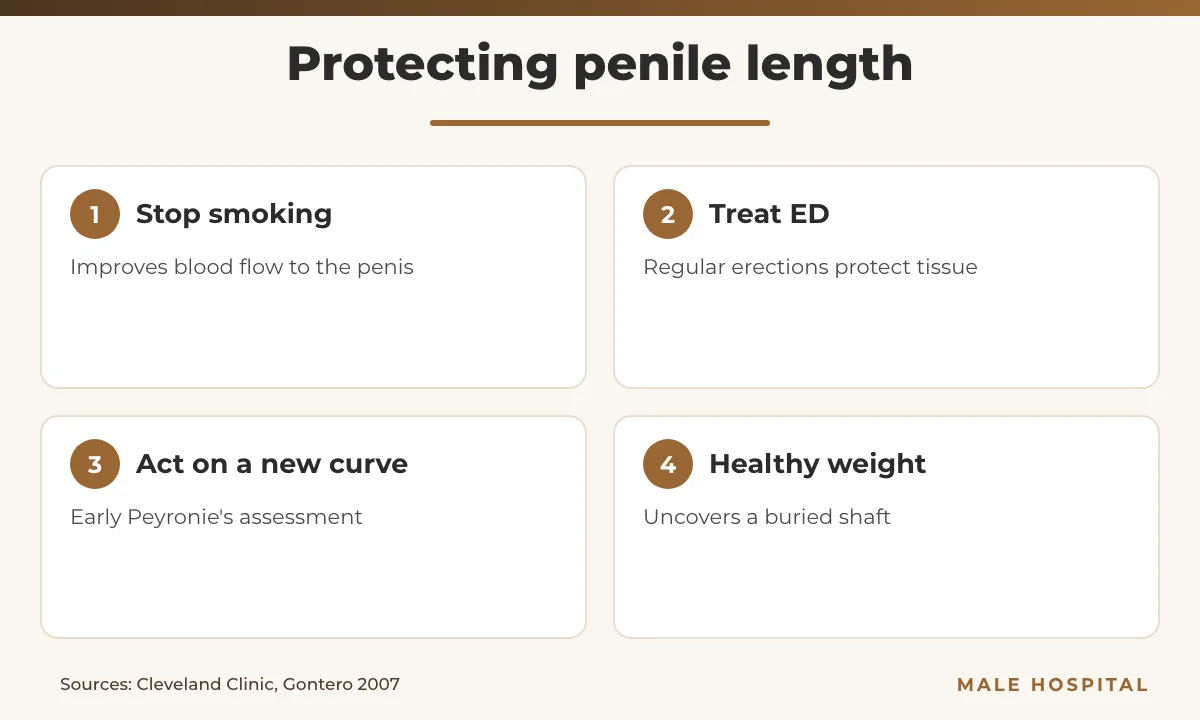
No pill, cream or exercise restores lost length, and products marketed for this are not evidence-based. What works is targeting the cause:
- Protect your arteries: stop smoking, stay active, and manage blood pressure, cholesterol and diabetes.
- Keep erections regular after prostate surgery: studies link erectile recovery with less shortening; ask about rehabilitation options.
- Treat Peyronie’s disease early: see a urologist when a curve, lump or painful erection appears rather than waiting.
- Lose excess weight: this can uncover a shaft hidden by pubic fat.
- Treat erectile dysfunction: firmer, more frequent erections keep blood flowing through the erectile tissue.
Source: Cleveland Clinic — Can your penis shrink?; Gontero et al., J Urol 2007 (PubMed) — Penile shortening after radical prostatectomy and the role of postoperative sexual function; NIDDK — Penile Curvature (Peyronie’s Disease)
Mechanical devices such as vacuum pumps and traction devices have specific, limited roles; our article on the penis pump for size versus ED explains what they can and cannot do.
How to tell if shrinkage is real
Because flaccid length changes with temperature and mood, it is not a reliable measure. If you are worried, doctors use stretched length: the penis is gently pulled to its full length and measured along the top from the pubic bone to the tip. Measuring the same way at intervals gives a much more honest picture than comparing how it looks.
Other clues point to a real problem: a new bend, a hard lump, an hourglass dent, pain with erections, or a clear drop in erection firmness. These suggest a structural or vascular cause rather than normal variation.
Source: Gontero et al., J Urol 2007 (PubMed) — Penile shortening after radical prostatectomy and the role of postoperative sexual function; NHS — Peyronie’s disease
When to see a doctor
Book an appointment with a urologist if you notice any of the following:
- A new curve, bend or dent in the erect penis
- A hard lump or band under the skin of the shaft
- Painful erections or pain during sex
- Noticeable loss of length together with weaker erections
- Shortening after prostate surgery that is not improving
- Trouble urinating, pain or skin infections linked to a buried penis
Source: NHS — Peyronie’s disease; Cleveland Clinic — Can your penis shrink?
If you would like a confidential assessment, our urologist-andrologist can review your history and examination over WhatsApp first. For erection problems, see our erectile dysfunction treatment options.
FAQs about penis shrinkage
Is penis shrinkage with age normal?
Some shortening with age is common. As arteries narrow and erectile tissue loses elasticity, maximum erect length can drop slightly, usually by fractions of an inch. Age alone does not cause erectile problems, though, and men who keep their heart and blood vessels healthy tend to keep firmer erections and lose less length.
Source: Cleveland Clinic — Can your penis shrink?
How much penis shrinkage happens after prostatectomy?
Studies report an average loss of about 1 cm of stretched length in the first months after radical prostatectomy. In one five-year study, the difference narrowed to 0.6 cm at three years and was no longer significant at four years. Nerve-sparing surgery and recovery of erections were linked to less loss.
Source: Vasconcelos et al., Urology 2012 (PubMed) — The natural history of penile length after radical prostatectomy; Gontero et al., J Urol 2007 (PubMed) — Penile shortening after radical prostatectomy and the role of postoperative sexual function
Does Peyronie’s disease cause penis shrinkage?
It can. The scar tissue (plaque) of Peyronie’s disease does not stretch during erection, so the penis may bend, shorten, narrow or develop an hourglass dent. Shortening is one reason urologists advise assessment early, when pain or a new curve first appears, rather than waiting for the deformity to settle.
Source: NHS — Peyronie’s disease; NIDDK — Penile Curvature (Peyronie’s Disease)
Can losing weight make my penis look bigger?
Yes, if fat is hiding part of the shaft. Excess fat over the pubic bone can bury the base of the penis, and at very high body weight this becomes buried penis. Losing weight uncovers more of the shaft; the penis itself does not grow, but more of its true length becomes visible.
Source: Cleveland Clinic — Can your penis shrink?
Can smoking cause penis shrinkage?
Long-term smoking reduces blood flow to the penis and may reduce tissue elasticity, leading to weaker erections. It also raises the risk of erectile dysfunction and Peyronie’s disease, both of which can affect length. Quitting improves blood flow and can reverse some of these effects over time.
Source: Cleveland Clinic — Can your penis shrink?
Is temporary penis shrinkage in cold water a problem?
No. Cold makes the muscles around the penis and scrotum contract, pulling the genitals closer to the body to stay warm. It is a normal response, and size returns once the body warms up. It does not indicate any lasting penis shrinkage or damage.
Source: Cleveland Clinic — Can your penis shrink?
Can lost length be restored?
It depends on the cause. Shortening after prostate surgery often recovers over two to four years, apparent loss from weight gain improves with weight loss, and Peyronie’s disease treatments aim to limit further loss. A urologist can identify the cause and explain which options apply to you.
Source: Cleveland Clinic — Can your penis shrink?; Vasconcelos et al., Urology 2012 (PubMed) — The natural history of penile length after radical prostatectomy
Medically reviewed by Assoc. Prof. Dr. Zülfü Sertkaya, urologist and andrologist (FEBU), Istanbul. Last reviewed: November 2026.
This article is for general information and does not replace an individual consultation with a qualified doctor.
- Cleveland Clinic — Can your penis shrink?
- EAU Guidelines — Sexual and Reproductive Health: Penile curvature
- NIDDK — Penile Curvature (Peyronie's Disease)
- NHS — Peyronie's disease
- Vasconcelos et al., Urology 2012 (PubMed) — The natural history of penile length after radical prostatectomy
- Gontero et al., J Urol 2007 (PubMed) — Penile shortening after radical prostatectomy and the role of postoperative sexual function