
Penile implant infection is uncommon, affecting about 1–3% of men after a first implant, but it is the most feared complication because an infected device usually has to be removed. It typically shows up within the first year as fever, worsening pain, redness or discharge, or more quietly as persistent pain and a pump stuck to the scrotal skin. Today most infected implants can be replaced in the same operation, a technique called immediate salvage. For the full range of other risks, see our overview of penile implant complications.
Source: ISSM — Fungal IPP infections more common in diabetic and overweight men; EAU Guidelines — Sexual and Reproductive Health: Management of erectile dysfunction
- Penile implant infection affects about 1–3% of first implants and up to about 10% of revision operations; antibiotic or hydrophilic coatings cut the risk to roughly 1–2%.
- About 56% of penile implant infections appear within 7 months of surgery and 36% between 7 and 12 months; late infections after 5 years are rare.
- Warning signs range from fever and pus to subtle ones: persistent or worsening pain, warmth, redness, swelling or the pump sticking to the scrotal skin.
- A penile implant infection usually means the device has to be removed; immediate salvage (removal, washout and a new implant in the same operation) succeeds in more than 80% of men.
- Diabetes, revision surgery, longer operations, spinal cord injury and smoking raise the risk, so prevention starts before surgery.
How common is penile implant infection?
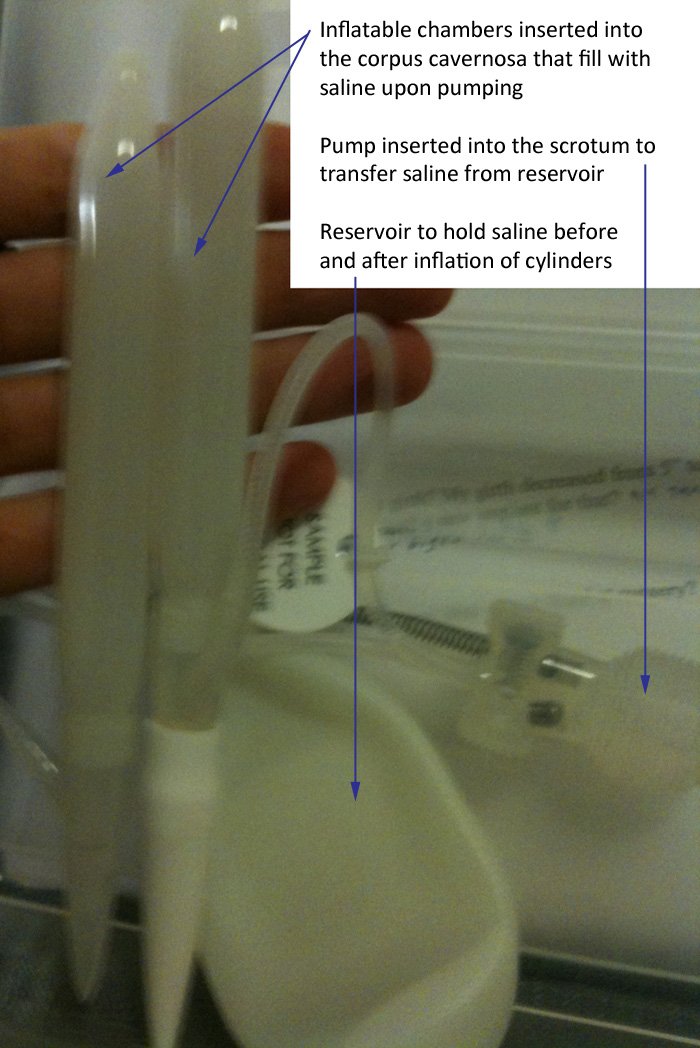
EAU guidelines report that careful surgical technique with antibiotic prophylaxis against both Gram-positive and Gram-negative bacteria keeps penile implant infection at 2–3% for first implants in low-risk men at high-volume centres, falling to 1–2% with an antibiotic-impregnated (AMS InhibiZone) or hydrophilic-coated (Coloplast Titan) device. ISSM summarises the wider picture as about 1–3% of first implants and up to 10% of revision operations.
Source: EAU Guidelines — Sexual and Reproductive Health: Management of erectile dysfunction; ISSM — Fungal IPP infections more common in diabetic and overweight men
Large studies show what coatings changed. In one registry of more than 35,000 men, 1.1% of those with a coated implant needed revision for penile implant infection, compared with 2.5% of men with an uncoated device. One surgeon’s series fell from 5.3% with uncoated implants to 2% with coated devices, and then to 0.46% when a “no-touch” technique was added.
| Situation | Reported penile implant infection rate | Source context | |
|---|---|---|---|
| First implant, uncoated device (older series) | About 3–5% | Before coatings were standard | |
| First implant, coated device | About 1–2% | EAU summary | |
| Coated device plus no-touch technique | 0.46% | Single large surgeon series | |
| Revision surgery | Up to about 10% | ISSM; lower with antiseptic washout | |
| Spinal cord injury | Up to 16% in published series | EAU |
Source: EAU Guidelines — Sexual and Reproductive Health: Management of erectile dysfunction; O’Rourke TK Jr et al., Transl Androl Urol 2017 (PMC) — Prevention, identification, and management of post-operative penile implant complications of infection, hematoma, and device malfunction; ISSM — Fungal IPP infections more common in diabetic and overweight men
When does infection appear?
Most penile implant infections show up in the first year. In one large analysis, 56% of infections were diagnosed within 7 months of surgery, 36% between 7 and 12 months, and only about 2.5% after 5 years.
Source: Brimley SC et al., Arab J Urol 2021 (PMC) — Tips and tricks in the management of inflatable penile prosthesis infection: a review; O’Rourke TK Jr et al., Transl Androl Urol 2017 (PMC) — Prevention, identification, and management of post-operative penile implant complications of infection, hematoma, and device malfunction
The timing hints at the cause. Infections within about two months that look severe, with systemic illness and a raised white cell count, are usually caused by aggressive bacteria such as Staphylococcus aureus, Klebsiella, Serratia or E. coli. Later penile implant infections tend to be indolent and caused by skin bacteria such as Staphylococcus epidermidis, which form a protective biofilm on the device.
Fungal penile implant infection is no longer considered rare. In a multicentre study of 217 infected implants, 12% involved fungi, and 88% of these men were diabetic or overweight.
Source: ISSM — Fungal IPP infections more common in diabetic and overweight men
Signs and symptoms of penile implant infection
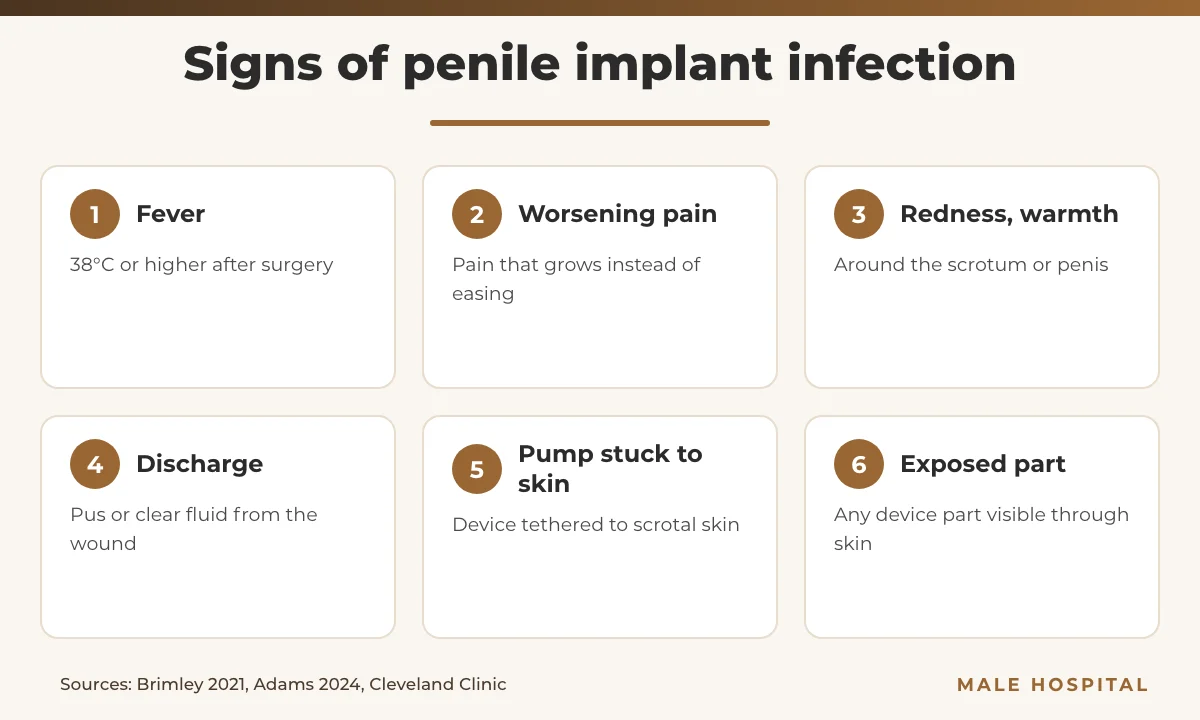
Some pain and swelling are normal after surgery and usually ease within a week, with tenderness for up to six weeks. Penile implant infection looks different:
- fever of 38°C (100°F) or higher, chills or feeling generally unwell;
- pain that persists or gets worse instead of improving;
- redness, warmth or swelling of the scrotum or penis;
- pus or persistent clear fluid from the incision;
- the pump becoming fixed or tethered to the scrotal skin;
- any part of the device visible through the skin (erosion).
Source: Cleveland Clinic — Penile implants; Brimley SC et al., Arab J Urol 2021 (PMC) — Tips and tricks in the management of inflatable penile prosthesis infection: a review; Adams ES et al., Transl Androl Urol 2024 (PMC) — Narrative review of immediate salvage for penile prosthesis infection
A narrative review stresses that indolent penile implant infection is more common than obvious sepsis and may present only as localised persistent or worsening pain, clear drainage with or without redness, swelling or tethering. Surgeons also need to rule out non-infectious causes such as diabetic nerve pain.
Who is at higher risk?
The EAU identifies diabetes as a risk factor in a large database study and notes that hypogonadism was independently associated with penile implant infection in a large US claims database. Other factors reported across reviews include:
- revision surgery, especially without an antiseptic washout (10.3% in one series);
- longer operating time, with roughly a 1% higher likelihood of penile implant infection for every extra minute in one study summarised by ISSM;
- spinal cord injury, smoking, immunosuppression and substance misuse;
- active skin or urinary infection at the time of surgery.
Source: EAU Guidelines — Sexual and Reproductive Health: Management of erectile dysfunction; O’Rourke TK Jr et al., Transl Androl Urol 2017 (PMC) — Prevention, identification, and management of post-operative penile implant complications of infection, hematoma, and device malfunction; ISSM — Factors that may increase chances of infection with inflatable penile prostheses; Adams ES et al., Transl Androl Urol 2024 (PMC) — Narrative review of immediate salvage for penile prosthesis infection; Cleveland Clinic — Penile implants
Diabetes deserves special attention. In one large analysis, men with diabetes who received a coated implant had a 1.47% revision rate for penile implant infection versus 4.17% with an uncoated device. There is no agreed HbA1c cut-off for surgery, but control is checked beforehand. Our guide to erectile dysfunction and diabetes explains why sugar control matters for erections too.
Source: O’Rourke TK Jr et al., Transl Androl Urol 2017 (PMC) — Prevention, identification, and management of post-operative penile implant complications of infection, hematoma, and device malfunction; EAU Guidelines — Sexual and Reproductive Health: Management of erectile dysfunction
How surgeons prevent infection
Prevention combines patient preparation and operating-room discipline. Measures supported by guidelines and reviews include:
- clearing any skin or urinary infection before surgery, and often a pre-operative urine culture;
- antibiotics before surgery that cover Gram-positive and Gram-negative bacteria;
- coated devices (antibiotic-impregnated or hydrophilic, dipped in antibiotics);
- a no-touch technique that minimises skin contact with the device and avoids prolonged wound exposure;
- chlorhexidine-alcohol skin preparation and clipper hair removal, which may help although definitive evidence is lacking;
- screening for nasal Staphylococcus aureus and decolonisation with mupirocin and chlorhexidine, which reduced surgical-site infection from 4.4% to 0.9% in one study.
Source: EAU Guidelines — Sexual and Reproductive Health: Management of erectile dysfunction; Carvajal A, Henry GD., Curr Urol Rep 2022 (PubMed) — Prevention of penile prosthesis infection; Brimley SC et al., Arab J Urol 2021 (PMC) — Tips and tricks in the management of inflatable penile prosthesis infection: a review
For men with diabetes receiving a Coloplast Titan implant, a large multicentre analysis found vancomycin plus gentamicin the most effective dipping combination. Prolonged antibiotics after surgery (more than 24 hours) have not been proven to help: in one comparison, explantation rates were 2.2% with oral antibiotics versus 1.9% without.
Source: EAU Guidelines — Sexual and Reproductive Health: Management of erectile dysfunction; Brimley SC et al., Arab J Urol 2021 (PMC) — Tips and tricks in the management of inflatable penile prosthesis infection: a review
Choosing an experienced surgeon also matters, because operative time and technique influence risk. Our penile implant recovery guide covers the wound-care steps that patients control at home.
Source: ISSM — Factors that may increase chances of infection with inflatable penile prostheses
Treatment: removal, salvage and antibiotics
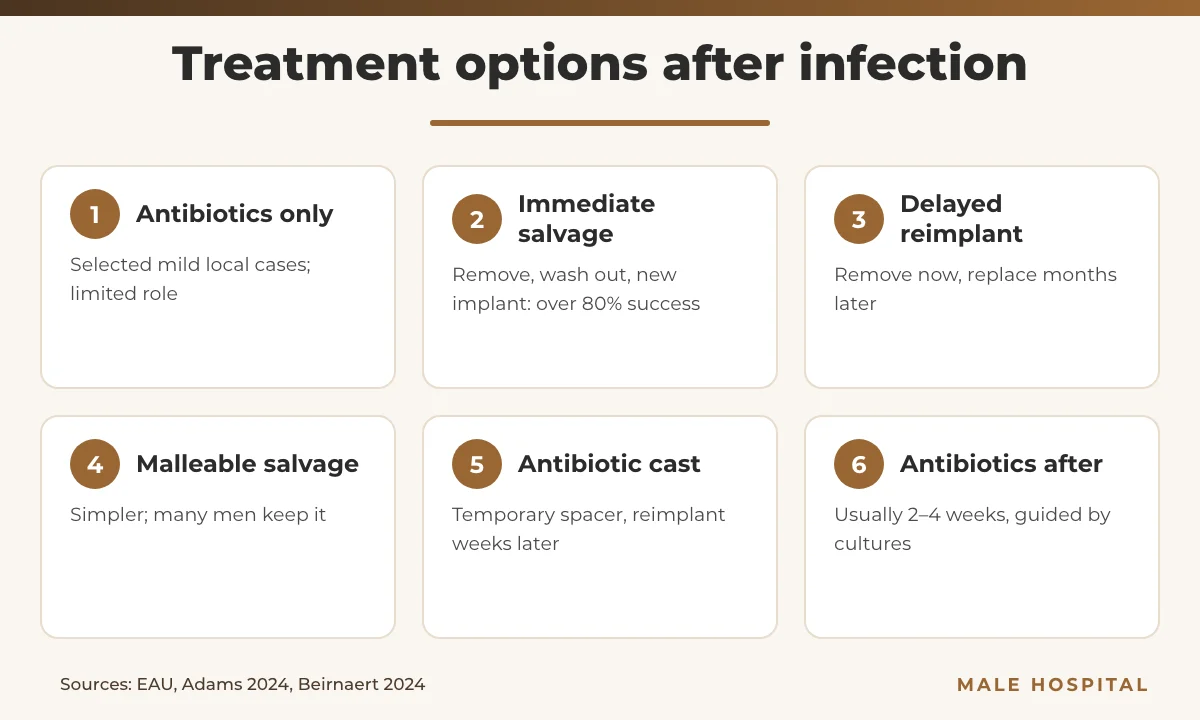
The EAU states that prosthetic infection requires removal of the device and antibiotics. Bacteria living in a biofilm on the implant are very hard to clear with antibiotics alone, so in most cases the whole device comes out.
Source: EAU Guidelines — Sexual and Reproductive Health: Management of erectile dysfunction
Delayed reimplantation
The traditional approach was removal and waiting several months before a new implant. The problem is scarring: delayed replacement is associated with significant fibrosis of the erection chambers and 15–30% loss of penile length, a harder second operation and lower satisfaction (around 58% in one review, versus 75–98% commonly reported for first implants).
Source: Adams ES et al., Transl Androl Urol 2024 (PMC) — Narrative review of immediate salvage for penile prosthesis infection; Brimley SC et al., Arab J Urol 2021 (PMC) — Tips and tricks in the management of inflatable penile prosthesis infection: a review
Immediate salvage
In the 1990s surgeons showed that the infected device could be removed, the space washed out with a series of antiseptic solutions, and a new implant placed in the same operation (the “Mulcahy salvage”). The EAU reports success in more than 80% of cases; Mulcahy’s series kept 45 of 55 men infection-free. A 2024 systematic review found success rates of 80% or more, increasingly using a malleable implant for the salvage.
Source: EAU Guidelines — Sexual and Reproductive Health: Management of erectile dysfunction; Adams ES et al., Transl Androl Urol 2024 (PMC) — Narrative review of immediate salvage for penile prosthesis infection; Beirnaert J et al., Fr J Urol 2024 (PubMed) — Salvage procedures for infected penile implants: a comprehensive review and analysis of functional outcomes
A malleable salvage is technically simpler and needs no pump or reservoir; up to 70% of men choose to keep it, while 20–33% later convert to an inflatable device. Immediate salvage is now considered safe even in many men with diabetes, pus or erosion, so it has become the preferred strategy for most infected implants. Antibiotics are usually continued for 2–4 weeks afterwards, guided by cultures taken during surgery.
Source: Adams ES et al., Transl Androl Urol 2024 (PMC) — Narrative review of immediate salvage for penile prosthesis infection; Beirnaert J et al., Fr J Urol 2024 (PubMed) — Salvage procedures for infected penile implants: a comprehensive review and analysis of functional outcomes
Antibiotics alone
Small case series report success with long-term antibiotics in carefully selected men who have only local signs and no fever or systemic illness, but this approach has a limited role. Our article on penile implant revision surgery explains what any second operation involves.
When to see a doctor
Call your implant surgeon the same day if you notice any of the following after surgery, even months later:
- fever of 38°C or higher;
- increasing pain, warmth or redness around the scrotum or penis;
- discharge from the wound, or a wound that opens;
- the pump becoming stuck to the skin, or any part of the device showing through the skin;
- heavy bleeding from an incision.
Source: Cleveland Clinic — Penile implants; Brimley SC et al., Arab J Urol 2021 (PMC) — Tips and tricks in the management of inflatable penile prosthesis infection: a review
Early assessment can make the difference between a straightforward salvage and a more difficult operation. Our urologist-andrologist, whose research includes penile prosthesis infection risk, can review symptoms or a planned implant confidentially on WhatsApp; details of the procedure are on our penile prosthesis surgery page.
FAQs about penile implant infection
What are the chances of a penile implant infection?
For a first implant in a low-risk man, EAU guidelines report 2–3%, falling to 1–2% with antibiotic or hydrophilic coatings. Some series with coated devices and a no-touch technique report under 0.5%. Risk is higher with revision surgery (up to about 10%), diabetes, spinal cord injury and long operations.
Source: EAU Guidelines — Sexual and Reproductive Health: Management of erectile dysfunction; O’Rourke TK Jr et al., Transl Androl Urol 2017 (PMC) — Prevention, identification, and management of post-operative penile implant complications of infection, hematoma, and device malfunction; ISSM — Fungal IPP infections more common in diabetic and overweight men
Can a penile implant infection appear years later?
Yes, but late penile implant infection is uncommon. In one analysis, 56% of infections were diagnosed within 7 months and 36% between 7 and 12 months, with only about 2.5% after five years. Late penile implant infections are often caused by low-virulence skin bacteria and may present only as persistent pain or the pump sticking to the skin.
Source: Brimley SC et al., Arab J Urol 2021 (PMC) — Tips and tricks in the management of inflatable penile prosthesis infection: a review; O’Rourke TK Jr et al., Transl Androl Urol 2017 (PMC) — Prevention, identification, and management of post-operative penile implant complications of infection, hematoma, and device malfunction
Can an infected penile implant be treated with antibiotics?
Usually not on their own. Bacteria form a biofilm on the device that antibiotics struggle to reach, so the EAU states that infection requires removal of the implant. Long-term antibiotics alone have worked only in small series of carefully selected men with local signs and no systemic illness.
Source: EAU Guidelines — Sexual and Reproductive Health: Management of erectile dysfunction; Adams ES et al., Transl Androl Urol 2024 (PMC) — Narrative review of immediate salvage for penile prosthesis infection
What is immediate salvage surgery?
It is an operation that removes the entire infected implant, cleans the space with antiseptic and antibiotic irrigation, and places a new implant at the same time. Success rates above 80% are reported, and it avoids the scarring and 15–30% length loss linked to waiting months before reimplantation.
Source: EAU Guidelines — Sexual and Reproductive Health: Management of erectile dysfunction; Adams ES et al., Transl Androl Urol 2024 (PMC) — Narrative review of immediate salvage for penile prosthesis infection
Does diabetes increase the risk of penile implant infection?
Yes. Diabetes is the most consistent risk factor in large studies. In one summary of 597 operations, 64% of patients with penile implant infection had HbA1c levels consistent with diabetes, versus 25% of those without infection. Coated devices lower the risk in diabetic men, and good sugar control before surgery is important.
Source: ISSM — Factors that may increase chances of infection with inflatable penile prostheses; O’Rourke TK Jr et al., Transl Androl Urol 2017 (PMC) — Prevention, identification, and management of post-operative penile implant complications of infection, hematoma, and device malfunction
Will I lose length after a penile implant infection?
Not necessarily. Length loss mainly occurs when the implant is removed and the chambers are left empty to scar for months before reimplantation, which has been linked to 15–30% shortening. Immediate salvage, where a new implant is placed in the same operation, is used largely to preserve length.
How long are antibiotics needed after salvage surgery?
Practice varies. A North American consensus agreed on 2–4 weeks of antibiotics after salvage based on cultures taken during surgery, and one centre reported a 92% infection-free rate with a two-week course. Your surgeon will choose the drug according to the organisms found.
Medically reviewed by Assoc. Prof. Dr. Zülfü Sertkaya, urologist and andrologist (FEBU), Istanbul. Last reviewed: November 2026.
This article is for general information and does not replace an individual consultation with a qualified doctor.
- EAU Guidelines — Sexual and Reproductive Health: Management of erectile dysfunction
- O'Rourke TK Jr et al., Transl Androl Urol 2017 (PMC) — Prevention, identification, and management of post-operative penile implant complications of infection, hematoma, and device malfunction
- Brimley SC et al., Arab J Urol 2021 (PMC) — Tips and tricks in the management of inflatable penile prosthesis infection: a review
- Adams ES et al., Transl Androl Urol 2024 (PMC) — Narrative review of immediate salvage for penile prosthesis infection
- Beirnaert J et al., Fr J Urol 2024 (PubMed) — Salvage procedures for infected penile implants: a comprehensive review and analysis of functional outcomes
- Carvajal A, Henry GD., Curr Urol Rep 2022 (PubMed) — Prevention of penile prosthesis infection
- ISSM — Factors that may increase chances of infection with inflatable penile prostheses
- ISSM — Fungal IPP infections more common in diabetic and overweight men
- Cleveland Clinic — Penile implants