
Penile implant candidates are usually men with erectile dysfunction (ED), or ED combined with Peyronie’s disease, that has not improved with tablets, injections or a vacuum device, or men who cannot use those treatments or prefer a definitive solution. They also need to be fit for a short operation, free of active infection, and to understand that an implant permanently replaces natural erections and does not make the penis longer.
Source: EAU Guidelines — Sexual and Reproductive Health: Management of erectile dysfunction; Cleveland Clinic — Penile implants
- Good penile implant candidates have ED or Peyronie’s disease that has not improved with, or cannot be treated by, tablets, injections or a vacuum device.
- Men may also choose an implant directly after tablets fail if they prefer a definitive treatment and understand that the change is permanent.
- Active infections, poorly controlled diabetes and unrealistic expectations about size are the main reasons surgery is delayed or advised against.
- Among penile implant candidates, the device type depends on the man: inflatable for a natural look, two-piece after major abdominal surgery, malleable for limited hand dexterity.
- Satisfaction is high in well-selected men (at least 92% in EAU-cited series), and careful counselling is the strongest predictor of a happy outcome.
- Penile implant candidates: who qualifies?
- Six signs you may be a good candidate
- Health checks for penile implant candidates
- Health conditions that raise the risk
- Reasons to delay or reconsider surgery
- Matching the device to the candidate
- What penile implant candidates should understand
- When to see a doctor
- FAQs about penile implant candidates
Penile implant candidates: who qualifies?

The European Association of Urology (EAU) recommends considering a penile prosthesis in men who are not suitable for drug treatments or prefer a definitive therapy, and in men who do not respond to other treatment options. Because of its high efficacy, safety and satisfaction, the EAU considers the evidence sufficient to recommend an implant when less invasive treatments fail.
Source: EAU Guidelines — Sexual and Reproductive Health: Management of erectile dysfunction
Cleveland Clinic describes typical penile implant candidates in similar terms: a man with ED or Peyronie’s disease whose condition cannot improve naturally or with conservative treatments such as medicines or a vacuum device. Implants are also used after penis reconstruction surgery (phalloplasty or metoidioplasty). The US National Institute of Diabetes and Digestive and Kidney Diseases notes that most men with ED never need surgery; it is considered after other options have been tried. For the procedure itself, see our penile prosthesis surgery page.
Source: Cleveland Clinic — Penile implants; NIDDK — Treatment for erectile dysfunction
Six signs you may be a good candidate

1. Tablets do not work or are not safe for you
PDE5 inhibitors (sildenafil, tadalafil and others) are first-line therapy, but they fail in some men and are forbidden in men taking nitrates. Before calling tablets a failure, check that the dose and timing were right.
Source: EAU Guidelines — Sexual and Reproductive Health: Management of erectile dysfunction
2. Injections or other second-line options have failed or are not acceptable
Injections work for most men, yet 41–68% stop them, often because of pain, fear of needles or lack of spontaneity. Our comparison of penile implant vs injections sets out the trade-offs.
Source: EAU Guidelines — Sexual and Reproductive Health: Management of erectile dysfunction
3. You want a definitive, on-demand solution
Penile implant candidates do not have to work through every option first. SMSNA quotes an implant specialist who says that any man healthy enough to climb a flight of stairs who has failed pills, or cannot take them, is a good candidate, and notes that AUA guidance supports choosing an implant once pills fail if the man is well informed.
Source: SMSNA — Penile implants for erectile dysfunction: a Q&A with an implant specialist
4. You have ED together with Peyronie’s disease
When curvature and ED coexist and ED does not respond to medicines, the EAU recommends an implant, with or without straightening manoeuvres, as the treatment of choice.
Source: EAU Guidelines — Sexual and Reproductive Health: Penile curvature
5. ED persists after prostate cancer treatment
Implants are a recognised third-line option when tablets and injections are not effective after radical prostatectomy. Our article on erectile dysfunction after prostatectomy explains the earlier steps.
Source: EAU Guidelines — Sexual and Reproductive Health: Management of erectile dysfunction
6. You are fit for surgery and committed to using the device
The operation is done under anaesthesia, and the man must learn to operate the pump or bend the rods. The pre-operative check covers general health, bladder emptying and any urinary problems.
Source: Cleveland Clinic — Penile implants
Health checks for penile implant candidates
A surgeon will review your general health, vital signs, medicines and allergies, and confirm that you can empty your bladder without severe urinary problems. Blood thinners, aspirin, anti-inflammatory drugs and some herbal supplements raise bleeding risk and need a plan, but should not be stopped without medical advice.
Source: Cleveland Clinic — Penile implants
For penile implant candidates, infection prevention starts before the operation. Cleveland Clinic advises that any active skin or urinary infection must be reported, because both raise the risk of infecting the implant. Many surgeons also order a urine culture: surveys show about 60% of SMSNA members and 50% of ISSM members still do so routinely.
Source: Cleveland Clinic — Penile implants; Brimley SC et al., Arab J Urol 2021 (PMC) — Tips and tricks in the management of inflatable penile prosthesis infection: a review
In penile implant candidates with diabetes, blood sugar control is checked. The EAU notes that diabetes is a risk factor for implant infection but that there is no agreed HbA1c cut-off. In one recent series summarised by ISSM, all patients had HbA1c below 8.5% before surgery, and diabetes was still the strongest risk factor for infection.
Source: EAU Guidelines — Sexual and Reproductive Health: Management of erectile dysfunction; ISSM — Factors that may increase chances of infection with inflatable penile prostheses
In penile implant candidates, a physical examination records penile length and checks for plaques of Peyronie’s disease, which help set expectations and plan surgery.
Health conditions that raise the risk
Some men remain penile implant candidates but need extra precautions and frank counselling about higher risk:
| Condition | Why it matters | What usually happens | |
|---|---|---|---|
| Diabetes | Main risk factor for implant infection | Optimise blood sugar first; read our guide to ED and diabetes | |
| Spinal cord injury | Infection reported in up to 16% in published series | Specialist centre; careful wound care | |
| Low testosterone (hypogonadism) | Independently linked to implant infection in a large US database | Assess and discuss before surgery | |
| Previous major abdominal or pelvic surgery | Reservoir placement may be risky | Two-piece inflatable or malleable device | |
| Limited hand dexterity | Hard to operate a scrotal pump | Malleable (bendable) implant | |
| Severe vascular disease | Higher risk of erosion and glans ischaemia | Careful planning, avoid extra lengthening steps | |
| Substance misuse | 30–40% more post-operative infections in one study | Address before elective surgery |
Source: EAU Guidelines — Sexual and Reproductive Health: Management of erectile dysfunction; Brimley SC et al., Arab J Urol 2021 (PMC) — Tips and tricks in the management of inflatable penile prosthesis infection: a review
Reasons to delay or reconsider surgery
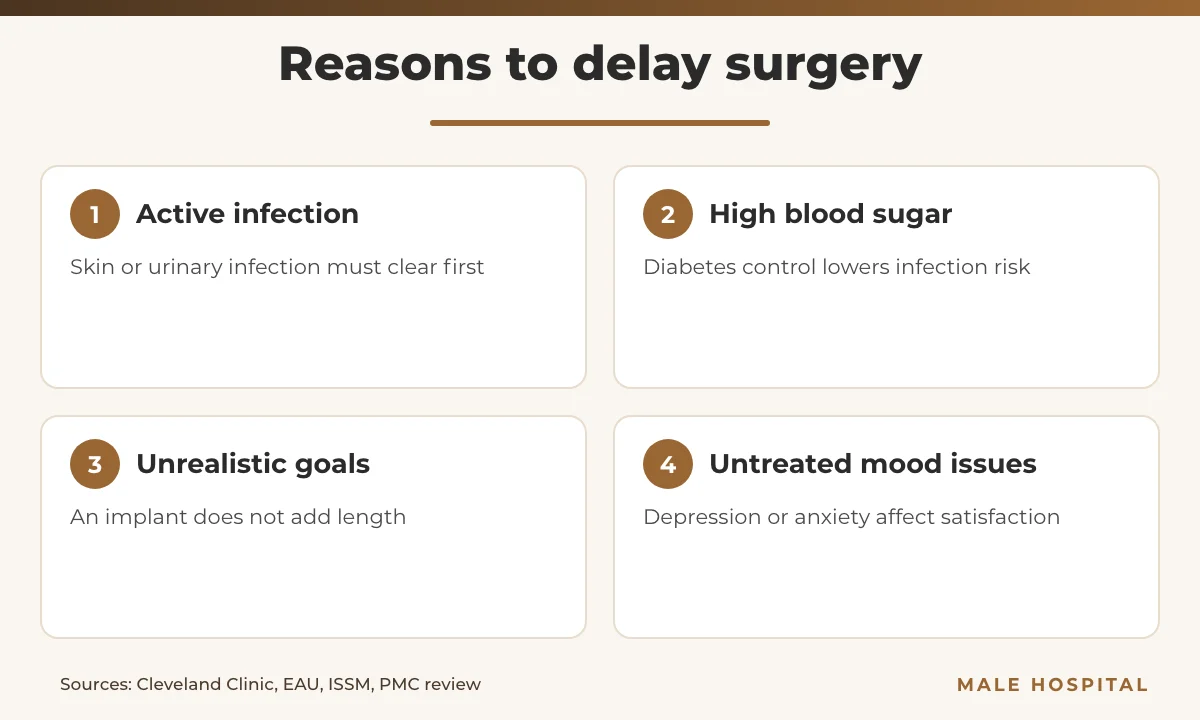
An implant is elective surgery, so it is usually postponed until a problem is fixed rather than refused outright:
- an active skin, urinary or other infection;
- poorly controlled diabetes;
- expectations that the implant will make the penis longer or thicker than before;
- untreated depression, anxiety or other active psychiatric symptoms;
- uncertainty about losing the option of natural or drug-assisted erections.
Source: Cleveland Clinic — Penile implants; EAU Guidelines — Sexual and Reproductive Health: Management of erectile dysfunction; Helo S et al., Transl Androl Urol 2023 (PMC) — Assessing psychiatric risk with a focus on optimizing patient satisfaction with penile prosthesis placement: a narrative review
Expectations about size
Implants do not make the penis larger than it was before surgery, and the glans does not become firm, so many men feel the erection is shorter. ISSM explains that length loss is often caused by years of untreated ED, Peyronie’s disease, prostate cancer treatment or low testosterone rather than by the implant itself. Recording penile length before surgery helps set realistic goals.
Source: Cleveland Clinic — Penile implants; ISSM — Is it common to lose length after penile implant surgery?; Helo S et al., Transl Androl Urol 2023 (PMC) — Assessing psychiatric risk with a focus on optimizing patient satisfaction with penile prosthesis placement: a narrative review
Mental health and motivation
A narrative review found anxiety or depressive symptoms in 13.8–17.1% of men with ED, and noted that only about half of prosthetic urologists routinely take a psychiatric history. Surgeons use the “CURSED” mnemonic (compulsive, unrealistic, revision, surgeon shopping, entitled, denial, psychiatric) to flag men who may be dissatisfied even after a technically perfect operation. Penile dysmorphic disorder, a preoccupation with penis size or shape, is a particular warning sign.
Matching the device to the candidate
Being a good candidate also means choosing the right implant. EAU guidance summarises the options:
- Three-piece inflatable: often preferred for the most natural erection and flaccid look.
- Two-piece inflatable: a choice for men at high risk of reservoir complications, for example after previous abdominal surgery.
- Malleable (semi-rigid): simpler to implant and use, useful with limited manual dexterity, but the penis is always firm and harder to conceal.
Source: EAU Guidelines — Sexual and Reproductive Health: Management of erectile dysfunction
There are no head-to-head studies showing one manufacturer’s implant is superior. Our guides to the malleable penile implant and the inflatable models go into the design differences.
Source: EAU Guidelines — Sexual and Reproductive Health: Management of erectile dysfunction
What penile implant candidates should understand
A 2023 review on patient selection stresses that most men are satisfied, but that even a technically successful operation can disappoint a man who was not properly counselled. Good penile implant candidates understand that:
- the implant is permanent; pills and injections will not work afterwards;
- recovery takes weeks, with sex usually avoided for at least four weeks;
- infection (about 2–3% for first implants, lower with coated devices) can mean removal;
- devices can fail mechanically and may need replacement after many years;
- sensation, ejaculation and orgasm are not changed by the implant.
Source: Stroie FA et al., Int J Impot Res 2023 (PubMed) — Patient selection, counseling and preparation for penile prosthesis; Cleveland Clinic — Penile implants; EAU Guidelines — Sexual and Reproductive Health: Management of erectile dysfunction
When these points are clear, outcomes are excellent: EAU-cited series report satisfaction in at least 92% of patients and 91–95% of partners.
Source: EAU Guidelines — Sexual and Reproductive Health: Management of erectile dysfunction
When to see a doctor
See a urologist if ED persists despite treatment, if tablets are unsafe for you, or if you have a new bend, lump or painful erection. Seek prompt care before any planned surgery if you develop a fever, a urinary infection or a skin infection in the groin, because the operation will need to be postponed. After an implant, call your surgeon urgently for heavy bleeding, fever of 38°C or higher, signs of wound infection or increasing pain.
Source: Cleveland Clinic — Penile implants
If you are wondering whether you are a candidate, our urologist-andrologist can review your history confidentially on WhatsApp before any decision is made.
FAQs about penile implant candidates
Am I too old for a penile implant?
Age alone does not exclude penile implant candidates. What matters is general health, the ability to undergo a short anaesthetic, and the ability to use the device. An implant specialist quoted by SMSNA describes any man healthy enough to climb a flight of stairs, who has failed or cannot take pills, as a good candidate.
Source: SMSNA — Penile implants for erectile dysfunction: a Q&A with an implant specialist
Do I have to try injections before an implant?
No. EAU guidelines treat men who are not suitable for drug treatments, do not respond, or prefer a definitive therapy as penile implant candidates. SMSNA notes that AUA guidance allows men who have failed tablets to choose an implant directly if they understand the benefits, risks and burdens of every option.
Source: EAU Guidelines — Sexual and Reproductive Health: Management of erectile dysfunction; SMSNA — Penile implants for erectile dysfunction: a Q&A with an implant specialist
Can men with diabetes get a penile implant?
Yes, men with diabetes are often penile implant candidates, but diabetes is the main risk factor for implant infection. Surgeons check blood sugar control before operating. The EAU notes that no ideal HbA1c threshold has been agreed in trials; in one recent series all patients were below 8.5%. Better control before surgery lowers the risk.
Source: EAU Guidelines — Sexual and Reproductive Health: Management of erectile dysfunction; ISSM — Factors that may increase chances of infection with inflatable penile prostheses
Can I get an implant after prostate cancer surgery?
Yes. After radical prostatectomy, men can be penile implant candidates when tablets and injections are ineffective or unsuitable. Men are usually advised to allow time for natural recovery of erections first, and the surgical plan accounts for any previous pelvic operations, which may affect where the reservoir is placed.
Source: EAU Guidelines — Sexual and Reproductive Health: Management of erectile dysfunction
Who should not get a penile implant?
Surgery is postponed for penile implant candidates with an active infection or uncontrolled medical conditions, and approached with great caution in men who expect a longer penis or have untreated depression, anxiety or penile dysmorphic disorder. Men who are unsure about permanently losing natural erections should take more time before deciding.
Source: Cleveland Clinic — Penile implants; Helo S et al., Transl Androl Urol 2023 (PMC) — Assessing psychiatric risk with a focus on optimizing patient satisfaction with penile prosthesis placement: a narrative review
Can a penile implant help with Peyronie’s disease?
Yes, if Peyronie’s disease is accompanied by ED that does not respond to medicines. The EAU recommends an implant, sometimes combined with manual modelling or other straightening steps, as the technique of choice in this situation. Men with good erections and curvature alone usually have other surgical options.
Source: EAU Guidelines — Sexual and Reproductive Health: Penile curvature
Is a penile implant worth it?
For well-selected and well-counselled men, satisfaction is very high, at least 92% of patients and 91–95% of partners in EAU-cited series. Our article on penile implant satisfaction rates explains what drives satisfied and dissatisfied outcomes.
Source: EAU Guidelines — Sexual and Reproductive Health: Management of erectile dysfunction
Medically reviewed by Assoc. Prof. Dr. Zülfü Sertkaya, urologist and andrologist (FEBU), Istanbul. Last reviewed: November 2026.
This article is for general information and does not replace an individual consultation with a qualified doctor.
- EAU Guidelines — Sexual and Reproductive Health: Management of erectile dysfunction
- EAU Guidelines — Sexual and Reproductive Health: Penile curvature
- Cleveland Clinic — Penile implants
- NIDDK — Treatment for erectile dysfunction
- SMSNA — Penile implants for erectile dysfunction: a Q&A with an implant specialist
- Helo S et al., Transl Androl Urol 2023 (PMC) — Assessing psychiatric risk with a focus on optimizing patient satisfaction with penile prosthesis placement: a narrative review
- Stroie FA et al., Int J Impot Res 2023 (PubMed) — Patient selection, counseling and preparation for penile prosthesis
- ISSM — Is it common to lose length after penile implant surgery?
- ISSM — Factors that may increase chances of infection with inflatable penile prostheses
- Brimley SC et al., Arab J Urol 2021 (PMC) — Tips and tricks in the management of inflatable penile prosthesis infection: a review