PSA test results measure prostate-specific antigen, a protein made by normal and cancerous prostate cells, in a small blood sample. A high level does not mean you have prostate cancer: an enlarged prostate, prostatitis, a urinary infection, recent ejaculation, cycling or a biopsy can all push PSA up, while finasteride and dutasteride push it down. This guide explains what the number means at your age, how to prepare so the result is accurate, who the EAU, AUA and USPSTF say should be tested, and what happens after a raised result.
Source: National Cancer Institute — Prostate-Specific Antigen (PSA) Test Fact Sheet; MedlinePlus — Prostate-Specific Antigen (PSA) Test
- There is no single “normal” PSA. Most men are below 3 ng/mL, and many doctors use age-adjusted referral thresholds of 2.5 (40s), 3.5 (50s), 4.5 (60s) and 6.5 ng/mL (70s).
- About 1 in 4 men with a PSA of 4–10 ng/mL has prostate cancer on biopsy; above 10 the chance is over 50%, and about 15% of men below 4 still have cancer.
- Avoid ejaculation, vigorous exercise and cycling for 48 hours before the test; wait 4–6 weeks after a urinary infection or a prostate biopsy.
- The EAU and AUA recommend offering testing from age 50, or from 40–45 if you are of African descent, have a strong family history or carry a BRCA2 mutation, repeated every 2–4 years depending on your baseline.
- A raised result is repeated first, usually after about four weeks; if it stays high, an MRI scan now comes before any biopsy.
- What a PSA test measures
- Who should have a PSA test, and when
- How to prepare for a PSA test
- 7 things that change a PSA test result without cancer
- PSA test results: normal levels by age
- Free PSA, PSA density and PSA velocity
- What happens after a high PSA test
- Benefits and harms of PSA screening
- PSA test and your sexual health
- When to see a doctor
- FAQs about the PSA test
What a PSA test measures
Prostate-specific antigen, also called human kallikrein 3, is an enzyme the prostate secretes into semen to liquefy it after ejaculation. A small amount leaks into the bloodstream, and the test measures that amount in nanograms per milliliter (ng/mL). Because both healthy and cancerous cells make PSA, the test is specific to the prostate, not to cancer: anything that inflames, enlarges or squeezes the gland can raise the number.
Most PSA in blood is bound to proteins; a smaller share floats free. Total PSA has a half-life of two to three days, while free PSA is cleared within about 110 minutes, which is why timing matters after ejaculation or a procedure. Doctors order the test to screen men without symptoms, to investigate urinary symptoms or an abnormal rectal exam, and to monitor known prostate cancer, where a rising PSA after treatment is often the first sign of recurrence.
Source: Daher & Beaini 1998, Clin Chem Lab Med — Prostate-specific antigen and new related markers for prostate cancer; Richardson 1996, Urology — Half-life determination of serum free prostate-specific antigen; National Cancer Institute — PSA Test Fact Sheet
Who should have a PSA test, and when
The major guidelines agree on the principle, informed choice, and differ on the details. The European Association of Urology (EAU) recommends offering early PSA testing to well-informed men from age 50, from 45 if a relative was diagnosed before 60 or if you are of African descent, and from 40 if you carry a BRCA2 mutation; men with a life expectancy under 15 years are unlikely to benefit. The baseline value sets the interval: a PSA above 1 ng/mL at 40 or above 2 ng/mL at 60 means a check every two years, otherwise the next test can wait up to eight years.
The American Urological Association (AUA) 2023 guideline states that clinicians “should use PSA as the first screening test”, may offer a baseline PSA at 45–50, should start at 40–45 for men of Black ancestry, with germline mutations or a strong family history, and should screen men aged 50–69 every two to four years. The US Preventive Services Task Force (2018) makes screening an individual decision for men 55–69 and recommends against it from 70. In the UK, routine PSA testing is not offered on the NHS unless you carry a faulty BRCA2 gene, but any man over 50, or over 45 if Black or with a family history, can ask his GP for a PSA test.
| Guideline | Average-risk start | Higher-risk start | Interval | Stop |
|---|---|---|---|---|
| EAU | 50 | 45 (family history, African descent); 40 (BRCA2) | 2 years if PSA >1 at 40 or >2 at 60; otherwise up to 8 years | Life expectancy <15 years |
| AUA/SUO 2023 | Baseline 45–50; regular 50–69 | 40–45 | 2–4 years; 1–4 years if PSA 1–3; longer if PSA <1 | 75 if PSA <3; life expectancy <10 years |
| American Cancer Society | 50 (≥10 years life expectancy) | 45 (African American, relative diagnosed <65); 40 (several relatives) | Every 2 years if PSA <2.5; yearly if ≥2.5 | Poor health or short life expectancy |
| USPSTF 2018 | 55–69, individual decision | Same ages | Periodic | 70 |
Source: EAU — Prostate Cancer Guidelines: Diagnostic Evaluation; Wei 2023, J Urol (PMC) — Early Detection of Prostate Cancer: AUA/SUO Guideline Part I; American Cancer Society — Recommendations for Prostate Cancer Early Detection; USPSTF — Prostate Cancer: Screening; NHS — PSA testing; Prostate Cancer UK — The PSA test
How to prepare for a PSA test
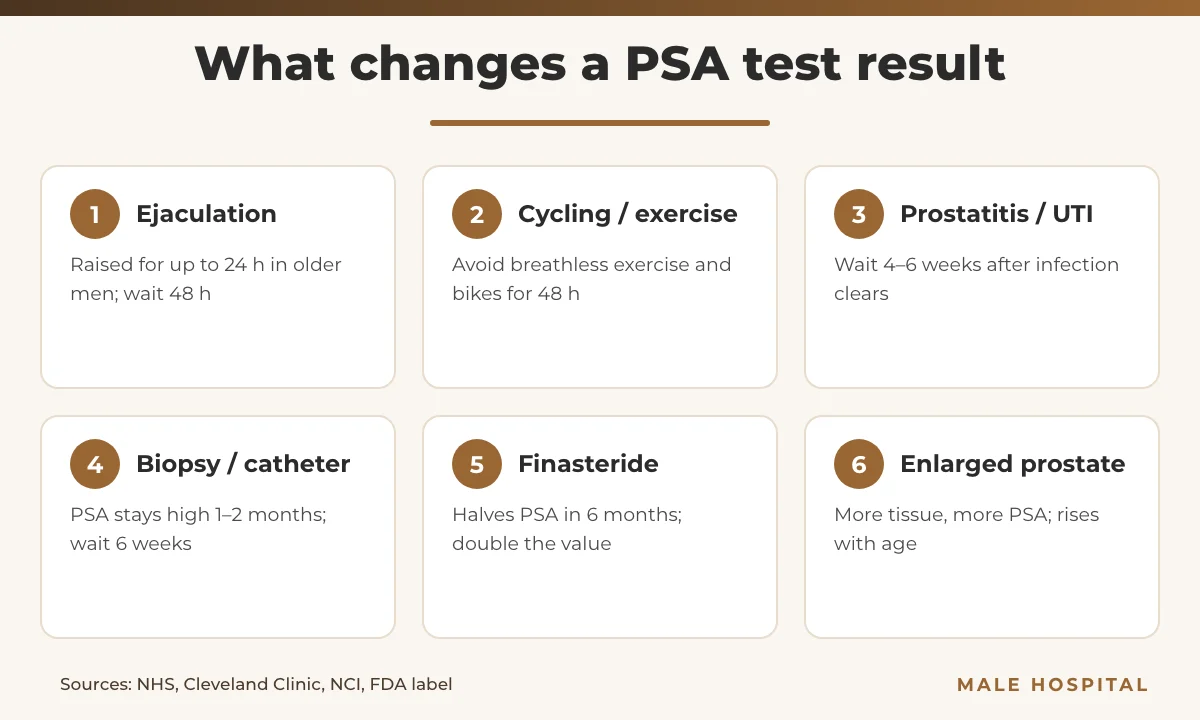
The blood draw takes under five minutes and needs no fasting. What matters is the 48 hours before it: the NHS, Cleveland Clinic and Prostate Cancer UK all advise avoiding ejaculation (sex or masturbation), exercise that leaves you out of breath, and riding a bike for two days beforehand. Prostate Cancer UK adds a one-week pause after anal sex or any prostate stimulation.
Timing around illness and procedures is stricter. After a urinary infection, wait four to six weeks once it clears; after a prostate biopsy, cystoscopy, catheter or prostate surgery, wait about six weeks. If a digital rectal exam (DRE) is planned at the same visit, ask for the blood to be drawn first. Tell the clinic about every medicine you take, especially finasteride or dutasteride, and do not stop any of them on your own. Results usually arrive within one to two weeks.
Source: NHS — PSA testing; Cleveland Clinic — PSA Test; Prostate Cancer UK — The PSA test
7 things that change a PSA test result without cancer
1. Ejaculation
In 20 men with a mean age of 59, total PSA rose one hour after ejaculation and was still raised at 6 and 24 hours; at 24 hours, 40% of the men were above their own baseline. An Istanbul study of 62 men with urinary symptoms found total and free PSA rose at 1 and 5 hours and had settled by 24 hours, with the authors warning that recent ejaculation can tip a borderline value over the biopsy cut-off.
Source: Herschman 1997, Urology — Effect of ejaculation on serum total and free prostate-specific antigen; Tarhan 2016, Int Braz J Urol — Effect of ejaculation on serum PSA concentration
2. Cycling and hard exercise
A meta-analysis of eight studies (912 men) found no significant average change in PSA after cycling, but two of the studies reported rises of up to 3.3-fold after long rides and the trials were small. Guidelines therefore keep the simple rule: no cycling or breathless exercise for 48 hours.
Source: Jiandani 2015, Prostate Cancer Prostatic Dis — The effect of bicycling on PSA levels: a systematic review and meta-analysis; Cancer Research UK — Prostate specific antigen (PSA) test
3. Prostatitis and urinary infection
Acute prostatitis can raise PSA sharply; with antibiotics the level usually returns to normal within one to three months. Chronic or silent inflammation produces smaller, less predictable rises and is a common reason for a persistently borderline result. If you have had pelvic pain, fever or burning when urinating, our guide to prostatitis explains how it is treated before the PSA is rechecked.
Source: Sindhwani & Wilson 2005, Curr Urol Rep — Prostatitis and serum prostate-specific antigen
4. An enlarged prostate (BPH)
More prostate tissue means more PSA, so levels rise slowly with age and gland size. Benign enlargement is the most common reason for a raised result in men over 60, which is why PSA density (PSA divided by prostate volume) helps separate a big benign gland from cancer. Enlargement also affects urinary flow and erections, as we explain in enlarged prostate and erectile dysfunction.
5. Biopsy, catheter and other procedures
A prostate biopsy can keep PSA elevated for a month or two; cystoscopy, a urinary catheter and prostate surgery such as TURP have similar effects, which is why the six-week wait exists.
6. Digital rectal exam
In 202 men aged 50–85, PSA drawn 30 minutes after a DRE was on average 0.26 ng/mL higher, and 2.9% of men crossed the 4 ng/mL line. The change is real but small, so most doctors draw blood first or accept it.
7. Finasteride and dutasteride
These 5-alpha-reductase inhibitors, taken for BPH or hair loss, lower PSA by about 50% within six months. The Proscar label instructs doctors to double the measured value when comparing it with normal ranges, and to investigate “any confirmed increase from the lowest PSA value” on treatment, even if it looks normal. Testosterone therapy can raise PSA, and aspirin, statins and thiazide diuretics may lower it slightly.
Source: American Cancer Society — Tests to Diagnose and Stage Prostate Cancer; Internal Medicine Clinic Research Consortium 1995, Arch Intern Med — Effect of digital rectal examination on serum PSA; DailyMed (FDA label) — PROSCAR (finasteride) prescribing information
PSA test results: normal levels by age
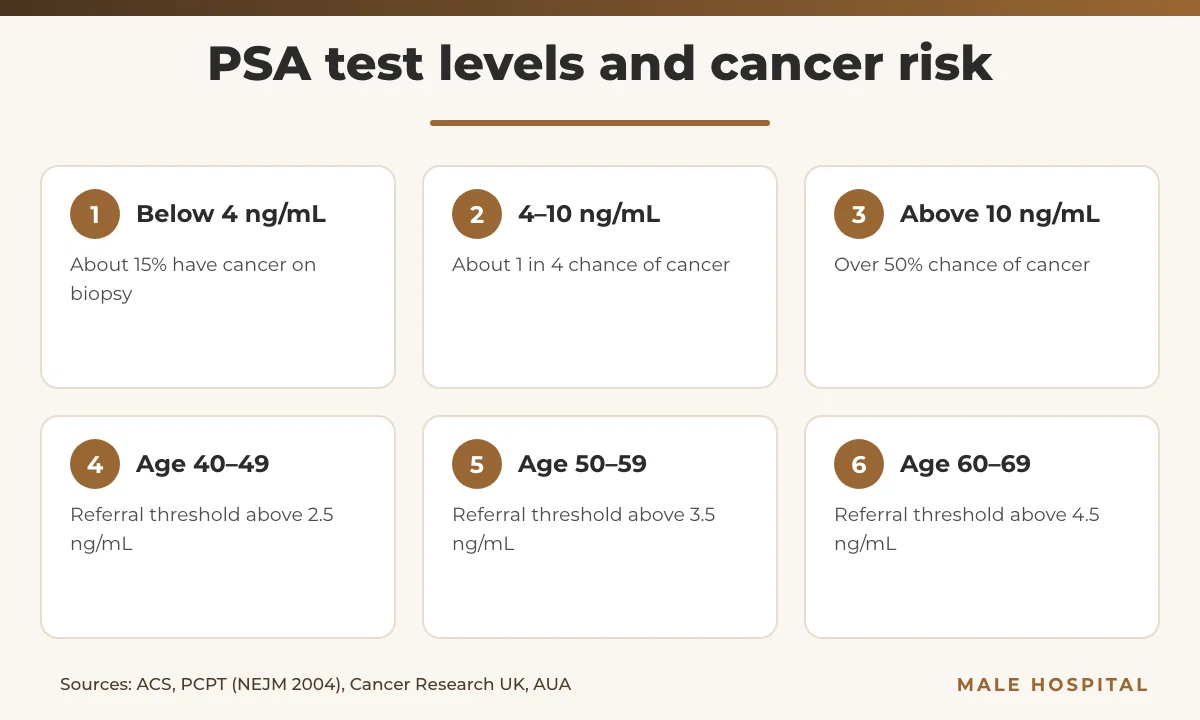
There is no fixed line between normal and abnormal. Historically 4.0 ng/mL was the cut-off and some doctors still use it; others use 2.5 or 3.0, and the European screening trials used 3.0. For many men a normal level is below 3 ng/mL. Because PSA rises with age, UK referral guidance and the AUA both cite age-adjusted thresholds:
| Age | Referral threshold (ng/mL) | What the level suggests |
|---|---|---|
| 40–49 | Above 2.5 | A PSA above 1 ng/mL at 40 already marks a man for closer follow-up (EAU) |
| 50–59 | Above 3.5 | Most screening programs act at 3.0; repeat first |
| 60–69 | Above 4.5 | Benign enlargement is common; PSA density helps |
| 70–79 | Above 6.5 | Screening benefit falls; life expectancy guides the decision |
| Any age | 4–10 | About 1 in 4 chance of cancer on biopsy |
| Any age | Above 10 | Over 50% chance of cancer |
A low number is reassuring but not a guarantee. In the Prostate Cancer Prevention Trial, 2,950 men aged 62–91 whose PSA never exceeded 4.0 all had a biopsy after seven years: 15.2% had cancer, and 14.9% of those cancers were Gleason 7 or higher. Risk rose with the level, from 6.6% at a PSA of 0.5 or less to 26.9% at 3.1–4.0 ng/mL. Prostate Cancer UK puts it simply: “1 in 7 men with a normal PSA may still have prostate cancer”, and 1 in 50 a fast-growing one.
Source: Cancer Research UK — PSA test; American Cancer Society — Tests to Diagnose and Stage Prostate Cancer; Thompson 2004, N Engl J Med — Prevalence of prostate cancer among men with a PSA level ≤4.0 ng per milliliter
Free PSA, PSA density and PSA velocity
Percent-free PSA
Cancer cells release more bound PSA, so a low percentage of free PSA points toward cancer. In a multicenter trial of 773 men with a PSA of 4–10 ng/mL and a benign-feeling prostate, biopsying everyone with 25% free PSA or less detected 95% of cancers while avoiding 20% of unnecessary biopsies; an individual man’s risk ranged from 8% to 56% depending on his ratio. Many doctors recommend a biopsy at 10% or less and consider one between 10% and 25%. The ratio is only useful in the 4–10 range.
PSA density
PSA density divides the level by prostate volume measured on MRI or ultrasound. The EAU notes that a cut-off of 0.15 ng/mL/cc has been used in several studies, and that men with a density below 0.09 had only a 4% chance of clinically significant cancer. Density now sits inside the EAU decision matrix: a PI-RADS 1–2 scan with a density below 0.20 and no family history, or a PI-RADS 3 scan with a density below 0.10, can be followed with PSA monitoring instead of biopsy.
PSA velocity
How fast PSA rises sounds useful, but studies have not shown that velocity adds much to the level itself. The AUA states clinicians “should not use PSA velocity as the sole indication” for a biomarker, imaging or biopsy. A single jump is more often ejaculation, infection or lab variation than cancer, which is why the first response to a rise is a repeat test.
Source: Catalona 1998, JAMA — Use of the percentage of free PSA to enhance differentiation of prostate cancer from benign prostatic disease; EAU — Prostate Cancer Guidelines: Diagnostic Evaluation; Wei 2023, J Urol (PMC) — AUA/SUO Guideline Part I
What happens after a high PSA test
Step 1: repeat it. The EAU advises repeating a PSA of 3–10 ng/mL in a man without symptoms after about four weeks, in the same laboratory and under standardized conditions. The AUA says the same: a newly elevated PSA should be repeated “prior to a secondary biomarker, imaging, or biopsy”. Many raised results simply come back down.
Step 2: risk assessment. If the level stays up, your urologist combines it with a DRE (the AUA suggests one whenever PSA is 2 ng/mL or more), your age, family history, prostate size and, where available, a validated risk calculator or a second blood test such as the Prostate Health Index or 4Kscore. These newer tests may help decide who needs a biopsy, but none has yet been shown to lower prostate cancer deaths.
Step 3: MRI before biopsy. The EAU strongly recommends a prostate MRI for men with a PSA of 3–20 ng/mL before any biopsy. Using a PI-RADS score of 3 or higher to trigger biopsy, the MRI pathway avoids biopsy in 21–49% of men while missing only a small number of mostly low-grade cancers.
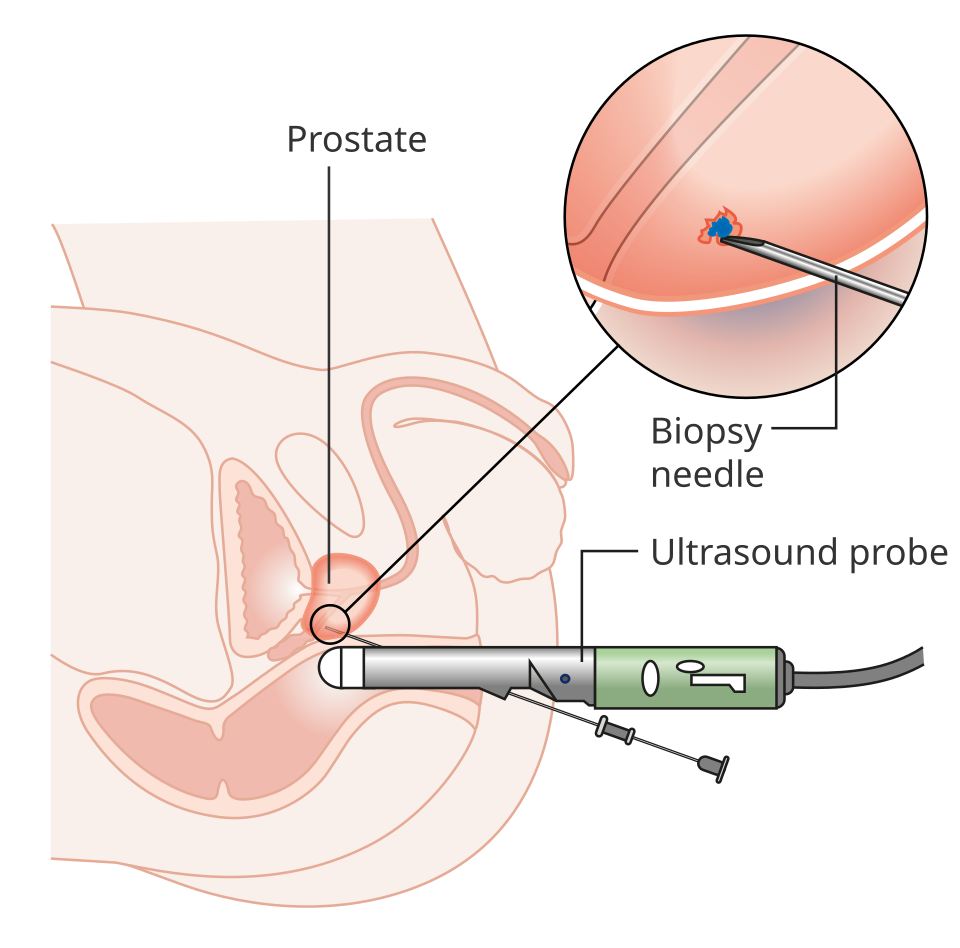
Step 4: biopsy if needed. A biopsy is the only way to confirm cancer. The EAU now recommends the transperineal route (through the skin behind the scrotum), because sepsis occurs in 0.1% of transperineal versus 0.9% of transrectal biopsies, and targeted sampling found significant cancer in 60% of men versus 54% with the older approach in the TRANSLATE trial. Expect blood in the urine or semen for a few weeks afterward.
Source: EAU — Prostate Cancer Guidelines: Diagnostic Evaluation; Wei 2023, J Urol (PMC) — AUA/SUO Guideline Part I; National Cancer Institute — PSA Test Fact Sheet
Benefits and harms of PSA screening
The best evidence comes from the European Randomized Study of Screening for Prostate Cancer (ERSPC), which followed 182,160 men for up to 16 years. Screening cut prostate cancer deaths by 20% (rate ratio 0.80); 570 men had to be invited, and 18 diagnosed, to prevent one death, and the benefit grew with repeated rounds. The USPSTF model for men 55–69 estimates that screening 1,000 men for 13 years prevents about 1.3 prostate cancer deaths and 3 cases of metastatic disease, with no change in overall mortality.
The harms are concrete. Of the same 1,000 men, about 240 will have a positive PSA test, 100 will be diagnosed, 80 treated, 50 will develop sexual dysfunction and 15 urinary incontinence as a result of treatment. More than 15% of men screened every two to four years have at least one false-positive result over ten years, only about 25% of biopsies for a raised PSA find cancer, roughly 1% of biopsies lead to hospital admission, and 20–50% of screen-detected cancers may be overdiagnosed. Most low-risk cancers are now monitored rather than treated, which removes much of that harm.
Source: Hugosson 2019, Eur Urol — A 16-yr Follow-up of the European Randomized study of Screening for Prostate Cancer; USPSTF — Prostate Cancer: Screening; National Cancer Institute — PSA Test Fact Sheet; CDC — Screening for Prostate Cancer
PSA test and your sexual health
Before and during testosterone therapy
The EAU states that a DRE “should be performed in all subjects to exclude prostate abnormalities before testosterone therapy” and that PSA and hematocrit checks are mandatory before and during treatment: at baseline, 3 months, 12 months and then yearly, with a significant rise triggering further tests. The TRAVERSE trial found that in carefully screened men testosterone did not increase prostate cancer, urinary retention or biopsy rates compared with placebo, although PSA rose slightly more in the first year. Untreated or advanced prostate cancer remains an absolute contraindication. If you are considering treatment, read our guides to testosterone replacement therapy and low testosterone treatment.
If you take BPH medicines
Finasteride and dutasteride halve your PSA, so 2.0 ng/mL on these drugs equals roughly 4.0 off them, and any confirmed rise from your lowest value needs a urology review. Both these drugs and alpha-blockers have sexual side effects of their own, explained in BPH medications and sexual side effects.
Erection problems and a raised PSA
The NHS lists trouble getting or keeping an erection among the symptoms that may prompt a PSA test, although erectile dysfunction is far more often vascular, hormonal or psychological than prostate-related. The stronger link is downstream: treatment of a cancer found through screening, whether surgery, radiation or hormone therapy, carries a high risk of erectile dysfunction, which is why guidelines insist on an informed decision before the first test. We describe those effects in prostate cancer treatment side effects on sexual function.
Source: EAU — Sexual and Reproductive Health Guidelines: Male Hypogonadism; Bhasin & Thompson 2024, J Clin Endocrinol Metab — Prostate Risk and Monitoring During Testosterone Replacement Therapy; DailyMed (FDA label) — PROSCAR (finasteride); NHS — PSA testing
If you have a raised PSA test result and are unsure what to do next, or want a baseline PSA before starting testosterone, you can arrange a confidential consultation with our urologist-andrologist in Istanbul via WhatsApp. He will review your numbers, age and risk factors and tell you whether a repeat test, an MRI or simple monitoring is the right next step.
When to see a doctor
Book a PSA test and examination promptly, rather than waiting for a routine screen, if you notice any of the following:
- Blood in your urine or semen.
- Needing to urinate much more often, a sudden urge, or getting up repeatedly at night, especially if new.
- Difficulty starting, a weak stream, or the feeling that your bladder never empties.
- Pain in the pelvis, lower back or hips that does not go away, or bone pain with no injury.
- Fever with pelvic pain and painful urination, which may be acute prostatitis and needs same-day treatment.
- A father or brother diagnosed with prostate cancer, particularly before 60, or a known BRCA2 mutation, if you have never discussed testing.
Urinary symptoms are rarely caused by prostate cancer and far more often by benign enlargement, but they still need a proper assessment.
Source: NHS — PSA testing; MedlinePlus — PSA Test; Cancer Research UK — PSA test
FAQs about the PSA test
What is a normal PSA level for my age?
Most men have a PSA below 3 ng/mL, but the level climbs with age. Commonly used referral thresholds are above 2.5 ng/mL in your 40s, 3.5 in your 50s, 4.5 in your 60s and 6.5 in your 70s. Your doctor sets your personal target using prostate size, symptoms and medicines, so compare your number with that advice rather than a single cut-off.
Source: Cancer Research UK — PSA test; Cleveland Clinic — PSA Test
Can I have sex before a PSA test?
Ejaculation can raise total PSA for up to 24 hours in older men, and 40% of men in one study were still above their baseline a day later. Guidelines therefore recommend no sex or masturbation for 48 hours before the blood draw, and a week without anal sex or prostate stimulation. If you forgot, tell the clinic so the result can be interpreted or repeated.
Source: Herschman 1997, Urology — Effect of ejaculation on serum PSA; Prostate Cancer UK — The PSA test
Does a high PSA mean I have cancer?
No. Only about 25% of men who have a biopsy for a raised PSA are found to have cancer; the rest have benign enlargement, inflammation, infection or a temporary rise from ejaculation or exercise. That is why a raised PSA is repeated after about four weeks and followed by an MRI before anyone discusses a biopsy.
Source: National Cancer Institute — PSA Test Fact Sheet; EAU — Diagnostic Evaluation
Can prostate cancer be present with a normal PSA?
Yes. When men whose PSA never exceeded 4.0 ng/mL were all biopsied, 15.2% had cancer and about one in seven of those cancers was high-grade. A normal result lowers your risk but does not rule cancer out, which is why doctors also weigh the DRE, family history and the trend over time.
Source: Thompson 2004, N Engl J Med — Prevalence of prostate cancer among men with a PSA ≤4.0 ng/mL
How often should I repeat a PSA test?
It depends on your baseline. The AUA suggests every two to four years between 50 and 69, stretching the interval when PSA is below 1 ng/mL and shortening it to one to four years when it is 1–3. The American Cancer Society uses a simpler rule: every two years if PSA is below 2.5 ng/mL, yearly if it is 2.5 or higher.
Source: Wei 2023, J Urol (PMC) — AUA/SUO Guideline Part I; American Cancer Society — Recommendations for Prostate Cancer Early Detection
Does riding a bike really raise PSA?
Probably only a little, and not in everyone. A meta-analysis of eight studies found no significant average rise after cycling, yet individual studies recorded increases of up to 3.3-fold after long rides. Because the trials were small, the safe advice is to skip cycling for the two days before your test.
Source: Jiandani 2015 — The effect of bicycling on PSA levels: a systematic review and meta-analysis
Should I stop finasteride before a PSA test?
No. Do not stop any medicine for a blood test. Tell the clinic you take finasteride or dutasteride; your doctor will double the result to compare it with normal ranges and will track your lowest value on treatment, because any confirmed rise from that point is the signal that matters.
Source: DailyMed (FDA label) — PROSCAR (finasteride); MedlinePlus — PSA Test
Does testosterone therapy make prostate cancer more likely?
In the TRAVERSE trial, men with low testosterone who were screened to exclude high prostate cancer risk had the same low rates of prostate cancer, urinary retention and biopsy whether they received testosterone or placebo, though PSA rose slightly more on testosterone in the first year. PSA and DRE monitoring before and during treatment is still required.
Source: Bhasin & Thompson 2024 — Prostate Risk and Monitoring During Testosterone Replacement Therapy; EAU — Male Hypogonadism
Medically reviewed by Assoc. Prof. Dr. Zülfü Sertkaya, urologist and andrologist (FEBU), Istanbul. Last reviewed: November 2026.
This article is for general information and does not replace an individual consultation with a qualified doctor.
- National Cancer Institute — Prostate-Specific Antigen (PSA) Test Fact Sheet
- MedlinePlus — Prostate-Specific Antigen (PSA) Test
- EAU — Prostate Cancer Guidelines: Diagnostic Evaluation
- EAU — Sexual and Reproductive Health Guidelines: Male Hypogonadism
- Wei JT et al., J Urol 2023 (PMC) — Early Detection of Prostate Cancer: AUA/SUO Guideline Part I: Prostate Cancer Screening
- USPSTF — Prostate Cancer: Screening (2018 recommendation)
- American Cancer Society — Recommendations for Prostate Cancer Early Detection
- American Cancer Society — Tests to Diagnose and Stage Prostate Cancer
- NHS — PSA testing
- Cleveland Clinic — PSA Test
- Prostate Cancer UK — The PSA test
- Cancer Research UK — Prostate specific antigen (PSA) test
- CDC — Screening for Prostate Cancer
- DailyMed (FDA label) — PROSCAR (finasteride) tablets prescribing information
- Daher R, Beaini M., Clin Chem Lab Med 1998 (PubMed) — Prostate-specific antigen and new related markers for prostate cancer
- Richardson TD et al., Urology 1996 (PubMed) — Half-life determination of serum free prostate-specific antigen following radical retropubic prostatectomy
- Herschman JD et al., Urology 1997 (PubMed) — Effect of ejaculation on serum total and free prostate-specific antigen concentrations
- Tarhan F et al., Int Braz J Urol 2016 (PubMed) — Effect of ejaculation on serum prostate-specific antigen concentration
- Jiandani D et al., Prostate Cancer Prostatic Dis 2015 (PubMed) — The effect of bicycling on PSA levels: a systematic review and meta-analysis
- Sindhwani P, Wilson CM., Curr Urol Rep 2005 (PubMed) — Prostatitis and serum prostate-specific antigen
- Internal Medicine Clinic Research Consortium, Arch Intern Med 1995 (PubMed) — Effect of digital rectal examination on serum prostate-specific antigen in a primary care setting
- Thompson IM et al., N Engl J Med 2004 (PubMed) — Prevalence of prostate cancer among men with a prostate-specific antigen level ≤4.0 ng per milliliter
- Catalona WJ et al., JAMA 1998 (PubMed) — Use of the percentage of free prostate-specific antigen to enhance differentiation of prostate cancer from benign prostatic disease
- Hugosson J et al., Eur Urol 2019 (PubMed) — A 16-yr Follow-up of the European Randomized study of Screening for Prostate Cancer
- Bhasin S, Thompson IM., J Clin Endocrinol Metab 2024 (PubMed) — Prostate Risk and Monitoring During Testosterone Replacement Therapy