Penis size and age are linked far less tightly than most men assume. The penis grows mainly during puberty, reaches adult size somewhere between 13 and 18, and then stays essentially the same length for decades: a 2023 meta-analysis of 55,761 measured men found no association between a man’s age and his flaccid, stretched or erect length. What does change after 50 is how the penis looks and performs, because of a thicker pubic fat pad, less elastic erectile tissue, falling testosterone and conditions such as Peyronie’s disease. For the measured averages themselves, see our guide to average penis size.
Source: PMC — Belladelli et al., Worldwide temporal trends in penile length: a systematic review and meta-analysis (World J Mens Health 2023); American Academy of Pediatrics (HealthyChildren.org) — Physical development in boys: what to expect
- Penis size and age are linked mainly in puberty: boys usually start it between 9 and 14; the testicles enlarge first, then the penis grows in length and later in width.
- Adult genital size is reached as early as 13 or as late as 18. After that, penis size and age part ways: measured penis length does not fall with age.
- In a German study, men aged 40 to 68 had the same erect length as men aged 18 to 19, but a slightly longer flaccid penis and a thinner erection.
- After 50, penis size and age do seem to connect: the penis can look or feel smaller because of belly fat, stiffer erectile tissue, weaker erections and lower testosterone, not because the organ itself has shrunk.
- Whatever the link between penis size and age, Peyronie’s disease, prostate surgery, smoking and injury can cause real length loss; most of it is preventable or treatable.
- Does penis size change with age?
- Penis size and age in childhood and puberty
- When does the penis stop growing?
- Penis size and age in adulthood: 20s to 40s
- Penis size after 50: what actually changes
- Medical causes of penile shortening at any age
- Penis size and age at a glance
- How to protect size and function as you age
- When to see a doctor
- FAQs about penis size and age
Does penis size change with age?
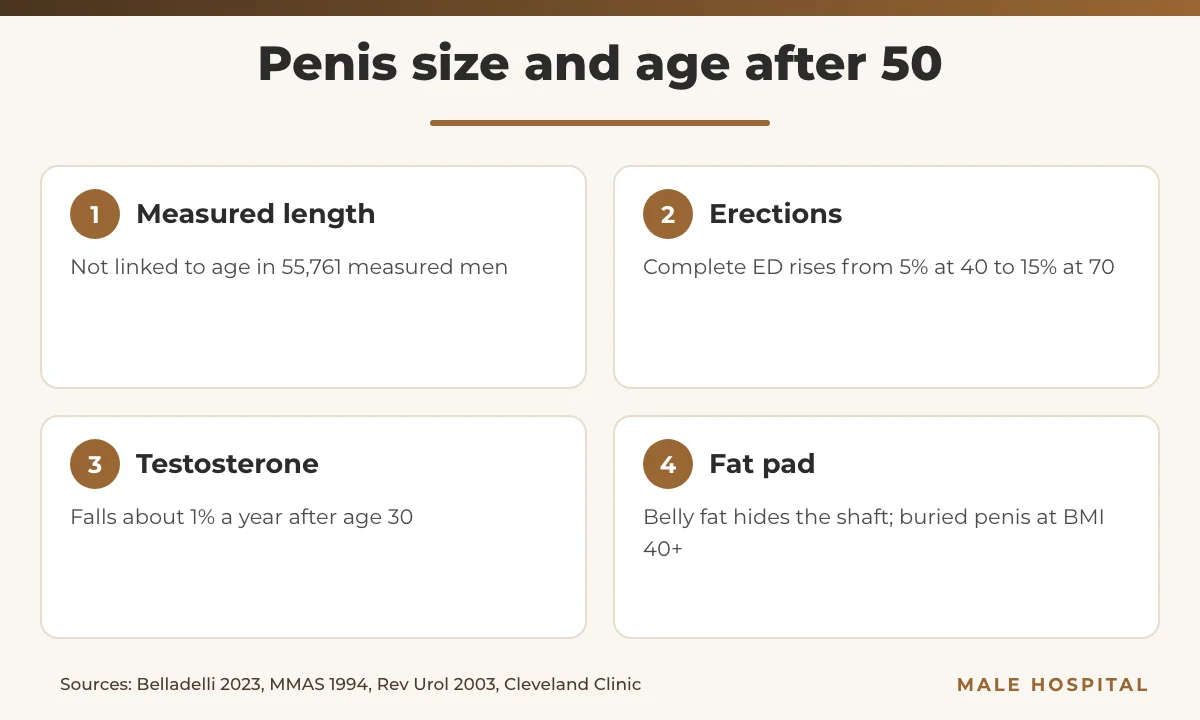
Measured by clinicians, no: penis size and age are not linked in adults. The largest analysis so far pooled 75 studies published between 1942 and 2021 covering 55,761 men aged 17 and over. Pooled averages were 8.70 cm flaccid, 12.93 cm stretched and 13.93 cm erect. When the authors adjusted for region and population type, participant age was not associated with any of the three measurements (flaccid p = 0.079, stretched p = 0.372, erect p = 0.505).
Why, then, if penis size and age are unrelated, do so many men over 50 feel smaller? Because what changes with age is the surroundings and performance of the penis, not its tissue length: fat over the pubic bone hides part of the shaft, erectile tissue loses elasticity, testosterone drifts down, and conditions that physically shorten the penis become more common. Each is covered below.
Penis size and age in childhood and puberty
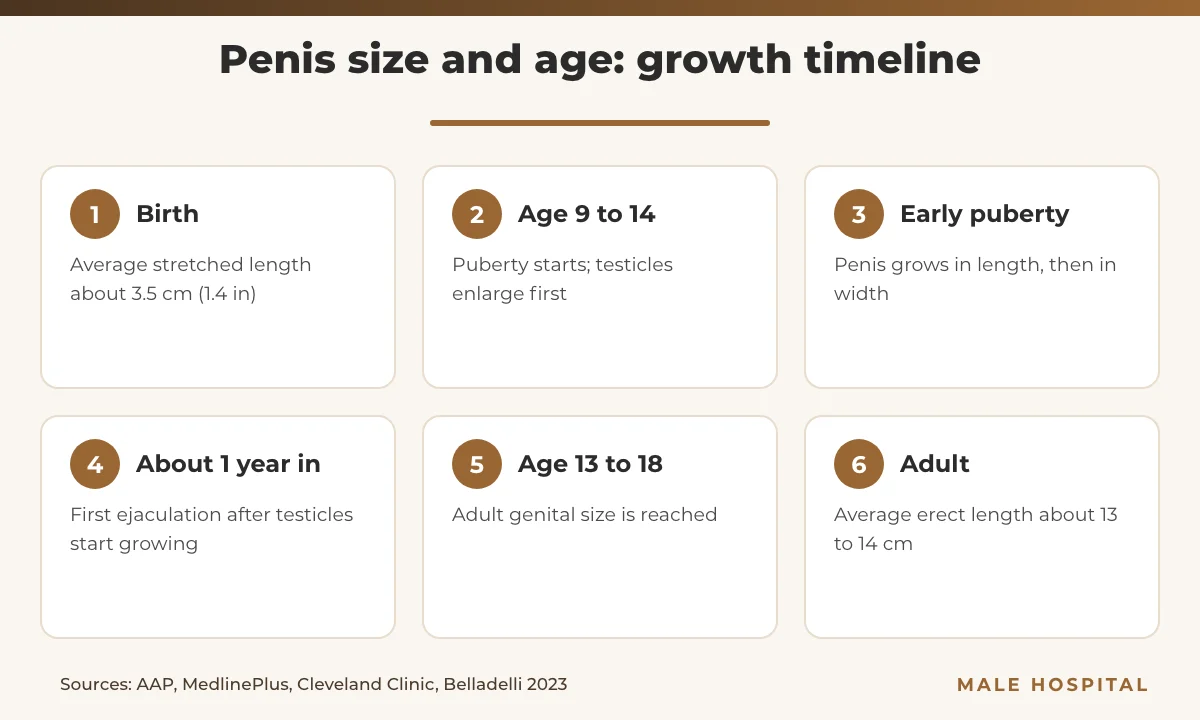
The story of penis size and age begins at birth: in a newborn boy the average stretched penile length is about 3.5 cm (1.4 in); a stretched length of 1.9 cm (0.75 in) or less meets the definition of micropenis, which is why pediatricians check the genitals at birth. If micropenis is confirmed, a short course of testosterone in infancy is the usual first-line treatment, and growth is good in many treated infants when the diagnosis is made early.
Source: Cleveland Clinic — Micropenis: causes, symptoms, diagnosis and treatment
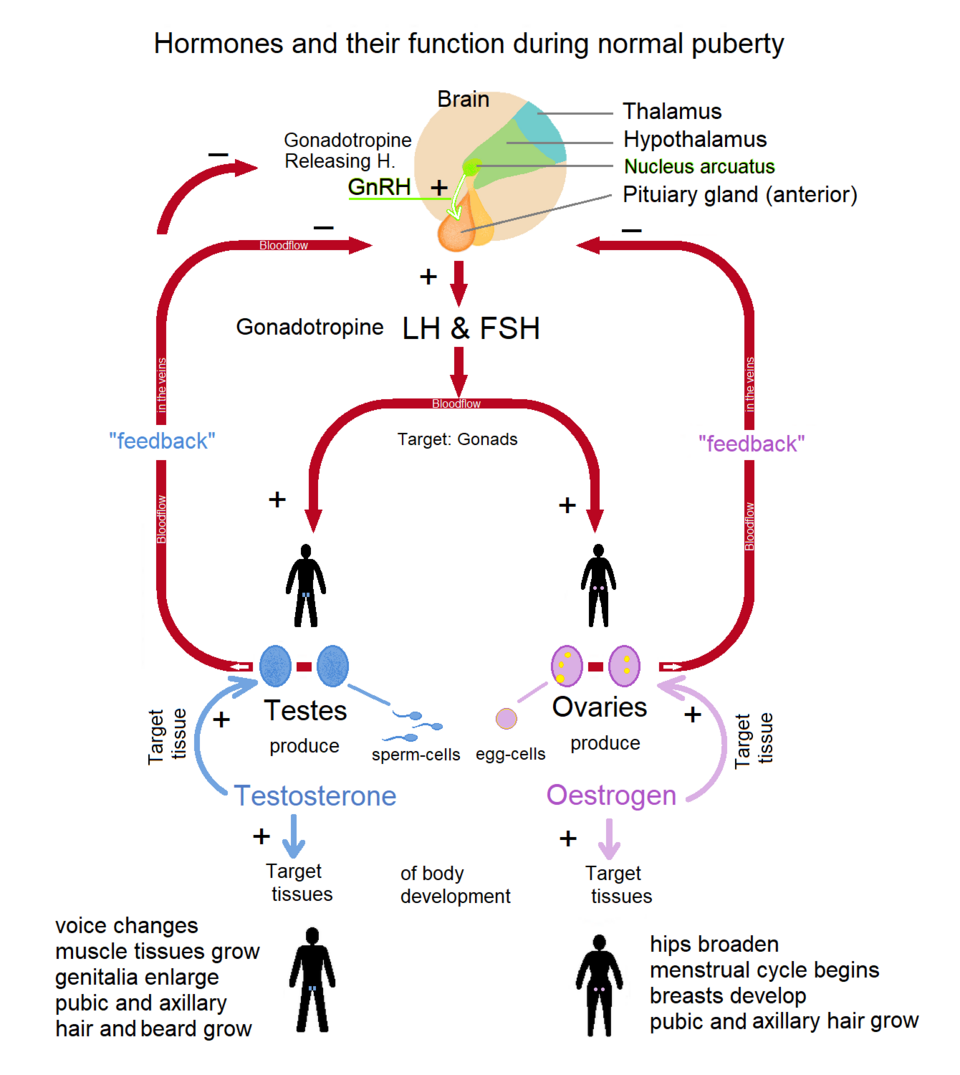
Through childhood the penis grows only slowly, so penis size and age are loosely matched until puberty. The real change comes with puberty, which for boys usually starts between ages 9 and 14. The first sign is not the penis at all but the testicles: a near doubling of testicular and scrotal size announces that puberty has begun, driven by the rise in luteinizing hormone (LH), follicle-stimulating hormone (FSH) and testosterone shown in the diagram above. Pubic hair follows, and only then does the penis begin to enlarge, first in length and afterwards in width.
Source: MedlinePlus — Puberty; American Academy of Pediatrics (HealthyChildren.org) — Physical development in boys: what to expect
The timing varies widely and often runs in families, which is why penis size and age never match exactly between boys. The NHS considers it normal for puberty to start anywhere between 8 and 14; signs before 8 may indicate early puberty, and no signs by 15 may indicate delayed puberty. In boys, the specific warning signs of delay are testicles and penis that have not started to grow by 14, or genital growth that drags on for more than five years. A doctor can check hormone levels and order a wrist X-ray for bone age; treatment is usually only needed when the delay causes physical or emotional problems.
Source: NHS — Early or delayed puberty; Nemours KidsHealth — Puberty basics
When does the penis stop growing?
According to the American Academy of Pediatrics, a boy may have adult-size genitals as early as 13 or as late as 18, so penis size and age vary widely within a single class of teenagers. Because the penis lengthens before it thickens, a teenager can be at his final length while girth is still catching up. The first ejaculation typically occurs about a year after the testicles begin to enlarge, which is usually well before the penis reaches its adult dimensions.
Three practical points about penis size and age follow. First, a 15-year-old who is “smaller than his friends” is very often simply earlier or later in the same process. Second, there is no evidence that the penis keeps growing in the 20s; growth ends when puberty ends. Third, in an adult, a stretched length of 6.8 cm (2.67 in) or less is the threshold for micropenis, a rare condition that is almost always identified long before adulthood.
Source: American Academy of Pediatrics (HealthyChildren.org) — Physical development in boys: what to expect; Cleveland Clinic — Micropenis
European urology guidelines define micropenis as a stretched length more than 2.5 standard deviations below the mean for the man’s age and ethnicity, and separate it from a “short penis” complaint in a man of normal size and from a buried penis hidden by obesity. Age-specific reference charts matter because penis size and age must be read together in children: a measurement that is small for an adult may be entirely normal for a 13-year-old who has only just entered puberty.
Source: EAU Guidelines — Sexual and Reproductive Health: penile size abnormalities and dysmorphophobia
Penis size and age in adulthood: 20s to 40s
Once puberty is complete, penis size and age stop tracking each other. The Veale nomograms, built from up to 15,521 men measured by health professionals, give an average flaccid length of 9.16 cm, stretched length of 13.24 cm and erect length of 13.12 cm. Height was the only body measurement with a link to penile length, and that correlation was modest (r = 0.2 to 0.6); a later study of 800 Argentine men found low or no correlation with height, weight or foot length.
Source: PubMed — Veale et al., Am I normal? Nomograms for flaccid and erect penis length and circumference in up to 15,521 men (BJU Int 2015); PubMed — Solé et al., Reference penile size measurement and correlation with other anthropometric dimensions: a prospective study in 800 men (Asian J Androl 2022)
The most direct comparison of penis size and age in young and older men comes from a German urology department that measured 111 men aged 18 to 19 and 32 men aged 40 to 68. Erect length was statistically the same in both groups (14.48 cm versus 14.18 cm). The older men actually had a slightly longer flaccid penis (9.22 cm versus 8.60 cm), but a thinner erection: erect width at the base was 3.95 cm in the young group and 3.50 cm in the older group, and glans width 3.49 cm versus 3.32 cm. One caveat is that the older men’s erections were produced with an intracavernosal injection rather than self-stimulation.
The meta-analysis authors read the longer flaccid but equal erect length in older men as a sign that penile elasticity changes with age: older tissue stretches further at rest but does not expand more when erect. In everyday terms, the penis may hang a little longer and fill out a little less; neither change means the organ has grown or shrunk, and neither alters the basic penis size and age finding.
Source: PubMed — Schneider et al., Does penile size in younger men cause problems in condom use? A prospective measurement of penile dimensions in 111 young and 32 older men (Urology 2001); PMC — Belladelli et al., Worldwide temporal trends in penile length (2023)
Penis size after 50: what actually changes
The pubic fat pad
The base of the penis sits behind the skin and fat of the lower abdomen. As weight accumulates below the navel, that fat pad buries more of the shaft, so the visible penis gets shorter even though the measured, bone-pressed length is unchanged; this is the most common reason penis size and age seem connected. Cleveland Clinic urologists note that a true buried penis can develop at a body mass index of 40 or higher, and that weight loss often resolves the problem; European guidelines name obesity as the main risk factor for adult acquired buried penis. If this sounds familiar, our guide to buried penis explains the diagnosis and the surgical options.
Source: Cleveland Clinic — Can your penis shrink?; Cleveland Clinic — Buried or hidden penis; EAU Guidelines — Penile size abnormalities and dysmorphophobia
Less elastic erectile tissue
Ageing alters the corpora cavernosa and the tunica albuginea around them. Atherosclerosis in the small penile arteries lowers oxygen levels in the tissue, smooth muscle cells are lost, and the balance of collagen types shifts, reducing elasticity. Researchers describe a diffuse, slowly progressive fibrosis of the erectile tissue as the common pathway behind vascular erectile dysfunction linked to ageing, smoking, diabetes and high blood pressure. This fibrosis is the second link between penis size and age: it is why an erection in later life may be slightly shorter and less rigid than at 25 (by fractions of an inch, according to Cleveland Clinic), and why men who keep their blood vessels healthy may never notice a difference.
Source: PMC — El-Sakka, Reversion of penile fibrosis: current information and a new horizon (Arab J Urol 2011); PubMed — Gonzalez-Cadavid, Mechanisms of penile fibrosis (J Sex Med 2009); Cleveland Clinic — Can your penis shrink?
Weaker and less frequent erections
Erection quality, not length, is the penis size and age change most men notice first. In the Massachusetts Male Aging Study of men aged 40 to 70, some degree of erectile difficulty affected 52%, and complete erectile dysfunction tripled from 5% at 40 to 15% at 70. Age was the strongest predictor, but the risk also rose with heart disease, hypertension, diabetes, their medications, and smoking. MedlinePlus adds that erections normally occur less often with age, and that about 90% of erectile dysfunction has a medical rather than psychological cause, which means it is usually treatable.
Source: PubMed — Feldman et al., Impotence and its medical and psychosocial correlates: results of the Massachusetts Male Aging Study (J Urol 1994); MedlinePlus — Aging changes in the male reproductive system
Lower testosterone and reduced sensitivity
Total testosterone falls gradually, at roughly 1% a year after age 30, and the free, active fraction falls faster (about 2% to 3% a year) because the liver makes more sex hormone-binding globulin. By their 60s around 20% of men, and by their 80s around 50%, have total testosterone clearly below young-adult levels. Testosterone also maintains erectile tissue: androgen deprivation leads to atrophy of penile tissue, loss of trabecular smooth muscle and fat deposits beneath the tunica, which is why severe hypogonadism can reduce size as well as desire. Normal age-related decline is far milder and does not explain most penis size and age worries; our article on normal testosterone levels by age explains when a level is actually low.
Nerve function changes too, another penis size and age factor that affects feeling rather than length. In 39 healthy men aged 21 to 82, penile vibration and electrical thresholds rose with age (the penis became less sensitive) and erectile response to erotic stimulation declined, while self-rated erectile capacity did not. It is a small study, but it fits the common experience that more direct stimulation is needed in later life.
Source: PMC — Matsumoto, Fundamental aspects of hypogonadism in the aging male (Rev Urol 2003); Harvard Health — Testosterone: what it does and doesn’t do; PMC — El-Sakka, Reversion of penile fibrosis (2011); PubMed — Rowland et al., Aging and sexual function in men (Arch Sex Behav 1993)
Medical causes of penile shortening at any age
A few conditions do shorten the penis, and most become more common with age, which is where penis size and age genuinely overlap. Recognizing them matters because each has a treatment path.
Peyronie’s disease
Scar tissue (plaque) in the tunica albuginea makes the erect penis bend, narrow or develop an hourglass shape, and the plaque reduces functional length and sometimes girth. Cleveland Clinic estimates that about 6% to 10% of men between 40 and 70 have Peyronie’s disease, with risk rising with age, family history and connective tissue disorders, making it the main medical link between penis size and age. A pain-free curve that has always been there is not Peyronie’s; a new curve, a palpable lump, painful erections or a recent loss of length deserves an early urology visit, because the acute phase (6 to 12 months) is when treatment can limit the damage.
Source: Cleveland Clinic — Peyronie’s disease; Cleveland Clinic — Can your penis shrink?
Radical prostatectomy
Removal of the prostate for cancer typically costs about 1 cm of stretched length, a measurable penis size and age effect with a specific cause. In a prospective study of 105 men the loss was present at 3 months, persisted at 24 months, shrank to 0.6 cm at 36 months and was no longer significant at 48 and 60 months; a separate series of 126 men found the greatest shortening (0.84 cm) at catheter removal. In both studies, nerve-sparing surgery and recovery of erections predicted recovery of length, one more reason to start erectile rehabilitation after prostatectomy early.
Source: PubMed — Vasconcelos et al., The natural history of penile length after radical prostatectomy: a long-term prospective study (Urology 2012); PubMed — Gontero et al., New insights into the pathogenesis of penile shortening after radical prostatectomy (J Urol 2007)
Smoking, injury and cold
Long-term smoking reduces penile blood flow and tissue elasticity and raises the risk of erectile dysfunction and Peyronie’s disease; quitting reverses some of the damage. Trauma leaves scar tissue that is less elastic than normal tissue and can limit erections. Cold is the one cause that is entirely temporary and unrelated to penis size and age: the muscles of the scrotum and penis contract to protect sperm production, and everything returns to normal on warming up.
Source: Cleveland Clinic — Can your penis shrink?
Penis size and age at a glance
The table summarizes the measured penis size and age facts at each stage of life. Averages are clinician-measured; individual variation is wide and normal.
| Life stage | What the evidence shows | What it means |
|---|---|---|
| Newborn | Average stretched length about 3.5 cm; 1.9 cm or less is micropenis | Checked at birth; testosterone in infancy if needed |
| Childhood (to 9–14) | Slow growth; puberty normally begins between 9 and 14 | Testicles enlarge first, then pubic hair, then penis |
| Puberty | Penis grows in length, then width; first ejaculation about a year after testicles start growing | No growth by 14 or growth lasting over 5 years should be checked |
| 13–18 | Adult genital size reached | Growth ends with puberty; no further growth in the 20s |
| Adults 18–40 | Average erect length about 13.1–13.9 cm; age not associated with size in 55,761 men | Only height shows a weak correlation |
| 40–70 | Erect length unchanged; flaccid slightly longer, erection slightly thinner; complete ED rises from 5% to 15% | Elasticity and blood flow change, not length |
| 70+ | Testosterone down about 1% a year since 30; about half of men in their 80s below young-adult levels | Fat pad, fibrosis and hormones shape appearance and function |
Source: Cleveland Clinic — Micropenis; American Academy of Pediatrics — Physical development in boys; PMC — Belladelli et al. (2023); PubMed — Feldman et al. (1994)
How to protect size and function as you age
Because the penis size and age changes are mostly vascular, hormonal and weight-related, the same habits that protect the heart protect the penis. None of these will add length to a healthy adult penis; their value is in preventing the losses described above.
- Keep the fat pad thin. Weight loss is the first treatment for a penis hidden by abdominal fat and often resolves a buried penis without surgery.
- Protect the blood vessels. Treating high blood pressure, diabetes and high cholesterol preserves both erections and the oxygen supply erectile tissue needs. A new decline in erection quality can be an early sign of heart disease.
- Stop smoking. Smoking impairs penile blood flow and elasticity and raises the risk of Peyronie’s disease; quitting reverses some of the harm.
- Act early on Peyronie’s or post-surgical shortening. Treatment works best in the active phase, and after prostatectomy erectile rehabilitation supports recovery of length.
- Have testosterone measured, not guessed. Low desire, fatigue and weaker erections, rather than concern about penis size and age alone, justify a morning blood test; replacement is only appropriate for confirmed deficiency.
Source: Cleveland Clinic — Can your penis shrink?; National Institute on Aging — Sexuality and intimacy in older adults; MedlinePlus — Aging changes in the male reproductive system
Men of any age who are unhappy with a normal-sized penis sometimes ask about enlargement instead of reassurance about penis size and age. European guidelines advise counseling and screening for body dysmorphic disorder first, because most men who request enlargement measure within the normal range. If, after assessment, a procedure is appropriate, our penis enlargement page explains the realistic options and their limits.
Source: EAU Guidelines — Penile size abnormalities and dysmorphophobia
When to see a doctor
Penis size and age rarely need medical attention on their own, but the following changes do, because they point to a treatable condition rather than normal ageing:
- A boy with no testicular or penile growth by 14, puberty signs before 8, or genital growth that has continued for more than five years.
- A newborn or child whose penis seems very small; micropenis is treated most successfully in infancy.
- A new curve, lump, indentation or loss of erect length in an adult, which is not a normal penis size and age change, especially with painful erections (possible Peyronie’s disease).
- Erections that are regularly shorter, softer or less frequent than before, the penis size and age change men usually notice first. The National Institute on Aging advises seeing a doctor when this happens often; it can be the first sign of cardiovascular disease.
- Difficulty urinating, pain or recurrent skin infections in a penis buried by abdominal fat.
- Sudden pain, swelling or bruising after a bend during sex, which may be a penile fracture and is an emergency.
Source: NHS — Early or delayed puberty; National Institute on Aging — Sexuality and intimacy in older adults; Cleveland Clinic — Peyronie’s disease
If you have noticed a change in the size, shape or performance of your penis and want a clear answer about penis size and age rather than guesswork, Assoc. Prof. Dr. Zülfü Sertkaya, urologist and andrologist in Istanbul, offers confidential assessments that include measurement, erectile evaluation and hormone testing. You can ask questions or book a consultation on WhatsApp.
FAQs about penis size and age
At what age does the penis grow the most?
Penis size and age are most closely linked during puberty, which in boys usually starts between 9 and 14. The testicles enlarge first, then pubic hair appears, and then the penis grows, first in length and later in width. The fastest genital growth happens in the middle and later stages of puberty, alongside the height spurt.
Source: American Academy of Pediatrics — Physical development in boys; MedlinePlus — Puberty
Does the penis keep growing after 18?
Not in a meaningful way, and penis size and age are unrelated from then on. Adult genital size is reached somewhere between 13 and 18, and large pooled studies of men aged 17 and over show no relationship between age and penile length. Some late developers finish puberty at 18 or slightly after, but there is no evidence of growth continuing through the 20s.
Source: American Academy of Pediatrics — Physical development in boys; PMC — Belladelli et al. (2023)
Does the penis really shrink after 50 or 60?
Measured length does not fall with age in healthy men, which is the central penis size and age finding. What many men experience is a penis that looks shorter because of pubic fat, erections that are slightly less full because erectile tissue loses elasticity, and lower testosterone. Real shortening usually has a specific cause such as Peyronie’s disease or prostate surgery.
Source: PMC — Belladelli et al. (2023); Cleveland Clinic — Can your penis shrink?
Why does my flaccid penis hang lower now than when I was young?
Tissue elasticity changes with age, one penis size and age change that is harmless. In a German study, men aged 40 to 68 had a flaccid length about 0.6 cm longer than men aged 18 to 19, while erect length was the same. The resting penis stretches further but does not expand more when erect, so a longer “hang” is not a sign of a problem.
Source: PubMed — Schneider et al. (Urology 2001)
Can low testosterone make the penis smaller?
Severe, untreated androgen deficiency can cause atrophy of erectile tissue, loss of smooth muscle and fat deposits beneath the tunica, which reduces size and erection quality. The normal age-related decline of about 1% a year is far milder and mainly affects desire and erection firmness. A blood test, not symptoms or assumptions about penis size and age, decides whether testosterone is low.
Source: PMC — El-Sakka, Reversion of penile fibrosis (2011); PMC — Matsumoto, Fundamental aspects of hypogonadism in the aging male (2003)
How much length is lost after prostate surgery, and does it come back?
About 1 cm of stretched length is typical in the first year after radical prostatectomy. In a five-year prospective study the difference faded by 36 months and was no longer significant at 48 months. Men who had nerve-sparing surgery and recovered erections regained length sooner, so early erectile rehabilitation is worthwhile.
Source: PubMed — Vasconcelos et al. (Urology 2012); PubMed — Gontero et al. (J Urol 2007)
Is a small penis in a teenager a reason to worry?
Usually not, because penis size and age vary widely in the teenage years. Boys reach adult genital size anywhere from 13 to 18, so classmates can be years apart in the same process. A doctor should assess a boy whose testicles and penis have not started growing by 14, or whose genital growth has lasted more than five years, because hormone tests and a bone-age X-ray can rule out treatable causes.
Source: Nemours KidsHealth — Puberty basics; NHS — Early or delayed puberty
Medically reviewed by Assoc. Prof. Dr. Zülfü Sertkaya, urologist and andrologist (FEBU), Istanbul. Last reviewed: November 2026.
This article is for general information and does not replace an individual consultation with a qualified doctor.
- PMC (World Journal of Men's Health) — Belladelli et al. Worldwide temporal trends in penile length: a systematic review and meta-analysis (2023)
- PubMed (BJU International) — Veale et al. Am I normal? Nomograms for flaccid and erect penis length and circumference in up to 15,521 men (2015)
- PubMed (Urology) — Schneider et al. Does penile size in younger men cause problems in condom use? A prospective measurement of penile dimensions in 111 young and 32 older men (2001)
- PubMed (Asian Journal of Andrology) — Solé et al. Reference penile size measurement and correlation with other anthropometric dimensions: a prospective study in 800 men (2022)
- American Academy of Pediatrics (HealthyChildren.org) — Physical development in boys: what to expect
- MedlinePlus — Puberty
- NHS — Early or delayed puberty
- Nemours KidsHealth — Puberty basics (for teens)
- Cleveland Clinic — Micropenis: causes, symptoms, diagnosis and treatment
- EAU Guidelines — Sexual and Reproductive Health: penile size abnormalities and dysmorphophobia
- Cleveland Clinic — Can your penis shrink?
- Cleveland Clinic — Buried or hidden penis: causes, symptoms and treatment
- MedlinePlus — Aging changes in the male reproductive system
- PMC (Arab Journal of Urology) — El-Sakka. Reversion of penile fibrosis: current information and a new horizon (2011)
- PubMed (Journal of Sexual Medicine) — Gonzalez-Cadavid. Mechanisms of penile fibrosis (2009)
- PubMed (Journal of Urology) — Feldman et al. Impotence and its medical and psychosocial correlates: results of the Massachusetts Male Aging Study (1994)
- PMC (Reviews in Urology) — Matsumoto. Fundamental aspects of hypogonadism in the aging male (2003)
- Harvard Health Publishing — Testosterone: what it does and doesn't do
- PubMed (Archives of Sexual Behavior) — Rowland et al. Aging and sexual function in men (1993)
- Cleveland Clinic — Peyronie's disease
- PubMed (Urology) — Vasconcelos et al. The natural history of penile length after radical prostatectomy: a long-term prospective study (2012)
- PubMed (Journal of Urology) — Gontero et al. New insights into the pathogenesis of penile shortening after radical prostatectomy and the role of postoperative sexual function (2007)
- National Institute on Aging — Sexuality and intimacy in older adults