
Sperm Retrieval Surgery in Istanbul
Sperm retrieval surgery collects sperm directly from the epididymis or the testicle in men with azoospermia, meaning no sperm in the ejaculate. The sperm are then used for ICSI, where a single sperm is injected into each egg, or frozen for later cycles. The right method depends on the cause: needle techniques such as PESA and TESA usually work when sperm are blocked, while microdissection TESE (micro-TESE) is the guideline choice when the testicles make very little sperm.
Source: EAU — Sexual and Reproductive Health Guidelines (male infertility chapter); NHS — Infertility: treatment
- There are four main sperm retrieval surgery techniques: PESA and TESA (needle methods), conventional TESE (open biopsy) and micro-TESE (microscope-guided).
- In obstructive azoospermia sperm production is normal, so sperm retrieval surgery finds sperm in most men and simple needle methods are usually enough.
- In non-obstructive azoospermia, large studies report sperm in about 46–47% of procedures; the EAU names micro-TESE the treatment of choice and advises against needle aspiration.
- Retrieved sperm are always used with ICSI and can be frozen; a meta-analysis reported a live birth rate of about 24% per ICSI cycle in non-obstructive cases.
- Genetic tests come first: men with complete AZFa or AZFb Y-chromosome deletions should not have sperm retrieval surgery.
Told you have zero sperm? Send your semen, hormone and genetic results for a confidential, personalised opinion on sperm retrieval surgery from our urologist-andrologist.
- What is sperm retrieval surgery?
- Who is a good candidate for sperm retrieval surgery?
- Sperm retrieval surgery options compared: PESA, TESA, TESE and micro-TESE
- The procedure step by step
- Success rates and what predicts them
- Recovery timeline
- Risks and side effects
- Results and realistic expectations: freezing, ICSI and pregnancy
- Treatment with Dr. Zülfü Sertkaya in Istanbul
- How to start
- When to see a doctor
- FAQs about sperm retrieval surgery
What is sperm retrieval surgery?
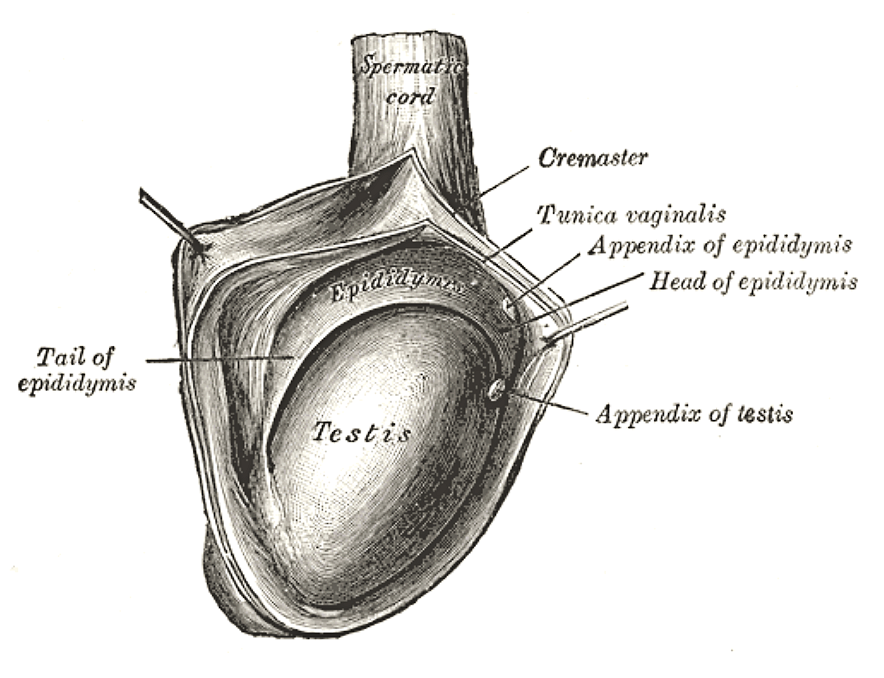
Sperm are made inside the testicles in tiny coiled tubes called seminiferous tubules. They mature in the epididymis, a coiled duct on the back of each testicle, and then travel up the vas deferens to mix with seminal fluid at ejaculation. Azoospermia means that none of these sperm reach the final sample, either because they are blocked on the way or because the testicles make very few.
Sperm retrieval surgery bypasses that problem by taking sperm from where they are made or stored. The NHS notes that surgical sperm extraction is usually done as an outpatient procedure, often under local anesthetic, and that any sperm found are frozen for later use. Micro-TESE is the exception: it is normally done under general anesthesia.
Source: NHS — Infertility: treatment; Cleveland Clinic — MicroTESE (Microdissection Testicular Sperm Extraction)
The key distinction in sperm retrieval surgery is between two types of azoospermia. In obstructive azoospermia (OA), the testicles produce sperm normally but a blockage stops them. The EAU reports that OA accounts for 20–40% of azoospermic men, who usually have normal FSH and normal-sized testicles. In non-obstructive azoospermia (NOA), production itself is failing, and sperm, if present, sit in small scattered pockets of the testicle.
Source: EAU — Sexual and Reproductive Health Guidelines (male infertility chapter); Cleveland Clinic — Azoospermia (Zero Sperm Count): Causes & Treatment
Who is a good candidate for sperm retrieval surgery?
Sperm retrieval surgery is considered only after azoospermia has been confirmed. The EAU recommends at least two semen analyses, with the sample centrifuged so that very rare sperm are not missed, followed by a full work-up. Typical candidates include men with:
- Obstructive azoospermia: after vasectomy, infection, groin or scrotal surgery, or congenital absence of the vas deferens (CBAVD), when repair is not chosen or not possible.
- Non-obstructive azoospermia: including previously undescended testicles, Klinefelter syndrome (47,XXY) and AZFc Y-chromosome microdeletions.
- Azoospermia after chemotherapy or radiotherapy: the AUA/ASRM guideline says these men should be told TESE is a treatment option.
- A failed earlier attempt: a salvage micro-TESE can be considered after an unsuccessful TESA or conventional TESE.
Source: EAU — Sexual and Reproductive Health Guidelines (male infertility chapter); AUA/ASRM — Diagnosis and Treatment of Infertility in Men: Guideline Part II
Some men need a different first step. Men with low pituitary hormones (hypogonadotropic hypogonadism) are treated with hCG and FSH injections, which can restart sperm production without sperm retrieval surgery. Men taking testosterone or anabolic steroids must stop, because outside testosterone switches off sperm production. When obstruction is the cause and the female partner has good ovarian reserve, the EAU strongly recommends microsurgical repair, such as vasectomy reversal.
Source: EAU — Sexual and Reproductive Health Guidelines (male infertility chapter); AUA/ASRM — Diagnosis and Treatment of Infertility in Men: Guideline Part II
There is one firm exclusion. The EAU advises against sperm retrieval surgery in men with complete AZFa or AZFb deletions, because the chance of finding sperm is effectively zero. A karyotype and Y-chromosome microdeletion test, with genetic counselling, should therefore always come before any operation. For the full range of causes and options beyond surgery, see our male infertility treatment page.
Source: EAU — Sexual and Reproductive Health Guidelines (male infertility chapter)
Sperm retrieval surgery options compared: PESA, TESA, TESE and micro-TESE
Each sperm retrieval surgery technique differs in where sperm are taken from, how much tissue is explored and whether a microscope is used. PESA (percutaneous epididymal sperm aspiration) draws fluid from the epididymis with a fine needle. TESA (testicular sperm aspiration) uses a needle in the testicle. Conventional TESE removes small open biopsies, and micro-TESE opens the testicle and selects tubules under an operating microscope.
| Method | How it works | Best suited to | Main limitation |
|---|---|---|---|
| PESA | Fine needle into the epididymis through the skin | Obstructive azoospermia | Blind; may miss sperm-containing ducts |
| MESA | Epididymis opened under a microscope | Obstructive; often yields sperm for several cycles | Open microsurgery |
| TESA | Needle aspiration of testicular tissue | Obstructive azoospermia | 11–60% in NOA; not recommended there |
| Conventional TESE | One or more open biopsies without magnification | Where microsurgery is not available | More hematoma and scarring |
| Micro-TESE | Testicle opened; healthier tubules picked at 24–36× magnification | Non-obstructive azoospermia | General anesthesia, longer surgery, specialist skill |
Source: EAU — Sexual and Reproductive Health Guidelines (male infertility chapter); J Clin Med (PMC) — Colpi & Caroppo 2021, Performing microdissection TESE: surgical pearls
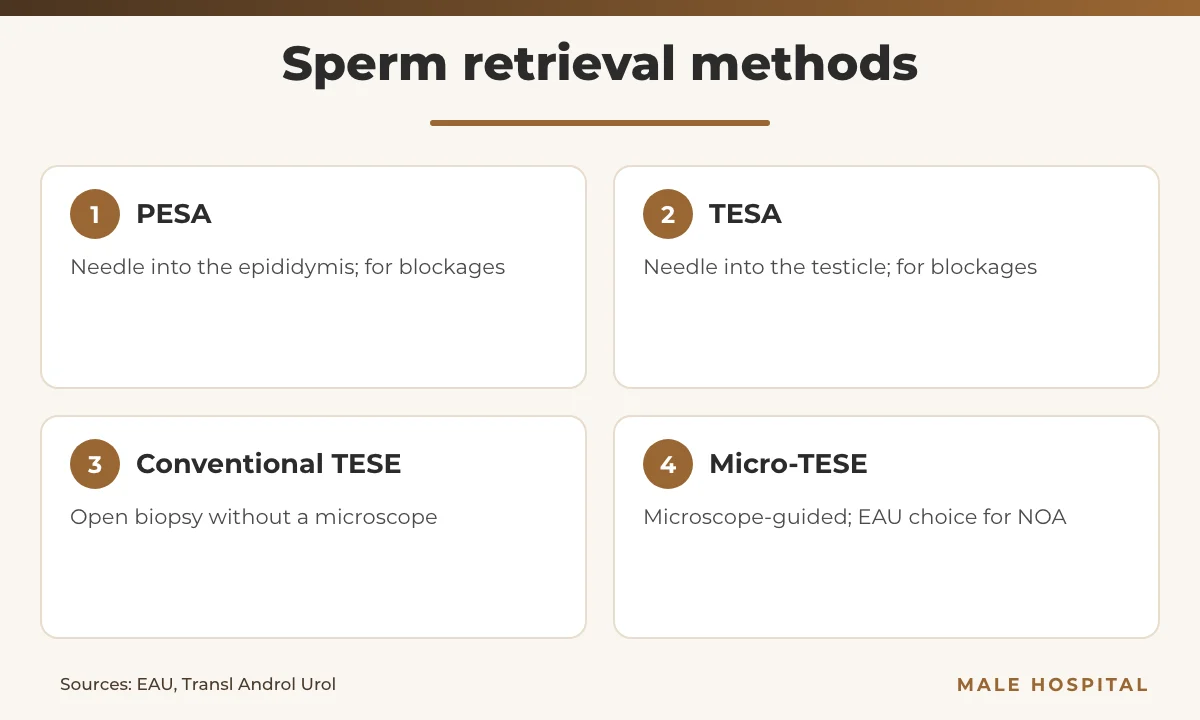
Obstructive azoospermia: needle methods usually work
Because production is normal, sperm retrieval surgery usually finds sperm easily. A meta-analysis in Translational Andrology and Urology pooled five studies with 1,541 men and found no significant difference in pregnancy rates between TESA and PESA. The choice often comes down to anatomy and the surgeon’s preference, and sperm can also be taken and frozen during a reconstruction operation as a backup.
Source: Transl Androl Urol (PMC) — Shih et al. 2019, TESA versus PESA for obstructive azoospermia
Non-obstructive azoospermia: why the microscope matters
In NOA, tubules that still make sperm are wider and more opaque than those containing only support (Sertoli) cells. Micro-TESE, described by Peter Schlegel in 1999, uses this difference: in his first series, sperm were found in 63% of men compared with 45% before, using far less tissue. The EAU now names micro-TESE the treatment of choice in NOA and advises against TESA or fine-needle aspiration.
Source: Hum Reprod (PubMed) — Schlegel 1999, Microdissection improves sperm yield with minimal tissue excision; EAU — Sexual and Reproductive Health Guidelines (male infertility chapter)
The procedure step by step
Every plan starts with tests. Before sperm retrieval surgery, your urologist reviews at least two semen analyses, hormones (FSH, LH, total testosterone), a karyotype, Y-chromosome microdeletion testing and a scrotal ultrasound. If your first result showed zero sperm, our guide to semen analysis explains why the sample must be repeated and centrifuged. Routine hormone stimulation before TESE is not recommended by the EAU in idiopathic NOA.
Source: EAU — Sexual and Reproductive Health Guidelines (male infertility chapter)
Needle methods (PESA and TESA)
After local anesthetic, the surgeon passes a fine needle through the scrotal skin into the epididymis (PESA) or the testicle (TESA) and draws out fluid or tissue. An embryologist checks the sample under a microscope, and further passes are made if needed. No incision is required, and most men go home the same day after this form of sperm retrieval surgery.
Source: Transl Androl Urol (PMC) — Shih et al. 2019, TESA versus PESA for obstructive azoospermia; NHS — Infertility: treatment
Micro-TESE
- Anesthesia: general anesthesia, with no food or drink from midnight.
- Incision: a small cut in the middle of the scrotum; one high-volume center describes 1.5–3 cm.
- Opening the testicle: the outer layer (tunica albuginea) is opened in an area without large blood vessels.
- Microscopic search: at 24–36× magnification the surgeon removes tiny samples of dilated, opaque tubules.
- Laboratory check: an embryologist examines the tissue within minutes; if no sperm are seen, the search continues and the other testicle may be explored.
- Closure and storage: the wound is closed, and sperm are used fresh for ICSI or frozen.
Cleveland Clinic says the operation usually takes less than two hours. In one experienced surgeon’s series, the average was 87 minutes for one testicle and 126 minutes when both were explored.
Source: Cleveland Clinic — MicroTESE (Microdissection Testicular Sperm Extraction); J Clin Med (PMC) — Colpi & Caroppo 2021, Performing microdissection TESE: surgical pearls
Success rates and what predicts them
In obstructive cases, sperm production is intact, which is why needle methods are usually successful. In NOA the odds of successful sperm retrieval surgery are lower. The largest meta-analysis (Corona et al., 2019: 117 studies, 21,404 men) reported sperm retrieval in 47% of procedures overall, and Cleveland Clinic states that healthy sperm can be retrieved in up to 60% of micro-TESE procedures, depending on the cause.
Source: Hum Reprod Update (PubMed) — Corona et al. 2019, Sperm recovery and ICSI outcomes in NOA; Cleveland Clinic — MicroTESE (Microdissection Testicular Sperm Extraction)
The evidence comparing sperm retrieval surgery techniques is honest but mixed. Pooled case-control data quoted by the EAU show 52% for micro-TESE versus 35% for conventional TESE, and one randomized trial of 100 men found 43% versus 22% for multiple-pass TESA. Yet the Corona meta-analysis found the same 46% for conventional and microdissection TESE, so no large trial has fully settled the question.
Source: EAU — Sexual and Reproductive Health Guidelines (male infertility chapter); Hum Reprod Update (PubMed) — Corona et al. 2019, Sperm recovery and ICSI outcomes in NOA
Success predictors
- Testicular histology: the strongest clue. Hypospermatogenesis gives retrieval rates of 73% or more; Sertoli-cell-only syndrome only 22.5–41%; maturation arrest falls in between.
- Testicle volume: in the Corona analysis, a mean volume above 12.5 mL predicted retrieval rates above 60%.
- Genetics: AZFc deletions 50–75%; Klinefelter syndrome up to 50%; complete AZFa or AZFb deletions effectively zero.
- Hormones and age: FSH, inhibin B and age did not reliably predict the result, and men with high FSH may still have small areas of sperm production.
- Surgical experience: results of sperm retrieval surgery differ between centers and improve with experience.
Source: Transl Androl Urol (PMC) — Flannigan, Bach & Schlegel 2017, Microdissection testicular sperm extraction; Hum Reprod Update (PubMed) — Corona et al. 2019, Sperm recovery and ICSI outcomes in NOA; EAU — Sexual and Reproductive Health Guidelines (male infertility chapter)
A palpable varicocele is sometimes repaired before sperm retrieval surgery. The EAU notes higher retrieval rates after repair in a meta-analysis but calls the evidence low quality, and any benefit takes months, so the partner’s age matters in that decision. Our varicocele treatment page explains the options.
Source: EAU — Sexual and Reproductive Health Guidelines (male infertility chapter)
Recovery timeline
Recovery after needle-based sperm retrieval surgery is usually quick, while micro-TESE needs a little more time. Cleveland Clinic gives the following general pattern after micro-TESE; your own surgeon’s instructions always take priority.
| Time | What to expect |
|---|---|
| Day 0 | Usually home the same day; some centers keep patients overnight to check for bleeding |
| Days 1–2 | The most uncomfortable period; ice packs and simple painkillers help |
| First week | A few days off work; avoid heavy lifting, strenuous exercise and sex for several days |
| Few weeks | Most men have recovered fully |
| 6–12 months | Minimum wait usually advised before a repeat micro-TESE |
Source: Cleveland Clinic — MicroTESE (Microdissection Testicular Sperm Extraction); NHS — Infertility: treatment
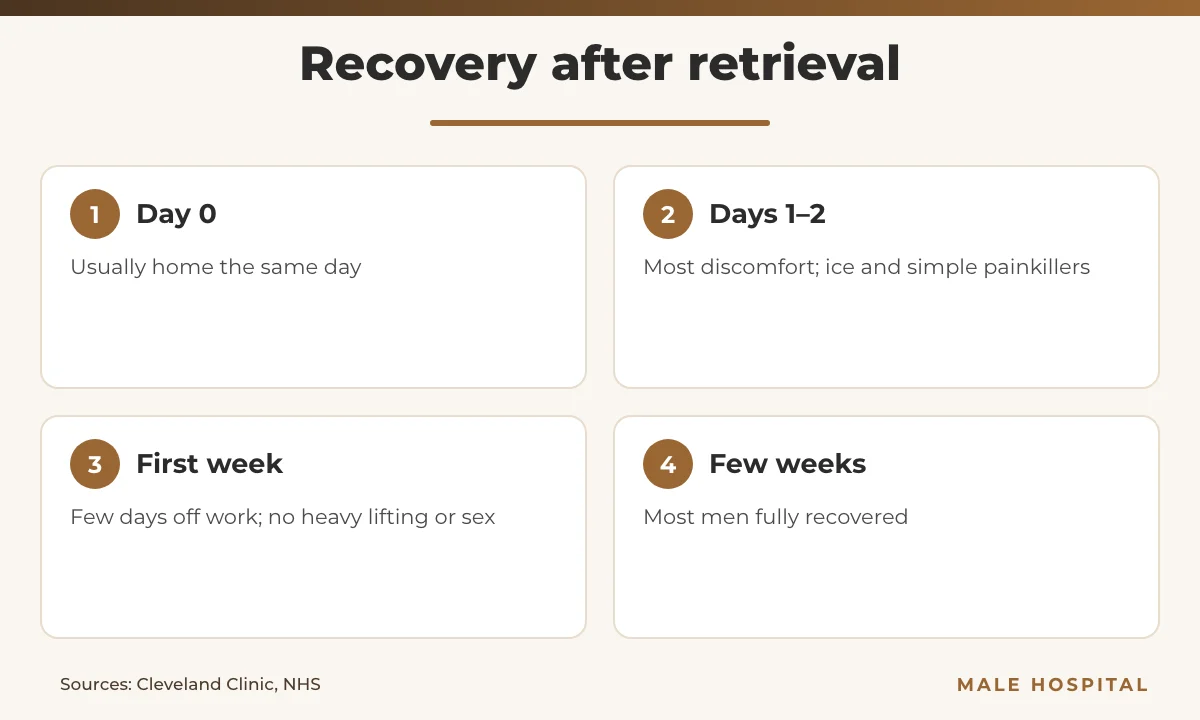
Recovery protocols after sperm retrieval surgery vary between surgeons. One high-volume center, for example, advises a return to work at three days, sexual activity at ten days and intense exercise after twenty days, with oral antibiotics for about a week.
Source: J Clin Med (PMC) — Colpi & Caroppo 2021, Performing microdissection TESE: surgical pearls
Risks and side effects
The main risk of any sperm retrieval surgery is that no usable sperm are found, which is far more likely in NOA than in obstruction. Cleveland Clinic also lists reactions to anesthesia, bleeding, infection and pain; permanent damage to the testicle is possible but very rare.
- Needle methods: multiple TESA passes can cause bleeding inside the testicle or a blood collection around it (hematocele); PESA can cause a hematoma and may miss sperm-containing ducts.
- Conventional TESE: the EAU reports intratesticular hematomas in 51.7% of men on ultrasound at three months and scarring (fibrosis) in up to 30% at six months; rates are lower after microdissection.
- Testosterone: after micro-TESE, average testosterone fell from 316 to 251 ng/dL in one large series and returned to about 95% of baseline by 18 months; about 5–10% of men needed testosterone replacement.
Source: Cleveland Clinic — MicroTESE (Microdissection Testicular Sperm Extraction); Transl Androl Urol (PMC) — Shih et al. 2019, TESA versus PESA for obstructive azoospermia; Transl Androl Urol (PMC) — Flannigan, Bach & Schlegel 2017, Microdissection testicular sperm extraction
A follow-up hormone test after sperm retrieval surgery is sensible, especially in men with Klinefelter syndrome or low testosterone before surgery. Testosterone treatment should only be started once no further fertility treatment is planned, because it suppresses sperm production; read more in our guide to testosterone replacement therapy.
Source: AUA/ASRM — Diagnosis and Treatment of Infertility in Men: Guideline Part II
Results and realistic expectations: freezing, ICSI and pregnancy
Sperm collected by sperm retrieval surgery are too few for natural conception or standard IVF, so they are always used with ICSI (intracytoplasmic sperm injection). The UK fertility regulator HFEA describes ICSI as the most common and successful treatment for male infertility and lists surgical sperm collection as a main reason to use it. Outcomes still depend heavily on the female partner’s age and egg quality.
Source: HFEA — Intracytoplasmic sperm injection (ICSI)
Fresh or frozen sperm?
Sperm retrieval surgery can be timed with the partner’s egg collection, or done first with the sperm frozen. The AUA/ASRM guideline accepts either. Doing surgery first tells the couple whether sperm exist before ovarian stimulation, while a same-day approach avoids thawing losses; one high-volume center notes that only about a third of frozen-thawed testicular sperm remain usable. Extra sperm can be stored for later cycles.
Source: AUA/ASRM — Diagnosis and Treatment of Infertility in Men: Guideline Part II; Transl Androl Urol (PMC) — Flannigan, Bach & Schlegel 2017, Microdissection testicular sperm extraction
Published pregnancy figures
- Obstructive: in a meta-analysis of 20 studies, 44.1% of ICSI cycles with fresh epididymal sperm gave a clinical pregnancy versus 36.6% with frozen epididymal sperm; for testicular sperm, freezing made no significant difference.
- Non-obstructive: the Corona meta-analysis reported a cumulative pregnancy rate of 29% and a live birth rate of 24% per ICSI cycle; fresh sperm gave higher pregnancy rates (35% vs 20%), but a difference in live births was not confirmed.
Source: J Assist Reprod Genet (PMC) — Liu et al. 2020, Cryopreserved testicular or epididymal sperm and ICSI outcome in obstructive azoospermia; Hum Reprod Update (PubMed) — Corona et al. 2019, Sperm recovery and ICSI outcomes in NOA
If sperm retrieval surgery finds no sperm, the result is not always final. The EAU reports that a salvage micro-TESE finds sperm in 18.4–42.8% of men after a failed microdissection. Donor sperm and adoption are other paths. The HFEA also notes that a son conceived through ICSI may inherit his father’s infertility, especially with a Y-chromosome cause, which is why genetic counselling matters.
Source: EAU — Sexual and Reproductive Health Guidelines (male infertility chapter); HFEA — Intracytoplasmic sperm injection (ICSI)
Sperm retrieval surgery with Dr. Zülfü Sertkaya in Istanbul
Assoc. Prof. Dr. Zülfü Sertkaya is a urologist and andrologist in Istanbul. He is a Fellow of the European Board of Urology (FEBU, 2017), became Associate Professor of Urology in 2020 and has been a urology specialist since 2014. Male infertility is one of his main areas of focus, and his published research includes micro-TESE, male hormones and semen quality.
He is a member of the European Association of Urology, the European Society for Sexual Medicine, the International Society for Sexual Medicine and the Turkish Society of Andrology, and since 2022 he has run his own men’s health clinic in Zeytinburnu, Istanbul. Read his full profile on the Dr. Zülfü Sertkaya page.
For patients travelling to Istanbul for sperm retrieval surgery, our team provides practical support around the medical care:
- Reception at the airport and transport during your stay
- Translation throughout consultations
- Trip planning around test, surgery and follow-up dates
- Hotel accommodation
- Medical consultation before you travel
- Aftercare and follow-up once you are home
Sperm retrieval surgery pricing is given after a free assessment, because it depends on the technique (PESA, TESA or micro-TESE), whether one or both testicles are explored, and whether sperm freezing is needed.
How to start
Start with a free, confidential WhatsApp consultation. Share your history and any results you have: semen analyses, FSH, LH and testosterone, karyotype and Y-chromosome tests, and scrotal ultrasound. Dr. Sertkaya reviews them and gives you a personalised plan, which may be repair, hormone treatment, a needle method or micro-TESE, coordinated with your partner’s ICSI clinic. For the wider picture, our guide to male infertility explains common causes and tests.
When to see a doctor
See a urologist-andrologist if a semen test shows no sperm, if you have tried to conceive for 12 months without success, or sooner if your partner is 36 or older. After sperm retrieval surgery, contact your surgeon promptly if you notice:
- Severe or worsening pain that painkillers do not control
- Heavy bleeding from the wound or a rapidly growing scrotal swelling
- Blood in the urine
- Fever, chills, pus or spreading redness around the wound
- Feeling very unwell, confused or breathless, which can signal sepsis and needs emergency care
Source: Cleveland Clinic — MicroTESE (Microdissection Testicular Sperm Extraction); NHS — Infertility
Related men’s health guides
- Azoospermia: Types, Causes, Tests and 5 Treatment Paths
- Micro TESE: How It Works, 6 Steps and Success Rates
- Vasectomy Reversal: Success Rates, Options and 6 Key Facts
- Retrograde Ejaculation: 4 Causes, Tests and Fertility Help
- Male Infertility: Causes, Tests and 6 Proven Treatments
- Semen Analysis: WHO 2021 Values and 7 Key Results Explained
FAQs about sperm retrieval surgery
Is sperm retrieval surgery painful?
The procedure itself is done under local or general anesthesia, so you should not feel pain during it. Afterward, the first one or two days are usually the most uncomfortable, and ice packs and simple painkillers are generally enough. Needle methods tend to cause less discomfort than open micro-TESE, and most men recover fully within a few weeks.
Source: Cleveland Clinic — MicroTESE (Microdissection Testicular Sperm Extraction)
What is the success rate of sperm retrieval surgery?
It depends on the type of azoospermia. In obstructive cases sperm production is normal and sperm are usually found. In non-obstructive azoospermia, large meta-analyses report sperm in about 46–47% of procedures, and Cleveland Clinic cites up to 60% for micro-TESE. Testicular histology, testicle volume and genetics are the most useful predictors.
Source: Hum Reprod Update (PubMed) — Corona et al. 2019, Sperm recovery and ICSI outcomes in NOA
Which is better, TESA or micro-TESE?
The best sperm retrieval surgery depends on the cause. For obstructive azoospermia, TESA or PESA usually works well. For non-obstructive azoospermia, a randomized trial of 100 men found sperm in 43% with micro-TESE versus 22% with multiple-pass TESA, and the EAU advises against needle aspiration in that group, naming micro-TESE the treatment of choice.
Source: EAU — Sexual and Reproductive Health Guidelines (male infertility chapter)
Can retrieved sperm be frozen?
Yes. The NHS notes that sperm found during extraction are frozen for later use, and the AUA/ASRM guideline accepts fresh or frozen testicular sperm for ICSI. Freezing lets one sperm retrieval surgery serve several ICSI cycles. With epididymal sperm, fresh samples gave somewhat higher pregnancy rates in one meta-analysis, while for testicular sperm freezing made no significant difference.
Source: NHS — Infertility: treatment; J Assist Reprod Genet (PMC) — Liu et al. 2020, Cryopreserved testicular or epididymal sperm and ICSI outcome in obstructive azoospermia
Can we conceive naturally after sperm retrieval?
Not with the retrieved sperm: there are too few for natural conception or standard IVF, so they are used with ICSI. Natural conception is only possible if the underlying cause is fixed, for example after a successful vasectomy reversal, or when hormone treatment restarts sperm production in men with low pituitary hormones.
Source: HFEA — Intracytoplasmic sperm injection (ICSI); EAU — Sexual and Reproductive Health Guidelines (male infertility chapter)
Does sperm retrieval surgery affect testosterone?
It can, mainly after open testicular surgery. In one large micro-TESE series, average testosterone fell from 316 to 251 ng/dL and returned to about 95% of baseline by 18 months. Around 5–10% of men needed testosterone replacement. A follow-up blood test is sensible, particularly in men with Klinefelter syndrome or low levels before surgery.
Can the operation be repeated if no sperm are found?
Yes, in selected men. Surgeons usually wait 6–12 months before repeat sperm retrieval surgery so the testicle can heal. The EAU reports that a salvage micro-TESE after a failed microdissection finds sperm in about 18% to 43% of men, so repeat surgery is a realistic option for some, but not a certainty. Donor sperm is another path.
Source: EAU — Sexual and Reproductive Health Guidelines (male infertility chapter); Cleveland Clinic — MicroTESE (Microdissection Testicular Sperm Extraction)
Do I need genetic tests before surgery?
Yes. The EAU recommends a karyotype and Y-chromosome microdeletion testing, with genetic counselling, for azoospermic men. Complete AZFa or AZFb deletions mean sperm retrieval surgery should not be done, while AZFc deletions still allow sperm retrieval in 50–75%. Men with absent vas deferens need CFTR testing, and the partner should be tested too.
Source: EAU — Sexual and Reproductive Health Guidelines (male infertility chapter)
How much does sperm retrieval surgery cost?
The cost depends on the technique, whether one or both testicles are explored, anesthesia, sperm freezing and coordination with the partner’s ICSI cycle. A reliable figure is only possible after your semen, hormone, genetic and ultrasound results are reviewed. You can send them for a free WhatsApp consultation and receive a personalised plan and price.
Send your test results today and get a free, confidential sperm retrieval plan from Dr. Zülfü Sertkaya.
Medically reviewed by Assoc. Prof. Dr. Zülfü Sertkaya, urologist and andrologist (FEBU), Istanbul. Last reviewed: October 2026.
This article is for general information and does not replace an individual consultation with a qualified doctor.
- EAU — Sexual and Reproductive Health Guidelines (male infertility chapter)
- AUA/ASRM — Diagnosis and Treatment of Infertility in Men: Guideline Part II
- Cleveland Clinic — MicroTESE (Microdissection Testicular Sperm Extraction)
- Cleveland Clinic — Azoospermia (Zero Sperm Count): Causes & Treatment
- NHS — Infertility: treatment
- NHS — Infertility
- HFEA — Intracytoplasmic sperm injection (ICSI)
- Hum Reprod Update (PubMed) — Corona et al. 2019, Sperm recovery and ICSI outcomes in NOA
- Hum Reprod (PubMed) — Schlegel 1999, Microdissection improves sperm yield with minimal tissue excision
- Transl Androl Urol (PMC) — Shih et al. 2019, TESA versus PESA for obstructive azoospermia
- Transl Androl Urol (PMC) — Flannigan, Bach & Schlegel 2017, Microdissection testicular sperm extraction
- J Clin Med (PMC) — Colpi & Caroppo 2021, Performing microdissection TESE: surgical pearls
- J Assist Reprod Genet (PMC) — Liu et al. 2020, Cryopreserved testicular or epididymal sperm and ICSI outcome in obstructive azoospermia