Penuma is a soft, crescent-shaped silicone sleeve that a surgeon places under the skin of the penis, on top of the erectile bodies, to make the flaccid penis look longer and thicker. Published case series report average flaccid gains of roughly 2.5 to 4 cm in length and 3 to 4 cm in girth, but removal rates of about 3% to 12%, and European urology guidelines classify Penuma as experimental and strongly advise against it. It is one of several approaches covered on our penis enlargement page, and this guide looks only at the evidence for this one device.
Sources: EAU Guidelines — Sexual and Reproductive Health — Penile size abnormalities and dysmorphophobia; PMC (Therapeutic Advances in Urology) — Salkowski & Levine, Outcomes and patient satisfaction after Penuma silicone implant surgery via two surgical approaches (2024)
- It is a cosmetic silicone implant for the flaccid penis; it does not treat erectile dysfunction and does not make the erect penis harder.
- The FDA cleared it through the 510(k) route (substantial equivalence), which is not the same as FDA approval after clinical trials.
- All published data are retrospective case series, mostly from experienced implanters; a 2026 meta-analysis pooled a 7% removal rate and about 5% erosion.
- The EAU gives a strong recommendation against Penuma for girth enhancement, and the SMSNA calls it investigational.
- When the implant has to come out, some men are left with curvature, shortening or scarring that needs further surgery.
- What is Penuma?
- How the surgery is done and the recovery
- Penuma results: what the studies measured
- Penuma complications, revision and removal
- Penuma FDA status: what 510(k) clearance means
- What urology guidelines say
- Who should and should not consider it
- Penuma vs other size options
- When to see a doctor
- FAQs about Penuma
What is Penuma?
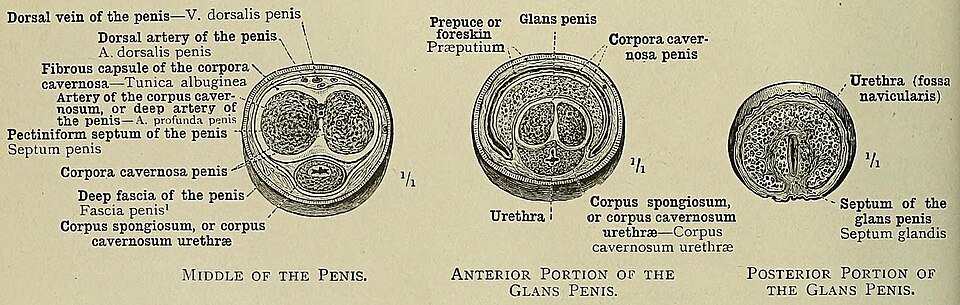
Penuma is a pre-formed block of soft medical-grade silicone shaped like a half-pipe. It is placed in the layer just under the shaft skin, above the deep (Buck’s) fascia that wraps the erectile bodies, so the corpora cavernosa themselves are not cut or replaced. A similar device sold under the name Himplant works on the same principle, and studies often group the two as “subcutaneous silicone sleeve implants”.
The device comes in several widths (large, XL, XXL) and two lengths, and the surgeon trims it to fit. Its far end is stitched to the tissue just below the head of the penis, while the base sits loosely in a pocket in front of the suspensory ligament. The aim is cosmetic: a fuller, longer-looking penis at rest. Published series describe it as designed for men who already have normal erections.
Sources: PMC (Therapeutic Advances in Urology) — Siegal et al., A multi-institutional update on surgical outcomes after penile silicone sleeve implantation (2024); PMC (Therapeutic Advances in Urology) — Salkowski & Levine, Outcomes and patient satisfaction after Penuma silicone implant surgery via two surgical approaches (2024)
That last point matters. The device is very different from a penile prosthesis, which goes inside the erectile bodies to treat erectile dysfunction (ED). The sleeve sits outside them and adds bulk only. Men with ED that does not respond to tablets were excluded from the main studies.
How the surgery is done and the recovery
The operation is usually done under general anesthesia, though a few cases in the largest series were done under local anesthesia alone. The surgeon reaches the shaft through one of two cuts: a 4–5 cm incision across the base of the penis (infrapubic approach) or a 4 cm incision on the side of the scrotum (lateral scrotal approach). The multi-center series listed lack of circumcision among the reasons to avoid the procedure.
Sources: PMC (Therapeutic Advances in Urology) — Salkowski & Levine, Outcomes and patient satisfaction after Penuma silicone implant surgery via two surgical approaches (2024); PMC (Therapeutic Advances in Urology) — Siegal et al., A multi-institutional update on surgical outcomes after penile silicone sleeve implantation (2024)
Infrapubic vs scrotal approach
In one surgeon’s 92 cases, removal was needed in 21% of infrapubic cases versus 6% of scrotal cases, and revision in 13% versus 2%. Both differences were statistically significant, and size gains did not differ between approaches. This is one series, so it does not settle the question, but it shows that technique and surgeon experience strongly affect outcomes.
Recovery after surgery
Typical instructions from the multi-center series were to avoid normal activity for about 1 week, masturbation and vigorous exercise for 4 to 6 weeks, and intercourse for 6 weeks. Men wear a mesh compression wrap and must avoid penile rings or anything that squeezes the shaft for long periods. A drain is often placed and removed after a few days, and some surgeons ask for photos every 2 weeks during the first 6 weeks to catch problems early.
Sources: PMC (Therapeutic Advances in Urology) — Siegal et al., A multi-institutional update on surgical outcomes after penile silicone sleeve implantation (2024); PMC (Therapeutic Advances in Urology) — Salkowski & Levine, Outcomes and patient satisfaction after Penuma silicone implant surgery via two surgical approaches (2024)
Penuma results: what the studies measured
Every published study of the device is a retrospective case series without a control group, and nearly all measure the flaccid penis only. Several were written by the inventor or by high-volume implanters, and the satisfaction questionnaires used were not validated. With those limits in mind, here are the main numbers.
| Study | Men | Flaccid gain | Removal |
|---|---|---|---|
| Elist 2018 (inventor, single surgeon) | 400 | Girth 8.5 → 13.4 cm | 3% |
| Siegal 2023 (single center) | 49 | Length +4.9 cm | Not given as a rate; 1 infection, 2 erosions |
| Siegal 2024 (four surgeons) | 299 | Length +4.1 cm, girth +3.4 cm | 7% |
| Salkowski & Levine 2024 | 92 | Length +2.5 cm, girth +3.1 cm | 12% |
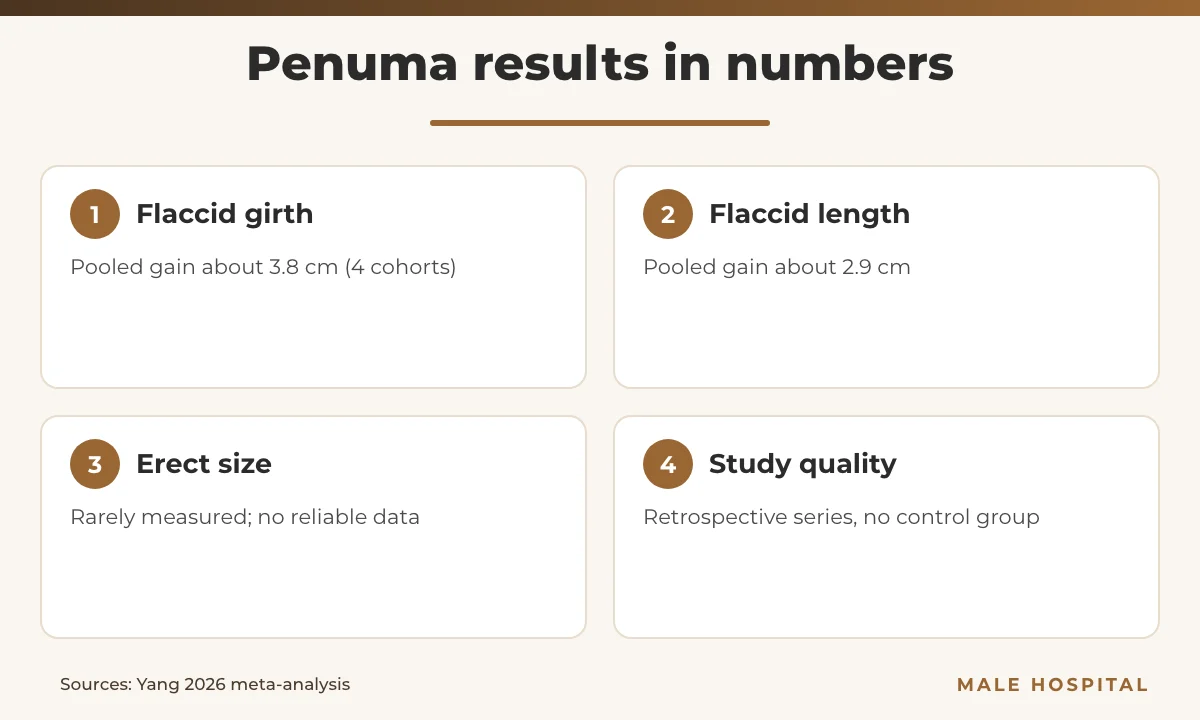
| Yang 2026 meta-analysis (4 cohorts) | Pooled | Length +2.94 cm, girth +3.77 cm | 7.08% |
Sources: PubMed (Journal of Sexual Medicine) — Elist et al., Single-surgeon evaluation of the Penuma silicone sleeve implant (2018); PubMed (Urology) — Siegal et al., Outcomes of a single center’s initial experience with the Penuma penile implant (2023); PMC (Therapeutic Advances in Urology) — Siegal et al., A multi-institutional update on surgical outcomes after penile silicone sleeve implantation (2024); PMC (Therapeutic Advances in Urology) — Salkowski & Levine, Outcomes and patient satisfaction after Penuma silicone implant surgery via two surgical approaches (2024); PubMed (International Journal of Impotence Research) — Yang et al., Subcutaneous penile silicone sleeve implants: systematic review and meta-analysis (2026)
Satisfaction figures look high but come from weak surveys. In the inventor’s series, 81% reported “high” or “very high” satisfaction after an average of 4 years. In the Salkowski and Levine series, 82% of the 43 men who answered were satisfied with how the penis looked, but only 47% of patients replied and men whose implant had been removed were not surveyed. In a separate survey of 100 respondents, 57% reported high satisfaction and 10% had already had the device removed.
Sources: PubMed (Journal of Sexual Medicine) — Elist et al., Single-surgeon evaluation of the Penuma silicone sleeve implant (2018); PMC (Therapeutic Advances in Urology) — Salkowski & Levine, Outcomes and patient satisfaction after Penuma silicone implant surgery via two surgical approaches (2024); PMC (Translational Andrology and Urology) — Pignanelli et al., Complications and management of penile enhancement procedures (2025)
The 2026 meta-analysis notes that erect size and validated patient-reported outcomes were rarely measured, so the data cannot show whether the implant changes erect dimensions or quality of sex. Measurements in one large series were taken while the patient was still under anesthesia, which can flatter the result.
Sources: PubMed (International Journal of Impotence Research) — Yang et al., Subcutaneous penile silicone sleeve implants: systematic review and meta-analysis (2026); PMC (Therapeutic Advances in Urology) — Siegal et al., A multi-institutional update on surgical outcomes after penile silicone sleeve implantation (2024)
Penuma complications, revision and removal
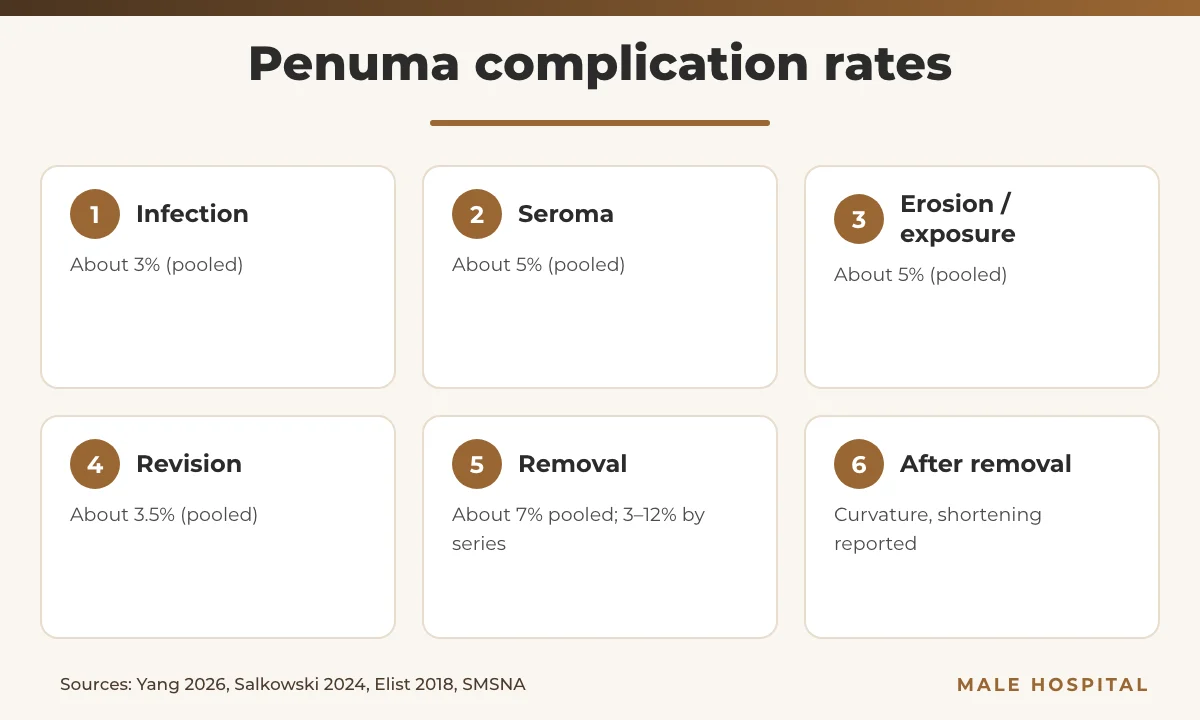
The most common Penuma complications in the published series are fluid collection (seroma), infection, erosion of the implant through the skin, and “flaring” or malposition of the device edge near the head of the penis. Pooled rates from the 2026 meta-analysis were about 3% for infection, 5% for seroma, 5% for erosion or exposure, 3.5% for revision and 7% for removal.
What happens when the implant has to come out
Infection and erosion usually mean the device must be removed, and a review in 2025 noted there is no published evidence on salvaging an infected implant. Removal is not always the end of the problem. Scar tissue (a capsule) forms around any silicone implant, and when it contracts after removal it can pull the penis into a bend or shorten it.
Sources: PMC (Translational Andrology and Urology) — Pignanelli et al., Complications and management of penile enhancement procedures (2025); PMC (Therapeutic Advances in Urology) — Siegal et al., A multi-institutional update on surgical outcomes after penile silicone sleeve implantation (2024)
In a series of 13 men treated at one referral center for complications of this implant, 69% developed disabling upward (dorsal) curvature, 62% penile shortening, 62% protrusion of the device edge, 23% infection and 15% erectile dysfunction. Because this group was selected for having problems, it does not show how often these happen overall. Still, the SMSNA cites reports that about 60% to 80% of men seen by outside surgeons after removal had severe, persistent problems.
Sources: PMC (Translational Andrology and Urology) — Pignanelli et al., Complications and management of penile enhancement procedures (2025); Journal of Sexual Medicine (SMSNA) — Cosmetic penile enhancement procedures: an SMSNA position statement (2024)
Earlier, a referral center that cared for men with complications from several types of enlargement surgery, including silicone implants, described sexually disabling deformity, severe shortening, curvature, swelling, non-healing wounds and sexual dysfunction. Most needed corrective surgery, and some needed skin grafts.
The device is also intended to stay in place long term. The SMSNA points out that most men having it are in their 30s or 40s, with decades of life ahead, so the lifetime chance of eventual removal is unknown. For a broader view of these issues across all methods, see our guide to penis enlargement surgery.
Penuma FDA status: what 510(k) clearance means
Penuma is often marketed as “FDA-cleared”, and that is technically true. The FDA database lists a 510(k) for a “Pre-Formed Penile Silicone Block” from International Medical Devices, Inc., number K220760, decided on May 13, 2022, as “substantially equivalent” under the product code for silicone elastomer blocks. Authors of the multi-center series report that the device was first cleared in 2004, and the 2022 clearance covers cosmetic enhancement of the flaccid penis.
Sources: FDA — 510(k) premarket notification K220760 — Pre-Formed Penile Silicone Block; PMC (Therapeutic Advances in Urology) — Siegal et al., A multi-institutional update on surgical outcomes after penile silicone sleeve implantation (2024); PMC (Therapeutic Advances in Urology) — Salkowski & Levine, Outcomes and patient satisfaction after Penuma silicone implant surgery via two surgical approaches (2024)
A 510(k) is a submission showing that a device is as safe and effective as a device already legally on the market (a “predicate”) with the same intended use. When the FDA agrees, it “clears” the device for sale. The supporting performance data can be clinical, bench testing or both, and this is a different pathway from premarket approval (PMA). The SMSNA position statement says the FDA should re-evaluate the clearance and treat these implants as new (de novo) therapies.
Sources: FDA — Premarket Notification 510(k); Journal of Sexual Medicine (SMSNA) — Cosmetic penile enhancement procedures: an SMSNA position statement (2024)
In short, FDA clearance tells you the device may be sold in the United States. It does not mean the FDA has reviewed long-term outcome data, and it does not override the recommendations of urology societies.
What urology guidelines say
The European Association of Urology (EAU) is the most direct. Its guideline on penile size abnormalities says not to use biodegradable scaffolds or the subcutaneous penile implant (Penuma) for girth enhancement, because they are considered experimental. This is a strong recommendation, and the evidence summary notes there is not enough long-term data on the device.
Source: EAU Guidelines — Sexual and Reproductive Health — Penile size abnormalities and dysmorphophobia
The Sexual Medicine Society of North America (SMSNA) published a position statement in 2024 saying placement of Penuma and Himplant devices should be considered investigational. It recommends that the surgery be done only under the oversight of an ethics board (IRB) while long-term data are gathered, and it says it was not possible to counsel patients adequately about the true balance of risks and benefits.
The American Urological Association (AUA) policy on penile augmentation predates the spread of silicone sleeve implants and addresses fat injection and suspensory ligament division, which it says have not been shown to be safe or effective. The International Society for Sexual Medicine (ISSM) lists silicone implant insertion among proposed enlargement procedures that are considered experimental.
Sources: AUA — Penile Augmentation Surgery — policy statement; ISSM — What are some penile augmentation procedures? Do they work?
Who should and should not consider it
Most men who ask about this implant have a normal-sized penis. The EAU defines micropenis as a stretched length more than 2.5 standard deviations below the average, and reports mean flaccid girth of about 9.3 cm. If you are unsure where you stand, our article on average penis size explains the measurements.
Source: EAU Guidelines — Sexual and Reproductive Health — Penile size abnormalities and dysmorphophobia
The EAU strongly recommends that doctors ask about body dysmorphic disorder (BDD) in men with a normal penis who feel it is too small, and refer them for mental health support when it is suspected. ISSM notes that penile dysmorphic disorder tends to respond better to psychotherapy and cognitive behavioral therapy than to surgery. When anxiety rather than anatomy is the problem, an operation is unlikely to fix it.
Sources: EAU Guidelines — Sexual and Reproductive Health — Penile size abnormalities and dysmorphophobia; ISSM — What are some penile augmentation procedures? Do they work?
Factors that raise the risk
- Uncontrolled diabetes or a weakened immune system
- Current smoking
- Previous cosmetic penile surgery
- Not being circumcised
- Erectile dysfunction, which the implant does not treat
Penuma vs other size options
A silicone sleeve is only one way men try to change size or appearance. The table compares it with the main alternatives and their guideline standing. Our penile girth enhancement guide covers the girth options in more depth.
| Option | What it targets | EAU position | Main concern in the guideline |
|---|---|---|---|
| Penuma silicone sleeve | Flaccid girth and apparent length | Strong against: experimental | Not enough long-term data |
| Hyaluronic acid or other soft tissue filler | Girth | Weak for | Strongly advised against in penile dysmorphic disorder |
| Autologous fat injection | Girth | Weak for | Strongly advised against in penile dysmorphic disorder |
| Grafts | Girth | Strong against: experimental | High complication rates, low satisfaction |
| Silicone, paraffin or Vaseline injection | Girth | Strong against | Swelling, infection, Fournier’s gangrene |
Source: EAU Guidelines — Sexual and Reproductive Health — Penile size abnormalities and dysmorphophobia
Fillers are the option the EAU rates most favorably for girth, and our penile filler page explains how they are used. Men with a true micropenis or penile loss are assessed differently, because reconstructive surgery may be appropriate for them.
Sources: EAU Guidelines — Sexual and Reproductive Health — Penile size abnormalities and dysmorphophobia; ISSM — What are some penile augmentation procedures? Do they work?
When to see a doctor
If you already have a Penuma or similar implant, contact a urologist promptly if you notice any of the following:
- Fever, increasing redness, warmth or pus around the shaft or incision
- Skin thinning, a visible or palpable edge, or the implant showing through the skin
- Sudden swelling or a soft, fluid-filled bulge
- New bending, shortening or pain during erections
- Loss of sensation or new difficulty getting or keeping an erection
Infection and erosion usually require removal, and early treatment limits damage to the surrounding skin. If you are only considering the procedure, a urologist-andrologist can measure you, check for erectile problems and talk through whether any procedure is likely to help.
Sources: PMC (Therapeutic Advances in Urology) — Siegal et al., A multi-institutional update on surgical outcomes after penile silicone sleeve implantation (2024); PMC (Translational Andrology and Urology) — Pignanelli et al., Complications and management of penile enhancement procedures (2025)
If you would like a confidential, evidence-based opinion on penis size, Penuma or its complications, you can message our urologist-andrologist on WhatsApp. Costs depend on the assessment, and the first consultation by message is free.
FAQs about Penuma
Is Penuma FDA approved?
Penuma is FDA-cleared rather than approved through premarket approval (PMA). It went through the 510(k) pathway, in which the FDA accepts that a device is substantially equivalent to one already on the market; the 2022 clearance (K220760) covers a pre-formed penile silicone block. The SMSNA has asked the FDA to re-evaluate these implants as new (de novo) therapies.
Sources: FDA — 510(k) premarket notification K220760 — Pre-Formed Penile Silicone Block; FDA — Premarket Notification 510(k); Journal of Sexual Medicine (SMSNA) — Cosmetic penile enhancement procedures: an SMSNA position statement (2024)
How much size does Penuma add?
A 2026 meta-analysis of four cohort studies found average flaccid gains of about 2.9 cm in length and 3.8 cm in girth. Individual series range from 2.5 to 4.9 cm in flaccid length. These are flaccid measurements, sometimes taken under anesthesia; reliable data on erect size are lacking, so the change during sex is not well documented.
Sources: PubMed (International Journal of Impotence Research) — Yang et al., Subcutaneous penile silicone sleeve implants: systematic review and meta-analysis (2026); PubMed (Urology) — Siegal et al., Outcomes of a single center’s initial experience with the Penuma penile implant (2023)
Does Penuma make you bigger when erect?
The studies were designed around the flaccid penis and rarely measured erect size, so there is no good evidence either way. The device sits outside the erectile bodies, so it does not make the erection itself longer or harder. Men with erectile dysfunction were excluded from the main series, and the implant is not a treatment for it.
Sources: PubMed (International Journal of Impotence Research) — Yang et al., Subcutaneous penile silicone sleeve implants: systematic review and meta-analysis (2026); PMC (Therapeutic Advances in Urology) — Salkowski & Levine, Outcomes and patient satisfaction after Penuma silicone implant surgery via two surgical approaches (2024)
Is Penuma permanent?
It is designed to remain in place, but it can be removed. Published removal rates range from 3% in the inventor’s series to 12% in another surgeon’s series, with a pooled rate of about 7%. Removal can leave scar tissue that causes curvature or shortening, so “removable” does not always mean “fully reversible”.
Sources: PubMed (Journal of Sexual Medicine) — Elist et al., Single-surgeon evaluation of the Penuma silicone sleeve implant (2018); PMC (Therapeutic Advances in Urology) — Salkowski & Levine, Outcomes and patient satisfaction after Penuma silicone implant surgery via two surgical approaches (2024); PubMed (International Journal of Impotence Research) — Yang et al., Subcutaneous penile silicone sleeve implants: systematic review and meta-analysis (2026)
What are the most common Penuma complications?
The pooled data show infection in about 3%, seroma in about 5%, erosion or exposure of the implant in about 5% and revision in about 3.5% of men. Flaring of the device edge near the glans is another frequent reason for revision. More serious outcomes such as disabling curvature and shortening are reported mainly after removal.
Sources: PubMed (International Journal of Impotence Research) — Yang et al., Subcutaneous penile silicone sleeve implants: systematic review and meta-analysis (2026); PMC (Therapeutic Advances in Urology) — Siegal et al., A multi-institutional update on surgical outcomes after penile silicone sleeve implantation (2024)
Is Penuma recommended by urologists?
Not by the major guideline bodies. The European Association of Urology strongly recommends against using it for girth enhancement because it is experimental, and the Sexual Medicine Society of North America considers it investigational and suggests it be offered only within ethics-board-supervised studies.
Sources: EAU Guidelines — Sexual and Reproductive Health — Penile size abnormalities and dysmorphophobia; Journal of Sexual Medicine (SMSNA) — Cosmetic penile enhancement procedures: an SMSNA position statement (2024)
How long is recovery after Penuma surgery?
In the largest multi-center series, men avoided normal activity for about a week, masturbation and strenuous exercise for 4 to 6 weeks, and sex for 6 weeks. They wore a compression wrap and avoided penile rings. A surgical drain is often removed after a few days.
Sources: PMC (Therapeutic Advances in Urology) — Siegal et al., A multi-institutional update on surgical outcomes after penile silicone sleeve implantation (2024); PMC (Therapeutic Advances in Urology) — Salkowski & Levine, Outcomes and patient satisfaction after Penuma silicone implant surgery via two surgical approaches (2024)
Can Penuma be done if I am not circumcised?
The largest multi-center study lists lack of circumcision among the reasons to avoid Penuma, alongside smoking, uncontrolled diabetes, a weakened immune system and previous cosmetic penile surgery. The device is anchored just below the head of the penis. Discuss your own situation with a urologist before considering any procedure.
Medically reviewed by Assoc. Prof. Dr. Zülfü Sertkaya, urologist and andrologist (FEBU), Istanbul. Last reviewed: November 2026.
This article is for general information and does not replace an individual consultation with a qualified doctor.
- EAU Guidelines — Sexual and Reproductive Health — Penile size abnormalities and dysmorphophobia
- PMC (Therapeutic Advances in Urology) — Salkowski & Levine, Outcomes and patient satisfaction after Penuma silicone implant surgery via two surgical approaches (2024)
- PMC (Therapeutic Advances in Urology) — Siegal et al., A multi-institutional update on surgical outcomes after penile silicone sleeve implantation (2024)
- PubMed (Journal of Sexual Medicine) — Elist et al., Single-surgeon evaluation of the Penuma silicone sleeve implant (2018)
- PubMed (Urology) — Siegal et al., Outcomes of a single center's initial experience with the Penuma penile implant (2023)
- PubMed (International Journal of Impotence Research) — Yang et al., Subcutaneous penile silicone sleeve implants: systematic review and meta-analysis (2026)
- PMC (Translational Andrology and Urology) — Pignanelli et al., Complications and management of penile enhancement procedures (2025)
- Journal of Sexual Medicine (SMSNA) — Cosmetic penile enhancement procedures: an SMSNA position statement (2024)
- PubMed (Journal of Sexual Medicine) — Furr et al., Complications of genital enlargement surgery (2018)
- FDA — 510(k) premarket notification K220760 — Pre-Formed Penile Silicone Block
- FDA — Premarket Notification 510(k)
- AUA — Penile Augmentation Surgery — policy statement
- ISSM — What are some penile augmentation procedures? Do they work?