How to increase sperm count starts with finding out why it is low: lifestyle changes such as stopping smoking, reaching a healthy weight, cutting back on alcohol, staying active and keeping the testicles cool can help, and they take about three months to show in a new semen test. If a medical cause such as a hormone problem or a varicocele is found, treating it works better than any supplement, and large trials show that popular fertility supplements do not reliably raise sperm count. This guide focuses on what you can change; for definitions, causes and the full medical work-up, read our main guide to low sperm count.
Source: Cleveland Clinic — Health Essentials: sperm count and male fertility; EAU — Sexual and Reproductive Health Guidelines (male infertility chapter)
- Sperm take about three months to develop, so judge any attempt to increase sperm count with a repeat semen analysis after roughly three months, not after a few weeks.
- The changes with the best evidence to increase sperm count are quitting smoking, losing excess weight, avoiding heavy drinking, exercising regularly and avoiding heat, steroids and recreational drugs.
- Testosterone, including “testosterone boosters” that contain it, lowers sperm production. It is not a fertility treatment.
- Two large randomized trials (MOXI and FAZST) found that antioxidant and folic acid–zinc supplements did not improve sperm count or live birth rates.
- Medical causes such as hypogonadotropic hypogonadism or a clinical varicocele have proven treatments, so a urologist-andrologist assessment comes first.
- Why increasing sperm count takes about three months
- How to increase sperm count with lifestyle changes
- Keep the testicles cool
- Diet and sperm count: what the evidence shows
- Do supplements increase sperm count? The MOXI and FAZST trials
- Medicines and drugs that lower sperm count
- Medical treatments that can increase sperm count
- Evidence at a glance
- When to see a doctor
- FAQs about how to increase sperm count
Why increasing sperm count takes about three months
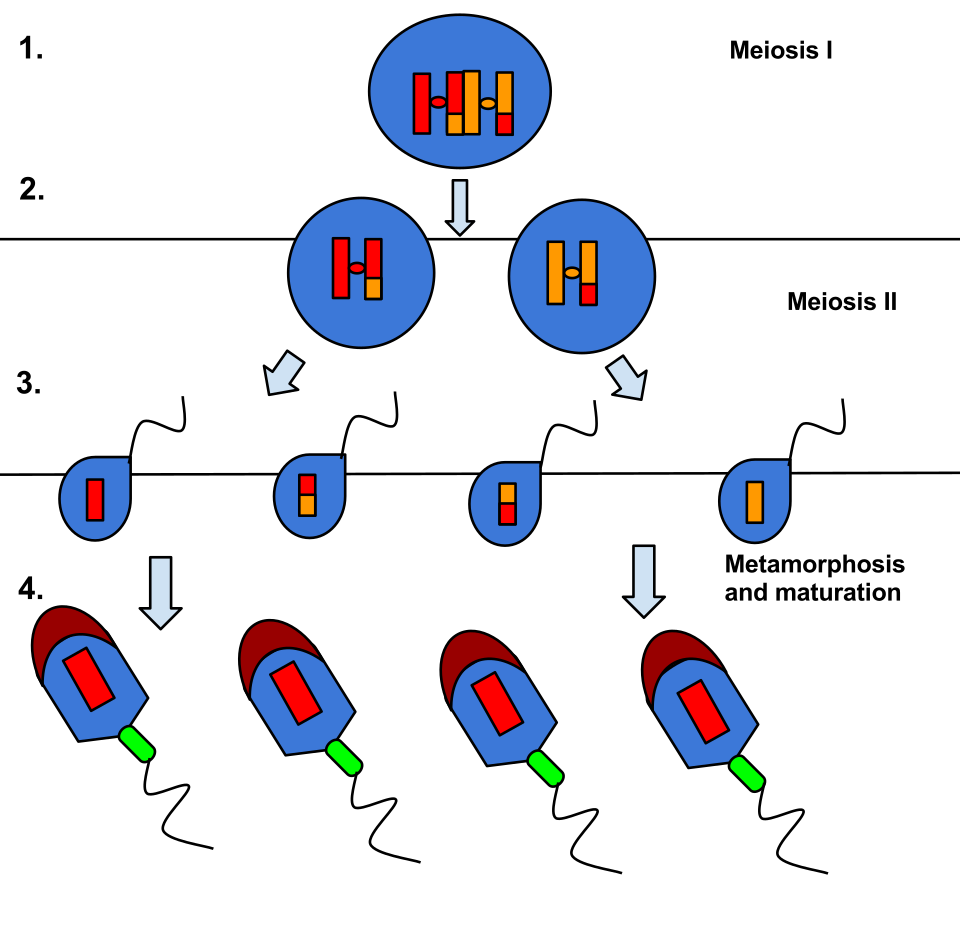
Sperm are made inside the testicles in a long, multi-step process called spermatogenesis. Immature cells divide, mature and then travel through the epididymis before they are ejaculated. Because of this cycle, Cleveland Clinic advises that, when you try to increase sperm count, it usually takes at least three months to see the results of a lifestyle change in a semen sample.
The same timing explains why a single “bad” test is not the end of the story. The NHS usually repeats an abnormal semen analysis about three months after the first one, and our guide to semen analysis explains how to prepare so the result is reliable. A realistic plan to increase sperm count is therefore: test, find the cause, make changes, and retest after about three months.
Source: Cleveland Clinic — Health Essentials: sperm count and male fertility; NHS — Low sperm count
Lifestyle changes increase sperm count most when lifestyle is part of the problem. They cannot fix a blocked duct, a genetic cause or a severe hormone deficiency, which is why the European Association of Urology (EAU) recommends a full assessment, including testosterone, FSH and LH blood tests, in every man with a low count.
Source: EAU — Sexual and Reproductive Health Guidelines (male infertility chapter)
How to increase sperm count with lifestyle changes
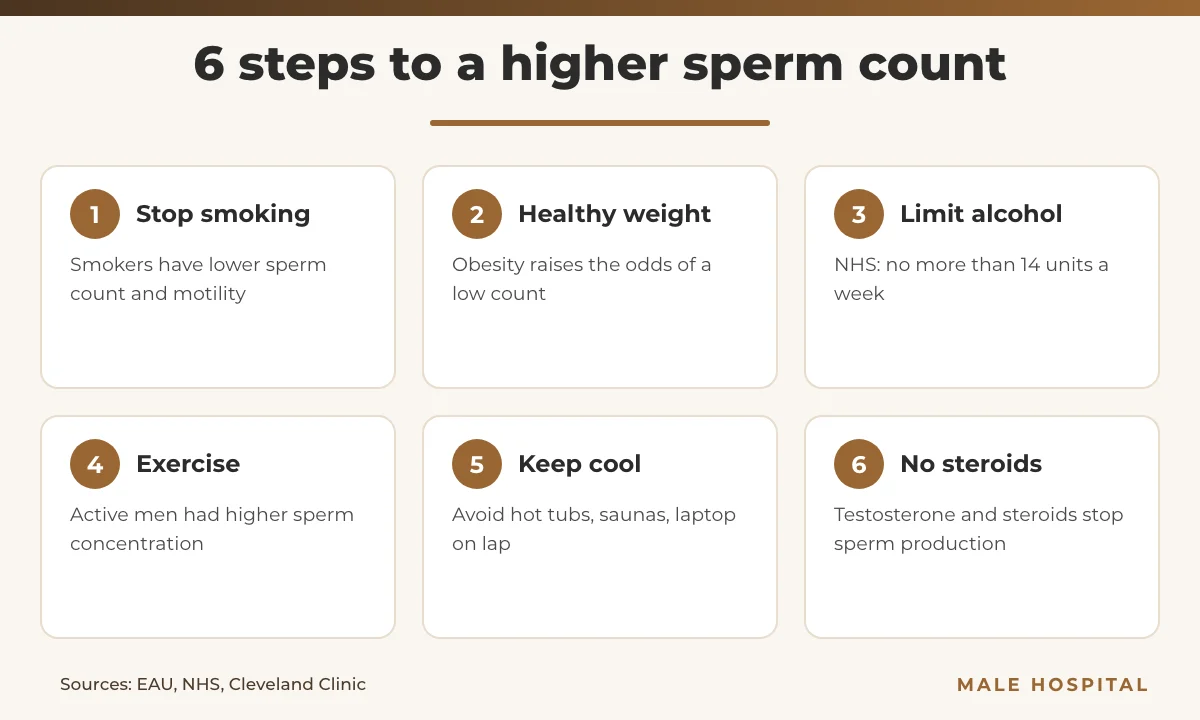
The EAU gives a strong recommendation that infertile men should be told about the harmful effects of obesity, low physical activity, smoking and high alcohol intake, and advised to improve these factors to raise their chances of conception. These are the foundations of any answer to how to increase sperm count without medicine.
Source: EAU — Sexual and Reproductive Health Guidelines (male infertility chapter)
Stop smoking
Quitting is one of the best-supported ways to increase sperm count. A 2016 meta-analysis in European Urology pooled 20 studies with 5,865 men. Smokers had a lower sperm concentration (on average about 9.7 million/mL less), lower motility and fewer normally shaped sperm. The effect was larger in moderate and heavy smokers and in men already attending fertility clinics. Cleveland Clinic adds that chemicals in tobacco can damage sperm DNA, and it advises avoiding cannabis while trying to conceive.
Source: European Urology (PubMed) — Sharma et al. 2016, Cigarette smoking and semen quality: a new meta-analysis; Cleveland Clinic — Health Essentials: sperm count and male fertility
Reach a healthy weight
Excess body fat changes the hormones that drive sperm production. A meta-analysis of 21 studies and 13,077 men found a J-shaped link between body mass index (BMI) and a low or absent sperm count: compared with normal-weight men, the odds were 11% higher in overweight men, 28% higher in obese men and about twice as high in morbidly obese men. The authors noted that it is still unproven whether weight loss itself restores sperm count, but the NHS and EAU both advise losing excess weight.
Source: Human Reproduction Update (PMC) — Sermondade et al. 2013, BMI in relation to sperm count; NHS — Low sperm count
Keep alcohol moderate
A meta-analysis of 15 studies with 16,395 men linked alcohol to lower semen volume and fewer normally shaped sperm. The difference was clearest in daily drinkers compared with occasional drinkers, while moderate drinking did not appear to harm semen quality. The NHS advises no more than 14 units a week, spread over three days or more; Cleveland Clinic links more than seven drinks a week to poorer semen quality.
Source: Reproductive BioMedicine Online (PubMed) — Ricci et al. 2017, Semen quality and alcohol intake; NHS — Low sperm count
Move more, sit less
In a study of 189 healthy men aged 18 to 22, those doing 15 or more hours a week of moderate-to-vigorous exercise had a 73% higher sperm concentration than those doing less than five hours. Men who watched more than 20 hours of TV a week had a 44% lower concentration than those who watched none. This was an observational study, so it shows a link rather than proof, but regular exercise also helps with weight, which supports the same goal to increase sperm count.
Sleep and stress
Cleveland Clinic recommends about seven to eight hours of sleep a night: fewer than six hours is linked to a lower chance of conception, and more than nine hours to poorer sperm health. It also suggests stress-reducing habits such as breathing exercises, guided imagery or yoga. These links are weaker than those for smoking or weight, but good sleep and lower stress make the other changes to increase sperm count easier to keep up.
Source: Cleveland Clinic — Health Essentials: sperm count and male fertility
Keep the testicles cool
The testicles work best at a temperature slightly below core body temperature, which is why they sit outside the body. Cleveland Clinic lists long periods in very hot environments, such as hot tubs, among the factors linked to a low count, and advises avoiding hot tubs, saunas and resting a laptop on your lap for long periods while trying to conceive.
Source: Cleveland Clinic — Oligospermia (Low Sperm Count); Cleveland Clinic — Health Essentials: sperm count and male fertility
Underwear is a smaller and less certain factor. The NHS suggests loose-fitting underwear because tight pants can raise testicular temperature. A Harvard study of 656 men at a fertility center found that men who mostly wore boxers had a 25% higher sperm concentration and 17% higher total count than men who did not, although the study was cross-sectional and cannot prove cause. Switching to loose underwear costs nothing, but on its own it is unlikely to increase sperm count enough to fix a significantly low count.
Source: NHS — Low sperm count; Human Reproduction (PMC) — Mínguez-Alarcón et al. 2018, Type of underwear worn and markers of testicular function
A scrotal heat source you cannot see is a varicocele, a cluster of enlarged veins that raises testicular temperature. If you notice a soft, “bag of worms” swelling above a testicle, see our guide to varicocele and get it checked, because this is a treatable cause.
Diet and sperm count: what the evidence shows
No single “sperm food” has been proven to increase sperm count, but overall eating patterns matter. A systematic review of 35 observational studies found that diets rich in fish and seafood, poultry, cereals, vegetables, fruit and low-fat dairy were associated with better sperm quality. Diets high in processed meat, full-fat dairy, sugar-sweetened drinks and sweets were associated with poorer semen quality in some studies.
In practice, Cleveland Clinic recommends a Mediterranean-style, whole-food diet with leafy greens and fish rich in omega-3 fats, and cutting back on ultra-processed food, sugary treats and meals high in saturated fat. The same diet supports a healthy weight and heart health, so it is a sensible choice for men trying to increase sperm count, even though the fertility evidence is mainly observational.
Source: Cleveland Clinic — Health Essentials: sperm count and male fertility
Do supplements increase sperm count? The MOXI and FAZST trials
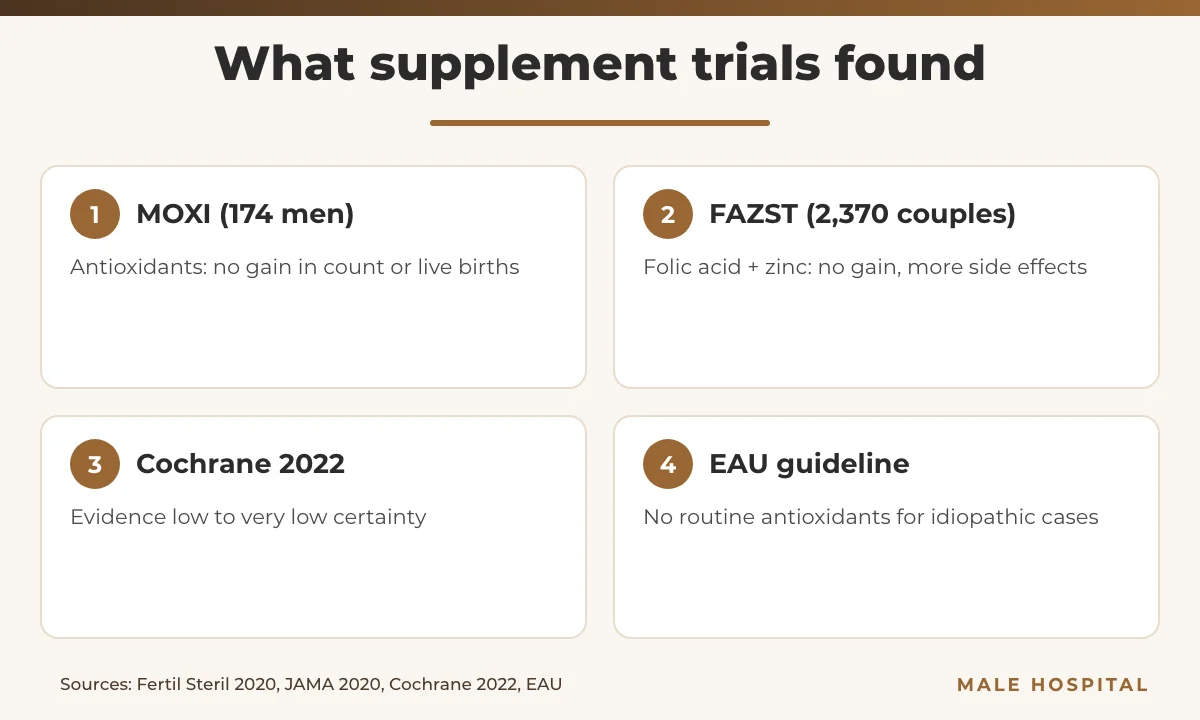
Male fertility supplements usually combine antioxidants (vitamins C and E, selenium, L-carnitine, coenzyme Q10, lycopene) with zinc and folic acid. The idea that antioxidants could increase sperm count is reasonable, because oxidative stress can damage sperm, but the two largest placebo-controlled trials did not support the marketing.
The MOXI trial
The Males, Antioxidants, and Infertility (MOXI) trial randomized 174 men with abnormal semen results to a daily antioxidant combination (vitamin C, vitamin E, selenium, L-carnitine, zinc, folic acid and lycopene) or placebo for three to six months. Antioxidants did not improve sperm concentration, motility, shape or DNA fragmentation, including in the subgroup of men with a low count. Live birth rates did not differ either (15% with antioxidants versus 24% with placebo).
Source: Fertility and Sterility (PMC) — Steiner et al. 2020, The MOXI randomized clinical trial
The FAZST trial
The Folic Acid and Zinc Supplementation Trial (FAZST), published in JAMA, randomized 2,370 couples planning fertility treatment. The men took 5 mg of folic acid plus 30 mg of zinc or a placebo daily for six months. Sperm concentration, motility, shape and total motile count did not improve, and live birth rates were the same (34% versus 35%). Sperm DNA fragmentation was slightly higher with the supplement, and stomach pain, nausea and vomiting were more common.
Source: JAMA (PubMed) — Schisterman et al. 2020, Folic acid and zinc supplementation in men (FAZST)
What the wider evidence says
A 2022 Cochrane review pooled 90 smaller trials with 10,303 men. It found very low-certainty evidence that antioxidants may increase live birth rates, but when trials at high risk of bias were removed, there was no evidence of benefit, and the authors called the overall evidence inconclusive. On this basis, the EAU advises against routinely treating idiopathic infertility with antioxidants.
Source: Cochrane Database of Systematic Reviews (PubMed) — de Ligny et al. 2022, Antioxidants for male subfertility; EAU — Sexual and Reproductive Health Guidelines (male infertility chapter)
The honest summary: a basic multivitamin to cover gaps in your diet is reasonable and low-risk, and Cleveland Clinic suggests one for that purpose. Expensive “sperm boosters” are not a proven way to increase sperm count, so do not let them delay testing or effective treatment, and tell your doctor about every product you take.
Source: Cleveland Clinic — Health Essentials: sperm count and male fertility
Medicines and drugs that lower sperm count
Sometimes the fastest way to increase sperm count is to remove what is suppressing it. The most important example is testosterone. Extra testosterone from injections, gels or steroids signals the brain to switch off the hormones that drive sperm production. The EAU strongly recommends against testosterone therapy as a treatment for male infertility, and Cleveland Clinic warns that taking testosterone suppresses natural sperm production. If you have low testosterone and still want children, read our guide to testosterone replacement therapy and our article on how to increase testosterone naturally before starting anything.
Source: EAU — Sexual and Reproductive Health Guidelines (male infertility chapter); Cleveland Clinic — Health Essentials: sperm count and male fertility
For men who have used anabolic steroids and want to increase sperm count, the EAU suggests stopping them for six to 12 months before hormone treatment is considered, because recovery can be slow. The NHS also advises avoiding anabolic steroids and cocaine.
Cleveland Clinic lists several prescription medicines that may lower sperm count, including clomipramine, finasteride, lamotrigine, methadone, methotrexate, nitrofurantoin, paroxetine, prednisone, sirolimus and testosterone. Do not stop a prescribed medicine on your own to increase sperm count: ask the prescribing doctor whether a fertility-friendly alternative exists.
Source: Cleveland Clinic — Oligospermia (Low Sperm Count); NHS — Low sperm count
Workplace exposures matter too. The NHS advises limiting exposure to pesticides, solvents and some heavy metals, so use the protective equipment your employer provides.
Medical treatments that can increase sperm count
When a specific cause is found, treating it is usually a more effective way to increase sperm count than lifestyle change alone. We cover each option in detail in our low sperm count and male infertility guides; in brief, the EAU recommends:
- Hormone treatment for hypogonadotropic hypogonadism: when the brain does not produce enough FSH and LH, treatment with hCG and, if needed, FSH can start sperm production (strong recommendation).
- FSH for idiopathic low count: in men with an unexplained low count and a normal FSH level, FSH treatment may be used (weak recommendation); high-dose FSH is not recommended.
- Varicocele repair: recommended for men with a clinical (palpable) varicocele, abnormal semen results and otherwise unexplained infertility, provided the female partner’s ovarian reserve is good; it is not advised when the semen analysis is normal.
- Not for routine use: clomiphene-type drugs (SERMs) and aromatase inhibitors in idiopathic infertility.
Source: EAU — Sexual and Reproductive Health Guidelines (male infertility chapter)
If you cannot increase sperm count enough, assisted reproduction such as IVF with intracytoplasmic sperm injection (ICSI) needs only a small number of sperm. Men with no sperm at all in the ejaculate (azoospermia) need a different work-up.
Source: Cleveland Clinic — Oligospermia (Low Sperm Count)
Evidence at a glance
This table ranks the most common ideas on how to increase sperm count by the strength of the evidence behind them.
| Approach | What the evidence shows | Verdict |
|---|---|---|
| Stop smoking | Meta-analysis of 5,865 men: lower count and motility in smokers | Do it |
| Lose excess weight | Obesity linked to higher odds of a low or absent count | Do it |
| Avoid heavy drinking | Daily drinking linked to lower volume and shape; moderate intake less clear | Do it |
| Regular exercise | Observational link with higher concentration | Do it |
| Avoid hot tubs, saunas, laptop on lap | Heat impairs sperm production | Do it |
| Mediterranean-style diet | Observational studies only | Reasonable |
| Antioxidant supplements | MOXI: no benefit; Cochrane: very low-certainty evidence | Not proven |
| Folic acid + zinc | FAZST (2,370 couples): no benefit, more side effects | Not recommended |
| Testosterone or steroids | Suppress sperm production | Avoid |
| Treating a found cause (hormones, varicocele) | EAU guideline recommendations | Most effective when it applies |
Sources: EAU — Sexual and Reproductive Health Guidelines (male infertility chapter); Fertility and Sterility (PMC) — Steiner et al. 2020, The MOXI randomized clinical trial; JAMA (PubMed) — Schisterman et al. 2020, Folic acid and zinc supplementation in men (FAZST)
When to see a doctor
The NHS advises seeing a doctor if you have had regular unprotected sex for more than a year without a pregnancy, or after six months if your partner is 36 or older. Cleveland Clinic suggests an earlier evaluation if you have known risk factors. Do not spend months trying to increase sperm count with supplements first: a semen analysis is quick, and the couple’s time, especially the female partner’s age, matters.
Source: NHS — Low sperm count; Cleveland Clinic — Health Essentials: sperm count and male fertility
See a doctor sooner if you have:
- a lump, swelling or pain in a testicle or the scrotum;
- a history of undescended testicles, testicular injury, groin or scrotal surgery;
- signs of low testosterone, such as low sex drive, erection problems or loss of body hair;
- past or current use of testosterone or anabolic steroids;
- previous chemotherapy or radiotherapy;
- a semen analysis showing a very low count or no sperm.
Source: Cleveland Clinic — Oligospermia (Low Sperm Count); EAU — Sexual and Reproductive Health Guidelines (male infertility chapter)
If you would like a personal plan to increase sperm count based on your semen analysis and hormone results, you can book a confidential consultation with our urologist-andrologist Assoc. Prof. Dr. Zülfü Sertkaya, whose focus includes male infertility. Send your results on WhatsApp for a free first review.
FAQs about how to increase sperm count
How long does it take to increase sperm count?
Plan on at least three months to increase sperm count. Sperm take roughly that long to develop and mature, so a change you make today shows up in semen produced about three months later. That is why doctors usually repeat a semen analysis after around three months rather than weeks. After anabolic steroids, recovery is slower: the EAU suggests allowing six to 12 months off them before hormone treatment is considered.
Source: Cleveland Clinic — Health Essentials: sperm count and male fertility; EAU — Sexual and Reproductive Health Guidelines (male infertility chapter)
Can you increase sperm count naturally?
Often, yes, you can increase sperm count naturally when lifestyle factors are contributing. Quitting smoking, losing excess weight, limiting alcohol, exercising, keeping the testicles cool and stopping steroids or recreational drugs are all supported by guidelines and studies. Natural changes cannot correct a blockage, a genetic cause or a serious hormone deficiency, so get tested if a pregnancy does not happen.
Source: EAU — Sexual and Reproductive Health Guidelines (male infertility chapter); NHS — Low sperm count
Do zinc and folic acid improve sperm count?
Not according to the best evidence. In the FAZST trial of 2,370 couples, men who took 5 mg of folic acid and 30 mg of zinc daily for six months had no better sperm count, motility or live birth rate than men on placebo, and they had more stomach side effects. Getting these nutrients from a balanced diet remains sensible.
Source: JAMA (PubMed) — Schisterman et al. 2020, Folic acid and zinc supplementation in men (FAZST)
Does CoQ10 or L-carnitine increase sperm count?
These antioxidants are widely sold to increase sperm count, but evidence is weak. The MOXI trial, whose combination included L-carnitine, found no improvement in sperm count, motility or DNA damage. A Cochrane review rated the overall evidence for antioxidants as low to very low certainty, and the EAU does not recommend them routinely. Discuss any product with your doctor before buying.
Source: Fertility and Sterility (PMC) — Steiner et al. 2020, The MOXI randomized clinical trial; Cochrane Database of Systematic Reviews (PubMed) — de Ligny et al. 2022, Antioxidants for male subfertility
Will taking testosterone increase my sperm count?
No, it does the opposite. Testosterone from injections, gels or steroids tells the brain to stop releasing the hormones that drive sperm production, which suppresses natural sperm production. The EAU strongly recommends against testosterone for treating male infertility. Men with low testosterone who want children need a different treatment plan.
Source: EAU — Sexual and Reproductive Health Guidelines (male infertility chapter); Cleveland Clinic — Health Essentials: sperm count and male fertility
Does wearing boxers help sperm count?
It may help a little to increase sperm count. In a study of 656 men at a fertility center, those who mostly wore boxers had a 25% higher sperm concentration than men who did not, but the study could not prove cause and effect. The NHS suggests loose-fitting underwear because tight pants can warm the testicles. It is a free change, but not a cure for a low count.
Source: Human Reproduction (PMC) — Mínguez-Alarcón et al. 2018, Type of underwear worn and markers of testicular function; NHS — Low sperm count
How often should we have sex when trying to conceive?
The NHS advises having sex every two to three days without contraception, rather than trying to time sex only around ovulation. This keeps fresh sperm available throughout the cycle and takes the pressure off planning. If you have tried for a year, or six months when your partner is 36 or older, see a doctor.
Source: NHS — Low sperm count
Does alcohol lower sperm count?
Heavy and daily drinking is linked to poorer semen quality. A meta-analysis of more than 16,000 men found lower semen volume and fewer normally shaped sperm, mostly in daily drinkers, while moderate drinking did not appear harmful. The NHS limit of 14 units a week, spread over three days or more, is a reasonable ceiling while trying to conceive.
Source: Reproductive BioMedicine Online (PubMed) — Ricci et al. 2017, Semen quality and alcohol intake; NHS — Low sperm count
Medically reviewed by Assoc. Prof. Dr. Zülfü Sertkaya, urologist and andrologist (FEBU), Istanbul. Last reviewed: November 2026.
This article is for general information and does not replace an individual consultation with a qualified doctor.
- EAU — Sexual and Reproductive Health Guidelines (male infertility chapter)
- NHS — Low sperm count
- Cleveland Clinic — How To Increase Sperm Count and Improve Male Fertility
- Cleveland Clinic — Oligospermia (Low Sperm Count)
- Fertility and Sterility (PMC) — Steiner et al. 2020, The effect of antioxidants on male factor infertility: the MOXI randomized clinical trial
- JAMA (PubMed) — Schisterman et al. 2020, Effect of folic acid and zinc supplementation in men on semen quality and live birth (FAZST)
- Cochrane Database of Systematic Reviews (PubMed) — de Ligny et al. 2022, Antioxidants for male subfertility
- European Urology (PubMed) — Sharma et al. 2016, Cigarette smoking and semen quality: a new meta-analysis
- Human Reproduction Update (PMC) — Sermondade et al. 2013, BMI in relation to sperm count: systematic review and meta-analysis
- Reproductive BioMedicine Online (PubMed) — Ricci et al. 2017, Semen quality and alcohol intake: a systematic review and meta-analysis
- British Journal of Sports Medicine (PMC) — Gaskins et al. 2015, Physical activity and television watching in relation to semen quality in young men
- Human Reproduction (PMC) — Mínguez-Alarcón et al. 2018, Type of underwear worn and markers of testicular function
- Human Reproduction Update (PubMed) — Salas-Huetos et al. 2017, Dietary patterns, foods and nutrients in male fertility parameters and fecundability