Blue balls is the everyday name for an aching, heavy or throbbing feeling in the testicles after sexual arousal that does not end in orgasm. Doctors sometimes call it epididymal hypertension. It is harmless, it does not turn anything blue, and it usually fades within minutes to a few hours as blood flow to the genitals returns to normal. Sudden, severe pain or pain lasting over an hour is something else: see our full guide to testicular pain and seek urgent care.
Source: Cleveland Clinic — Are ‘Blue Balls’ Real?; NHS — Testicle pain
- The sensation is real for many men, but it is not a disease and leaves no lasting effects.
- The mechanism is simple: arousal fills the genitals with blood, the testicles swell and draw up, and without orgasm that congestion takes longer to drain.
- In a 2023 survey of 1,483 people with a penis, 56% had felt pain when approaching orgasm without ejaculating. Most described it as mild, and only 6.7% of those who rated it called it severe.
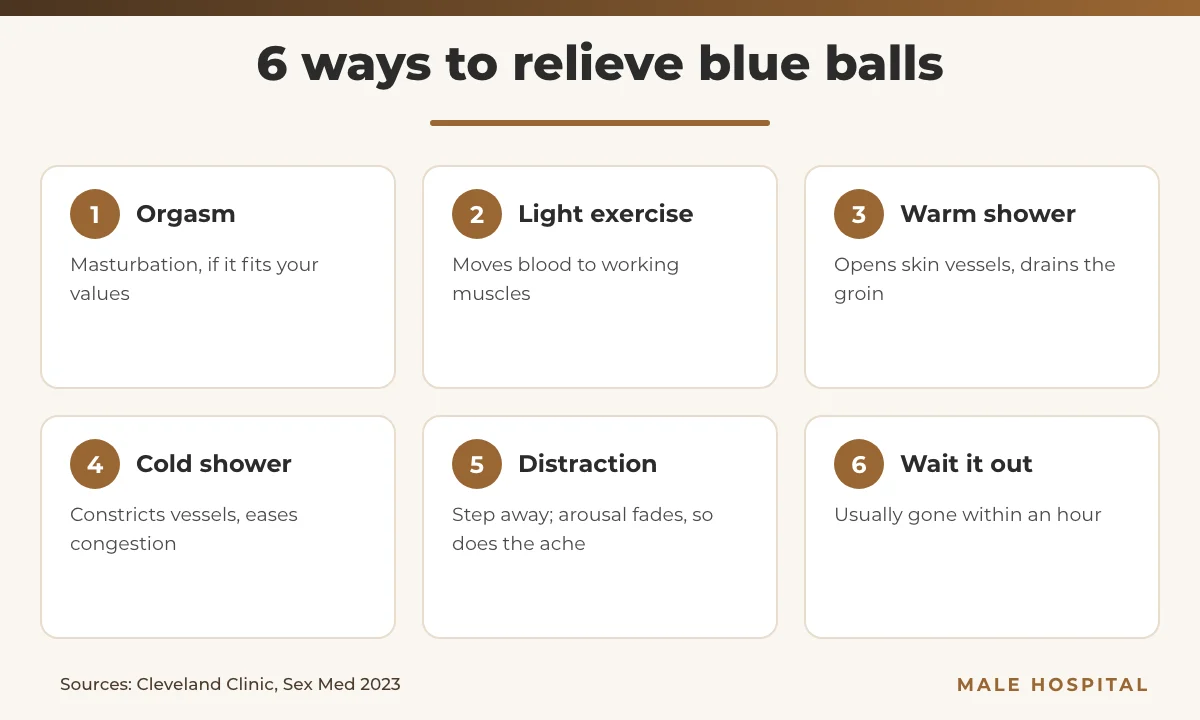
- Relief does not require a partner: masturbation, light exercise, a warm or cold shower, distraction or simply waiting all work.
- Pain that is sudden and severe, comes with nausea or vomiting, lasts over an hour, or continues at rest needs emergency assessment to rule out testicular torsion.
- What are blue balls (epididymal hypertension)?
- Blue balls symptoms: what it actually feels like
- Why blue balls happen: the physiology
- How common are blue balls? What the research says
- How long do blue balls last?
- How to get rid of blue balls: 6 relief options
- Myths vs facts
- Conditions that mimic epididymal hypertension
- Consent: the dark side of the term
- When to see a doctor
- FAQs about blue balls
What are blue balls (epididymal hypertension)?
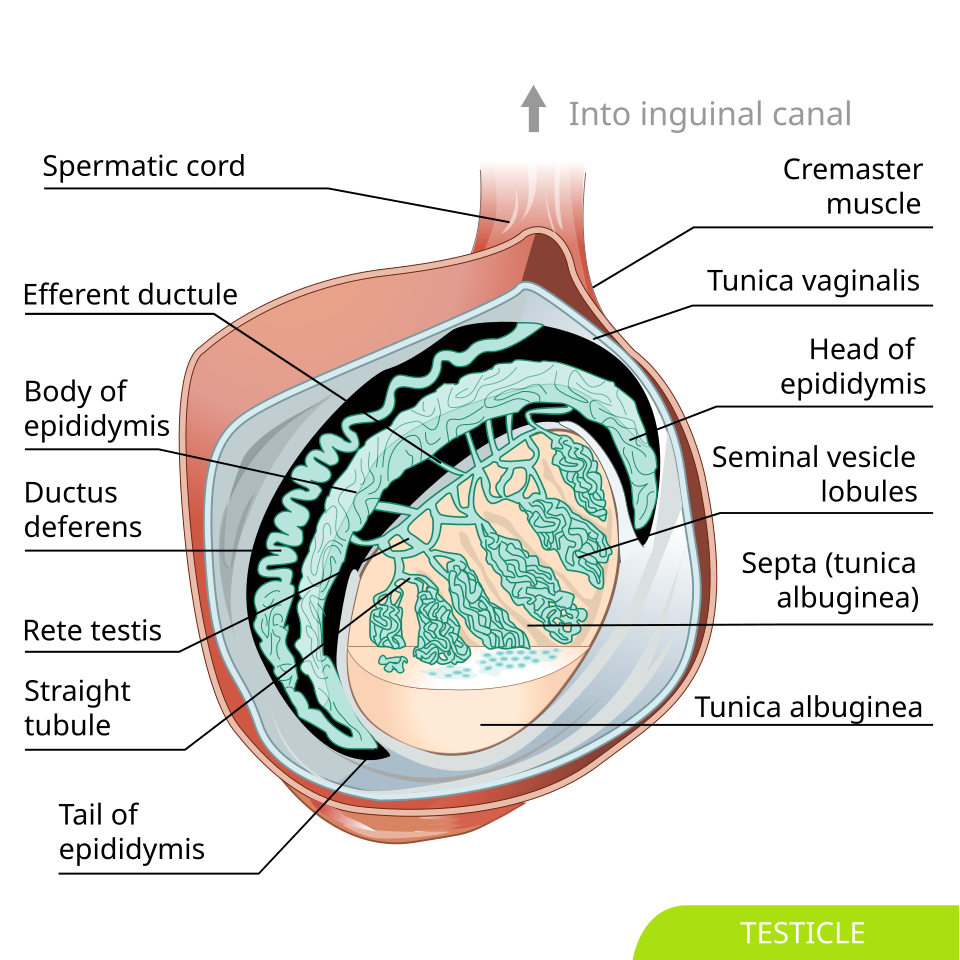
Cleveland Clinic defines blue balls as a feeling of pressure or discomfort in the testicles after sexual arousal without orgasm, and notes that some providers call the same experience epididymal hypertension. The epididymis is the coiled tube on top of and behind each testicle, where sperm mature and are stored.
Despite the medical-sounding name, epididymal hypertension is not a recognised diagnosis in urology guidelines. It is not listed as a condition in the EAU chronic pelvic pain guideline, which instead defines scrotal, testicular and epididymal pain syndromes as persistent or recurrent pain with no proven infection or other obvious cause, chronic once it has lasted three months or more. The short-lived ache after arousal does not meet that definition.
Medical interest in the subject is old. A 2025 historical review in Sexual Medicine Reviews found this kind of scrotal pain well documented between the 1820s and 1920s under 14 names, including “epididymitis erotica” and “testicular neuralgia”. Modern research is thin: a 2024 editorial in The Journal of Sexual Medicine found only a brief 2000 case report, a few letters and one 2023 survey.
Source: Cleveland Clinic — Are ‘Blue Balls’ Real?; EAU — Chronic Pelvic Pain Guidelines; PubMed — Janssen, a brief history (Sex Med Rev, 2025); The Journal of Sexual Medicine — Jones et al., editorial on the evidence (2024)
Blue balls symptoms: what it actually feels like
Cleveland Clinic lists swollen-feeling testicles, aching, throbbing, heaviness or pressure, and mild pain. The discomfort is usually felt in the testicles, though some men feel it lower in the abdomen or in the groin.
In the 2023 survey published in Sexual Medicine, respondents with a penis most often characterised it as an ache or throbbing, a feeling of pressure or tension, or simply as uncomfortable and frustrating. Some reported lingering arousal, restlessness or a dull stomach cramp rather than pain in the testicles. Those with moderate symptoms mentioned swollen testicles and pain; those with mild symptoms described an ache or slight discomfort.
Two features set this apart from anything serious. First, the skin does not change colour: testicles do not turn blue from not ejaculating, and any scrotal discolouration should be checked by a provider. Second, arousal without ejaculation should never cause severe or debilitating pain. Sharp, one-sided pain, or pain that makes you feel sick, is something else until a doctor says otherwise.
Source: Cleveland Clinic — Are ‘Blue Balls’ Real?; PubMed — Levang et al., survey of genitopelvic pain after arousal without orgasm (Sex Med, 2023)
Why blue balls happen: the physiology
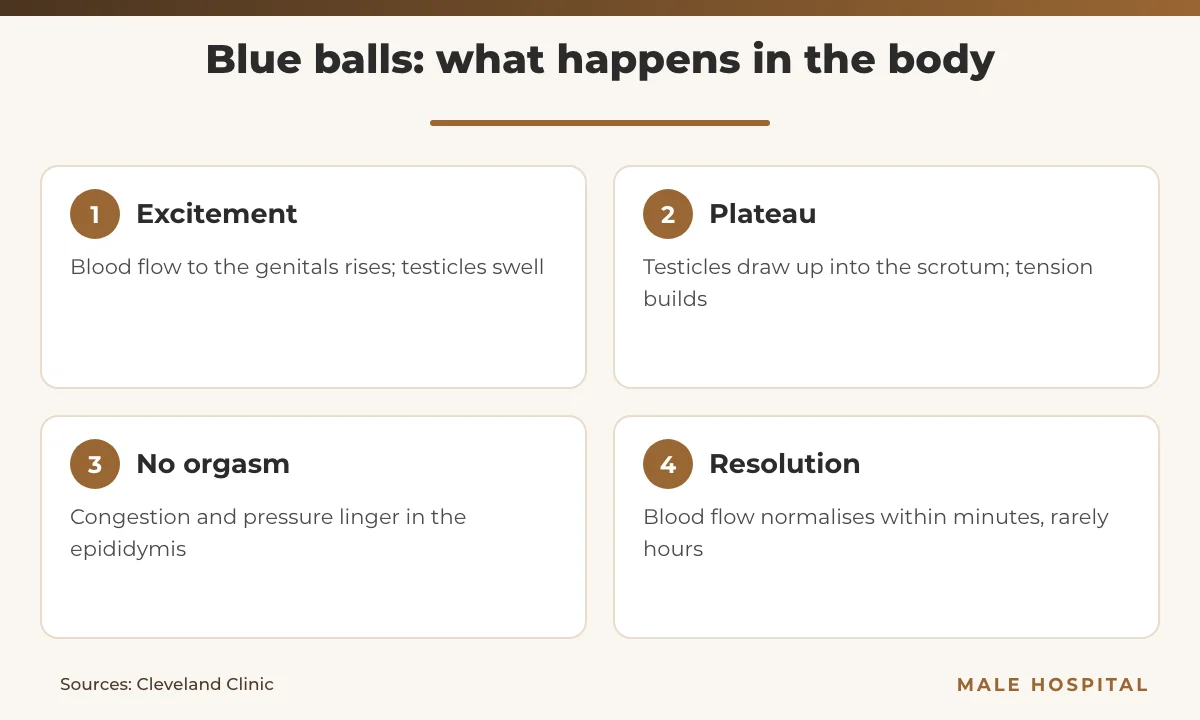
The explanation sits in the normal sexual response cycle. During the excitement phase, blood flow to the genitals increases, producing an erection; the testicles may swell and the scrotum tightens. During the plateau phase these changes intensify and the testicles withdraw up into the scrotum. Orgasm releases the built-up tension, and in the resolution phase the body returns to its normal state, with swollen tissues going back to their previous size and position.
When arousal stops without orgasm, the body still enters resolution, but it does so without the release. Cleveland Clinic’s urologist explains that pressure builds in the epididymis during arousal, orgasm normally relieves it, and without orgasm the extra blood and pressure remain a little longer, causing short-lived heaviness or discomfort until blood flow returns to normal. In plain terms, it is a congested, slow-draining version of a process that happens every time a man is aroused.
Is the epididymis really “hypertensive”?
Nobody has measured pressure inside the epididymis in this situation. The 2024 editorial notes that “epididymal hypertension” exists mostly as a search term and that the medical basis of the phenomenon is unclear; Cleveland Clinic adds that it has not been formally researched because it is not a health threat. The congestion explanation fits the physiology, but it is a description, not a proven mechanism.
Source: Cleveland Clinic — Sexual Response Cycle; Cleveland Clinic — Are ‘Blue Balls’ Real?; The Journal of Sexual Medicine — Jones et al., editorial on the evidence (2024)
How common are blue balls? What the research says
The best data come from a 2023 cross-sectional online survey of 2,621 people, 1,483 with a penis and 1,138 with a vagina, published in Sexual Medicine. Among respondents with a penis, 41.5% believed the phenomenon is real, 27.6% did not and 28.2% were unsure. When asked directly, 56% said they had experienced pain in the testicles when approaching orgasm without ejaculating; 37.8% had not, and 6.2% said they always ejaculate.
Severity was mostly low. Of the 851 respondents who rated their pain, 57.8% called it mild, 35.5% moderate and 6.7% severe. Frequency was also low: 45.5% said it happened very rarely, 35% rarely, 17.4% often, and only 2.1% every time they did not ejaculate. Many respondents who commented on age said it began around puberty, and was worse and more frequent when they were younger.
The authors acknowledge limits: participants were recruited through a science podcast, age was not recorded, and some reported pain may have come from other pelvic conditions or from vigorous sex. Even so, it is the largest dataset on the subject, and its message is consistent: common, usually mild, and infrequent for most men.
Before this survey, the only clinical literature was a 2000 case report in Pediatrics proposing the diagnosis as a consideration in young adults with testicular and scrotal pain. That single case, plus the fact that the discomfort resolves on its own, explains why no guideline has ever addressed it.
Source: PubMed — Levang et al., survey of genitopelvic pain after arousal without orgasm (Sex Med, 2023); PubMed — Chalett & Nerenberg, case report in testiculoscrotal pain of young adults (Pediatrics, 2000)
How long do blue balls last?
Usually minutes. Cleveland Clinic says the discomfort typically lasts minutes and, in rare cases, a few hours. In the 2023 survey, many respondents described it lasting from a few minutes to under an hour, others said several hours, and a small number of men reported discomfort over days. Those longer accounts are hard to interpret, because the authors could not always tell whether the pain had another cause.
A practical rule follows from this. If testicular discomfort after arousal is still there hours later, is getting worse, or interferes with daily life, stop assuming it is epididymal hypertension. Cleveland Clinic advises seeing a primary care provider in that situation, because another cause may be responsible. For an erection, rather than testicular ache, the threshold is stricter: an erection lasting more than four hours is priapism, a medical emergency.
Source: Cleveland Clinic — Are ‘Blue Balls’ Real?; PubMed — Levang et al., survey of genitopelvic pain after arousal without orgasm (Sex Med, 2023)
How to get rid of blue balls: 6 relief options
Because the cause is lingering congestion, anything that lets blood flow return to normal works, and none of it requires a partner.
1. Orgasm, if it fits your values
Masturbation to orgasm is the most direct relief, listed first by Cleveland Clinic for people comfortable with it, and the most commonly named relieving factor in the survey. The authors also cite earlier work in which orgasm did not resolve the discomfort for some men, so it is not the only answer.
2. Light exercise
A brisk walk, a few flights of stairs or some bodyweight exercise diverts blood flow to working muscles. Both Cleveland Clinic and survey respondents name it as relief.
3. A warm shower
Warmth expands blood vessels in the skin and redirects blood away from the groin. Heat was also listed as a relief method by survey respondents.
4. A cold shower or cold pack
Cold has the opposite action, constricting vessels and reducing congestion in the groin. Cleveland Clinic lists a cold shower; the survey authors mention cold showers or baths. If you use a cold pack on the scrotum, wrap it in a cloth, as MedlinePlus advises for testicular discomfort generally.
5. Distraction
Arousal maintains the congestion, so stepping away lets resolution happen. The survey authors list nonsexual distraction, breathing techniques to slow the heart rate and urinating; an earlier study they cite found that going to sleep, studying or simply doing something else resolved the pain.
6. Wait it out
Time is itself a treatment: for most men the ache is gone within an hour whatever they do. Over-the-counter acetaminophen or ibuprofen is reasonable for a mild ache, but needing it regularly deserves a medical review.
Cleveland Clinic adds that it cannot be fully prevented, but open communication with a partner, avoiding rushed encounters and limiting long breaks during sex make it less likely.
Source: Cleveland Clinic — Are ‘Blue Balls’ Real?; PubMed — Levang et al., survey of genitopelvic pain after arousal without orgasm (Sex Med, 2023); MedlinePlus — Testicle pain
Myths vs facts
Because the subject is rarely discussed with doctors, myths fill the gap.
| Claim | Verdict | What the evidence says |
|---|---|---|
| The testicles turn blue | Myth | No colour change occurs. Any scrotal discolouration needs a medical check. |
| It is dangerous or damages the testicles | Myth | Not medically concerning and leaves no lasting effects. |
| It is completely made up | Myth | 56% of men surveyed reported the sensation; a urologist confirms it can happen. |
| It can last for days | Mostly myth | Typically minutes, rarely hours. Longer pain suggests another cause. |
| Only men get it | Myth | 42% of surveyed people with a vagina reported similar pelvic discomfort (“blue vulva”). |
| Severe pain is normal | Myth | Arousal without ejaculation should never cause severe or debilitating pain. |
Source: Cleveland Clinic — Are ‘Blue Balls’ Real?; PubMed — Levang et al., survey of genitopelvic pain after arousal without orgasm (Sex Med, 2023)
Conditions that mimic epididymal hypertension
The real clinical importance of the term is as a diagnosis to rule out, not to make. Sex and arousal can coincide with genuine scrotal problems, and these are the ones a urologist considers when a man reports testicular pain around sexual activity.
| Condition | How it differs | What to do |
|---|---|---|
| Testicular torsion | Sudden, severe pain in one testicle, often with swelling on that side, nausea or vomiting, and a testicle sitting higher than usual. Can follow exercise or injury, or start with no trigger. | Emergency room now. Within about 6 hours most of the testicle can usually be saved. |
| Epididymitis | Pain builds over hours to days with a tender, warm, swollen scrotum; sometimes burning on urination or discharge. Often an STI under 35, a urine infection over 35. | See a doctor; antibiotics are the usual treatment. |
| Varicocele, hydrocele, spermatocele | Dull ache or heaviness that is there most days, often worse after standing; a swelling or soft lump may be felt. | Non-urgent GP or urology review with ultrasound. |
| Inguinal hernia | Groin bulge and ache that worsen with straining or lifting. | Doctor’s assessment; surgery if symptomatic. |
| Chronic scrotal pain syndrome | Persistent or recurrent testicular or epididymal pain for 3 months or more with no infection or obvious cause. | Urology or pain clinic; see our guide to chronic pelvic pain syndrome. |
| Painful ejaculation | Pain happens during or just after ejaculation, not from its absence. | Usually prostatitis or related; see painful ejaculation. |
Torsion deserves emphasis. MedlinePlus notes it is most common in infancy and at the start of puberty but can occur in older men, and the chance of saving the testicle falls the longer blood flow is cut off. A teenager who blames blue balls but is lying still with one swollen, high-riding testicle needs an emergency department, not reassurance. Our article on epididymitis covers the most common infectious mimic.
Source: MedlinePlus — Testicular torsion; NHS — Epididymitis; Cleveland Clinic — Testicular Pain; EAU — Chronic Pelvic Pain Guidelines
Consent: the dark side of the term
The 2024 editorial in The Journal of Sexual Medicine describes a “dark side” to the term: it is sometimes used to pressure a partner into continuing sexual activity. The 2023 survey measured this. Among respondents with a vagina, 40.1% said they had been pressured into a sexual act because of a partner’s fear of pain without orgasm, compared with 3.7% of respondents with a penis. In open answers, participants on both sides agreed the phenomenon should never be used to coerce or manipulate anyone.
The medical position is unambiguous. The discomfort is mild for most, self-limiting for all, and relievable alone. Cleveland Clinic states it is never a reason to pressure someone into intimacy, and the survey authors conclude that this pain is not a valid reason to continue unwanted sexual activity.
Source: The Journal of Sexual Medicine — Jones et al., editorial on the evidence (2024); PubMed — Levang et al., survey of genitopelvic pain after arousal without orgasm (Sex Med, 2023); Cleveland Clinic — Are ‘Blue Balls’ Real?
When to see a doctor
Epididymal hypertension never needs treatment. The red flags matter because serious causes of testicular pain can begin at the same moment, and torsion is time-critical. Go to the emergency department, or call an ambulance, if you have:
- Sudden, severe pain in one or both testicles, with or without a sexual trigger.
- Testicular pain together with nausea, vomiting or abdominal pain.
- Pain lasting more than an hour, or pain that continues while you are resting.
- Pain or swelling that persists an hour after an injury to the scrotum.
- One testicle swollen, hard, or sitting higher than the other.
- An erection lasting more than four hours. Ischaemic priapism beyond four hours behaves like a compartment syndrome, and the risk of permanent erectile dysfunction rises with time.
Book a GP or urologist appointment within days if you notice a lump, a change in the size or shape of a testicle, aching that keeps coming back, fever, redness or warmth of the scrotum, burning on urination, or discharge. NHS advice is simple: do not try to self-diagnose the cause of testicular pain.
Expect an examination of the groin, testicles and abdomen, and often a scrotal ultrasound and urine tests, including screening for sexually transmitted infections. These are quick and usually settle the question in one visit.
If you would like a confidential assessment of recurring testicular discomfort, or any concern about sexual function, you can message Assoc. Prof. Dr. Zülfü Sertkaya, urologist-andrologist in Istanbul, on WhatsApp. Clinic hours are Monday to Saturday, 09:00 to 17:00.
Source: NHS — Testicle pain; MedlinePlus — Testicle pain; EAU — Sexual and Reproductive Health Guidelines: Priapism
FAQs about blue balls
Are blue balls real?
Yes, as a sensation. A Cleveland Clinic urologist confirms it can happen, and 56% of 1,483 men in a 2023 survey reported testicular pain when approaching orgasm without ejaculating. What is not real is the idea of a medical condition: it is harmless, needs no treatment and has never been addressed by a urology guideline.
Source: Cleveland Clinic — Are ‘Blue Balls’ Real?; PubMed — Levang et al., survey of genitopelvic pain after arousal without orgasm (Sex Med, 2023)
Do blue balls hurt?
For most men it is an ache, heaviness or throbbing rather than true pain. Among survey respondents who rated it, 57.8% said mild, 35.5% moderate and 6.7% severe. Severe, sharp or one-sided pain is not typical and should be assessed, because it may be torsion, infection or another condition.
Source: PubMed — Levang et al., survey of genitopelvic pain after arousal without orgasm (Sex Med, 2023)
Can blue balls cause long-term damage?
No. Cleveland Clinic states the experience is not medically concerning and has no lasting effects. It does not affect fertility, testosterone or erections. Pain that persists for hours, recurs without sexual arousal, or comes with swelling or fever is a sign of a different problem that does need a medical opinion.
Source: Cleveland Clinic — Are ‘Blue Balls’ Real?
Can you get blue balls from edging?
Edging, which means deliberately staying close to orgasm for a long time, is exactly the kind of prolonged arousal without release that produces the sensation. Survey respondents named prolonged foreplay, prolonged arousal without orgasm and waiting for orgasm as the usual causes. Finishing with orgasm, or stopping and letting arousal fade, resolves it.
Source: PubMed — Levang et al., survey of genitopelvic pain after arousal without orgasm (Sex Med, 2023)
Do women get blue balls?
Anyone can feel discomfort after prolonged arousal without orgasm. In women it is sometimes called “blue vulva”: blood engorges the vulva and clitoris, and without orgasm this can leave heaviness or pressure. In the 2023 survey, 42.1% of respondents with a vagina reported it, mostly as mild discomfort. It involves no colour change and is not dangerous.
Source: Cleveland Clinic — Are ‘Blue Balls’ Real?; PubMed — Levang et al., survey of genitopelvic pain after arousal without orgasm (Sex Med, 2023)
Why do my testicles hurt after sex even though I ejaculated?
Pain that follows ejaculation rather than its absence points elsewhere: epididymitis, prostatitis, a varicocele aggravated by exertion, a hernia, or a minor injury during sex. If it lasts more than an hour, is one-sided, or comes with swelling, fever or urinary symptoms, see a doctor for an ultrasound and urine tests.
Source: Cleveland Clinic — Testicular Pain; NHS — Epididymitis
Is “epididymal hypertension” an official diagnosis?
No. The term appears in popular health writing and as a search term, but it is not a diagnosis in the EAU guidelines, which define chronic scrotal, testicular and epididymal pain syndromes only after three months of symptoms with no identifiable cause. A 2024 editorial in The Journal of Sexual Medicine concluded that the medical basis of the phenomenon remains unclear and under-researched.
Source: EAU — Chronic Pelvic Pain Guidelines; The Journal of Sexual Medicine — Jones et al., editorial on the evidence (2024)
Medically reviewed by Assoc. Prof. Dr. Zülfü Sertkaya, urologist and andrologist (FEBU), Istanbul. Last reviewed: November 2026.
This article is for general information and does not replace an individual consultation with a qualified doctor.
- Cleveland Clinic — Are 'Blue Balls' Real?
- Cleveland Clinic — Sexual Response Cycle
- Cleveland Clinic — Testicular Pain
- NHS — Testicle pain
- NHS — Epididymitis
- MedlinePlus — Testicle pain
- MedlinePlus — Testicular torsion
- PubMed — Levang SL et al. "Blue balls" and sexual coercion: a survey study of genitopelvic pain after sexual arousal without orgasm. Sex Med, 2023
- PubMed — Chalett JM, Nerenberg LT. "Blue balls": a diagnostic consideration in testiculoscrotal pain in young adults. Pediatrics, 2000
- PubMed — Janssen DF. Blue balls: a brief history. Sex Med Rev, 2025
- The Journal of Sexual Medicine — Jones JM et al. Does blue balls exist, and why should we care? J Sex Med, 2024
- EAU — Chronic Pelvic Pain Guidelines
- EAU — Sexual and Reproductive Health Guidelines: Priapism