Peyronie’s disease surgery straightens a curved penis in one of three ways: shortening the longer side with plication, lengthening the shorter side by cutting into the plaque and adding a graft, or placing a penile prosthesis with modelling when erectile dysfunction is also present. It is offered only once the disease has stopped changing and the bend makes sex difficult. Surgery is one part of the wider Peyronie’s disease treatment pathway, which also covers medicines, injections and traction.
Source: EAU Guidelines — Sexual and Reproductive Health: Penile Curvature; AUA — Peyronie’s Disease Guideline
- Surgery is for stable disease, usually 12 to 18 months after symptoms start, when the curve is unchanged for at least 3 to 6 months and gets in the way of sex.
- Plication is the usual first choice for men with good erections, adequate length and a simpler curve. It straightens more than 85% of men but often shortens the penis by about 1 to 1.5 cm.
- Plaque incision or excision with a graft suits men with good erections but a severe curve, short length or an hourglass shape. It carries a higher risk of new erectile dysfunction.
- Men who also have erectile dysfunction that does not respond to tablets or injections are usually offered a penile prosthesis, with modelling or extra straightening if needed.
- The realistic goal is a “functionally straight” penis that allows comfortable intercourse, not a perfectly straight one.
- Peyronie’s disease surgery: the three main options
- When is Peyronie’s disease surgery considered?
- How surgeons choose the right operation
- Plication and other tunical shortening procedures
- Plaque incision or excision with grafting
- Penile prosthesis with modelling
- Peyronie’s disease surgery outcomes and risks
- Recovery after Peyronie’s disease surgery
- When to see a doctor
- FAQs about Peyronie’s disease surgery
Peyronie’s disease surgery: the three main options
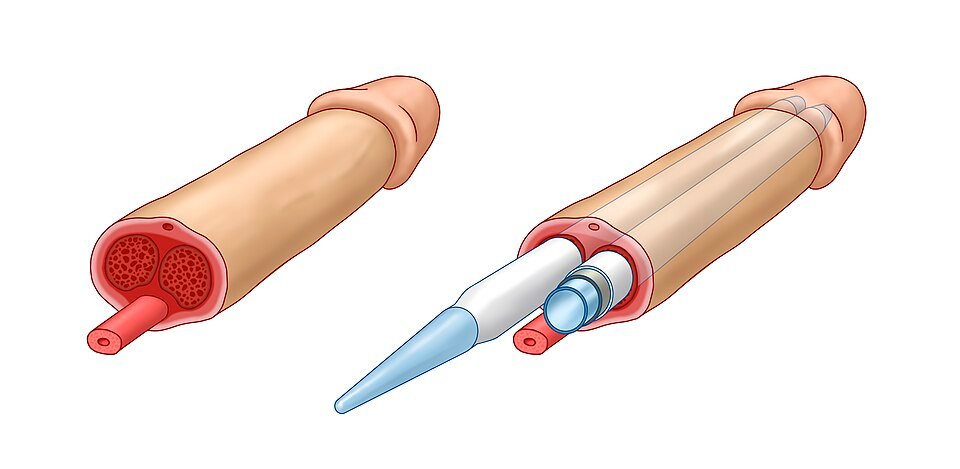
In Peyronie’s disease, scar tissue (a plaque) forms in the tunica albuginea, the tough sheath around the two erectile chambers. The scarred side cannot stretch, so the erect penis bends toward it and may also narrow or shorten. If you want a full overview of the condition itself, our guide to Peyronie’s disease covers symptoms, phases and non-surgical care. Here we focus only on Peyronie’s disease surgery.
Every straightening operation works on the same principle: make the two sides of the shaft equal in length. Surgeons can either shorten the long (convex) side, lengthen the short (concave) side, or place cylinders inside the penis that hold it straight and rigid. The European Association of Urology (EAU) groups these as tunical shortening, tunical lengthening and penile prosthesis implantation.
- Tunical shortening (plication, Nesbit and related techniques): stitches, or small removed wedges of tissue, on the side opposite the plaque.
- Tunical lengthening (incision or excision with grafting): the plaque is cut or partly removed and the gap is covered with a tissue patch.
- Penile prosthesis: implant cylinders that treat erectile dysfunction and straighten the penis, sometimes combined with modelling, plication or grafting.
No technique of Peyronie’s disease surgery has been proven superior in randomised trials, so the choice depends on your erections, your length, the type of curve and what you value most.
Source: EAU Guidelines — Sexual and Reproductive Health: Penile Curvature; NIDDK — Penile Curvature (Peyronie’s Disease)
When is Peyronie’s disease surgery considered?
Peyronie’s disease has an active phase, when pain and the curve may still change, and a stable (chronic) phase. Peyronie’s disease surgery is planned only in the stable phase, because operating while the plaque is still evolving can leave a new bend. Cleveland Clinic recommends surgery only once scar tissue is fully formed, about 12 to 18 months after symptoms start, and NIDDK advises waiting until the plaque and the curve have stabilized.
The guidelines phrase this slightly differently. The EAU says the disease should be stable for 3 to 6 months, or more than 9 to 12 months after onset. The AUA asks clinicians to confirm that symptoms have been unchanged for at least 3 months, and notes that most surgical studies required at least 12 months of symptoms and 3 to 6 months of a stable curve. Results of Peyronie’s disease surgery during the active phase are unknown.
Being stable is not enough on its own. Peyronie’s disease surgery is offered when the deformity actually compromises intercourse and causes bother, for example when penetration is difficult or painful for either partner. A mild curve that does not interfere with sex usually needs no operation.
Source: Cleveland Clinic — Peyronie’s Disease Treatment; AUA — Peyronie’s Disease Guideline; EAU Guidelines — Sexual and Reproductive Health: Penile Curvature
What is checked before surgery
The EAU lists the items that should be documented before reconstruction: plaque size and location, penile length, the degree of curvature and any complex deformity (such as an hourglass narrowing or hinge), erectile function including the response to tablets or injections, and your expectations. Erect penile photos or an in-clinic injection test show the true curve. According to NIDDK, an ultrasound Can show the exact location and size of the plaque before Peyronie’s disease surgery.
Your erections matter most when planning Peyronie’s disease surgery. The AUA notes that straightening operations without an implant generally do not restore erections in men whose erectile dysfunction does not respond to medicines or a vacuum device. Those men should be counselled about a prosthesis instead.
Source: EAU Guidelines — Sexual and Reproductive Health: Penile Curvature; NIDDK — Penile Curvature (Peyronie’s Disease); AUA — Peyronie’s Disease Guideline
How surgeons choose the right operation
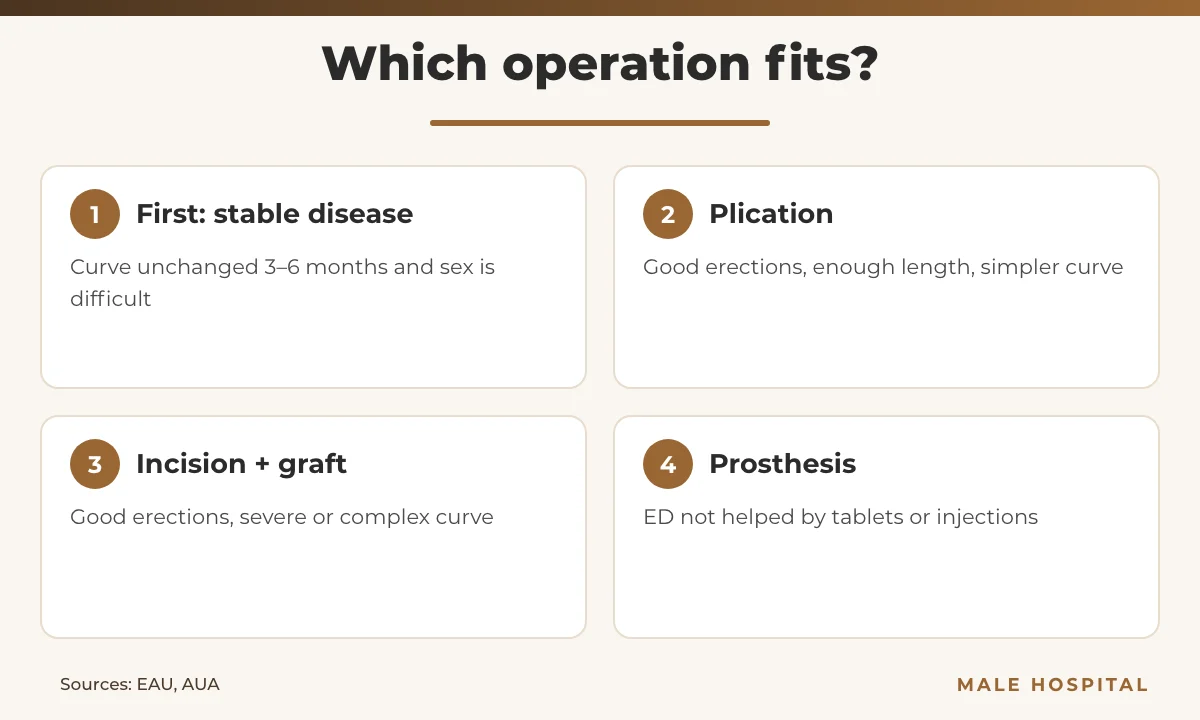
Choosing the type of Peyronie’s disease surgery follows three questions. Are your erections firm enough for sex, with or without tablets? Is your penis long enough to accept some shortening? Is the curve simple, or is it severe or complex? The EAU recommends shortening first for men with adequate length and rigidity, a less severe curve and no complex deformity; lengthening with a graft for men with normal erections but inadequate length, severe curvature or complex deformity; and a prosthesis for men whose erectile dysfunction does not respond to medical treatment.
The EAU mentions a curve above 60 degrees as a proposed, not validated, threshold for preferring grafting, and a grafting review by Hatzichristodoulou likewise names curves above 60 degrees, a short penis or an hourglass deformity as reasons to graft. In Peyronie’s disease surgery, these numbers are guides rather than strict rules.
| Option | Best suited for | Main trade-off |
|---|---|---|
| Plication / Nesbit (shortening) | Good erections, adequate length, simpler curve, no hourglass or hinge | Some loss of length is common; lower risk of new ED |
| Incision or excision + graft (lengthening) | Good erections but severe curve, short penis or complex deformity | Longer, more complex operation; higher risk of new ED |
| Penile prosthesis ± modelling | ED not responding to tablets or injections | Permanent implant; infection and mechanical risks |
Source: EAU Guidelines — Sexual and Reproductive Health: Penile Curvature; Translational Andrology and Urology (PMC) — Grafting techniques for Peyronie’s disease (Hatzichristodoulou, 2016); Cleveland Clinic — Peyronie’s Disease Treatment
Plication and other tunical shortening procedures
In tunical shortening, the surgeon works on the side opposite the plaque. In the classic Nesbit operation, small ellipses of tunica are removed and the edges are sewn together. The Yachia technique uses small lengthwise incisions closed crosswise, while simple plication and the “16-dot” technique fold the tunica with permanent stitches without removing tissue. Depending on the approach, circumcision is sometimes performed at the same time, which the EAU lists among the points to discuss beforehand.
The EAU considers shortening the first option when length and rigidity are adequate, and the AUA says plication may be offered to men whose rigidity is adequate for intercourse. Plication cannot restore lost length or girth, and NIDDK notes it is less likely than grafting to cause numbness or erectile dysfunction. Our dedicated page on penile curvature correction explains how the same techniques are used for congenital curves.
Source: EAU Guidelines — Sexual and Reproductive Health: Penile Curvature; AUA — Peyronie’s Disease Guideline; NIDDK — Penile Curvature (Peyronie’s Disease)
Plication outcomes in the EAU guideline
The EAU pooled Peyronie’s disease surgery results from non-comparable, mostly retrospective studies. The figures below are weighted averages and should be read as broad ranges, not promises.
| Technique | Straightening | Any shortening | New ED | Reduced sensation | Satisfaction |
|---|---|---|---|---|---|
| Nesbit | 88.5% | 21.8% | 6.9% | 11.8% | 83.5% |
| Yachia | 95.5% | 69% | 9.6% | 1% | 86.8% |
| 16-dot | 96.9% | 44.6% | 3.8% | 8.2% | 94% |
| Simple plication | 94.2% | 33.4% | 8.8% | 9% | 85.2% |
Overall, after plication-type Peyronie’s disease surgery, the EAU reports complete straightening in more than 85% of men, recurrence and reduced sensation in roughly 10%, and a low risk of new erectile dysfunction. Shortening of 1 to 1.5 cm occurs in 22 to 69% of men but rarely causes sexual problems. In the AUA review of 60 plication studies, the most common complaint was palpable or painful stitches, reported by up to 35.5% of men.
Source: EAU Guidelines — Sexual and Reproductive Health: Penile Curvature; AUA — Peyronie’s Disease Guideline
Plaque incision or excision with grafting
Tunical lengthening works on the concave (plaque) side. The surgeon makes one or more cuts into the plaque, or removes part of it, which lets the short side expand when the penis is straightened. The resulting gap is covered with a graft. NIDDK notes that this may straighten the penis and restore some of the length lost to the disease, while Cleveland Clinic warns that grafting can worsen erectile dysfunction or even cause it. For that reason, men need firm erections before this type of Peyronie’s disease surgery: the Hatzichristodoulou review requires satisfactory preoperative rigidity.
Grafts may come from your own body (vein, dermis, tunica vaginalis, buccal or lingual mucosa, fascia), from a donor (pericardium, fascia lata), from animals (porcine small intestinal submucosa, bovine pericardium), or as a ready-made collagen fleece. Synthetic materials such as Dacron or Gore-Tex are generally avoided because of infection, fibrosis and contracture risks. The EAU states that no graft has been shown to be superior. It also advises against the “sliding” technique because of reported glans necrosis.
Source: NIDDK — Penile Curvature (Peyronie’s Disease); Cleveland Clinic — Peyronie’s Disease Treatment; EAU Guidelines — Sexual and Reproductive Health: Penile Curvature
Selected graft outcomes (EAU weighted averages)
| Graft | Success | Shortening | New ED |
|---|---|---|---|
| Dermis (own tissue) | 81.2% | 59.9% | 20.5% |
| Vein (own tissue) | about 86% | about 30–33% | about 14–15% |
| Buccal or lingual mucosa | about 94% | 8.3–15.2% | 4.9–5.3% |
| Pericardium (donor) | 85.1–93.1% | about 22–23% | 18.5–37.8% |
| Porcine SIS (animal) | 83.9% | 19.6% | 21.9% |
The EAU stresses that lengthening carries a higher erectile dysfunction risk than shortening, and that Men without erectile problems before Peyronie’s disease surgery should be told the risk of postoperative erectile dysfunction can be as high as 50%. Long-term data also show recurrence: Hatzichristodoulou reports curvature recurring in 10 to 33% of cases.
Source: EAU Guidelines — Sexual and Reproductive Health: Penile Curvature; Translational Andrology and Urology (PMC) — Grafting techniques for Peyronie’s disease (Hatzichristodoulou, 2016)
Plication vs grafting head to head
Direct comparisons of these two types of Peyronie’s disease surgery are rare. A review by Tran and colleagues describes a one-year study of 35 plication and 32 grafting patients: straightening, satisfaction and perceived shortening did not differ significantly, but grafting patients had more loss of sensation and rigidity and were more often unable to have intercourse. Palpable stitches were more common after plication. Mean operating time was 71 minutes for plication versus 234 minutes for grafting.
Penile prosthesis with modelling
When Peyronie’s disease and erectile dysfunction occur together, and the erections do not respond to tablets or injections, both the EAU (strong recommendation) and the AUA advise a penile prosthesis. The implant restores rigidity, and in many men it straightens the penis on its own. NIDDK notes that if the implant alone is not enough, it can be combined with plication or grafting. Learn more about the device and operation on our penile prosthesis page.
The EAU describes a stepwise approach during this form of Peyronie’s disease surgery. If the remaining curve is under 30 degrees, nothing more is done, because the cylinders act as an internal tissue expander over 6 to 9 months. If it is over 30 degrees, the surgeon may first try manual modelling: bending the penis against the curve with the cylinders fully inflated for about 90 seconds. If a curve of more than 30 degrees persists, an incision, plication or graft is added. Modelling carries a reported 3% risk of urethral perforation.
The AUA recommends an inflatable rather than a malleable device in Peyronie’s disease (expert opinion), partly because modelling is hard with semi-rigid rods. The EAU notes that some studies found similar satisfaction with both types. Our guide to the inflatable penile prosthesis compares the designs.
Source: EAU Guidelines — Sexual and Reproductive Health: Penile Curvature; AUA — Peyronie’s Disease Guideline; NIDDK — Penile Curvature (Peyronie’s Disease)
Peyronie’s disease surgery outcomes and risks
The AUA guideline reviewed several thousand Peyronie’s disease surgery patients across observational studies. Its findings are summarised below. The ranges are wide because the studies used different methods and follow-up times, so they cannot be compared like a trial.
| AUA evidence | Plication | Incision/excision + graft | Prosthesis |
|---|---|---|---|
| Studies / patients | 60 / 2,958 | 88 / 2,585 | 43 / 2,216 |
| Curve improvement | 90% or more in 42 study arms | Over 80% in 64 of 72 arms | Over 80% in all 26 reporting studies |
| Sensation change | 0–10% in most studies | 0% to 25% | 0% to 50% |
| Patient satisfaction | From 41% up | 40.9–93.3% | Over 70% in most studies |
| Typical complications | Palpable stitches, shortening | Hematoma, ED, sensation loss | Infection, mechanical revision |
Source: AUA — Peyronie’s Disease Guideline
What to discuss before you agree to surgery
The EAU lists the risks every man should hear about before Peyronie’s disease surgery: penile shortening, erectile dysfunction, numbness, delayed orgasm, recurrence of the curve, palpable knots or stitches, possible circumcision and some residual curvature. It also stresses that the aim is a functionally straight penis. The NHS puts it plainly: it is not usually possible to make the penis as straight as it was before the curve began.
Perception matters too. In plication studies quoted by the AUA, many men felt shorter even when measurements showed little or no change, so Measuring stretched length before and after Peyronie’s disease surgery helps set expectations. A good outcome for most men is comfortable penetration and less worry, not a change in size.
Source: EAU Guidelines — Sexual and Reproductive Health: Penile Curvature; NHS — Peyronie’s disease; AUA — Peyronie’s Disease Guideline
Recovery after Peyronie’s disease surgery
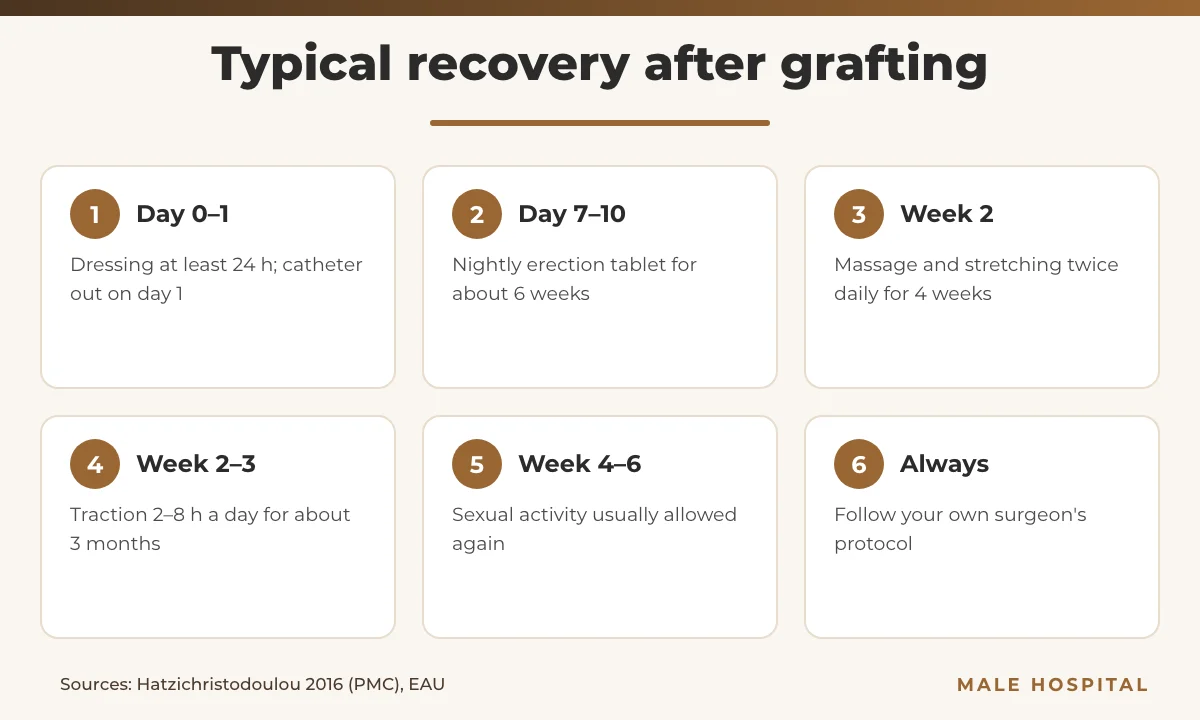
Recovery after Peyronie’s disease surgery depends on the operation and your surgeon’s protocol. Plication is the shortest procedure, while grafting takes longer and needs a more structured rehabilitation. The Hatzichristodoulou review describes a typical program after grafting:
- A loose or compressive dressing for at least 24 hours to prevent bruising and hematoma.
- The urinary catheter, if used, is usually removed on the first day after surgery.
- No sexual activity for 4 to 6 weeks.
- Gentle penile massage and stretching twice daily, starting 2 weeks after surgery, for 4 weeks.
- A nightly PDE5 inhibitor (an erection tablet) from 7 to 10 days after surgery for about 6 weeks, to encourage night-time erections.
- Penile traction for 2 to 8 hours a day, starting 2 to 3 weeks after surgery, for about 3 months.
The EAU notes that Traction and vacuum devices after Peyronie’s disease surgery have been described to limit loss of length, and that nightly PDE5 inhibitors may support graft blood flow, although outcome data are limited. After a prosthesis, recovery follows the usual implant timeline before the device is first used; our guide to penile implant recovery covers that step by step.
Source: Translational Andrology and Urology (PMC) — Grafting techniques for Peyronie’s disease (Hatzichristodoulou, 2016); EAU Guidelines — Sexual and Reproductive Health: Penile Curvature
When to see a doctor
See a urologist if you notice a new bend, a lump in the shaft, pain with erections, an hourglass narrowing or shortening, or if the curve makes sex difficult. Early assessment helps confirm the diagnosis and plan non-surgical options. After Peyronie’s disease surgery, contact your surgeon promptly for:
- Rapidly increasing swelling or dark bruising of the shaft, which may signal a hematoma.
- Fever, spreading redness, discharge from the wound or, after an implant, pain that worsens rather than settles, which can signal infection.
- Difficulty passing urine.
- A sudden new bend, loss of erections or numbness that does not improve over the following weeks.
Source: NIDDK — Penile Curvature (Peyronie’s Disease); AUA — Peyronie’s Disease Guideline
If you are weighing plication, grafting or an implant, you can arrange a confidential consultation with Assoc. Prof. Dr. Zülfü Sertkaya, a urologist-andrologist in Istanbul whose focus includes Peyronie’s disease and penile prosthesis, via WhatsApp. The right operation and its cost depend on your assessment, which you can begin with our Peyronie’s disease treatment team.
FAQs about Peyronie’s disease surgery
Is Peyronie’s disease surgery worth it?
For men with a stable curve that prevents comfortable sex, Peyronie’s disease surgery is the most reliable way to straighten the penis. EAU data show plication straightens more than 85% of men, and AUA reviews report high curve improvement for all three approaches. It is worth it when the bend truly limits intercourse and you accept trade-offs such as possible shortening.
Source: EAU Guidelines — Sexual and Reproductive Health: Penile Curvature; AUA — Peyronie’s Disease Guideline
Will Peyronie’s disease surgery make my penis shorter?
It can. Plication shortens the longer side, and the EAU reports 1 to 1.5 cm of shortening in 22 to 69% of men, rarely causing sexual problems. Grafting aims to preserve or regain some length, but shortening still occurs in a share of men. In AUA-reviewed prosthesis studies, shortening ranged from 0 to 30%. NIDDK notes surgery does not always correct shortening caused by the disease.
Source: EAU Guidelines — Sexual and Reproductive Health: Penile Curvature; NIDDK — Penile Curvature (Peyronie’s Disease)
Which is better, plication or grafting?
Neither is better for everyone. Plication is simpler, quicker and less likely to cause erectile dysfunction, but it shortens the penis. Grafting suits severe or complex curves and shorter penises but carries a higher risk of new erectile problems. A one-year comparison found similar straightening and satisfaction, with more sensation and rigidity loss after grafting.
Source: Advances in Urology (PMC) — Review of the Surgical Approaches for Peyronie’s Disease (Tran et al., 2008); Cleveland Clinic — Peyronie’s Disease Treatment
How long should I wait before having surgery?
Wait until the disease is stable. Cleveland Clinic recommends surgery once scar tissue is fully formed, about 12 to 18 months after symptoms start. The EAU asks for 3 to 6 months of stability or more than 9 to 12 months from onset, and the AUA for symptoms unchanged for at least 3 months. Peyronie’s disease surgery during the active phase risks a new bend.
Source: Cleveland Clinic — Peyronie’s Disease Treatment; EAU Guidelines — Sexual and Reproductive Health: Penile Curvature
Can the curve come back after surgery?
Yes, in a minority of men after Peyronie’s disease surgery. The EAU estimates recurrence after shortening procedures at roughly 10%, and a grafting review reports curvature recurring in 10 to 33% of cases. Some residual bend is also common, which is why the target is a functionally straight penis rather than a perfectly straight one.
Source: EAU Guidelines — Sexual and Reproductive Health: Penile Curvature; Translational Andrology and Urology (PMC) — Grafting techniques for Peyronie’s disease (Hatzichristodoulou, 2016)
When can I have sex after Peyronie’s disease surgery?
Most surgeons ask men to avoid sexual activity for about 4 to 6 weeks after straightening surgery, as described in a review of grafting rehabilitation. After a penile prosthesis, the device is not used until the surgeon confirms healing. Your own timeline depends on the procedure and how your wound heals, so follow your surgeon’s instructions.
Do I need an implant if I have Peyronie’s disease and ED?
If erectile dysfunction responds to tablets or injections, straightening surgery alone may still be possible. If it does not respond, the EAU strongly recommends a penile prosthesis, with or without additional straightening, because plication or grafting will not restore erections. Cleveland Clinic likewise suggests implants for men with both a curve and erectile dysfunction.
Source: EAU Guidelines — Sexual and Reproductive Health: Penile Curvature; Cleveland Clinic — Peyronie’s Disease Treatment
What is penile modelling?
Modelling is a technique used during implant surgery. With the prosthesis fully inflated, the surgeon bends the penis firmly in the direction opposite the curve for about 90 seconds to stretch the scarred tissue. The EAU suggests it when more than 30 degrees of curve remains after implantation, and notes a 3% risk of urethral injury.
Source: EAU Guidelines — Sexual and Reproductive Health: Penile Curvature
Medically reviewed by Assoc. Prof. Dr. Zülfü Sertkaya, urologist and andrologist (FEBU), Istanbul. Last reviewed: November 2026.
This article is for general information and does not replace an individual consultation with a qualified doctor.
- EAU — Sexual and Reproductive Health Guidelines: Penile Curvature
- AUA — Peyronie's Disease Guideline
- Cleveland Clinic — Peyronie's Disease Treatment
- NIDDK — Penile Curvature (Peyronie's Disease)
- Translational Andrology and Urology (PMC) — Grafting techniques for Peyronie's disease (Hatzichristodoulou, 2016)
- Advances in Urology (PMC) — Review of the Surgical Approaches for Peyronie's Disease: Corporeal Plication and Plaque Incision with Grafting (Tran et al., 2008)
- NHS — Peyronie's disease