HPV in men is extremely common, usually silent, and in 9 out of 10 cases cleared by the immune system within two years. A small share of infections persist and can cause genital warts or, years later, cancers of the throat, anus or penis. There is no routine HPV test for men, so prevention rests on vaccination, condoms and knowing which symptoms to show a doctor. If you are being checked for other infections at the same time, our guide to STI testing for men explains what a screen can and cannot detect.
Source: CDC — About Genital HPV Infection; NHS — Human papillomavirus (HPV)
- A 2023 meta-analysis of 44,769 men in 35 countries found genital HPV in 31% of men at any given time, and a high-risk type in 21%.
- Most cases of HPV in men cause nothing and disappear: median duration in the HIM cohort study was about 7.5 months for any type and 12 months for HPV 16.
- Genital warts come from low-risk types 6 and 11; cancers come from high-risk types, above all HPV 16. Warts do not turn into cancer.
- In the United States HPV in men causes about 16,800 cancers each year; throat (oropharyngeal) cancer, not penile cancer, is the most common.
- No approved test checks a man’s “HPV status”. The vaccine (Gardasil 9) is licensed for males aged 9 to 45 and works best before first sexual contact.
- What is HPV in men?
- How common is HPV in men? The numbers
- How men catch HPV
- HPV symptoms in men: warts and silent infection
- HPV-related cancers in men
- HPV in men and fertility
- Is there an HPV test for men?
- Treatment of HPV in men: warts and precancer
- HPV vaccine for men and other prevention
- When to see a doctor
- FAQs about HPV in men
What is HPV in men?

Human papillomavirus (HPV) is not one virus but a family of around 200 known types that infect skin and the moist linings of the mouth, throat, genitals and anus. More than 40 types cause genital HPV in men and women, and they are split into two groups that behave very differently.
Low-risk types, mainly HPV 6 and 11, cause genital warts and are not linked to cancer. High-risk HPV in men can, if it persists for years, turn normal cells into abnormal cells and eventually cancer. The National Cancer Institute lists 12 high-risk types; two of them, HPV 16 and 18, cause most HPV-related cancers. The wart-causing types and the cancer-causing types are different viruses, which is why a man with warts does not have a precancer, and a man with a high-risk type usually has no visible sign at all.
The reassuring part of HPV in men is the natural history. The CDC states that in most cases (9 out of 10) the infection goes away on its own within two years without causing health problems. The World Health Organization puts the figure the same way: in 90% of people the body controls the infection by itself. It is the minority of infections that linger for many years that matter.
Source: National Cancer Institute — HPV and Cancer; CDC — Basic Information about HPV and Cancer; WHO — Human papillomavirus and cancer
How common is HPV in men? The numbers
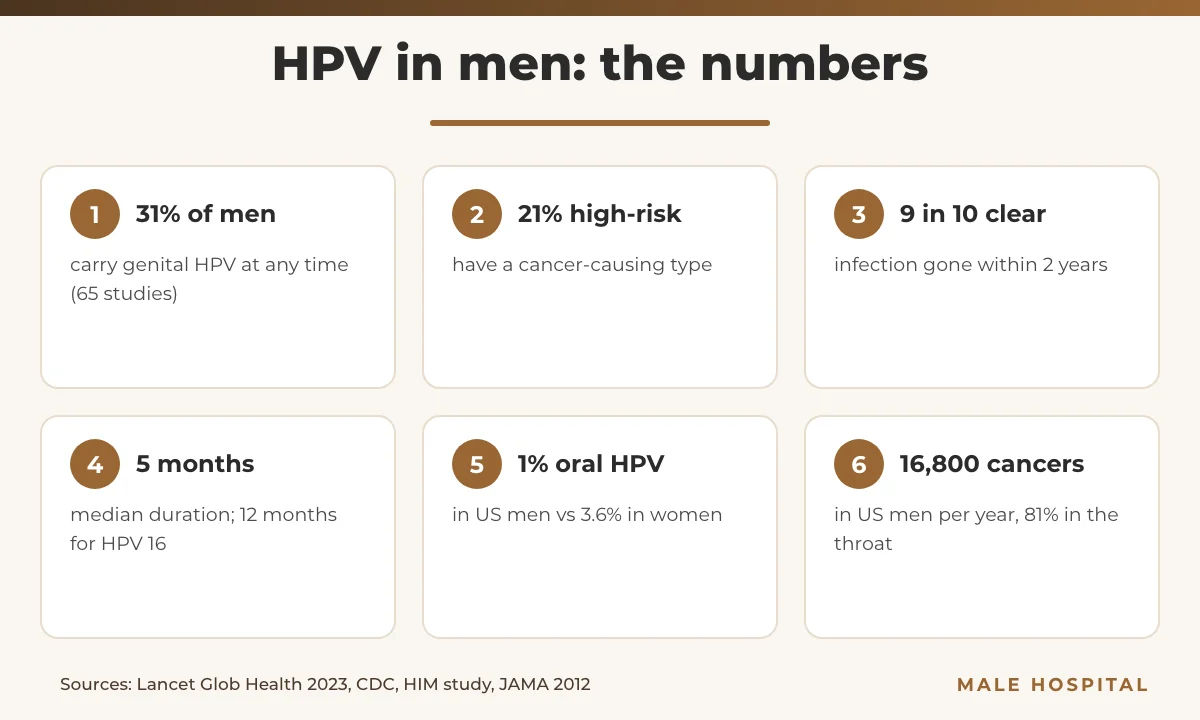
The best global estimate of HPV in men comes from a 2023 systematic review in The Lancet Global Health that pooled 65 studies with 44,769 men from 35 countries. At any one moment, 31% of men aged 15 or older carried at least one genital HPV type and 21% carried a high-risk type. Prevalence peaked between ages 25 and 29 and then stabilised or fell only slightly, so infection stays common throughout adult life. HPV 16 was the single most frequent type (5%), followed by HPV 6 (4%).
The HPV Infection in Men (HIM) cohort study followed 1,159 men aged 18 to 70 in Brazil, Mexico and the United States and swabbed the penis and scrotum every six months. New cases of genital HPV in men appeared at a rate of 38.4 per 1,000 person-months, roughly one new infection per man every two years. The median infection lasted 7.5 months for any type and 12.2 months for HPV 16. Men with many lifetime female partners, or several recent male anal-sex partners, were more likely to acquire a cancer-causing type, and clearance became faster with increasing age.
The mouth is a separate reservoir of HPV in men. In the US NHANES survey of 5,579 people aged 14 to 69, oral HPV was found in 10.1% of men but only 3.6% of women, and it increased with number of partners and with cigarettes smoked per day. Across the United States, the CDC estimates that more than 42 million people carry disease-causing HPV types and about 13 million are newly infected each year.
Source: PubMed — Bruni et al., global genital HPV prevalence among men (Lancet Glob Health, 2023); PubMed — Giuliano et al., incidence and clearance of genital HPV in men, HIM study (Lancet, 2011); PubMed — Gillison et al., prevalence of oral HPV in the United States (JAMA, 2012); CDC — About HPV
How men catch HPV
HPV in men spreads through skin-to-skin contact of the genital area during vaginal, anal or oral sex, and through sharing sex toys. Penetration and ejaculation are not required; rubbing of infected skin against uninfected skin is enough. A person can pass the virus on when they have no warts and no symptoms, and because symptoms can appear years after exposure it is usually impossible to say when, or from whom, an infection was acquired.
That last point about HPV in men matters in relationships. The CDC’s treatment guideline is explicit that partners tend to share HPV, that it cannot be determined who transmitted it first, and that a diagnosis does not mean either partner has had sex outside the relationship. Men can catch HPV the first time they have sex and after only one partner.
Genital warts are not spread by kissing, towels, cutlery, cups or toilet seats.
Source: CDC — About Genital HPV Infection; CDC — STI Treatment Guidelines: Human Papillomavirus Infection; NHS — Genital warts
HPV symptoms in men: warts and silent infection
Most cases of HPV in men cause no symptoms at any stage. When the infection does show, it does so in one of two ways: visible genital warts from a low-risk type, or, far less often and much later, cell changes from a high-risk type.
Genital warts
Genital warts, the visible form of HPV in men, appear as small rough lumps on or around the penis, around the anus, or on the skin between the genitals and the anus. They can be single or grouped, flat or raised, and sometimes have a cauliflower-like surface. They are usually painless, though some men notice itching, soreness or bleeding. Warts can take weeks or months to appear after contact, and the CDC’s guideline states that 90% are caused by non-cancer-causing types 6 or 11. Before vaccines, roughly 355,000 new cases occurred every year in the United States.
Lesions that are not warts
Many bumps on the penis are harmless and have nothing to do with HPV in men. Pearly penile papules ring the rim of the glans and Fordyce spots are tiny sebaceous glands on the shaft; neither is infectious, and a doctor can usually tell them from warts by inspection alone.
Signs of a high-risk infection
High-risk HPV in men causes no sensation by itself. The warning signs are those of the disease it can eventually produce: a sore, patch, lump or thickened area on the glans or foreskin that does not heal, bleeding or a lump at the anus, or a sore throat, lump in the neck, ear pain or difficulty swallowing that does not go away. These are not symptoms of HPV; they are symptoms that HPV has, over years, done damage, and they always need examination.
Source: NHS — Genital warts; CDC — STI Treatment Guidelines: Anogenital Warts; CDC — STI Treatment Guidelines: Human Papillomavirus Infection; MedlinePlus — HPV
HPV-related cancers in men
HPV in men causes three cancers: oropharyngeal cancer (tonsils, base of the tongue and back of the throat), anal cancer and penile cancer. According to CDC data for 2018 to 2022, HPV is responsible for about 39,300 cancers a year in the United States, of which about 16,800 occur in men. Oropharyngeal cancer accounts for roughly 13,600 of those male cases, anal cancer about 2,300 and penile cancer about 900. Worldwide, the WHO estimated 70,000 HPV-caused cancers in men in 2019, against 620,000 in women.
| Cancer | Share caused by HPV | US cases in men per year | Main HPV type |
|---|---|---|---|
| Oropharyngeal (throat) | About 70% | About 13,600 | HPV 16 |
| Anal | Over 90% | About 2,300 | HPV 16 |
| Penile | About 50–63% (varies by source) | About 900 | HPV 16 |
Source: CDC — Cancers Caused by HPV; National Cancer Institute — HPV and Cancer; WHO — Human papillomavirus and cancer
Throat cancer
HPV 16 drives a distinct form of oropharyngeal cancer whose incidence has been rising among men, and it is now the most common cancer from HPV in men by a wide margin. Smoking more than 10 pack-years and heavy alcohol use add to the risk. One consolation: HPV-positive oropharyngeal cancer has a better prognosis and recurs less often than HPV-negative disease.
Anal cancer
More than 90% of anal cancers are caused by HPV. Risk from HPV in men is highest in men who have sex with men, in people living with HIV or other causes of weakened immunity, in those who practise receptive anal sex, in smokers (the higher the pack-year history, the higher the risk) and in people over 75. Some doctors offer anal HPV testing together with an anal Pap test to people at high risk, although this is not routine screening.
Penile cancer
Estimates of the share of penile cancer due to HPV in men differ by method: the National Cancer Institute attributes 63% of penile cancers to HPV, Cancer Research UK about 60%, and a 52-study review cited by the European Association of Urology found HPV DNA in 50.8% of tumours, with HPV 16 making up 68.3% of those. The EAU guideline lists phimosis, chronic penile inflammation, lichen sclerosus, smoking and PUVA light therapy as further risk factors, and notes that neonatal circumcision lowers the incidence of invasive penile cancer. Men who have had genital warts carry a higher risk. The disease is uncommon before 40; the average age at diagnosis in the US is about 60. Our separate guide to penile cancer covers symptoms, staging and treatment in depth.
Source: National Cancer Institute — Oropharyngeal Cancer Treatment (PDQ); American Cancer Society — Risk Factors for Anal Cancer; NHS — Anal cancer: causes; American Cancer Society — HPV and HPV Testing; EAU — Penile Cancer Guidelines: Epidemiology, Aetiology and Pathology; Cancer Research UK — Penile cancer: risks and causes; American Cancer Society — Risk Factors for Penile Cancer
HPV in men and fertility
A growing body of research links HPV in men’s semen with poorer sperm quality. A 2021 meta-analysis of 50 studies in Andrology found seminal HPV in 20.9% of infertile men versus 8.2% of the general population, with an odds ratio for infertility of 3.30. HPV-positive men had lower progressive motility, poorer morphology and a higher sperm DNA fragmentation index. In couples undergoing assisted reproduction, seminal HPV was associated with a roughly five-fold higher miscarriage rate and a lower chance of ongoing pregnancy.
Two 2024 reviews of HPV in men and fertility reached similar conclusions: one of 25 studies (6,942 patients) confirmed lower morphology and motility in HPV-positive men, with no difference in volume, concentration or pH; a larger review of 135 studies (30,298 men) reported higher DNA fragmentation, lower sperm count and viability, and lower clinical pregnancy rates.
These are associations, not proof that HPV in men causes infertility, and the authors call for better-designed studies. For a man with unexplained poor semen results, however, HPV is one of the factors an andrologist may consider alongside the standard work-up described in our male infertility guide.
Source: PubMed — Moreno-Sepulveda & Rajmil, seminal HPV infection and reproduction (Andrology, 2021); PubMed — Garolla et al., papillomavirus infection and male infertility (Health Sci Rep, 2024); PubMed — Guo et al., male viral infections and infertility (Rev Med Virol, 2024)
Is there an HPV test for men?
No. The CDC states plainly that there is no test to find out a person’s “HPV status”, that HPV tests are not recommended to screen men, and that no approved test detects HPV in the mouth or throat. The FDA has approved HPV testing only on cervical samples, which is why it is part of cervical screening for women and has no male equivalent. There is no blood test for HPV in men either.
What a man can have is a clinical examination for the signs of HPV in men. Genital warts are diagnosed by looking at them; biopsy is reserved for atypical lesions or when the diagnosis is uncertain. The CDC guideline advises against two things that are still sometimes offered: HPV testing of the male partners of women with HPV, and painting the genitals with acetic acid to reveal “hidden” lesions, because the results do not change management.
The exception to the no-test rule for HPV in men is anal screening for men at high risk of anal cancer, particularly men who have sex with men and men living with HIV. Some clinics offer an anal Pap test, with or without an anal HPV test, to look for cell changes that could progress. This checks for precancer rather than for the virus itself and is a decision to discuss with a specialist.
Source: CDC — About Genital HPV Infection; NHS — Human papillomavirus (HPV); American Cancer Society — HPV and HPV Testing; CDC — STI Treatment Guidelines: Anogenital Warts; Cleveland Clinic — HPV (Human Papillomavirus)
Treatment of HPV in men: warts and precancer
There is no drug that clears HPV in men. The CDC guideline states that specific antiviral therapy is not recommended to eradicate HPV infection; treatment targets the lesions HPV produces. For most men that means genital warts, and for a few it means a precancerous patch on the penis or anus.
Treating genital warts
Untreated warts from HPV in men can resolve on their own, stay the same, or grow in size and number. The NHS notes that they sometimes disappear within six months, so watchful waiting is a legitimate choice. When treatment is wanted, it comes in two groups: creams the patient applies at home and procedures the doctor performs in clinic.
| Treatment | Who applies it | How it is used (CDC 2021) | Notes |
|---|---|---|---|
| Imiquimod 5% cream | Patient | At bedtime, 3 times a week, up to 16 weeks | Irritation and burning at the site are common |
| Podofilox 0.5% | Patient | Twice daily for 3 days, then 4 days off, in cycles | Treated area no larger than 10 cm² |
| Sinecatechins 15% ointment | Patient | 3 times daily, no longer than 16 weeks | Plant-derived (green tea catechins) |
| Cryotherapy | Doctor | Liquid nitrogen freezing, repeated as needed | Can be painful; several sessions usual |
| TCA / BCA 80–90% | Doctor | Acid applied to each wart in clinic | Clinic use only; needs a trained provider |
| Surgical removal | Doctor | Excision, curettage, electrosurgery or laser under local anaesthetic | Best for large or numerous warts; may scar |
Whatever the method, the CDC warns that warts from HPV in men often recur after treatment, especially during the first three months, because the surrounding skin may still carry the virus. Treatment can take weeks or months to work and sometimes does not work at all. Avoid vaginal, anal and oral sex until the warts have cleared, and tell your doctor if a cream might come into contact with condoms, because some weaken latex. Partners should be told, so they can be examined and screened for other infections, but HPV testing of partners is not recommended.
Treating penile precancer (PeIN)
Penile intraepithelial neoplasia (PeIN) is the precursor of penile squamous cell cancer and may be HPV-associated or HPV-independent. It presents as a persistent patch or plaque on the glans or inner foreskin that does not heal, and the diagnosis is made by biopsy. The EAU guideline reports that isolated PeIN rarely progresses to invasive cancer (about 2%) but recurs in 30 to 48% of cases after excision, so it needs long follow-up. Phimosis is strongly associated with invasive penile cancer and chronic foreskin inflammation is a recognised risk factor, so a tight foreskin should not be left untreated; our phimosis treatment page explains the options.
Source: CDC — STI Treatment Guidelines: Anogenital Warts; CDC — STI Treatment Guidelines: Human Papillomavirus Infection; NHS — Genital warts; EAU — Penile Cancer Guidelines: Epidemiology, Aetiology and Pathology
HPV vaccine for men and other prevention
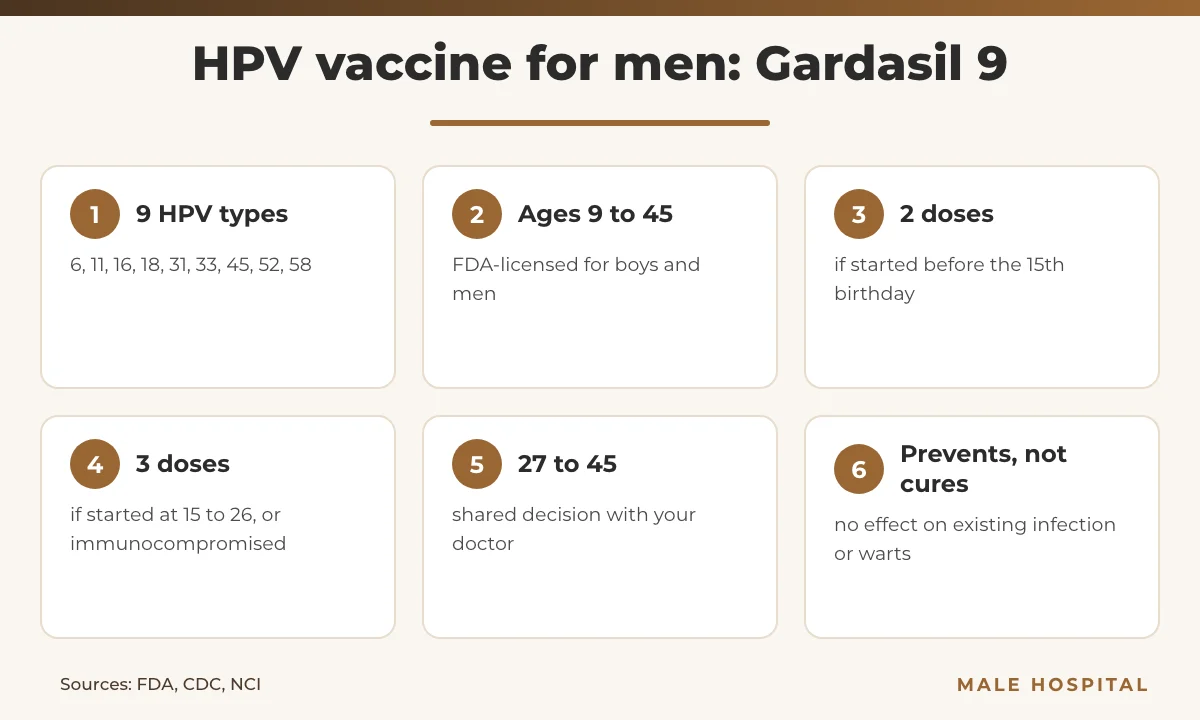
Vaccination is the single most effective measure against HPV in men. The vaccine used in the United States and the United Kingdom is Gardasil 9, which covers nine types: 6 and 11 (about 90% of genital warts), 16 and 18 (about 70% of cervical cancers and the dominant cancer types in men) plus 31, 33, 45, 52 and 58. The FDA licenses it for boys and men aged 9 through 45 to prevent anal, oropharyngeal and other head and neck cancers, anal precancer and genital warts. It contains no live virus or viral DNA.
Who should get it, and how many doses
To prevent HPV in men and women, the CDC recommends routine vaccination at age 11 or 12, starting as early as 9. Two doses given 6 to 12 months apart are enough if the first dose is before the 15th birthday; those who start at 15 to 26 need three doses over six months, as do people with weakened immune systems aged 9 to 26. Adults aged 27 to 45 are not routinely vaccinated, because most have already been exposed to some HPV types, but may decide to be after discussing their risk with a doctor. In England all children are offered the vaccine at 12 to 13, boys born after 1 September 2006 can catch up free until 25, and men who have sex with men can be vaccinated at a sexual health or HIV clinic up to their 46th birthday (one dose under 25, two doses from 25 to 45).
Does it work, and is it safe?
The National Cancer Institute reports that the vaccines are highly effective at preventing infection with the targeted types in men and women, that protection has lasted more than a decade, and that more than two decades of safety monitoring have found no serious side effects; brief soreness at the injection site is the usual complaint. The CDC estimates the vaccine could prevent more than 90% of HPV-caused cancers. Two limits matter for HPV in men: it does not treat an infection or warts you already have, and it covers only nine types, so a man who already has one type still gains protection against the others. The EAU penile cancer guideline notes that most countries have no general male vaccination programme, but encourages vaccination for at-risk men.
Other measures
Latex condoms greatly reduce, but do not eliminate, the risk of catching or spreading HPV; a Danish study cited by Cancer Research UK found men who had never used condoms had more than double the risk of penile cancer. Smoking raises the risk of both throat and anal cancers from HPV in men, and quitting appears to lower anal cancer risk. Uncircumcised men may be more likely to get and stay infected with HPV, and neonatal circumcision lowers penile cancer incidence; our article on adult circumcision weighs what that means for adults. Fewer partners means fewer exposures, and men with HIV or other immune suppression should discuss anal screening with their doctor.
Source: FDA — Gardasil 9; CDC — HPV Vaccination; NHS — HPV vaccine; National Cancer Institute — HPV Vaccination fact sheet; MedlinePlus — HPV; Cancer Research UK — Penile cancer: risks and causes; WHO — Human papillomavirus and cancer; American Cancer Society — Risk Factors for Anal Cancer; American Cancer Society — Risk Factors for Penile Cancer
When to see a doctor
Because HPV in men has no test and usually no symptoms, the trigger for a visit is a change you can see or feel. Arrange an appointment for any new lump, bump or growth on the penis, scrotum or around the anus, even if painless; a sore or patch on the glans or foreskin that does not heal; bleeding, pain or a lump at the anus; or a foreskin that has become tight or difficult to retract.
See a doctor promptly, and do not wait for a routine slot, if you have a sore throat that does not go away, a lump in the neck, ear pain or difficulty swallowing, especially if you smoke; if a penile patch is ulcerated, bleeding or growing; or if you have HIV or take immune-suppressing medicines and develop any anogenital lesion. Persistent symptoms in these areas are never explained by “just HPV” without an examination.
A confidential assessment of HPV in men with our urologist-andrologist in Istanbul takes one visit: inspection, a clear diagnosis of what the lesion is, and treatment or referral on the same day where appropriate. You can arrange it directly on WhatsApp.
Source: CDC — About Genital HPV Infection; National Cancer Institute — Oropharyngeal Cancer Treatment (PDQ)
FAQs about HPV in men
Can a man get rid of HPV?
Not with medicine, but HPV in men usually clears with time. Around 90% of infections are cleared by the immune system within one to two years; in the HIM study the median infection lasted about seven and a half months. Treatments remove warts or abnormal cells, not the virus. Not smoking and keeping the immune system healthy support clearance, and the vaccine prevents new infections with the covered types.
Source: National Cancer Institute — HPV and Cancer; PubMed — Giuliano et al., HIM study (Lancet, 2011)
How do I know if I have HPV as a man?
Usually you cannot, because there is no approved test for HPV in men and most infections are silent. The only visible sign is genital warts, which a doctor can diagnose by inspection. If a female partner has been told she has HPV, the CDC does not recommend testing you; the sensible steps are vaccination if you are eligible and a check of any lesion you notice.
Source: CDC — About Genital HPV Infection; CDC — STI Treatment Guidelines: HPV
Is HPV in men dangerous?
For the great majority, no. Cleveland Clinic notes that HPV poses fewer health risks to males than to females, and most male infections clear without any disease. The danger is in the minority of persistent high-risk infections, which over years can lead to throat, anal or penile cancer, and in men with HIV or other immune suppression, who clear the virus less easily.
Source: Cleveland Clinic — HPV (Human Papillomavirus)
Can genital warts turn into cancer?
No. Warts are caused by low-risk types 6 and 11, which are different viruses from the high-risk types that cause cancer. A man can, however, carry both groups at the same time, and men who have had genital warts have a somewhat higher risk of penile cancer, probably because the same behaviours expose them to high-risk types too. Any wart-like lesion that bleeds, ulcerates or keeps growing should be biopsied.
Source: CDC — Basic Information about HPV and Cancer; American Cancer Society — Risk Factors for Penile Cancer
Should a man over 26 get the HPV vaccine?
The vaccine against HPV in men is licensed up to 45 and reasonable for men who were not vaccinated earlier, have new partners ahead, or are at higher risk, such as men who have sex with men. The CDC frames it as a shared decision rather than a routine recommendation, because the benefit is smaller once a man has already met several HPV types. In England it is free for men who have sex with men up to 45 at sexual health clinics.
Source: CDC — HPV Vaccination; NHS — HPV vaccine
How long after exposure do genital warts appear?
Typically a few weeks to a few months, though the NHS and Cleveland Clinic both note that warts can surface years after the original contact. This long and variable delay is why a new wart in a long-term relationship does not point to recent infidelity; the virus may have been acquired long before and only now become visible.
Source: NHS — Genital warts; Cleveland Clinic — HPV (Human Papillomavirus)
Can HPV in semen affect my partner’s pregnancy?
Meta-analyses of couples in assisted reproduction have linked seminal HPV with a roughly five-fold higher miscarriage rate and lower ongoing-pregnancy rates. These are observational findings and do not prove cause, but they are consistent across several reviews. A couple with repeated pregnancy loss or failed IVF cycles can raise seminal HPV testing with their fertility specialist.
Source: PubMed — Moreno-Sepulveda & Rajmil (Andrology, 2021); PubMed — Guo et al. (Rev Med Virol, 2024)
Medically reviewed by Assoc. Prof. Dr. Zülfü Sertkaya, urologist and andrologist (FEBU), Istanbul. Last reviewed: November 2026.
This article is for general information and does not replace an individual consultation with a qualified doctor.
- CDC — About Genital HPV Infection
- CDC — About HPV
- CDC — HPV Vaccination
- CDC — Cancers Caused by HPV
- CDC — Basic Information about HPV and Cancer
- CDC — STI Treatment Guidelines 2021: Anogenital Warts
- CDC — STI Treatment Guidelines 2021: Human Papillomavirus Infection
- NHS — Human papillomavirus (HPV)
- NHS — Genital warts
- NHS — HPV vaccine
- NHS — Anal cancer: causes
- WHO — Human papillomavirus and cancer (fact sheet)
- National Cancer Institute — HPV and Cancer
- National Cancer Institute — Human Papillomavirus (HPV) Vaccines fact sheet
- National Cancer Institute — Oropharyngeal Cancer Treatment (PDQ), patient version
- Cleveland Clinic — HPV (Human Papillomavirus)
- EAU — Penile Cancer Guidelines: Epidemiology, Aetiology and Pathology
- FDA — Gardasil 9
- American Cancer Society — HPV and HPV Testing
- American Cancer Society — Risk Factors for Penile Cancer
- American Cancer Society — Risk Factors for Anal Cancer
- Cancer Research UK — Penile cancer: risks and causes
- MedlinePlus — HPV
- PubMed — Bruni L et al. Global and regional estimates of genital HPV prevalence among men: a systematic review and meta-analysis. Lancet Glob Health, 2023
- PubMed — Giuliano AR et al. Incidence and clearance of genital HPV infection in men (HIM): a cohort study. Lancet, 2011
- PubMed — Gillison ML et al. Prevalence of oral HPV infection in the United States, 2009-2010. JAMA, 2012
- PubMed — Moreno-Sepulveda J, Rajmil O. Seminal HPV infection and reproduction: a systematic review and meta-analysis. Andrology, 2021
- PubMed — Garolla A et al. Papillomavirus infection and male infertility: a systematic review and meta-analysis. Health Sci Rep, 2024
- PubMed — Guo Y et al. The association between male viral infections and infertility: a systematic review and meta-analysis. Rev Med Virol, 2024