STI testing for men is a short panel of laboratory tests, usually a urine sample for chlamydia and gonorrhea, a blood sample for HIV and syphilis, and swabs of the throat, rectum or any sore when they are relevant, that tells you whether you carry an infection you cannot feel. Most sexually transmitted infections cause no symptoms in men, so a test, not the absence of symptoms, is the only reliable way to know. This guide explains which tests exist, who needs them and how often, how soon after sex each test becomes accurate, what the appointment involves and how to read the result.
Sources: NHS — Sexually transmitted infections (STIs); CDC — Getting Tested for STIs
- Standard STI testing for men is a first-void urine test (chlamydia, gonorrhea, often trichomonas), a blood test (HIV, syphilis, hepatitis B) and site-specific swabs if you have had oral or anal sex.
- Timing of STI testing matters: chlamydia and gonorrhea show up about 2 weeks after exposure, a laboratory HIV antigen/antibody test at 18 to 45 days, and the NHS advises that a full screen with no symptoms is reliable 7 weeks after unprotected sex.
- The CDC recommends at least one HIV test for everyone aged 13 to 64, hepatitis B and C tests at least once for all adults, and yearly chlamydia, gonorrhea, syphilis and HIV tests for sexually active men who have sex with men (every 3 to 6 months at higher risk).
- There is no routine blood screen for herpes and no approved HPV test for men; herpes is diagnosed by swabbing a sore and genital warts by examination.
- After chlamydia or gonorrhea treatment, repeat STI testing about 3 months later; reinfection from an untreated partner is the most common reason a test turns positive again.
- What STI testing for men involves
- Which STI tests men need: infection-by-infection guide
- Who should get STI testing and how often
- When to test: window periods after sex
- What happens at an STI test: urine, swabs and blood
- Home STI testing for men: kits and accuracy
- Understanding STI test results
- When to see a doctor: symptoms that need urgent testing
- STI testing and the rest of your sexual health
- FAQs about STI testing for men
What STI testing for men involves

STI testing is not a single test but a panel chosen to match your sexual history. The three sample types are a urine sample, a swab (a small cotton bud that collects cells or fluid from the urethra, throat, rectum or a sore) and a blood sample taken from a vein or by finger prick. A clinician asks about your partners, the kind of sex you have had and any symptoms, may examine your genitals, and then decides which combination you need.
The scale of the problem explains why STI testing is routine rather than exceptional. The World Health Organization estimates that more than 1 million curable STIs are acquired every day among people aged 15 to 49, most of them without symptoms; in 2020 alone it counted about 374 million new infections with four curable STIs: trichomoniasis (156 million), chlamydia (129 million), gonorrhea (82 million) and syphilis (7.1 million). In the United States, provisional CDC data for 2024 still recorded more than 2.2 million reported cases of chlamydia, gonorrhea and syphilis after a third year of decline. Because these infections are usually silent, testing finds them at the stage when a short course of antibiotics still cures them completely.
Sources: WHO — Sexually transmitted infections (STIs) fact sheet; CDC — Sexually Transmitted Infections Surveillance, 2024; NHS — Sexually transmitted infections (STIs)
Which STI tests men need: infection-by-infection guide
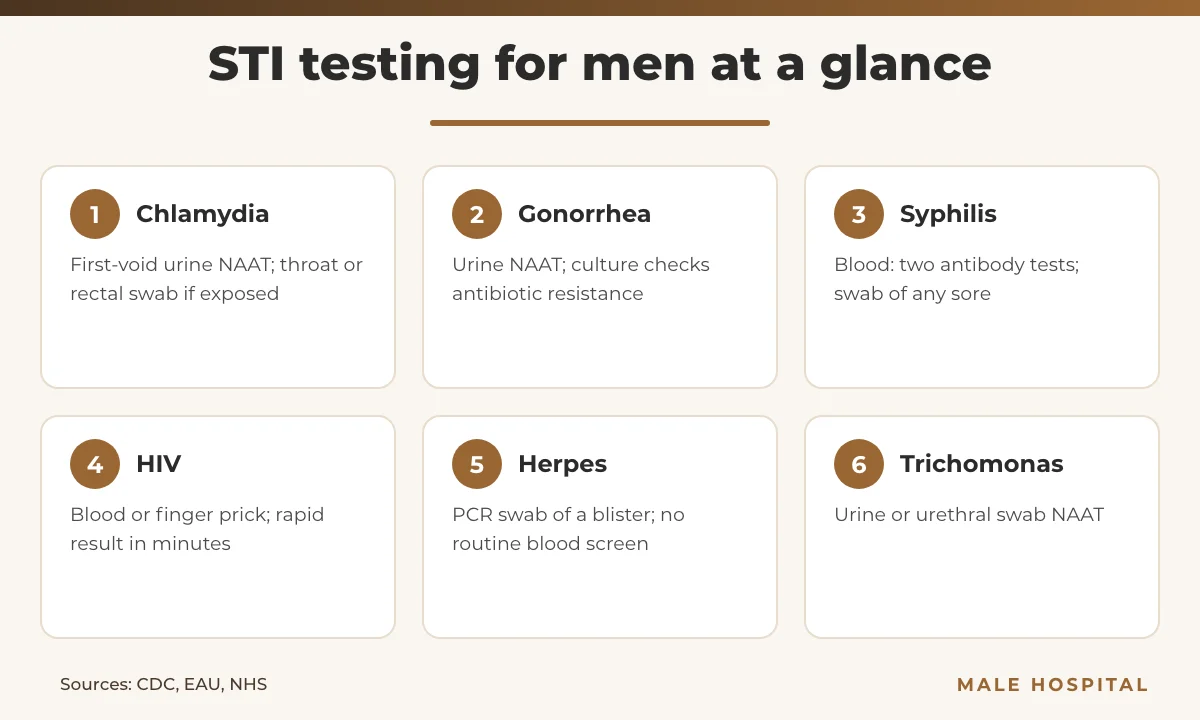
Each infection has a preferred sample and method, and matching them is what makes STI testing for men accurate. Nucleic acid amplification tests (NAATs), which detect the organism’s genetic material, have replaced culture and microscopy for most bacterial STIs because they are far more sensitive and work on urine.
Chlamydia and gonorrhea
For both infections the CDC names first-catch (first-void) urine, the first part of the stream rather than a mid-stream sample, as the optimal specimen for men; a urethral swab is acceptable, and a self-collected swab of the urethral opening performs as well as a clinician’s swab. If you have had receptive anal or oral sex, STI testing needs a rectal or throat swab as well, because a urine test cannot detect infection at those sites. When a gonorrhea NAAT is positive, the European Association of Urology recommends a urethral swab culture before treatment so that antibiotic susceptibility can be checked.
Syphilis
In STI testing, syphilis is diagnosed from blood with two kinds of antibody test: a nontreponemal test (RPR or VDRL), whose titer rises and falls with disease activity, and a treponemal test (TP-PA, EIA or CIA) that confirms the infection. The CDC notes that relying on one type alone can produce false negatives in early primary syphilis. If a sore is present, fluid from it can be examined by darkfield microscopy or PCR, the definitive methods for early syphilis.
HIV
Three HIV test types exist in STI testing: antibody tests (most rapid finger-prick tests and self-tests), laboratory antigen/antibody tests that also detect the p24 antigen and so turn positive earlier, and nucleic acid tests (NAT) that detect the virus itself. Rapid HIV tests at some clinics give a result in about 20 minutes.
Genital herpes
Herpes is confirmed by a PCR swab of a blister or sore, the most sensitive method with reported sensitivity above 90%; viral culture is less reliable, especially as lesions heal. A blood test for type-specific HSV-2 antibodies exists but is not recommended as a routine screen for people without symptoms, because low-positive results are often false and antibodies can take about 12 weeks to appear. The NHS adds that the swab test simply cannot be done without visible blisters or sores.
Trichomonas, Mycoplasma genitalium and HPV
In STI testing, trichomonas is detected by NAAT on urine or a urethral swab; the CDC lists two assays cleared for male urine and warns that wet-mount microscopy misses roughly a third to a half of infections. Mycoplasma genitalium testing is reserved for men whose urethritis persists or recurs after treatment, where it accounts for about 40% of cases; screening men without symptoms is not recommended. There is no approved HPV test for men, so genital warts are diagnosed by examination.
| Infection | Best sample for men | Test method | Notes |
|---|---|---|---|
| Chlamydia | First-void urine; throat/rectal swab if exposed | NAAT | Retest about 3 months after treatment |
| Gonorrhea | First-void urine; throat/rectal swab if exposed | NAAT; culture for resistance | Throat infection needs a test of cure 7 to 14 days after treatment |
| Syphilis | Blood; fluid from a sore if present | Nontreponemal + treponemal antibody tests; darkfield/PCR | Follow-up blood tests over 12 months after treatment |
| HIV | Blood (vein or finger prick) or oral fluid | Antibody, antigen/antibody or NAT | Window period 10 to 90 days depending on test |
| Genital herpes | Swab of a blister or sore | PCR (preferred) or culture | No routine blood screen without symptoms |
| Trichomonas | Urine or urethral swab | NAAT | Wet mount misses many cases |
| Hepatitis B / C | Blood | HBsAg, anti-HBs, anti-HBc; HCV antibody | At least once for all adults; hepatitis B is vaccine-preventable |
| HPV / genital warts | None for men | Clinical examination | HPV tests are not recommended to screen men |
Sources: CDC STI Treatment Guidelines — Chlamydial Infections; CDC STI Treatment Guidelines — Gonococcal Infections; CDC STI Treatment Guidelines — Syphilis; CDC STI Treatment Guidelines — Genital Herpes; CDC STI Treatment Guidelines — Trichomoniasis; CDC STI Treatment Guidelines — Mycoplasma genitalium; CDC — About Genital HPV Infection; EAU Guidelines — Urological Infections (Urethritis); CDC — HIV Testing; Cleveland Clinic — STI Testing
Who should get STI testing and how often
The CDC STI testing recommendations treat men in two groups, and the difference shapes what a clinic will offer you. For every man aged 13 to 64 the CDC recommends at least one HIV test, offered on an opt-out basis, and repeat testing at least yearly for anyone with more than one partner since the last test. All adults aged 18 and over should be tested at least once for hepatitis C, and once for hepatitis B with a three-marker panel (HBsAg, anti-HBs and total anti-HBc).
For heterosexual men at low risk, routine chlamydia and gonorrhea STI testing is not recommended because the evidence of benefit is insufficient; the CDC suggests chlamydia screening for young men in high-prevalence settings such as STI clinics and correctional facilities, and syphilis screening for asymptomatic men at increased risk, which it defines to include men under 29. In practice, if you have a new partner, condomless sex or symptoms, ask for the full panel rather than waiting to be offered it; the NHS gives everyone a simple rule: a gonorrhea test once a year or whenever you have a new sexual partner.
For sexually active men who have sex with men the STI testing guidance is explicit: test for chlamydia at the urethra and rectum, for gonorrhea at the urethra, rectum and pharynx, and for syphilis and HIV at least once a year regardless of condom use, and every 3 to 6 months if you are on PrEP, living with HIV, or have multiple or anonymous partners. All MSM should also be tested for hepatitis B with the three-marker panel and vaccinated if not immune. Any man who has had oral or anal sex should say so, because throat and rectal testing are not part of a urine-only check.
Sources: CDC STI Treatment Guidelines — Screening Recommendations; CDC — Clinical Overview of Hepatitis B; NHS — Gonorrhoea: Diagnosis; MedlinePlus — STD Tests
When to test: window periods after sex
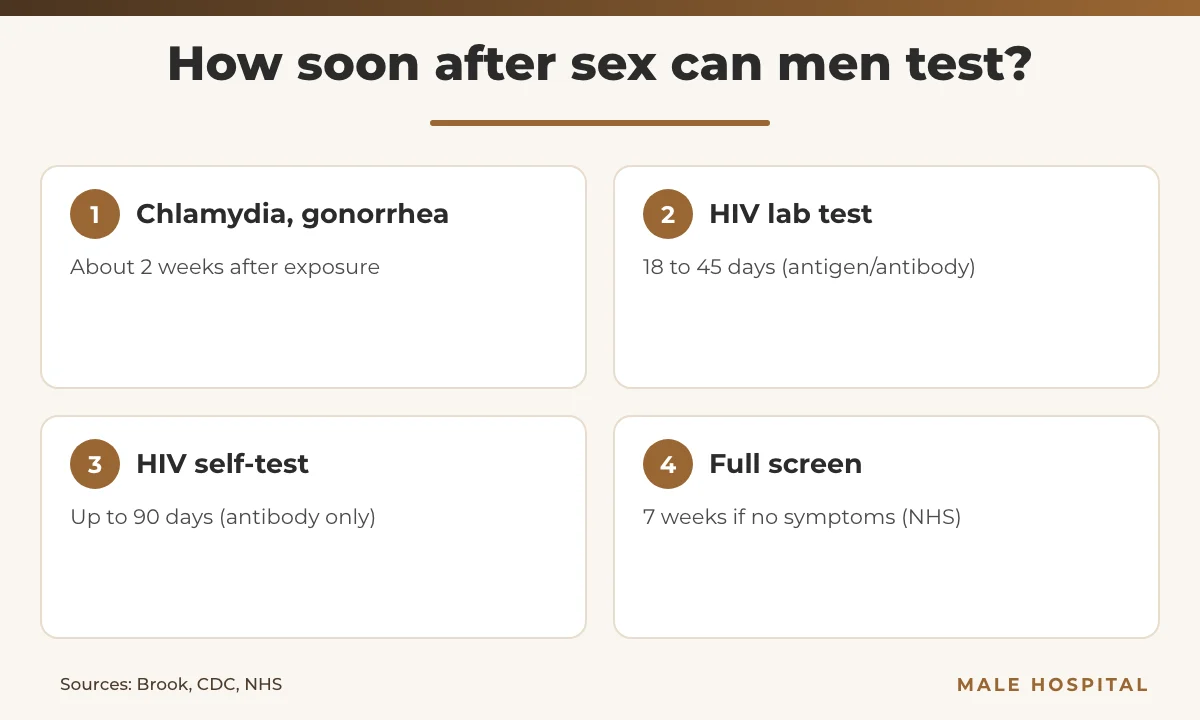
The window period is the time between exposure and the point at which a test can reliably detect the infection; STI testing too early gives false reassurance, which is why clinics ask when the sex you are worried about happened. Brook, the UK sexual health charity the NHS points readers to for testing timelines, puts the window at about 2 weeks for chlamydia and gonorrhea and 6 to 7 weeks for HIV, and the NHS states that STIs can take up to 7 weeks to show up, so a man with no symptoms should wait 7 weeks after unprotected sex for a complete screen.
HIV windows depend on the technology. According to the CDC, a nucleic acid test can detect HIV about 10 to 33 days after exposure, a laboratory antigen/antibody test at 18 to 45 days, a rapid finger-prick antigen/antibody test at 18 to 90 days, and an antibody-only test (including most self-tests) at 23 to 90 days. A negative result taken inside the window should be repeated once the window has passed.
Two exceptions change the timing of STI testing. If you have symptoms, do not wait: a discharge or burning on urination should be tested the same day, and the EAU recommends that a NAAT be taken before any antibiotic is started. And if a possible HIV exposure happened within the last 72 hours, go to a sexual health clinic or emergency department at once, because post-exposure medicine (PEP) can only be offered within that window. For syphilis, a blood test taken in the first days of a sore can still be negative, which is why clinicians sample the sore directly and repeat the blood test.
Sources: Brook — Getting tested for STIs; NHS — Sexually transmitted infections (STIs); CDC — HIV Testing; NHS — HIV and AIDS: Diagnosis; CDC STI Treatment Guidelines — Syphilis
What happens at an STI test: urine, swabs and blood
A sexual health clinic visit for STI testing is quicker and less awkward than most men expect. In the UK you need no referral, can ask for a male or female clinician and do not have to give your real name. The nurse or doctor asks about your symptoms, your partners in recent months and the type of sex you have had; honest answers decide which sites are sampled, so they are the most useful part of the appointment.
The urine sample
You catch the first part of your stream in a pot, because the first-void sample carries cells from the urethra where chlamydia and gonorrhea live; a mid-stream sample, the kind used for a urinary tract infection, is the wrong sample for an STI NAAT. Brook notes that for people with a penis, STI testing for chlamydia and gonorrhea is usually a urine sample alone.
Swabs
A swab used in STI testing looks like a long cotton bud. For throat and rectal testing the clinician rubs it over the back of the throat or inserts it just inside the rectum for a few seconds; the CDC confirms that self-collected rectal swabs perform as well as clinician-collected ones, so many clinics let you take them in private. A urethral swab is only needed if you cannot provide urine or a culture is required for gonorrhea resistance testing. Any sore or blister is swabbed for herpes PCR or syphilis testing.
Blood and examination
In STI testing, blood for HIV, syphilis and hepatitis is taken from an arm vein or by finger prick; rapid point-of-care tests give an HIV or syphilis result in minutes, while laboratory results take a few days. If you have symptoms, the clinician examines the penis, scrotum and, when relevant, the anus and mouth. In a man with discharge, a Gram stain can show the Gram-negative diplococci of gonorrhea on the spot and allows treatment to begin before the NAAT returns.
Sources: NHS — Sexually transmitted infections (STIs); CDC STI Treatment Guidelines — Chlamydial Infections; CDC STI Treatment Guidelines — Gonococcal Infections; Cleveland Clinic — STI Testing; Brook — Getting tested for STIs
Home STI testing for men: kits and accuracy
Home STI testing is a legitimate first step rather than a compromise. Self-tests give a result at home within minutes from a finger-prick blood sample or oral swab; in the United States the FDA has approved self-tests for HIV and syphilis. Self-collection kits let you take a urine or finger-prick sample at home and post it to a laboratory, with results in a few days; FDA-approved self-collection options cover HIV, syphilis, chlamydia and gonorrhea. In the UK, free postal kits for chlamydia and gonorrhea are available from many sexual health services and some pharmacies, and the NHS stresses that only kits clearly marked for self-testing should be bought.
The laboratory NAAT run on a posted urine sample is the same test a clinic uses for STI testing, so accuracy depends mainly on timing (respect the window period) and on sampling the right site: a urine-only kit cannot find a throat or rectal infection. Brook advises returning the sample within 24 hours of collecting it. A positive home result is a reason to see a clinician promptly for treatment and partner notification, and the CDC recommends discussing even a negative self-test with a provider so that the rest of the panel is not missed.
Sources: CDC — Getting Tested for STIs; NHS — HIV and AIDS: Diagnosis; NHS — Chlamydia; Brook — Getting tested for STIs
Understanding STI test results
Always collect your STI testing result, even a negative one; Cleveland Clinic makes this point because clinics do not always chase patients who assume no news is good news. A negative result is reliable only if the test was taken after the window period and from the right site. A positive chlamydia, gonorrhea, trichomonas or syphilis result is curable: the CDC’s first-line regimens are doxycycline 100 mg twice daily for 7 days for chlamydia, a single intramuscular injection of ceftriaxone for gonorrhea, a single 2 g dose of metronidazole for trichomonas in men, and benzathine penicillin for syphilis. Herpes and HIV are not curable but are treatable with antiviral medicine.
Three follow-up steps after STI testing matter as much as the prescription. First, abstain from sex until treatment is complete, which the CDC defines as 7 days after a single-dose regimen or after finishing the full course with symptoms resolved; for syphilis the NHS advises waiting 2 weeks after both partners have finished. Second, tell recent partners: the CDC asks that all partners from the previous 60 days be tested and treated, and clinics can notify them anonymously. Third, retest: about 3 months after chlamydia or gonorrhea treatment whether or not partners were treated, 7 to 14 days after treatment of throat gonorrhea, and with repeated syphilis blood tests over the 12 months after treatment to confirm the titer has fallen fourfold.
A syphilis result also needs interpretation. Because treponemal antibodies usually stay reactive for life, a man treated years ago can have a positive treponemal test with a negative or low RPR; it is the RPR titer, not the treponemal result, that tracks whether an infection is active. Likewise a low-positive HSV-2 antibody index should be confirmed with a second method before it is treated as a diagnosis.
Sources: Cleveland Clinic — STI Testing; CDC STI Treatment Guidelines — Urethritis and Cervicitis; CDC STI Treatment Guidelines — Gonococcal Infections; NHS — Syphilis; CDC STI Treatment Guidelines — Syphilis; CDC STI Treatment Guidelines — Genital Herpes
When to see a doctor: symptoms that need urgent testing
Most STI testing for men is done without symptoms, but certain signs mean you should be tested and examined without waiting for a window period. The NHS and CDC list the typical warning signs as a white, cloudy, yellow or green discharge from the penis, burning or pain when urinating, pain or swelling in one or both testicles, a sore, blister, ulcer or wart on the genitals or around the anus, a rash (especially a non-itchy rash on the palms and soles, which suggests secondary syphilis), rectal pain, discharge or bleeding, and a sore throat after oral sex. Chlamydia symptoms, when they occur, appear 1 week to several months after infection; gonorrhea symptoms usually begin about 2 weeks after exposure.
Seek same-day care for a painful, swollen testicle, which can be epididymitis from chlamydia or gonorrhea but must be distinguished from testicular torsion; for fever, joint pain or swelling, or red painful eyes alongside urinary symptoms, which the NHS flags as signs that gonorrhea may have spread; and for any possible HIV exposure within the last 72 hours. A painless genital ulcer that heals on its own is not reassurance: it is the classic sign of primary syphilis, which remains in the body after the sore disappears.
Men with a persistent discharge after a full course of treatment need a second look and repeat STI testing rather than a repeat prescription. The CDC advises confirming inflammation objectively, checking adherence and re-exposure, then testing for Mycoplasma genitalium and trichomonas, which the first-line chlamydia regimen does not cover. Our guides to epididymitis and penis rash explain what else can cause scrotal pain and genital skin changes.
Sources: NHS — Chlamydia; CDC — About Gonorrhea; CDC — About Syphilis; NHS — Gonorrhoea: Diagnosis; CDC STI Treatment Guidelines — Urethritis and Cervicitis
STI testing and the rest of your sexual health
For a urologist-andrologist, STI testing is often the first step in investigating a wider problem. Untreated chlamydia and gonorrhea can inflame the epididymis and, in rare cases, impair fertility, so an STI panel belongs in the work-up of men with painful ejaculation, blood in the semen or an abnormal semen analysis before male infertility treatment is planned. The EAU recommends that whenever urethritis is diagnosed, testing for HIV and the other STIs is offered at the same visit, and that sexual partners are treated while the patient’s confidentiality is preserved.
Prevention sits alongside STI testing. MedlinePlus lists condoms used correctly every time (which reduce but do not eliminate risk), fewer partners, mutual testing before sex with a new partner, and vaccination against hepatitis B and HPV; the CDC describes vaccination as the best way to prevent hepatitis B, and the three-marker blood panel tells you whether you are already immune.
If you would rather discuss symptoms, a recent exposure or an unclear result in private, you can arrange a confidential consultation with our urologist-andrologist, Assoc. Prof. Dr. Zülfü Sertkaya, in Istanbul via WhatsApp; the tests you need depend on your history, so the assessment comes first and the test list follows.
Sources: CDC — About Chlamydia; EAU Guidelines — Urological Infections (Urethritis); MedlinePlus — STD Tests; CDC — Clinical Overview of Hepatitis B
FAQs about STI testing for men
What does a full STI test for men include?
Standard STI testing for men is a first-void urine NAAT for chlamydia and gonorrhea, a blood test for HIV and syphilis, and, depending on history, hepatitis B and C serology, a trichomonas NAAT, and throat or rectal swabs after oral or anal sex. Herpes is tested only by swabbing a sore, and there is no HPV test for men.
Sources: MedlinePlus — STD Tests; CDC — About Genital HPV Infection
How soon after unprotected sex can a man get tested?
STI testing can detect chlamydia and gonorrhea about 2 weeks after exposure. A laboratory HIV antigen/antibody test is reliable from 18 to 45 days, while finger-prick and self-tests need up to 90 days. The NHS advises a man without symptoms to wait 7 weeks for a complete screen; with symptoms, test immediately.
Sources: Brook — Getting tested for STIs; CDC — HIV Testing
Can a urine test detect all STIs?
No. Urine-based STI testing (NAAT) is excellent for chlamydia, gonorrhea and trichomonas in the urethra, but it cannot detect HIV, syphilis or hepatitis, which need blood, and it misses throat and rectal infections, which need a swab of that site. Herpes requires a swab of an active sore.
Sources: CDC STI Treatment Guidelines — Chlamydial Infections; NHS — Genital herpes
How often should a sexually active man be tested?
The CDC recommends at least one lifetime HIV test for everyone aged 13 to 64 and yearly testing for men with new or multiple partners. Men who have sex with men should test for chlamydia, gonorrhea, syphilis and HIV at least yearly, or every 3 to 6 months at higher risk. The NHS suggests a gonorrhea test yearly or with each new partner.
Sources: CDC STI Treatment Guidelines — Screening Recommendations; NHS — Gonorrhoea: Diagnosis
Are home STI test kits accurate for men?
Postal kits that send a urine or finger-prick sample to a laboratory use the same NAAT and antibody tests as clinics, so they are accurate if taken after the window period and from the right site. FDA-approved self-collection options exist for HIV, syphilis, chlamydia and gonorrhea; rapid self-tests are approved for HIV and syphilis.
Sources: CDC — Getting Tested for STIs; NHS — Chlamydia
Why is there no routine blood test for herpes?
The HSV-2 antibody test produces frequent false positives at low index values, cannot say when or from whom you acquired the virus, and takes about 12 weeks to turn positive. The CDC therefore does not recommend serologic screening of people without symptoms; a PCR swab of a blister or sore is the reliable test.
Sources: CDC STI Treatment Guidelines — Genital Herpes; NHS — Genital herpes
Do I need to retest after treatment?
Yes for chlamydia and gonorrhea: repeat STI testing about 3 months after treatment, even if your partner was treated, because reinfection is common. Throat gonorrhea needs a test of cure 7 to 14 days after treatment, and syphilis needs follow-up blood tests over 12 months. Data are insufficient to recommend routine retesting of men after trichomonas treatment.
Sources: CDC — About Gonorrhea; CDC STI Treatment Guidelines — Trichomoniasis; NHS — Syphilis
Can an STI cause infertility or other complications in men?
Yes, although serious problems are uncommon. Untreated chlamydia or gonorrhea can infect the tubes attached to the testicles (epididymitis) and in rare cases lead to infertility, chlamydia can trigger reactive arthritis, and untreated gonorrhea can rarely spread to the blood or joints. Early treatment prevents all of these, which is why STI testing is part of a fertility work-up.
Sources: NHS — Chlamydia; CDC — About Gonorrhea
Is STI testing confidential?
Yes. Sexual health clinics in the UK let you register without giving your real name and without a referral from your family doctor, and the CDC notes that many US clinics offer confidential testing that is free or low-cost. Partner notification can be done anonymously by the clinic on your behalf.
Sources: NHS — Sexually transmitted infections (STIs); CDC — Getting Tested for STIs
Medically reviewed by Assoc. Prof. Dr. Zülfü Sertkaya, urologist and andrologist (FEBU), Istanbul. Last reviewed: November 2026.
This article is for general information and does not replace an individual consultation with a qualified doctor.
- NHS — Sexually transmitted infections (STIs)
- CDC — Getting Tested for STIs
- WHO — Sexually transmitted infections (STIs) fact sheet
- CDC — Sexually Transmitted Infections Surveillance, 2024
- CDC STI Treatment Guidelines — Chlamydial Infections
- CDC STI Treatment Guidelines — Gonococcal Infections Among Adolescents and Adults
- CDC STI Treatment Guidelines — Syphilis
- CDC STI Treatment Guidelines — Genital Herpes
- CDC STI Treatment Guidelines — Trichomoniasis
- CDC STI Treatment Guidelines — Mycoplasma genitalium
- CDC STI Treatment Guidelines — Urethritis and Cervicitis
- CDC STI Treatment Guidelines — Screening Recommendations and Considerations
- CDC — About Genital HPV Infection
- CDC — HIV Testing
- CDC — Clinical Overview of Hepatitis B
- CDC — About Chlamydia
- CDC — About Gonorrhea
- CDC — About Syphilis
- EAU Guidelines — Urological Infections — Urethritis
- Cleveland Clinic — STI Testing (STD Testing)
- MedlinePlus (NIH) — STD Tests
- Brook — Getting tested for STIs
- NHS — Gonorrhoea: Diagnosis
- NHS — HIV and AIDS: Diagnosis
- NHS — Chlamydia
- NHS — Syphilis
- NHS — Genital herpes