Sperm morphology is the size and shape of sperm, reported on a semen analysis as the percentage of “normal forms”. Under the WHO 2021 (6th edition) manual, the lower reference limit is 4% normal forms by strict (Tygerberg) criteria, which means a man can have 96% abnormal-looking sperm and still sit inside the fertile reference range. A result below 4%, often called teratozoospermia, lowers the odds of conception somewhat but does not by itself mean a man is infertile, and most men with poor morphology can still father a child naturally or with treatment.
Sources: EAU Guidelines — Sexual and Reproductive Health: Male Infertility; Arab Journal of Urology (PMC) — Chung et al. 2023, Sixth edition of the WHO laboratory manual: updates for busy clinicians
- The WHO 2021 lower reference limit for sperm morphology is 4% normal forms (95% CI 3.9–4.0), unchanged from the 2010 edition and based on fertile men from 12 countries.
- Strict criteria are deliberately harsh: a sperm counts as normal only if head, midpiece and tail all match the ideal, so 96% abnormal forms can still be a “normal” result.
- In a meta-analysis of 41,018 insemination cycles, pregnancy rates were similar whether morphology was above or below 4%, and even below 1%.
- A few rare patterns, such as globozoospermia (round-headed sperm without an acrosome), affect almost every sperm, are genetic and do cause infertility.
- Stopping smoking, keeping the testicles cool and treating a clinical varicocele can help; the EAU does not routinely recommend antioxidant pills.
- What is sperm morphology?
- Sperm morphology normal range: WHO 2021 reference values
- How sperm morphology is assessed: Kruger and Tygerberg strict criteria
- Teratozoospermia: types of abnormal sperm shapes
- Causes of abnormal sperm shape
- Does sperm morphology affect fertility?
- How to improve sperm morphology
- Fertility treatment when normal forms are low
- When to see a doctor
- FAQs about sperm morphology
What is sperm morphology?
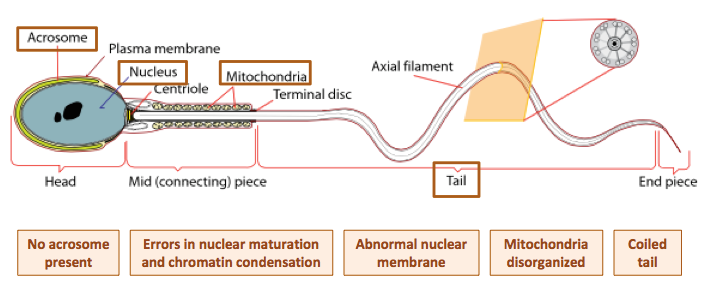
A sperm cell has three working parts. The head carries the DNA and is covered by a cap called the acrosome, which holds the enzymes the sperm needs to get through the outer layer of the egg. The midpiece is packed with mitochondria that make energy, and the tail (flagellum) beats in a corkscrew-like motion to push the cell forward. In a healthy sperm the head comes to a slight point, like an almond, and healthy morphology lets the sperm swim strongly in a straight line.
Sperm morphology is the assessment of these shapes under the microscope: the size and outline of the head, the appearance of the midpiece and the structure of the tail. It is one of the three core numbers on a semen analysis, alongside concentration and sperm motility. The lab reports the percentage of sperm that meet the definition of a normal form; everything else counts as abnormal, even if the defect is minor.
Sources: Cleveland Clinic — Sperm: Cells, How Long It Lives, Anatomy & Function; MedlinePlus — Semen Analysis
Sperm morphology normal range: WHO 2021 reference values
The WHO laboratory manual for the examination and processing of human semen, 6th edition (2021), sets the lower reference limit for normal forms at 4%. This figure is the 5th centile of results from more than 3,500 men in 12 countries on five continents whose partners conceived within 12 months of trying, so 95% of these fertile men had 4% or more normal forms. The 2010 (5th edition) value was also 4%, and the two editions differ only in the width of the confidence interval.
Two points matter when you read your report. First, the WHO and the EAU both stress that the 5th centile is not a dividing line between fertile and infertile men. Second, the 6th edition dropped labels such as “teratozoospermia” and replaced “reference values” with “decision limits”, without proposing any; most laboratories therefore still use the 4% cutoff, and the EAU panel still finds the teratozoospermia category useful in practice.
| Semen parameter | WHO 2010 (5th ed.) | WHO 2021 (6th ed.) |
|---|---|---|
| Normal forms (sperm morphology) | 4% (95% CI 3–4) | 4% (95% CI 3.9–4.0) |
| Semen volume | 1.5 mL | 1.4 mL |
| Sperm concentration | 15 million/mL | 16 million/mL |
| Total sperm number | 39 million per ejaculate | 39 million per ejaculate |
| Total motility | 40% | 42% |
| Progressive motility | 32% | 30% |
| Vitality (live sperm) | 58% | 54% |
Sources: Arab Journal of Urology (PMC) — Chung et al. 2023, Sixth edition of the WHO laboratory manual: updates for busy clinicians; Andrology (PubMed) — Campbell et al. 2021, Distribution of semen examination results 2020: a follow-up of data collated for the WHO manual; WHO — Laboratory manual for the examination and processing of human semen, 6th edition
How sperm morphology is assessed: Kruger and Tygerberg strict criteria
Modern morphology scoring comes from the Tygerberg Hospital group in South Africa. In 1988, Thinus Kruger and colleagues showed that when sperm were judged by “strict criteria”, the percentage of normal forms predicted IVF success: men with under 4% normal forms fertilised only 7.6% of eggs, men with 4–14% fertilised 63.9%, and men above 14% fertilised within the laboratory’s normal range. Higher thresholds were used for years before the WHO adopted 4% in 2010, which is why older reports quote different numbers.
Under strict criteria, the technician stains a semen smear (the WHO uses a sperm-adapted Papanicolaou stain), examines it at high magnification and classes each sperm as normal, borderline or abnormal, recording head, midpiece and tail defects and large cytoplasmic droplets separately. Because so many sperm fail this test, 4% normal and 96% abnormal is an expected result, not a sign that 96% of the sample is “bad”.
Why two labs can give different results
Sperm morphology is the most subjective number on the report. Reviews describe a lack of consensus on classification and technique, considerable inter-observer variability and, in the words of a 2017 Andrology review, a major lack of analytical reliability, especially in grading the details of each defect. If a single result is surprisingly low, repeat the test at an accredited andrology laboratory.
Sources: Fertility and Sterility (PubMed) — Kruger et al. 1988, Predictive value of abnormal sperm morphology in in vitro fertilization; Life (PMC) — Boitrelle et al. 2021, The sixth edition of the WHO manual for human semen analysis: a critical review; Andrology (PubMed) — Gatimel et al. 2017, Sperm morphology: assessment, pathophysiology, clinical relevance, and state of the art
Teratozoospermia: types of abnormal sperm shapes
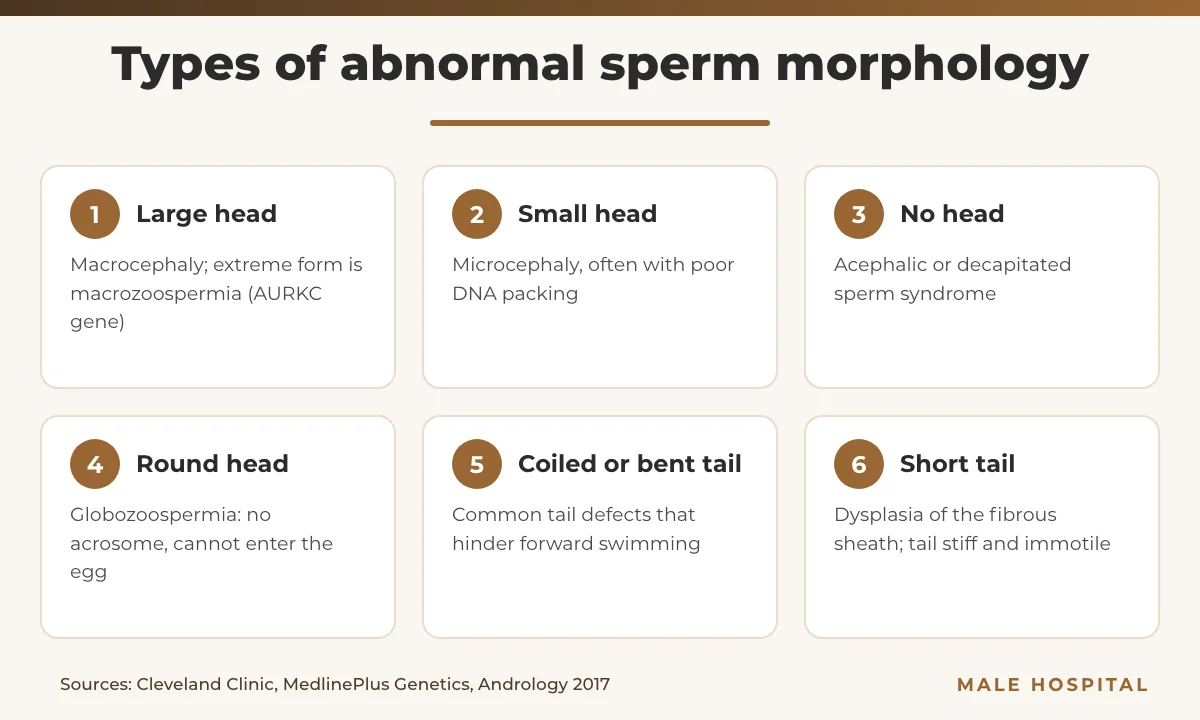
Teratozoospermia (also written teratospermia) is the older term for a sample with fewer normal forms than the reference limit, in practice under 4%. Abnormal shapes are grouped by the part of the sperm affected. Head defects include a missing head (acephalic sperm), a very small head (microcephaly), a very large head (macrocephaly) or a double head. Tail defects include a missing tail, a bent or crooked tail, a coiled tail and a short, stiff tail caused by dysplasia of the fibrous sheath. Midpiece defects and leftover cytoplasmic droplets are also recorded.
Most men with low sperm morphology have a mixture of these defects, and many minor ones (a slightly thin or amorphous head, an asymmetrical neck) appear to be normal variation with little clinical meaning. The picture changes when one specific defect affects virtually every sperm: these rare syndromes are usually genetic and do impair fertility.
Globozoospermia
Round-headed sperm with no acrosome. Without the acrosome, the sperm cannot penetrate the egg, so natural conception does not occur. Globozoospermia is estimated to affect 1 in 65,000 men, is most common in North Africa (about 1 in 100 cases of male infertility there), and is inherited in an autosomal recessive pattern; mutations in the DPY19L2 gene account for about 70% of cases.
Macrozoospermia
Almost all sperm have abnormally large, misshapen heads and multiple tails, most often four. The heads carry extra chromosome copies, so if such a sperm fertilises an egg the embryo does not develop or the pregnancy miscarries. It is caused by mutations in the AURKC gene, is also autosomal recessive, and is estimated to affect 1 in 10,000 males in North Africa.
Other defined syndromes include decapitated sperm syndrome and fibrous sheath dysplasia. Because a genetic diagnosis is often involved, the EAU states that genetic counselling is mandatory for couples with a known genetic abnormality before any assisted reproduction.
Sources: Cleveland Clinic — Sperm: Cells, How Long It Lives, Anatomy & Function; MedlinePlus Genetics — Globozoospermia; MedlinePlus Genetics — Macrozoospermia; EAU Guidelines — Sexual and Reproductive Health: Male Infertility
Causes of abnormal sperm shape
In most men no single cause is found, and sperm morphology usually falls together with count and motility rather than alone. Documented factors include:
- Smoking. A meta-analysis of 20 studies and 5,865 men found that smokers had on average 1.37% fewer normal forms, plus lower count and motility; the effect was larger in moderate and heavy smokers.
- Varicocele. Enlarged scrotal veins raise testicular temperature and are a recognised cause of male infertility, although the EAU notes that the benefit of repair for morphology is less clear than for concentration.
- Heat. The NHS warns that tight underwear can increase the temperature of the testicles and affect sperm quality.
- Obesity, heavy drinking and inactivity. The EAU gives a strong recommendation to inform infertile men about the detrimental effects of obesity, low physical activity, smoking and high alcohol intake.
- Drugs and chemicals. Anabolic steroids, cocaine and workplace exposure to pesticides, solvents or some heavy metals can harm sperm.
- Genetic causes. The syndromes above; the EAU notes that exome sequencing is identifying more gene defects behind specific morphology patterns, though it is not yet routine.
The same exposures that cause a low sperm count usually lower sperm morphology too, which is why the three parameters are assessed and treated together rather than one at a time.
Sources: European Urology (PubMed) — Sharma et al. 2016, Cigarette smoking and semen quality: a new meta-analysis; EAU Guidelines — Sexual and Reproductive Health: Male Infertility; NHS — Low sperm count
Does sperm morphology affect fertility?
Sperm morphology matters less than most men fear. The EAU states that no single semen parameter is diagnostic of infertility and that a semen analysis alone cannot separate fertile from infertile men. Reviews conclude that sperm morphology has very poor sensitivity and specificity for diagnosing infertility, apart from the rare specific syndromes, and low predictive value for pregnancy in both natural and assisted conception.
The strongest data come from intrauterine insemination (IUI). A 2018 meta-analysis pooled 20 studies and 41,018 IUI cycles scored by Kruger strict criteria, with female age 25–40 and a total motile sperm count above 10 million. Pregnancy per cycle was 14.2% above 4% normal forms and 12.1% at 4% or less, about 3 extra pregnancies per 100 cycles and not statistically significant; below 1% versus 1% or more, the rates were 14.0% and 13.9%. The authors concluded that abnormal morphology alone should not exclude couples from IUI.
Even 0% normal forms is not a verdict. In a Baylor College of Medicine cohort, 24 men with 0% normal forms and normal hormones were followed for a median of 2.5 years: 29.2% achieved a first pregnancy without assisted reproduction (versus 55.6% of controls with 4% or more), and 75% of all their pregnancies did not require IVF. The authors concluded that strict morphology should not be used to predict fertilisation, pregnancy or live birth.
| Evidence | What it showed | Takeaway |
|---|---|---|
| Kruger 1988 (IVF, strict criteria) | <4% normal forms: 7.6% of eggs fertilised; 4–14%: 63.9% | Morphology matters for conventional IVF dishes |
| Kohn 2018 meta-analysis (IUI, 41,018 cycles) | 14.2% vs 12.1% pregnancy per cycle above/below 4%; 14.0% vs 13.9% above/below 1% | Poor morphology alone should not rule out IUI |
| Kovac 2017 cohort (0% normal forms) | 29.2% conceived without ART; 75% of all their pregnancies without IVF | 0% is not a diagnosis of sterility |
| Globozoospermia / macrozoospermia | Virtually all sperm affected; genetic | True infertility; needs ICSI and genetic counselling |
Sources: Journal of Urology (PubMed) — Kohn et al. 2018, Effect of sperm morphology on pregnancy success via intrauterine insemination: systematic review and meta-analysis; Asian Journal of Andrology (PubMed) — Kovac et al. 2017, Men with a complete absence of normal sperm morphology exhibit high rates of success without assisted reproduction; EAU Guidelines — Sexual and Reproductive Health: Male Infertility
How to improve sperm morphology
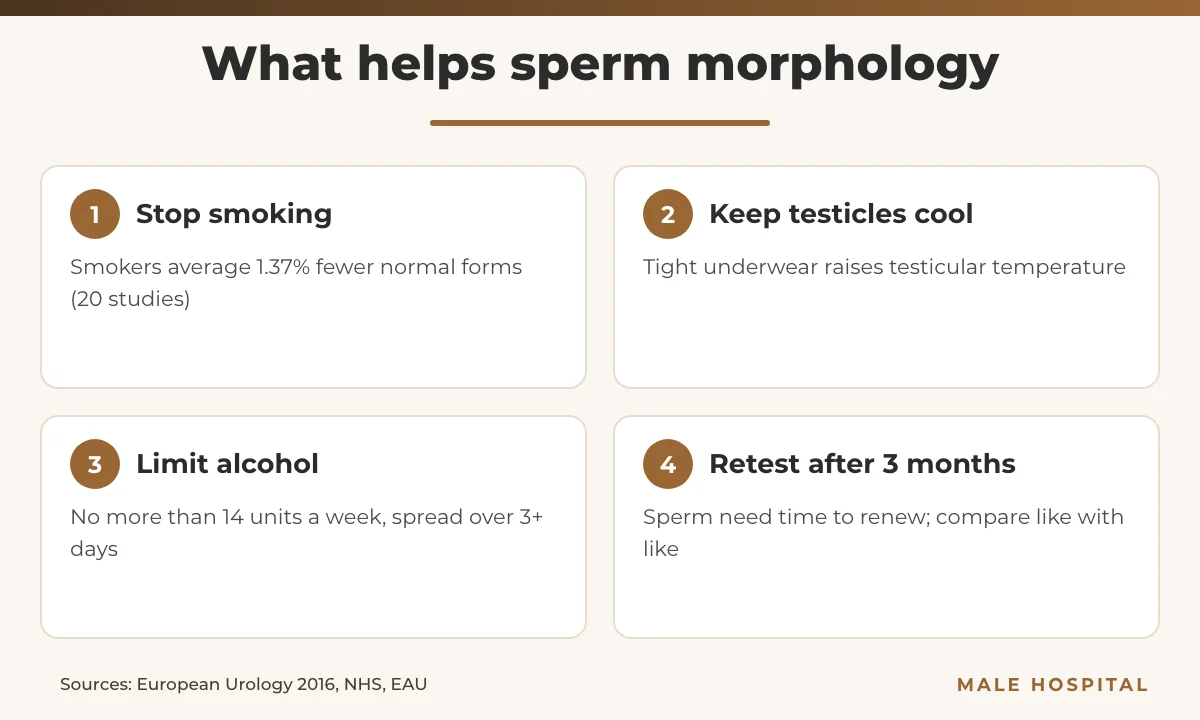
No pill reliably reshapes sperm, but removing the exposures that damage sperm production lets the testicles make healthier cells. The best-supported steps are the same ones recommended for improving sperm count:
- Stop smoking. The lifestyle factor most consistently linked to fewer normal forms; the harm scales with how much you smoke.
- Keep the testicles cool. Choose loose underwear and avoid prolonged heat on the groin.
- Moderate alcohol. The NHS advises no more than 14 units a week, spread across 3 or more days. Heavy drinking also lowers testosterone.
- Lose excess weight and move more. The EAU advises improving these factors to raise the chance of conception, although randomised data on weight loss are mixed.
- Avoid anabolic steroids and recreational drugs, and reduce workplace chemical exposure where possible.
- Treat a clinical varicocele if your semen is abnormal and the infertility is otherwise unexplained; the EAU recommends repair in this situation when the partner has good ovarian reserve, and advises against operating on subclinical varicoceles or men with normal semen. Our page on varicocele surgery explains the microsurgical technique.
Do antioxidants help?
Not reliably. The EAU gives a weak recommendation against routinely treating idiopathic infertility with antioxidants, because no conclusive data show benefit even though some trials report better semen parameters. The 2022 Cochrane review of 90 trials and 10,303 men rated the evidence as low to very low certainty: antioxidants may increase live birth, but the finding rests on 12 trials and remains uncertain.
How long until a change shows?
Sperm production takes time, so the NHS repeats an abnormal semen test about 3 months after the first, and the EAU uses the same 3-month interval to judge response to hormonal treatment. Make the changes, then retest.
Sources: EAU Guidelines — Sexual and Reproductive Health: Male Infertility; Cochrane Database of Systematic Reviews (PubMed) — de Ligny et al. 2022, Antioxidants for male subfertility; NHS — Low sperm count
Fertility treatment when normal forms are low
Treatment depends on the whole picture: the partner’s age and ovarian reserve, the total motile sperm count, how long you have tried and whether a cause was found. For many couples with isolated low morphology, timed intercourse or IUI is reasonable, since the IUI data show little penalty once the motile count exceeds 10 million.
When the motile count is also low, or IUI has failed, IVF with intracytoplasmic sperm injection (ICSI) is the usual next step. The UK regulator HFEA lists abnormally shaped sperm among the reasons to recommend ICSI, because injecting a single sperm into the egg bypasses the problems the sperm would have getting inside on its own. HFEA also notes that ICSI carries slightly more risk than other fertility treatments and that a son conceived by ICSI may inherit his father’s infertility when the cause is genetic. For the genetic syndromes, ICSI is the only route to fertilisation and genetic counselling comes first.
A urologist-andrologist’s role is to find and treat the male-side causes first, which is the aim of structured male infertility treatment: examination, hormone tests, scrotal ultrasound, genetic tests where indicated and lifestyle correction, so that the couple does not move to IVF earlier than necessary.
Sources: HFEA — Intracytoplasmic sperm injection (ICSI); EAU Guidelines — Sexual and Reproductive Health: Male Infertility
When to see a doctor
The EAU recommends that the man in every infertile couple is evaluated by a urologist trained in male reproduction, and that an abnormal first semen analysis is followed by at least two consecutive tests. See a specialist if:
- Two semen analyses, taken about 3 months apart, both show under 4% normal forms, especially if count or motility is also low.
- Your report says 0% normal forms, or describes one dominant defect such as round heads or large heads with several tails.
- You have a swelling, lump or dragging ache in the scrotum, which can point to a varicocele.
- You have had no pregnancy after 12 months of regular unprotected sex, the definition of infertility used by the WHO and EAU.
- You use anabolic steroids or cocaine, or have a hormone disorder, diabetes or a genetic condition such as cystic fibrosis.
- There is a family history of infertility or a known inherited condition in either partner.
For a confidential review of your semen analysis, Assoc. Prof. Dr. Zülfü Sertkaya, a urologist-andrologist in Istanbul whose research includes male infertility and semen parameters, can advise you on WhatsApp.
Sources: EAU Guidelines — Sexual and Reproductive Health: Male Infertility; NHS — Low sperm count
FAQs about sperm morphology
What is a normal sperm morphology percentage?
By WHO 2021 strict criteria, 4% or more normal forms is within the reference range. This is the 5th centile of fertile men, so a value only a little above 4% is entirely compatible with fertility. Older Kruger grading used 14%, which is why some reports and older articles quote a higher number.
Sources: Arab Journal of Urology (PMC) — Chung et al. 2023, Sixth edition of the WHO laboratory manual: updates for busy clinicians; Current Urology Reports (PubMed) — Danis & Samplaski 2019, Sperm Morphology: History, Challenges, and Impact on Natural and Assisted Fertility
Is 2% sperm morphology bad?
It is below the reference limit, but on its own it is not a diagnosis of infertility. In the largest IUI analysis, men under 4% and even under 1% normal forms achieved pregnancy rates close to those with normal morphology when the motile sperm count was adequate. Count, motility, your partner’s age and time trying matter more.
Can you get pregnant naturally with 0% normal sperm morphology?
Yes, it happens. In a cohort of 24 men with 0% normal forms, about 29% achieved a first pregnancy without assisted reproduction, and three-quarters of all their pregnancies occurred without IVF. The exception is a uniform genetic defect such as globozoospermia, where the sperm cannot penetrate the egg and ICSI is needed.
Sources: Asian Journal of Andrology (PubMed) — Kovac et al. 2017, Men with a complete absence of normal sperm morphology exhibit high rates of success without assisted reproduction; MedlinePlus Genetics — Globozoospermia
Does abnormal sperm morphology cause miscarriage or birth defects?
Ordinary mixed morphology defects are not an established cause of either. Macrozoospermia is a specific exception: its large-headed sperm carry extra chromosome sets, so fertilisation leads to failed development or miscarriage. HFEA notes a very small number of genetic and developmental problems in children born after ICSI, which may reflect the underlying infertility rather than the procedure.
Sources: MedlinePlus Genetics — Macrozoospermia; HFEA — Intracytoplasmic sperm injection (ICSI)
How is sperm morphology tested?
Through a standard semen analysis. You abstain from ejaculation for 2–7 days, produce a sample into a sterile container, and the laboratory stains a smear and scores each sperm as normal or abnormal under the microscope using strict criteria. Because results vary from day to day, you may be asked for two or more samples a few weeks apart.
Sources: MedlinePlus — Semen Analysis; Cleveland Clinic — Semen Analysis
Can varicocele repair improve morphology?
Sometimes. Repair in men with a clinical varicocele, abnormal semen and otherwise unexplained infertility improves pregnancy rates and sperm concentration, but the EAU describes the benefit for sperm morphology as less clear: one meta-analysis found no change in normal forms while another found an improvement. It is not recommended for subclinical varicoceles or for men with normal semen.
Source: EAU Guidelines — Sexual and Reproductive Health: Male Infertility
Why did the WHO stop using the word teratozoospermia?
The 6th edition (2021) deliberately removed the labels normozoospermia, oligozoospermia, asthenozoospermia and teratozoospermia, and replaced “reference values” with the idea of decision limits, to discourage treating the 5th centile as a pass/fail line. Critics point out that no decision limits were actually proposed, so most clinicians still use the 4% figure.
Does smoking affect sperm shape?
Yes. Across 20 studies of 5,865 men, smokers averaged 1.37% fewer normal forms than non-smokers, with bigger losses in moderate and heavy smokers, and lower count and motility as well. Quitting is the most useful lifestyle change; judge its effect on a semen test after about 3 months.
Sources: European Urology (PubMed) — Sharma et al. 2016, Cigarette smoking and semen quality: a new meta-analysis; NHS — Low sperm count
Medically reviewed by Assoc. Prof. Dr. Zülfü Sertkaya, urologist and andrologist (FEBU), Istanbul. Last reviewed: November 2026.
This article is for general information and does not replace an individual consultation with a qualified doctor.
- EAU — Sexual and Reproductive Health Guidelines: Male Infertility
- WHO — Laboratory manual for the examination and processing of human semen, 6th edition (2021)
- Arab Journal of Urology (PMC) — Chung et al. 2023, Sixth edition of the WHO laboratory manual: updates for busy clinicians
- Life (PMC) — Boitrelle et al. 2021, The sixth edition of the WHO manual for human semen analysis: a critical review
- Andrology (PubMed) — Campbell et al. 2021, Distribution of semen examination results 2020: a follow-up of data collated for the WHO manual
- Fertility and Sterility (PubMed) — Kruger et al. 1988, Predictive value of abnormal sperm morphology in in vitro fertilization
- Andrology (PubMed) — Gatimel et al. 2017, Sperm morphology: assessment, pathophysiology, clinical relevance, and state of the art
- Current Urology Reports (PubMed) — Danis & Samplaski 2019, Sperm Morphology: History, Challenges, and Impact on Natural and Assisted Fertility
- Journal of Urology (PubMed) — Kohn et al. 2018, Effect of sperm morphology on pregnancy success via intrauterine insemination: systematic review and meta-analysis
- Asian Journal of Andrology (PubMed) — Kovac et al. 2017, Men with a complete absence of normal sperm morphology exhibit high rates of success without assisted reproduction
- European Urology (PubMed) — Sharma et al. 2016, Cigarette smoking and semen quality: a new meta-analysis
- Cochrane Database of Systematic Reviews (PubMed) — de Ligny et al. 2022, Antioxidants for male subfertility
- Cleveland Clinic — Sperm: Cells, How Long It Lives, Anatomy & Function
- Cleveland Clinic — Semen Analysis
- MedlinePlus — Semen Analysis
- MedlinePlus Genetics — Globozoospermia
- MedlinePlus Genetics — Macrozoospermia
- NHS — Low sperm count
- HFEA — Intracytoplasmic sperm injection (ICSI)