
Low Testosterone Treatment in Istanbul
Low testosterone treatment starts with proof, not pills: symptoms plus at least two low early-morning blood tests, then LH and FSH to find where the problem lies. Many men first need weight loss, sleep care or a medicine change; men with confirmed deficiency can use testosterone gel, injections or pellets with regular blood checks, while men who want children are steered to fertility-sparing options such as hCG or clomiphene instead of testosterone.
Source: EAU Guidelines — Sexual and Reproductive Health: Male Hypogonadism; Urology Times — Testosterone deficiency FAQs from the AUA guideline
- A diagnosis needs both symptoms and consistently low morning testosterone; one low result or a questionnaire is not enough.
- LH and FSH separate testicular (primary) from pituitary or hypothalamic (secondary) causes, and that difference shapes the whole low testosterone treatment plan.
- Testosterone therapy lowers sperm production, so guidelines advise against it for men who want to become fathers.
- In February 2025 the FDA removed the cardiovascular boxed warning from testosterone labels after the TRAVERSE trial; in June 2026 HHS and the FDA began a further label update.
- Low testosterone treatment is a long-term commitment with blood tests for testosterone, haematocrit and PSA, and it should be stopped if symptoms do not improve within 3–6 months.
Send us your symptoms and recent blood tests for a confidential, personalised low testosterone treatment plan from our urologist-andrologist.
- What is low testosterone treatment?
- Diagnosis first: two morning tests, LH and FSH
- Causes that change the plan
- Who is a good candidate and who is not
- Lifestyle and treating the cause
- Low testosterone treatment options compared
- Wanting children: clomiphene, hCG and other fertility-sparing options
- The treatment process step by step
- Monitoring and timeline
- Risks, side effects and the current FDA label
- Results and realistic expectations
- Low testosterone treatment with Dr. Zülfü Sertkaya in Istanbul
- How to start
- When to see a doctor
- FAQs about treating testosterone deficiency
What is low testosterone treatment?
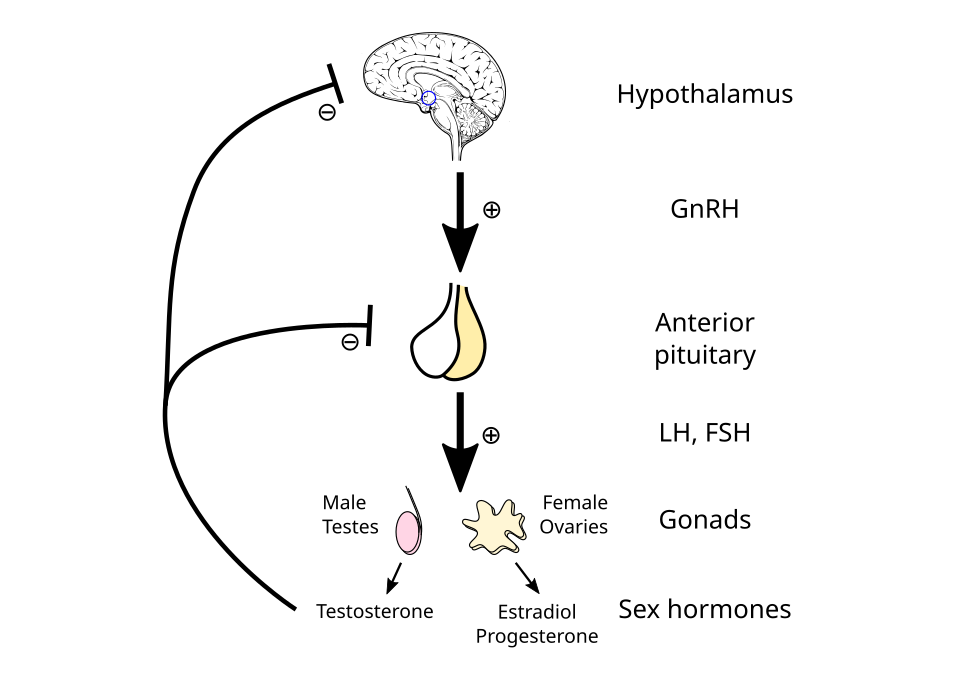
Testosterone is made in the testicles under instructions from the brain. The hypothalamus releases GnRH, which tells the pituitary gland to release luteinizing hormone (LH) and follicle-stimulating hormone (FSH). LH drives testosterone production, while FSH, together with testosterone inside the testicle, supports sperm production. A fault anywhere along this chain can leave a man with too little testosterone, a condition doctors call male hypogonadism or testosterone deficiency.
Low testosterone treatment is not one product. It is a sequence: confirm the deficiency, find the cause, correct what can be corrected, and only then decide whether to replace testosterone or to stimulate the body’s own production. The right choice depends on the cause, your symptoms, your health risks and, very importantly, whether you want children now or in the future.
Source: MedlinePlus — Hypogonadism; Endocrine Society — Testosterone Therapy for Hypogonadism Guideline
Diagnosis first: two morning tests, LH and FSH
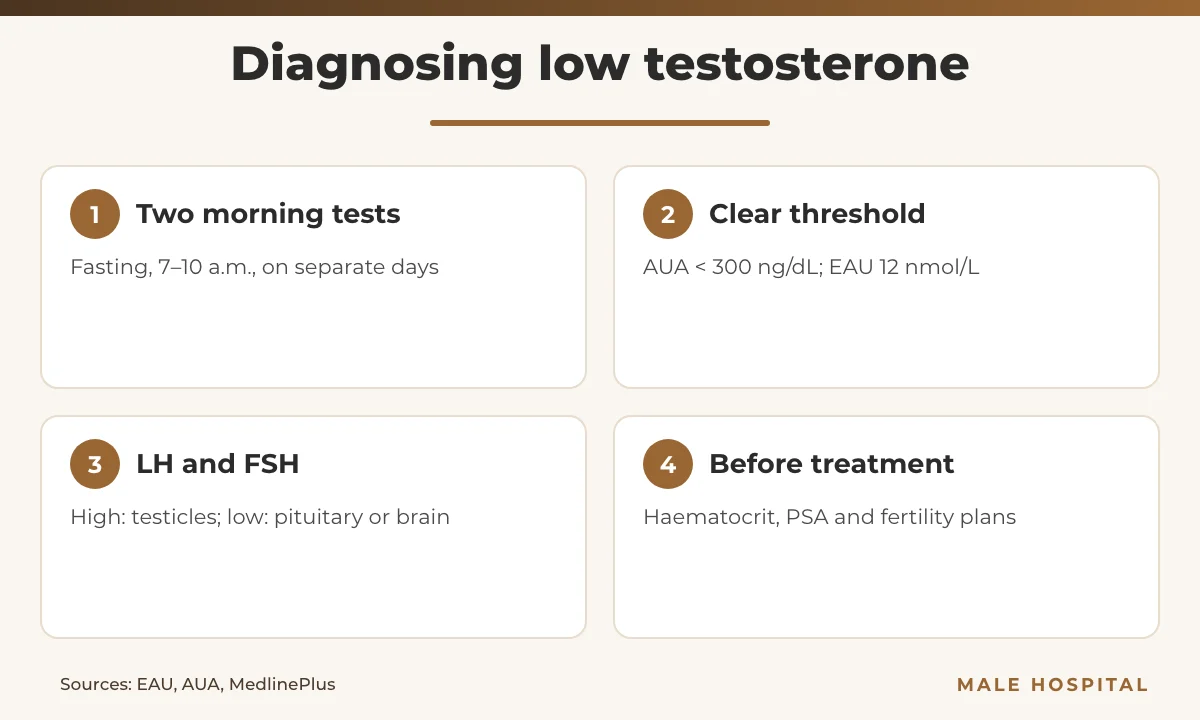
Testosterone levels are highest in the morning and vary from day to day, so timing matters. The blood sample is usually taken between 7 and 10 a.m., and the EAU asks for a fasting sample measured with a reliable laboratory method. Both the EAU and the American Urological Association (AUA) require at least two separate low results before a diagnosis is made and low testosterone treatment is considered. Symptom questionnaires are not recommended for screening because they are not specific enough.
- Thresholds: the AUA uses total testosterone below 300 ng/dL; the EAU uses 12 nmol/L (about 3.5 ng/mL).
- LH and FSH: high values point to the testicles (primary hypogonadism); low or low-normal values point to the pituitary or hypothalamus (secondary hypogonadism).
- Prolactin: checked when LH is low or low-normal, or when low desire suggests a pituitary cause.
- SHBG and free testosterone: calculated when total testosterone is borderline or binding proteins may be abnormal.
- Before any testosterone: haemoglobin and haematocrit, PSA in men over 40, and a conversation about fertility plans.
Source: MedlinePlus — Testosterone Levels Test; EAU Guidelines — Sexual and Reproductive Health: Male Hypogonadism; Urology Times — Testosterone deficiency FAQs from the AUA guideline
Imaging is not routine before low testosterone treatment. The EAU recommends a pituitary MRI when secondary hypogonadism comes with raised prolactin, symptoms of a pituitary mass or other pituitary hormone problems, and suggests it when total testosterone is very low (below 6 nmol/L). For a deeper look at benefits and risks of the hormone itself, read our guide to testosterone replacement therapy.
Source: EAU Guidelines — Sexual and Reproductive Health: Male Hypogonadism
Causes that change the plan
Doctors sort low testosterone into three groups, because each one needs a different low testosterone treatment. Knowing the group tells your doctor whether replacing testosterone, stimulating the testicles or fixing an underlying problem makes the most sense.
- Primary (testicular) hypogonadism: the testicles cannot respond. Causes include Klinefelter syndrome, infection such as orchitis, chemotherapy or radiation, testicular injury or torsion, and iron overload (hemochromatosis).
- Secondary (central) hypogonadism: the brain does not send enough LH and FSH. Causes include pituitary tumours, opioids and glucocorticoids, stopping anabolic steroids, Kallmann syndrome and rapid major weight loss.
- Functional hypogonadism: the hormone axis is intact but suppressed by obesity, type 2 diabetes, other illness or medicines. It is a diagnosis of exclusion, and the EAU advises treating the underlying condition before any low testosterone treatment.
Source: MedlinePlus — Hypogonadism; EAU Guidelines — Sexual and Reproductive Health: Male Hypogonadism
Who is a good candidate and who is not
A good candidate for low testosterone treatment has symptoms or signs that fit deficiency, such as low sex drive, fewer morning erections, erectile problems, fatigue, low mood or loss of muscle and bone, together with confirmed low levels. The AUA also advises testing men with anaemia, bone loss, diabetes, HIV, previous chemotherapy or radiation, long-term opioid or steroid use, infertility or pituitary disease. The Endocrine Society advises against screening all men and against routinely treating every man over 65 with a low number.
The EAU lists absolute reasons not to start testosterone: locally advanced or metastatic prostate cancer, male breast cancer, an active wish to have children, a haematocrit of 54% or more, and uncontrolled heart failure. Relative cautions include severe urinary symptoms (IPSS above 19), a baseline haematocrit of 48–50% and a family history of blood clots. The Endocrine Society adds a prostate nodule or raised PSA without urological evaluation, untreated severe sleep apnoea, a heart attack or stroke in the last 6 months, and thrombophilia.
Source: Urology Times — Testosterone deficiency FAQs from the AUA guideline; EAU Guidelines — Sexual and Reproductive Health: Male Hypogonadism; Endocrine Society — Testosterone Therapy for Hypogonadism Guideline
Lifestyle and treating the cause
Every guideline puts lifestyle first in low testosterone treatment. The EAU strongly recommends improving lifestyle, reducing weight, stopping medicines that suppress testosterone where possible and treating other illnesses before starting hormone therapy. The AUA likewise lists lifestyle counselling as the first management step.
Be realistic about what lifestyle-based low testosterone treatment can achieve. According to the EAU, diet and exercise raise testosterone only modestly, by roughly 1–2 nmol/L, so lifestyle change helps most in men with functional, weight-related deficiency. Practical steps include losing excess weight, staying active, treating sleep apnoea, controlling blood sugar and reviewing medicines such as opioids or glucocorticoids with your doctor. For men whose erections are the main concern, our erectile dysfunction treatment page explains options that can be combined with hormone care.
Source: EAU Guidelines — Sexual and Reproductive Health: Male Hypogonadism; Urology Times — Testosterone deficiency FAQs from the AUA guideline
Low testosterone treatment options compared
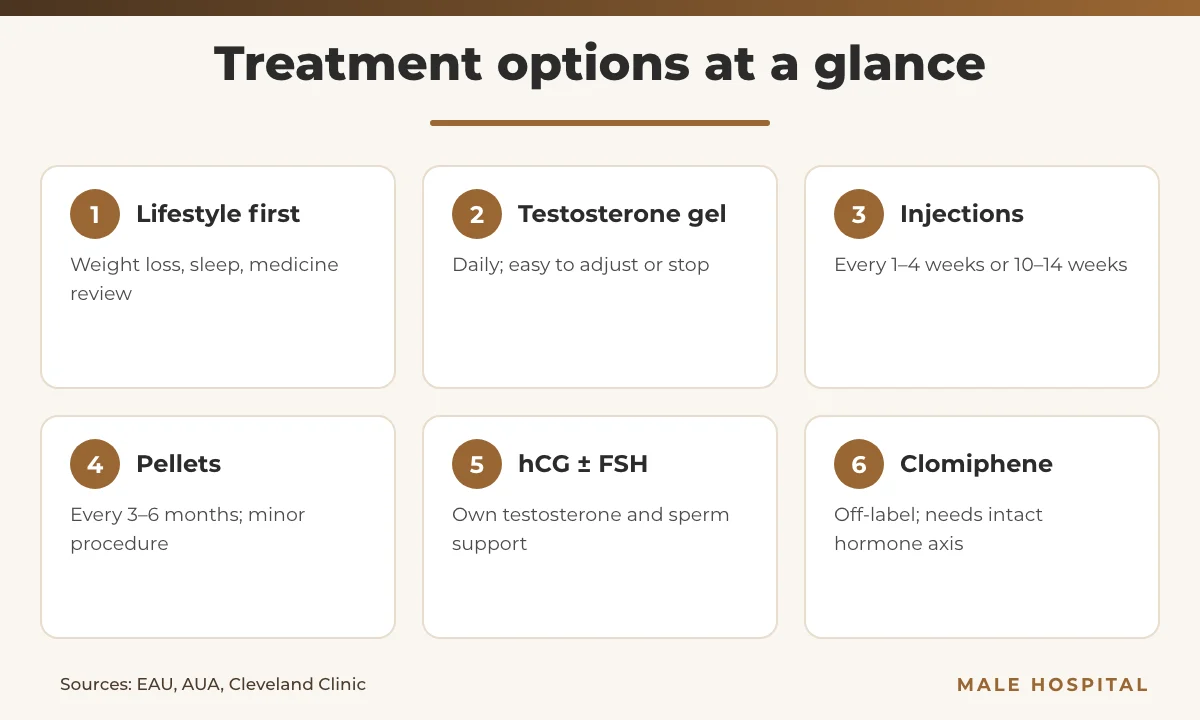
When replacement is the right low testosterone treatment, the hormone itself is the same; the forms differ in how often you use them, how steady blood levels are and their practical drawbacks. The EAU suggests gel rather than depot injections for men at higher risk of side effects, because a daily gel can be stopped quickly. The AUA advises avoiding alkylated oral testosterone and compounded products where possible.
| Option | How often | Advantages | Drawbacks |
|---|---|---|---|
| Testosterone gel | Once daily on the skin | Most widely used; easy to adjust or stop | Daily routine; skin irritation; avoid skin contact with others while wet |
| Short-acting injections | Every 1–4 weeks into muscle, or weekly under the skin | Inexpensive and widely available | Larger swings in levels and symptoms |
| Long-acting undecanoate injection | 1,000 mg every 10–14 weeks after loading doses | Few injections a year; steady levels | Given in clinic; slow to wear off |
| Pellets under the skin | Every 3–6 months | No daily dosing | Minor procedure each time; extrusion and infection risk |
| Patch, nasal gel, buccal or oral | Daily to three times daily | No needles | Frequent dosing; patches irritate skin; oral undecanoate carries a blood-pressure boxed warning |
| Fertility-sparing (hCG, SERMs) | Injections or tablets as prescribed | Raise your own testosterone and support sperm | Off-label in part; need an intact hormone axis or specialist care |
Source: EAU Guidelines — Sexual and Reproductive Health: Male Hypogonadism; Cleveland Clinic — Testosterone Replacement Therapy (TRT)
Gel
Gels are the most frequently used preparation in low testosterone treatment, typically 50–100 mg a day applied to clean, dry skin. Blood levels are best checked 2–4 hours after applying. Avoid skin-to-skin contact while the gel is still wet so it does not pass to another person.
Injections
Short-acting esters such as enanthate or cypionate are given every 1–2 weeks (Cleveland Clinic) or every 2–4 weeks (EAU), and cause bigger peaks and troughs. Long-acting testosterone undecanoate is given as 1,000 mg every 12 weeks after a six-week loading dose, adjusted to 10–14 weeks, aiming for a trough level above 12 and below 18 nmol/L.
Pellets
Pellets are small implants placed under the skin in a brief office procedure every 3–6 months; the EAU notes they last four to seven months. As a low testosterone treatment, they avoid daily dosing, but the dose cannot be stopped quickly, and the procedure carries a small risk of infection or the pellet working its way out.
Source: EAU Guidelines — Sexual and Reproductive Health: Male Hypogonadism; Cleveland Clinic — Testosterone Replacement Therapy (TRT)
Wanting children: clomiphene, hCG and other fertility-sparing options
This is the most common and most avoidable mistake in low testosterone treatment. Testosterone from outside the body tells the brain to switch off LH and FSH, so the testicles shrink and sperm counts fall. The EAU strongly recommends not using testosterone therapy to treat male infertility or in men wishing to become fathers, and Cleveland Clinic notes that restoring fertility after testosterone can be slow and costly.
- hCG (with FSH when needed): hCG acts like LH and makes the testicles produce their own testosterone. In secondary hypogonadism, the EAU considers gonadotropins the standard when a man wants children, and states that combining hCG with FSH gives better results than hCG alone.
- Clomiphene and other SERMs: these tablets block oestrogen feedback in the brain so the pituitary releases more LH and FSH. They are off-label in men, the evidence is limited, and they only work when the hormone axis is intact (functional secondary hypogonadism). They do not work in primary hypogonadism, and men should be warned of a possible rise in blood-clot risk.
- Aromatase inhibitors: also off-label, with limited evidence, and used in selected men only.
Source: EAU Guidelines — Sexual and Reproductive Health: Male Hypogonadism; Urology Times — Testosterone deficiency FAQs from the AUA guideline; Cleveland Clinic — Testosterone Replacement Therapy (TRT)
The AUA guideline allows men who want to preserve fertility to be offered SERMs, hCG or aromatase inhibitors instead of testosterone. A semen analysis before starting low testosterone treatment is sensible for any man who may want children. When hormone treatment alone is not enough, our male infertility treatment page covers the next steps.
Source: Urology Times — Testosterone deficiency FAQs from the AUA guideline; MedlinePlus — Hypogonadism
The treatment process step by step
- History and examination: symptoms, medicines (including opioids, steroids and previous anabolic steroid use), fertility plans, prostate and urinary symptoms, sleep and heart history, and an examination including the testicles and a digital rectal exam.
- Confirming blood tests: two early-morning total testosterone results, then LH, FSH and, when indicated, prolactin, SHBG and free testosterone.
- Baseline safety tests: haemoglobin and haematocrit, PSA in men over 40 and, where relevant, blood sugar and lipids.
- Cause-directed care: weight loss, sleep apnoea treatment, medicine changes or pituitary assessment where needed.
- Choosing the low testosterone treatment: testosterone gel, injections or pellets for men not seeking fertility; hCG, FSH or a SERM for men who want children.
- Dose adjustment: the AUA aims for the middle third of the normal range, adjusting the dose to symptoms and blood results.
Source: Urology Times — Testosterone deficiency FAQs from the AUA guideline; EAU Guidelines — Sexual and Reproductive Health: Male Hypogonadism
Monitoring and timeline
Monitoring is what keeps low testosterone treatment safe. The EAU schedule is the most detailed, and the AUA recommends re-checking testosterone every 6–12 months once treatment is stable.
| When | What happens |
|---|---|
| Before starting | Testosterone, haematocrit, PSA, digital rectal exam, fertility discussion |
| About 30 days | Many doctors re-check the testosterone level |
| 3 months | Testosterone and haematocrit; first review of symptoms; PSA |
| 3–6 months | No symptom improvement: stop treatment and look for another cause |
| 6 and 12 months | Testosterone and haematocrit (every 3 months in year one for high-risk men); PSA at 12 months |
| Every year after | Testosterone, haematocrit, PSA and rectal exam |
If haematocrit rises above 54% during low testosterone treatment, the EAU recommends adjusting or stopping testosterone and removing blood if needed, then restarting at a lower dose, ideally as a gel. The Endocrine Society advises urological referral if PSA rises by more than 1.4 ng/mL in the first 12 months, if a confirmed PSA exceeds 4.0 ng/mL, or if the rectal exam becomes abnormal.
Source: EAU Guidelines — Sexual and Reproductive Health: Male Hypogonadism; Cleveland Clinic — Testosterone Replacement Therapy (TRT); Endocrine Society — Testosterone Therapy for Hypogonadism Guideline
Risks, side effects and the current FDA label
Most side effects of low testosterone treatment are predictable and are the reason for monitoring: a rise in red blood cells that thickens the blood, smaller testicles and lower sperm counts, acne or oily skin, ankle swelling, breast tenderness or enlargement, prostate stimulation with urinary symptoms and a higher PSA, skin irritation with gels and patches, and worsening of sleep apnoea in some men.
Source: Cleveland Clinic — Testosterone Replacement Therapy (TRT)
Heart safety and TRAVERSE
The TRAVERSE trial randomised 5,246 men aged 45 to 80 with hypogonadism and existing or high cardiovascular risk to testosterone gel or placebo, with a mean follow-up of 33 months. Major cardiac events (cardiovascular death, heart attack or stroke) occurred in 7.0% on testosterone and 7.3% on placebo, meeting the trial’s safety goal. Atrial fibrillation, acute kidney injury and pulmonary embolism were more common with testosterone.
Source: N Engl J Med (PubMed) — Cardiovascular Safety of Testosterone-Replacement Therapy (TRAVERSE, 2023)
FDA labeling: 2025 changes and the 2026 update
On February 28, 2025, the FDA announced class-wide labeling changes for testosterone products. It removed the boxed-warning language about an increased risk of adverse cardiovascular outcomes, added the TRAVERSE results to all labels, added warnings about increased blood pressure, and at that time kept the “limitation of use” for age-related hypogonadism.
On June 18, 2026, HHS, working with the FDA, announced it was beginning the process of updating the prescribing information again. The announced changes would remove the limitation of use for age-related hypogonadism, update information on prostate cancer risk and revise the warnings on benign prostatic enlargement. Labels change product by product, so your doctor should check the current label of the exact product prescribed. None of these changes removes the need for a confirmed diagnosis and regular monitoring during low testosterone treatment.
Source: FDA — FDA issues class-wide labeling changes for testosterone products; AUA — HHS announces updates to testosterone replacement therapy labeling
Results and realistic expectations
Changes from low testosterone treatment usually take a few weeks to appear. Sexual desire and erections are often the first things men notice, and the first formal review takes place at about three months. If symptoms have not improved after 3–6 months despite normal levels on treatment, both the AUA and Cleveland Clinic advise stopping, because low testosterone was probably not the main cause.
Testosterone therapy treats a hormone deficiency; it does not fix the underlying cause, and symptoms usually return if it is stopped. It is not a weight-loss or diabetes treatment, and the Endocrine Society advises against using it to improve blood sugar control. Successful low testosterone treatment means feeling better with safe blood results, not chasing the highest possible number.
Source: Cleveland Clinic — Testosterone Replacement Therapy (TRT); Urology Times — Testosterone deficiency FAQs from the AUA guideline; Endocrine Society — Testosterone Therapy for Hypogonadism Guideline
Low testosterone treatment with Dr. Zülfü Sertkaya in Istanbul
Assoc. Prof. Dr. Zülfü Sertkaya is a urologist and andrologist in Istanbul, a urology specialist since 2014, a Fellow of the European Board of Urology (FEBU, 2017) and an Associate Professor of Urology since 2020. His clinical focus includes male infertility, and his research covers male infertility topics such as hormones and semen. He is a member of the EAU, ESSM, ISSM, the Turkish Urological Association and the Turkish Society of Andrology.
That background matters for hormone care, because the key decision is often whether to replace testosterone or protect sperm production. Our team supports international patients with reception and transport, translation, trip planning, hotel accommodation, medical consultation and aftercare. Pricing is given after a free assessment, because it depends on your tests and the low testosterone treatment chosen.
How to start
Start with a free, confidential WhatsApp consultation. Share your symptoms, any testosterone, LH, FSH, prolactin, haematocrit and PSA results you already have, your medicines and whether you plan to have children. Our urologist-andrologist will review them and send you a personalised plan, including which tests are still needed before any low testosterone treatment begins.
When to see a doctor
See a doctor if you have a lasting drop in sex drive, fewer morning erections, erectile problems, unexplained fatigue, low mood or loss of muscle. Seek prompt care if you notice any of the following:
- Headaches or vision changes, which can be symptoms of a pituitary mass.
- Breast enlargement or a lump in the breast or testicle.
- On testosterone: chest pain, shortness of breath, leg pain or swelling (possible blood clot), or new difficulty passing urine.
- Very low testosterone together with infertility or small testicles.
Source: EAU Guidelines — Sexual and Reproductive Health: Male Hypogonadism; MedlinePlus — Hypogonadism
Related men’s health guides
- Low Testosterone: Causes, Diagnosis and 4 Treatment Options
- Low Testosterone Symptoms: 10 Signs and How to Test
- Testosterone Replacement Therapy: 10 Facts Before You Start
- Normal Testosterone Levels by Age: 6 Decades of Data
- How to Increase Testosterone Naturally: 6 Proven Steps
- Testosterone and Erectile Dysfunction: 7 Key Facts
FAQs about treating testosterone deficiency
What is the first step in low testosterone treatment?
The first step is confirming the diagnosis: symptoms plus at least two low early-morning total testosterone results on separate days. LH and FSH are then measured to find whether the testicles or the brain’s signals are the source. Lifestyle changes and treating causes such as obesity or certain medicines come before hormone therapy.
Source: EAU Guidelines — Sexual and Reproductive Health: Male Hypogonadism
Which is better, testosterone gel or injections?
Neither form of low testosterone treatment is better for everyone. Gel is applied daily, keeps levels steadier and can be stopped quickly, which is why the EAU suggests it for higher-risk men. Injections are less frequent and inexpensive, but short-acting forms cause swings in levels. Long-acting undecanoate injections are given only a few times a year in clinic.
Source: EAU Guidelines — Sexual and Reproductive Health: Male Hypogonadism
Will testosterone therapy make me infertile?
It can. Outside testosterone switches off the brain’s LH and FSH signals, so sperm production falls and the testicles shrink. Cleveland Clinic advises against it for men planning biological children, and recovery after stopping can be slow. Men who want children are usually offered hCG, FSH or, in selected cases, clomiphene instead.
Source: Cleveland Clinic — Testosterone Replacement Therapy (TRT)
Is clomiphene approved for men with low testosterone?
No. Clomiphene and other SERMs are used off-label in men. The EAU describes the evidence as limited and says they only work when the hormone axis is intact, not in primary testicular failure. Men should be told about a possible increase in blood-clot risk, and treatment should be supervised with blood tests.
Source: EAU Guidelines — Sexual and Reproductive Health: Male Hypogonadism
Did the FDA remove the heart warning on testosterone?
Yes. In February 2025 the FDA removed the boxed-warning language about increased cardiovascular risk and added the TRAVERSE trial results to all testosterone labels. It also added warnings about increased blood pressure. In June 2026, HHS and the FDA began a further update affecting age-related use, prostate cancer and prostate enlargement wording.
Source: FDA — FDA issues class-wide labeling changes for testosterone products; AUA — HHS announces updates to testosterone replacement therapy labeling
How long does low testosterone treatment take to work?
Most men notice changes within a few weeks, and sexual symptoms are often first. Doctors usually re-check levels after about a month and review symptoms at three months. If there is no improvement after 3–6 months of adequate levels, low testosterone treatment should usually be stopped and other causes explored.
Source: Cleveland Clinic — Testosterone Replacement Therapy (TRT)
Do I have to stay on testosterone for life?
Testosterone replaces a missing hormone rather than curing the cause, so levels usually fall again if it is stopped. Men with functional deficiency linked to weight, sleep or medicines may recover after the cause is corrected. Anyone stopping low testosterone treatment should do so with their doctor and have levels re-checked.
Source: EAU Guidelines — Sexual and Reproductive Health: Male Hypogonadism
Can I use testosterone if I have had prostate cancer?
Locally advanced or metastatic prostate cancer is an absolute contraindication under the EAU guideline. Some carefully selected men treated for low-risk disease may be considered after specialist review, with closer PSA monitoring. This decision belongs with a urologist who knows your cancer history.
Source: EAU Guidelines — Sexual and Reproductive Health: Male Hypogonadism
Can weight loss raise testosterone without medicine?
Yes, especially in men whose low levels are linked to obesity or diabetes. Guidelines recommend weight reduction and lifestyle change before hormone therapy. The rise from diet and exercise is usually modest, around 1–2 nmol/L according to the EAU, so men with true hypogonadism often still need low testosterone treatment.
Source: EAU Guidelines — Sexual and Reproductive Health: Male Hypogonadism
Low testosterone treatment works best when the diagnosis, the cause and your plans for children all guide the choice. Our urologist-andrologist offers a confidential review of your tests and a personalised plan.
Get a free, confidential review of your hormone tests and a clear low testosterone treatment plan.
Medically reviewed by Assoc. Prof. Dr. Zülfü Sertkaya, urologist and andrologist (FEBU), Istanbul. Last reviewed: October 2026.
This article is for general information and does not replace an individual consultation with a qualified doctor.
- EAU — Sexual and Reproductive Health Guidelines: Male Hypogonadism
- Urology Times — Testosterone deficiency FAQs from the AUA guideline
- Endocrine Society — Testosterone Therapy for Hypogonadism Guideline
- FDA — FDA issues class-wide labeling changes for testosterone products
- AUA — HHS announces updates to testosterone replacement therapy labeling
- N Engl J Med (PubMed) — Cardiovascular Safety of Testosterone-Replacement Therapy (TRAVERSE, 2023)
- Cleveland Clinic — Testosterone Replacement Therapy (TRT)
- MedlinePlus — Hypogonadism
- MedlinePlus — Testosterone Levels Test