Small penis syndrome is persistent, distressing anxiety about penis size in a man whose penis is actually within the normal range. When the worry becomes an all-consuming preoccupation with checking, comparing and avoidance, doctors may call it penile dysmorphic disorder, a form of body dysmorphic disorder (BDD). The good news is that it is treatable: structured counseling and cognitive behavioral therapy (CBT) are the recommended first steps, while enlargement surgery is generally discouraged. If you first want to know where you stand, our guide to average penis size explains the measured norms in detail.
Sources: EAU Guidelines — Penile size abnormalities and dysmorphophobia; PubMed — Wylie & Eardley, Penile size and the ‘small penis syndrome’ (BJU Int 2007)
- Small penis syndrome (also called small penis anxiety) is excessive worry about a penis that is normal in size. It is common, and it is not a sign of weakness.
- Penile dysmorphic disorder is the more severe form: a type of body dysmorphic disorder with intrusive thoughts, checking, avoidance and real impact on daily life.
- In studies of men asking for lengthening surgery, almost all had a normal-sized penis, and most overestimated what “normal” is.
- European urology guidelines recommend psychological assessment and counseling; CBT is the best-supported therapy for body dysmorphic disorder.
- Enlargement procedures have weak evidence, real complication risks and often poor satisfaction in men with normal size; guidelines advise against fillers in men with penile dysmorphic disorder.
- What is small penis syndrome?
- Small penis syndrome vs penile dysmorphic disorder
- Is your penis really small? What the measurements show
- Signs and symptoms of small penis syndrome
- What causes small penis anxiety?
- How size anxiety affects sex and relationships
- How size anxiety is treated: counseling, CBT and medication
- Why surgery is discouraged
- Practical steps you can take now
- When to see a doctor
- FAQs about small penis syndrome
What is small penis syndrome?
The European Association of Urology (EAU) defines small penis anxiety, or small penis syndrome, as a man’s excessive anxiety about his normal-sized penis. It is not a formal diagnosis in the American Psychiatric Association’s classification, but the guideline notes that men with this anxiety may be at risk of body dysmorphic disorder.
Urologists Kevan Wylie and Ian Eardley point out that size worry is often within the normal experience of men. It becomes a clinical problem when the concern is excessive: it can present as obsessive rumination with compulsive checking, as body dysmorphic disorder, or as part of social anxiety or another condition such as erectile dysfunction. They stress that a careful assessment that first normalizes the worry is essential.
Sources: EAU Guidelines — Penile size abnormalities and dysmorphophobia; PubMed — Wylie & Eardley, Penile size and the ‘small penis syndrome’ (BJU Int 2007)
Psychotherapists who treat these men describe the problem as a syndrome with psychiatric comorbidities and social consequences that impair life, and warn that affected men are vulnerable to treatments that are not evidence based and potentially harmful. The suffering of small penis syndrome is real even when the anatomy is normal.
Source: PubMed — Pastoor & Gregory, Penile size dissatisfaction (J Sex Med 2020)
Small penis syndrome vs penile dysmorphic disorder
Researchers at King’s College London separate two groups. Men with small penis anxiety worry about their size but do not meet criteria for a mental disorder. Penile dysmorphic disorder (PDD) is shorthand for men diagnosed with body dysmorphic disorder whose main, if not only, preoccupation is the size or shape of the penis, causing significant shame or handicap. The EAU guideline uses the same definition.
When the two groups were compared with men without concerns, men with PDD scored clearly higher for intrusive mental imagery, avoidance, safety-seeking behaviors and general psychological distress. Men with small penis anxiety sat in between. To tell the groups apart, the team developed a nine-item questionnaire, the Cosmetic Procedure Screening Scale for PDD (COPS-P), which clinicians can use before any intervention.
Sources: PubMed — Veale et al., Penile dysmorphic disorder: development of a screening scale (Arch Sex Behav 2015); PubMed — Veale et al., Phenomenology of men with BDD concerning penis size (Body Image 2015)
| Feature | Small penis anxiety | Penile dysmorphic disorder | Micropenis |
|---|---|---|---|
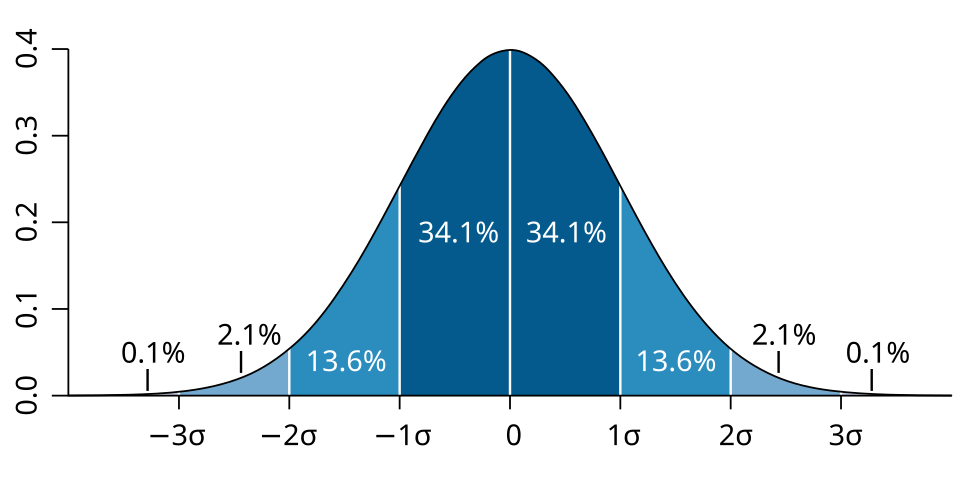
| Actual size | Normal | Usually normal | Stretched length more than 2.5 SD below the mean for age |
| Main problem | Worry and dissatisfaction | Preoccupation, shame, checking and avoidance that impair life | A physical condition, usually found in infancy or childhood |
| Diagnostic status | Not a formal psychiatric diagnosis | A form of body dysmorphic disorder | Medical diagnosis made by measurement |
| First-line help | Measurement, education and counseling | Mental health referral, CBT, sometimes an SSRI | Endocrine and urological care |
Sources: EAU Guidelines — Penile size abnormalities and dysmorphophobia; NHS — Body dysmorphic disorder (BDD)
True micropenis is a different, rare medical condition, usually found in childhood; our article on micropenis covers its causes and treatment.
Is your penis really small? What the measurements show
The largest systematic review of penis measurements, which pooled data from up to 15,521 men measured by health professionals, found an average flaccid length of 9.16 cm, an average stretched length of 13.24 cm and an average erect length of 13.12 cm (about 5.2 inches), with an average erect girth of 11.66 cm. Most men fall close to these averages; the full percentile charts are in our average penis size guide.
In small penis syndrome, what matters most is the gap between perception and reality. In an Italian andrology clinic, 67 men asking for surgical lengthening were measured: none was below the 2.5th percentile, and none had an anatomical abnormality. Most of them overestimated normal length, and about two in three worried mainly about how they looked when flaccid.
Another King’s College study found that men’s shame-based beliefs about their penis did not correlate with their actual measured size. The ISSM likewise notes that men with PDD tend to view their penis as much smaller than it actually is. That is why a careful clinical measurement is more reliable than a mirror or a glance in the locker room.
Sources: PubMed — Mondaini et al., Penile length is normal in most men seeking penile lengthening procedures (Int J Impot Res 2002); PubMed — Veale et al., Beliefs about penis size scale (J Sex Med 2014); ISSM — What is penile dysmorphic disorder?
Signs and symptoms of small penis syndrome
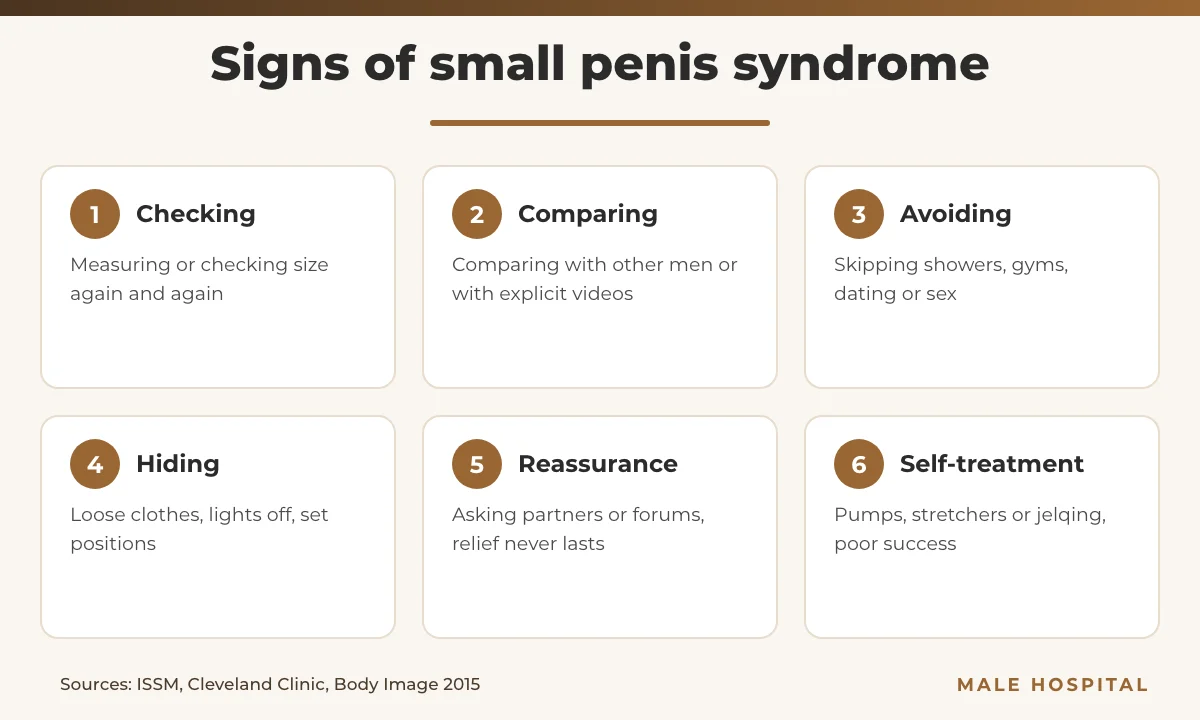
Body dysmorphic disorder in general shows up as frequent worry about one body area, comparing yourself with others, checking or avoiding mirrors, and hiding the perceived flaw. Intrusive appearance thoughts can take up hours each day. When the penis is the focus, as in small penis syndrome, these patterns take a recognizable shape:
- Repeated measuring or checking, often several times a day, and checking how the penis looks in clothing.
- Comparing with other men in changing rooms, gyms or pornography.
- Avoidance: skipping public showers, swimming, urinals or medical exams, and avoiding dating or sex.
- Camouflage and safety behaviors: loose clothing, particular positions or keeping the lights off during sex.
- Reassurance seeking from partners, forums or doctors, with relief that never lasts.
- Trying to change size with stretching, pumps, pills or “jelqing” exercises.
Sources: Cleveland Clinic — Body dysmorphic disorder; PubMed — Veale et al., Phenomenology of men with BDD concerning penis size (Body Image 2015)
The ISSM adds that men with PDD may have recurring unwanted thoughts or images about their penis and about how others will react, and may resort to self-treatment with vacuum or stretching devices or even repeated cosmetic surgery. Body dysmorphic disorder can also lead to depression, self-harm and suicidal thoughts, which is why ongoing distress should never be brushed aside.
Sources: ISSM — What is penile dysmorphic disorder?; NHS — Body dysmorphic disorder (BDD)
What causes small penis anxiety?
There is no single cause of small penis anxiety. The NHS says the exact cause of body dysmorphic disorder is not known, but it has been linked to a family history of BDD, obsessive-compulsive disorder or depression, and to past teasing, bullying or abuse. Cleveland Clinic notes that BDD often begins in the early teenage years.
Studies on men with penis-size concerns point in the same direction. The ISSM summarizes King’s College research linking PDD with childhood emotional or physical abuse, neglect and childhood teasing. In the Italian clinic series, 62.7% of men said the worry began in childhood, when they felt smaller than their friends, and 37.3% said it began in their teens after seeing erotic images. Early comparisons and explicit images can quietly set an unrealistic idea of what “normal” looks like.
Sources: NHS — Body dysmorphic disorder (BDD); Cleveland Clinic — Body dysmorphic disorder; ISSM — What is penile dysmorphic disorder?; PubMed — Mondaini et al. (Int J Impot Res 2002)
How size anxiety affects sex and relationships
Size worries rarely stay in the head. In a cohort of 90 men, those with PDD had lower erectile function, orgasmic function, intercourse satisfaction and overall satisfaction than men without concerns, while men with small penis anxiety mainly reported lower intercourse satisfaction. Sexual desire and how often the men had sex or masturbated did not differ between the groups. Men in both worried groups were more likely to have tried jelqing, vacuum pumps or stretching devices, with poor reported success.
Source: PubMed — Veale et al., Sexual functioning of men with BDD concerning penis size (Sex Med 2015)
The likely mechanism linking small penis anxiety to sexual problems is attention. A man who is monitoring his size during sex is not focused on arousal or his partner, a pattern that feeds sexual performance anxiety and can lead to anxiety-driven erection problems.
Sources: PubMed — Wylie & Eardley (BJU Int 2007); ISSM — What is penile dysmorphic disorder?
How size anxiety is treated: counseling, CBT and medication
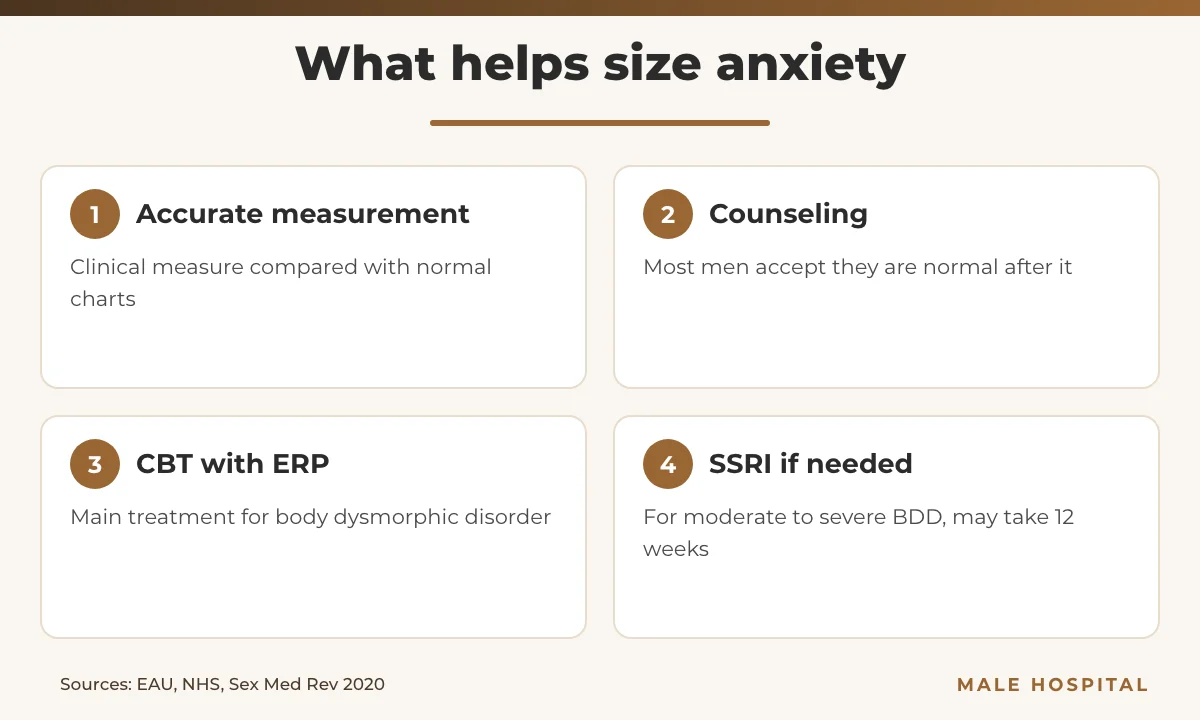
Experts agree that care for small penis syndrome should start with a full biopsychosocial assessment, followed by psychoeducation, counseling and psychological interventions, even if surgery is being considered. The EAU guideline recommends that men with a normal-sized penis be screened with validated questionnaires (a weak recommendation) and that anyone with suspected body dysmorphic disorder be referred for mental health counseling (a strong recommendation).
Sources: PubMed — Pastoor & Gregory (J Sex Med 2020); EAU Guidelines — Penile size abnormalities and dysmorphophobia
Measurement and structured counseling
For many men with small penis anxiety, simply being measured properly and shown where they sit on a normal chart is the turning point. A systematic review of interventions in normal men complaining of small size found that when counseling was provided, it was effective: most men came to understand that their penis was normal and did not want further treatment. A Tulane review likewise describes structured psychological counseling as the recommended initial standard of care.
Sources: PubMed — Marra et al., Interventions in normal men complaining of small penis size (Sex Med Rev 2020); PubMed — Soubra et al., Men who seek penile augmentation surgery: a review (Sex Med Rev 2022)
Cognitive behavioral therapy (CBT)
CBT is the main treatment for body dysmorphic disorder. It targets the unhelpful thoughts about appearance and the repeated behaviors that keep them going, usually with exposure and response prevention (ERP): gradually facing avoided situations, such as a public changing room, while resisting checking or reassurance seeking.
The evidence comes mostly from BDD in general. In a randomized controlled trial of 46 people with BDD, 12 weeks of CBT worked significantly better than anxiety management, with a large effect, and it helped even people with very strong (delusional) beliefs or depression. An international consensus on BDD treatment concludes that CBT has good evidence for efficacy and that online and telephone-assisted formats look promising.
It is important to be honest about the gap: the EAU guideline states that CBT for BDD could be applied to penis-size anxiety, but no clinical trials in this specific group have been reported yet. A CBT program for small penis syndrome usually adapts the BDD approach, for example by dropping measuring rituals, testing feared predictions about partners and reducing comparison with pornography.
Sources: Cleveland Clinic — Body dysmorphic disorder; PubMed — Veale et al., CBT versus anxiety management for BDD: an RCT (Psychother Psychosom 2014); PubMed — Castle et al., BDD treatment synthesis and consensus (Int Clin Psychopharmacol 2021); EAU Guidelines — Penile size abnormalities and dysmorphophobia
Medication
For moderate body dysmorphic disorder, the NHS offers CBT or an SSRI antidepressant, and for severe symptoms both together. Fluoxetine is the SSRI most commonly used, and it can take up to 12 weeks to work, so close monitoring is needed at the start. The international consensus notes that higher SSRI doses and longer treatment periods may be needed. In the UK, adults can self-refer to NHS Talking Therapies.
Sources: NHS — Body dysmorphic disorder (BDD); PubMed — Castle et al. (Int Clin Psychopharmacol 2021)
Why surgery is discouraged for small penis syndrome
Surgery treats anatomy, but in small penis anxiety the anatomy is normal and the problem is perception. The EAU guideline reports that penile lengthening or girth surgery seems to result in poor satisfaction in men with normal penis size, and it strongly advises against penile prosthesis implantation, penile disassembly or the sliding technique for men who only want more length. It also strongly advises against hyaluronic acid, soft tissue fillers or fat injection in men with penile dysmorphic disorder, and against silicone, paraffin or petroleum jelly in anyone.
Source: EAU Guidelines — Penile size abnormalities and dysmorphophobia
The wider evidence explains why. A systematic review of 17 studies covering 1,192 men found that study quality was poor, extenders added less than 2 cm of flaccid length, injectables increased girth but had a high complication rate, vacuum devices did not increase size, and surgical techniques had frequent complications and no external validation. The authors concluded that injectables and surgery should be a last option and are unethical outside clinical trials.
Body dysmorphic disorder adds another layer. Among 200 people with BDD, cosmetic surgical and minimally invasive procedures sometimes reduced worry about the treated area, but overall BDD severity improved after only 2.3% of treatments. Cleveland Clinic and the ISSM both advise against surgery as a treatment for body dysmorphic disorder, and the ISSM warns that it may worsen distress about penile image. Consensus guidance recommends that psychoeducation specifically address the dangers of cosmetic procedures.
Sources: PubMed — Marra et al. (Sex Med Rev 2020); PubMed — Crerand et al., Cosmetic procedures among persons with BDD (Ann Plast Surg 2010); Cleveland Clinic — Body dysmorphic disorder; ISSM — What is penile dysmorphic disorder?
Not every man interested in enlargement has a disorder, but the order matters: an honest measurement, BDD screening and counseling come first, and any procedure should only be discussed after thorough counseling about limited evidence and risks. Our pages on penis enlargement treatment and penis enlargement surgery describe what each option can and cannot realistically achieve.
Sources: EAU Guidelines — Penile size abnormalities and dysmorphophobia; PubMed — Soubra et al. (Sex Med Rev 2022)
Practical steps you can take now
These steps for small penis anxiety borrow from CBT principles; they do not replace therapy if your worry is severe:
- Get one accurate measurement from a clinician, then stop measuring at home. Repeated checking keeps the anxiety alive.
- Notice your comparisons. Explicit videos and locker-room glances are poor reference points; clinical charts based on thousands of men are better.
- Reduce reassurance seeking. Asking partners or forums again and again brings short relief and long-term doubt.
- Gradually face avoided situations, such as a gym shower, instead of building your life around avoiding them.
- Shift attention during sex to sensation and connection rather than self-monitoring.
- Avoid unproven products and devices. Pills, pumps and unregulated injections can cause harm without easing the worry.
Sources: NHS — Body dysmorphic disorder (BDD); PubMed — Mondaini et al. (Int J Impot Res 2002); PubMed — Marra et al. (Sex Med Rev 2020)
When to see a doctor
The NHS advises seeing a doctor if you think you may have body dysmorphic disorder, because symptoms probably will not go away without treatment and may get worse. Consider booking an appointment if:
- worry about your penis takes up a large part of your day, or you measure and check repeatedly;
- you avoid sex, dating, swimming, gyms or medical exams because of your size;
- you have erection or orgasm problems, or low mood or anxiety, linked to the worry;
- you are tempted by injections, implants or surgery, or have already had a procedure and still feel the same;
- your penis really does look very small, buried in fat or curved, so a physical cause can be checked.
Seek urgent help if you have thoughts of self-harm or suicide. Contact your local emergency number or a crisis line straight away; in the US you can call or text 988.
Sources: NHS — Body dysmorphic disorder (BDD); Cleveland Clinic — Body dysmorphic disorder
If you would like an accurate measurement and an unhurried, confidential conversation with our urologist-andrologist, you can reach us on WhatsApp. If your size is normal, we will tell you so honestly, and we can guide you toward counseling rather than an operation you do not need.
FAQs about small penis syndrome
Is small penis syndrome a real condition?
Yes. It is not a formal psychiatric diagnosis, but the European Association of Urology recognizes small penis anxiety as excessive worry about a normal-sized penis and notes these men may be at risk of body dysmorphic disorder. Specialists describe real psychological and social consequences, so the distress deserves proper assessment rather than dismissal.
Source: EAU Guidelines — Penile size abnormalities and dysmorphophobia
How do I know if I have penile dysmorphic disorder?
Penile dysmorphic disorder is likely when the preoccupation is intense, time-consuming and causes significant shame or impairment, with checking, comparing and avoidance. Only a clinician can diagnose it. Questionnaires such as the nine-item COPS-P were developed to help separate PDD from milder size anxiety and to measure progress after treatment.
Source: PubMed — Veale et al. (Arch Sex Behav 2015)
Does CBT work for penis size anxiety?
CBT is the best-supported psychological treatment for body dysmorphic disorder and beat anxiety management in a randomized trial. Guidelines suggest applying the same approach to small penis anxiety, but no trial has yet tested it specifically in this group, so results are inferred from wider BDD research and clinical experience rather than direct proof.
Sources: PubMed — Veale et al. (Psychother Psychosom 2014); EAU Guidelines
Will penis enlargement surgery cure small penis syndrome?
Usually not. Guidelines report poor satisfaction after lengthening or girth surgery in men of normal size, and in body dysmorphic disorder cosmetic procedures rarely improve the overall condition. Because the worry is driven by perception rather than anatomy, it often persists or shifts after surgery, while the complication risks remain real.
Sources: EAU Guidelines; PubMed — Crerand et al. (Ann Plast Surg 2010)
What penis size counts as normal?
There is no universal cut-off, but pooled measurements of thousands of men give an average erect length of about 13.1 cm (5.2 inches) and a flaccid length of about 9.2 cm. Medically, micropenis means a stretched length more than 2.5 standard deviations below the average for age, which is rare in adults.
Sources: PubMed — Veale et al. (BJU Int 2015); EAU Guidelines
Can small penis anxiety cause erectile dysfunction?
It can contribute. Men with penis-focused body dysmorphic disorder reported lower erectile and orgasmic function and less sexual satisfaction than men without concerns, even though their desire was similar. Self-monitoring during sex fuels performance anxiety; a doctor can still check for physical causes of erection problems.
Source: PubMed — Veale et al. (Sex Med 2015)
Do penis pumps, stretching or jelqing help?
Not for small penis anxiety, and mostly not for size. Worried men who tried jelqing, pumps or stretchers reported poor success. A systematic review found vacuum devices did not increase size and extenders added less than 2 cm of flaccid length.
Sources: PubMed — Veale et al. (Sex Med 2015); PubMed — Marra et al. (Sex Med Rev 2020)
Should I see a urologist or a psychologist first?
Either is a reasonable first step, and ideally both work together. A urologist can measure you accurately and exclude a physical problem; a mental health professional can assess for body dysmorphic disorder and provide CBT. The EAU strongly recommends referral for mental health counseling when body dysmorphic disorder is suspected.
Sources: EAU Guidelines; PubMed — Pastoor & Gregory (J Sex Med 2020)
Medically reviewed by Assoc. Prof. Dr. Zülfü Sertkaya, urologist and andrologist (FEBU), Istanbul. Last reviewed: November 2026.
This article is for general information and does not replace an individual consultation with a qualified doctor.
- EAU — Sexual and Reproductive Health Guidelines — Penile size abnormalities and dysmorphophobia
- ISSM — What is penile dysmorphic disorder?
- NHS — Body dysmorphic disorder (BDD)
- Cleveland Clinic — Body Dysmorphic Disorder (BDD)
- PubMed — BJU Int 2007 — Wylie & Eardley. Penile size and the 'small penis syndrome'
- PubMed — BJU Int 2015 — Veale et al. Am I normal? Nomograms for flaccid and erect penis length and circumference in up to 15,521 men
- PubMed — Int J Impot Res 2002 — Mondaini et al. Penile length is normal in most men seeking penile lengthening procedures
- PubMed — J Sex Med 2014 — Veale et al. Beliefs about penis size: validation of a scale for men ashamed about their penis size
- PubMed — Arch Sex Behav 2015 — Veale et al. Penile dysmorphic disorder: development of a screening scale
- PubMed — Body Image 2015 — Veale et al. Phenomenology of men with BDD concerning penis size
- PubMed — Sex Med 2015 — Veale et al. Sexual functioning and behavior of men with BDD concerning penis size
- PubMed — J Sex Med 2020 — Pastoor & Gregory. Penile size dissatisfaction
- PubMed — Sex Med Rev 2020 — Marra et al. Systematic review of surgical and nonsurgical interventions in normal men complaining of small penis size
- PubMed — Sex Med Rev 2022 — Soubra et al. Revelations on men who seek penile augmentation surgery: a review
- PubMed — Psychother Psychosom 2014 — Veale et al. Efficacy of CBT versus anxiety management for body dysmorphic disorder: a randomised controlled trial
- PubMed — Int Clin Psychopharmacol 2021 — Castle et al. Body dysmorphic disorder: a treatment synthesis and consensus
- PubMed — Ann Plast Surg 2010 — Crerand et al. Surgical and minimally invasive cosmetic procedures among persons with BDD