Buried penis is a condition in which a normal-sized penis is hidden, partly or completely, under the skin and fat of the pubic area, scrotum or thighs. In babies it is usually congenital and often improves with growth; in adults it is usually acquired, most often from obesity, scarring or lichen sclerosus, and it can make urinating, hygiene and sex difficult. Treatment ranges from weight loss and treating infection to reconstructive surgery that frees the penis, though surgery does not make the penis itself larger. If you are mainly interested in size, our penis enlargement treatment page covers lengthening and girth options separately.
Sources: Cleveland Clinic — Hidden penis: causes, symptoms and treatment; EAU Guidelines — Penile size abnormalities
- The penis itself is normal in size; it only looks small because surrounding tissue covers it. It is also called a hidden, concealed or trapped penis.
- In infants it is mostly congenital and often settles as the child grows; in adults the main risk factor is obesity, with lichen sclerosus, lymphedema, aggressive circumcision and previous surgery as other causes.
- Typical problems are urine dribbling, skin infections, painful or difficult erections, poor hygiene and low self-esteem.
- European urology guidelines strongly recommend weight loss and risk-factor control before surgery and advise that adult repair be done in high-volume centres.
- Surgery improves urinary and sexual function in most men, but complications such as wound infection and skin graft problems are common, so careful counseling matters.
What is a buried penis?
The European Association of Urology (EAU) defines a buried penis as a normal-sized penis with a functional and visible loss of length. The shaft is still there, with normal erectile tissue, but it sits below or inside the pubic fat pad, the scrotum or folds of skin. When a doctor presses the surrounding tissue down, the penis can usually be exposed.
Cleveland Clinic lists several other names for the same problem: buried penile syndrome, hidden penis and concealed penis. The tissues that hide it include lower belly fat, the fat pad above the penis (the mons pubis, sometimes called the escutcheon), upper-thigh fat, scrotal fat and skin that is attached at the wrong level.
Sources: EAU Guidelines — Penile size abnormalities; Cleveland Clinic — Hidden penis: causes, symptoms and treatment
Buried penis is not micropenis
This difference matters, because the treatments are completely different. A micropenis is a genuinely short penis, usually caused by hormone problems before birth. A concealed penis, by contrast, has a normal length and structure. Many men with an acquired buried penis also worry about size; checking the facts on average penis size often helps put the concern in perspective.
Source: Cleveland Clinic — Hidden penis: causes, symptoms and treatment
What causes a buried penis?
The cause depends strongly on age. In babies, the skin at the base of the penis attaches in an unusual way, so at rest the penis tucks inward. Theories include an inelastic layer of tissue under the skin (the dartos fascia), extra pubic fat and loose attachment of the skin to the deeper layers; one 2025 tissue study found thick, abnormal fascia and very little fat in the boys it examined.
Sources: Cleveland Clinic — Hidden penis: causes, symptoms and treatment; Front Pediatr — Fawzy & Hadidi, dartos fascia histology study (2025)
In adults, the EAU names obesity as the main risk factor and notes that the adult acquired form appears to be becoming more common as obesity rates rise. The proposed mechanism is a cycle: the trapped penis stays moist, bacteria and yeast grow, the skin becomes chronically inflamed, and the inflamed tissue scars and pulls the penis further inward.
Source: EAU Guidelines — Penile size abnormalities
Main causes in adults
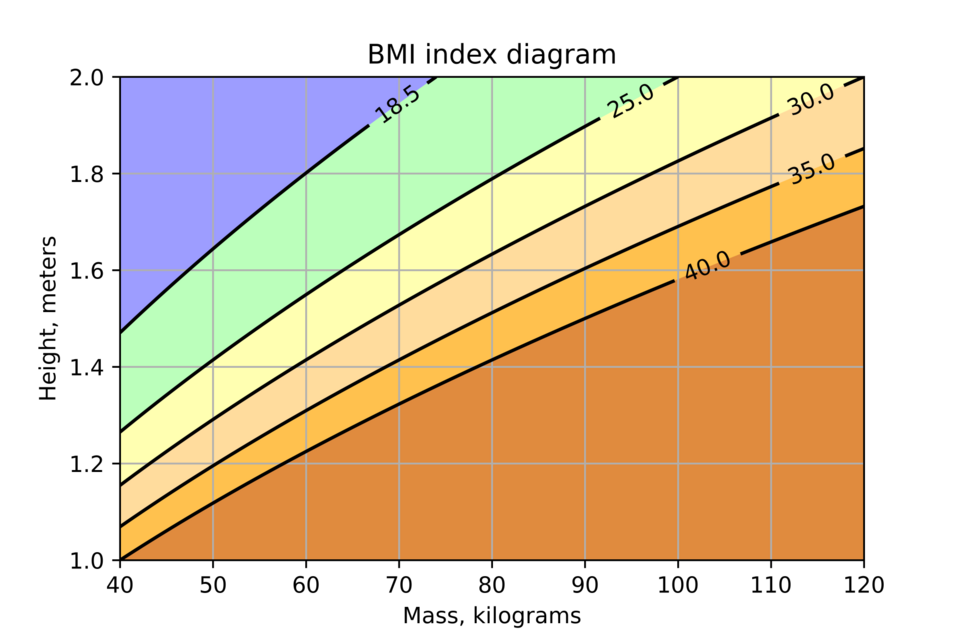
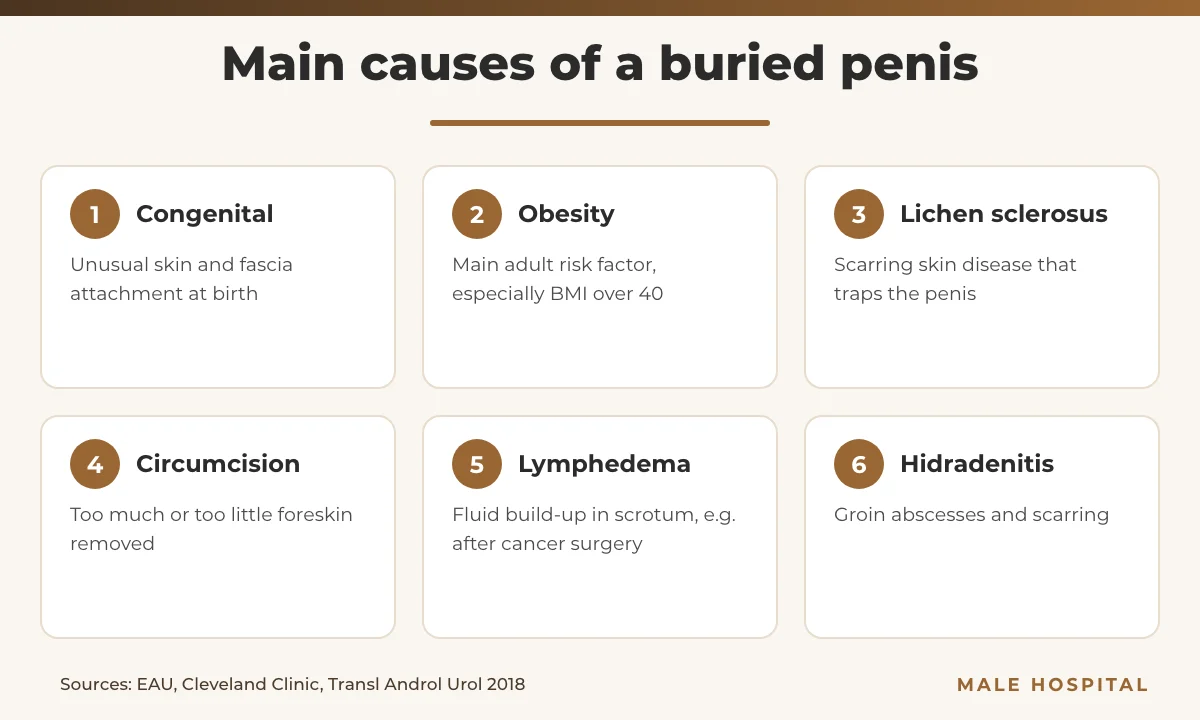
- Obesity: Cleveland Clinic links adult cases to a body mass index (BMI) above 30, and especially to class III obesity (BMI over 40), when abdominal and pubic fat can cover the shaft.
- Lichen sclerosus: a chronic skin condition that whitens, thins and scars genital skin and can tighten the foreskin. It is one of the EAU-listed risk factors. Read more in our guide to lichen sclerosus in men.
- Circumcision problems: removing too much or too little foreskin can let the penis retract into the surrounding fat.
- Genital lymphedema: fluid build-up in the scrotum, for example after lymph node surgery for prostate or penile cancer or melanoma, can engulf the penis.
- Hidradenitis suppurativa: an inflammatory disease of the sweat glands that causes abscesses and scarring in the groin.
- Previous surgery or trauma: including penile cancer treatment, Fournier’s gangrene, and complications of enlargement procedures such as injected silicone.
Sources: Cleveland Clinic — Hidden penis: causes, symptoms and treatment; EAU Guidelines — Penile size abnormalities; Transl Androl Urol — Ho & Gelman, evaluation and management review (2018)
Symptoms and complications
Some people have no symptoms other than the appearance of a penis that seems tucked in. Problems start when the penis cannot be exposed easily, or when inflammation and scar tissue trap it completely. A review of adult cases found that urinary complaints are the most common reason men seek help.
Sources: Cleveland Clinic — Hidden penis: causes, symptoms and treatment; Cureus — Cohen, a hidden problem in obese men (2021)
Common symptoms
- Urine spraying or dribbling onto the scrotum, thighs or clothes, and needing to sit down to urinate.
- Difficulty cleaning and drying the area, leading to rashes, odor, fungal and bacterial skin infections and urinary tract infections.
- Trouble getting or keeping an erection, pain during erections and difficulty with penetration.
- Low self-esteem, anxiety, depression and relationship stress.
Source: Cleveland Clinic — Hidden penis: causes, symptoms and treatment
The emotional burden is real. In one small series cited in a 2021 review, 64% of men had clinical depression and 91% had erectile dysfunction before repair. Urethral narrowing (stricture) is also common in this group: two series found strictures in 33% and 31% of patients, often related to lichen sclerosus.
Source: Transl Androl Urol — Staniorski & Rusilko, narrative review (2021)
Hidden cancer risk
Because the penis cannot be examined properly, skin changes can be missed. In a study of 150 men having repair, cited in the same review, 7% had invasive penile cancer and 35% had premalignant lesions in the removed tissue. Both a hidden penis and lichen sclerosus can predispose to penile squamous cell carcinoma, and diagnosis may be delayed when the penis is hidden. This is one reason the EAU strongly recommends a detailed genital examination in men with a BMI above 30, lichen sclerosus, a history of penile cancer, or urinary or sexual complaints.
Sources: Transl Androl Urol — Staniorski & Rusilko, narrative review (2021); Cureus — Cohen, a hidden problem in obese men (2021); EAU Guidelines — Penile size abnormalities
Buried penis in babies and children
The congenital form is most common in infants and toddlers. Cleveland Clinic cites one study that found it in about 4% of newborns in Japan. In most children it causes no health problems and needs no treatment; surgery is a last resort used only when the child develops problems such as difficulty urinating or repeated infections.
Source: Cleveland Clinic — Hidden penis: causes, symptoms and treatment
A buried appearance can also appear after newborn circumcision. In a Turkish study of 88 infants, a buried penis was still visible in all 14 children under one year, in 32.2% of children aged one to three, and in only 6.7% of children older than three. The authors concluded that this form usually resolves with growth and did not recommend surgery before age three.
Source: J Urol — Eroğlu et al., natural history after newborn circumcision (2009)
Circumcision itself needs care. Surgeons have long warned that circumcising a baby with an unrecognized congenital buried penis can make the problem worse, because removing foreskin leaves too little skin to cover the shaft. If the problem is noticed at birth, circumcision may be delayed and done later by a pediatric urologist.
Sources: J Am Coll Surg — Alter et al., a contraindication for circumcision (1994); Cleveland Clinic — Hidden penis: causes, symptoms and treatment
| Feature | Congenital (children) | Acquired (adults) |
|---|---|---|
| Main cause | Unusual skin and fascia attachment at the base of the penis | Obesity, lichen sclerosus, scarring, lymphedema |
| Natural course | Often improves with growth | Tends to persist; scarring can worsen it |
| First step | Observation; delay circumcision if noticed at birth | Treat infection, weight loss, manage skin disease |
| Surgery | Only when problems develop; high success rate | Often needed for lasting relief; complex in severe cases |
| Main surgical risks | Generally low; recovery over a few weeks | Wound infection, lymphedema, skin graft problems |
Sources: Cleveland Clinic — Hidden penis: causes, symptoms and treatment; EAU Guidelines — Penile size abnormalities; BJU Int — Falcone et al., systematic review of surgical options (2023)
How doctors diagnose a buried penis
In most cases a doctor diagnoses the condition from the history and a physical examination; no special test is required to confirm it. The examination is done both lying down and standing, and the doctor gently compresses the surrounding fat to show the penis and assess how much is hidden.
Sources: Cleveland Clinic — Hidden penis: causes, symptoms and treatment; Cureus — Cohen, a hidden problem in obese men (2021)
A specialist will also ask how long the penis has been buried, about weight change, urinary and sexual symptoms, previous operations such as circumcision or cancer surgery, and conditions such as diabetes, high blood pressure, lung disease and smoking, which affect surgical risk. Your own goals, such as standing to urinate or having intercourse, shape the plan.
The skin is checked for phimotic bands, lichen sclerosus and hidradenitis. If the urinary opening cannot be seen, or a stricture is suspected, tests such as urethral calibration, cystoscopy or a retrograde urethrogram may be needed; a CT scan can help assess a very large scrotal swelling.
Source: Transl Androl Urol — Ho & Gelman, evaluation and management review (2018)
Non-surgical treatment and weight loss
Treatment depends on the cause. Cleveland Clinic describes first-line, non-surgical steps as antibiotics for genital infections, weight loss with nutritional counseling, and psychological support for depression, sexual problems and low self-esteem. In some people with obesity, weight loss alone may resolve the problem, and it also lowers the risk of surgical complications.
Source: Cleveland Clinic — Hidden penis: causes, symptoms and treatment
The EAU gives a strong recommendation to start lifestyle changes and risk-factor reduction, especially weight loss, before surgery. Surgical data support this: in one cohort, a BMI above 40 was associated with a much higher risk of overall complications, and smoking with a higher risk of serious complications.
Sources: EAU Guidelines — Penile size abnormalities; Transl Androl Urol — Staniorski & Rusilko, narrative review (2021)
Limits of weight loss
Weight loss is helpful but is not always enough. A urology review notes that losing weight can improve symptoms and make repair easier, yet the penis may stay buried when the suprapubic fat pad persists or scar tissue has formed. Lifestyle programs also tend to produce modest weight loss that is often regained, which is why many adults eventually need surgery.
Sources: Transl Androl Urol — Ho & Gelman, evaluation and management review (2018); Transl Androl Urol — Staniorski & Rusilko, narrative review (2021)
Treating lichen sclerosus
When lichen sclerosus is part of the picture, a strong prescription steroid ointment is the usual first treatment, often for a few months. In severe cases a small operation such as circumcision may be needed. Lichen sclerosus increases the risk of penile cancer; the risk is low, but regular self-checks are advised.
Sources: NHS — Lichen sclerosus; Transl Androl Urol — Ho & Gelman, evaluation and management review (2018)
Buried penis surgery in adults
When symptoms persist despite conservative care, surgery is the main route to lasting relief. One US surgical series argued that conservative treatment is likely to fail in established adult cases and that surgery should be first-line. The EAU is more cautious, with a weak recommendation to consider surgery after thorough counseling.
Sources: BJU Int — Jun et al., contemporary management (2018); EAU Guidelines — Penile size abnormalities
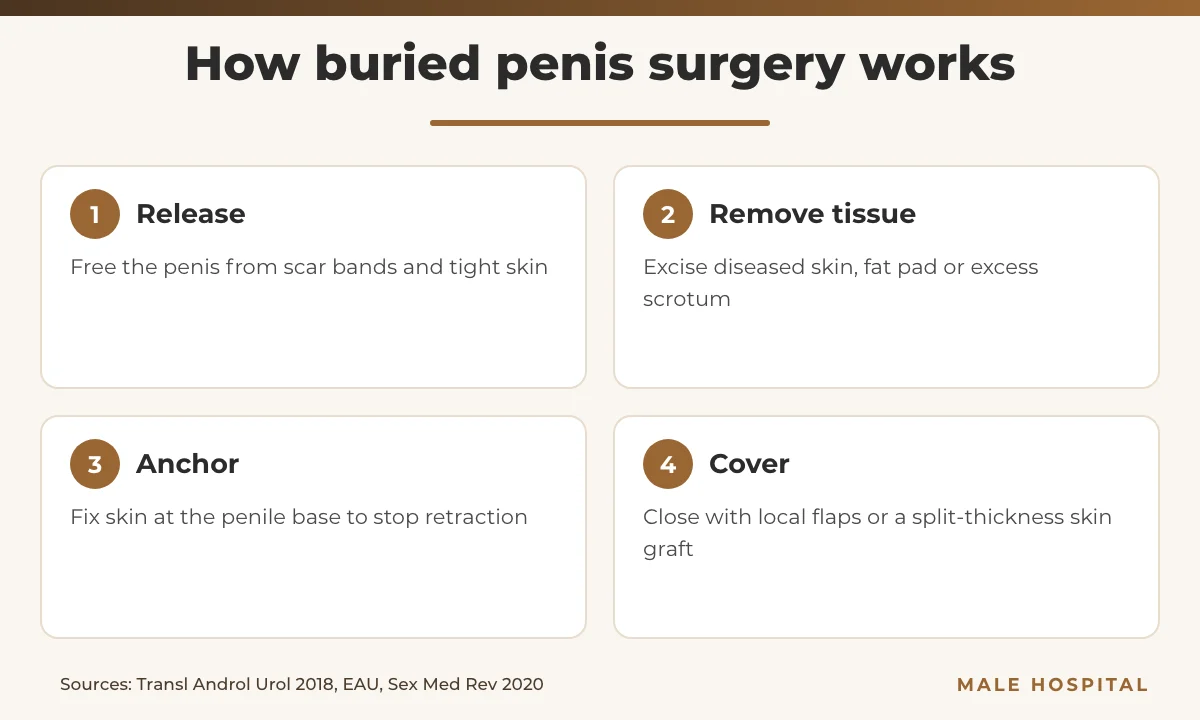
Every repair follows the same principles: free (unbury) the penis, remove diseased or excess tissue, re-create the angle where the penis meets the pubic area by anchoring the skin to deeper tissue, and cover any skin defect with local flaps or skin grafts. Recent techniques rely on skin grafting to cover the shaft, combined with fat removal or scrotal reshaping to improve exposure, and often involve plastic or general surgeons alongside the urologist.
Sources: Transl Androl Urol — Ho & Gelman, evaluation and management review (2018); Sex Med Rev — Smith-Harrison et al., review of surgical management (2020)
Procedures that may be combined
- Release of scar bands: cutting a tight phimotic ring or scar tissue that traps the penis.
- Penile skin reconstruction: removing diseased skin and covering the shaft with a split-thickness skin graft, usually taken from the thigh.
- Anchoring sutures: fixing the skin at the base of the penis so it cannot retract again.
- Escutcheonectomy: removal of the fat pad above the pubic area; suction lipectomy (liposuction) is another option.
- Panniculectomy or abdominoplasty: removing a hanging apron of abdominal skin and fat.
- Scrotoplasty: removing excess or lymphedematous scrotal tissue.
- Circumcision revision: when a previous circumcision caused the retraction.
Sources: Cleveland Clinic — Hidden penis: causes, symptoms and treatment; BJU Int — Jun et al., contemporary management (2018); EAU Guidelines — Penile size abnormalities
Surgeons grade the operation by complexity. One five-stage system ranges from Stage 1, involving only a phimotic band, up to Stage 5, which requires panniculectomy. Low-complexity repairs focus on the penis and scrotum; high-complexity repairs add escutcheonectomy and abdominal wall surgery. If the main reason for a consultation is length rather than function, note that this repair can reveal hidden shaft, but Cleveland Clinic is clear that it does not make the penis larger or longer.
Sources: BJU Int — Jun et al., contemporary management (2018); EAU Guidelines — Penile size abnormalities; Cleveland Clinic — Hidden penis: causes, symptoms and treatment
Results, risks and recovery
The results for function and quality of life are generally good. In a 2024 Italian study of 46 men with a median follow-up of 46 months, 90.3% were satisfied, 32.6% had a complication, 93.5% reported a positive impact on quality of life, urinary and sexual scores improved significantly, and median stretched penile length increased by 2 cm because hidden shaft was uncovered. A 2021 review reported that 80% to 91% of men could urinate standing with a good stream after repair.
Sources: Life (Basel) — Falcone et al., surgical reconstruction outcomes (2024); Transl Androl Urol — Staniorski & Rusilko, narrative review (2021)
Complications, however, are frequent and men should know this before surgery. A systematic review by EAU guideline authors pooled 21 studies with 570 patients. Complication rates varied widely between studies, from 0% to 80.8%, and the most serious grades occurred in 3.1% to 3.7% of cases. Wound infection was reported in 4.7% to 33% and genital lymphedema in 7.1% to 60%. Skin grafts contracted in 2.4% to 14.3% and were partly or totally lost in 1.5% to 21%. Recurrence ranged from 5.2% to 13%.
Source: BJU Int — Falcone et al., systematic review of surgical options (2023)
Most complications are minor: in a US series of 73 men, 85% had no complication or only a grade I–II one, and men with less extensive disease had far fewer problems. The EAU therefore strongly recommends that adult repair be done in high-volume centres.
Sources: BJU Int — Jun et al., contemporary management (2018); EAU Guidelines — Penile size abnormalities
Recovery and keeping results
Recovery time depends on how extensive the operation is: children usually recover within a few weeks, while complex adult repairs with grafts or abdominal surgery take longer and may be done in stages. Adults with the acquired form need to keep a healthy weight afterwards, because regaining weight can bury the penis again.
Sources: Cleveland Clinic — Hidden penis: causes, symptoms and treatment; Transl Androl Urol — Ho & Gelman, evaluation and management review (2018)
When to see a doctor
See a urologist if the condition stops you urinating comfortably, makes it hard to keep the area clean and dry, causes repeated urinary or skin infections, or affects erections and sex. Get prompt medical attention for these warning signs:
- You cannot pass urine, or the stream is very weak or painful.
- Redness, swelling, pus, fever or a foul smell around the penis or groin.
- A lump, ulcer, bleeding or skin thickening on the penis that does not heal.
- Itchy, white, shiny or scarred patches on the foreskin or tip, which may suggest lichen sclerosus.
- Feeling very low or anxious about the condition.
Sources: Cleveland Clinic — Hidden penis: causes, symptoms and treatment; NHS — Lichen sclerosus; Cureus — Cohen, a hidden problem in obese men (2021)
Parents should talk to a pediatrician or pediatric urologist if a baby’s penis looks buried before circumcision, or if a child has urine spraying, difficulty urinating or repeated infections. Circumcision decisions are covered in more detail in our adult circumcision guide.
Sources: Cleveland Clinic — Hidden penis: causes, symptoms and treatment; J Am Coll Surg — Alter et al., a contraindication for circumcision (1994)
If you are living with a buried penis, you can get a confidential assessment with our urologist-andrologist, Assoc. Prof. Dr. Zülfü Sertkaya, by sending a message on WhatsApp. The cost and the right treatment depend on your examination, so we will explain the options honestly after reviewing your situation.
FAQs about buried penis
Is a buried penis the same as a small penis?
No. A buried penis has a normal length and structure but is hidden by fat, skin or scar tissue around it. A micropenis is genuinely short for age, usually because of hormone problems before birth. Pressing the surrounding tissue down usually exposes a concealed penis, which helps a doctor tell the two apart during a simple physical examination.
Sources: Cleveland Clinic — Hidden penis: causes, symptoms and treatment; EAU Guidelines — Penile size abnormalities
Can a buried penis go away on its own?
In babies and toddlers it often improves as the child grows, and most children need no treatment. In one study of infants after newborn circumcision, it persisted in only 6.7% of children older than three. In adults, weight loss may help, but scarring or a persistent fat pad often means the penis stays buried without surgery.
Sources: Cleveland Clinic — Hidden penis: causes, symptoms and treatment; J Urol — Eroğlu et al., natural history after newborn circumcision (2009); Transl Androl Urol — Ho & Gelman, evaluation and management review (2018)
Can losing weight fix a buried penis?
Sometimes. Cleveland Clinic notes that weight loss alone may cure an obesity-related case, and the EAU strongly recommends weight loss before surgery to reduce complications. However, once scar tissue has formed or the suprapubic fat pad persists, weight loss may improve symptoms without fully exposing the penis, and surgery may still be needed.
Sources: Cleveland Clinic — Hidden penis: causes, symptoms and treatment; EAU Guidelines — Penile size abnormalities; Transl Androl Urol — Ho & Gelman, evaluation and management review (2018)
Does buried penis surgery make the penis bigger?
Surgery does not enlarge the penis itself; it uncovers length that was already there. Because hidden shaft becomes visible, the measured stretched length can increase, by a median of 2 cm in one 2024 study. Men whose main goal is extra size should discuss realistic expectations and separate enlargement options with a specialist.
Sources: Cleveland Clinic — Hidden penis: causes, symptoms and treatment; Life (Basel) — Falcone et al., surgical reconstruction outcomes (2024)
What are the risks of buried penis surgery?
The main risks are wound infection, genital swelling (lymphedema), skin graft shrinkage or loss, and recurrence. A systematic review of 570 patients found complication rates varying from 0% to 80.8% between studies, mostly minor. Serious complications are less common, and outcomes are better in experienced, high-volume centres, as European guidelines recommend.
Sources: BJU Int — Falcone et al., systematic review of surgical options (2023); EAU Guidelines — Penile size abnormalities
Can a buried penis cause erectile dysfunction?
It is commonly associated with erection problems, painful erections and difficulty with penetration. In one small series, 91% of men had erectile dysfunction before repair, and the figure fell after surgery. Studies report significant improvement in sexual function scores after reconstruction, though underlying conditions such as diabetes and vascular disease can still affect erections.
Sources: Cleveland Clinic — Hidden penis: causes, symptoms and treatment; Transl Androl Urol — Staniorski & Rusilko, narrative review (2021); Life (Basel) — Falcone et al., surgical reconstruction outcomes (2024)
Should a baby with a buried penis be circumcised?
Circumcision is usually delayed if the condition is noticed at birth. Removing foreskin in a baby with an unrecognized congenital form can worsen the problem because too little skin is left to cover the shaft. A pediatric urologist can decide whether and when circumcision or corrective surgery is appropriate.
Sources: J Am Coll Surg — Alter et al., a contraindication for circumcision (1994); Cleveland Clinic — Hidden penis: causes, symptoms and treatment
Is a buried penis linked to cancer?
A hidden penis cannot be examined easily, so skin disease can go unnoticed. In one series of 150 men having repair, 7% had invasive penile cancer and 35% had premalignant lesions. Lichen sclerosus, which often accompanies it, also raises penile cancer risk, so any non-healing lump or sore needs prompt review.
Sources: Transl Androl Urol — Staniorski & Rusilko, narrative review (2021); NHS — Lichen sclerosus
Medically reviewed by Assoc. Prof. Dr. Zülfü Sertkaya, urologist and andrologist (FEBU), Istanbul. Last reviewed: November 2026.
This article is for general information and does not replace an individual consultation with a qualified doctor.
- Cleveland Clinic — Buried penis (hidden penis)
- EAU Guidelines — Penile size abnormalities: adult acquired buried penis
- PMC (Front Pediatr) — Fawzy & Hadidi, Buried penis; what buried the penis? (2025)
- PMC (Transl Androl Urol) — Ho & Gelman, Evaluation and management of adult acquired buried penis (2018)
- PubMed (Cureus) — Cohen, Adult acquired buried penis: a hidden problem in obese men (2021)
- PMC (Transl Androl Urol) — Staniorski & Rusilko, The concealed morbidity of buried penis (2021)
- PubMed (J Urol) — Eroğlu et al., Buried penis after newborn circumcision (2009)
- PubMed (J Am Coll Surg) — Alter et al., Buried penis as a contraindication for circumcision (1994)
- PubMed (BJU Int) — Falcone et al., Benefits and harms of surgery for adult-acquired buried penis: a systematic review (2023)
- NHS — Lichen sclerosus
- PubMed (BJU Int) — Jun et al., Contemporary management of adult-acquired buried penis (2018)
- PubMed (Sex Med Rev) — Smith-Harrison et al., Acquired buried penis in adults: a review of surgical management (2020)
- PMC (Life, Basel) — Falcone et al., Outcomes of adult acquired buried penis surgical reconstruction (2024)