
A penis pump is a plastic cylinder that uses suction to pull blood into the penis. Used as a medical vacuum erection device, it is an established, drug-free treatment for erectile dysfunction (ED). As a tool for making the penis permanently bigger, it does not work: the extra fullness lasts only as long as the blood stays trapped, and a 6-month study found no significant gain in length. Aggressive pumping with cheap devices can injure the penis.
Source: EAU Guidelines — Penile size abnormalities and dysmorphophobia; BJU Int 2006 (PubMed) — Aghamir et al. A vacuum device for penile elongation: fact or fiction?
- A penis pump makes the penis look fuller for a short time; the European Association of Urology (EAU) calls vacuum devices ineffective for lengthening.
- In a 6-month study, average stretched length moved from 7.6 cm to 7.9 cm, a change that was not statistically significant.
- The same device is a recognized ED treatment, producing erections good enough for sex in up to 90% of users.
- Pumps can help protect length in specific medical situations, such as after prostate surgery or before a penile implant, under a urologist’s guidance.
- Novelty “enlargement” pumps fall outside US FDA rules for medical vacuum devices and may lack a pressure-release valve.
- What is a penis pump?
- Does a penis pump increase size? What studies show
- Why pumping looks like it works, and why it fades
- The penis pump as a medical treatment for ED
- When a pump can help protect length
- Penis pump risks when used for size
- Medical vacuum devices vs “enlargement” pumps
- Better options if you are worried about size
- When to see a doctor
- FAQs about the penis pump
What is a penis pump?
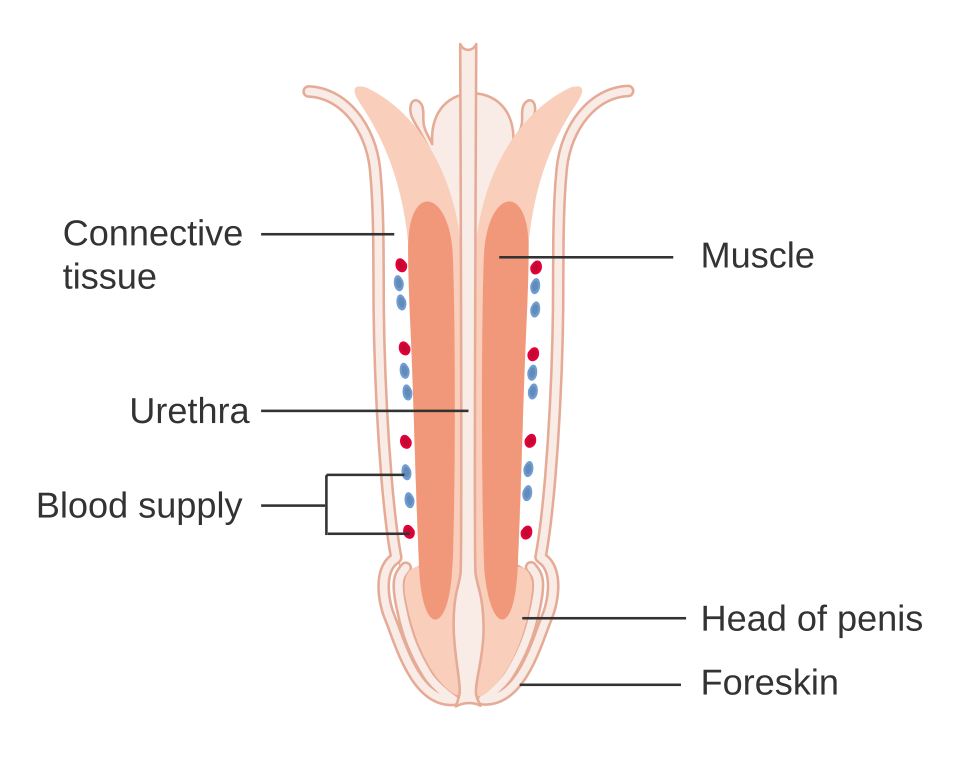
Every penis pump works on the same principle. You place the flaccid penis in a clear cylinder sealed against the body, and a hand or battery pump removes the air. The negative pressure draws blood into the spongy erectile tissue, and the penis swells and stiffens. In the medical version, an elastic ring slid onto the base keeps the blood in for intercourse.
What differs is the purpose the device is sold for. One group of products is marketed to treat erection problems and, in the United States, regulated by the Food and Drug Administration (FDA) as Class II medical devices with built-in safety features. A second group is marketed with promises of a bigger penis, often next to pills, creams and stretching routines. The International Society for Sexual Medicine (ISSM) lists vacuum pumps among the products that “purport” to enlarge the penis and states that there is no safe, reliable way for a man to do so.
Source: FDA — External Penile Rigidity Devices: Class II Special Controls Guidance; ISSM — Can a man make his penis larger?
Does a penis pump increase size? What studies show
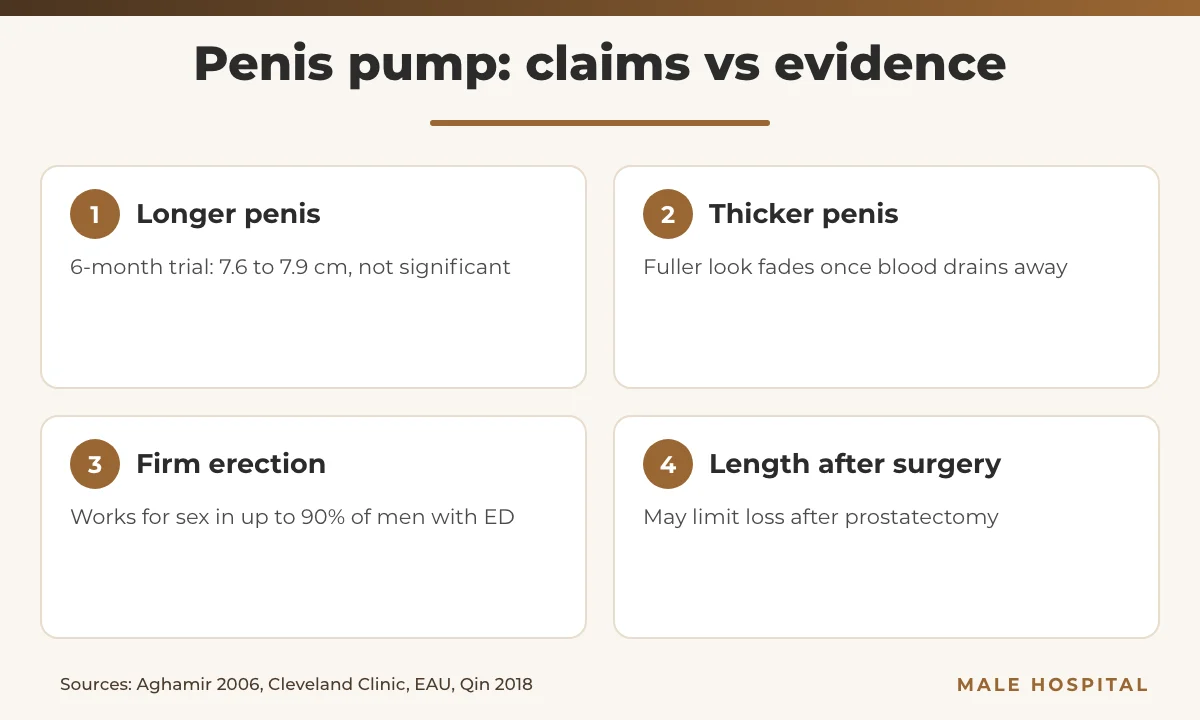
The best-known penis pump trial was published in the BJU International in 2006. Researchers in Tehran gave 37 sexually active men with a stretched penile length under 10 cm a vacuum device to use three times a week, 20 minutes each time, for six months. Average stretched length went from 7.6 cm to 7.9 cm, which was not a statistically significant difference. The authors estimated the efficacy at about 10%, yet 30% of the men were satisfied, and they concluded that vacuum treatment does not lengthen the penis but gives some men psychological satisfaction.
Source: BJU Int 2006 (PubMed) — Aghamir et al. A vacuum device for penile elongation: fact or fiction?
Expert reviews reached the same conclusion. A 2011 review of non-invasive lengthening methods in the same journal found that vacuum devices, penoscrotal rings and “physical exercises” are mostly not supported by scientific evidence, and that penile traction devices (extenders) were the only evidence-based non-surgical technique. The EAU guideline panel summarizes the data plainly: vacuum erection devices did not significantly increase flaccid or stretched length and are an ineffective treatment for penile lengthening.
Source: BJU Int 2011 (PubMed) — Oderda and Gontero. Non-invasive methods of penile lengthening: fact or fiction?; EAU Guidelines — Penile size abnormalities and dysmorphophobia
There is also no good evidence that a penis pump adds girth. Girth claims usually rely on before-and-after photos taken right after a session, when the shaft is still engorged with blood and fluid. Cleveland Clinic urologist Dr. Raevti Bole puts it simply: a vacuum pump does not produce lasting increases in size, and if you already have an erection, pumping will not make it significantly bigger.
Source: Cleveland Clinic — Male Enhancement: Can You Make Your Penis Bigger?
Why pumping looks like it works, and why it fades
The effect men notice after using a penis pump is real, but it is temporary. Suction stretches the blood spaces in the erectile tissue and pulls blood and some tissue fluid into the shaft and skin. For a while the penis looks thicker and hangs lower. Once the vacuum is released and circulation returns to normal, that blood and fluid drain away and the penis goes back to its usual size. Cleveland Clinic describes the fuller look as “just for the moment.”
Penis pump sessions are short, and nothing in the trial data suggests the effect builds up over time. Traction is different: it applies a gentle, steady pull for hours a day over months, and it is the only non-surgical method with studies showing small length gains. This also explains the gap in the 2006 trial between measured results and satisfaction: men saw a fuller penis after each session, while their tape-measure length barely changed.
Source: Cleveland Clinic — Male Enhancement: Can You Make Your Penis Bigger?; BJU Int 2011 (PubMed) — Oderda and Gontero
The penis pump as a medical treatment for ED
Where the penis pump earns its place is erectile dysfunction. The EAU reports that vacuum devices produce erections satisfactory for intercourse in up to 90% of men, regardless of the cause of ED, although satisfaction ranges from 27% to 94% and long-term use falls to 50% to 64% after two years. The panel gives a weak recommendation to use them in well-informed men who want non-invasive, drug-free treatment. The NHS adds that vacuum pumps work for most men and can be used when medicine is not suitable or has not worked.
The essential penis pump safety rules are short: remove the constriction ring within 30 minutes, never sleep with it on, and avoid a pump if you have a bleeding disorder or take blood thinners. Step-by-step use, side effects and device choice are covered in detail in our vacuum erection device guide, and all ED options, from tablets to implants, are on our erectile dysfunction treatment page.
Source: EAU Guidelines — Management of erectile dysfunction; NHS — Erectile dysfunction: treatment
When a pump can help protect length
A penis pump cannot make a healthy penis bigger, but in some medical situations it can help limit length loss or recover length that was lost. These uses are supervised by a urologist and have specific protocols, so they are not a shortcut to enlargement.
After prostate cancer surgery
After radical prostatectomy, the penis often shortens while erections are absent. A 2018 meta-analysis of six randomized trials (273 men) found that starting vacuum therapy early improved erectile function scores compared with no treatment. In two trials that combined a vacuum device with PDE5 inhibitor tablets, penile length was on average 1.26 cm longer than with tablets alone. The authors rated the studies as low quality, mainly because none were blinded or placebo-controlled.
Before a penile implant
Many men worry about length before a penile prosthesis. In a randomized trial from Qatar, 51 men scheduled for implant surgery either used a vacuum device for 10 to 15 minutes a day for at least 30 days or did nothing. On the day of surgery, the vacuum group had gained on average 0.8 cm more stretched length than controls, and surgeons, who did not know which group a patient was in, found the erectile tissue easier to dilate. Long-term results were not reported. The EAU notes separately that an implant itself does not increase penile length.
Source: Andrology 2017 (PubMed) — Canguven et al. Daily vacuum erection device use before penile prosthesis implantation: randomized controlled trial; EAU Guidelines — Penile size abnormalities and dysmorphophobia
What a 2022 review concluded
A 2022 review in Nature Reviews Urology compared traction and vacuum devices across conditions. It found that vacuum devices are favored for ED and for penile length loss after radical prostatectomy, that traction devices are favored for curvature in Peyronie’s disease, and that research on either device for penile dysmorphophobia (distress about a normal-sized penis) is very limited.
Penis pump risks when used for size
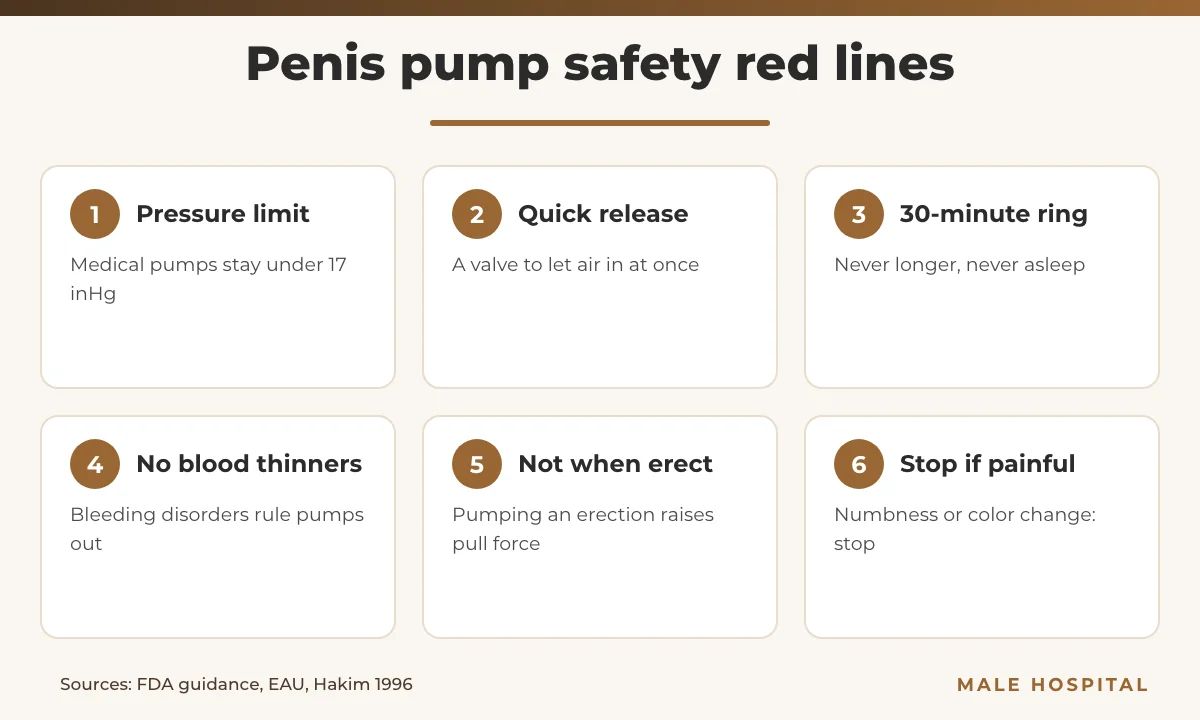
Men who use a penis pump for size tend to use more suction, longer sessions and more frequent use than ED treatment requires, often with devices that have no pressure limit. That raises the risk of injury. Dr. Bole of Cleveland Clinic cautions against being “over-aggressive” with a vacuum pump because of swelling, discomfort and even injury. The FDA lists tissue injury, trauma or infection, and worsening of existing conditions such as Peyronie’s disease, priapism (a prolonged erection) and urethral strictures, among the health risks of these devices.
Source: Cleveland Clinic — Male Enhancement: Can You Make Your Penis Bigger?; FDA — External Penile Rigidity Devices guidance
A case that shows the danger
A 1996 report in the Journal of Urology described a 66-year-old man with normal erections who used a catalogue vacuum device with no pressure-release valve, applying it to an erection he already had. The overinflation was followed by a curved penis, weaker and shorter-lasting erections, a Peyronie’s plaque, and a venous leak at the base of the erectile tissue. The authors estimated the pulling force at about 29 pounds. He needed corrective surgery and penile injections to have sex. This is a single case, but it shows why a pressure limiter on any penis pump matters.
Source: J Urol 1996 (PubMed) — Hakim et al. Vacuum erection associated impotence and Peyronie’s disease
Common, milder problems
- Bruising and tiny red spots (petechiae): among the most common side effects listed by the EAU for vacuum devices.
- Numbness and pain: in the 2006 size trial, one man developed a blood collection (hematoma) and one had glans numbness, both of which settled on their own.
- Swelling: fluid can collect in the skin after long or strong sessions.
- Ring injuries: the EAU links skin necrosis (tissue death) to leaving a constriction ring on beyond 30 minutes.
Source: EAU Guidelines — Management of erectile dysfunction; BJU Int 2006 (PubMed) — Aghamir et al.
Who should not use a pump at all
FDA labeling guidance tells manufacturers to warn against use by men with sickle cell disease, a history of prolonged erections, or heavy use of aspirin or other blood thinners. It also advises against use if you have reduced pain sensation in the penis or weak hands, because you may not notice an injury or be able to remove the device quickly. The EAU lists bleeding disorders and anticoagulant therapy as contraindications.
Source: FDA — External Penile Rigidity Devices guidance; EAU Guidelines — Management of erectile dysfunction
Medical vacuum devices vs “enlargement” pumps
The FDA’s special controls for external penile rigidity devices cover pumps and rings intended to create or maintain an erection for intercourse. The same guidance explicitly excludes products intended for penile enhancement, such as penis enlargement, and devices for curvature. Medical vacuum pumps typically draw less than 17 inches of mercury, and the guidance calls for a way to release the vacuum quickly. An enlargement penis pump bought online has no such assurance.
| Feature | Medical vacuum erection device | “Enlargement” or novelty pump |
|---|---|---|
| Intended use | Erection for intercourse in ED; rehabilitation | Claimed size gain |
| US regulation | FDA Class II device with special controls | Outside the scope of that FDA guidance |
| Pressure limit | Verified maximum, typically under 17 inHg | Not assured |
| Quick release | Required manual release | Not assured |
| Evidence | Erections for sex in up to 90% (EAU) | No significant length gain at 6 months |
| Best used | After a urologist’s assessment and demonstration | Not recommended for enlargement |
Sources: FDA — External Penile Rigidity Devices guidance; EAU Guidelines — Management of erectile dysfunction; BJU Int 2006 (PubMed) — Aghamir et al.
If your doctor recommends a penis pump for ED, ask for a model made for that purpose, with a vacuum limiter, a quick-release valve and rings sized for you, and ask to be shown how to use it.
Better options if you are worried about size
Check whether your size is actually small
Most men who buy a penis pump for size have a normal penis. The ISSM gives an average erect length of 4.7 to 6.3 inches and notes that many men unhappy with their size fall within the normal range. A true micropenis is defined by the EAU as a stretched length 2.5 standard deviations or more below the average for age. Our guide to average penis size explains how to measure correctly.
Source: ISSM — Can a man make his penis larger?; EAU Guidelines — Penile size abnormalities and dysmorphophobia
Take the worry itself seriously
The EAU distinguishes small penis anxiety, which is excessive worry about a normal-sized penis, from penile dysmorphic disorder, a form of body dysmorphic disorder. It strongly recommends referring men with suspected body dysmorphic disorder for mental health counseling and considering psychotherapy when psychological problems are found. Talking therapy often helps more than any device.
Traction is the device with evidence
If you still want a non-surgical option for length, penile traction has better data than suction. Studies summarized by the EAU report average stretched-length gains of roughly 1.2 to 1.7 cm after months of daily wear, and the panel gives traction a weak recommendation, while noting that it does not increase girth. Our penis extender guide covers how traction works and how long it takes. Surgical and filler options, with their risks, are explained on our penis enlargement page; the EAU strongly advises extensive counseling before any girth procedure.
Source: EAU Guidelines — Penile size abnormalities and dysmorphophobia
When to see a doctor
See a urologist before buying a penis pump if your goal is better erections, so the cause of ED can be checked; the FDA warns that using a device should not delay diagnosis of conditions such as diabetes. Seek urgent care if, after using a pump or ring, you notice:
- a ring that is stuck or a penis that stays cold, pale, dark blue or numb;
- severe pain, a large swelling or heavy bruising;
- blisters, skin breakdown or bleeding;
- an erection that does not go down;
- a new bend, a lump in the shaft, or erections that are suddenly weaker;
- blood in the urine or difficulty passing urine.
Source: FDA — External Penile Rigidity Devices guidance; J Urol 1996 (PubMed) — Hakim et al.
If you are unsure whether a penis pump, tablets, traction or a procedure fits your situation, you can arrange a confidential consultation with our urologist-andrologist on WhatsApp. He will check what is really going on before suggesting any device.
FAQs about the penis pump
Does a penis pump permanently increase size?
No. A penis pump makes the penis look fuller by drawing blood and fluid into it, but this drains away after the session. In a 6-month trial of 37 men using a vacuum device three times a week, stretched length rose from 7.6 cm to just 7.9 cm, a non-significant change. The EAU describes vacuum devices as ineffective for lengthening.
Source: BJU Int 2006 (PubMed) — Aghamir et al.
How long do penis pump results last?
Only as long as the blood stays in the penis. With a constriction ring, an erection lasts until the ring comes off, which must be within 30 minutes. Without a ring, the extra fullness fades as normal circulation returns. Cleveland Clinic says the fuller look is only for the moment and that pumps do not produce lasting size increases.
Source: Cleveland Clinic — Male Enhancement: Can You Make Your Penis Bigger?
Can a penis pump damage the penis?
Yes, especially with strong suction or devices that lack a pressure limit. Bruising, petechiae, numbness and pain are common. The FDA lists tissue injury and worsening of Peyronie’s disease and priapism among device risks, and a published case linked a valveless catalogue pump to curvature and long-term erection problems.
Source: FDA — External Penile Rigidity Devices guidance; J Urol 1996 (PubMed) — Hakim et al.
Is a penis pump good for erectile dysfunction?
Yes, a penis pump is an accepted treatment. The EAU reports erections satisfactory for intercourse in up to 90% of men whatever the cause of ED, and it recommends vacuum devices for well-informed men who want a drug-free option. Satisfaction varies, and many men stop within two years, often because of bulk and preparation time.
Source: EAU Guidelines — Management of erectile dysfunction
Is a penis pump or an extender better for length?
An extender. Traction devices worn for hours a day over months have shown average stretched-length gains of about 1.2 to 1.7 cm in studies cited by the EAU, which gives traction a weak recommendation. A penis pump did not significantly increase length. Neither device has been shown to increase girth meaningfully.
Source: EAU Guidelines — Penile size abnormalities and dysmorphophobia; BJU Int 2011 (PubMed) — Oderda and Gontero
Can a pump prevent shrinkage after prostate surgery?
It may help. In a 2018 meta-analysis, early vacuum therapy after radical prostatectomy improved erectile function, and in two trials combining it with PDE5 inhibitor tablets the penis was about 1.26 cm longer than with tablets alone. The trials were small and of low quality, so follow your surgeon’s rehabilitation plan.
Source: Am J Mens Health 2018 (PMC) — Qin et al.
How often is it safe to use a penis pump?
For ED, use it as needed for sex, following your device’s instructions; FDA labeling advises no more than 30 minutes with a ring and at least 60 minutes between ring uses. Medical protocols, such as before an implant, have used 10 to 15 minutes a day. Longer or stronger sessions for size add risk without benefit.
Source: FDA — External Penile Rigidity Devices guidance; Andrology 2017 (PubMed) — Canguven et al.
Do I need a prescription for a penis pump?
Usually not. FDA guidance describes these devices as over-the-counter products that are often used with a doctor’s advice and may be prescribed. The NHS notes that vacuum pumps are not always available on the NHS and suggests asking a doctor where to get one. A urologist can check the cause of ED and show you safe penis pump use.
Source: FDA — External Penile Rigidity Devices guidance; NHS — Erectile dysfunction: treatment
Medically reviewed by Assoc. Prof. Dr. Zülfü Sertkaya, urologist and andrologist (FEBU), Istanbul. Last reviewed: November 2026.
This article is for general information and does not replace an individual consultation with a qualified doctor.
- EAU — Sexual and Reproductive Health Guidelines — Penile size abnormalities and dysmorphophobia
- EAU — Sexual and Reproductive Health Guidelines — Management of erectile dysfunction
- FDA — External Penile Rigidity Devices — Class II Special Controls Guidance Document
- ISSM — Can a man make his penis larger?
- Cleveland Clinic — Male Enhancement: Can You Make Your Penis Bigger?
- NHS — Erectile dysfunction (impotence) — Treatment
- BJU Int 2006 (PubMed) — Aghamir et al. A vacuum device for penile elongation: fact or fiction?
- BJU Int 2011 (PubMed) — Oderda and Gontero. Non-invasive methods of penile lengthening: fact or fiction?
- J Urol 1996 (PubMed) — Hakim et al. Vacuum erection associated impotence and Peyronie's disease
- Andrology 2017 (PubMed) — Canguven et al. Daily vacuum erection device use before penile prosthesis implantation: a randomized controlled trial
- Nat Rev Urol 2022 (PubMed) — Sultana et al. Indications and characteristics of penile traction and vacuum erection devices
- Am J Mens Health 2018 (PMC) — Qin et al. The early use of vacuum therapy for penile rehabilitation after radical prostatectomy: systematic review and meta-analysis