
Xiaflex (collagenase clostridium histolyticum) is an enzyme injected directly into the scar tissue of Peyronie’s disease to break down collagen and reduce penile curvature. It is FDA-approved in the US for adult men with a palpable plaque and a bend of at least 30 degrees, but its European version, Xiapex, was withdrawn from the EU market in 2020 for commercial reasons. It is one option within Peyronie’s disease treatment, alongside traction, other injections and surgery.
Source: DailyMed (NLM) — FDA label, collagenase clostridium histolyticum; European Medicines Agency — Xiapex (withdrawn)
- Xiaflex is the only FDA-approved drug for Peyronie’s disease; it is used for stable disease with a curve of 30 degrees or more and a plaque you can feel.
- In the two IMPRESS trials (832 men), curvature improved by about a third on average at one year, compared with roughly a fifth with placebo.
- A full course is up to 4 cycles about 6 weeks apart: two injections plus one modeling session per cycle, then daily home stretching.
- Bruising, swelling and pain are very common; penile fracture (corporal rupture) is rare but serious, so in the US it is given only through a restricted REMS program.
- The EU marketing authorisation for Xiapex was withdrawn at the company’s request; European guidelines still keep the evidence on record.
- What is Xiaflex and how does it work?
- Who is a candidate for Xiaflex?
- How Xiaflex treatment works, cycle by cycle
- Xiaflex results: the IMPRESS trials and beyond
- Xiaflex side effects and the boxed warning
- The Xiaflex REMS program
- Xiaflex in Europe: why Xiapex was withdrawn
- Xiaflex vs other Peyronie’s treatments
- When to see a doctor
- FAQs
What is Xiaflex and how does it work?
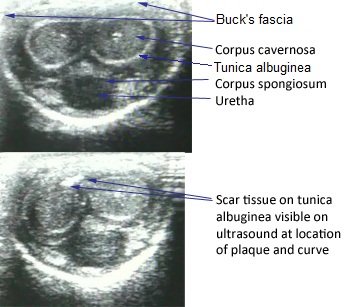
Peyronie’s disease is caused by a plaque of fibrous scar tissue in the tunica albuginea, the elastic sheath around the erectile chambers. Because the plaque does not stretch, the penis bends toward it during an erection. If you are new to the condition, our guide to Peyronie’s disease symptoms and causes explains how the plaque forms and how the disease moves from an active to a stable phase.
The drug targets that plaque chemically. It contains two collagenase enzymes, called AUX-I and AUX-II, purified from fermentation of the bacterium Clostridium histolyticum. Collagenases are enzymes that cut collagen. Laboratory studies on Peyronie’s plaque tissue suggest the enzymes break down the main collagen types found in plaques (types I and III). Once the plaque is partly disrupted, a doctor-performed “modeling” maneuver and home stretching help the penis straighten.
Source: DailyMed (NLM) — FDA label, collagenase clostridium histolyticum; NIDDK — Penile Curvature (Peyronie’s Disease)
The same drug was first approved in the US in 2010 for Dupuytren’s contracture, a collagen cord in the palm that bends the fingers. After the phase 3 IMPRESS trials, the FDA approved it for Peyronie’s disease in 2013. The US National Institute of Diabetes and Digestive and Kidney Diseases (NIDDK) still describes intralesional collagenase as the only FDA-approved treatment for the condition.
Source: DailyMed (NLM) — FDA label, collagenase clostridium histolyticum; World J Urol (PubMed) — collagenase from benchtop to FDA approval; NIDDK — Penile Curvature (Peyronie’s Disease)
Who is a candidate for Xiaflex?
The US label limits the drug to adult men with Peyronie’s disease who have a palpable plaque and a curvature of at least 30 degrees at the start of therapy. The pivotal trials enrolled only men in the stable phase of the disease, and in 98% of them penile pain was absent or mild at baseline. In practice, stable usually means the pain has settled and the bend has stopped changing.
The American Urological Association (AUA) guideline says clinicians may offer intralesional collagenase, combined with modeling, to men with stable disease, a curvature greater than 30 and less than 90 degrees, and intact erectile function, with or without the use of medications. The European Association of Urology (EAU) gives it a strong recommendation for men who want non-surgical treatment and have a dorsal (upward) or lateral (sideways) curve above 30 degrees.
Source: DailyMed (NLM) — FDA label, collagenase clostridium histolyticum; AUA — Peyronie’s Disease Guideline; EAU Guidelines — Sexual and Reproductive Health: Penile Curvature
Who is not suitable
- Plaque involving the urethra: the label lists this as a contraindication because of the risk to the urinary channel.
- Previous allergy to the drug: also a contraindication.
- Bleeding disorders or anticoagulants: the label recommends avoiding it in these men, except those on low-dose aspirin (up to 150 mg a day).
- Features excluded from the trials: a downward (ventral) curve, an isolated hourglass deformity, or a calcified plaque that could interfere with injection. Benefit in these groups is not established.
The EAU also notes that men with curves of 30 to 60 degrees, longer disease duration, better erectile function scores and no plaque calcification tended to improve more. That is why an ultrasound and an erection test usually come before any decision.
Source: DailyMed (NLM) — FDA label, collagenase clostridium histolyticum; EAU Guidelines — Sexual and Reproductive Health: Penile Curvature
How Xiaflex treatment works, cycle by cycle
Treatment is given in the office by a trained urologist. Before each cycle, the doctor induces an erection, often with a small injection of alprostadil (10 or 20 micrograms) into the erectile tissue, and marks the point of maximum bend on the plaque. Our article on penile injections for erectile dysfunction explains how these erection-inducing injections work.
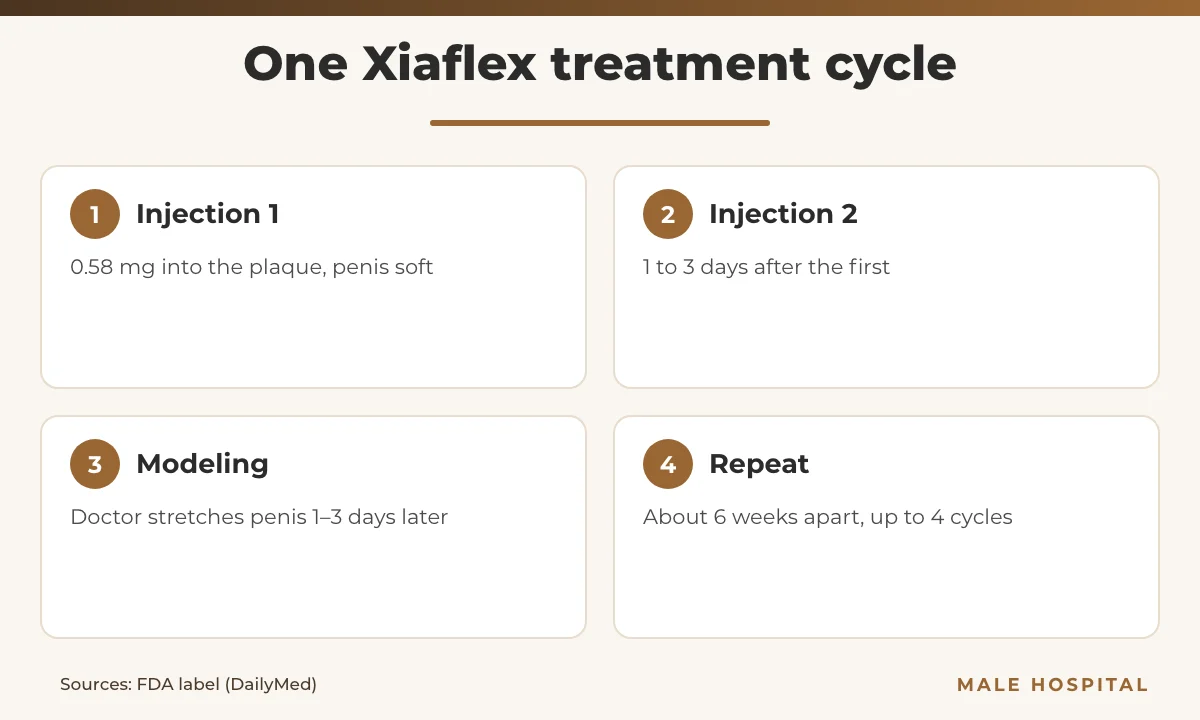
The injection itself is given into the plaque with the penis soft, after antiseptic and, if desired, local anesthetic. Each dose is 0.58 mg. If there is more than one plaque, the one causing the curve is treated.
Source: DailyMed (NLM) — FDA label, collagenase clostridium histolyticum
The labeled schedule
- Injection 1: 0.58 mg into the plaque.
- Injection 2: 1 to 3 days after the first.
- Modeling: 1 to 3 days after the second injection, the doctor gently stretches and bends the penis against the curve to help remodel the weakened plaque.
- Repeat: cycles are about 6 weeks apart, up to 4 cycles, so a maximum of 8 injections and 4 modeling sessions.
If the curve falls below 15 degrees after the first, second or third cycle, or the doctor decides more treatment is not needed, further cycles are not given. The safety of more than one full course is not known.
Source: DailyMed (NLM) — FDA label, collagenase clostridium histolyticum; J Urol (PubMed) — IMPRESS I and II phase 3 trials
Home modeling and activity rules
For 6 weeks after each cycle, the label instructs men to gently stretch the soft penis three times a day and to gently straighten a spontaneous (non-sexual) erection once a day. Men should not use a vacuum erection device during treatment, should avoid sexual activity between the two injections of a cycle, and should wait at least 4 weeks after the second injection, and until pain and swelling have gone, before resuming sex. Straining, for example during bowel movements, should also be avoided.
Source: DailyMed (NLM) — FDA label, collagenase clostridium histolyticum
The shortened protocol
Because the labeled course is long, some centers use modified schedules. In one London study of 53 men, a single 0.9 mg injection per cycle was given at 4-week intervals for three cycles, combined with home modeling, stretching and a vacuum device. Curvature improved by a mean of 17.4 degrees (31.4%), comparable to the original trials. The EAU describes this approach, but it differs from the FDA label and rests on far smaller studies.
Source: BJU Int (PubMed) — modified shortened collagenase protocol; EAU Guidelines — Sexual and Reproductive Health: Penile Curvature
Xiaflex results: the IMPRESS trials and beyond
The drug was tested in IMPRESS I and II, two identical randomized, double-blind, placebo-controlled phase 3 trials with 832 men. Participants were randomized 2:1 to collagenase or placebo and received up to four cycles. The co-primary outcomes, measured at week 52, were the percent change in curvature and the change in the “bother” score of the Peyronie’s Disease Questionnaire (PDQ), which captures concern about erection pain, appearance and the impact on intercourse.
The average participant was about 58 years old with a curve of roughly 49 to 51 degrees; about half had a history of erectile dysfunction.
Source: J Urol (PubMed) — IMPRESS I and II phase 3 trials; DailyMed (NLM) — FDA label, collagenase clostridium histolyticum
| Outcome at week 52 | Xiaflex | Placebo |
|---|---|---|
| Mean curvature change, Study 1 | −35.0% | −17.8% |
| Mean curvature change, Study 2 | −33.2% | −21.8% |
| Pooled curvature change (degrees per man) | −17.0° | −9.3° |
| PDQ bother score change, Study 1 | −2.8 | −1.6 |
| PDQ bother score change, Study 2 | −2.6 | −1.5 |
Source: DailyMed (NLM) — FDA label, collagenase clostridium histolyticum; J Urol (PubMed) — IMPRESS I and II phase 3 trials
Two points stand out. First, the drug roughly doubled the improvement seen with placebo, which itself included modeling and stretching. Second, the average result was a reduction, not a fully straight penis: a man starting at 50 degrees might expect to end somewhere around 33 degrees on average, though individual results vary widely. The label notes that results were similar whether the starting curve was 30 to 60 or 61 to 90 degrees, and whether or not men used PDE5 inhibitors such as sildenafil.
Source: DailyMed (NLM) — FDA label, collagenase clostridium histolyticum
Real-world and long-term data
A five-center US analysis of 918 men treated between 2014 and 2018 found curvature fell from a mean of 48.2 to 32.9 degrees (30.1%), and 68.7% of men improved by at least 20%. Men who completed four or more cycles did better, and the number of cycles predicted improvement. Complications occurred in 9% of patients.
A phase 4 follow-up of men previously treated in the trials found the improvement was maintained: at year 5, curvature had improved by an additional 9.1% without further injections, PDQ bother scores improved further, and no long-term safety issues were identified.
Source: J Urol (PubMed) — multi-institutional collagenase analysis; J Urol (PubMed) — 5-year follow-up after collagenase
Xiaflex side effects and the boxed warning
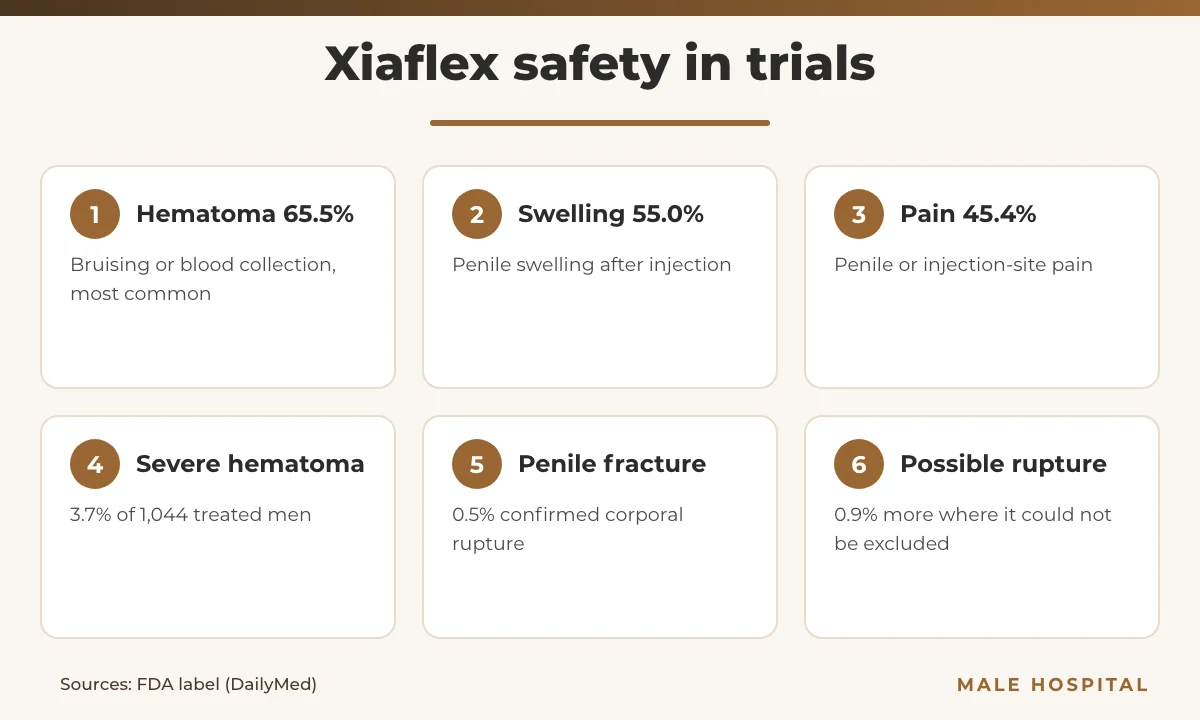
Local side effects are expected. In the placebo-controlled trials, 84.2% of treated men reported at least one adverse reaction, compared with 36.3% on placebo. Most were bruising, swelling and pain at the injection site, and the EAU notes that most mild-to-moderate penile events resolved within about 14 days.
| Adverse reaction (trials) | Xiaflex (n=551) | Placebo (n=281) |
|---|---|---|
| Penile hematoma (bruising/blood collection) | 65.5% | 19.2% |
| Penile swelling | 55.0% | 3.2% |
| Penile pain | 45.4% | 9.3% |
| Penile ecchymoses | 14.5% | 6.8% |
| Blood blister | 4.5% | 0 |
| Localized itching | 4% | 1% |
Source: DailyMed (NLM) — FDA label, collagenase clostridium histolyticum; EAU Guidelines — Sexual and Reproductive Health: Penile Curvature
The boxed warning: penile fracture and serious injury
The drug carries an FDA boxed warning, the strongest type. Across 1,044 men treated in clinical studies, corporal rupture (a tear in the erectile chamber, also called penile fracture) was reported in 5 (0.5%). Another 9 men (0.9%) had a combination of bruising or hematoma, sudden loss of erection and a “popping” sound or sensation, where rupture could not be excluded. Severe penile hematoma occurred in 39 men (3.7%). After marketing, cases of skin and soft-tissue necrosis following hematoma have been reported, some needing surgery. Our guide to penile fracture explains why this injury is an emergency.
Source: DailyMed (NLM) — FDA label, collagenase clostridium histolyticum
Other warnings
- Allergic reactions: because the drug contains foreign proteins, severe allergic reactions including anaphylaxis can occur.
- Acute back pain reactions: reported after marketing, usually starting within minutes of an injection (never after the first one in reported cases) and typically settling within 15 minutes; chest pain, headache or shortness of breath may accompany them.
- Bleeding risk: men with clotting problems or on anticoagulants (other than low-dose aspirin) were excluded from the trials.
Source: DailyMed (NLM) — FDA label, collagenase clostridium histolyticum
The Xiaflex REMS program: why only certified doctors can give it
Because of the risk of penile fracture and other serious injury, the FDA requires that Xiaflex for Peyronie’s disease be available only through a Risk Evaluation and Mitigation Strategy (REMS). Under the Xiaflex REMS program, prescribers must enroll and complete training in administering the drug for Peyronie’s disease, and healthcare sites must be certified and ensure that it is dispensed only for use by certified prescribers.
The label also tells doctors to inject only into the plaque, avoiding the urethra, nerves, blood vessels and the erectile chambers, and to give each patient the patient guide on home modeling. The AUA separately advises counseling every patient about bruising, swelling, pain and corporal rupture before starting.
Source: DailyMed (NLM) — FDA label, collagenase clostridium histolyticum; AUA — Peyronie’s Disease Guideline
Xiaflex in Europe: why Xiapex was withdrawn
In Europe the same drug was sold as Xiapex. It received EU marketing authorisation on 28 February 2011, for Dupuytren’s contracture and for Peyronie’s disease in men with a palpable plaque and a curve of at least 30 degrees. On 5 December 2019, the European Commission withdrew that authorisation, effective 1 March 2020.
The withdrawal was requested by the marketing authorisation holder, Swedish Orphan Biovitrum (Sobi), which had decided to permanently stop marketing the product for commercial reasons. The European Medicines Agency (EMA) record does not cite a safety or efficacy finding as the reason.
Source: European Medicines Agency — Xiapex (withdrawn)
The EAU guideline states that collagenase has been officially withdrawn from the European market by its manufacturer, but keeps the evidence and recommendation in its text for completeness. In practical terms, a man in an EU country cannot simply be prescribed Xiapex. In the US, Xiaflex remains approved, and its prescribing information on DailyMed was updated in 2026. Availability in other countries depends on local regulators, so ask your urologist what can actually be obtained where you live or plan to be treated.
Source: EAU Guidelines — Sexual and Reproductive Health: Penile Curvature; DailyMed (NLM) — FDA label, collagenase clostridium histolyticum
Xiaflex vs other Peyronie’s treatments
Where collagenase is unavailable, unsuitable or unsuccessful, other options exist, but the evidence behind them differs. The EAU rates intralesional hyaluronic acid as a weak recommendation with limited data, calls the evidence for verapamil contradictory, and does not recommend interferon alpha-2b, which has been withdrawn from the European and US markets. Once the disease is stable, surgery is the main option for a severe or complex curve that prevents intercourse.
| Option | Typical use | Guideline view |
|---|---|---|
| Xiaflex (collagenase) | Stable disease, palpable plaque, curve ≥30° | FDA-approved; AUA option; EAU strong (but withdrawn in EU) |
| Hyaluronic acid injections | Pain and/or curve, including active phase | EAU weak; limited data, no placebo-controlled trials |
| Verapamil injections | Plaque injection | EAU: contradictory evidence |
| Interferon alpha-2b | Plaque injection | EAU: not recommended; withdrawn from EU and US markets |
| Surgery (plication, grafting, implant) | Stable disease that prevents intercourse | Main option for severe or complex curves once stable |
Source: EAU Guidelines — Sexual and Reproductive Health: Penile Curvature; AUA — Peyronie’s Disease Guideline
Collagenase does not rule out later surgery. The EAU notes that men who needed surgery after collagenase were more likely to have a complex curve, especially above 60 degrees, without a clearly higher complication rate. Our overview of Peyronie’s disease surgery compares plication, grafting and penile implants in detail.
Source: EAU Guidelines — Sexual and Reproductive Health: Penile Curvature
When to see a doctor
See a urologist if you notice a new bend, a hard lump on the shaft, painful erections, an hourglass dent or shortening, especially if it is changing or makes sex difficult. Early assessment lets the doctor document the curve and decide when the disease is stable enough for treatment.
If you are having collagenase injections, contact your doctor right away if you notice:
- a popping or cracking sound or sensation in the erect penis
- sudden loss of the ability to keep an erection
- severe pain, or severe purple bruising and swelling of the penis
- difficulty urinating or blood in the urine
- hives, a swollen face, breathing trouble, chest pain, dizziness or fainting after an injection
Source: DailyMed (NLM) — FDA label, collagenase clostridium histolyticum; NIDDK — Penile Curvature (Peyronie’s Disease)
If you are weighing collagenase against other options, you can get a confidential assessment from our urologist-andrologist on WhatsApp; the plan depends on your curve, your erections and what is available to you, and is explained on our Peyronie’s disease treatment page.
FAQs about Xiaflex
Does Xiaflex make the penis completely straight?
Usually not. In the IMPRESS trials, the average curve improved by about a third (roughly 17 degrees per man) at one year, versus about a fifth with placebo. Some men improve more and some hardly at all. The goal is a curve that allows comfortable intercourse and less bother, not a perfectly straight penis.
Source: J Urol (PubMed) — IMPRESS I and II phase 3 trials
How many Xiaflex injections will I need?
The labeled course is up to four cycles, each with two injections given 1 to 3 days apart and one modeling session, so a maximum of eight injections over about six months. Treatment stops early if the curve drops below 15 degrees or the doctor decides further cycles are not needed.
Source: DailyMed (NLM) — FDA label, collagenase clostridium histolyticum
Is Xiaflex painful?
Penile pain was reported by 45.4% of treated men in the trials, and bruising and swelling were even more common. A local anesthetic may be used before the injection, and the label mentions over-the-counter painkillers afterward. Most local reactions settle within about two weeks, according to the EAU.
Source: DailyMed (NLM) — FDA label, collagenase clostridium histolyticum; EAU Guidelines — Sexual and Reproductive Health: Penile Curvature
Is Xiaflex available in Europe?
No. The European version, Xiapex, lost its EU marketing authorisation with effect from 1 March 2020 after the company asked for withdrawal for commercial reasons. The EMA record does not cite a safety finding. Men in Europe usually discuss other injections, traction or surgery with their urologist instead.
Source: European Medicines Agency — Xiapex (withdrawn)
Can Xiaflex be used in the active, painful phase?
The pivotal trials enrolled men in the stable phase, and the AUA statement refers to stable disease. Using collagenase in the active phase is an area of ongoing research rather than the labeled standard, so most urologists wait until pain has settled and the curve has stopped changing.
Source: DailyMed (NLM) — FDA label, collagenase clostridium histolyticum; AUA — Peyronie’s Disease Guideline; World J Urol (PubMed) — collagenase from benchtop to FDA approval
When can I have sex after Xiaflex?
Avoid any sexual activity between the two injections of a cycle. After the second injection, wait at least four weeks, and until pain and swelling have gone, before resuming sex. During this time, gentle home stretching and straightening are still done as instructed by your doctor.
Source: DailyMed (NLM) — FDA label, collagenase clostridium histolyticum
Does Xiaflex help erectile dysfunction?
It is not a treatment for erectile dysfunction. Its trials measured curvature and Peyronie’s-related bother. Results did not differ meaningfully by baseline erectile function or PDE5 inhibitor use, and the AUA reserves it for men whose erections are intact with or without medication. Men with significant ED may be better served by other options, including an implant.
Source: DailyMed (NLM) — FDA label, collagenase clostridium histolyticum; AUA — Peyronie’s Disease Guideline
Do Xiaflex results last?
Long-term data are encouraging. In a follow-up of men treated in earlier studies, curvature and PDQ bother scores were maintained and slightly improved at five years without extra injections, and no new safety problems were found. The disease can still progress in some men, so follow-up is sensible.
Source: J Urol (PubMed) — 5-year follow-up after collagenase
Medically reviewed by Assoc. Prof. Dr. Zülfü Sertkaya, urologist and andrologist (FEBU), Istanbul. Last reviewed: November 2026.
This article is for general information and does not replace an individual consultation with a qualified doctor.
- DailyMed (NLM) — XIAFLEX (collagenase clostridium histolyticum) prescribing information
- European Medicines Agency — Xiapex: EPAR (withdrawn)
- EAU — Sexual and Reproductive Health Guidelines: Penile Curvature
- AUA — Peyronie's Disease Guideline
- NIDDK — Penile Curvature (Peyronie's Disease)
- Journal of Urology (PubMed) — Gelbard et al. Collagenase clostridium histolyticum for Peyronie disease in 2 phase 3 studies (IMPRESS I and II), 2013
- Journal of Urology (PubMed) — Long-term safety and curvature after collagenase for Peyronie's disease (5-year follow-up), 2020
- BJU International (PubMed) — Abdel Raheem et al. Collagenase using a new modified shortened protocol, 2017
- Journal of Urology (PubMed) — Intralesional collagenase in Peyronie's disease: multi-institutional analysis, 2019
- World Journal of Urology (PubMed) — Mills & Gelbard. Collagenase clostridium histolyticum, from benchtop to FDA approval and beyond, 2020