Smoking and erectile dysfunction are directly linked: cigarette smoke damages the lining of the blood vessels that fill the penis, so smokers are more likely to develop erection problems, and the risk rises with every extra cigarette and every extra year of smoking. Pooled data show current smokers have about 1.5 times the odds of erectile dysfunction (ED) of men who never smoked. The good news is that quitting can improve erections, especially in younger men with mild ED, and it works best alongside proper erectile dysfunction treatment.
Sources: PLoS One (PMC) — Smoking and risk of erectile dysfunction: meta-analysis (Cao 2013); European Urology Focus (PubMed) — The link between cigarette smoking and ED (Verze 2015)
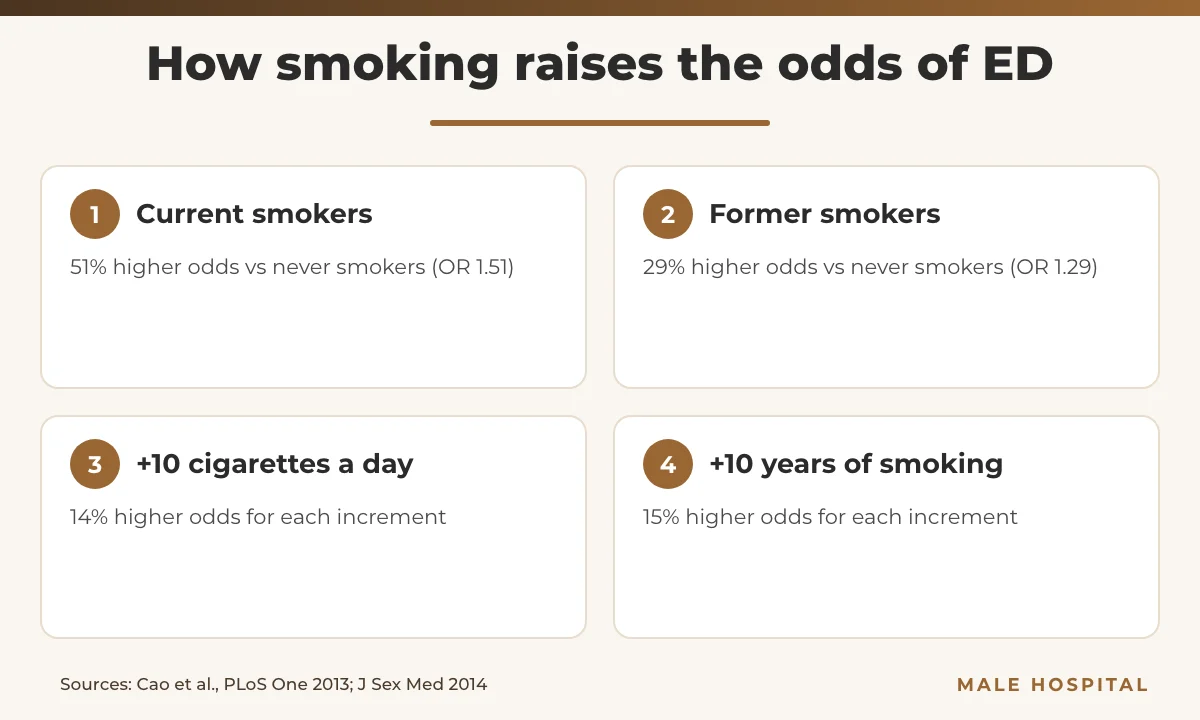
- On smoking and erectile dysfunction, a meta-analysis of prospective cohort studies found 51% higher odds of ED in current smokers and 29% higher odds in former smokers, compared with never smokers.
- The effect is dose-dependent: each extra 10 cigarettes a day and each extra 10 years of smoking raised the odds of ED by about 14% to 15%.
- Smoking and erectile dysfunction are linked mainly through endothelial damage, less nitric oxide and more oxidative stress. Secondhand smoke may also play a role.
- In a 1-year study, erectile function improved in at least 25% of men who quit but in none who kept smoking. Younger men with milder ED gained most.
- Daily e-cigarette users reported ED more than twice as often as never users in a large US survey, so vaping is not a proven safe swap.
- How smoking causes erectile dysfunction
- Smoking and erectile dysfunction: what the research shows
- More cigarettes, more years, more risk
- Vaping, nicotine and secondhand smoke
- Quitting smoking and erectile dysfunction: can ED reverse?
- How to quit: support that works
- Treating erectile dysfunction in smokers
- Smoking and erectile dysfunction as a heart warning sign
- When to see a doctor
- FAQs about smoking and erectile dysfunction
How smoking causes erectile dysfunction
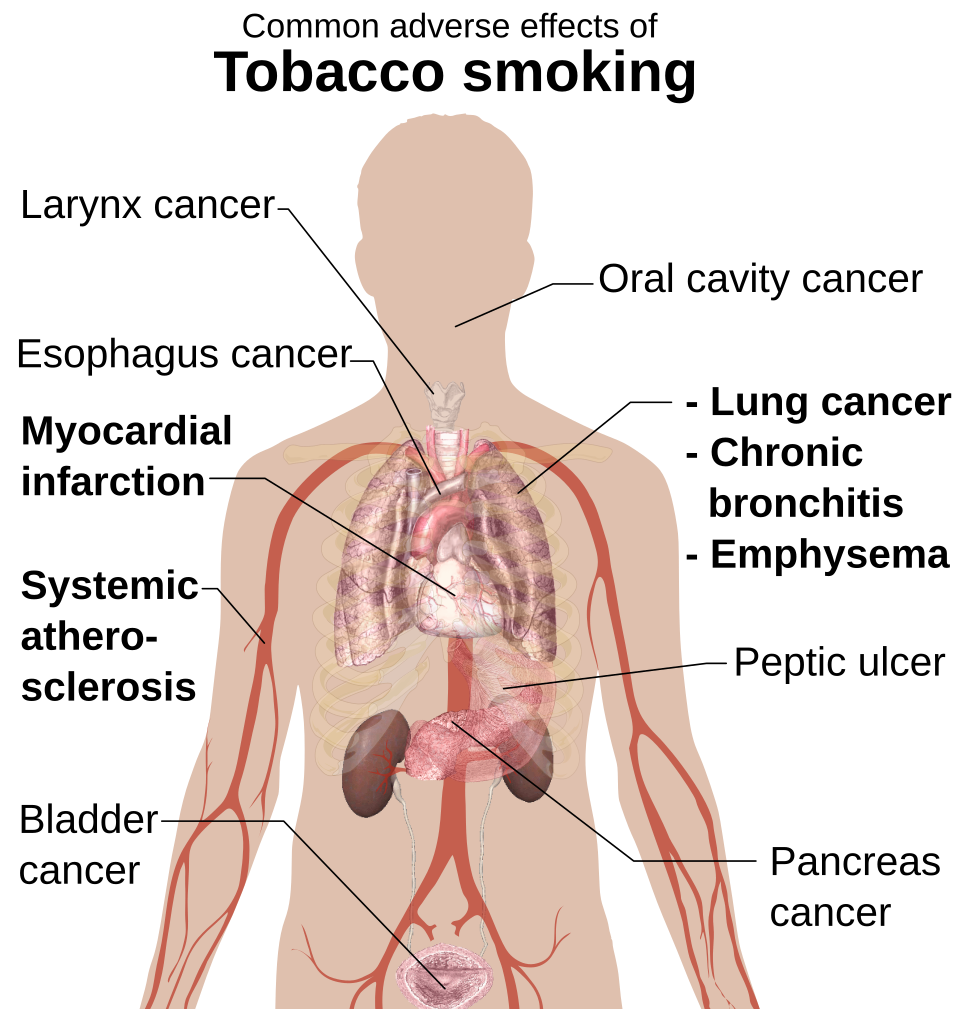
To understand smoking and erectile dysfunction, remember that an erection is a blood-flow event. When you are aroused, nerves and the inner lining of the penile arteries release nitric oxide, a chemical signal that relaxes smooth muscle and lets blood rush into the spongy erectile tissue. Anything that damages blood vessels can therefore cause ED. Both the European Association of Urology (EAU) and the US National Institute of Diabetes and Digestive and Kidney Diseases (NIDDK) list cigarette smoking among the causes, and the US Centers for Disease Control and Prevention (CDC) states plainly that smoking can lead to impotence. For the full picture of other physical and psychological triggers, see our guide to erectile dysfunction causes.
Sources: EAU — Sexual and Reproductive Health Guidelines — Management of Erectile Dysfunction; NIDDK — Symptoms and causes of erectile dysfunction; CDC — Cigarettes and reproductive health
Damage to the blood vessel lining
A 2015 systematic review in European Urology Focus concluded that the link between smoking and erectile dysfunction is mainly driven by injury to the endothelium (the thin inner lining of blood vessels), reduced availability of nitric oxide, and an imbalance between oxidative and antioxidant reactions that increases oxidative stress. In plain terms, smoke chemicals make the penile arteries less able to widen when they need to. Over time, this endothelial dysfunction is also the first step toward atherosclerosis, the hardening and narrowing of arteries.
Source: European Urology Focus (PubMed) — The link between cigarette smoking and ED (Verze 2015)
Vessel spasm and nervous system effects
A review of 83 studies in Sexual Medicine Reviews found that smoking contributes to ED in several ways, especially by causing spasm of the penile blood vessels and by increasing the tone of the sympathetic nervous system, the “fight or flight” system that works against erections. A small US study of smoking and erectile dysfunction in 62 long-term smokers supports this: as men cut down, measures of heart rate variability changed, and those changes tracked with better erectile responses in the lab.
Sources: Sexual Medicine Reviews (PubMed) — Male sexual function and smoking (Biebel 2016); Int J Impot Res (PMC) — Smoking, heart rate variability and erectile tumescence (Harte 2013)
Smoking and erectile dysfunction: what the research shows
The strongest evidence on smoking and erectile dysfunction comes from studies that followed men over time. A 2013 meta-analysis in PLoS One pooled 4 prospective cohort studies and 4 case-control studies with 28,586 participants. Because the cohort studies were more consistent, the authors relied on them: compared with never smokers, current smokers had an odds ratio of 1.51 for ED and former smokers had an odds ratio of 1.29. Put simply, current smokers had about 51% higher odds, and even ex-smokers kept some excess risk.
Source: PLoS One (PMC) — Smoking and risk of erectile dysfunction: meta-analysis (Cao 2013)
The link between smoking and erectile dysfunction holds even in men without heart disease. A study of 7,684 Chinese men aged 35 to 74 with no clinical vascular disease found 41% higher odds of ED in smokers after adjusting for age, alcohol, exercise, diabetes, blood pressure, weight and cholesterol. The authors estimated that, if the relationship is causal, 22.7% of ED cases among Chinese men could be attributed to smoking.
Source: Am J Epidemiol (PubMed) — Cigarette smoking and ED among Chinese men (He 2007)
Larger reviews of smoking and erectile dysfunction point the same way. A 2021 systematic review in the Journal of Sexual Medicine identified smoking, alcohol and drug use as behavioral risk factors for ED, while diet, physical activity and intimacy were protective. The European review summarized the evidence bluntly: smoking is strongly associated with ED. Alcohol is the other common habit with a similar effect, covered in our article on alcohol and erectile dysfunction.
Sources: J Sex Med (PubMed) — Behavior-related erectile dysfunction: systematic review (Sivaratnam 2021); European Urology Focus (PubMed) — The link between cigarette smoking and ED (Verze 2015)
More cigarettes, more years, more risk
One of the clearest signs that smoking itself harms erections is the dose-response pattern: the more you smoke, the higher the risk. A 2014 dose-response meta-analysis of 10 studies with 50,360 participants found that every additional 10 cigarettes a day raised the odds of ED by 14%, and every additional 10 years of smoking raised them by 15%. The relationship between smoking and erectile dysfunction was roughly linear, with no safe threshold identified.
Source: J Sex Med (PubMed) — Dose-response meta-analysis of smoking and ED (Cao 2014)
Individual studies of smoking and erectile dysfunction show the same gradient. In the Chinese study, odds of ED rose step by step with daily cigarette count. In an Iranian study of smokers with no other major ED risk factors, the severity of ED was significantly linked to pack-years, a measure that combines how much and how long a man has smoked.
Sources: Am J Epidemiol (PubMed) — Cigarette smoking and ED among Chinese men (He 2007); BJU International (PubMed) — Do smokers with ED benefit from stopping? (Pourmand 2004)
| Smoking exposure | Odds of ED vs never smokers | Study |
|---|---|---|
| 1–10 cigarettes a day | 1.27 (not statistically significant) | He et al., 7,684 men, 2007 |
| 11–20 cigarettes a day | 1.45 | He et al., 7,684 men, 2007 |
| More than 20 cigarettes a day | 1.65 | He et al., 7,684 men, 2007 |
| Each extra 10 cigarettes a day | 1.14 per increment | Cao et al., 50,360 participants, 2014 |
| Each extra 10 years of smoking | 1.15 per increment | Cao et al., 50,360 participants, 2014 |
| Former smoker | 1.29 | Cao et al., cohort studies, 2013 |
Sources: Am J Epidemiol (PubMed) — Cigarette smoking and ED among Chinese men (He 2007); J Sex Med (PubMed) — Dose-response meta-analysis of smoking and ED (Cao 2014); PLoS One (PMC) — Smoking and risk of erectile dysfunction: meta-analysis (Cao 2013)
Smoking also seems to multiply other risks. In the Chinese study, the link between smoking and erectile dysfunction was much stronger in men with diabetes (odds ratio 3.29) than in men without it (1.33). If you have diabetes, high blood pressure or high cholesterol, stopping smoking matters even more.
Source: Am J Epidemiol (PubMed) — Cigarette smoking and ED among Chinese men (He 2007)
Vaping, nicotine and secondhand smoke
E-cigarettes
Many men switch to vaping hoping to protect their health. Compared with the data on smoking and erectile dysfunction, the evidence on vaping and erections is still young, and it is not reassuring. In the US Population Assessment of Tobacco and Health (PATH) Study, men who used e-cigarettes every day were more likely to report ED than men who never used them (adjusted odds ratio 2.24). The association persisted in a subgroup of men aged 20 to 65 with no heart disease (2.41).
This was a cross-sectional survey, so it shows an association, not proof that vaping causes ED, and the authors noted e-cigarettes are still being evaluated for harm reduction and quitting. Their advice was that vapers should be told about the possible link. Cleveland Clinic also lists nicotine among substances that may contribute to ED.
Sources: Am J Prev Med (PubMed) — E-cigarettes and erectile dysfunction, PATH Study (2022); Cleveland Clinic — Erectile dysfunction
Secondhand smoke
When it comes to smoking and erectile dysfunction, you do not have to light up to be affected. The European systematic review found that passive (secondhand) smoking, especially with long-term exposure, can also have a negative effect on erectile function. That is one more reason to keep your home and car smoke-free.
Source: European Urology Focus (PubMed) — The link between cigarette smoking and ED (Verze 2015)
Quitting smoking and erectile dysfunction: can ED reverse?
Yes, quitting smoking can improve erectile dysfunction in many men, but how much depends on your age, how severe your ED is and how long you have smoked. Cleveland Clinic notes that for men with mild ED, quitting smoking can lead to improvement after several months.
Source: Cleveland Clinic — Erectile dysfunction
The evidence on stopping
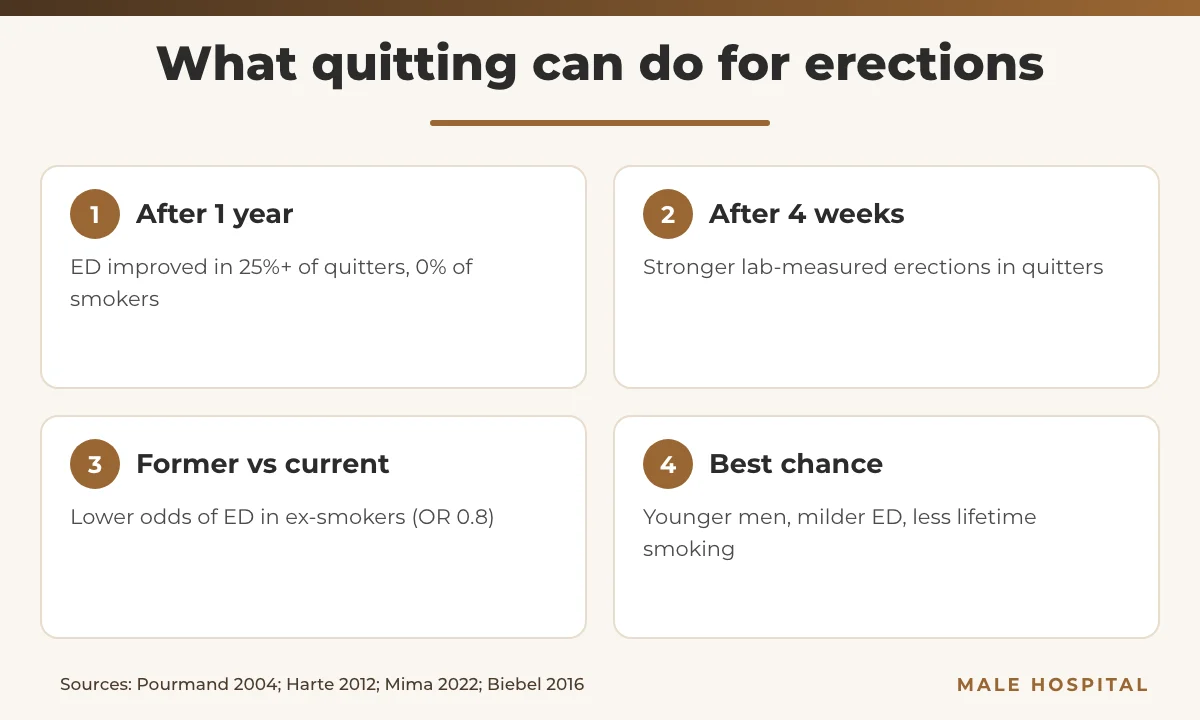
- One-year follow-up: in a prospective study of 281 smokers with ED and no other major risk factors, erectile function improved in at least 25% of the 118 men who quit, but in none of the 163 who kept smoking. Erections got worse in 2.5% of ex-smokers and 6.8% of continuing smokers. Older men and those with advanced ED improved less.
- Measured in the lab: in an 8-week program combining nicotine patches and counseling, men who were still smoke-free 4 weeks later had stronger erectile responses on penile measurement and reached peak arousal faster than men who relapsed. The study was small and short.
- Large population data: among 6,754 men aged 50 to 75 in the REDUCE trial, former smokers had lower odds of ED (odds ratio 0.8) and of low libido than current smokers.
Sources: BJU International (PubMed) — Do smokers with ED benefit from stopping? (Pourmand 2004); BJU International (PMC) — Smoking cessation and sexual health in men (Harte 2012); BJU International (PubMed) — The impact of smoking on sexual function (Mima 2022)
Why some damage may not reverse
Quitting does not always fully undo smoking and erectile dysfunction damage. The Sexual Medicine Reviews authors concluded that smoking cessation can restore erectile function, but mainly when lifetime smoking exposure has been limited. The 2013 meta-analysis also found that former smokers still had higher odds of ED than never smokers. The message is simple: the sooner you stop, the better your chances.
Sources: Sexual Medicine Reviews (PubMed) — Male sexual function and smoking (Biebel 2016); PLoS One (PMC) — Smoking and risk of erectile dysfunction: meta-analysis (Cao 2013)
How to quit: support that works
Nicotine is highly addictive, and most men facing smoking and erectile dysfunction need more than willpower. In the UK, the NHS says free local stop smoking services can improve your chances of quitting for good. The main tools are:
- Nicotine replacement therapy (NRT): patches, gum, lozenges, inhalators and mouth or nasal sprays.
- Prescription tablets: varenicline, cytisinicline and bupropion (Zyban).
- Behavioral support: counseling from a stop smoking adviser.
- E-cigarettes: the NHS notes there is evidence they can help people stop smoking, although they are not licensed medicines.
Source: NHS — NHS stop smoking services help you quit
Both quitting studies on smoking and erectile dysfunction above used NRT to help men stop, and quitters still saw better erections, so a short course of patches or gum should not stop you from quitting. Given the possible vaping link to ED described above, it makes sense to treat an e-cigarette as a temporary step to stopping rather than a long-term habit. Other lifestyle steps, such as exercise, weight loss and less alcohol, add to the benefit; our guide to natural remedies for erectile dysfunction explains which ones have real evidence.
Sources: BJU International (PubMed) — Do smokers with ED benefit from stopping? (Pourmand 2004); BJU International (PMC) — Smoking cessation and sexual health in men (Harte 2012); Am J Prev Med (PubMed) — E-cigarettes and erectile dysfunction, PATH Study (2022)
Treating erectile dysfunction in smokers
With smoking and erectile dysfunction, you do not have to wait until you have quit to get help with erections. The EAU guidelines give a strong recommendation to start lifestyle changes and risk factor modification before or at the same time as ED treatment. In practice, that means working on stopping smoking while using a proven therapy.
Source: EAU — Sexual and Reproductive Health Guidelines — Management of Erectile Dysfunction
For smoking and erectile dysfunction, treatment options are the same as for non-smokers and usually follow a step-by-step approach:
- First line: PDE5 inhibitor tablets such as sildenafil or tadalafil, plus lifestyle changes.
- Second line: penile injections, urethral medicine or a vacuum erection device when tablets do not work or are not suitable.
- Third line: a penile prosthesis (implant) for men with severe ED that does not respond to other treatments.
When treating smoking and erectile dysfunction, your doctor will also check blood pressure, blood sugar and cholesterol, because the EAU advises that conditions such as high blood pressure be well controlled as the first step of any ED treatment. Our ED treatment page explains the options available with our specialist.
Sources: EAU — Sexual and Reproductive Health Guidelines — Management of Erectile Dysfunction; Cleveland Clinic — Erectile dysfunction
Smoking and erectile dysfunction as a heart warning sign
In a smoker, new erection problems may be an early sign of wider blood vessel disease, which is why smoking and erectile dysfunction should never be ignored. NIDDK lists heart and blood vessel diseases such as atherosclerosis, high blood pressure and stroke among the causes of ED, and Cleveland Clinic notes that ED can be the first symptom of an underlying condition such as heart disease. Because smoking damages arteries throughout the body, the penis may simply show the damage first.
Sources: NIDDK — Symptoms and causes of erectile dysfunction; Cleveland Clinic — Erectile dysfunction
That is why a good assessment of smoking and erectile dysfunction always includes a heart risk check, not just a prescription. Our article on erectile dysfunction and heart disease explains the link and which heart checks to ask for.
When to see a doctor
The NHS advises seeing a doctor if erection problems keep happening. As a smoker worried about smoking and erectile dysfunction, book an appointment if:
- You have trouble getting or keeping an erection most of the time, for several weeks or more.
- ED started gradually and is slowly getting worse, which suggests a blood-flow cause.
- You also have high blood pressure, diabetes, high cholesterol or a family history of early heart disease.
- Erection problems come with low sex drive, tiredness or other hormonal symptoms.
- You are under 40 and a heavy or long-term smoker. Read more in our guide to erectile dysfunction in young men.
Sources: NHS — Erection problems (erectile dysfunction); NIDDK — Symptoms and causes of erectile dysfunction
Seek urgent medical help if erection problems come with chest pain, shortness of breath on exertion, or sudden weakness, numbness or trouble speaking. These can signal a heart attack or stroke and need emergency care, not an ED appointment.
Source: NIDDK — Symptoms and causes of erectile dysfunction
If you would like a confidential assessment of smoking and erectile dysfunction, you can message our urologist-andrologist on WhatsApp for a free initial consultation; any treatment plan and its cost depend on that assessment. You can also read about our approach on the erectile dysfunction treatment page.
FAQs about smoking and erectile dysfunction
Can quitting smoking reverse erectile dysfunction?
Often, yes, at least partly. In a 1-year study, erections improved in at least 25% of men who stopped smoking and in none of those who continued. Improvement was less likely in older men and those with severe ED. Reviews of smoking and erectile dysfunction suggest recovery is most likely when total lifetime smoking has been limited, so quitting early gives the best chance.
Sources: BJU International (PubMed) — Do smokers with ED benefit from stopping? (Pourmand 2004); Sexual Medicine Reviews (PubMed) — Male sexual function and smoking (Biebel 2016)
How long after quitting smoking does ED improve?
Cleveland Clinic says men with mild ED may notice improvement several months after quitting. In a small lab study, measurable improvements in erectile response were already seen 4 weeks after men finished an 8-week quit program. Larger studies measured benefit after 1 year. With smoking and erectile dysfunction, timing varies with age, smoking history and other health conditions.
Sources: Cleveland Clinic — Erectile dysfunction; BJU International (PMC) — Smoking cessation and sexual health in men (Harte 2012)
Does vaping cause erectile dysfunction?
It has not been proven, but, as with smoking and erectile dysfunction, there is a warning signal. In a large US survey, men who vaped daily were more than twice as likely to report ED as men who never vaped, even after accounting for age and heart disease. The study could not show cause and effect, so vaping is best seen as a short-term quitting aid, not a safe habit.
Source: Am J Prev Med (PubMed) — E-cigarettes and erectile dysfunction, PATH Study (2022)
Can secondhand smoke affect erections?
Possibly. A systematic review in European Urology Focus concluded that passive smoking, especially long-term exposure, can have a negative effect on erectile function. The evidence is weaker than for active smoking and erectile dysfunction, but keeping your home and car smoke-free protects both your partner and your own vascular health.
Source: European Urology Focus (PubMed) — The link between cigarette smoking and ED (Verze 2015)
Do nicotine patches or gum cause erection problems?
Nicotine replacement is meant to be temporary and is a standard way to quit. In the studies on smoking and erectile dysfunction showing better erections after stopping, men used nicotine patches or other NRT to quit, and they still improved. If you are worried, talk with your doctor about prescription options such as varenicline or bupropion, which the NHS lists as quitting medicines.
Sources: BJU International (PubMed) — Do smokers with ED benefit from stopping? (Pourmand 2004); NHS — NHS stop smoking services help you quit
Does smoking lower testosterone and cause ED that way?
Smoking and erectile dysfunction are linked mainly through a blood vessel problem, not a hormone problem. In the REDUCE trial of 6,754 older men, current smokers actually had higher average total testosterone than non-smokers, yet they had more ED and more low libido. A hormone test is still worth doing if you have low desire or fatigue.
Source: BJU International (PubMed) — The impact of smoking on sexual function (Mima 2022)
Do ED pills work if I still smoke?
ED tablets can be prescribed to smokers, and treatment does not have to wait until you quit. The EAU recommends starting lifestyle changes and risk factor control before or alongside ED treatment, because they support the treatment and your overall blood vessel health. With smoking and erectile dysfunction, your doctor will check your heart risk before prescribing.
Source: EAU — Sexual and Reproductive Health Guidelines — Management of Erectile Dysfunction
How many cigarettes a day are enough to cause ED?
There is no proven safe level for smoking and erectile dysfunction risk. A dose-response meta-analysis found risk rose roughly in a straight line, by about 14% for every extra 10 cigarettes a day and 15% for every extra 10 years of smoking. In one large study, men smoking more than 20 cigarettes a day had 65% higher odds of ED than never smokers.
Sources: J Sex Med (PubMed) — Dose-response meta-analysis of smoking and ED (Cao 2014); Am J Epidemiol (PubMed) — Cigarette smoking and ED among Chinese men (He 2007)
Medically reviewed by Assoc. Prof. Dr. Zülfü Sertkaya, urologist and andrologist (FEBU), Istanbul. Last reviewed: November 2026.
This article is for general information and does not replace an individual consultation with a qualified doctor.
- EAU — Sexual and Reproductive Health Guidelines — Management of Erectile Dysfunction
- NIDDK — Symptoms and causes of erectile dysfunction
- NHS — Erection problems (erectile dysfunction)
- NHS — NHS stop smoking services help you quit
- Cleveland Clinic — Erectile dysfunction
- CDC — Cigarettes and reproductive health
- PLoS One (PMC) — Smoking and risk of erectile dysfunction: systematic review of observational studies with meta-analysis (Cao et al., 2013)
- Journal of Sexual Medicine (PubMed) — Association of quantity and duration of smoking with erectile dysfunction: a dose-response meta-analysis (Cao et al., 2014)
- European Urology Focus (PubMed) — The link between cigarette smoking and erectile dysfunction: a systematic review (Verze et al., 2015)
- American Journal of Preventive Medicine (PubMed) — Association of e-cigarettes with erectile dysfunction: the PATH Study (El-Shahawy et al., 2022)
- American Journal of Epidemiology (PubMed) — Cigarette smoking and erectile dysfunction among Chinese men without clinical vascular disease (He et al., 2007)
- Sexual Medicine Reviews (PubMed) — Male sexual function and smoking (Biebel et al., 2016)
- BJU International (PubMed) — Do cigarette smokers with erectile dysfunction benefit from stopping? A prospective study (Pourmand et al., 2004)
- BJU International (PMC) — Association between smoking cessation and sexual health in men (Harte and Meston, 2012)
- International Journal of Impotence Research (PMC) — Association between cigarette smoking and erectile tumescence: the mediating role of heart rate variability (Harte and Meston, 2013)
- BJU International (PubMed) — The impact of smoking on sexual function (Mima et al., 2022)
- Journal of Sexual Medicine (PubMed) — Behavior-related erectile dysfunction: a systematic review and meta-analysis (Sivaratnam et al., 2021)