The AMS 700 penile implant is a 3-piece inflatable penile prosthesis, now made by Boston Scientific, that treats erectile dysfunction (ED) when pills, injections and other options have failed or are not suitable. It has two fluid-filled cylinders in the penis, a pump in the scrotum and a reservoir in the lower abdomen, and it comes in three cylinder types (LGX, CX and CXR) with an optional antibiotic surface treatment. For the operation itself, see our main penile prosthesis (penile implant) surgery page, and for how 3-piece and 2-piece designs differ in general, our guide to the inflatable penile prosthesis. This article focuses only on the AMS 700 line and the independent evidence behind it.
Sources: Boston Scientific — AMS 700 inflatable penile prosthesis (EU); EAU Guidelines — Management of erectile dysfunction
- The AMS 700 is a 3-piece inflatable implant: two cylinders, a scrotal pump and an abdominal reservoir, first released in 1983 and owned by Boston Scientific since 2015.
- Three cylinder types exist: LGX (expands in length and girth), CX (expands mainly in girth) and CXR (narrower, for scarred or smaller erection chambers).
- The InhibiZone version carries minocycline and rifampin; in a manufacturer-registry study, infection-related revision at up to 7.7 years was 1.1% versus 2.5% without it.
- Independent long-term series report 10-year device survival of roughly 75–83% for AMS 700 CX models, in line with inflatable implants in general.
- European guidelines find no head-to-head proof that any implant brand is superior; the right device depends on your anatomy, history and your surgeon’s experience.
- What is the AMS 700 penile implant?
- How the AMS 700 penile implant works: the three components
- LGX vs CX vs CXR cylinders
- InhibiZone and Parylene: what the coatings do
- How long does the AMS 700 penile implant last?
- Will the LGX make the penis longer?
- AMS 700 penile implant vs other implants
- Who is a candidate and how the device is chosen
- When to see a doctor
- FAQs
What is the AMS 700 penile implant?
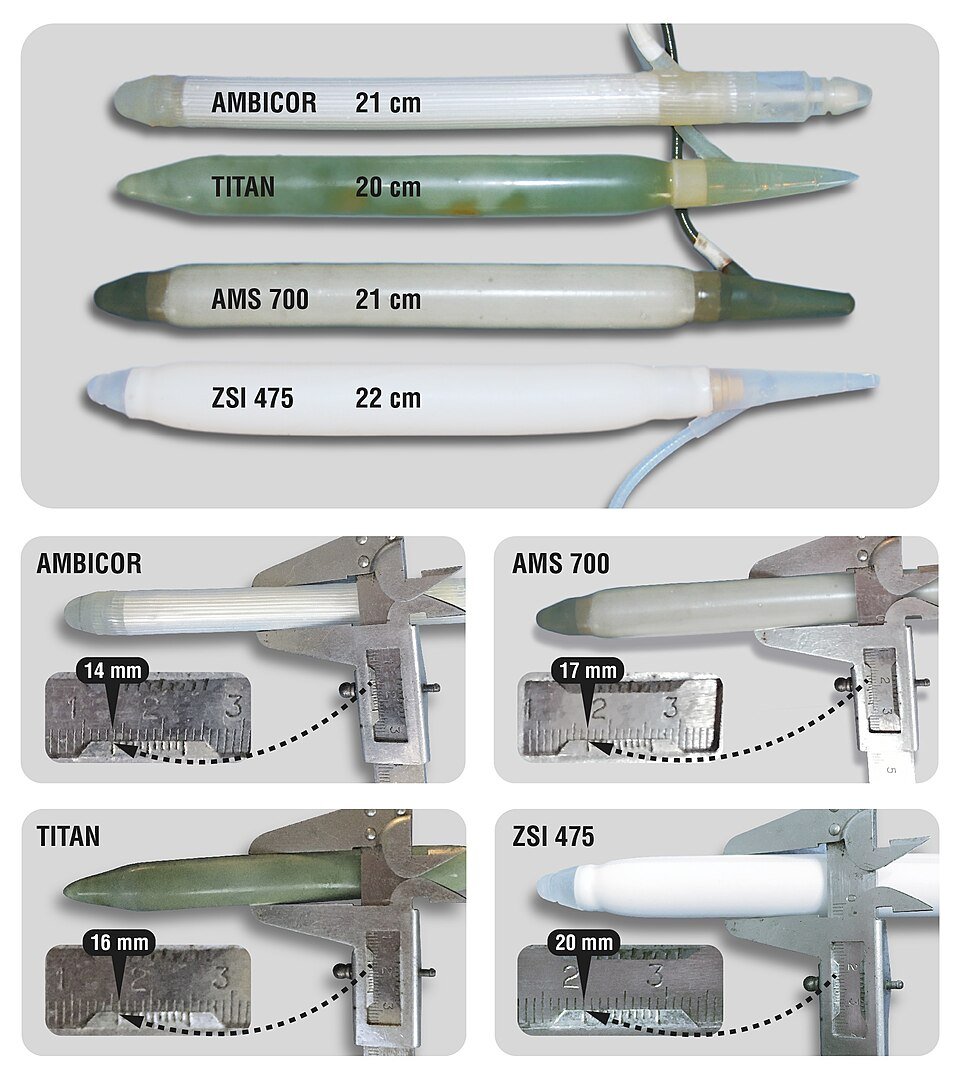
The AMS 700 is one of the longest-running inflatable penile prosthesis lines. A 2021 review of implant technology dates the first 3-piece AMS 700 to 1983, the CX (controlled expansion) cylinder to 1987, and the Ultrex cylinder, later renamed LGX, to 1990. The line was developed by American Medical Systems (AMS); Boston Scientific completed its acquisition of the AMS men’s health portfolio, including this implant line, in August 2015.
Like every penile implant, it does not cure the underlying cause of ED. It replaces the natural blood-filling mechanism with a hydraulic one that you control. That is why guidelines position it as a treatment for men in whom other options have failed or who prefer a definitive solution.
Sources: PMC (Transl Androl Urol) — Polchert et al., Narrative review of penile prosthetic implant technology (2021); Boston Scientific — Closes acquisition of the AMS male urology portfolio (2015)
How the AMS 700 penile implant works: the three components
All 3-piece inflatable implants share the same basic layout. Two cylinders sit inside the two erection chambers (corpora cavernosa). Tubing connects them to a pump placed in the scrotum and to a fluid reservoir placed under the lower abdominal muscles. Squeezing the pump moves fluid into the cylinders to create an erection; pressing a release on the pump sends the fluid back so the penis softens.
Source: Cleveland Clinic — Penile implants
Pump
Over the years the AMS 700 has used several pumps. The Momentary Squeeze (MS) pump, introduced in 2006, allowed deflation in about 2–4 seconds and is still listed on the European product page. In November 2023 the US Food and Drug Administration approved a new-generation pump, the TENACIO, for this implant. Boston Scientific’s US page says this pump has a one-press release button and was designed for an expected implant life of 10 years, corresponding to 1,000 uses. Pump availability differs between countries, so ask which version your surgeon uses.
Sources: PMC (Transl Androl Urol) — Polchert et al. (2021); FDA — PMA supplement N970012 S197, AMS 700 TENACIO pump (2023); Boston Scientific — AMS 700 (US)
Reservoir
Boston Scientific lists three reservoirs: a 65 ml spherical, a 100 ml spherical and a 100 ml flat “Conceal” reservoir. The flat reservoir stays flat when filled and is intended for placement in alternative (ectopic) positions rather than the usual space behind the pubic bone.
Sources: Boston Scientific — AMS 700 (EU); PMC (Transl Androl Urol) — Polchert et al. (2021)
Cylinders and sizing
Cylinders come in several lengths and are fine-tuned with rear tip extenders, small caps that match the measured length of your erection chambers. Parts suit either a penoscrotal (base of the penis) or infrapubic (above the penis) incision.
Source: Boston Scientific — AMS 700 (US)
LGX vs CX vs CXR cylinders
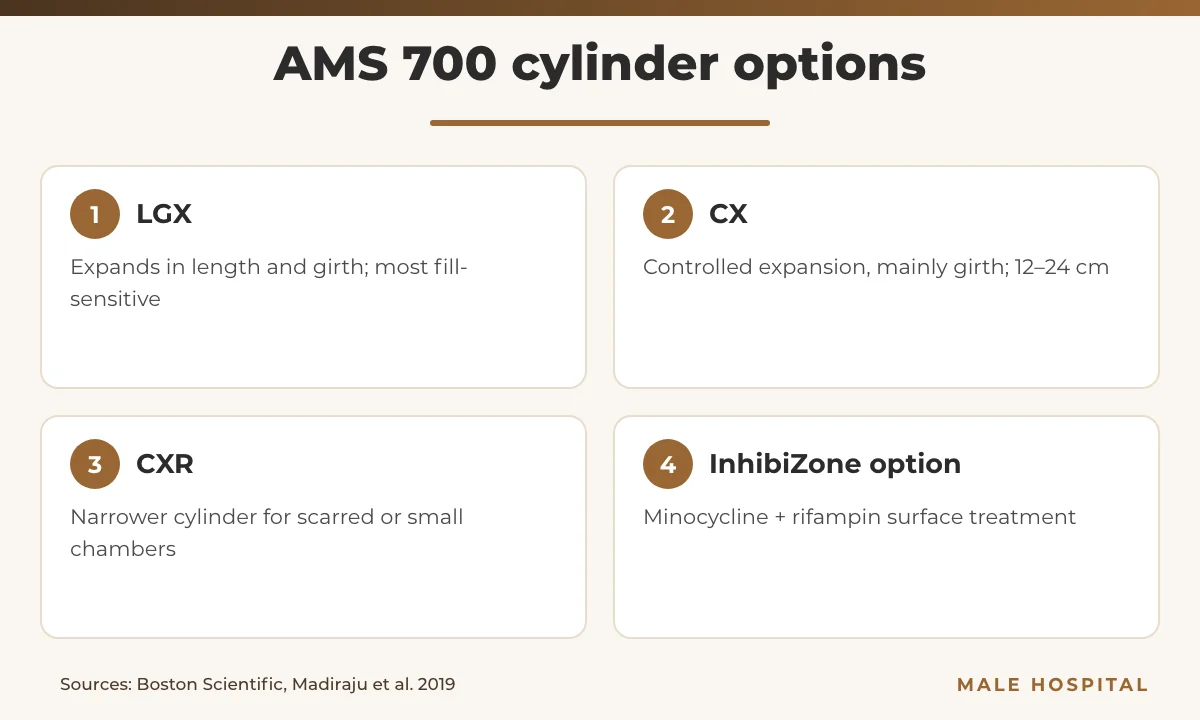
The main choice within this implant line is the cylinder. Each type expands differently when inflated, and your surgeon picks one based on the size and condition of your erection chambers, any scarring and what you hope to achieve.
| Cylinder | How it expands (manufacturer description) | Listed lengths | Typical use |
|---|---|---|---|
| LGX | Length and girth expansion; EU page: up to 20% elongation depending on anatomy; US page: up to 25% in length and up to 18 mm ± 2 mm in girth | 12, 15, 18, 21 cm | Men for whom preserving length is a priority |
| CX | Controlled expansion that mainly optimizes girth | 12–24 cm | Standard choice for many men, including some with Peyronie’s disease |
| CXR | Girth expansion in a narrower cylinder | EU: 12, 14, 16 cm (10 and 18 cm special order) | Men who need smaller cylinders, such as those with scarred or sclerotic chambers |
Sources: Boston Scientific — AMS 700 (EU); Boston Scientific — AMS 700 (US)
Note that the European and US pages describe LGX length expansion differently (20% versus 25%). Both are manufacturer descriptions of the cylinder’s capacity, not a promise of how much longer your erection will be. A laboratory review of implant mechanics also found that the LGX was the most sensitive to how fully it is inflated: at lower fill pressures it buckled more easily than girth-expanding cylinders such as the CX.
InhibiZone and Parylene: what the coatings do
InhibiZone antibiotic surface treatment
Infection is the most serious complication of any implant, because it usually means removing the device. Since 2001, the device’s parts have been available with InhibiZone, a surface treatment that combines two antibiotics, minocycline and rifampin. Non-coated versions of each part are also sold.
The evidence for InhibiZone comes mainly from registry forms that surgeons file with the manufacturer. In 4,205 first-time implants, the infection rate at 180 days was 0.68% with InhibiZone versus 1.61% without. A longer follow-up of more than 39,000 devices found that, at up to 7.7 years, 1.1% of men with impregnated implants versus 2.5% without needed revision surgery because of infection. These are retrospective, voluntary reports rather than randomized trials, but the European Association of Urology (EAU) accepts that antibiotic-impregnated or hydrophilic-coated implants reduce infection to about 1–2%.
Sources: PubMed (J Urol) — Carson, Antibiotic impregnation of inflatable penile prostheses (2004); PubMed (J Urol) — Carson et al., Long-term infection outcomes, up to 7.7 years (2011); EAU Guidelines — Management of erectile dysfunction
Parylene coating
In January 2001, a thin Parylene layer was added to the inner silicone surfaces of the CX cylinders to reduce friction and silicone wear. In a single surgical group’s series of 775 men, freedom from mechanical breakage at 3 years rose from 89.2% with the older uncoated cylinders to 97.5% with the coated ones. Coatings lower risk; they do not remove it. Careful technique, skin preparation and control of diabetes still matter most, and you can read more in our guide to penile implant complications.
How long does the AMS 700 penile implant last?
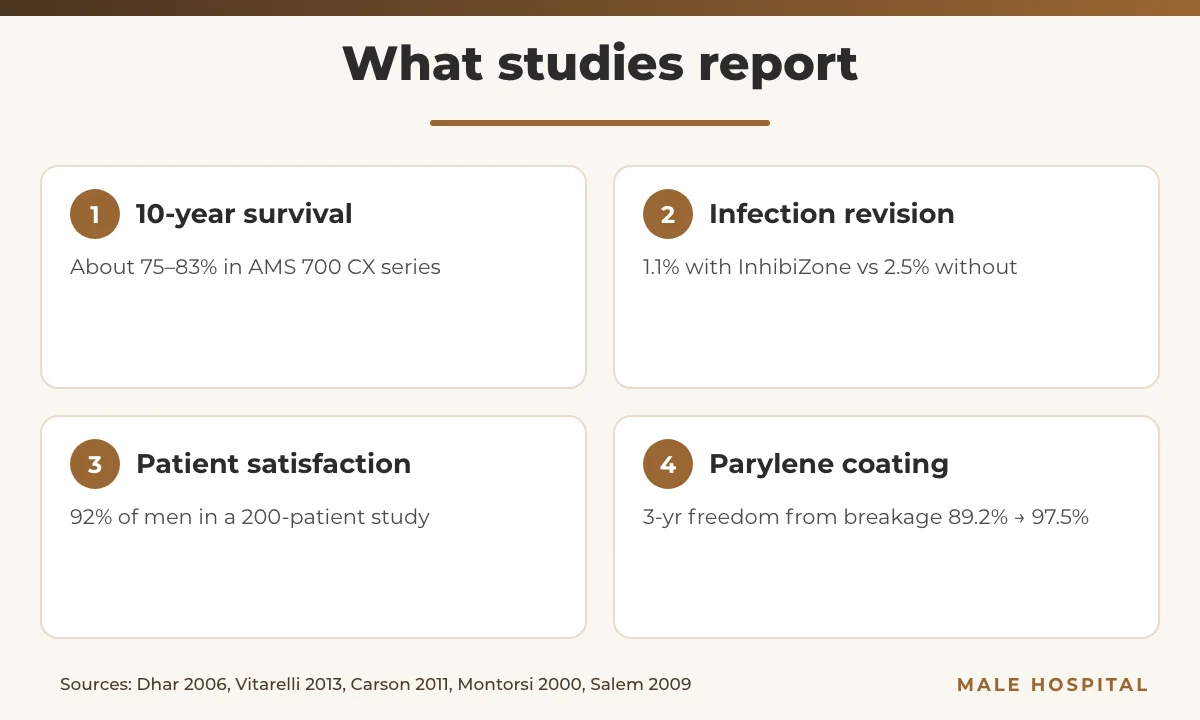
No implant lasts forever, and long-term figures describe older versions of the device because modern versions have not yet been followed for 10–20 years. With that caveat, independent studies of this implant report the following:
- Cleveland Clinic series (455 men, AMS 700 CX/CXM, 1986–2004): 10-year overall survival without revision of 74.9% and freedom from mechanical failure of 81.3%.
- US multicenter study (372 men, AMS 700 CX): mechanical reliability of 92.1% at 3 years and 86.2% at 5 years; infection in 3.2%.
- Italian series (AMS 700 CX/CXR): estimated 10-year survival of 77.6% with the older touch pump and 82.5% with the Momentary Squeeze pump.
- Single surgical group, 2,384 first-time inflatable implants of four models: 68.5% free of revision at 10 years and 59.7% at 15 years for the whole series.
These numbers fit the EAU’s pooled data for all penile implants, which estimate survival of 87.2% at 5 years and 76.8% at 10 years. Cleveland Clinic notes that implants last about 20 years on average and that a worn-out device can usually be replaced. Boston Scientific’s US page also makes comparative durability claims against a competitor based on “data on file”; such unpublished data cannot be checked independently, so we do not rely on them.
Sources: PubMed (J Urol) — Dhar et al., Long-term mechanical reliability of AMS 700CX/CXM (2006); PubMed (J Urol) — Carson et al., AMS 700CX long-term multicenter study (2000); PubMed (Arch Ital Urol Androl) — Vitarelli et al. (2013); PubMed (J Sex Med) — Wilson et al., Long-term survival of inflatable penile prostheses (2007)
Satisfaction
In an Italian multi-institution study of 200 men with AMS 3-piece implants followed for a mean of 59 months, overall satisfaction was 92% for patients and 96% for partners. The most common complaints were a feeling that the penis was shorter (30%) and a softer glans (20%). In the US multicenter study, 88.2% of men interviewed would recommend an implant to a relative or friend. The EAU reports satisfaction of 92 to 100 percent in patients and 91 to 95 percent in partners across all implant brands when men are properly counseled.
Sources: PubMed (Eur Urol) — Montorsi et al., AMS three-piece inflatable implants: 200 patients (2000); PubMed (J Urol) — Carson et al. (2000); EAU Guidelines — Management of erectile dysfunction
Will the LGX make the penis longer?
This is the question men ask most about this implant, and the honest answer is: it may help protect length, but results vary and gains are modest. Cleveland Clinic states that an implant cannot make the penis larger than it was before surgery, although modern devices may slightly increase length and thickness over time with use.
Studies of the LGX point in different directions. In a Korean series of 342 men, average stretched flaccid length rose from 11.1 cm before surgery to 12.2 cm at 12 months. In a smaller prospective two-center US study, only 23.1% of men kept their stretched penile length after LGX implantation, and the authors changed their after-care to longer partial inflation and a daily inflation routine. Neither study was randomized, so differences in patients and after-care likely explain much of the gap.
Sources: Cleveland Clinic — Penile implants; PMC (BMC Urol) — Kim et al., AMS 700 LGX for preserving penile length (2019); PMC (Asian J Androl) — Wallen et al., Length-expanding IPP not sufficient to prevent shortening (2019)
Regular inflation during recovery, as your surgeon instructs, is part of getting the best size result; the timing of first use is covered in our penile implant recovery timeline.
AMS 700 penile implant vs other implants
It is not the only 3-piece device; the other widely used family is the Coloplast Titan, and both makers also sell non-inflatable options. When comparing brands, the most important point comes from the EAU: there are no head-to-head studies showing that one implant type or manufacturer is superior, and the guideline finds no difference in efficacy or safety between available implants.
| Question | What published evidence shows |
|---|---|
| Infection protection | AMS uses an antibiotic surface treatment (InhibiZone); Titan uses a hydrophilic coating that is dipped in an antibiotic solution before implantation. Studies in a 2021 review found no significant difference in infection rates between the two brands. |
| Durability | The EAU reports mechanical failure below 5% at 5 years for modified 3-piece devices from both makers (AMS 700CX/CXRT and Titan Zero degree). |
| Peyronie’s disease | One series cited in the 2021 review found 5-year survival of 91% for the AMS 700 CX and 87% for the Titan, with no statistically significant difference. |
| Rigidity | In cadaver testing, both brands performed similarly at full inflation; girth-expanding cylinders (AMS CX, Titan) resisted bending better than the LGX at lower pressures. |
Sources: EAU Guidelines — Management of erectile dysfunction; PMC (Transl Androl Urol) — Polchert et al. (2021); PubMed (Sex Med Rev) — Madiraju et al. (2019)
If you cannot or would rather not use a pump, a semi-rigid device is the main alternative; see our article on the malleable penile implant.
Who is a candidate and how the device is chosen
The EAU recommends a penile prosthesis when other treatments fail or when a man prefers a definitive solution. In large series, common causes of ED in implant patients include diabetes, vascular disease, prostate cancer surgery and Peyronie’s disease. Three-piece devices such as this one are often preferred for the most natural-looking erection, while two-piece or semi-rigid devices may suit men at high risk of reservoir problems or with limited hand dexterity.
Your surgeon will consider:
- Erection chamber condition: scarred or narrowed (sclerotic) chambers may call for a narrower cylinder such as the CXR.
- Previous pelvic or abdominal surgery: this affects where, and whether, a reservoir can be placed safely.
- Infection risk: diabetes and low testosterone are linked with higher infection rates, so they are optimized first; the EAU notes rates up to 16% in published spinal cord injury series.
- Hand function: you need to be able to squeeze the pump and press the release.
- Expectations: an implant restores rigidity, not natural engorgement of the glans, and it will not add size beyond what you had before.
Sources: EAU Guidelines — Management of erectile dysfunction; Cleveland Clinic — Penile implants; PubMed (J Urol) — Carson et al. (2000)
Recovery is the same as for other 3-piece implants, with device training at a follow-up visit about four to six weeks after surgery. Costs vary by device and country; our penile implant cost guide explains what drives the price.
Source: Cleveland Clinic — Penile implants
When to see a doctor
If you are considering an implant, see a urologist when ED persists despite medication or lifestyle changes. If you already have this or any other inflatable implant, contact your surgeon urgently if you notice:
- Fever, increasing pain, redness, warmth or swelling of the penis or scrotum, or pus from the wound, which can be signs of infection.
- Thin, shiny or broken skin over the pump or the tip of a cylinder, which can mean erosion.
- Pain that worsens weeks after surgery instead of settling.
- Difficulty passing urine or blood in the urine.
- An implant that stays inflated, will not inflate, loses fluid, or a pump that becomes stuck or very hard to squeeze.
Sources: Cleveland Clinic — Penile implants; Boston Scientific — AMS 700 (US)
If you would like to know whether an inflatable implant, and which device, suits your situation, you can arrange a confidential consultation with our urologist-andrologist on WhatsApp. You can also read more about the procedure on our penile prosthesis surgery page.
FAQs about the AMS 700 penile implant
Is the AMS 700 FDA approved?
Yes. It is sold in the United States under an FDA premarket approval (PMA N970012), and the FDA database lists approved changes to it, including the TENACIO pump approved on 14 November 2023. In Europe the product carries a CE mark. Specific components available may still differ from one country to another.
Sources: FDA — PMA N970012 S197 (2023); Boston Scientific — AMS 700 (EU)
Does an AMS 700 affect orgasm or ejaculation?
According to Cleveland Clinic, a penile implant does not affect ejaculation or orgasm and does not change the sensation of the skin of the penis. Some men need a few weeks or months to get used to how the implant feels. The glans does not swell the way it does with a natural erection.
Source: Cleveland Clinic — Penile implants
Can people tell I have an AMS 700?
When deflated, the penis hangs naturally and the pump sits inside the scrotum, so the device is generally not obvious in clothing or locker rooms. A partner may notice the pump on close contact. In the Italian 200-patient study, 25% of partners mentioned that the erection felt less natural, which is worth discussing before surgery.
Sources: Cleveland Clinic — Penile implants; PubMed — Montorsi et al. (2000)
Does the InhibiZone coating make infection impossible?
No. InhibiZone lowered infection-related revision in large registry studies, but infections still occur. The EAU puts infection at about 1–2% with coated devices and higher in men with diabetes, low testosterone or spinal cord injury. Careful surgical technique and treating risk factors before surgery remain essential.
Sources: PubMed — Carson et al. (2011); EAU Guidelines — Management of erectile dysfunction
What happens if my AMS 700 breaks?
Mechanical problems such as fluid leaks or a faulty pump usually mean the device stops inflating properly. They are fixed with revision surgery, in which the faulty part or the whole device is replaced, ideally by an experienced implant surgeon. Long-term studies estimate that around four in five AMS 700 CX devices are still free of mechanical failure at 10 years.
Sources: PubMed — Dhar et al. (2006); Cleveland Clinic — Penile implants
Is the AMS 700 better than the Coloplast Titan?
Neither has been proven superior. The EAU states that no head-to-head studies show one manufacturer is better, and published comparisons have found similar infection rates and device survival. The best choice depends on your anatomy, medical history and the device your surgeon has the most experience with.
Sources: EAU Guidelines — Management of erectile dysfunction; PMC — Polchert et al. (2021)
Medically reviewed by Assoc. Prof. Dr. Zülfü Sertkaya, urologist and andrologist (FEBU), Istanbul. Last reviewed: November 2026.
This article is for general information and does not replace an individual consultation with a qualified doctor.
- Boston Scientific — AMS 700 inflatable penile prosthesis (EU product page)
- Boston Scientific — AMS 700 inflatable penile prosthesis (US product page)
- Boston Scientific — Boston Scientific closes acquisition of the American Medical Systems male urology portfolio (2015)
- EAU Guidelines — Management of erectile dysfunction
- Cleveland Clinic — Penile implants
- FDA — PMA N970012 S197: AMS 700 TENACIO pump (2023)
- PMC (Transl Androl Urol) — Polchert et al., Narrative review of penile prosthetic implant technology (2021)
- PubMed (J Urol) — Carson, Efficacy of antibiotic impregnation of inflatable penile prostheses (2004)
- PubMed (J Urol) — Carson et al., Long-term infection outcomes after antibiotic impregnated IPP, up to 7.7 years (2011)
- PubMed (J Sex Med) — Salem et al., Mechanical reliability of AMS 700 CX improved by Parylene coating (2009)
- PubMed (J Urol) — Dhar et al., Long-term mechanical reliability of AMS 700CX/CXM (2006)
- PubMed (J Urol) — Carson et al., AMS 700CX long-term multicenter study (2000)
- PubMed (Arch Ital Urol Androl) — Vitarelli et al., Long-term satisfaction with AMS 700CX (2013)
- PubMed (J Sex Med) — Wilson et al., Long-term survival of inflatable penile prostheses (2007)
- PubMed (Eur Urol) — Montorsi et al., AMS three-piece inflatable implants: 200 consecutive patients (2000)
- PubMed (Sex Med Rev) — Madiraju et al., Biomechanical studies of the inflatable penile prosthesis (2019)
- PMC (BMC Urol) — Kim et al., AMS 700 LGX for preserving penile length in Korea (2019)
- PMC (Asian J Androl) — Wallen et al., Length-expanding IPP not sufficient to prevent shortening (2019)