Erectile dysfunction after prostatectomy is common: the European Association of Urology (EAU) reports that 25–75% of men have erection problems after radical prostate removal, mainly because the nerves that trigger erections run right alongside the prostate. Recovery, when it happens, is slow and can take up to two years or longer, and in the meantime tablets, a vacuum device, penile injections or, if these fail, a penile implant can restore sexual activity. This guide focuses on the post-surgery situation; for the full range of options, see our main page on erectile dysfunction treatment.
Source: EAU — Sexual and Reproductive Health Guidelines: Management of erectile dysfunction; Burnett 2006, Rev Urol — Erectile function outcomes in the current era of anatomic nerve-sparing radical prostatectomy (PMC)
- Erection problems after radical prostatectomy are expected, even after nerve-sparing surgery; age, erections before surgery, surgeon volume and how well the nerves were preserved matter most.
- Recovery is gradual: in a large US series of bilateral nerve-sparing operations, 27% of men had recovered erectile function at 1 year and 34% at 2 years.
- “Penile rehabilitation” (scheduled pills, vacuum devices or injections soon after surgery) helps men have sex during recovery, but good trials have not shown it brings back natural erections faster.
- Tablets (PDE5 inhibitors) are first-line; injections are an alternative first-line or second-line option; a vacuum device is a drug-free choice.
- A penile implant is the guideline-recommended option when other treatments fail, with high satisfaction rates in men and partners.
- Why erectile dysfunction after prostatectomy happens
- Nerve-sparing surgery and your chances of recovery
- Recovery timeline: what to expect month by month
- Penile rehabilitation: what the evidence really shows
- Treating erectile dysfunction after prostatectomy step by step
- Penile implants when other options fail
- Other sexual changes after prostate removal
- When to see a doctor
- FAQs about erectile dysfunction after prostatectomy
Why erectile dysfunction after prostatectomy happens
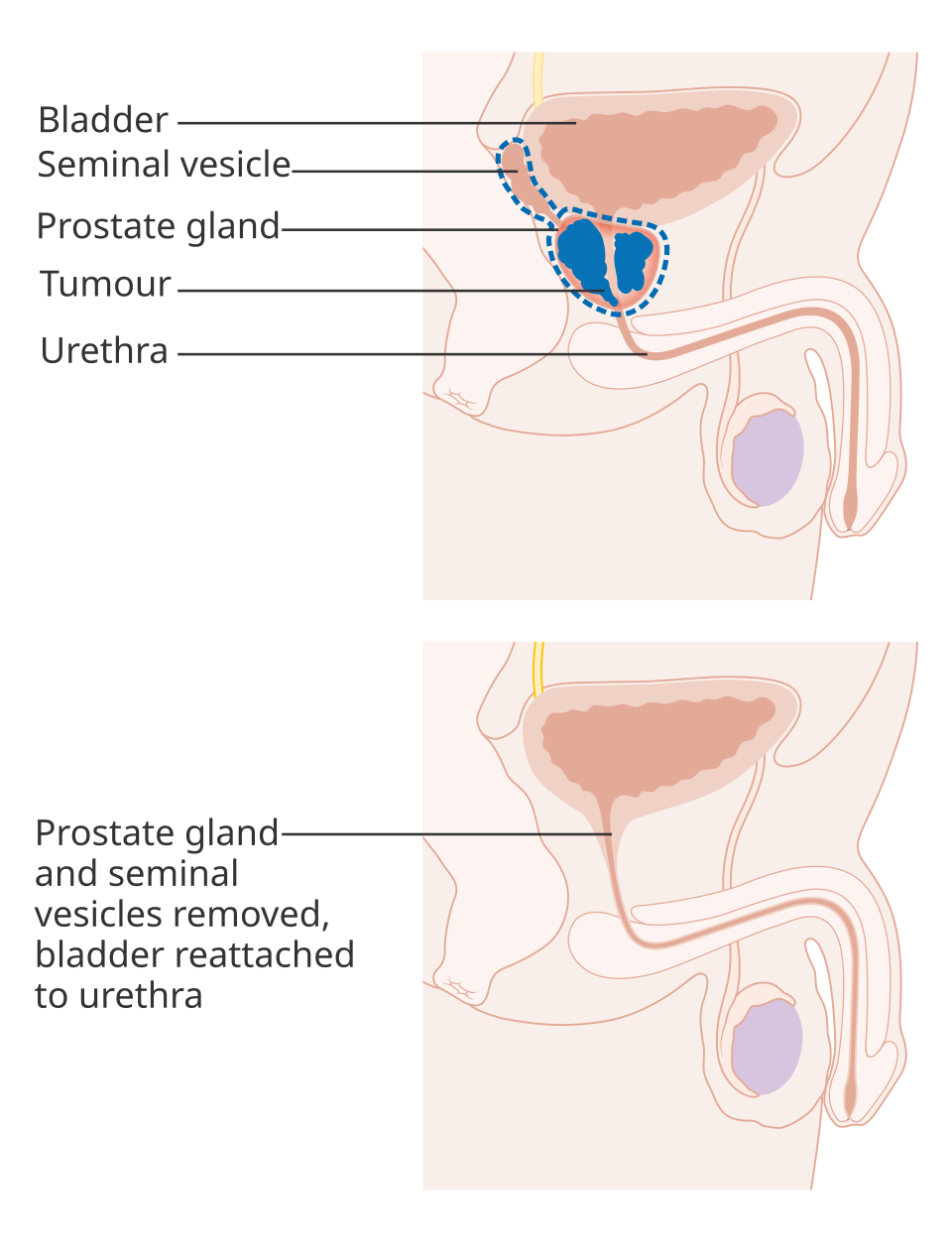
A radical prostatectomy removes the whole prostate gland, usually to treat prostate cancer. The NHS lists problems getting or keeping an erection among the side effects men may experience after this operation, along with leaking urine and changes in orgasm.
Erections depend on two thin cavernous nerves that travel in “neurovascular bundles” on each side of the prostate. Even when the surgeon preserves them, they can be stretched while the prostate is moved, heated by electrocautery, deprived of blood, or inflamed. Injured nerve fibers then go through a slow process of breakdown and regrowth, which is why erections often return over many months rather than weeks.
Blood supply matters too. Some men have small accessory arteries near the prostate that feed the penis; if these are tied off, the effect on erections can be permanent. Specialists also believe that months without erections leave the erectile tissue poorly oxygenated, which may encourage scarring. That theory is the basis of penile rehabilitation, although, as explained below, it has not been proven in trials.
Source: NHS — Treatment for prostate cancer; Burnett 2006, Rev Urol — Erectile function outcomes in the current era of anatomic nerve-sparing radical prostatectomy (PMC)
Nerve-sparing surgery and your chances of recovery
Nerve-sparing techniques, which aim to preserve the nerve bundles beside the prostate, have improved erectile recovery after pelvic surgery. The American Urological Association (AUA) is clear, however, that even with nerve-sparing techniques many men will still have erectile dysfunction. The National Cancer Institute notes that nerve-sparing surgery can sometimes prevent these problems, but not always.
According to the EAU, the main factors that predict whether erections return are:
- Age: younger men recover more often. In a meta-analysis of 22 studies, men under 60 recovered erectile function more often than men aged 60 or older (77% vs 61%).
- Erections before surgery: men with strong erections before the operation start from a better baseline.
- Nerve preservation: whether one, both or neither nerve bundle could be saved.
- Surgeon and hospital volume: experience with the operation influences results.
Robotic, laparoscopic and open surgery are often compared. The same meta-analysis found similar recovery for open and laparoscopic surgery, and a higher rate in only two robotic series, but the EAU describes the evidence comparing robotic and open prostatectomy for erections as inconclusive. The EAU also notes that rates of unassisted recovery, generally 20–25% in most studies, have not substantially improved for two decades.
Source: AUA — Erectile Dysfunction: AUA Guideline (2018); National Cancer Institute — Sexual Health Issues in Men with Cancer; Tal et al. 2009, J Sex Med — Erectile function recovery rate after radical prostatectomy: a meta-analysis (PubMed)
Recovery timeline: what to expect month by month
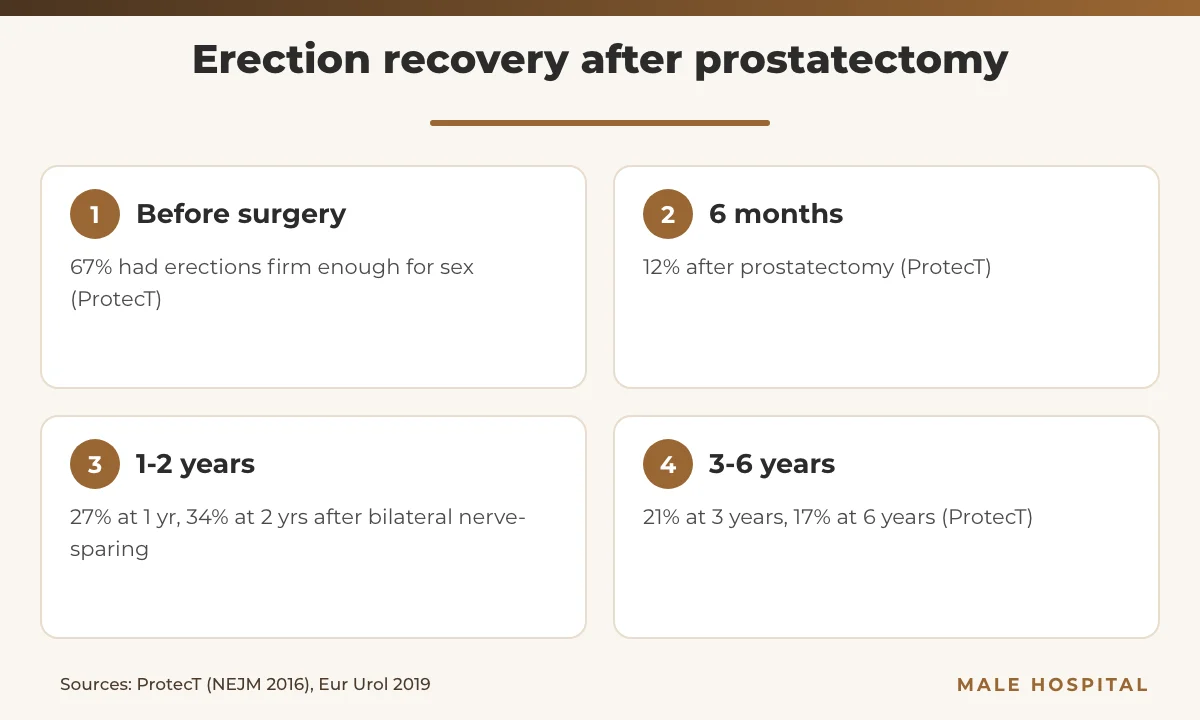
Published recovery rates vary because studies define “recovery” differently, but the pattern is consistent: function drops sharply after surgery and improves slowly over the following one to two years.
The first weeks
Most men stay in hospital for 1 to 4 days, and a urinary catheter stays in for a few days to a few weeks. Erections are usually absent or weak at this stage. Many urologists discuss starting pro-erectile treatment early; the EAU gives a weak recommendation to begin it at the earliest opportunity after surgery.
Six months
The ProtecT trial, which randomized UK men with localized prostate cancer, offers the clearest patient-reported picture. Before treatment, 67% of men reported erections firm enough for intercourse. Six months after prostatectomy, only 12% did.
One to three years
Nerve recovery continues well beyond the first year. In one prospective series, maximal recovery was not reached until 18 months after surgery, and many men need as long as two years or more. At a major US cancer center, 27% of men who had bilateral nerve-sparing surgery had recovered erectile function at 1 year and 34% at 2 years. In ProtecT, the prostatectomy group improved to 21% with erections firm enough for intercourse at 3 years.
Beyond three years
Further gains are possible but less likely, and age-related decline continues. In ProtecT, 17% of men in the prostatectomy group reported erections firm enough for intercourse at 6 years. These figures describe unassisted erections; many more men can have sex with treatment.
Source: MedlinePlus — Radical prostatectomy; Donovan et al. 2016, NEJM — Patient-reported outcomes after monitoring, surgery, or radiotherapy for prostate cancer (ProtecT, PMC); Capogrosso et al. 2019, Eur Urol — Are we improving erectile function recovery after radical prostatectomy? (PMC)
Penile rehabilitation: what the evidence really shows
Penile rehabilitation means using erection-producing treatments on a schedule soon after surgery, whether or not you plan to have sex, to protect the erectile tissue while the nerves heal. It makes sense biologically, but the strongest evidence is disappointing for the goal of bringing natural erections back.
Scheduled PDE5 inhibitor tablets
Sildenafil, tadalafil and vardenafil have been studied most because they are easy to take. Large trials tell a consistent story:
- Vardenafil (628 men): nightly or on-demand vardenafil did not increase the share of men with good erections after a two-month drug-free washout, although on-demand use improved erections during treatment.
- Tadalafil, REACTT (423 men): after a six-week washout, 20.9% on daily tadalafil, 16.9% on on-demand tadalafil and 19.1% on placebo had good unassisted function. Daily tadalafil did give the best drug-assisted erections and reduced penile length loss by about 4 mm at 9 months versus placebo.
- Nightly sildenafil: a small trial that was stopped early found spontaneous erections in 27% of men on sildenafil versus 4% on placebo, but only 76 men completed it.
A Cochrane review of eight randomized trials (1,699 men) concluded, on mostly very-low-quality evidence, that scheduled PDE5 inhibitors may not improve potency or erectile function any more than taking them on demand. The AUA advises telling men that early PDE5 inhibitor use may not improve spontaneous, unassisted erections, and the EAU states that available data do not support any specific rehabilitation regimen.
Sources: Montorsi et al. 2008, Eur Urol — Nightly versus on-demand vardenafil after nerve-sparing prostatectomy (PubMed); Montorsi et al. 2014, Eur Urol — Tadalafil after bilateral nerve-sparing radical prostatectomy (REACTT, PubMed); Padma-Nathan et al. 2008, Int J Impot Res — Nightly sildenafil after nerve-sparing prostatectomy (PubMed); Philippou et al. 2018, Cochrane — Penile rehabilitation for postprostatectomy erectile dysfunction (PubMed)
Vacuum erection devices
A vacuum device draws blood into the penis, and a ring at the base holds the erection. In a randomized study of 109 men, daily use began about four weeks after surgery; 80% of users managed intercourse with the device, and fewer reported a loss of penile length and girth than men who were only observed. The EAU describes early vacuum use as having an excellent therapeutic effect after prostatectomy and notes advantages when combined with tablets. Read more in our guide to the vacuum erection device.
Penile injections and urethral alprostadil
Injections of alprostadil (or drug mixtures) into the side of the penis work directly on the erectile tissue, so they do not depend on healed nerves. The EAU reports overall efficacy above 70%, but many men stop, with drop-out rates of 41–68%. Alprostadil pellets placed in the urethra are less effective, with long-term adherence of about 30%. Our article on penile injections for erectile dysfunction explains the technique and side effects.
Other approaches
Low-intensity shockwave therapy and pelvic floor training with biofeedback are being studied after prostatectomy, but the EAU rates the evidence as low or still awaiting better trials. Psychological and couples support is also part of good rehabilitation, because sudden, severe erectile loss commonly brings depression, anxiety and relationship stress.
Sources: Raina et al. 2006, Int J Impot Res — Early use of vacuum constriction device after radical prostatectomy (PubMed); EAU — Sexual and Reproductive Health Guidelines: Management of erectile dysfunction; AUA — Erectile Dysfunction: AUA Guideline (2018)
Treating erectile dysfunction after prostatectomy step by step
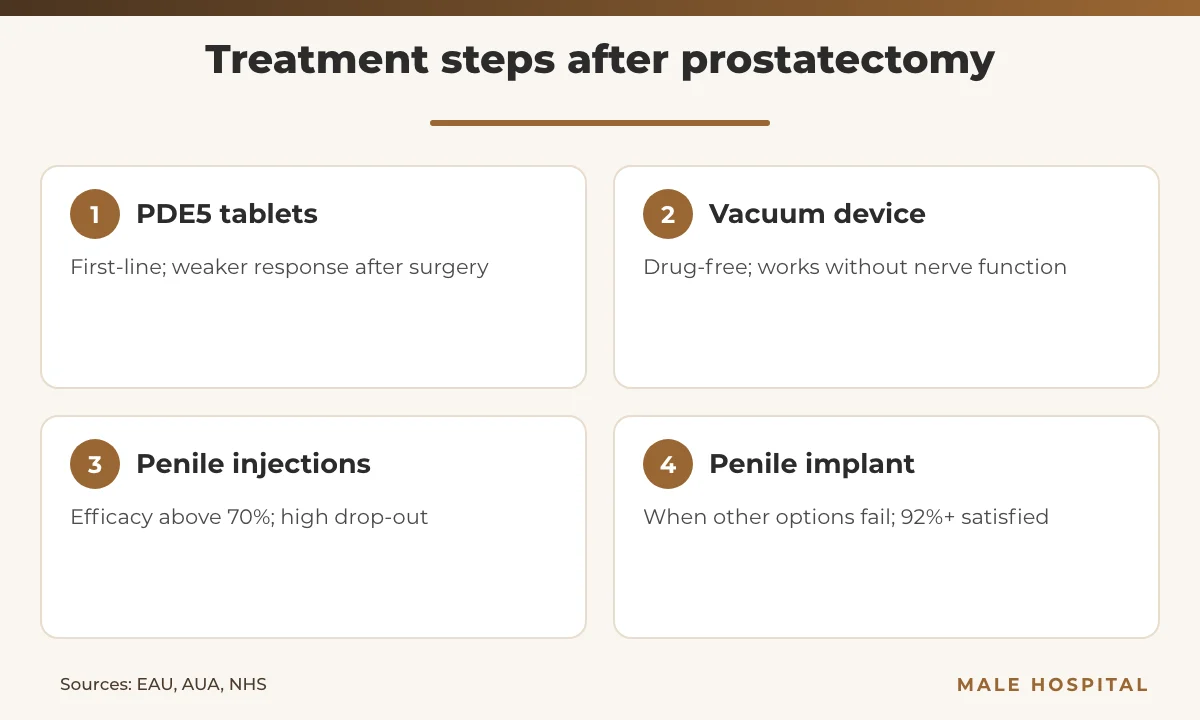
Even if rehabilitation does not speed natural recovery, treatment lets you stay sexually active while you wait, and it is the main way most men manage erectile dysfunction after prostatectomy over the long term. Guidelines use a stepwise approach tailored to your preferences.
The AUA notes that men who have had a prostatectomy tend to have more severe erectile dysfunction and respond less strongly to tablets than the general population, so it is normal to need a higher dose, a different drug or a second-line option. The NHS describes PDE5 inhibitors (sildenafil, tadalafil, vardenafil and avanafil) as the main treatments and vacuum pumps as an option when medicines are unsuitable or do not work.
| Option | Guideline position (EAU) | What the evidence shows | Main drawbacks |
|---|---|---|---|
| PDE5 inhibitor tablets | First-line (strong) | First choice after nerve-sparing surgery; help drug-assisted erections | Weaker response after surgery; not with nitrates |
| Vacuum erection device | Option for drug-free management (weak) | Works without nerve function; may limit length loss | Satisfaction varies widely between men |
| Penile injections | Alternative first-line or second-line (strong) | Overall efficacy above 70% | Needles, drop-out 41–68%, risk of prolonged erection |
| Urethral or topical alprostadil | Alternative first-line for selected men (weak) | Success 30–65.9% in general ED groups | Urethral discomfort; adherence about 30% |
| Penile implant | When other treatments fail or by preference (strong) | Satisfaction at least 92% (men), 91% (partners) | Requires surgery; infection 1–3% |
Sources: EAU — Sexual and Reproductive Health Guidelines: Management of erectile dysfunction; NHS — Erectile dysfunction (impotence): treatment; AUA — Erectile Dysfunction: AUA Guideline (2018)
Penile implants when other options fail
If tablets, a vacuum device and injections do not give satisfactory erections, or if you simply prefer a permanent solution, the EAU strongly recommends a penile prosthesis after full counseling. The implant sits inside the erectile chambers, so it works regardless of nerve damage. The NCI describes two main types for men after cancer treatment: a firm (malleable) rod or an inflatable device, which is pumped up for sex and deflated afterwards.
Results are among the best in sexual medicine. Across all indications, the EAU reports satisfaction of at least 92% in patients and 91–95% in partners. Device survival is 93.3% at 1 year, 87.2% at 5 years and 76.8% at 10 years. Infection affects 2–3% of men, falling to 1–2% with antibiotic- or hydrophilic-coated devices, and the EAU found no difference in efficacy or safety between implant types or surgical approaches.
Timing is a personal decision. Because natural recovery can continue for up to two years, some men prefer to see how far their erections return first, while others choose an implant sooner after a frank discussion with their urologist. Learn more about the procedure on our penile prosthesis surgery page and in our guide to the inflatable penile prosthesis.
Source: EAU — Sexual and Reproductive Health Guidelines: Management of erectile dysfunction; National Cancer Institute — Sexual Health Issues in Men with Cancer
Other sexual changes after prostate removal
Erections are only part of the picture, and the EAU strongly recommends that men be told about other changes before and after prostate cancer treatment:
- No ejaculation: orgasm becomes “dry”, without semen. The NHS notes that men cannot father children through sex after a prostatectomy; ask about sperm banking before surgery if fertility matters.
- Orgasm changes: some men find orgasm harder to reach or different in sensation.
- Lower desire: reduced sexual interest is one of the changes men should be warned about.
- Penile length and shape: men may notice a shorter penis or new curvature resembling Peyronie’s disease. Early treatment with daily tadalafil or a vacuum device has been linked to less length loss in trials.
Erectile dysfunction after prostatectomy can strain a relationship, so involving your partner and seeking counseling when needed are part of good care.
Sources: EAU — Sexual and Reproductive Health Guidelines: Management of erectile dysfunction; NHS — Treatment for prostate cancer; Montorsi et al. 2014, Eur Urol — REACTT (PubMed)
When to see a doctor
Talk to your urologist or an andrologist if:
- You have no useful erections a few months after surgery and have not yet been offered treatment.
- Tablets at the full prescribed dose are not working, or side effects stop you using them.
- You notice new penile curvature, a painful lump or obvious shortening.
- Erection problems are causing low mood, anxiety or relationship difficulties.
- You are considering an implant and want to know if you are a good candidate.
Get emergency care if an erection lasts more than 3 to 4 hours, which can happen with injections or other ED treatments. Do not take sildenafil or similar tablets with nitrates such as GTN unless a doctor has approved it, and call emergency services if you have chest pain during sex.
Sources: NHS — Priapism; NHS — Sildenafil (Viagra)
If you are dealing with erection problems after prostate surgery, you can arrange a confidential assessment with our urologist-andrologist Assoc. Prof. Dr. Zülfü Sertkaya, whose focus includes penile prosthesis surgery. Message us on WhatsApp for a free initial consultation; any cost depends on your assessment and chosen treatment.
FAQs about erectile dysfunction after prostatectomy
How long does erectile dysfunction last after prostatectomy?
It varies from months to permanently. Nerve healing is slow, and many men need up to two years or longer to regain satisfactory function, with maximal recovery seen around 18 months in one series. Some men never recover unassisted erections, but treatment can still allow sex.
Source: Burnett 2006, Rev Urol (PMC)
Is erectile dysfunction after prostatectomy permanent?
Not always. The EAU reports that 25–75% of men have erectile dysfunction after surgery, and in the ProtecT trial erections firm enough for intercourse rose from 12% at 6 months to 21% at 3 years in the surgery group. For men who do not recover, effective treatments, including implants, remain available.
Source: Donovan et al. 2016, NEJM — ProtecT patient-reported outcomes (PMC)
Does nerve-sparing surgery guarantee my erections will come back?
No. Nerve-sparing techniques have improved recovery rates, but the AUA notes that many men still experience erection problems after pelvic surgery even when nerves are preserved. Age, erections before surgery and surgical experience also strongly influence the outcome.
Source: AUA — Erectile Dysfunction: AUA Guideline (2018)
Should I take Viagra or Cialis every day after prostatectomy?
Daily tablets are widely offered and help erections during treatment, but trials and a Cochrane review found scheduled use does not clearly restore natural erections better than taking a tablet on demand. Discuss with your urologist which schedule suits you; daily tadalafil may help limit penile length loss.
Source: Philippou et al. 2018, Cochrane (PubMed)
When can I start penile rehabilitation after surgery?
The EAU suggests starting pro-erectile treatment at the earliest opportunity after prostatectomy; your surgeon will advise when it is safe to begin. In one randomized study, men began using a vacuum device at an average of about four weeks after surgery.
Source: Raina et al. 2006, Int J Impot Res (PubMed)
Do penile injections work after prostate removal?
Yes. Because they act directly on the erectile tissue, injections work even when nerve function is poor. The EAU reports overall efficacy above 70%, although many men stop using them over time because of needles, pain or loss of spontaneity.
Source: EAU — Management of erectile dysfunction
Can I still have an orgasm after prostatectomy?
Orgasm can still happen, but it is “dry” because no semen is ejaculated once the prostate is removed. The NHS notes that some men have difficulty reaching orgasm after surgery. You also cannot father a child through sex afterwards, so ask about sperm banking beforehand if fertility matters.
Sources: NHS — Treatment for prostate cancer; National Cancer Institute — Sexual Health Issues in Men with Cancer
When is a penile implant the right choice after prostatectomy?
Guidelines recommend an implant when tablets, vacuum devices and injections fail or are unacceptable, or when a well-informed man prefers it. It does not rely on the nerves, and satisfaction rates in men and partners are above 90% in most reports.
Source: EAU — Management of erectile dysfunction
Medically reviewed by Assoc. Prof. Dr. Zülfü Sertkaya, urologist and andrologist (FEBU), Istanbul. Last reviewed: November 2026.
This article is for general information and does not replace an individual consultation with a qualified doctor.
- EAU — Sexual and Reproductive Health Guidelines: Management of erectile dysfunction
- AUA — Erectile Dysfunction: AUA Guideline (2018)
- NHS — Treatment for prostate cancer
- NHS — Erectile dysfunction (impotence): treatment
- NHS — Priapism
- NHS — Sildenafil (Viagra)
- National Cancer Institute — Sexual Health Issues in Men with Cancer
- MedlinePlus — Radical prostatectomy
- NEJM (PMC) — Donovan et al. 2016, Patient-reported outcomes after monitoring, surgery, or radiotherapy for prostate cancer (ProtecT)
- European Urology (PMC) — Capogrosso et al. 2019, Are we improving erectile function recovery after radical prostatectomy?
- Reviews in Urology (PMC) — Burnett 2006, Erectile function outcomes in the current era of anatomic nerve-sparing radical prostatectomy
- Cochrane (PubMed) — Philippou et al. 2018, Penile rehabilitation for postprostatectomy erectile dysfunction
- J Sex Med (PubMed) — Tal et al. 2009, Erectile function recovery rate after radical prostatectomy: a meta-analysis
- European Urology (PubMed) — Montorsi et al. 2014, Tadalafil after bilateral nerve-sparing radical prostatectomy (REACTT)
- European Urology (PubMed) — Montorsi et al. 2008, Nightly versus on-demand vardenafil after nerve-sparing prostatectomy
- Int J Impot Res (PubMed) — Padma-Nathan et al. 2008, Nightly sildenafil after bilateral nerve-sparing radical prostatectomy
- Int J Impot Res (PubMed) — Raina et al. 2006, Early use of vacuum constriction device after radical prostatectomy