Penile implant complications are uncommon, but they matter because the device sits inside the penis for many years. The main risks are infection, erosion of a cylinder through the tissue, mechanical failure that needs a replacement device, autoinflation, glans problems such as a “floppy” glans, and the feeling that the penis is shorter. Knowing the real rates, the warning signs and what can be done helps you decide calmly and act fast if something goes wrong. For the full picture of the operation itself, see our penile prosthesis surgery page.
Source: EAU Guidelines — Management of erectile dysfunction; PubMed — Scherzer et al., Penile prosthesis complications: planning, prevention, and decision making (2019)
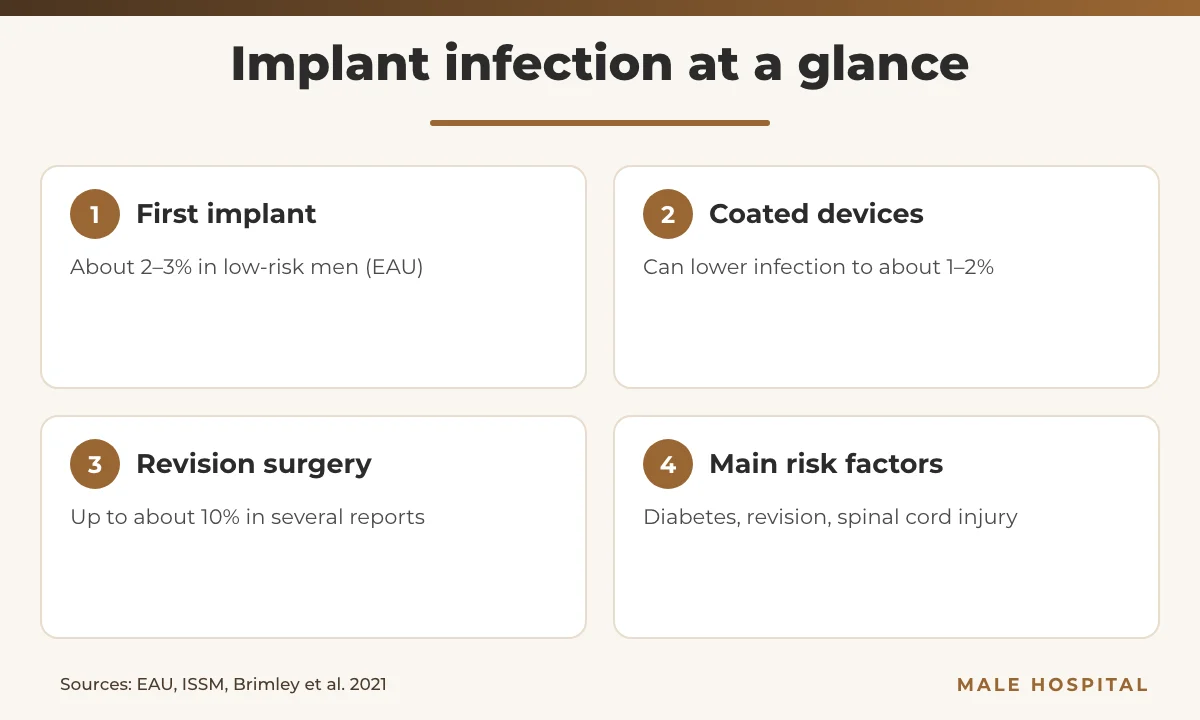
- European guidelines report infection in about 2–3% of first implants in low-risk men, falling to 1–2% with coated devices; revision surgery carries a clearly higher risk.
- Erosion is reported in roughly 1–6% of cases, and mechanical failure in under 5% of modern three-piece devices at five years.
- About 87% of devices are still working at five years and about 77% at ten years in a pooled analysis, so a later replacement is possible.
- Diabetes, revision surgery, spinal cord injury and low testosterone are linked to higher infection risk.
- Fever, increasing pain, redness, discharge, or a pump stuck to the scrotal skin need same-day medical review.
- How common are penile implant complications?
- Infection: the most serious penile implant complication
- Erosion and impending erosion
- Mechanical failure and device lifespan
- Autoinflation and pump or reservoir problems
- Glans problems: floppy glans and SST deformity
- Length perception: “it feels shorter”
- Bleeding, swelling and pain in the first weeks
- How to reduce the risk of penile implant complications
- When to see a doctor
- FAQs about penile implant complications
How common are penile implant complications?
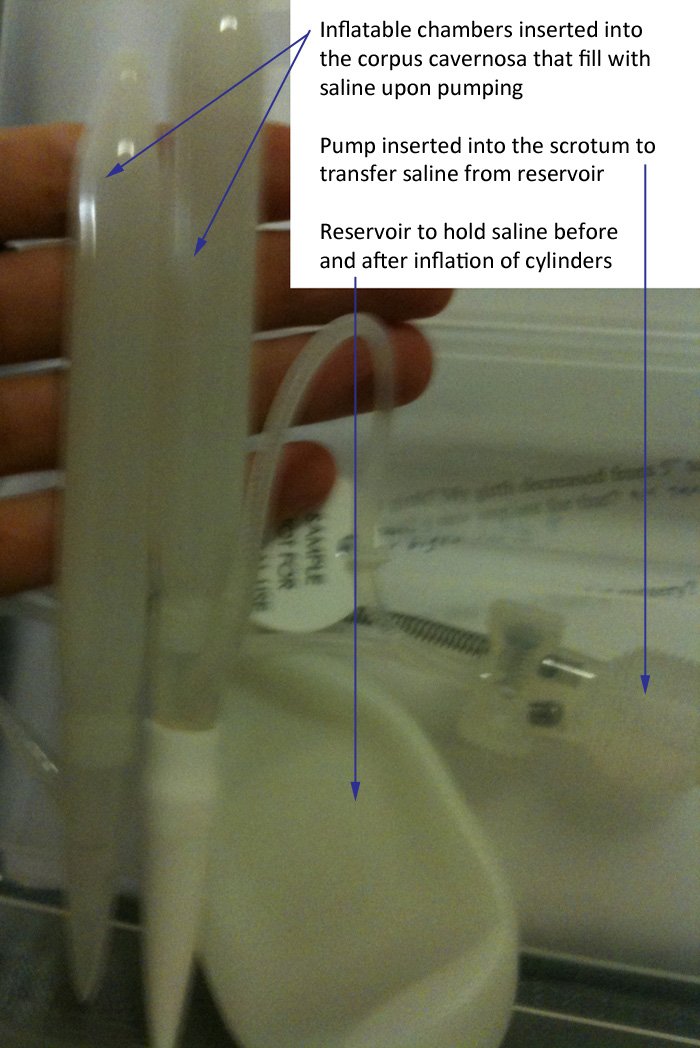
A penile prosthesis is usually offered when tablets, injections or a vacuum device have not worked or are not suitable. The most common type today is the three-piece inflatable implant: two cylinders inside the erectile bodies, a small pump in the scrotum and a fluid reservoir in the lower abdomen. More parts mean more ways the device can fail, which is why surgeons counsel men carefully about penile implant complications before surgery.
The good news is that results have improved a lot. A 2019 review of the literature from 1973 to 2018 concluded that standardized surgical technique and better devices have reduced all-cause penile implant complications to under 5% in recent reports. Satisfaction remains high: the EAU guidelines describe implants as having one of the highest satisfaction rates of any erectile dysfunction treatment, at 92 to 100 percent of patients and 91–95% of partners when men are properly counselled.
Source: PubMed — Scherzer et al., Penile prosthesis complications: planning, prevention, and decision making (2019); EAU Guidelines — Management of erectile dysfunction
Specialists usually group penile implant complications into four families: infection, tissue problems (erosion, glans issues, scarring), device problems (leaks, pump or reservoir faults, autoinflation) and dissatisfaction with how the erection looks or feels. Cleveland Clinic lists infection, erosion, mechanical failure, pump or reservoir displacement and excessive scar tissue as the main uncommon risks, and notes that a problem device can usually be revised by replacing it with a new implant.
Source: Cleveland Clinic — Penile implants
| Complication | Reported rate | Usual management |
|---|---|---|
| Infection, first implant | About 2–3% (1–2% with coated devices) | Antibiotics; removal or salvage with immediate replacement |
| Infection, revision surgery | Up to about 10%, higher in some series | Same as above; washout lowers risk |
| Erosion | About 1–6% | Surgery to remove or reposition the cylinder |
| Mechanical failure | Under 5% at 5 years (modern three-piece) | Replacement of the faulty part or whole device |
| Floppy glans / SST deformity | Up to about 5% | Glanulopexy (stitching the glans in place) if bothersome |
| Scrotal hematoma | About 0.2–3.6% | Mostly rest, elevation, compression |
Sources: EAU Guidelines — Management of erectile dysfunction; PMC — O’Rourke et al., Penile implant complications of infection, hematoma and device malfunction (2017); PMC — Ancha et al., Current devices, outcomes and pain management in penile implant surgery (2024)
Rates of penile implant complications vary between studies because centres define them differently and follow men for different lengths of time, so treat these figures as ranges rather than personal predictions. Your own risk depends on your health, your history and your surgeon’s experience.
Infection: the most serious penile implant complication
Among penile implant complications, infection is the one surgeons fear most, because bacteria can form a protective film (biofilm) on the device that antibiotics alone rarely clear. According to the EAU guidelines, careful technique with antibiotic prophylaxis has reduced infection to 2–3% after a first implant in low-risk men, and an antibiotic-impregnated or hydrophilic-coated device can lower this further to 1–2%. One series combining coated implants with a “no-touch” technique reported a rate as low as 0.46%.
Source: EAU Guidelines — Management of erectile dysfunction; PMC — O’Rourke et al., Penile implant complications of infection, hematoma and device malfunction (2017)
Who is at higher risk?
Revision surgery (replacing or repairing an earlier implant) is the clearest risk factor for penile implant complications such as infection: infections affect about 1–3% of men getting a first implant but up to 10% of revisions, and some reviews report up to 18% in revision cases. The EAU guidelines also list diabetes, spinal cord injury and low testosterone (hypogonadism) as risk factors. A 2025 study of 597 men found diabetes and revision surgery to be the most important factors, with longer operating time also adding risk.
Sources: ISSM — Fungal IPP infections more common in diabetic and overweight men; PMC — Brimley et al., Management of inflatable penile prosthesis infection: a review (2021); ISSM — Factors that may increase chances of infection with inflatable penile prostheses
Most infections come from the patient’s own skin bacteria, mainly coagulase-negative staphylococci. Fungi are less common but not rare: in a multicenter study of infected devices, 12% involved fungi, and 88% of those men had diabetes or were overweight. If you have diabetes, our guide to erectile dysfunction and diabetes explains why good glucose control matters before any surgery.
Sources: PMC — Brimley et al., Management of inflatable penile prosthesis infection: a review (2021); ISSM — Fungal IPP infections more common in diabetic and overweight men
When infections appear and what they look like
Infectious penile implant complications mostly show up early. In one large data set, 56% appeared within the first 7 months and 36% between 7 and 12 months, while only about 2.5% appeared after 5 years. Early, low-grade infection may cause new or returning pain, warmth, redness, or a pump that feels stuck to the scrotal skin. Obvious infection brings fever, penile pain, pus from the wound or part of the device pushing through the skin.
Source: PMC — Brimley et al., Management of inflatable penile prosthesis infection: a review (2021)
What happens if the implant gets infected?
The traditional treatment is removal of the whole device, antibiotics and a wait of 3–6 months before a new implant; this delay can cause scarring and shortening. Many surgeons now prefer a “salvage” operation: the infected device is removed, the space is washed out with antiseptic solutions and a new implant is placed in the same operation. The EAU guidelines report successful salvage in more than 80% of cases. Salvage is not suitable when there is severe sepsis, dead tissue or a cylinder pushing out through the skin.
Sources: EAU Guidelines — Management of erectile dysfunction; PMC — Brimley et al., Management of inflatable penile prosthesis infection: a review (2021)
Erosion and impending erosion
Erosion, one of the more serious penile implant complications, means part of the implant, usually the tip of a cylinder or the pump, wears through the tissue that covers it. It can push toward the glans, the urethra (the urine tube) or the skin. The EAU guidelines put erosion of the distal erectile bodies, urethra or glans at 1–6% after surgery. A 2024 review, citing AUA guideline data, reported that inflatable implants erode less often (2.5%) than malleable rods (4.1%).
Sources: EAU Guidelines — Management of erectile dysfunction; PMC — Ancha et al., Current devices, outcomes and pain management in penile implant surgery (2024)
Erosion is often linked to infection, to poor blood supply in the tissue, or to cylinders that are too long and press constantly on the tip. That is one reason surgeons may choose cylinders 1–2 cm shorter than the measured length. Warning signs of “impending erosion”, among the penile implant complications that can be caught early, include thinning, shiny or discolored skin over the device, or a cylinder tip you can feel just under the glans skin. Reviews recommend watching closely for impending erosion after surgery, since early action may allow repair or salvage before the device breaks through.
Sources: ISSM — Is it common to lose length after penile implant surgery?; PubMed — Scherzer et al., Penile prosthesis complications: planning, prevention, and decision making (2019)
Mechanical failure and device lifespan
An inflatable implant is a hydraulic machine, and like any machine it can wear out, so mechanical faults are among the most frequent penile implant complications. Fluid leaks are the most common type of failure, from a cylinder, the reservoir or the connecting tubing; pump faults are less frequent. The typical sign is an erection that is softer than before, or a device that no longer inflates even with correct pumping. With modern three-piece devices the EAU guidelines report mechanical failure under 5% after five years of follow-up, and a 2022 review states that design improvements have cut device malfunction within five years to under 2%.
Sources: EAU Guidelines — Management of erectile dysfunction; PMC — Çakır et al., Advances in penile prosthesis surgery: a clinical update (2022); PMC — O’Rourke et al., Penile implant complications of infection, hematoma and device malfunction (2017)
Over a longer horizon, replacement for mechanical penile implant complications becomes more likely. A meta-analysis quoted in the EAU guidelines found device survival of 93.3% at one year, 87.2% at five years, 76.8% at ten years, 63.7% at 15 years and 52.9% at 20 years. In practice this means many men will need one replacement during their lifetime. A replacement for a purely mechanical problem is usually a planned operation, often through the same incision, with a new coated device and antiseptic washout.
Sources: EAU Guidelines — Management of erectile dysfunction; PMC — O’Rourke et al., Penile implant complications of infection, hematoma and device malfunction (2017)
Autoinflation and pump or reservoir problems
Autoinflation means the implant partly inflates on its own, without pumping. Among penile implant complications it is usually more embarrassing than dangerous, and is linked to a firm capsule of scar tissue that forms around the reservoir and squeezes fluid back into the cylinders. Small series have reported it in about 1–3% of men, and in one large series it made up 10% of all device malfunctions. Lock-out valves were added to modern reservoirs specifically to prevent it and have greatly reduced the problem, although it can still occur.
Sources: PMC — O’Rourke et al., Penile implant complications of infection, hematoma and device malfunction (2017); PMC — Çakır et al., Advances in penile prosthesis surgery: a clinical update (2022)
Regular “cycling” of the implant (fully inflating and deflating as your surgeon instructs) helps keep the capsule spacious; our article on penile implant recovery covers the usual schedule. If autoinflation persists, it may need a minor revision. Other penile implant complications involving the reservoir and pump include a pump that migrates upward in the scrotum, or a reservoir that moves out of place, which is more relevant after prostate or pelvic surgery. Blood in the urine, new urinary symptoms or bowel changes after surgery should be reported, as they can rarely signal a misplaced reservoir.
Sources: PMC — O’Rourke et al., Penile implant complications of infection, hematoma and device malfunction (2017); Cleveland Clinic — Penile implants
Glans problems: floppy glans and SST deformity
The cylinders sit in the shaft and stop just under the head of the penis (the glans). Because the glans itself is not stiffened by the implant, it can sometimes droop or wobble over the cylinder tips during an erection. This is called glans hypermobility, “floppy glans” or SST deformity, named after the drooping nose of the supersonic Concorde. A 2024 review of penile implant complications reports glans hypermobility in up to 5% of men after implant surgery. It can make penetration awkward and may cause pain for the partner.
Sources: PMC — Ancha et al., Current devices, outcomes and pain management in penile implant surgery (2024); ISSM — Is it common to lose length after penile implant surgery?
If the cause is cylinders that are too short or poorly positioned, the fix may be a revision. When the cylinders are correctly placed, a small operation called glanulopexy can stitch the glans to the end of the erectile bodies; a modified technique uses a small incision and limits handling of the tissue that carries the nerves, to protect sensation. A rarer but serious problem is loss of blood supply to the glans (glans ischemia), which reviews flag as a reason for urgent assessment. Very aggressive lengthening techniques, such as the “sliding” operation, carry a known risk of glans necrosis and are avoided by many surgeons.
Sources: PMC — Çakır et al., Advances in penile prosthesis surgery: a clinical update (2022); PubMed — Scherzer et al., Penile prosthesis complications: planning, prevention, and decision making (2019)
Length perception: “it feels shorter”
The most common complaint after implant surgery is not one of the medical penile implant complications at all but a sense that the erect penis is shorter than it used to be. A 2024 review lists perceived penile shortening as one of the main reasons for dissatisfaction after implant surgery. Studies disagree on how much real length is lost; some find a measurable reduction, while others find no significant change.
Sources: PMC — Ancha et al., Current devices, outcomes and pain management in penile implant surgery (2024); ISSM — Is it common to lose length after penile implant surgery?
Several things explain the gap between feeling and ruler. Years of weak erections can shrink the erectile tissue before surgery. Peyronie’s disease, low testosterone and prostate cancer treatment can also reduce length. Surgeons may deliberately choose slightly shorter cylinders to lower erosion risk. And because the implant does not engorge the glans, the erection can feel less full even when measurements are unchanged; ISSM notes that some men who feel shorter actually have the same measurements as before.
Source: ISSM — Is it common to lose length after penile implant surgery?
Practical steps help: measure your stretched length before and after surgery, use a vacuum device before and after if advised, start cycling the implant as soon as your surgeon allows, and follow the rehabilitation plan. Our detailed guide to penile implant size explains the research on length and girth.
Source: ISSM — Is it common to lose length after penile implant surgery?
Bleeding, swelling and pain in the first weeks
Some swelling, bruising and soreness are expected and are not true penile implant complications. Cleveland Clinic says pain, swelling and discomfort generally ease after about a week, though tenderness can last up to six weeks. A collection of blood in the scrotum (hematoma) is reported in about 0.2–3.6% of cases; most settle with rest, scrotal elevation, compression and ice, and only some need surgical drainage.
Sources: Cleveland Clinic — Penile implants; PMC — O’Rourke et al., Penile implant complications of infection, hematoma and device malfunction (2017)
To lower the risk of hematoma, one of the early penile implant complications, reviews suggest limiting antiplatelet medicines where it is safe to do so, using a compressive dressing, placing a drain when indicated and leaving the device partly inflated for a short time after surgery. Never stop a blood thinner on your own: the decision belongs to your surgeon and the doctor who prescribed it. Pain that is getting worse instead of better after the first week is not normal and should be checked, because it can be an early sign of infection.
Sources: PubMed — Scherzer et al., Penile prosthesis complications: planning, prevention, and decision making (2019); PMC — Brimley et al., Management of inflatable penile prosthesis infection: a review (2021)
How to reduce the risk of penile implant complications
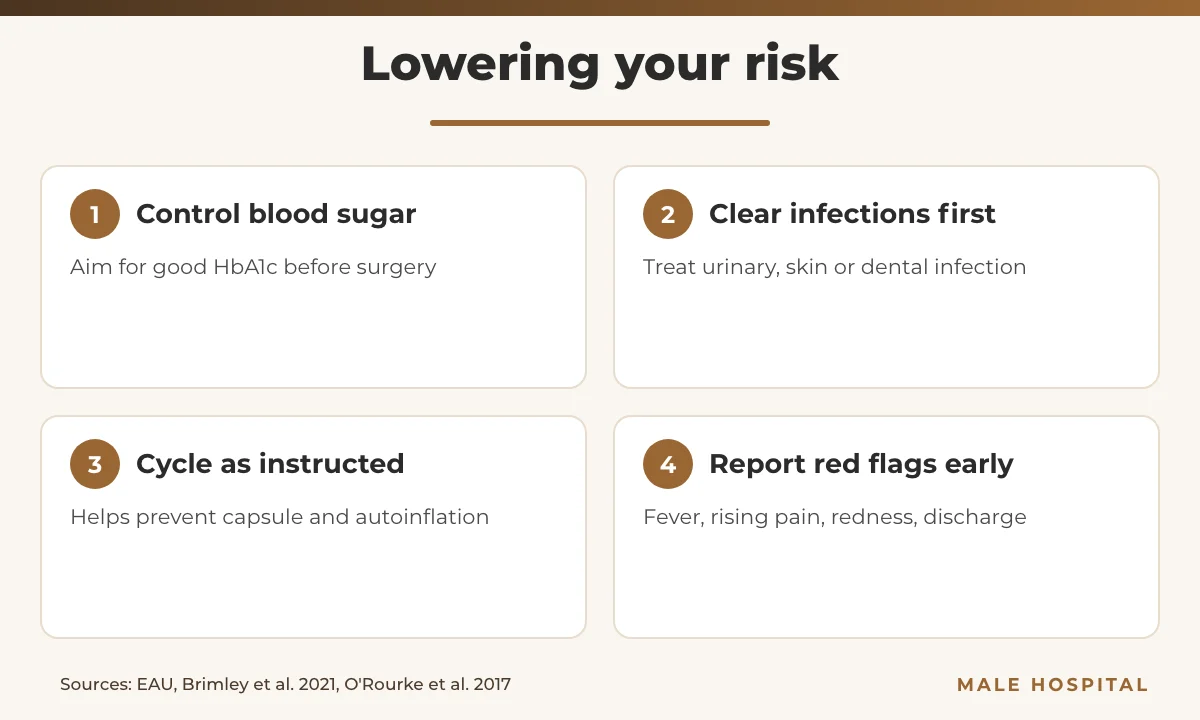
Preventing penile implant complications is shared between you and the surgical team. On the team’s side, the EAU guidelines support antibiotic prophylaxis, coated devices and protocols that limit wound exposure and skin contact with the implant. Men who carry Staphylococcus aureus in the nose can be treated beforehand with mupirocin and chlorhexidine; in one study this cut surgical site infection from 4.4% to 0.9%. Higher-volume implant surgeons also have lower infection rates.
Sources: EAU Guidelines — Management of erectile dysfunction; PMC — Çakır et al., Advances in penile prosthesis surgery: a clinical update (2022)
On your side, the most useful steps are:
- Control blood sugar. Infection reviews include an HbA1c target of about 7% or lower in pre-operative checklists, although the evidence linking HbA1c to infection is mixed.
- Treat any active infection first, including urinary, skin or dental infections, before the operation.
- Disclose everything: previous implants, pelvic or prostate surgery, Peyronie’s disease, spinal cord injury and all medicines.
- Follow wound and cycling instructions exactly, and keep every follow-up visit.
- Set realistic expectations about length, glans fullness and sensation before surgery.
Sources: PMC — Brimley et al., Management of inflatable penile prosthesis infection: a review (2021); PubMed — Scherzer et al., Penile prosthesis complications: planning, prevention, and decision making (2019)
If you also have Peyronie’s disease, the curve may need to be straightened during the same operation; our Peyronie’s disease treatment page explains the options. Choosing a surgeon who performs implants regularly is one of the most practical ways to lower your risk of penile implant complications.
When to see a doctor
Contact your surgeon the same day, or go to an emergency department, if you notice any of the following after implant surgery, whether it is days or years later:
- Fever of 38°C (100°F) or higher, chills or feeling generally unwell.
- Pain that is increasing instead of improving, or new pain months after surgery.
- Redness, warmth, swelling or pus from the incision.
- Heavy bleeding from the wound or rapidly growing scrotal swelling.
- Thin, shiny or dark skin over the pump or cylinder tip, or any part of the device visible through the skin.
- A pump that feels fixed to the scrotal skin.
- Blood in the urine, difficulty passing urine, or a cold, dark or painful glans.
Sources: Cleveland Clinic — Penile implants; PMC — Brimley et al., Management of inflatable penile prosthesis infection: a review (2021)
Less urgent penile implant complications, such as an implant that will not fully inflate or deflate, partial autoinflation, a drooping glans or concern about length, still deserve a planned review with your implant surgeon.
If you are considering an implant or worried about one you already have, you can get a confidential consultation with our urologist-andrologist on WhatsApp. You can also read more about penile prosthesis surgery in Istanbul.
FAQs about penile implant complications
What is the most common penile implant complication?
Over the long term, mechanical wear is the most frequent reason for another operation, with fluid leaks the commonest fault. In the early months, infection is the most important of the penile implant complications. European guidelines estimate infection at about 2–3% after a first implant in low-risk men and mechanical failure under 5% at five years with modern three-piece devices.
Sources: EAU Guidelines — Management of erectile dysfunction; PMC — O’Rourke et al., Penile implant complications of infection, hematoma and device malfunction (2017)
How do I know if my penile implant is infected?
Early signs of infectious penile implant complications include new or returning pain, warmth, redness, swelling, or a pump that seems stuck to the scrotal skin. Clear infection causes fever, pus from the wound or part of the device pushing through. Most infections appear within the first year. Any of these signs needs prompt review by your implant surgeon, not a wait-and-see approach.
Source: PMC — Brimley et al., Management of inflatable penile prosthesis infection: a review (2021)
Can an infected penile implant be saved?
Antibiotics alone rarely cure infectious penile implant complications, because bacteria form a protective film on the implant. In a salvage operation the device is removed, the space is thoroughly washed and a new implant is placed at the same time. The EAU guidelines report salvage success in more than 80% of cases, but it is not suitable with severe sepsis or dead tissue.
Source: EAU Guidelines — Management of erectile dysfunction
How long does a penile implant last before it fails?
Many devices last a decade or more. A meta-analysis cited by the EAU guidelines found about 87% of implants still working at five years, about 77% at ten years and about 53% at 20 years. When a device fails, it can usually be replaced with a new one in a planned operation.
Source: EAU Guidelines — Management of erectile dysfunction
Why does my implant inflate on its own?
This is called autoinflation, one of the mechanical penile implant complications. It usually happens when scar tissue forms tightly around the reservoir and pushes fluid back into the cylinders. Modern reservoirs have lock-out valves that greatly reduce it. Regular cycling as instructed helps, and if it persists your surgeon can assess whether a minor revision is needed.
Why does the head of my penis stay soft or droop?
The implant stiffens the shaft, not the glans, so the head is naturally softer than in a natural erection. If the glans droops over the cylinder tips (floppy glans or SST deformity), this is reported in up to 5% of men. If it is bothersome, a small operation called glanulopexy can fix the glans in place, or the cylinders can be revised.
Source: PMC — Ancha et al., Current devices, outcomes and pain management in penile implant surgery (2024)
Does diabetes increase the risk of penile implant complications?
Yes. Diabetes is one of the best-documented risk factors for implant infection in European guidelines and in recent studies, and fungal infections are especially linked to diabetes and excess weight. Good glucose control before surgery is part of most pre-operative checklists, and men with diabetes should discuss their personal risk in detail with their surgeon.
Source: ISSM — Factors that may increase chances of infection with inflatable penile prostheses
Is a revision operation riskier than the first implant?
Yes. Infection rates are clearly higher in revision surgery, reaching about 10% in several reports compared with roughly 1–3% for a first implant. Washing the space with antiseptic solutions during revision lowers this risk. Scar tissue from the first operation can also make the surgery technically harder, so experience matters.
Medically reviewed by Assoc. Prof. Dr. Zülfü Sertkaya, urologist and andrologist (FEBU), Istanbul. Last reviewed: October 2026.
This article is for general information and does not replace an individual consultation with a qualified doctor.
- EAU Guidelines — Sexual and Reproductive Health — Management of erectile dysfunction
- Cleveland Clinic — Penile implants
- ISSM — Is it common to lose length after penile implant surgery?
- ISSM — Fungal IPP infections more common in diabetic and overweight men (Gross et al., J Sex Med 2019)
- ISSM — Factors that may increase chances of infection with inflatable penile prostheses (Helo et al., J Sex Med 2025)
- PubMed (Sexual Medicine Reviews) — Scherzer et al. Penile prosthesis complications: planning, prevention, and decision making (2019)
- PMC (Transl Androl Urol) — O'Rourke et al. Prevention, identification, and management of post-operative penile implant complications of infection, hematoma, and device malfunction (2017)
- PMC (Arab Journal of Urology) — Brimley et al. Tips and tricks in the management of inflatable penile prosthesis infection: a review (2021)
- PMC (Asian Journal of Andrology) — Ancha et al. Current devices, outcomes, and pain management considerations in penile implant surgery (2024)
- PMC (Turkish Journal of Urology) — Çakır et al. Advances in penile prosthesis surgery: a clinical update (2022)