Penile injections for erectile dysfunction (intracavernosal injection therapy) deliver a small dose of a blood-vessel-widening drug through a very fine needle into the side of the penis, producing an erection within about 5 to 20 minutes. Alprostadil is the FDA-approved option, while mixtures such as trimix and bimix are compounded and used off-label. European guidelines rate penile injections as a strongly recommended choice for informed men, especially when pills do not work.
Source: EAU Guidelines — Management of erectile dysfunction; DailyMed — Caverject (alprostadil) prescribing information
- Penile injections work directly in the erectile tissue and succeed for more than 70% of men in studies, including men with diabetes or heart disease.
- Alprostadil (Caverject, Edex) is the only drug approved for injection; trimix and bimix are pharmacy-compounded mixtures that are not FDA-approved.
- The first doses are given and adjusted in a doctor’s office, where you are also trained to inject safely at home.
- The most common side effect is penile pain; an erection lasting more than 4 hours is a medical emergency.
- Many men stop penile injections within the first months, so good training, follow-up and realistic expectations matter.
- What are penile injections for erectile dysfunction?
- Alprostadil, trimix and bimix: the medicines used
- How penile injections work and how fast
- Injection technique, dosing and training
- Success rates of penile injections for erectile dysfunction
- Side effects: pain, priapism and fibrosis
- Who penile injections suit, and who should avoid them
- How injections compare with other ED treatments
- When to see a doctor
- FAQs about penile injections for erectile dysfunction
What are penile injections for erectile dysfunction?
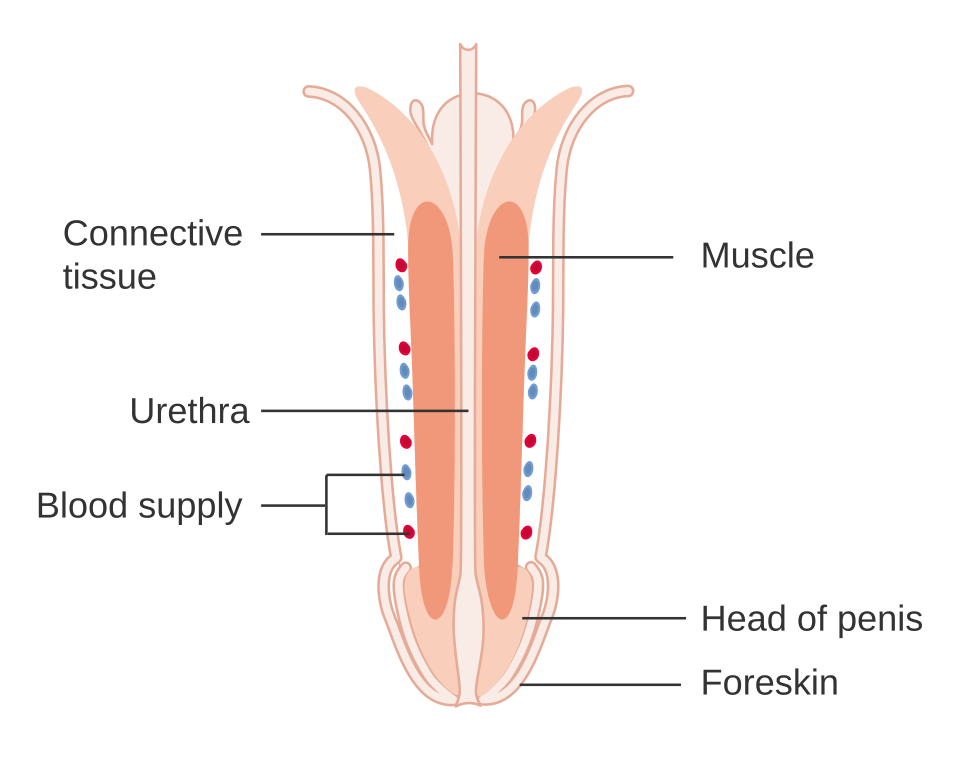
Intracavernosal means “into the corpora cavernosa,” the two spongy erectile chambers that run along the shaft of the penis and fill with blood during an erection. With penile injections, a man (or his partner) injects a vasoactive medicine directly into one of these chambers shortly before sex. The drug acts locally, so it does not need to travel through the bloodstream the way a tablet does.
Injection therapy has been part of erectile dysfunction (ED) care since it was first described in 1982. After oral PDE5 inhibitors such as sildenafil arrived in 1998, penile injections became a second-line option, but patients who use them continue to report high effectiveness and satisfaction compared with other options. They are also used by doctors as a diagnostic test, combined with Doppler ultrasound, to check penile blood flow.
Source: Belew et al. — Intracavernosal injection for ED: a review (2015); DailyMed — Caverject (alprostadil) prescribing information
Penile injections treat the symptom, not the underlying cause. They do not cure ED, increase sexual desire, or protect against pregnancy or sexually transmitted infections. If you are still working out why erections have become difficult, our guide to erectile dysfunction causes, tests and treatments is a good place to start.
Source: MedlinePlus — Alprostadil urogenital
Alprostadil, trimix and bimix: the medicines used
Several medicines can be used for penile injections, alone or as mixtures. Their regulatory status differs, which matters for quality control, cost and what your doctor can prescribe.
Alprostadil (prostaglandin E1)
Alprostadil is a synthetic form of prostaglandin E1, a substance that keeps blood vessels open. It is sold as Caverject, Caverject Impulse and Edex. The European Association of Urology (EAU) describes it as the first and only drug approved for intracavernous treatment of ED, and the Caverject label lists both treatment of ED and use as an aid in diagnosing ED as approved indications. It is most effective at doses of 5 to 40 micrograms (mcg).
Source: EAU Guidelines — Management of erectile dysfunction; Cleveland Clinic — Alprostadil: types, uses and side effects
Trimix and bimix (compounded mixtures)
Bimix combines papaverine and phentolamine; trimix adds alprostadil to these two. Neither papaverine nor phentolamine is licensed for ED, and they are rarely used alone because papaverine causes more side effects as monotherapy and phentolamine produces a poor erection by itself. In combination, the EAU reports that trimix has the highest efficacy rates of any of the penile injections, reaching 92%, with less pain than alprostadil but more fibrosis (5–10%) because of the papaverine.
Source: EAU Guidelines — Management of erectile dysfunction
Because these mixtures are prepared by compounding pharmacies, recipes and strengths vary. The FDA states that compounded drugs are not FDA-approved and that it does not verify their safety, effectiveness or quality before they are marketed. A 2019 systematic review likewise concluded that combination formulas are variable and should be standardized before they can be widely accepted. In a randomized trial comparing trimix with alprostadil, trimix gave similar rigidity and pain but longer erections and more priapism.
Source: FDA — Compounding and the FDA: Questions and Answers; Duncan et al. — Global review of intracavernosal injectables (2019); Seyam et al. — Trimix vs prostaglandin E1, randomized study (2005)
A further combination, vasoactive intestinal peptide plus phentolamine (aviptadil/phentolamine), is approved only in a few countries. According to the EAU it works in more than 80% of men, including some who failed other therapies, with little penile pain and a very low risk of priapism.
Source: EAU Guidelines — Management of erectile dysfunction; Duncan et al. — Global review of intracavernosal injectables (2019)
| Medicine | Contents | Status | What the evidence shows |
|---|---|---|---|
| Alprostadil (Caverject, Edex) | Prostaglandin E1 | FDA-approved for ED | Efficacy above 70%; pain is the main side effect |
| Bimix | Papaverine + phentolamine | Compounded, off-label | Used when alprostadil is painful or not suitable |
| Trimix | Papaverine + phentolamine + alprostadil | Compounded, off-label | Efficacy up to 92%; less pain, more fibrosis (5–10%) |
| Aviptadil/phentolamine | Vasoactive intestinal peptide + phentolamine | Approved in a few countries | Efficacy above 80%; low pain and priapism risk |
Source: EAU Guidelines — Management of erectile dysfunction; FDA — Compounding and the FDA: Questions and Answers
How penile injections work and how fast
An erection happens when the arteries of the penis widen and the erectile chambers fill with blood. Alprostadil is a vasodilator: given as one of the penile injections into the erectile tissue, it opens the blood vessels so that blood flows in and the penis becomes firm. Trimix and bimix use additional vasoactive drugs that push in the same direction.
Source: Cleveland Clinic — Alprostadil: types, uses and side effects; MedlinePlus — Alprostadil urogenital
Timing is predictable. With penile injections, an erection typically starts 5 to 20 minutes after injection and should last about 30 to 60 minutes. The EAU notes that duration depends on the dose and varies considerably between men, which is why the dose is adjusted individually rather than fixed.
Source: MedlinePlus — Alprostadil urogenital; EAU Guidelines — Management of erectile dysfunction
Because the drug acts directly in the erectile tissue, penile injections are an important option for men who cannot tolerate tablets or whose ED did not respond to them. Cleveland Clinic advises against combining alprostadil with oral ED drugs such as sildenafil, because this may increase side effects.
Source: Duncan et al. — Global review of intracavernosal injectables (2019); Cleveland Clinic — Alprostadil: types, uses and side effects
Injection technique, dosing and training
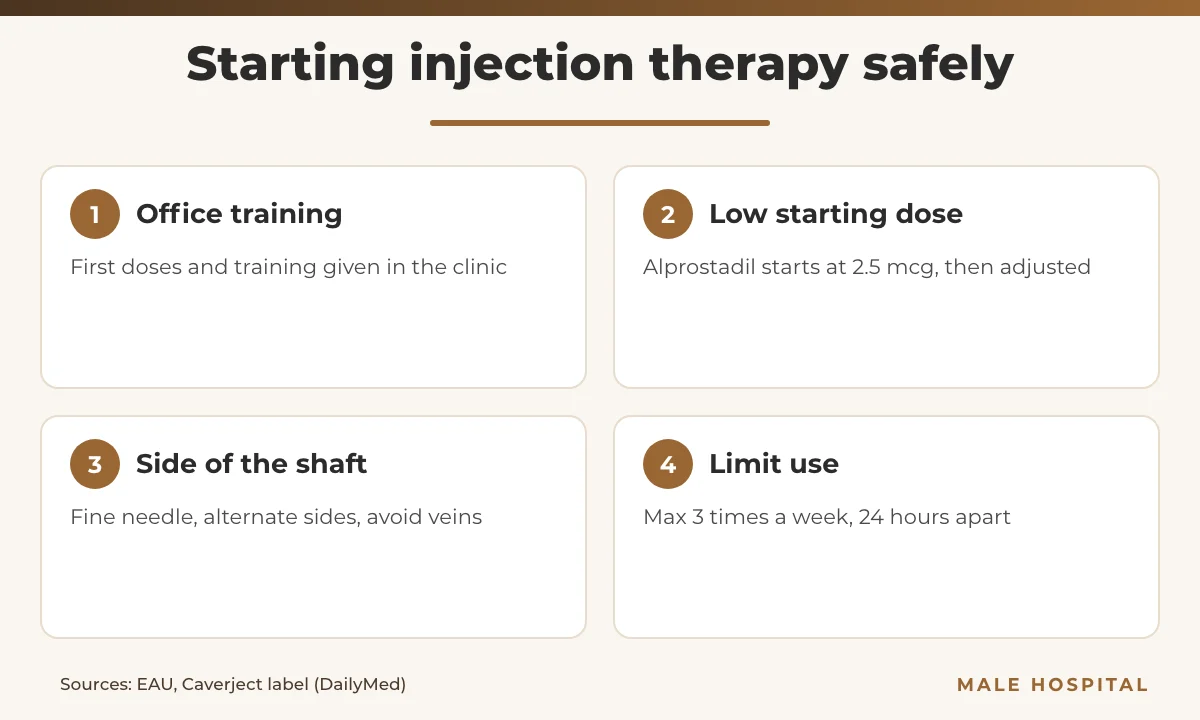
Nobody should start penile injections at home without supervision. The EAU states that an in-office training programme is needed to learn the technique, and the Caverject label specifies that the first doses and dose adjustments are done in the doctor’s office. Many men feel anxious about the first injection; a review found this in about 65% of men, with anxiety sometimes lasting around four months, so a calm, practical training session makes a real difference.
Source: EAU Guidelines — Management of erectile dysfunction; DailyMed — Caverject (alprostadil) prescribing information; Duncan et al. — Global review of intracavernosal injectables (2019)
Finding the right dose
For alprostadil, the label starts at 2.5 mcg for vascular, psychological or mixed causes and at 1.25 mcg for purely nerve-related ED such as spinal cord injury. The dose is then increased step by step, with no more than two doses in 24 hours during titration and further increases at least 24 hours apart. Doses above 60 mcg are not recommended. With penile injections, the goal is the lowest dose that gives an erection firm enough for sex without lasting too long. Doses of compounded mixtures are set by the prescribing doctor, as there is no standard formula.
Source: DailyMed — Caverject (alprostadil) prescribing information; Duncan et al. — Global review of intracavernosal injectables (2019)
How the injection is given
- A very fine, short needle is used (the Caverject label specifies 29 or 30 gauge, half an inch long).
- The injection goes into the side of the shaft, in the upper-side area of the third nearest the body, avoiding visible veins.
- The needle is inserted at a right angle to the length of the penis.
- Sides are alternated with each injection, and the site is pressed for about 5 minutes afterwards to prevent bruising.
- Needles, syringes and vials are single-use and never shared or reused.
Source: DailyMed — Caverject (alprostadil) prescribing information; MedlinePlus — Alprostadil urogenital
How often you can inject
Alprostadil injections should be used no more than three times a week, with at least 24 hours between doses. For penile injections, the label recommends a review with your doctor about every three months to check the dose, the injection sites and any side effects.
Source: DailyMed — Caverject (alprostadil) prescribing information; MedlinePlus — Alprostadil urogenital
Success rates of penile injections for erectile dysfunction
Penile injections for erectile dysfunction are among the most reliable non-surgical ED treatments. The EAU reports efficacy above 70% for alprostadil, both in the general ED population and in men with diabetes or cardiovascular disease. Satisfaction is high: 87–93.5% for patients and 86–90.3% for their partners.
Source: EAU Guidelines — Management of erectile dysfunction
In the Caverject clinical studies, more than 80% of men reported erections sufficient for intercourse. In a 6-month open-label study of 683 men, 87% of 13,762 injections led to satisfactory sexual activity. Cleveland Clinic similarly cites about 80% of men achieving an erection firm enough for intercourse. Across all agents used for penile injections, a systematic review found efficacy ranging from 54% in some studies to every patient in others, depending on the drug and the group studied.
Source: DailyMed — Caverject (alprostadil) prescribing information; Cleveland Clinic — Alprostadil: types, uses and side effects; Duncan et al. — Global review of intracavernosal injectables (2019)
Only around 5–10% of men fail to respond to combination injections, according to the EAU. Good results with penile injections are also reported in men with diabetes; our article on erectile dysfunction and diabetes explains how diabetes affects erections.
Source: EAU Guidelines — Management of erectile dysfunction
Why many men stop anyway
Effectiveness is not the same as long-term use. The EAU reports dropout rates of 41–68%, mostly within the first two to three months. A large 2025 study of 3,266 men using compounded combination injections found that only 25.4% were still using them at 6 months and 16.2% at 12 months, with older men and those treated for prostate cancer stopping sooner. Reasons reported in earlier research include a poor response, loss of interest, preferring another treatment, partner dissatisfaction, complications and natural recovery of erections.
Source: EAU Guidelines — Management of erectile dysfunction; Ledesma et al. — Continued use of intracavernosal injections (2025)
Side effects: pain, priapism and fibrosis
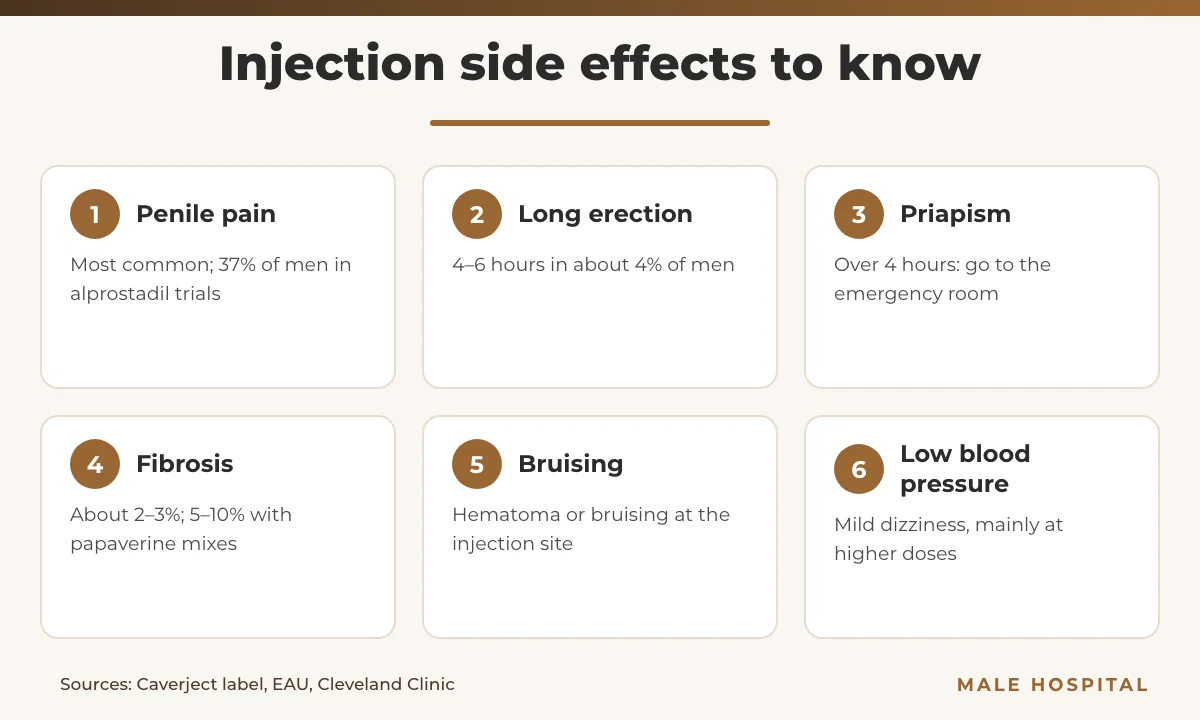
Most side effects of penile injections are local and manageable, but two of them, priapism and scarring, need to be understood before you start.
Penile pain
Pain is the most common side effect of alprostadil. In the Caverject trials, 37% of men reported penile pain at some point, while the EAU puts it at about 11% of individual injections. It is usually a mild ache rather than needle pain, and the EAU notes it can be reduced by adding sodium bicarbonate or local anesthetic. Trimix tends to cause less pain than alprostadil alone.
Source: DailyMed — Caverject (alprostadil) prescribing information; EAU Guidelines — Management of erectile dysfunction
Prolonged erection and priapism
An erection lasting 4 to 6 hours occurred in 4% of men in the Caverject studies, and priapism (longer than 6 hours) in 0.4%. The EAU reports prolonged erections in about 5% and priapism in about 1% with alprostadil, and trimix causes more priapism than alprostadil. Seek emergency care if an erection lasts more than 4 hours; Cleveland Clinic advises calling your doctor once it passes 2 hours.
Source: DailyMed — Caverject (alprostadil) prescribing information; EAU Guidelines — Management of erectile dysfunction; Seyam et al. — Trimix vs prostaglandin E1, randomized study (2005); Cleveland Clinic — Alprostadil: types, uses and side effects
Ischemic priapism after penile injections is an emergency because blood trapped in the penis loses oxygen, which can scar the erectile tissue and cause permanent ED. The AUA/SMSNA priapism guideline calls for urgent assessment and early treatment, which may include an injection of phenylephrine into the penis, draining the blood, or a minor shunt procedure.
Source: AUA/SMSNA — Acute ischemic priapism guideline (2021); DailyMed — Caverject (alprostadil) prescribing information
Fibrosis, bruising and other effects
Penile fibrosis, meaning small areas of scar tissue, occurred in 3% of men overall in the Caverject trials and 7.8% in an 18-month self-injection study. The EAU reports around 2% with alprostadil and 5–10% with papaverine-containing mixtures. Fibrosis usually clears within a few months after stopping, but scarring of the tunica (the outer sheath) may signal early Peyronie’s disease and may mean stopping injections permanently. Bruising, hematoma at the injection site and, at higher doses, mild low blood pressure or dizziness can also occur.
Source: DailyMed — Caverject (alprostadil) prescribing information; EAU Guidelines — Management of erectile dysfunction
The EAU also cites a large population study in men with existing heart disease, in which alprostadil users had more cardiovascular events than men taking PDE5 inhibitors. This does not prove the penile injections caused the events, but it is a reason for men with heart disease to plan treatment with their doctor.
Source: EAU Guidelines — Management of erectile dysfunction
Who penile injections suit, and who should avoid them
The EAU strongly recommends intracavernous injections as an alternative first-line treatment for well-informed men or as second-line therapy. In practice, penile injections are most often considered for:
- Men whose ED did not respond to tablets, or who cannot take them, for example because they use nitrates.
- Men with diabetes or cardiovascular disease, groups in which efficacy above 70% has been reported.
- Men after prostate cancer treatment, where penile injections are widely used; the EAU notes, however, that there is no evidence that “penile rehabilitation” itself speeds the return of natural erections.
- Men with nerve-related ED, such as spinal cord injury, for whom the alprostadil label gives a lower starting dose.
- Men who prefer a reliable, on-demand option and are comfortable handling a needle.
Source: EAU Guidelines — Management of erectile dysfunction; DailyMed — Caverject (alprostadil) prescribing information; Belew et al. — Intracavernosal injection for ED: a review (2015)
According to the Caverject label, alprostadil injections should not be used by men who are allergic to the drug, who have conditions that raise the risk of priapism (such as sickle cell anemia or trait, multiple myeloma or leukemia), who have penile scarring conditions such as Peyronie’s disease or cavernosal fibrosis, or who have a penile implant. The EAU adds bleeding disorders. MedlinePlus advises telling your doctor about low blood pressure, heart failure, past blood clots, fainting, and kidney, liver or lung disease before starting.
Source: DailyMed — Caverject (alprostadil) prescribing information; EAU Guidelines — Management of erectile dysfunction; MedlinePlus — Alprostadil urogenital
How injections compare with other ED treatments
Most men start with tablets because they are simple; our comparison of Viagra vs Cialis covers the main options. When tablets are not enough, penile injections offer higher efficacy than alprostadil placed in the urethra (a pellet called MUSE), which works in 30–65.9% of men and has about 30% long-term adherence, according to the EAU.
Source: EAU Guidelines — Management of erectile dysfunction
When neither pills nor penile injections give a satisfactory result, or a man prefers a permanent solution, the EAU strongly recommends a penile implant. A penile prosthesis is placed surgically inside the erectile chambers and is usually considered when other treatments fail or when a man prefers a definitive solution.
Source: EAU Guidelines — Management of erectile dysfunction
| Option | How it is used | Reported efficacy | Main drawbacks |
|---|---|---|---|
| Intracavernosal alprostadil | Injected into the side of the penis 5–20 minutes before sex | Above 70% | Pain, priapism, fibrosis, high dropout |
| Trimix (compounded) | Injected the same way | Up to 92% | Not FDA-approved; more fibrosis and priapism |
| Intraurethral alprostadil | Pellet placed in the urethra | 30–65.9% | Local pain, dizziness, low adherence |
| Penile prosthesis | Surgically implanted device | Recommended when other treatments fail | Requires surgery |
Source: EAU Guidelines — Management of erectile dysfunction
When to see a doctor
Go to an emergency department straight away if:
- An erection lasts more than 4 hours, whether or not it is painful.
- You feel faint, have a fast heartbeat, or a needle breaks inside the penis.
Contact your doctor promptly if you notice new hard lumps or nodules, a bend or unusual curve when erect, redness, swelling or tenderness, repeated bruising, or if penile injections stop working or start causing more pain.
Source: MedlinePlus — Alprostadil urogenital; Cleveland Clinic — Alprostadil: types, uses and side effects
If you are considering penile injections or they have not worked well for you, you can arrange a confidential consultation with our urologist-andrologist on WhatsApp or read more about our erectile dysfunction treatment options. Costs depend on the assessment and the treatment plan chosen.
FAQs about penile injections for erectile dysfunction
Do penile injections hurt?
The needle is very fine and most men describe the prick as minor. The more common complaint is an ache in the penis caused by the drug itself, reported by 37% of men in alprostadil trials. Your doctor can reduce it by adjusting the dose, adding a buffer or local anesthetic, or switching to a mixture such as trimix, which tends to cause less pain.
Source: DailyMed — Caverject (alprostadil) prescribing information; EAU Guidelines — Management of erectile dysfunction
How long does an erection from an injection last?
With penile injections, an erection usually begins 5 to 20 minutes after the injection and should last roughly 30 to 60 minutes. The dose is adjusted in the clinic to reach this window. An erection lasting more than 4 hours is not normal and needs emergency treatment, because prolonged trapped blood can damage the erectile tissue permanently.
Source: MedlinePlus — Alprostadil urogenital; Cleveland Clinic — Alprostadil: types, uses and side effects
Is trimix better than alprostadil?
Trimix has the highest reported efficacy, up to 92%, and usually causes less pain, so it helps men who do not respond to or cannot tolerate alprostadil. The trade-offs are that it is a compounded, non-FDA-approved product with variable formulas, and it is linked with more fibrosis and more priapism. Neither option is best for everyone.
Source: EAU Guidelines — Management of erectile dysfunction; Seyam et al. — Trimix vs prostaglandin E1, randomized study (2005)
How often can I use penile injections?
For alprostadil, the label limit is no more than three times a week, with at least 24 hours between injections. Alternate sides each time and avoid visible veins to lower the risk of bruising and scarring. Your doctor should review you about every three months to check the dose and look for nodules or curvature.
Source: DailyMed — Caverject (alprostadil) prescribing information
Can I use injections after prostate cancer surgery?
Yes, penile injections are widely used after radical prostatectomy and work through a direct effect on the erectile tissue. Be aware that the EAU finds no evidence that early “penile rehabilitation” itself increases the chance of natural erections returning, and men treated for prostate cancer tend to stop injections sooner, so plan follow-up with your urologist.
Source: Belew et al. — Intracavernosal injection for ED: a review (2015); EAU Guidelines — Management of erectile dysfunction; Ledesma et al. — Continued use of intracavernosal injections (2025)
Can I combine injections with Viagra or Cialis?
Not without your doctor’s explicit advice. Cleveland Clinic warns that combining alprostadil with oral ED drugs such as sildenafil may increase side effects. Ask before mixing penile injections with any other ED treatment.
Source: Cleveland Clinic — Alprostadil: types, uses and side effects
Do penile injections cause Peyronie’s disease?
Repeated injections can cause small areas of scar tissue in about 2–3% of alprostadil users, more often with papaverine mixtures. Fibrosis usually fades after stopping, but scarring of the outer sheath may be an early sign of Peyronie’s disease, so report any new lump or curve. Men who already have Peyronie’s disease should not use alprostadil injections.
Source: EAU Guidelines — Management of erectile dysfunction; DailyMed — Caverject (alprostadil) prescribing information
Are penile injections safe long term?
Studies of up to 18 months show a moderate, mostly local side-effect profile, and penile injections remain an established guideline-recommended therapy. The main long-term concern is fibrosis, reported in up to 7.8% of men in an 18-month self-injection study and more common with papaverine mixtures. Regular reviews, rotating injection sides, using the lowest effective dose and acting quickly on prolonged erections keep risks low.
Source: DailyMed — Caverject (alprostadil) prescribing information; Duncan et al. — Global review of intracavernosal injectables (2019)
Medically reviewed by Assoc. Prof. Dr. Zülfü Sertkaya, urologist and andrologist (FEBU), Istanbul. Last reviewed: October 2026.
This article is for general information and does not replace an individual consultation with a qualified doctor.
- EAU — Sexual and Reproductive Health Guidelines — Management of erectile dysfunction
- DailyMed (U.S. National Library of Medicine) — CAVERJECT (alprostadil) injection — prescribing information
- MedlinePlus — Alprostadil Urogenital
- Cleveland Clinic — Alprostadil: Types, Uses & Side Effects
- FDA — Compounding and the FDA: Questions and Answers
- PubMed — World J Urol 2019 — Duncan et al. Erectile dysfunction: a global review of intracavernosal injectables
- PubMed — Int J Impot Res 2005 — Seyam et al. Randomized study comparing trimix with prostaglandin E1
- PubMed — Sex Med Rev 2015 — Belew et al. Intracavernosal injection for the diagnosis, evaluation, and treatment of ED: a review
- PubMed — J Urol 2021 — Bivalacqua et al. Acute Ischemic Priapism: An AUA/SMSNA Guideline
- World J Mens Health 2025 (PMC) — Ledesma et al. Factors influencing continued usage of intracavernosal injections for ED