How long does Viagra last? For most men, a dose of Viagra (sildenafil) starts working in about 30–60 minutes and gives a useful window of roughly 4 to 5 hours, because its half-life is about 4 hours; some men still respond up to 8–12 hours later, with weaker effect. It does not give you an erection that lasts for hours: it only helps you get and keep an erection when you are sexually stimulated, and the erection goes down normally after sex or orgasm.
Sources: DailyMed (FDA label) — VIAGRA (sildenafil citrate) prescribing information; EAU Guidelines — Management of Erectile Dysfunction
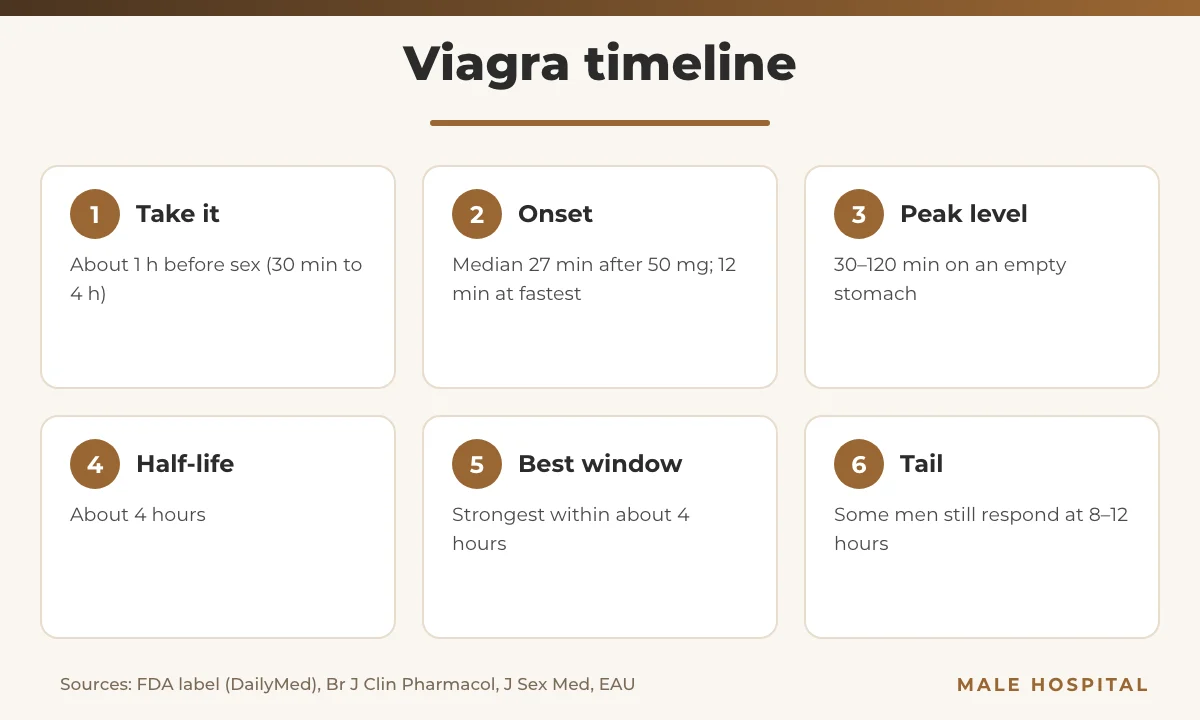
- Onset: in a controlled study, the median time to an erection was 27 minutes after 50 mg, and some men responded within 12 minutes.
- Peak blood level comes 30–120 minutes after a dose on an empty stomach; a high-fat meal delays it by about an hour.
- Half-life is about 4 hours. The label allows taking it 30 minutes to 4 hours before sex, and studies show some effect up to 12 hours.
- Age over 65, liver disease, severe kidney disease and drugs that block the CYP3A4 enzyme raise sildenafil levels, so a 25 mg start is advised.
- An erection lasting more than 4 hours is a medical emergency (priapism), not a sign the pill is “working well”.
- How Viagra works (and why it needs arousal)
- How long does Viagra last? Onset, peak and window
- What changes how long Viagra lasts: food, alcohol, dose and health
- Medicines that raise sildenafil levels
- How long Viagra stays in your body
- How long Viagra lasts compared with Cialis, Levitra and Stendra
- Tips to get the best results
- When Viagra doesn’t work
- When to see a doctor
- FAQs about how long Viagra lasts
How Viagra works (and why it needs arousal)
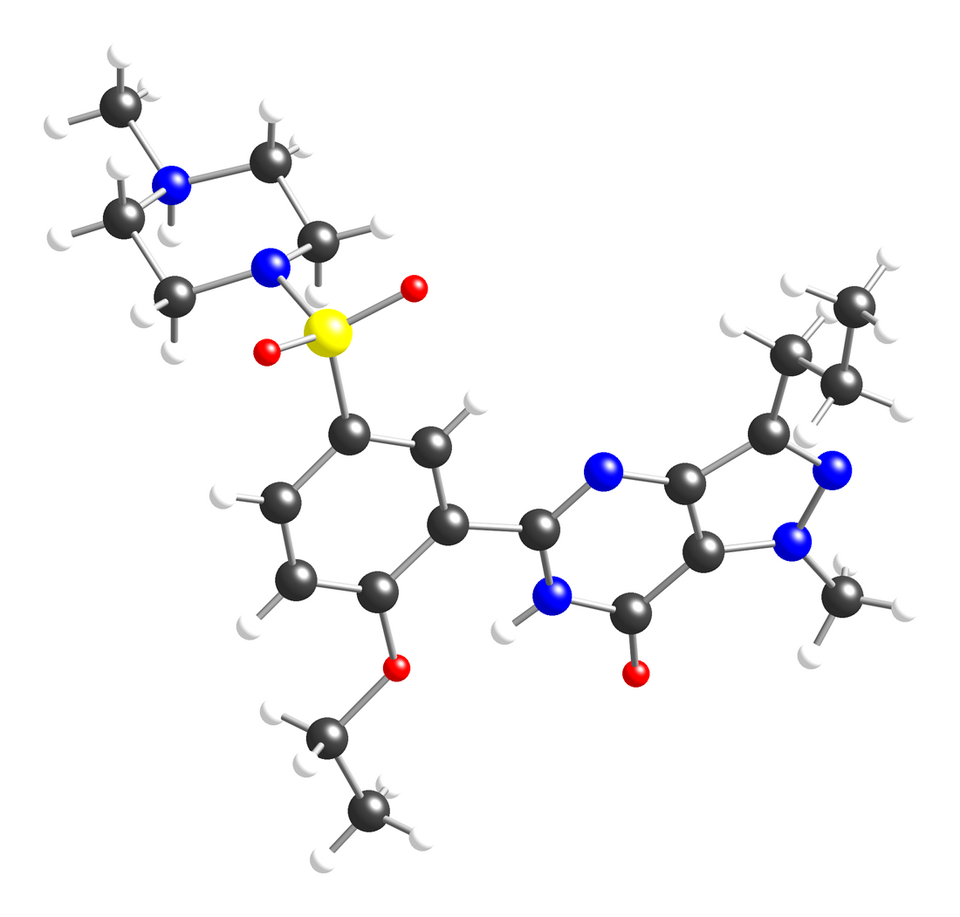
Viagra is the brand name of sildenafil citrate, the first drug in a class called phosphodiesterase type 5 (PDE5) inhibitors. During arousal, nerves in the penis release nitric oxide, which raises a messenger molecule called cGMP. cGMP relaxes the smooth muscle of the erectile tissue so blood can flow in. The enzyme PDE5 breaks cGMP down; sildenafil blocks that enzyme, so the signal lasts longer and the erection is easier to get and keep.
This is why the FDA label states that sildenafil at recommended doses has no effect without sexual stimulation. Swallowing the tablet does not produce an automatic erection, does not raise libido, and does not keep the penis hard after you climax. If you notice an erection that will not go down, that is a side effect to act on, not the expected effect.
Sources: DailyMed (FDA label) — VIAGRA (sildenafil citrate) prescribing information; MedlinePlus — Sildenafil
Sildenafil is a treatment for erectile dysfunction (ED), not a cure. It does not fix the underlying cause, whether that is reduced blood flow, diabetes, nerve damage or low testosterone. Our complete guide to erectile dysfunction explains those causes and the tests worth doing before or alongside tablets.
How long does Viagra last? Onset, peak and window
It helps to separate three different times: how quickly it starts, when the blood level peaks, and how long you can still get an erection with help from the drug.
Onset: 30–60 minutes for most men
The FDA label recommends taking sildenafil about 1 hour before sexual activity, and allows anywhere from 30 minutes to 4 hours before. In a randomized, placebo-controlled study using an objective rigidity monitor, the median time to an erection after 50 mg was 27 minutes (range 12–70). About 71% of men had onset within 30 minutes and 82% within 45 minutes. The EAU guidelines describe efficacy starting 30–60 minutes after a dose.
Sources: Br J Clin Pharmacol (PMC) — Onset and duration of action of sildenafil for the treatment of erectile dysfunction (Eardley et al., 2002); EAU Guidelines — Management of Erectile Dysfunction
Peak level and half-life
Taken on an empty stomach, sildenafil reaches its maximum blood concentration (Tmax) within 30 to 120 minutes. Only about 41% of the dose reaches the bloodstream, because much of it is broken down by the liver on first pass. Both sildenafil and its active metabolite (N-desmethyl sildenafil, about half as potent) have a terminal half-life of about 4 hours, meaning the blood level falls by half roughly every 4 hours. The EAU table gives 2.6–3.7 hours for a 100 mg dose.
The effective window: about 4–5 hours, sometimes longer
In the label’s pharmacodynamic data, sildenafil still showed an effect at 4 hours, though weaker than at 2 hours. In the same study series, men watching erotic material 4 hours after 100 mg still had more firm erections than with placebo. A later randomized crossover trial of 16 men found that, of the men who responded at 1 hour, 82% still responded at 8 hours and 45% at 12 hours; the EAU guidelines mention efficacy for up to 12 hours.
So the practical answer to how long does Viagra last is this: plan sex within about 4 hours of the dose for the strongest effect, knowing that the help fades gradually rather than switching off, and that some men keep a partial effect into the evening or the next morning.
Sources: DailyMed (FDA label) — VIAGRA (sildenafil citrate) prescribing information; J Sex Med (PubMed) — Duration of action of sildenafil citrate in men with erectile dysfunction (Gingell et al., 2004)
What changes how long Viagra lasts: food, alcohol, dose and health
A high-fat meal
When sildenafil is taken with a high-fat meal, absorption slows: peak level arrives on average 60 minutes later and is 29% lower. In real life that means a heavy dinner can make the tablet feel slow or weak. The NHS notes it may take longer to get an erection after a large meal. Taking it on an empty stomach, or after a light meal, gives the most predictable onset.
Alcohol
In healthy volunteers, a 50 mg dose did not add to the blood-pressure-lowering effect of a moderate amount of alcohol (0.5 g/kg). The bigger problem is that alcohol itself makes erections harder: the NHS advises against drinking too much while taking sildenafil for exactly that reason.
Sources: DailyMed (FDA label) — VIAGRA (sildenafil citrate) prescribing information; NHS — Sildenafil: a medicine for erection problems
Dose: 25, 50 or 100 mg
The usual starting dose is 50 mg, taken as needed, no more than once a day. Depending on how well it works and how well it is tolerated, a doctor may raise it to 100 mg (the maximum) or lower it to 25 mg. The dose decides how strong the response is and how many side effects you get; taking a second tablet the same day is not allowed and is not a way to stretch the window.
Age, liver and kidneys
Sildenafil is cleared mainly by the liver, and the label shows clear differences in some groups. These are reasons to start low, not reasons to avoid the drug, and your prescriber will adjust them.
| Group | Effect on sildenafil levels | Label advice |
|---|---|---|
| Men over 65 | About 84% higher exposure (AUC) than young men | Consider starting at 25 mg |
| Liver impairment (e.g., cirrhosis, Child-Pugh A/B) | AUC up 85%, peak up 47% | Consider starting at 25 mg |
| Severe kidney impairment (creatinine clearance under 30 mL/min) | AUC and peak roughly doubled | Consider starting at 25 mg |
| Mild or moderate kidney impairment | No meaningful change after a 50 mg dose | Usual dosing |
| Taking an alpha-blocker (e.g., for the prostate) | Added blood-pressure lowering | Be stable on the alpha-blocker; start at 25 mg |
Source: DailyMed (FDA label) — VIAGRA (sildenafil citrate) prescribing information
Medicines that raise sildenafil levels
Sildenafil is broken down mostly by a liver enzyme called CYP3A4. Drugs that block this enzyme keep sildenafil in the blood longer and at higher levels, which raises the risk of side effects such as headache, flushing, low blood pressure and, rarely, priapism. According to the FDA label:
- Ritonavir (an HIV medicine) increased sildenafil blood levels 11-fold; the label says not to exceed 25 mg in 48 hours.
- Saquinavir raised peak level by 140% and total exposure by 210%.
- Erythromycin (an antibiotic) raised peak level by 160% and exposure by 182%.
- Ketoconazole and itraconazole (antifungals) would be expected to have even larger effects than saquinavir.
With these or other strong CYP3A4 inhibitors, the label advises considering a 25 mg starting dose. MedlinePlus also asks you to talk to your doctor about grapefruit juice while on sildenafil. Separately, sildenafil must never be combined with nitrate medicines (such as nitroglycerin for chest pain) or riociguat, because blood pressure can drop dangerously.
Sources: DailyMed (FDA label) — VIAGRA (sildenafil citrate) prescribing information; MedlinePlus — Sildenafil
How long Viagra stays in your body
How long Viagra lasts in your sex life and how long it stays in your body are two different questions. With a half-life of about 4 hours, the level halves every 4 hours: by 8 hours roughly a quarter of the peak remains, and after about 24 hours (six half-lives) only around 1–2% is left. This is simple arithmetic from the label’s half-life; in older men, people with liver or severe kidney disease, or those on CYP3A4 inhibitors, clearance is slower and it lingers longer.
The body clears sildenafil mostly through the liver into the stool (about 80% of the dose), with about 13% excreted in urine as breakdown products. Because the drug lingers, Cleveland Clinic advises going straight to the emergency room for chest pain within 24 hours of any PDE5 inhibitor if you use nitroglycerin, so the treating team knows not to give nitrates.
Sources: DailyMed (FDA label) — VIAGRA (sildenafil citrate) prescribing information; Cleveland Clinic — Phosphodiesterase inhibitors
How long Viagra lasts compared with Cialis, Levitra and Stendra
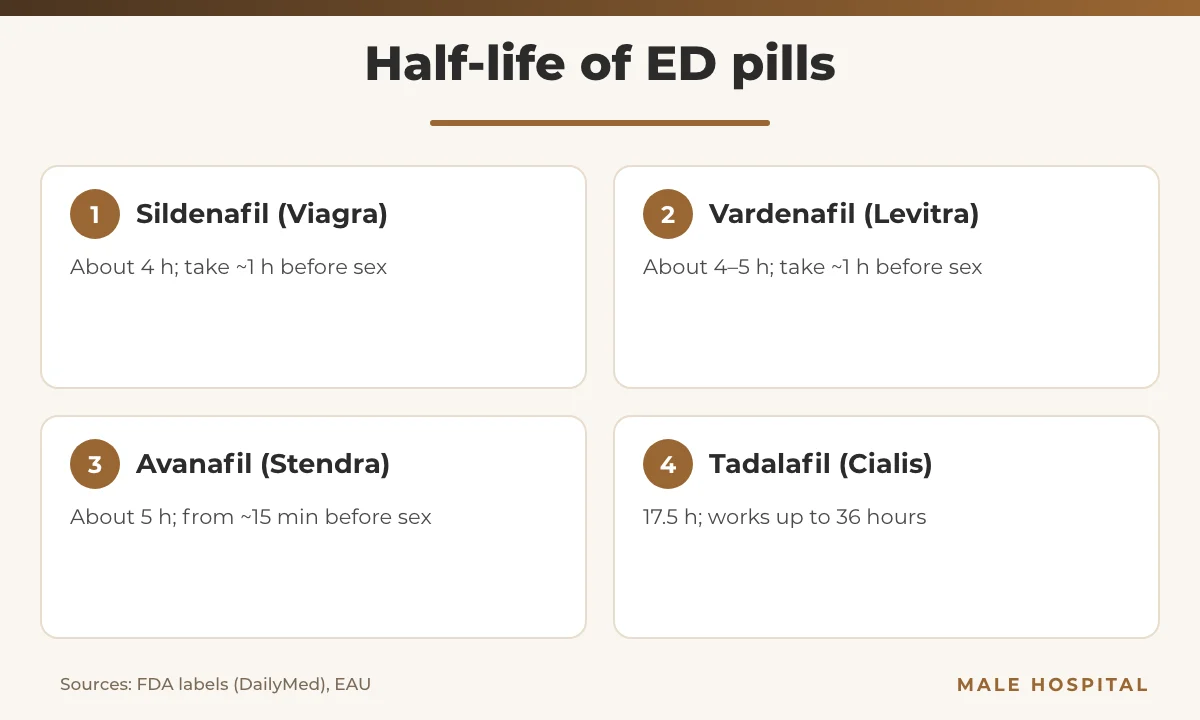
If you are asking how long does Viagra last compared with other ED pills, the short answer is: not the longest. All four approved PDE5 inhibitors work the same way, but their timing differs a lot. Sildenafil and vardenafil are short-acting, avanafil is the fastest to peak, and tadalafil is the long-acting option. The table below uses the US prescribing information and the EAU guidelines.
| Drug | When to take | Time to peak (fasted) | Half-life | Fatty meal |
|---|---|---|---|---|
| Sildenafil (Viagra) | About 1 h before (30 min–4 h) | 30–120 min | About 4 h | Peak ~1 h later, 29% lower |
| Vardenafil (Levitra) | About 60 min before | 30 min–2 h (median ~60 min) | About 4–5 h | Peak 18–50% lower |
| Avanafil (Stendra) | From about 15 min before (100–200 mg) | 30–45 min (median) | About 5 h | Peak ~1.1–1.25 h later, 39% lower |
| Tadalafil (Cialis) | Before sex, or a low dose daily | Peak efficacy about 2 h | 17.5 h; effect up to 36 h | Can be taken without regard to food |
Sources: DailyMed (FDA label) — Vardenafil hydrochloride tablets prescribing information; DailyMed (FDA label) — STENDRA (avanafil) prescribing information; DailyMed (FDA label) — CIALIS (tadalafil) prescribing information; EAU Guidelines — Management of Erectile Dysfunction
If the 4-hour planning window feels too tight, a longer-acting option may suit you better. The EAU table lists a wider half-life range for avanafil (6–17 hours at 200 mg) than the 5 hours in the US label, but in practice it is still used as an on-demand, short-window drug. We compare the two best-known options side by side in Viagra vs Cialis: key differences explained.
Tips to get the best results
Most men who think “Viagra doesn’t last long enough for me” are actually taking it in a way that blunts or wastes the window. These practical points follow the label and the EAU advice on getting the most from PDE5 inhibitors:
- Time it. Take it about 1 hour before you expect sex (the label allows 30 minutes to 4 hours). The EAU notes that trying too soon or too long after the dose is a common reason for failure.
- Go light on food. Take it on an empty stomach or after a light meal; a heavy, fatty meal delays and weakens the peak.
- Keep alcohol moderate. A drink or two is unlikely to interact, but heavy drinking works against erections.
- Allow arousal. Foreplay and physical stimulation are needed; the tablet will not act on its own.
- Don’t judge it on one try. If the first attempt disappoints, review dose, timing and stimulation with your doctor rather than doubling up; this re-education often restores a response.
- Use a licensed product. “Herbal” sexual enhancers bought online are, in the FDA’s words, likely to contain dangerous hidden ingredients.
Sources: EAU Guidelines — Management of Erectile Dysfunction; FDA — Sexual Enhancement and Energy Product Notifications
When Viagra doesn’t work
The EAU guidelines say that management of “non-responders” starts with finding the cause. The first checks are simple: was the drug properly prescribed, is it a licensed product, and is it being used correctly? Common mistakes are trying intercourse too soon or too long after the dose, taking it with a heavy meal, or expecting an erection without stimulation. Re-education about dose, timing and stimulation can turn many apparent non-responders into responders.
If correct use still fails, the next steps include checking for low testosterone (men with hypogonadism may respond better to PDE5 inhibitors once it is treated), reviewing diabetes, blood pressure, smoking and medicines, and considering other treatments. The EAU notes there is no strong trial evidence that simply switching to another PDE5 inhibitor helps true non-responders, although some men prefer a different drug’s timing. Options beyond tablets include low-dose daily tadalafil, injections into the penis, vacuum devices and, for men in whom nothing else works, a penile prosthesis.
Source: EAU Guidelines — Management of Erectile Dysfunction
If tablets have stopped working or never worked, you can arrange a confidential consultation with our urologist-andrologist through WhatsApp and learn about every option on our erectile dysfunction treatment page.
When to see a doctor
A common myth is that Viagra “lasts 4 hours” in the sense of a 4-hour erection. It does not, and an erection that will not go down is dangerous. Priapism (an erection lasting about 4 hours or more, often painful and unrelated to arousal) must be treated immediately; the FDA label warns that untreated priapism can cause penile tissue damage and permanent loss of potency. Get urgent medical care if you have:
- An erection lasting longer than 4 hours, or a painful erection that does not settle.
- Sudden loss of vision in one or both eyes, or a sudden decrease or loss of hearing (stop the drug and seek care).
- Chest pain, fainting or severe dizziness during or after sex; tell the emergency team you took sildenafil and when.
- Swelling of the face or throat, or difficulty breathing.
Also see a doctor if ED is new and you have not been checked for heart disease, diabetes or hormone problems, since erection trouble can be an early sign of vascular disease.
Sources: DailyMed (FDA label) — VIAGRA prescribing information; MedlinePlus — Sildenafil; Cleveland Clinic — Phosphodiesterase inhibitors; NHS — Sildenafil: a medicine for erection problems
FAQs about how long Viagra lasts
How long does Viagra last after you take it?
For most men the strongest effect is within about 4 hours of the dose, starting 30–60 minutes after taking it. The help then fades gradually. In one randomized study, 45% of men who responded at 1 hour still responded 12 hours later, so a partial effect can last into the evening, but it should not be relied on.
Source: J Sex Med (PubMed) — Duration of action of sildenafil citrate (Gingell et al., 2004)
Will I stay hard for hours on Viagra?
No. Sildenafil helps you get an erection when aroused and keep it during sex, but the erection usually goes down after orgasm as normal. An erection lasting over 4 hours is priapism and needs emergency care, so the drug is not meant to keep you erect continuously.
Source: DailyMed (FDA label) — VIAGRA prescribing information
How quickly does Viagra start working?
Usually in 30–60 minutes. In a controlled study, the median time to an erection after 50 mg was 27 minutes, and the fastest responders had a firm erection within 12 minutes. A heavy, fatty meal can delay the start by about an hour, so timing the dose on a light stomach gives the most reliable onset.
Source: Br J Clin Pharmacol (PMC) — Onset and duration of action of sildenafil
Does a 100 mg dose last longer than 50 mg?
The label does not present 100 mg as a way to extend the window; dose is adjusted for effectiveness and side effects, between 25 and 100 mg. Higher doses raise blood levels and side effects. The half-life of about 4 hours does not change with dose, so the timing of the strongest effect stays similar. Never take more than one dose a day.
Source: DailyMed (FDA label) — VIAGRA prescribing information
Can I drink alcohol with Viagra?
Moderate alcohol did not increase sildenafil’s blood-pressure effect in a label study using about 0.5 g/kg. However, the NHS advises avoiding drinking too much, because alcohol itself makes erections harder to get. If you drink, keep it light, and do not take sildenafil to “counteract” heavy drinking.
Source: NHS — Sildenafil: a medicine for erection problems
Is Viagra still working the next morning?
For some men, partly. Responses have been documented up to 12 hours after 100 mg, with weaker erections than at 1 hour. By 24 hours, based on the 4-hour half-life, very little drug remains in most healthy men. If you need reliable next-day effect, long-acting tadalafil, which works for up to 36 hours, is designed for that.
Source: EAU Guidelines — Management of Erectile Dysfunction
Why does Viagra last longer in some men?
Slower clearance. Men over 65 have about 84% higher exposure, and liver impairment or severe kidney disease raises levels too. Some medicines that block the CYP3A4 enzyme, such as ritonavir, erythromycin or certain antifungals, sharply increase levels. In these situations doctors often start at 25 mg to keep side effects down.
Source: DailyMed (FDA label) — VIAGRA prescribing information
Which ED pill lasts the longest?
Tadalafil (Cialis). Its half-life is 17.5 hours and the label shows improved erections up to 36 hours after a dose, compared with about 4 hours of half-life for sildenafil, 4–5 hours for vardenafil and about 5 hours for avanafil. Tadalafil can also be taken as a low daily dose, which removes the need to time sex around a tablet.
Source: DailyMed (FDA label) — CIALIS prescribing information
Medically reviewed by Assoc. Prof. Dr. Zülfü Sertkaya, urologist and andrologist (FEBU), Istanbul. Last reviewed: October 2026.
This article is for general information and does not replace an individual consultation with a qualified doctor.
- DailyMed (FDA label) — VIAGRA (sildenafil citrate) tablets — prescribing information
- DailyMed (FDA label) — Vardenafil hydrochloride tablets — prescribing information
- DailyMed (FDA label) — STENDRA (avanafil) tablets — prescribing information
- DailyMed (FDA label) — CIALIS (tadalafil) tablets — prescribing information
- EAU — Sexual and Reproductive Health Guidelines — Management of Erectile Dysfunction
- Br J Clin Pharmacol (PMC) — Onset and duration of action of sildenafil for the treatment of erectile dysfunction (Eardley et al., 2002)
- J Sex Med (PubMed) — Duration of action of sildenafil citrate in men with erectile dysfunction (Gingell et al., 2004)
- MedlinePlus — Sildenafil
- NHS — Sildenafil: a medicine for erection problems
- Cleveland Clinic — Phosphodiesterase inhibitors
- FDA — Sexual Enhancement and Energy Product Notifications