
High prolactin in men (hyperprolactinemia) means the pituitary gland is releasing too much prolactin, which switches off the signals that drive testosterone production. The usual results are low sex drive, erectile dysfunction, infertility and sometimes enlarged breast tissue. The most common causes are prescription medicines and a small benign pituitary tumor called a prolactinoma, and both are treatable: once prolactin comes down, testosterone and sexual function usually recover.
Source: NIDDK — Prolactinoma; Cleveland Clinic — Hyperprolactinemia: What It Is, Symptoms & Treatment
- Prolactin is normally low in men (usually under 20 ng/mL, depending on the laboratory). High prolactin suppresses LH and testosterone, so the symptoms look like low testosterone: low libido, weak erections, fatigue and infertility.
- Medicines are the most common cause, led by antipsychotics such as risperidone and haloperidol, the anti-nausea drugs metoclopramide and domperidone, some antidepressants, verapamil and opioids.
- Prolactinomas are benign pituitary tumors and the main tumor cause of high prolactin. In men they are more often large (over 1 cm), so headaches and narrowed side vision can be the first clue.
- Diagnosis of high prolactin is a blood test drawn 3 to 4 hours after waking, followed by testosterone, thyroid and kidney tests and a pituitary MRI if the level is confirmed high.
- Cabergoline tablets, taken once or twice a week, normalize prolactin in roughly 80 to 90 percent of men and usually shrink the tumor; surgery is reserved for men who cannot take or do not respond to the drug.
- What is high prolactin in men?
- High prolactin in men: symptoms to recognize
- 7 causes of high prolactin in men
- How high prolactin lowers testosterone, libido and erections
- Testing for high prolactin in men
- Treatment: cabergoline, medicine changes and surgery
- What to expect after treatment
- When to see a doctor
- FAQs about high prolactin in men
What is high prolactin in men?
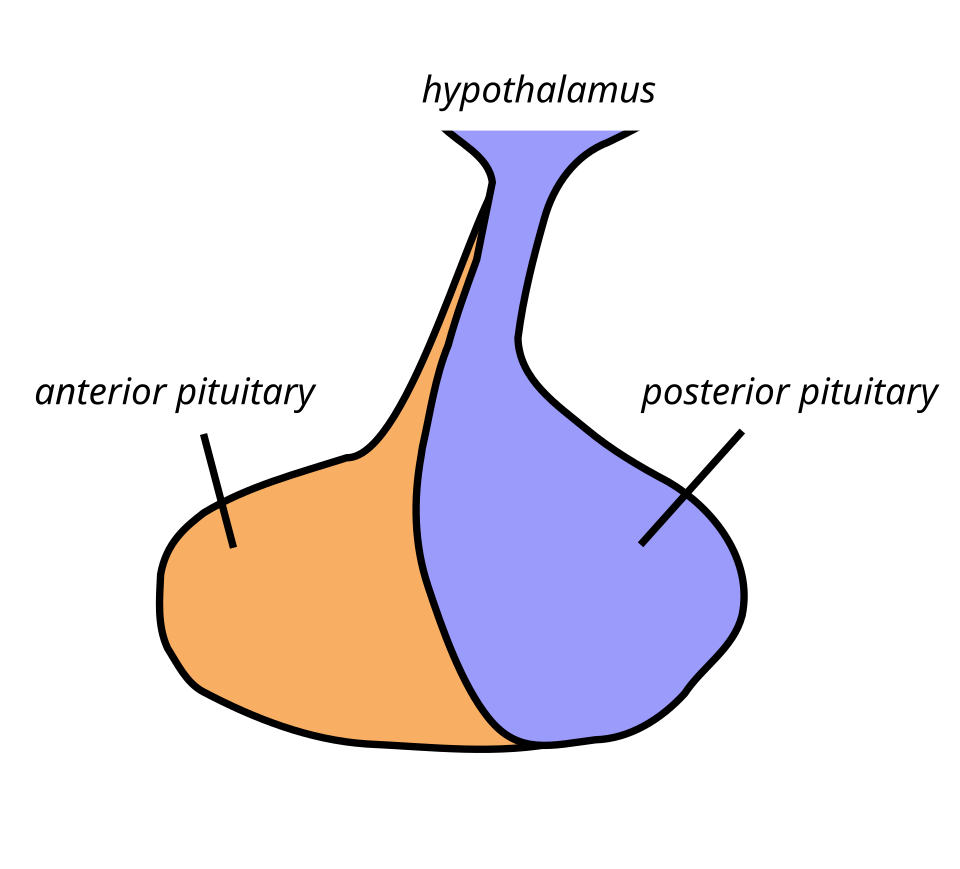
Prolactin is made by lactotroph cells in the front part of the pituitary, a pea-sized gland at the base of the brain. Its best-known job is milk production in women, but men make it too, at a low and steady level. The hypothalamus keeps it in check with dopamine: as long as dopamine reaches the pituitary, prolactin stays low. Anything that blocks dopamine, or any tumor that makes prolactin on its own, pushes the level up.
Hyperprolactinemia, the medical term for high prolactin, simply means a prolactin level above the laboratory’s reference range. In men that cutoff is typically around 20 micrograms per liter (µg/L, the same as ng/mL), compared with about 25 in women, although every assay has its own range. The condition affects less than 1 percent of the general population and is found three to four times more often in women, partly because women notice symptoms such as missed periods much sooner.
In men, high prolactin quietly dials down the hypothalamic-pituitary-testicular axis, producing secondary (hypogonadotropic) hypogonadism: the testicles are healthy, but the pituitary is no longer telling them to make testosterone. That is why many men are first investigated for low testosterone and only later discover that prolactin was the real driver.
Source: Journal of Clinical Medicine (PMC) — Samperi et al. 2019, Hyperprolactinaemia; Pharmaceutical Medicine (PMC) — Junqueira et al. 2023, Clinical Presentations of Drug-Induced Hyperprolactinaemia
High prolactin in men: symptoms to recognize
Most symptoms are really symptoms of the low testosterone that high prolactin causes, which is why the diagnosis is so often delayed. The US National Institute of Diabetes and Digestive and Kidney Diseases (NIDDK) notes that women tend to notice a prolactin problem early, whereas men may be diagnosed much later because their signs are less obvious.
Hormonal and sexual symptoms of high prolactin
- Low sex drive, usually the earliest and most consistent complaint.
- Erectile dysfunction: softer, less frequent erections and fewer morning erections.
- Infertility: lower sperm counts and poorer motility, often found only during a couple’s fertility work-up.
- Enlarged breast tissue (gynecomastia) and, far less often, a milky nipple discharge (galactorrhea), which is possible in men but very uncommon.
- Less facial and body hair, loss of muscle, fatigue and low mood.
- Bone thinning (osteopenia or osteoporosis) when the problem has gone untreated for years.
Symptoms from a large pituitary tumor
Because men more often harbor larger prolactinomas, pressure symptoms are more common than in women. A tumor growing upward can press on the optic chiasm and narrow the outer edges of vision. Persistent headaches, double vision or a drooping eyelid, and low levels of other pituitary hormones (thyroid hormone, cortisol) also point to a macroprolactinoma. Some older men have no symptoms and the tumor is found by chance on a scan.
Source: NIDDK — Prolactinoma; MedlinePlus — Prolactinoma; The Pituitary Foundation — Prolactinoma
7 causes of high prolactin in men
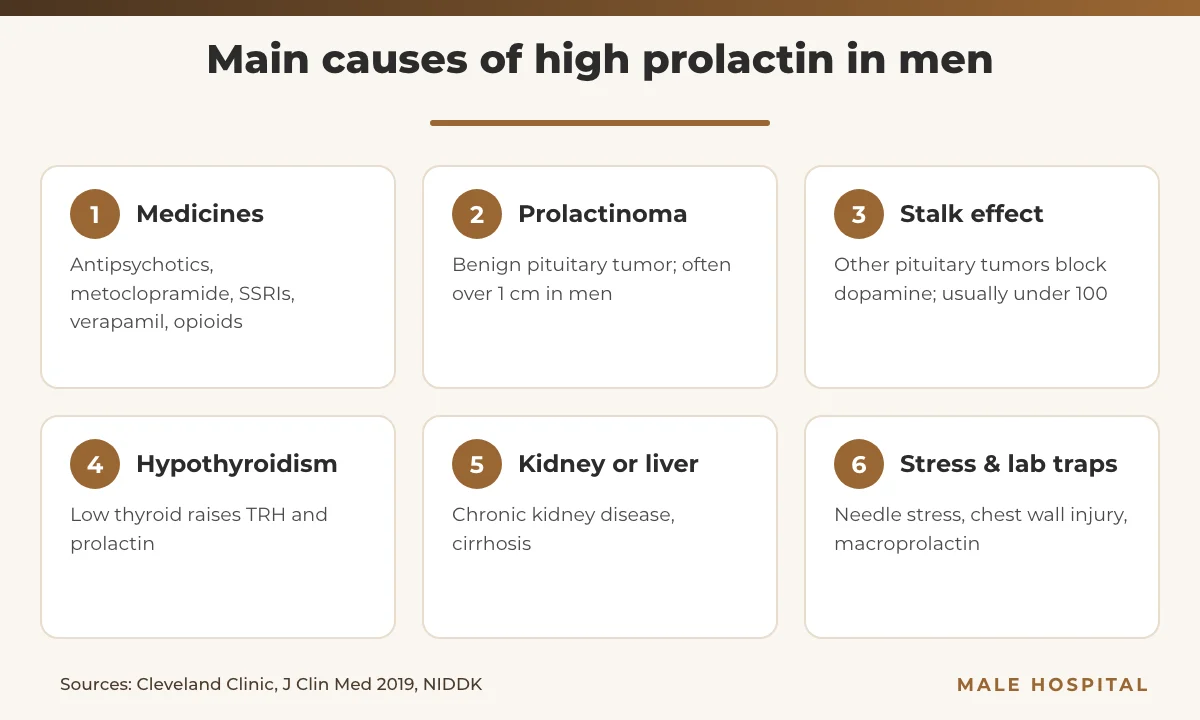
Finding the cause of high prolactin matters more than the number itself, because a drug effect, an underactive thyroid and a pituitary tumor are managed in completely different ways.
1. Medicines that block dopamine
Drug-induced hyperprolactinemia is the most common cause of high prolactin overall. Antipsychotics lead the list: haloperidol and other older agents, and among newer drugs risperidone, paliperidone and amisulpride, can raise prolactin to two or three times the upper limit of normal, while aripiprazole and clozapine are largely prolactin-sparing. The anti-nausea drugs metoclopramide and domperidone block the same dopamine receptors, and tricyclic antidepressants, SSRIs, methyldopa, verapamil, H2 blockers and opioids can all contribute. In a 2023 review of 50 studies, mean prolactin in drug-induced cases ranged from 32 to 168 ng/mL. Levels usually normalize within three to four days of stopping the drug, which should only be done with the prescriber’s agreement.
2. Prolactinoma
A prolactinoma is a benign (noncancerous) tumor of the pituitary lactotroph cells and the most common type of pituitary tumor. Microprolactinomas are under 1 cm and macroprolactinomas 1 cm or larger. Between ages 20 and 50 women outnumber men about 10 to 1, but after 60 the rates are similar, and men are more likely to present with a macroprolactinoma. A microprolactinoma typically produces prolactin of 100 to 200 µg/L; a level above 250 generally confirms a prolactinoma and above 500 points to a macroprolactinoma. The inherited condition multiple endocrine neoplasia type 1 (MEN1) raises the risk.
3. Other pituitary tumors (“stalk effect”)
A tumor that does not make prolactin can still raise it by squashing the pituitary stalk and blocking the flow of dopamine. These non-functioning adenomas usually cause only mildly high prolactin (in one series of 226 cases, 99 percent were under roughly 100 µg/L), and telling them apart matters because they are usually treated with surgery rather than tablets.
4. Underactive thyroid
Untreated hypothyroidism raises thyrotropin-releasing hormone, which stimulates prolactin, and can enlarge the pituitary enough to mimic a tumor. Thyroid function is therefore checked in every man with a high prolactin.
5. Kidney and liver disease
Chronic kidney disease reduces prolactin clearance and can cause high prolactin, and cirrhosis is also commonly associated with mild hyperprolactinemia, generally below 100 µg/L.
6. Stress and chest wall stimulation
Stress, including the needle itself, a protein-rich meal, exercise or sex shortly before the blood draw can produce a modest, temporary rise (stress-related values can reach about 100 µg/L). Fractured ribs, chest surgery or shingles on the chest stimulate prolactin through the same nerve pathways as nipple stimulation.
7. Macroprolactin and idiopathic cases
Macroprolactin is prolactin bound to an antibody into a large complex that is biologically inactive but still counted by many assays. It explains 4 to 40 percent of high prolactin readings in different series and is the first thing to exclude in a man with a high number but no symptoms. When every test is normal the condition is called idiopathic; mild idiopathic cases often settle on their own within months.
Source: Journal of Clinical Medicine (PMC) — Samperi et al. 2019, Hyperprolactinaemia; JCEM (PMC) — Auriemma et al. 2023, Approach to the Patient With Prolactinoma; Cleveland Clinic — Hyperprolactinemia; Pharmaceutical Medicine (PMC) — Junqueira et al. 2023
How high prolactin lowers testosterone, libido and erections
High prolactin acts at the top of the hormonal chain. It suppresses the hypothalamic pulses of gonadotropin-releasing hormone, so the pituitary releases less luteinizing hormone (LH) and follicle-stimulating hormone (FSH). With less LH, the Leydig cells of the testicles make less testosterone; with less FSH and testosterone, sperm production falls. Prolactin receptors also sit directly on Leydig and Sertoli cells, so very high levels may act on the testicle itself.
Low testosterone is the main reason libido disappears, and prolactin’s effect on desire is strong enough that the European Association of Urology (EAU) names reduced sexual desire as the specific trigger for prolactin testing. Erections suffer because testosterone supports the nitric oxide signaling they depend on; the link between testosterone and erectile dysfunction explains why PDE5 tablets alone often disappoint until the hormone problem is corrected.
High prolactin affects fertility too. In a review of 3,101 men evaluated for infertility at a US academic center, 2.1 percent had hyperprolactinemia. They had a lower median testosterone (280 vs 313 ng/dL), a far lower total motile sperm count (7.0 vs 34.7 million) and twice the rate of low sperm concentration (43.1 vs 21.5 percent). Seventeen percent of them had a prolactinoma, about 35 times the prevalence in the general male population. Overall, endocrine causes including high prolactin explain an estimated 2 to 4 percent of male infertility.
Source: Urology (PubMed) — Ambulkar et al. 2022, Prevalence of Hyperprolactinemia and Clinically Apparent Prolactinomas in Men Undergoing Fertility Evaluation; JCEM (PMC) — Auriemma et al. 2023; EAU — Sexual and Reproductive Health Guidelines (male hypogonadism)
Testing for high prolactin in men
Who should be tested for high prolactin
The EAU guideline on male hypogonadism recommends measuring prolactin together with LH whenever total testosterone is confirmed low, and treats prolactin as a first-line screen in any man whose main complaint is reduced sexual desire. It also calls for a pituitary MRI when secondary hypogonadism comes with high prolactin, symptoms of a pituitary mass or other pituitary hormone deficiencies. For erectile dysfunction alone, the EAU asks for a fasting early-morning total testosterone, with prolactin added in selected men with specific signs. A thorough erectile dysfunction test therefore includes a hormone panel, not just a questionnaire.
The prolactin blood test
Prolactin varies through the day, so the sample is usually drawn 3 to 4 hours after waking, sometimes fasting. Avoid strenuous exercise and sex beforehand, sit quietly before the draw, and list every medicine and supplement you take. A single sample can make the diagnosis if the venipuncture was not stressful; a borderline result is simply repeated. If you take a prolactin-raising drug and it is safe to pause it, the level is rechecked after about 72 hours off the medicine.
Reading a high prolactin result
| Prolactin (µg/L = ng/mL) | What it usually means in a man | Typical next step |
|---|---|---|
| Under about 20 | Normal for most assays | Look elsewhere for the cause of symptoms |
| 20 to 100 | Medicines, stress, hypothyroidism, kidney or liver disease, macroprolactin, stalk effect, small microprolactinoma | Repeat, review drugs, check TSH, kidney function and macroprolactin; MRI if unexplained |
| 100 to 250 | Typical microprolactinoma range; occasionally a non-functioning adenoma or strong drug effect | Pituitary MRI with contrast, testosterone and pituitary hormone panel |
| Over 250 | Generally confirms a prolactinoma | MRI; visual field test if the tumor is large |
| Over 500 | Macroprolactinoma | MRI, visual fields, full pituitary assessment, bone density scan |
One more laboratory trap is the “hook effect”: a huge tumor (over 3 cm) producing extremely high prolactin can overwhelm older assays and read falsely low, so a big pituitary mass with only a modest prolactin should be rechecked after diluting the sample 1:100. The work-up also includes total testosterone, LH and FSH, thyroid and kidney function, the other pituitary hormones and, for larger tumors, a visual field examination and a bone density (DEXA) scan.
Source: EAU — Male hypogonadism; EAU — Management of erectile dysfunction; MedlinePlus — Prolactin Levels; JCEM (PMC) — Auriemma et al. 2023; The Pituitary Foundation — Prolactinoma
Treatment: cabergoline, medicine changes and surgery
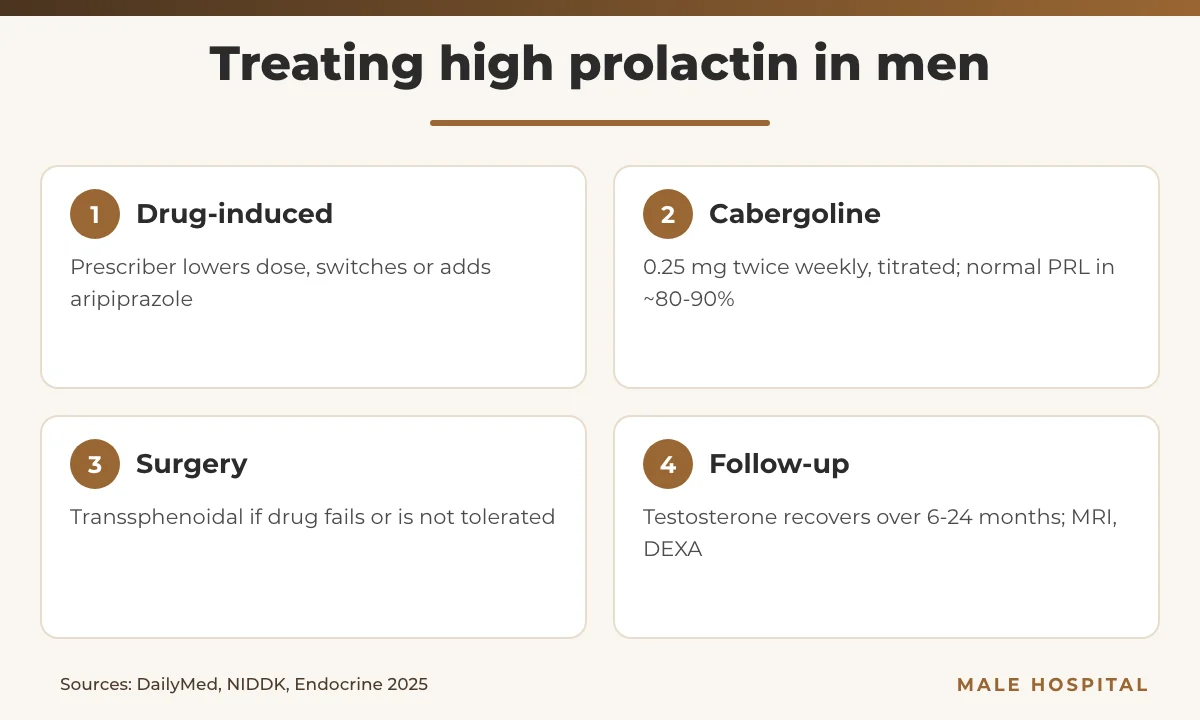
Treatment of high prolactin depends on the cause, but the goals set by the Endocrine Society and the Pituitary Society are always the same: normalize prolactin, shrink any tumor, restore testosterone and fertility, relieve pressure symptoms and protect the bones.
If a medicine is responsible
Never stop a prescribed drug on your own, especially an antipsychotic. The prescriber can often lower the dose, switch to a prolactin-sparing alternative such as aripiprazole, or add low-dose aripiprazole to the existing regimen. If the drug cannot be changed and the man has low testosterone, bone loss or sexual symptoms, options are testosterone replacement or, once an MRI has excluded a tumor and with psychiatric agreement, cautious use of a dopamine agonist. Treating hypothyroidism or kidney disease corrects high prolactin when they are the cause.
Dopamine agonists for prolactinoma
Cabergoline is the first-line treatment for prolactinomas of every size, including the large and giant tumors seen in men. It mimics dopamine at the pituitary, which stops prolactin release and makes the tumor shrink. The US label starts at 0.25 mg twice a week, increasing by 0.25 mg twice weekly no faster than every four weeks, up to 1 mg twice a week; most prolactinomas are controlled at 0.5 to 2 mg per week. Bromocriptine (2.5 mg two or three times daily) is the older alternative and causes more nausea; switching to cabergoline normalizes prolactin in 80 to 85 percent of patients who did not respond to it.
Results in men with high prolactin from a prolactinoma are good. Cabergoline normalizes prolactin in about 80 percent of treated men with prolactinomas, and in large series it normalizes prolactin and shrinks the tumor in roughly 95 percent of microprolactinomas and 80 percent of macroprolactinomas. In a 2025 cohort of 47 men with microprolactinoma, 89 percent reached a normal prolactin within a median of four months and had normal testosterone at their last visit; only 4 percent had side effects, all of which disappeared with a dose reduction. Primary resistance occurs in roughly 10 to 20 percent of patients on cabergoline.
Common side effects in the placebo-controlled trial were nausea (27 percent), headache (26 percent), dizziness (15 percent) and constipation (10 percent); taking the tablet with food and starting at a low dose helps. Heart valve thickening has been seen in people with Parkinson’s disease taking roughly ten times the prolactinoma doses, so the label calls for an echocardiogram before starting and periodically during treatment, and the drug is contraindicated in uncontrolled high blood pressure, existing valve disease and fibrotic lung or abdominal conditions. Dopamine agonists can also trigger impulse-control problems such as compulsive gambling or hypersexuality, which resolve when the dose is reduced or stopped, so report any new urges.
Surgery and radiotherapy
Transsphenoidal surgery, performed through the nose, is the second-line option when cabergoline is not tolerated or the tumor keeps growing on the maximum dose, when vision is deteriorating fast, when a man prefers an operation to years of tablets, or when an antipsychotic cannot be combined with a dopamine agonist. According to the NIDDK, surgery normalizes prolactin in about 90 percent of small tumors and 50 percent of large ones; risks include loss of other pituitary hormones, temporary diabetes insipidus, cerebrospinal fluid leak and infection. Radiotherapy is kept for tumors that grow despite drugs and surgery; it normalizes prolactin in about one patient in three, works slowly over years, and most often causes an underactive thyroid.
Source: DailyMed (FDA label) — Cabergoline tablets, Teva, 2025; Pituitary (PubMed) — Duskin-Bitan & Shimon 2020, Prolactinomas in males: any differences?; Endocrine (PubMed) — Rudman et al. 2025, Response to cabergoline treatment in men with microprolactinoma; Psychosomatics (PubMed) — Ajmal et al. 2014, Psychotropic-induced hyperprolactinemia: a clinical review; NIDDK — Prolactinoma; JCEM (PMC) — Auriemma et al. 2023
What to expect after treatment
Testosterone, libido and erections
Once high prolactin is brought down, the LH signal returns and the testicles restart on their own, but recovery takes months and is slower with bigger tumors. In a Turkish series of 84 men with prolactinomas on cabergoline, 89 percent were hypogonadal at the start; testosterone had recovered to at least 300 ng/dL in 31 percent at 6 months, 44 percent at 12 months and 60 percent at 24 months, with the average rising from 142 to 353 ng/dL. A tumor over about 2.3 cm and a very low starting testosterone predicted slower recovery. Reviews report improvement in libido and erectile function in about 61 percent of men on cabergoline, with semen parameters improving in the reported series.
If testosterone stays low after six to twelve months of normal prolactin, testosterone replacement therapy can be added, provided fertility is not the immediate goal; our low testosterone treatment page explains how that decision is made. Men who want children should have a semen analysis once prolactin is normal, because sperm production usually recovers and testosterone injections would suppress it.
How long treatment lasts
Treatment for high prolactin from a prolactinoma usually continues for at least two years. A tapering trial is possible after that if prolactin has been normal and no tumor is visible on MRI, but relapse is common: a pooled analysis found only about 21 percent stayed normal after stopping, although carefully selected patients in some centers reach 65 to 75 percent. In the men’s microprolactinoma cohort above, 5 of the 13 who tried stopping kept a normal prolactin, and they had typically been treated for more than five years. Lifelong low-dose cabergoline with an annual blood test is a common and reasonable outcome, particularly for the larger tumors found in men.
If you have noticed falling desire, weaker erections or fertility problems and want to know whether high prolactin or another hormone imbalance is behind them, you can arrange a confidential assessment with our urologist-andrologist Assoc. Prof. Dr. Zülfü Sertkaya, whose clinical and research work includes hormonal causes of male infertility. Message us on WhatsApp for a free initial consultation.
Source: Hormones (PubMed) — Fedai et al. 2026, Gonadal recovery in men with prolactinomas on cabergoline; Endocrine (PubMed) — Rudman et al. 2025; JCEM (PMC) — Auriemma et al. 2023; J Clin Endocrinol Metab (PubMed) — Melmed et al. 2011, Endocrine Society hyperprolactinemia guideline
When to see a doctor
High prolactin in men is easy to miss and easy to treat, so a low threshold for testing pays off. See a urologist, andrologist or endocrinologist if you have:
- Low sex drive or erectile dysfunction that began after starting an antipsychotic, antidepressant, anti-nausea drug, verapamil, methyldopa or long-term opioids.
- Low testosterone on a blood test, especially when LH is low or “normal” rather than high.
- Enlarged or tender breast tissue, or any nipple discharge.
- A low sperm count or poor motility on a semen analysis.
- Persistent headaches with loss of side vision, double vision or a drooping eyelid.
Seek emergency care the same day for a sudden, severe headache, often described as the worst of your life, with vision loss, nausea or collapse. This can be pituitary apoplexy, bleeding into a pituitary tumor, which is a medical emergency. Also contact your doctor promptly if, while taking a dopamine agonist, you develop breathlessness, leg swelling, fainting on standing or new compulsive behaviors.
Source: MedlinePlus — Prolactinoma; DailyMed (FDA label) — Cabergoline tablets; NHS — Low sex drive (loss of libido)
FAQs about high prolactin in men
What is a normal prolactin level for a man?
Most laboratories consider prolactin normal below about 20 µg/L (ng/mL) in men and below 25 in women, but the cutoff depends on the assay, so compare your result with the range printed on the report. Mildly high prolactin values are usually repeated, because stress, exercise, a protein meal or sex beforehand can nudge the level up temporarily.
Source: Journal of Clinical Medicine (PMC) — Samperi et al. 2019; MedlinePlus — Prolactin Levels
Can high prolactin cause erectile dysfunction?
Yes. High prolactin suppresses LH and therefore testosterone, which reduces desire and weakens erections, and very high levels may dampen sexual response directly. Among men with prolactinomas treated with cabergoline, libido and erectile function improve in about six out of ten, which is why hormone testing belongs in any ED work-up where desire is also low.
Source: JCEM (PMC) — Auriemma et al. 2023; EAU — Male hypogonadism
Which medications raise prolactin the most?
Antipsychotics that strongly block dopamine D2 receptors are the biggest offenders: haloperidol and other first-generation drugs, plus risperidone, paliperidone and amisulpride among the newer ones. Metoclopramide and domperidone act the same way. SSRIs, tricyclics, verapamil, methyldopa, H2 blockers and opioids cause smaller rises, while aripiprazole and clozapine are generally prolactin-sparing.
Source: Journal of Clinical Medicine (PMC) — Samperi et al. 2019; Cleveland Clinic — Hyperprolactinemia
Is a prolactinoma cancer?
No. Prolactinomas, the tumor cause of high prolactin, are benign adenomas and do not spread to other organs. The concern with large ones is pressure on the optic nerves and the rest of the pituitary. Even giant tumors in men usually shrink on cabergoline, and truly aggressive or treatment-resistant prolactinomas are rare.
Source: NIDDK — Prolactinoma; Pituitary (PubMed) — Duskin-Bitan & Shimon 2020
How long does cabergoline take to work in men?
High prolactin usually starts falling within weeks; in a cohort of men with microprolactinomas the median time to a normal level was four months. Testosterone lags behind: about a third of hypogonadal men recover by six months, 44 percent by one year and 60 percent by two years, with larger tumors recovering more slowly.
Source: Endocrine (PubMed) — Rudman et al. 2025; Hormones (PubMed) — Fedai et al. 2026
Can I take testosterone instead of treating the prolactin?
Not as a first step. Testosterone replacement relieves symptoms but does nothing about the tumor and shuts down sperm production. Guidelines recommend treating the cause first, then adding testosterone only if it remains low after prolactin has normalized and fertility is not the priority.
Source: EAU — Male hypogonadism; The Pituitary Foundation — Prolactinoma
Does high prolactin affect sperm and fertility?
It can. Men with high prolactin (hyperprolactinemia) in a fertility clinic had a median total motile sperm count of 7 million versus 35 million in other men, and twice the rate of low sperm concentration. Because the testicles themselves are healthy, sperm production generally recovers once prolactin and testosterone normalize.
Source: Urology (PubMed) — Ambulkar et al. 2022
Will I need cabergoline for life?
Many men do, particularly those with macroprolactinomas. A tapering trial can be considered after at least two years of normal prolactin with no visible tumor on MRI, but pooled data show only about one in five patients stays normal off treatment, so blood tests must continue after stopping. Men treated for more than five years before stopping have done best.
Source: NIDDK — Prolactinoma; JCEM (PMC) — Auriemma et al. 2023; Endocrine (PubMed) — Rudman et al. 2025
Medically reviewed by Assoc. Prof. Dr. Zülfü Sertkaya, urologist and andrologist (FEBU), Istanbul. Last reviewed: November 2026.
This article is for general information and does not replace an individual consultation with a qualified doctor.
- NIDDK — Prolactinoma
- Cleveland Clinic — Hyperprolactinemia: What It Is, Symptoms & Treatment
- MedlinePlus — Prolactinoma
- MedlinePlus — Prolactin Levels
- EAU — Sexual and Reproductive Health Guidelines (male hypogonadism)
- EAU — Sexual and Reproductive Health Guidelines (management of erectile dysfunction)
- The Pituitary Foundation — Prolactinoma
- NHS — Low sex drive (loss of libido)
- DailyMed (FDA label) — Cabergoline tablets, Teva Pharmaceuticals USA, 2025
- Journal of Clinical Medicine (PMC) — Samperi, Lithgow & Karavitaki 2019, Hyperprolactinaemia
- J Clin Endocrinol Metab (PMC) — Auriemma et al. 2023, Approach to the Patient With Prolactinoma
- Pharmaceutical Medicine (PMC) — Junqueira et al. 2023, Clinical Presentations of Drug-Induced Hyperprolactinaemia: A Literature Review
- J Clin Endocrinol Metab (PubMed) — Melmed et al. 2011, Diagnosis and treatment of hyperprolactinemia: an Endocrine Society clinical practice guideline
- Urology (PubMed) — Ambulkar et al. 2022, Prevalence of Hyperprolactinemia and Clinically Apparent Prolactinomas in Men Undergoing Fertility Evaluation
- Pituitary (PubMed) — Duskin-Bitan & Shimon 2020, Prolactinomas in males: any differences?
- Endocrine (PubMed) — Rudman et al. 2025, Response to cabergoline treatment, gonadal axis recovery, and outcomes of drug withdrawal, in men with microprolactinoma
- Hormones (PubMed) — Fedai et al. 2026, Gonadal recovery in men with prolactinomas on cabergoline
- Psychosomatics (PubMed) — Ajmal, Joffe & Nachtigall 2014, Psychotropic-induced hyperprolactinemia: a clinical review