Vasectomy reversal is microsurgery that reconnects the tubes cut during a vasectomy so sperm can enter the semen again and a couple can try to conceive naturally. In expert hands sperm return in most men, but pregnancy rates fall as the years since the vasectomy increase, and the female partner’s age matters as much as the surgery. It is one of two routes to a baby after vasectomy; the other, sperm retrieval with IVF/ICSI, is covered in our guides to male infertility and azoospermia.
Source: Cleveland Clinic — Purpose, procedure and success rate; AUA — Vasectomy: AUA Guideline
- There are two operations: vasovasostomy (vas joined to vas) and vasoepididymostomy (vas joined to the epididymis). The surgeon decides which one during surgery, based on the fluid inside the vas.
- After microsurgical vasovasostomy, the EAU reports sperm return in 90–97% of men and pregnancy in 52–73% of couples.
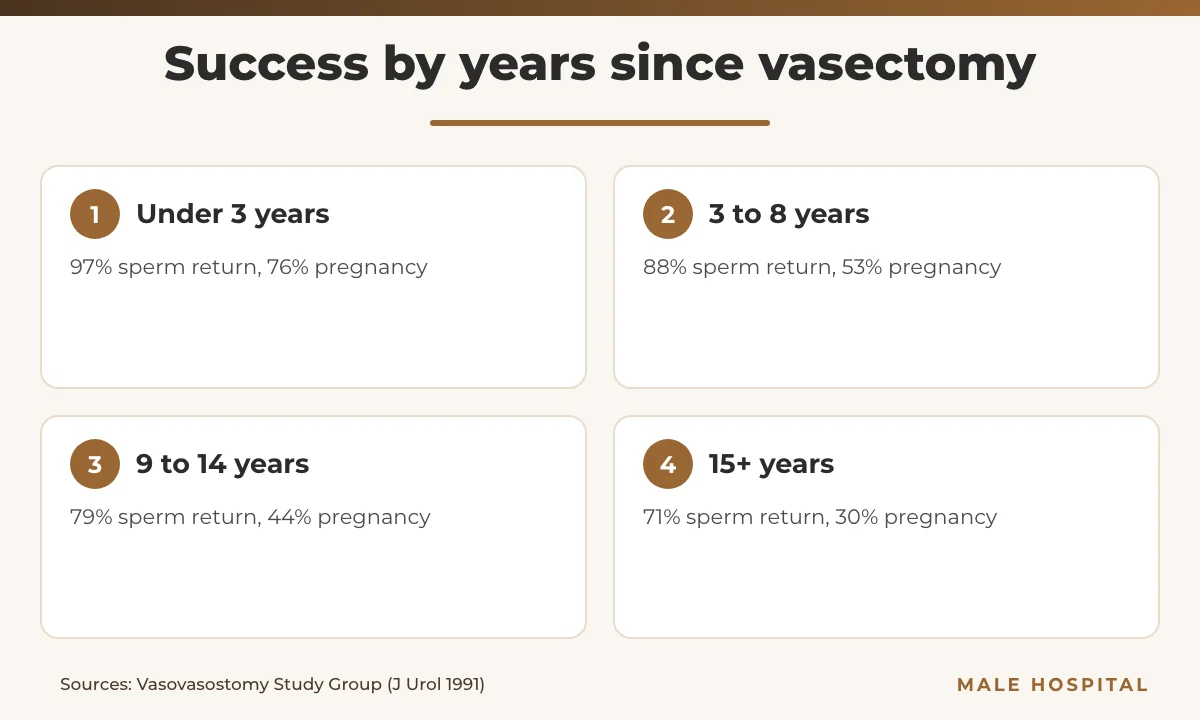
- The longer the time since vasectomy, the lower the success: in the largest series, pregnancy fell from 76% (under 3 years) to 30% (15 years or more).
- Female partner age is the strongest predictor of conception; with an older partner, sperm retrieval with IVF/ICSI may be the faster route.
- Most men go home the same day, return to desk work within about a week and wait two to three weeks before sex.
What is vasectomy reversal?
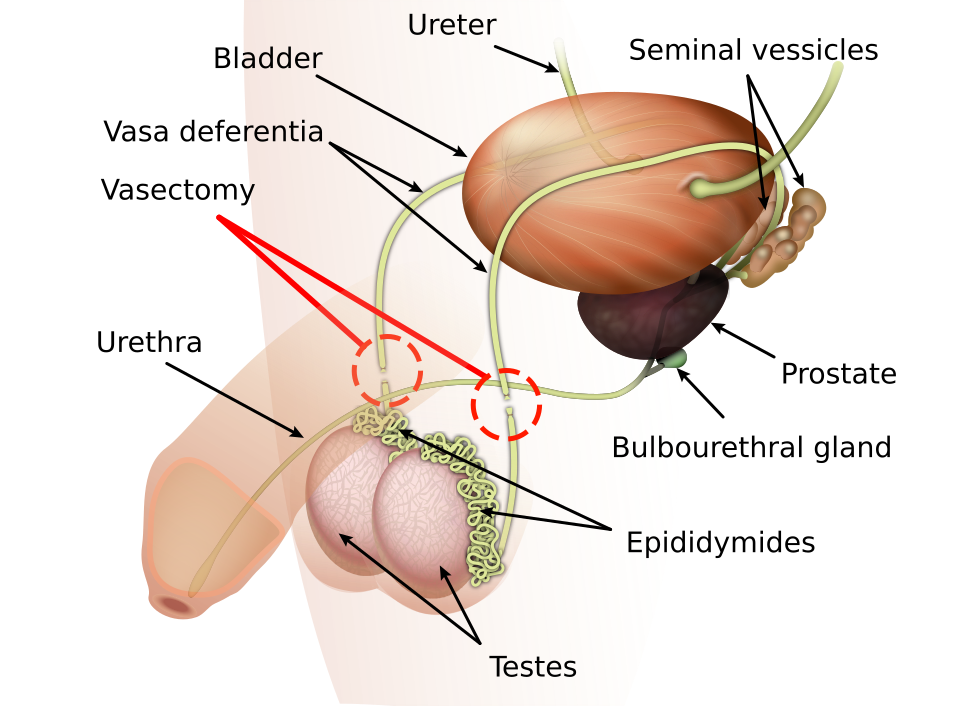
Sperm are made in the testicles, mature in the epididymis (a coiled tube on the back of each testicle) and travel up the vas deferens to mix with fluid from the prostate and seminal vesicles. A vasectomy cuts and seals each vas deferens, so the ejaculate no longer contains sperm. The testicles keep making sperm, which are simply absorbed by the body.
A vasectomy reversal removes the scarred ends of each vas and stitches the open channels back together under an operating microscope. The stitches are finer than a human hair, which is why the operation is far more demanding than the original vasectomy. MedlinePlus notes that reversal is a harder operation than vasectomy and that it may not work, which is why vasectomy should always be chosen as a lifelong decision.
Source: MedlinePlus — Vasectomy; Cleveland Clinic — Purpose, procedure and success rate
Why men ask for a reversal
Estimates suggest that 3–6% of men who have a vasectomy later seek a vasectomy reversal. The common reasons are a new relationship, the wish for more children, a change in family circumstances, and, less often, chronic testicular pain after vasectomy (post-vasectomy pain syndrome). In small studies, most men having a reversal for pain reported improvement, although the evidence base is limited.
Source: Asian Journal of Andrology (PMC) — Patel & Smith 2016, clinical update
Who is a good candidate for vasectomy reversal?
The American Urological Association (AUA) names three factors as the best predictors of success before surgery: the obstructive interval (years since the vasectomy), the man’s age and the female partner’s age. Older male age, especially over 40, is linked to lower chances of success. There is no fixed cut-off after which reconnection is impossible, but longer intervals lower patency and pregnancy rates and make the more complex vasoepididymostomy more likely.
The AUA panel also states that FSH levels, testicle volume and antisperm antibodies do not predict the result. Antibodies against sperm are found in most men after vasectomy, so routine antibody testing is not recommended.
Source: AUA — Vasectomy: AUA Guideline; Asian Journal of Andrology (PMC) — Patel & Smith 2016
What the assessment includes
- History: when and how the vasectomy was done, previous children, any later scrotal surgery, and testosterone use (most men on testosterone therapy have suppressed sperm production).
- Examination: testicle size and consistency, the vasectomy site, and any sperm granuloma (a small lump of leaked sperm).
- Blood tests when needed: FSH and testosterone are advised if the testicles are small, earlier semen tests were abnormal or sexual function is impaired.
- The partner: a fertility check of the female partner, including ovarian reserve, because her fertility often decides which route is best.
Source: Asian Journal of Andrology (PMC) — Patel & Smith 2016
Vasovasostomy vs vasoepididymostomy
Years of back-pressure after a vasectomy can cause a second blockage or “blowout” in the delicate epididymal tubule. If that has happened, joining the vas ends alone will not work, and the vas must instead be connected directly to the epididymis above the blockage. Because this cannot be known in advance, the AUA recommends that any surgeon offering vasectomy reversal be able to perform both operations.
The decision is made during surgery. The surgeon examines fluid from the testicular end of the vas under a microscope. Sperm in the fluid is the best intraoperative predictor of patency (a strong AUA recommendation). Clear, copious fluid also favors vasovasostomy even if no sperm are seen. If there are no sperm and the fluid is thick, pasty or “toothpaste-like”, a secondary epididymal blockage is likely and a vasoepididymostomy is performed.
Source: AUA — Vasectomy: AUA Guideline; EAU — Sexual and Reproductive Health Guidelines (male infertility)
| Feature | Vasovasostomy (VV) | Vasoepididymostomy (VE) |
|---|---|---|
| What is joined | Vas deferens to vas deferens | Vas deferens to a single epididymal tubule |
| When it is chosen | Sperm or clear fluid in the vas | No sperm and thick fluid (epididymal blockage) |
| Sperm return (patency) | 90–97% | 63–85% |
| Natural pregnancy | 52–73% | 21–45% (cumulative) |
| Average time to sperm return | 1.7–4.3 months | 2.8–6.6 months (up to about 15 months) |
| Late failure (re-blockage) | 0–12% | 1–50% |
Source: EAU — Sexual and Reproductive Health Guidelines (male infertility); Cleveland Clinic — Purpose, procedure and success rate
Many men end up with a different operation on each side: a vasovasostomy on one side and a vasoepididymostomy on the other. In men whose vasectomy was more than 15 years earlier, two studies found that 52% and 62% needed a vasoepididymostomy on at least one side.
Source: Asian Journal of Andrology (PMC) — Patel & Smith 2016
Vasectomy reversal success rates
Two numbers describe the outcome. Patency means sperm have returned to the semen. Pregnancy rate means the couple conceived. Patency is higher, because a pregnancy also depends on sperm quality and the partner’s fertility.
The largest single study, by the Vasovasostomy Study Group, followed 1,469 microsurgical reversals at five centers. Among first-time reversals, sperm returned in 86% of men with follow-up semen tests and 52% of couples with conception data achieved a pregnancy. Results fell steadily with time since vasectomy:
| Years since vasectomy | Sperm return (patency) | Pregnancy |
|---|---|---|
| Under 3 years | 97% | 76% |
| 3–8 years | 88% | 53% |
| 9–14 years | 79% | 44% |
| 15 years or more | 71% | 30% |
Source: Journal of Urology (PubMed) — Belker et al. 1991, Vasovasostomy Study Group results
A 2015 meta-analysis of 31 studies and 6,633 men found an average patency of 89.4% and an average pregnancy rate of 73.0% after microsurgical vasovasostomy. The mean age at reversal was 38.9 years and the mean interval was 7.2 years. Men whose vasectomy was under 10 years earlier had significantly higher patency and pregnancy rates than those at 10 years or more. Single-layer and two-layer stitching techniques gave similar results.
Source: Urology (PubMed) — Herrel et al. 2015, vasovasostomy meta-analysis
What else changes the odds
- Partner age: in one series, pregnancy was 73% when the partner was under 40 and 42% when she was over 40.
- Surgeon volume: surgeons doing more than 15 vasovasostomies a year achieved 87% patency, compared with 56% for those doing fewer than 6.
- Sperm in the vas fluid: when sperm were seen during surgery, patency was 94% and pregnancy 63%, versus 60% and 31% without sperm.
- Repeat reversal: a second attempt after a failed reversal is possible but less successful; in the Vasovasostomy Study Group, repeat procedures gave 75% patency and 43% pregnancy.
Source: Asian Journal of Andrology (PMC) — Patel & Smith 2016; Journal of Urology (PubMed) — Belker et al. 1991
Robot-assisted vasovasostomy is a newer option. A review of the published series reported patency ranges of 88% and above for robotic vasovasostomy, similar to the microscope, but the studies are small and neither approach has been shown to be superior. The EAU says larger studies, including cost analyses, are still needed.
Source: Turkish Journal of Urology (PMC) — Gözen et al. 2020, Robot-assisted vasovasostomy and vasoepididymostomy; EAU — Sexual and Reproductive Health Guidelines (male infertility)
Vasectomy reversal vs sperm retrieval with IVF/ICSI
The alternative to a vasectomy reversal is to take sperm directly from the epididymis or testicle with a needle or small incision and use it for ICSI, in which a single sperm is injected into each egg in the IVF lab. Both are valid, and the AUA advises that counseling be tailored to each couple. The EAU strongly recommends microsurgical reconstruction when the female partner has good ovarian reserve, and sperm retrieval when repair is not possible, when ovarian reserve is limited, or when the couple prefers to go straight to ICSI.
The AUA cites a comparison of 99 reconstructions and 64 couples who went straight to sperm retrieval with ICSI. Overall cumulative delivery rates were 50% after reversal and 44% after primary IVF/ICSI, a difference that was not statistically significant. The guideline highlights female partner age as the primary predictor of conception, whichever route is chosen.
Source: AUA — Vasectomy: AUA Guideline; EAU — Sexual and Reproductive Health Guidelines (male infertility)
| Question | Vasectomy reversal | Sperm retrieval + IVF/ICSI |
|---|---|---|
| Who is treated | The man (one operation) | Both partners; she needs ovarian stimulation and egg collection |
| Natural conception | Yes, month after month | No; each attempt is an IVF cycle |
| Time to pregnancy | Longer; about 12 months on average to conceive | Can be quicker once a cycle starts |
| Best suited to | Younger partner with good ovarian reserve; wish for more than one child | Older partner, low ovarian reserve, female factor needing IVF anyway |
| Contraception afterwards | Needed again once sperm return | Vasectomy stays in place |
Source: Asian Journal of Andrology (PMC) — Patel & Smith 2016; Cleveland Clinic — Purpose, procedure and success rate
Cleveland Clinic describes IVF as more expensive than a vasectomy reversal, and reviews describe reversal as typically the more cost-effective option, although neither gives figures that apply everywhere. During the reversal, the surgeon can also collect and freeze sperm for future ICSI as a back-up; the EAU advises that patients be counseled about this. For men in whom no sperm can be found in the reproductive tract, testicular techniques such as micro-TESE are used.
Source: Cleveland Clinic — Purpose, procedure and success rate; EAU — Sexual and Reproductive Health Guidelines (male infertility)
The vasectomy reversal procedure and recovery
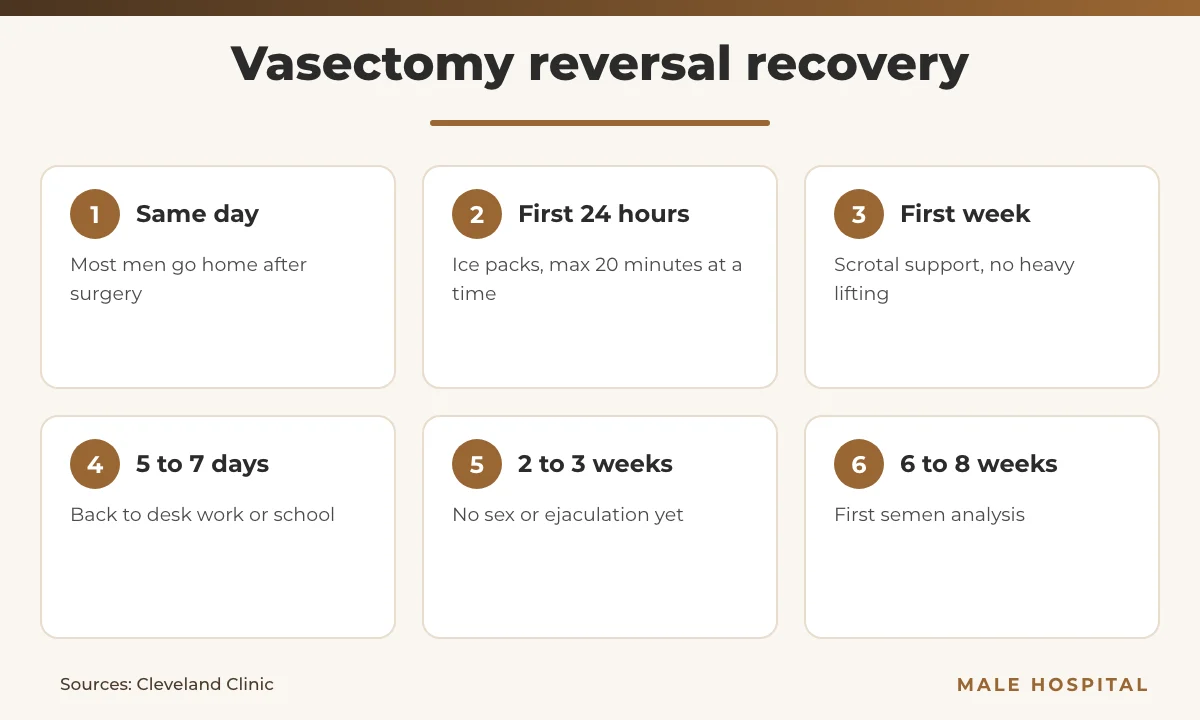
Vasectomy reversal is done under general or local anesthesia and can take up to four hours, depending on whether a vasoepididymostomy is needed; general anesthesia is often preferred when one is expected. Through small incisions in the scrotum, the surgeon frees each vas, cuts away the scarred segment, checks the fluid and then stitches the two channels together in layers. Most men go home the same day.
Source: Cleveland Clinic — Purpose, procedure and success rate; Asian Journal of Andrology (PMC) — Patel & Smith 2016
Recovery timeline
- First 24 hours: ice packs wrapped in a towel, no more than 20 minutes at a time, and simple pain relief agreed with your surgeon.
- Day 2: light normal activities can usually resume.
- First week: wear supportive underwear or an athletic supporter; avoid running and heavy lifting. Stitches are checked at about one week.
- 5–7 days: back to desk work or school; up to two weeks for physical jobs.
- 2–3 weeks: wait before sex or ejaculation so the joins can heal.
- 6–8 weeks: first semen analysis, then repeat tests until counts are stable.
Source: Cleveland Clinic — Purpose, procedure and success rate
Sperm usually appear within a few months after a vasovasostomy but can take longer after a vasoepididymostomy. Even once sperm are present, counts and movement may be low at first; if they stay low, the usual work-up for a low sperm count applies. Couples conceive on average about a year after a reversal, so patience and regular follow-up tests matter.
Source: EAU — Sexual and Reproductive Health Guidelines (male infertility); Asian Journal of Andrology (PMC) — Patel & Smith 2016
Vasectomy reversal risks and complications
Vasectomy reversal is generally a low-risk outpatient operation. Pain afterwards is usually moderate and similar to the original vasectomy. Possible problems include:
- Bleeding inside the scrotum (hematoma), swelling and bruising.
- Wound or scrotal infection.
- Risks of anesthesia.
- Failure: no sperm return, or late re-blockage of the join after sperm first appear (more common after vasoepididymostomy).
- Scarring at the incision sites.
If the vasectomy reversal fails, a second reversal or surgical sperm retrieval for ICSI remain options.
Source: Cleveland Clinic — Purpose, procedure and success rate; EAU — Sexual and Reproductive Health Guidelines (male infertility)
When to see a doctor
Book a consultation when you are first considering reversal, ideally together with your partner, so both of you can be assessed before choosing between surgery and IVF/ICSI. After surgery, contact your surgeon promptly if you notice:
- Rapidly growing, tense or very painful scrotal swelling, which can signal a hematoma.
- Fever, chills, spreading redness, warmth or pus from the wound.
- Pain that keeps getting worse instead of better after the first few days.
- No sperm on semen tests several months after a vasovasostomy, or counts that fall after initially returning.
- Ongoing testicular pain, which deserves its own work-up; see our guide to testicular pain.
Source: Cleveland Clinic — Purpose, procedure and success rate; EAU — Sexual and Reproductive Health Guidelines (male infertility)
If you are weighing a vasectomy reversal against sperm retrieval, you can arrange a confidential consultation with Assoc. Prof. Dr. Zülfü Sertkaya, a urologist-andrologist whose focus includes male infertility. Cost depends on the assessment and the technique needed, so message us on WhatsApp for a free first evaluation.
FAQs about vasectomy reversal
Is it ever too late to reverse a vasectomy?
There is no fixed time limit. Success falls as the years pass, and more men need the complex vasoepididymostomy, but sperm still returned in 71% of men 15 or more years after vasectomy in the largest series. Cleveland Clinic notes effectiveness starts to decline at around 15 years, yet reversal is not considered too late at any point.
Source: Journal of Urology (PubMed) — Belker et al. 1991; Cleveland Clinic — Purpose, procedure and success rate
How long after vasectomy reversal does sperm come back?
After a vasovasostomy, the EAU reports an average time to sperm return of about 1.7 to 4.3 months. After a vasoepididymostomy it is slower, around 2.8 to 6.6 months on average, and Cleveland Clinic notes it can take up to 15 months. Your first semen test is usually done 6 to 8 weeks after surgery.
Source: EAU — Sexual and Reproductive Health Guidelines (male infertility); Cleveland Clinic — Purpose, procedure and success rate
Is vasectomy reversal painful?
The operation is done under general or local anesthesia, so you should not feel pain during it. Afterwards, most men describe moderate soreness, similar to the original vasectomy, which is managed with ice, scrotal support and simple painkillers approved by the surgeon. Most return to desk work within 5 to 7 days.
Source: Cleveland Clinic — Purpose, procedure and success rate
Does my partner’s age matter more than mine?
Often, yes. The AUA describes female partner age as the primary predictor of conception after either reversal or IVF/ICSI. In one series, pregnancy after reversal was 73% when the partner was under 40 and 42% when she was over 40. Male age over 40 also lowers the chances, but to a smaller degree.
Source: AUA — Vasectomy: AUA Guideline; Asian Journal of Andrology (PMC) — Patel & Smith 2016
Can a reversal be done twice?
Yes. A repeat vasectomy reversal is technically harder and more often needs a vasoepididymostomy, but it can still work. In the Vasovasostomy Study Group, 222 repeat operations led to sperm return in 75% of men and pregnancy in 43% of couples with follow-up. Sperm retrieval with ICSI is the alternative.
Source: Journal of Urology (PubMed) — Belker et al. 1991
Do antisperm antibodies stop a reversal from working?
Antibodies against sperm develop in most men after vasectomy, but the AUA guideline states that they do not predict reversal success, and routine testing before surgery is not recommended. If sperm return but pregnancy does not follow, a full semen analysis and a fertility review of both partners help find the reason.
Source: AUA — Vasectomy: AUA Guideline; Asian Journal of Andrology (PMC) — Patel & Smith 2016
Can vasectomy reversal relieve testicular pain after vasectomy?
For some men, yes. Cleveland Clinic reports that more than 80% of men who had a reversal for post-vasectomy pain saw the pain resolve, and small studies report pain-free rates from 66% upward. The evidence comes from small series, so other causes of scrotal pain should be ruled out first.
Source: Cleveland Clinic — Purpose, procedure and success rate; Asian Journal of Andrology (PMC) — Patel & Smith 2016
Do I need contraception after a vasectomy reversal?
Yes, if you do not want a pregnancy straight away. Once the reversal works, sperm return to the semen and you are fertile again. A semen analysis showing sperm confirms the reversal has opened the tubes; until then, you cannot assume you are infertile or fertile.
Source: Cleveland Clinic — Purpose, procedure and success rate
Medically reviewed by Assoc. Prof. Dr. Zülfü Sertkaya, urologist and andrologist (FEBU), Istanbul. Last reviewed: November 2026.
This article is for general information and does not replace an individual consultation with a qualified doctor.
- EAU — Sexual and Reproductive Health Guidelines (male infertility chapter)
- AUA — Vasectomy: AUA Guideline (fertility restoration and vasectomy reversal)
- Cleveland Clinic — Vasectomy Reversal: Purpose, Procedure & Success Rate
- MedlinePlus — Vasectomy
- Journal of Urology (PubMed) — Belker et al. 1991, Results of 1,469 microsurgical vasectomy reversals by the Vasovasostomy Study Group
- Urology (PubMed) — Herrel et al. 2015, Outcomes of microsurgical vasovasostomy for vasectomy reversal: a meta-analysis and systematic review
- Asian Journal of Andrology (PMC) — Patel & Smith 2016, Vasectomy reversal: a clinical update
- Turkish Journal of Urology (PMC) — Gözen et al. 2020, Robot-assisted vasovasostomy and vasoepididymostomy: current status