
The Coloplast Titan penile implant is a 3-piece inflatable penile prosthesis for men with erectile dysfunction (ED) that has not responded to tablets, injections or other treatments. Two cylinders sit inside the penis, a pump sits in the scrotum and a fluid reservoir sits in the lower abdomen, so the man can create a firm erection on demand and return the penis to a soft state afterwards. For the operation itself, costs and recovery in general, see our main penile prosthesis (penile implant) surgery page; this guide focuses on the Coloplast Titan family itself: its models, materials, published results and known limitations.
Sources: Coloplast US — Erectile dysfunction products for health care professionals; EAU Guidelines — Management of erectile dysfunction
- The Titan is Coloplast’s 3-piece inflatable implant; versions include the original Titan, Titan OTR (One Touch Release), Titan Touch and narrow-base (NB) cylinders for scarred erection chambers.
- Its cylinders are made of Bioflex, Coloplast’s proprietary polymer, and every Titan has a hydrophilic coating that absorbs an antibiotic solution chosen by the surgeon just before implantation.
- In published series, 85–90% of men with a Titan were satisfied, and a large diabetic cohort found 3.4% infection overall, with lower rates when vancomycin plus gentamicin was used for dipping.
- European guidelines state there are no head-to-head trials showing that any manufacturer’s implant is superior; studies comparing the Coloplast Titan with the AMS 700 show broadly similar results with small trade-offs.
- Titan Prime, a next-generation model, received FDA approval in June 2026 and is being launched in the United States first; it is not yet available in other countries.
- What is the Coloplast Titan penile implant?
- Titan models: Titan, OTR, Touch, NB and Titan Prime
- How the Coloplast Titan penile implant works
- Hydrophilic coating, antibiotic dips and infection
- Satisfaction and reliability: what studies show
- Coloplast Titan vs AMS 700
- Who may suit a Coloplast Titan penile implant?
- Known limitations and risks
- When to see a doctor
- Choosing a surgeon for a Titan implant
- FAQs
What is the Coloplast Titan penile implant?
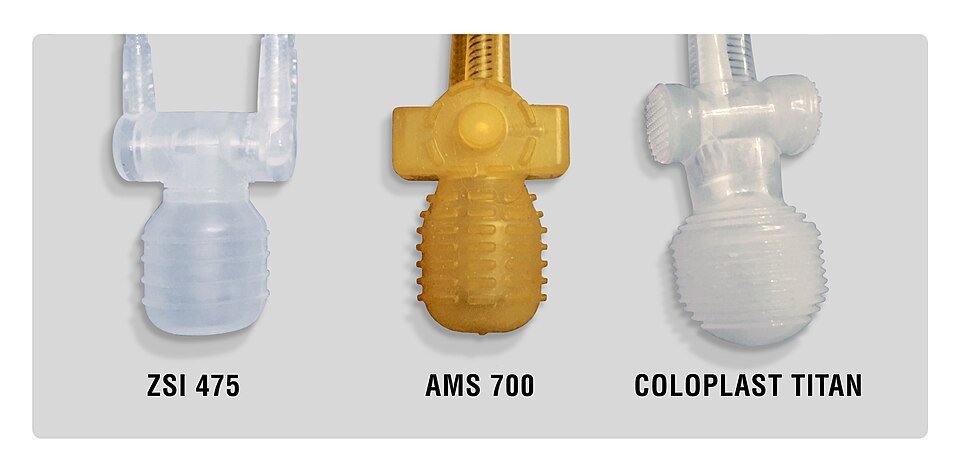
Coloplast describes the Titan as a self-contained, fluid-filled system made from Bioflex and silicone. It has three parts: a reservoir placed in the abdomen, two cylinders placed in the penis and a pump placed in the scrotum, all joined by silicone tubing. Once healed, the device sits entirely inside the body; when it is deflated the penis looks relaxed, and nothing is visible from the outside.
According to Coloplast, the Titan is MRI conditional, meaning scans are allowed under defined conditions (a static magnetic field of 3 tesla or less, among other limits), and it is latex-free. If you ever need an MRI, tell the radiology team you have a penile implant so they can check the conditions for your device.
Sources: Coloplast UK — Erectile dysfunction: patient information on the Titan implant; Coloplast US — Erectile dysfunction products for health care professionals
In the United States the Coloplast Titan is regulated by the Food and Drug Administration (FDA) as a class III device under premarket approval number P000006. A 2008 supplement to that approval covered the redesigned One Touch Release pump, an additional silicone grade and a 1.5 cm rear tip extender, and allowed the modified device to be marketed as the Titan OTR.
Sources: U.S. FDA — PMA P000006/S007: Coloplast Titan inflatable penile prosthesis (Titan OTR, 2008); PMC (Transl Androl Urol) — Polchert et al., Narrative review of penile prosthetic implant technology (2021)
Coloplast describes the Alpha 1, an earlier Mentor-branded device, as the Titan’s predecessor. Over the years Coloplast added a lock-out valve on the reservoir (2000), a hydrophilic coating on all Titan implants (2002), the One Touch Release pump (2008) and a flat “Cloverleaf” reservoir that, in 2015, became the first reservoir with FDA labeling for placement outside the usual space behind the pubic bone.
Sources: PMC (Transl Androl Urol) — Polchert et al., Narrative review of penile prosthetic implant technology (2021); Coloplast UK — Erectile dysfunction: patient information on the Titan implant
Titan models: Titan, OTR, Touch, NB and Titan Prime
“Titan” is a family name rather than a single product. The versions differ mainly in the pump design and in cylinder width; the basic 3-piece principle is the same. The table summarizes what manufacturer and peer-reviewed sources report about each.
| Model | What is different | Notes |
|---|---|---|
| Titan (standard) | Bioflex cylinders, scrotal pump, reservoir with lock-out valve | Cylinder lengths 11 cm and 14–28 cm (even sizes); rear tip extenders add length |
| Titan OTR | One Touch Release pump: squeezing two touch pads deflates the device | FDA supplement approved June 2008 |
| Titan Touch | Newer pump with fewer internal parts | Coloplast states 22% less force is needed to trigger inflation (company data) |
| Narrow-base (NB) versions | Narrower cylinders (11–12 mm base diameter listed) | Suggested for significant corporal scarring or Peyronie’s disease |
| Titan Prime | Next-generation Bioflex device with improved flaccid flexibility (company statement) | FDA-approved June 2026; phased US launch from late 2026; not yet approved elsewhere |
Sources: PMC (Transl Androl Urol) — Polchert et al., Narrative review of penile prosthetic implant technology (2021); Coloplast UK — Titan Touch professional information; Coloplast — Titan Prime inflatable penile prosthesis approved by the FDA (2026)
Titan Prime was announced by Coloplast on 3 June 2026. The company says it keeps the rigidity and girth of the current Titan while being more flexible when deflated, which may help comfort and concealment. It has no long-term published outcomes yet.
Source: Coloplast — Titan Prime inflatable penile prosthesis approved by the FDA (2026)
How the Coloplast Titan penile implant works
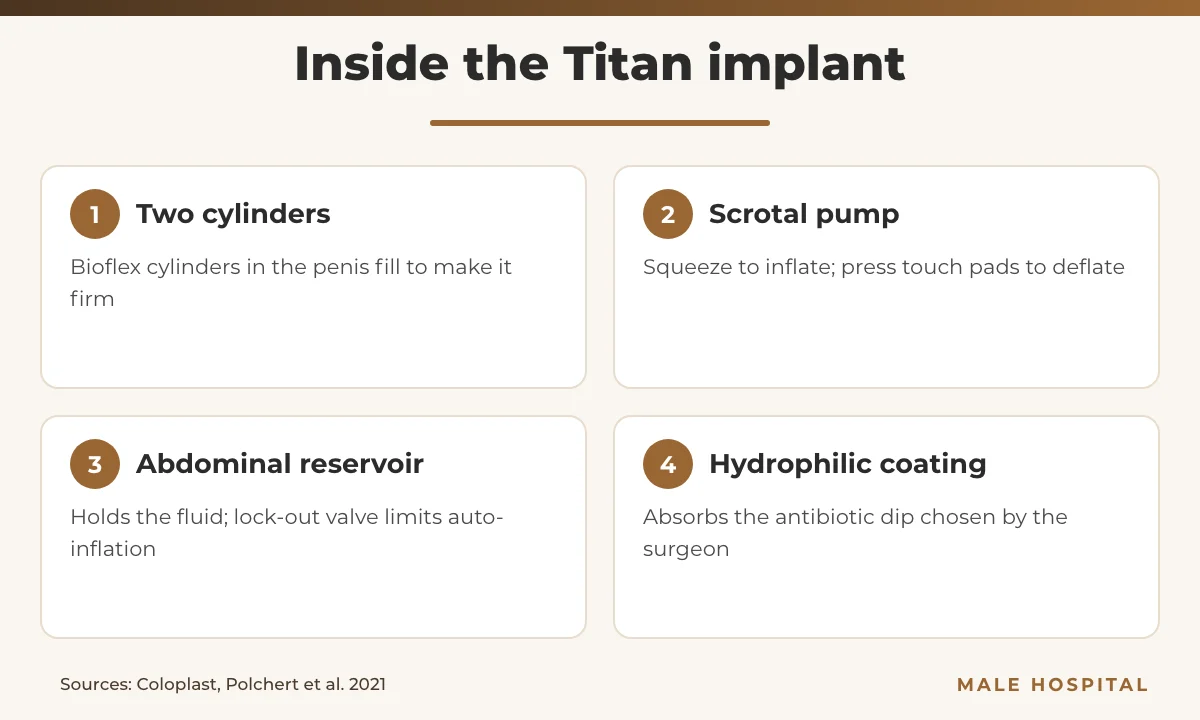
To get an erection, the man squeezes the pump bulb in the scrotum several times. Each squeeze moves fluid from the abdominal reservoir into the two penile cylinders, which expand in width and stiffen. To deflate, he presses the release mechanism on the pump: on OTR and Touch pumps this is done by squeezing the touch pads on either side of the pump, and the fluid flows back into the reservoir.
The reservoir carries a lock-out valve designed to stop fluid from flowing into the cylinders by itself, a problem called auto-inflation. In the review by Polchert and colleagues, auto-inflation fell from 11% with older technology to 1.3% after this valve was introduced. Titan cylinders also connect to the tubing at a zero-degree angle, and the cylinders have soft molded tips; Coloplast says these features ease surgical placement and give a more natural feel.
Sources: PMC (Transl Androl Urol) — Polchert et al., Narrative review of penile prosthetic implant technology (2021); Coloplast US — Erectile dysfunction products for health care professionals
Men usually wait four to six weeks before use, then learn inflation and deflation at a follow-up visit. Our penile implant recovery guide covers this period.
Source: Cleveland Clinic — Penile implants
Hydrophilic coating, antibiotic dips and infection
Infection is the most serious early complication of any penile implant, because an infected device usually has to be removed. The two main manufacturers tackle this differently. The AMS 700 uses a factory coating containing the antibiotics rifampin and minocycline (InhibiZone). The Coloplast Titan instead has a hydrophilic polyvinylpyrrolidone coating, which Coloplast calls HydroVANTAGE: when the surgeon soaks the device in an antibiotic solution in the operating room, the coating absorbs it, so the antibiotic choice can be tailored to the patient.
Sources: PMC (Transl Androl Urol) — Polchert et al., Narrative review of penile prosthetic implant technology (2021); PMC (Cureus) — Atri et al., A comparison between AMS 700 and Coloplast Titan: a systematic literature review (2020); Coloplast UK — Titan Touch professional information
The coating appears to matter. In data summarized by Polchert and colleagues, the infection rate was 1.06% among 2,357 men with coated Titan implants versus 2.07% among 482 men with non-coated devices. A larger Titan database of 29,360 patients with up to 11 years of follow-up reported an infection rate of 1.4%. European Association of Urology (EAU) guidelines state that antibiotic-impregnated or hydrophilic-coated prostheses may lower infection rates to about 1–2%.
Sources: PMC (Transl Androl Urol) — Polchert et al., Narrative review of penile prosthetic implant technology (2021); EAU Guidelines — Management of erectile dysfunction
Which antibiotic dip?
Men with diabetes have a higher infection risk, so the dip choice has been studied specifically in them. In an 18-center review of 468 diabetic men receiving a primary Titan implant, the overall infection rate was 3.4%. Infection was significantly lower when the device was dipped in vancomycin plus gentamicin than with other solutions (1.4% vs 6.4%), as were removal (1.1% vs 8.3%) and revision (2.5% vs 12.5%). Rifampin-containing dips did not show the same protection. The EAU guidelines cite this study when discussing dipping solutions.
Sources: PubMed (J Sex Med) — Towe et al., Antimicrobial dipping solutions and infection in diabetic men receiving a Coloplast Titan (2020); EAU Guidelines — Management of erectile dysfunction
Satisfaction and reliability: what studies show
Most Titan data come from case series rather than randomized trials, so treat these figures as guides, not promises.
- Titan OTR, multicenter prospective study (Ohl et al., 2012): 113 men at eight centers; overall satisfaction was 90.6% at 6 months and 90.0% at 12 months. Four devices (3.5%) were removed for infection and one for chronic pain.
- Danish university series (Lindeborg et al., 2014): 33 men; 85% of those who answered were satisfied, 92% would recommend an implant, one device was removed for infection and three needed revision for auto-inflation, deflation or a displaced reservoir.
- Men with Peyronie’s disease (Chung et al., 2013): 50 Titan and 88 AMS 700 CX implants with manual straightening; both gave similar straightening, and 5-year estimated mechanical survival was 87% for the Titan and 91% for the CX, a difference that was not statistically significant.
Sources: PubMed (J Sex Med) — Ohl et al., Prospective evaluation of the Coloplast Titan One Touch Release prosthesis (2012); PubMed (Scand J Urol) — Lindeborg et al., Satisfaction and complications with the Titan one-touch release implant (2014); PubMed (J Sex Med) — Chung et al., AMS 700 CX vs Coloplast Titan for Peyronie’s disease (2013)
Across all brands, EAU guidelines describe penile implants as having one of the highest satisfaction rates of any ED treatment (92 to 100 percent of patients and 91 to 95 percent of partners) and report mechanical failure rates of under 5% after five years for modern 3-piece devices. The same guidelines cite a meta-analysis in which implant survival was 87.2% at five years and fell to 52.9% at 20 years, so a second operation at some point is a realistic possibility.
Source: EAU Guidelines — Management of erectile dysfunction
Where Titan Touch devices fail
A 2026 study by Feng and colleagues looked at 1,907 Titan implants with Touch pumps placed by one high-volume surgeon between 2013 and 2025. Of these men, 214 needed reoperation or replacement, about 70% of them for mechanical failure, at a median of 59 months. The most common cause was a problem with the kink-resistant tubing, and 77% of tubing fractures occurred where the tubing joins the strain-relief boot near the scrotal pump. The authors suggest that knowing these weak points could guide changes in surgical technique and device design.
Source: PubMed (J Sex Med) — Feng et al., Patterns of mechanical failure in the Coloplast Titan Touch (2026)
Coloplast Titan vs AMS 700
The Coloplast Titan and Boston Scientific’s AMS 700 are the two most widely used 3-piece implants, and men often ask which one is “better.” The honest answer is that no randomized trial has settled this. The EAU guidelines state there are no head-to-head studies comparing different manufacturers’ implants, and a 2020 systematic review concluded that the literature is inconclusive, with small and inconsistent advantages for each device. Our separate article on the AMS 700 penile implant covers that device in detail.
Sources: EAU Guidelines — Management of erectile dysfunction; PMC (Cureus) — Atri et al., A comparison between AMS 700 and Coloplast Titan: a systematic literature review (2020)
| Feature | Coloplast Titan | AMS 700 |
|---|---|---|
| Cylinder material | Bioflex polymer with a polyurethane layer | Silicone base covered by a woven Dacron-Lycra layer (700 CX) |
| Infection-reducing surface | Hydrophilic coating soaked in surgeon-chosen antibiotics | Factory antibiotic coating (rifampin and minocycline) |
| Overall satisfaction (Morgado et al.) | No difference in EDITS score | No difference in EDITS score |
| Deflation (Otero et al.) | 24% dissatisfied with deflation | 4% dissatisfied with deflation |
| Preference with demonstration devices (125 men aged 60+) | Titan preferred by 44% for inflation | AMS 700 preferred by 40% for deflation |
| Cylinder rigidity (lab test) | Resisted bending loads better in one ex vivo study | AMS 700 LGX tested; CX model not tested |
Sources: PMC (Transl Androl Urol) — Polchert et al., Narrative review of penile prosthetic implant technology (2021); PubMed (Rev Int Androl) — Morgado et al., Long-term satisfaction: AMS 700CX vs Coloplast Titan (2018); PMC (Asian J Androl) — Otero et al., Patient and partner satisfaction with 700CX and Titan penile prostheses (2017); PubMed (Int J Impot Res) — Madhusoodanan et al., Inflation and deflation preference for common inflatable prostheses (2021); PMC (J Sex Med) — Scovell et al., Load testing of inflatable penile implant cylinders of two manufacturers (2016)
In the Spanish study by Otero and colleagues (248 men, not randomized), satisfaction was very high for both devices, but more AMS 700 CX patients were “very satisfied” and Titan users reported more difficulty deflating. In a Portuguese study of 55 men followed for almost five years, satisfaction scores were virtually identical (77.5 for Titan vs 77.2 for the 700 CX). The lab study by Scovell and colleagues, funded by its lead author, found Titan cylinders resisted kinking and bending better than AMS 700 LGX cylinders, but it tested cylinders outside the body and few devices, so it cannot predict how either feels in real use.
Sources: PMC (Asian J Androl) — Otero et al., Patient and partner satisfaction with 700CX and Titan penile prostheses (2017); PubMed (Rev Int Androl) — Morgado et al., Long-term satisfaction: AMS 700CX vs Coloplast Titan (2018); PMC (J Sex Med) — Scovell et al., Load testing of inflatable penile implant cylinders of two manufacturers (2016)
Who may suit a Coloplast Titan penile implant?
A Titan is considered for the same men as any 3-piece implant: those whose ED has not improved with medicines, injections or a vacuum device, or who prefer a lasting solution after counselling. EAU guidelines give a strong recommendation for a penile prosthesis if other treatments fail or depending on patient preference, and note that many men prefer 3-piece devices because they give more natural erections. If you are still weighing up device types, our guide to the inflatable penile prosthesis compares 3-piece and 2-piece designs.
Sources: EAU Guidelines — Management of erectile dysfunction; Cleveland Clinic — Penile implants
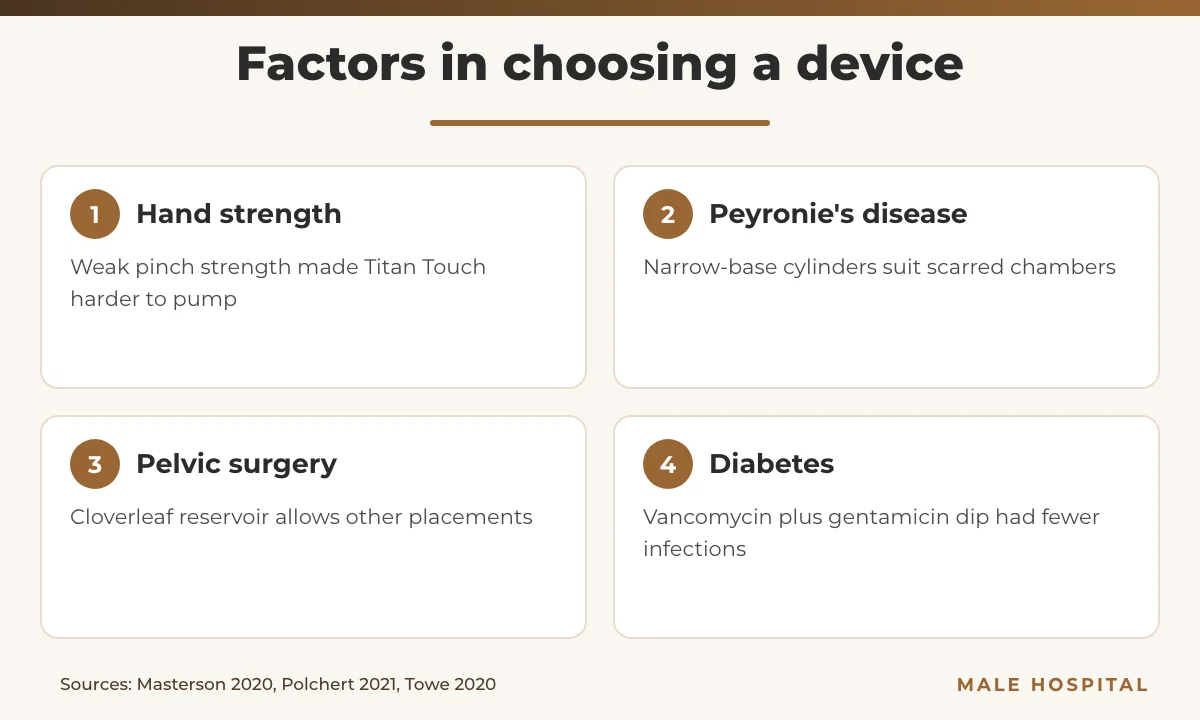
Choosing between brands is usually a surgeon decision based on several factors:
- Hand strength and dexterity: in a study of 100 men over 65 operating demonstration devices, lower pinch strength was linked to more difficulty inflating the Titan Touch; the authors suggest that men with weak pinch strength may do better with another model.
- Peyronie’s disease: Coloplast states that the Titan Touch is the only implant with FDA approval for manual modeling in the presence of Peyronie’s disease, and narrow-base cylinders are often chosen when the erection chambers are scarred.
- Previous pelvic surgery: after prostate or bladder surgery, the usual reservoir space may be scarred; the Cloverleaf reservoir is designed for alternative placement.
- Diabetes: the device can be soaked in a chosen antibiotic combination, which may be relevant given the higher infection risk in diabetic men.
Sources: PubMed (Int J Impot Res) — Masterson et al., Key pinch strength and preference for Coloplast and AMS models (2020); Coloplast UK — Titan Touch professional information; PMC (Transl Androl Urol) — Polchert et al., Narrative review of penile prosthetic implant technology (2021); PubMed (J Sex Med) — Towe et al., Antimicrobial dipping solutions and infection in diabetic men receiving a Coloplast Titan (2020)
Known limitations and risks
The Coloplast Titan shares the general risks of all penile implant surgery: bleeding, infection requiring removal, erosion, scar tissue, a pump or reservoir that moves out of place, mechanical failure and a penis that may feel shorter than before; our guide to penile implant complications covers these in detail. After implantation, the natural erection mechanism is permanently altered; tablets no longer work, and a firm erection depends on the device. The implant does not usually change skin sensation, ejaculation or orgasm.
Source: Cleveland Clinic — Penile implants
Device-specific issues have also been reported. In a series of 550 men with the Titan OTR pump, 7.8% experienced a “pseudo-malfunction” in which the valve disc became stuck in the deflate position, so the pump bulb felt hard and the device would not inflate. In every case, firm pressure on the pump bulb freed the valve and the device then worked normally.
Source: PubMed (Urology) — Garber et al., Pseudo-malfunction of the Titan One-Touch Release pump (2014)
Long-term durability is the other key limitation. As the Feng study showed, tubing near the pump is the most common failure point in Titan Touch devices, and EAU data show that roughly half of all implants are still working at 20 years. Coloplast’s UK patient information describes a lifetime replacement policy for its implants; ask your surgeon how manufacturer warranty terms apply in your country and what they do and do not cover.
Sources: PubMed (J Sex Med) — Feng et al., Patterns of mechanical failure in the Coloplast Titan Touch (2026); EAU Guidelines — Management of erectile dysfunction; Coloplast UK — Erectile dysfunction: patient information on the Titan implant
The device is only one part of the total price; our guide to penile implant cost explains the other components.
When to see a doctor
If you already have a Coloplast Titan penile implant, contact your surgeon promptly if you notice any of the following, especially in the first weeks after surgery:
- Fever, chills, or increasing redness, warmth, swelling or pus around the incision or scrotum.
- Pain that gets worse instead of better, or new pain months or years after surgery.
- A cylinder tip, tubing or part of the pump that can be felt pushing against or through the skin (possible erosion).
- The device will not inflate or deflate, inflates by itself, or the pump has moved out of reach.
Fever with a red, painful scrotum after implant surgery needs prompt medical attention, because an infected implant usually has to be removed and early treatment matters.
Sources: Cleveland Clinic — Penile implants; EAU Guidelines — Management of erectile dysfunction
Choosing a surgeon for a Titan implant
Much of the published Titan experience comes from experienced, high-volume implant centers, and the choice of surgeon matters as much as the choice of device. At Male Hospital, implant surgery is performed by Assoc. Prof. Dr. Zülfü Sertkaya, a urologist and andrologist (FEBU) whose focus includes penile prosthesis surgery and who holds a Titan® Inflatable Penile Prosthesis Center of Excellence certificate from Coloplast (2024). The device is chosen after examination, not by brand preference.
Sources: PubMed (J Sex Med) — Feng et al., Patterns of mechanical failure in the Coloplast Titan Touch (2026); PubMed (J Sex Med) — Ohl et al., Prospective evaluation of the Coloplast Titan One Touch Release prosthesis (2012)
For a confidential discussion of whether a penile implant suits you, you can contact our urologist-andrologist on WhatsApp; pricing depends on the assessment and is explained during the free consultation.
FAQs about the Coloplast Titan penile implant
Is the Coloplast Titan better than the AMS 700?
Neither has been proven better. EAU guidelines note there are no head-to-head trials between manufacturers, and a 2020 systematic review found the evidence inconclusive. Individual studies show only small trade-offs in deflation, inflation and cylinder stiffness. Your surgeon’s experience and your anatomy matter more than the brand.
Sources: EAU Guidelines — Management of erectile dysfunction; PMC (Cureus) — Atri et al., A comparison between AMS 700 and Coloplast Titan: a systematic literature review (2020)
What is the difference between Titan OTR and Titan Touch?
Both are 3-piece Titan devices with the same Bioflex cylinders and reservoir lock-out valve; the difference is the pump. The OTR pump, approved by the FDA in 2008, deflates when you squeeze two touch pads. The Titan Touch is a newer pump with fewer internal parts, and Coloplast reports it needs 22% less force to trigger inflation, based on company data.
Sources: U.S. FDA — PMA P000006/S007: Coloplast Titan inflatable penile prosthesis (Titan OTR, 2008); Coloplast UK — Titan Touch professional information
What is Bioflex?
Bioflex is Coloplast’s proprietary polymer used for Titan cylinders; the company describes it as a supple yet durable biopolymer. A peer-reviewed review describes the Coloplast Titan’s polyurethane layer, like the Dacron-Lycra layer of the AMS 700, as recommended for men with defects in the tunica albuginea, the tough sheath around the erection chambers, to limit bulging (aneurysm).
Sources: Coloplast US — Erectile dysfunction products for health care professionals; PMC (Transl Androl Urol) — Polchert et al., Narrative review of penile prosthetic implant technology (2021)
How many times do you pump a Titan implant?
The number of squeezes varies with cylinder size and model, and no single figure applies to every man. In a bench study, men over 65 operated identical penis models fitted with a Titan, a Titan Touch and an AMS 700; the Titan was the device most often preferred for ease of inflation (58%). Your surgeon or nurse will show you the technique at the activation visit.
Can I have an MRI with a Coloplast Titan implant?
Yes, within limits. Coloplast lists the Titan as MRI conditional: scanning is allowed in a static magnetic field of 3 tesla or less, with further limits on the gradient field and energy absorption. Always tell the radiology team you have an implant and, if possible, bring your implant card so they can confirm the exact model.
Source: Coloplast UK — Erectile dysfunction: patient information on the Titan implant
How long does a Coloplast Titan implant last?
There is no fixed lifespan. In Chung’s study, the estimated 5-year mechanical survival of Titan devices was 87%, and across all brands, EAU data show about half of implants still working at 20 years. A large Titan Touch series found a median of about five years to reoperation among the men who needed one. Many men never need revision, but you should plan for the possibility.
Sources: PubMed (J Sex Med) — Chung et al., AMS 700 CX vs Coloplast Titan for Peyronie’s disease (2013); EAU Guidelines — Management of erectile dysfunction; PubMed (J Sex Med) — Feng et al., Patterns of mechanical failure in the Coloplast Titan Touch (2026)
Medically reviewed by Assoc. Prof. Dr. Zülfü Sertkaya, urologist and andrologist (FEBU), Istanbul. Last reviewed: November 2026.
This article is for general information and does not replace an individual consultation with a qualified doctor.
- Coloplast US — Erectile dysfunction products for health care professionals
- EAU Guidelines — Management of erectile dysfunction
- Coloplast UK — Erectile dysfunction: patient information on the Titan implant
- U.S. FDA — PMA P000006/S007: Coloplast Titan inflatable penile prosthesis (Titan OTR, 2008)
- PMC (Transl Androl Urol) — Polchert et al., Narrative review of penile prosthetic implant technology (2021)
- Coloplast UK — Titan Touch professional information
- Coloplast — Titan Prime inflatable penile prosthesis approved by the FDA (2026)
- Cleveland Clinic — Penile implants
- PMC (Cureus) — Atri et al., A comparison between AMS 700 and Coloplast Titan: a systematic literature review (2020)
- PubMed (J Sex Med) — Towe et al., Antimicrobial dipping solutions and infection in diabetic men receiving a Coloplast Titan (2020)
- PubMed (J Sex Med) — Ohl et al., Prospective evaluation of the Coloplast Titan One Touch Release prosthesis (2012)
- PubMed (Scand J Urol) — Lindeborg et al., Satisfaction and complications with the Titan one-touch release implant (2014)
- PubMed (J Sex Med) — Chung et al., AMS 700 CX vs Coloplast Titan for Peyronie's disease (2013)
- PubMed (J Sex Med) — Feng et al., Patterns of mechanical failure in the Coloplast Titan Touch (2026)
- PubMed (Rev Int Androl) — Morgado et al., Long-term satisfaction: AMS 700CX vs Coloplast Titan (2018)
- PMC (Asian J Androl) — Otero et al., Patient and partner satisfaction with 700CX and Titan penile prostheses (2017)
- PubMed (Int J Impot Res) — Madhusoodanan et al., Inflation and deflation preference for common inflatable prostheses (2021)
- PMC (J Sex Med) — Scovell et al., Load testing of inflatable penile implant cylinders of two manufacturers (2016)
- PubMed (Int J Impot Res) — Masterson et al., Key pinch strength and preference for Coloplast and AMS models (2020)
- PubMed (Urology) — Garber et al., Pseudo-malfunction of the Titan One-Touch Release pump (2014)