A malleable penile implant (also called a semi-rigid penile prosthesis) is a pair of bendable rods placed inside the erection chambers of the penis, so a man with erectile dysfunction (ED) can bend the penis up for sex and down again afterwards, with no pump to operate. It is simpler to use and has fewer mechanical parts than an inflatable device, but the penis stays firm all the time and is harder to conceal. For the operation itself and the full range of implant options, see our main penile prosthesis (penile implant) surgery page; this guide focuses on who suits the semi-rigid option, which devices exist and how it compares with an inflatable implant.
Sources: EAU Guidelines — Management of erectile dysfunction; Cleveland Clinic — Penile implants
- A malleable penile implant is two bendable silicone rods with a metal core; you position the penis by hand, and its firmness never changes.
- European guidelines describe the malleable penile implant as simple to implant and easy to use, and an option for men with limited manual dexterity.
- The main drawbacks are a constantly firm penis that is harder to hide under clothing and a less natural erection than with an inflatable device.
- Reviews report fewer mechanical failures than inflatable implants, but higher erosion rates and somewhat lower satisfaction.
- Current malleable penile implants include the Coloplast Genesis, Boston Scientific Tactra and Rigicon Rigi10.
- What is a malleable penile implant?
- How semi-rigid implant rods work day to day
- Who is a good candidate for a malleable penile implant?
- Malleable penile implant devices on the market
- Malleable vs inflatable implant: pros and cons
- Surgery and recovery at a glance
- Outcomes: satisfaction, infection and durability
- When to see a doctor
- FAQs about the malleable penile implant
What is a malleable penile implant?
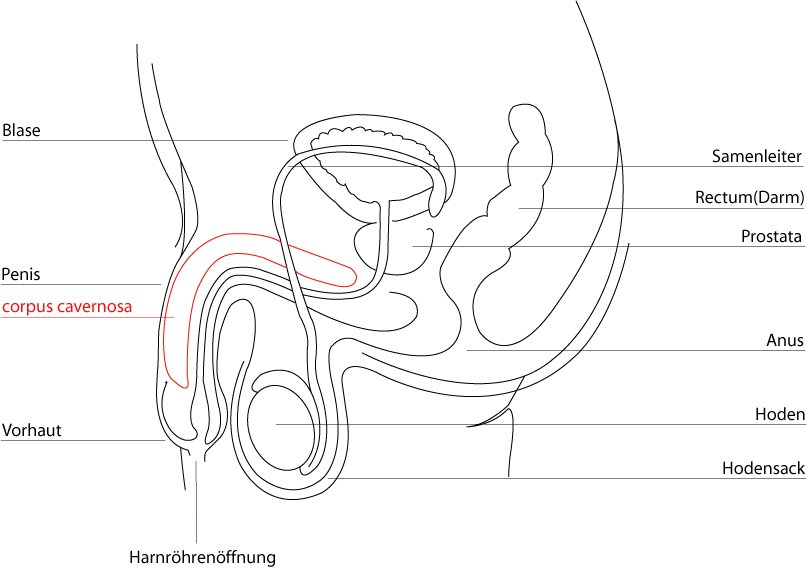
The shaft of the penis contains two parallel spongy chambers called the corpora cavernosa. During a natural erection they fill with blood and become rigid. When ED does not respond to other treatments, a surgeon can place a prosthesis inside these chambers so the penis can become firm enough for penetration.
The European Association of Urology (EAU) divides penile implants into two classes: inflatable devices (two-piece and three-piece) and semi-rigid devices. The semi-rigid group includes malleable, mechanical and soft flexible designs. In practice, almost all semi-rigid implants used today are malleable rods: a flexible metal core wrapped in medical-grade silicone. One rod goes into each chamber, and there is no pump, tubing or fluid reservoir.
Sources: EAU Guidelines — Management of erectile dysfunction; PMC — Patel et al., Recent technological development of penile prosthesis (2024)
The EAU gives a strong recommendation to implant a penile prosthesis when other treatments fail, or when the patient prefers it, after he is fully informed of the benefits and harms. Implants are usually offered for ED, including ED combined with Peyronie’s disease, once tablets, injections or other conservative options have not helped. Choosing between a malleable penile implant and an inflatable device is part of that counselling.
Sources: EAU Guidelines — Management of erectile dysfunction; Cleveland Clinic — Penile implants
How semi-rigid implant rods work day to day
Using a semi-rigid implant is simple. To have sex, you bend the penis upward into the erect position by hand. Afterwards, you press it back down against the body. There is nothing to pump and nothing to deflate, and the firmness does not change, even after orgasm.
Because the rods stay rigid, the penis is always semi-erect. It can be bent down or to the side for daily life, but it never becomes fully soft the way it does after an inflatable implant is deflated. Cleveland Clinic notes that this can make it more difficult to hide under clothing, and a review in the Asian Journal of Andrology points out that a malleable penile implant never reaches the relaxed state that inflatable devices achieve.
Sources: Cleveland Clinic — Penile implants; PMC — Akula & Raheem, Fundamentals of prosthetic urology (2019)
According to Cleveland Clinic, an implant does not change the skin sensation of the penis or your ability to orgasm and ejaculate; it replaces only the stiffness. The head of the penis does not swell with the implant, so the erection may look slightly smaller than a natural one. It also does not restore a natural erection, so the decision is usually considered once other ED treatments are no longer an option.
Source: Cleveland Clinic — Penile implants
Who is a good candidate for a malleable penile implant?
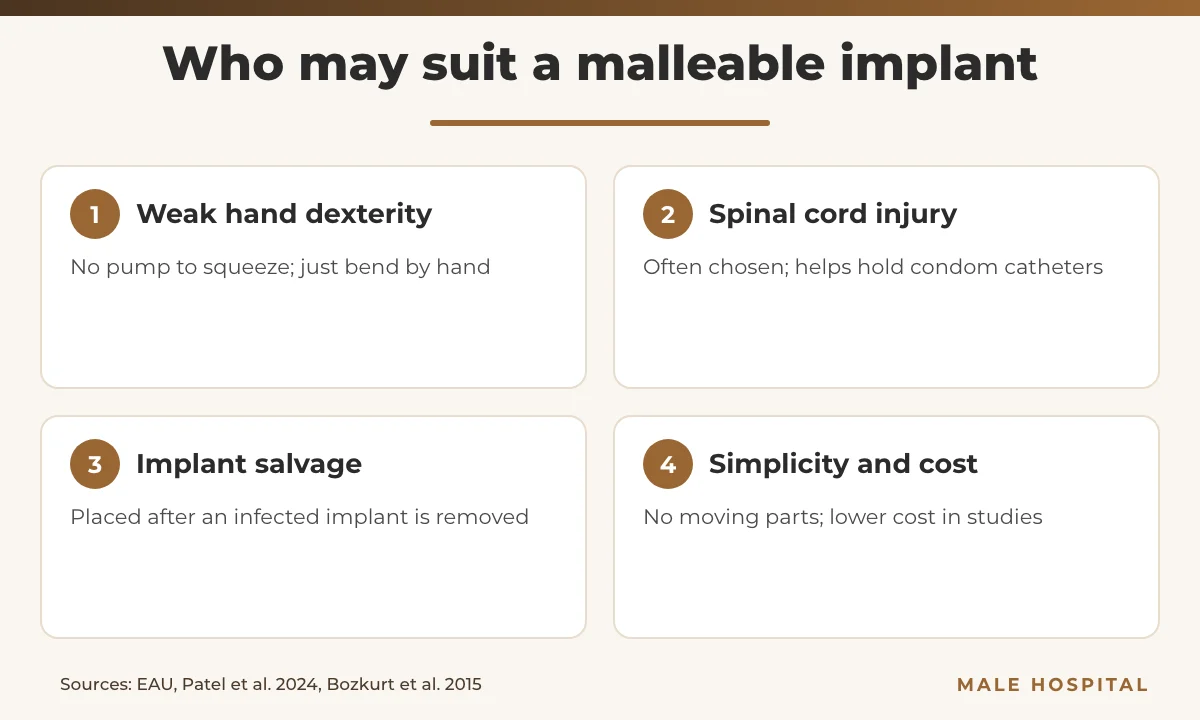
Most men who choose surgery are offered a three-piece inflatable device first, because it gives the most natural erection and flaccid state. A semi-rigid device is often the better fit in specific situations, which guidelines and reviews describe as follows.
Limited hand strength or dexterity
Operating an inflatable implant means squeezing a small pump in the scrotum and pressing a release valve. The EAU notes that malleable penile implants may be an option for men with limited manual dexterity, for example because of arthritis, stroke or nerve damage in the hands. The semi-rigid design only needs the penis to be bent by hand.
Spinal cord injury and condom catheters
Men with spinal cord injuries or those who have trouble pumping an inflatable device frequently receive malleable penile implants. A 2024 review also reports that semi-rigid rods can make it easier for these men to keep a condom-type urine catheter in place.
Implant salvage and buried penis
When an infected or damaged implant has to be removed, a malleable rod can be placed at the same operation, either as the final device or as a bridge to a later inflatable implant. This approach aims to limit scarring inside the erection chambers. Reviews also describe malleable penile implants as a treatment option in selected men with a buried penis and ED.
Simplicity and cost
Some men simply prefer a device with no moving parts. In a Turkish single-centre study, the authors concluded that the semi-rigid implant remains a viable option because of its low cost and high durability, with acceptable satisfaction rates. Device and hospital costs vary widely, so ask for an individual quote; our guide to penile implant cost explains what drives the price.
Sources: EAU Guidelines — Management of erectile dysfunction; PMC — Patel et al., Recent technological development of penile prosthesis (2024); PMC — Akula & Raheem, Fundamentals of prosthetic urology (2019); PubMed — Bozkurt et al., Patient and partner outcome of inflatable and semi-rigid penile prosthesis (2015)
Malleable penile implant devices on the market
Several companies make semi-rigid rods. The main current devices are summarised below from manufacturer pages, the US device registry and a 2024 review. Availability differs by country, and your surgeon will choose the size during surgery by measuring the length of each chamber.
Coloplast Genesis
The Genesis is a malleable penile prosthesis made by Coloplast. According to the 2024 review, it was released in 2004, has a hydrophilic (water-attracting) coating that can absorb an antibiotic solution before implantation, and comes in diameters of 9.5, 11 and 13 mm with length ranges from 14 to 27 cm. The US Global Unique Device Identification Database (GUDID) lists the 9.5 mm model with a 14–23 cm length and an MR Conditional status, meaning MRI scans are possible under specified conditions.
Sources: NLM AccessGUDID — Genesis malleable penile prosthesis (Coloplast A/S); PMC — Patel et al., Recent technological development of penile prosthesis (2024)
Boston Scientific Tactra
The Tactra has a dual-layer silicone body built around a nitinol (nickel–titanium) core. Boston Scientific lists three diameters, 9.5 mm (14–23 cm), 11 mm (16–25 cm) and 13 mm (18–27 cm), which the surgeon trims to length during the operation; rear tip extenders are included to fine-tune the fit. The 2024 review dates its US FDA approval to April 2019.
Sources: Boston Scientific — Tactra malleable penile prosthesis; PMC — Patel et al., Recent technological development of penile prosthesis (2024)
Rigicon Rigi10
The Rigi10 consists of two malleable rods with a stainless-steel core and titanium tips, a hydrophilic coating called HydroShield, and a bending angle of up to 135 degrees. The box includes rear tip extenders of 0.5 and 1.0 cm to adjust length. Rigicon describes it as suited to men seeking a low-maintenance, non-inflatable option, especially those with limited manual dexterity.
Sources: Rigicon — Inside the box: Rigi10 malleable penile implant; PMC — Patel et al., Recent technological development of penile prosthesis (2024)
No head-to-head trial shows that one malleable penile implant brand is superior. Manufacturer claims, such as better concealment or lower revision rates, are based on company data and should be weighed accordingly. Your surgeon’s experience with a device and its availability where you are treated usually matter more than the label.
Malleable vs inflatable implant: pros and cons
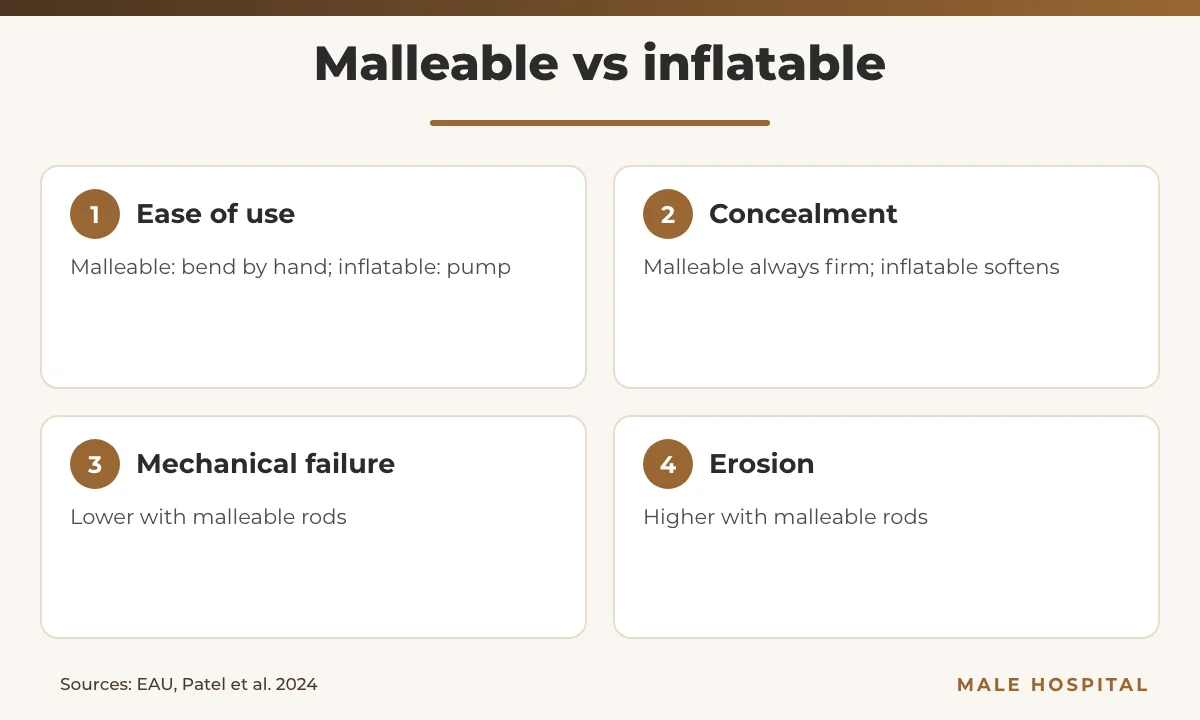
The alternative to a semi-rigid device is an inflatable implant, which uses fluid-filled cylinders and a scrotal pump to create an erection on demand and then soften the penis. We explain the two-piece and three-piece designs in detail in our guide to the inflatable penile prosthesis; the table below compares the two classes.
| Feature | Malleable (semi-rigid) | Inflatable (2- or 3-piece) |
|---|---|---|
| Parts | Two rods only | Cylinders, scrotal pump and (3-piece) a reservoir |
| How you use it | Bend the penis up or down by hand | Squeeze the pump to inflate; release to deflate |
| When not in use | Always firm; harder to conceal | Softer, more natural flaccid state |
| Hand dexterity needed | Minimal | Needed to work the pump |
| Mechanical failure | Lower (0.5–12% across studies) | Higher, because of more moving parts |
| Erosion through tissue | Higher (1.4–5.1% across studies) | Lower |
| Infection | 1.4–8.3% across studies | No significant difference between types |
| Satisfaction | 69–86.6% in retrospective surveys | Generally higher |
Sources: PMC — Patel et al., Recent technological development of penile prosthesis (2024); EAU Guidelines — Management of erectile dysfunction
In short, malleable rods win on simplicity, hand-free use and mechanical reliability, while inflatable devices win on concealment, a natural feel and satisfaction. The 2024 review concludes that the three-piece inflatable device, when suitable for the patient, is generally accepted as the preferred type, while malleable penile implants remain a valid choice for the men described above.
Sources: EAU Guidelines — Management of erectile dysfunction; PMC — Patel et al., Recent technological development of penile prosthesis (2024)
Surgery and recovery at a glance
The operation is the same in principle as for other implants: through a small incision, the surgeon opens and gently widens each erection chamber, measures its length and inserts a rod of the right size. Because there is no pump or reservoir to place, the EAU describes the technique as simple. Cleveland Clinic describes the operation under general anaesthesia, although placement under local anaesthesia in the office has also been reported as a cost-saving measure.
Cleveland Clinic advises that pain and swelling usually ease after about a week, with tenderness for up to six weeks. Men with desk jobs can typically return to work after about a week, and those with physical jobs after two to four weeks. Sexual activity should wait at least four weeks, and most men resume it around six weeks after surgery, depending on the surgeon’s advice. Our guide to penile implant recovery covers the weeks after surgery in more detail.
Sources: Cleveland Clinic — Penile implants; PMC — Akula & Raheem, Fundamentals of prosthetic urology (2019)
Will it change my penis size?
Many men worry that an implant will shorten the penis. In a prospective study of 133 men (88 malleable, 45 inflatable), stretched length measured before surgery was not reduced when the penis was measured erect at the end of the operation. Length rose slightly on average, by 0.22 cm with malleable rods and 0.62 cm with inflatable cylinders, and girth increased more with inflatable devices. Agreeing on measurements with your surgeon beforehand helps keep expectations realistic.
Source: PubMed — Habous et al., Penile length is preserved after implant surgery (2019)
Outcomes: satisfaction, infection and durability
Satisfaction
Across all implant types, the EAU reports some of the highest satisfaction rates of any ED treatment: 92 to 100 percent in patients and 91 to 95 percent in partners. For malleable devices specifically, retrospective surveys summarised in a 2024 review report patient satisfaction of 69% to 86.6%. In one study cited by that review, dissatisfaction was 11.2% with malleable penile implants, compared with 3.8% for two-piece and 3.3% for three-piece inflatable devices.
A Turkish study of 257 men (139 semi-rigid, 118 inflatable) found that both types significantly improved erectile function scores. Satisfaction scores were higher with inflatable devices for both patients and partners, but major complications were more common in the inflatable group.
Sources: EAU Guidelines — Management of erectile dysfunction; PMC — Patel et al., Recent technological development of penile prosthesis (2024); PubMed — Bozkurt et al., Patient and partner outcome of inflatable and semi-rigid penile prosthesis (2015)
Infection and erosion
Infection is the most serious early risk of any implant and usually means the device must be removed. The EAU reports infection rates of 2–3% for first-time implants in low-risk patients, falling to 1–2% with antibiotic-impregnated or hydrophilic-coated devices; risk is higher in men with diabetes or significant vascular disease. Reviews of malleable penile implants report infection rates of 1.4% to 8.3% and erosion rates of 1.4% to 5.1%. Our article on penile implant complications explains these risks and how they are managed.
Sources: EAU Guidelines — Management of erectile dysfunction; PMC — Patel et al., Recent technological development of penile prosthesis (2024)
Durability and newer devices
Cleveland Clinic states that penile implants last about 20 years on average. For one modern malleable penile implant, a 2023 multinational report on 605 first-time Rigi10 implants by 46 surgeons in 15 countries (mean follow-up 21.6 months) found that 0.99% needed revision or removal, with infection in 0.33%, erosion in 0.16% and no mechanical failures requiring surgery. Three-year survival free of revision was 99.2%. These figures are encouraging, but the data came from forms collected by the manufacturer, there was no comparison group, and several authors reported ties to the company.
Sources: Cleveland Clinic — Penile implants; PMC — Wilson et al., Safety outcomes of the first Rigi10 malleable penile prostheses implanted worldwide (2023)
When to see a doctor
If you are considering a malleable penile implant, see a urologist who performs implant surgery regularly to review whether other ED treatments have been tried and which device suits your hands, anatomy and lifestyle. After surgery, contact your surgeon promptly if you notice:
- A fever of 38 °C (100 °F) or higher.
- Heavy bleeding from the incision.
- Pain that gets worse instead of better, or new pain after the early healing period.
- Signs of wound infection, such as increasing redness, warmth, swelling or discharge.
- Thinning skin, a rod tip you can feel just under the skin, or a rod pushing through the tissue (signs of erosion).
Sources: Cleveland Clinic — Penile implants; PMC — Patel et al., Recent technological development of penile prosthesis (2024)
If you would like a confidential opinion on whether a semi-rigid or inflatable device suits you, you can message our urologist-andrologist on WhatsApp or read more about penile prosthesis surgery in Istanbul. The cost depends on the device and your assessment, so we provide an individual quote after a free consultation.
FAQs about the malleable penile implant
Is a malleable penile implant always hard?
Yes. The rods of a malleable penile implant keep the same firmness at all times, so the penis is always semi-erect. You bend it up for intercourse and down or to the side for daily life, but it never becomes fully soft as it does after an inflatable implant is deflated. This is the main trade-off for its simplicity and is why some men find it harder to conceal.
Source: Cleveland Clinic — Penile implants
Is a malleable implant better than an inflatable one?
Neither is better for everyone. Inflatable implants give a more natural erection and flaccid state and higher satisfaction in comparative studies, while malleable rods break down less often mechanically and need no hand strength. A 2024 review regards the three-piece inflatable device as the preferred choice when it suits the patient, and malleable penile implants as a sound option in selected men.
Source: PMC — Patel et al., Recent technological development of penile prosthesis (2024)
How long does a malleable penile implant last?
Cleveland Clinic reports that penile implants last around 20 years on average. Semi-rigid rods have fewer parts that can fail than inflatable devices, which is why mechanical failure is less common. A device may still need replacement for infection, erosion or dissatisfaction, and replacement surgery usually swaps the old device for a new one.
Sources: Cleveland Clinic — Penile implants; PMC — Patel et al., Recent technological development of penile prosthesis (2024)
Can a malleable implant be changed to an inflatable one later?
Yes, conversion is possible in revision surgery. In fact, surgeons sometimes place a malleable rod deliberately as a bridge after an infected implant is removed, then switch to an inflatable device later. Revision operations carry their own risks, including scarring inside the erection chambers, so the best time to choose carefully is before the first surgery.
Source: PMC — Akula & Raheem, Fundamentals of prosthetic urology (2019)
Can I have an MRI with a malleable implant?
Many modern devices are labelled MR Conditional. For example, the US device registry lists the Coloplast Genesis as MR Conditional, meaning scans are allowed under specific conditions. Keep your implant card, which names your exact model, and show it to the radiology team before any scan so they can check its conditions.
Source: NLM AccessGUDID — Genesis malleable penile prosthesis (Coloplast A/S)
How soon can I have sex after a semi-rigid implant?
Most surgeons ask you to avoid sexual activity for at least four weeks, and most men resume around six weeks after surgery once the wounds have healed and tenderness has settled. Your surgeon will confirm when it is safe at your follow-up visit, depending on how your healing is progressing.
Source: Cleveland Clinic — Penile implants
Medically reviewed by Assoc. Prof. Dr. Zülfü Sertkaya, urologist and andrologist (FEBU), Istanbul. Last reviewed: November 2026.
This article is for general information and does not replace an individual consultation with a qualified doctor.
- EAU Guidelines — Management of erectile dysfunction
- Cleveland Clinic — Penile implants
- PMC (Transl Androl Urol) — Patel et al., Recent technological development of penile prosthesis: a literature review (2024)
- PMC (Asian J Androl) — Akula & Raheem, Fundamentals of prosthetic urology (2019)
- PMC (Int J Impot Res) — Wilson et al., Safety outcomes of the first Rigi10 malleable penile prostheses implanted worldwide (2023)
- PubMed (Int Braz J Urol) — Bozkurt et al., Patient and partner outcome of inflatable and semi-rigid penile prosthesis (2015)
- PubMed (BJU Int) — Habous et al., Penile length is preserved after implant surgery (2019)
- NLM AccessGUDID — Genesis malleable penile prosthesis (Coloplast A/S)
- Boston Scientific — Tactra malleable penile prosthesis
- Rigicon — Inside the box: Rigi10 malleable penile implant