Blood in semen (hematospermia) looks alarming but is usually harmless and often clears on its own within days or weeks. In younger men it is mostly linked to minor bleeding, inflammation or infection of the prostate and seminal vesicles, or a recent procedure such as a prostate biopsy. Men over 40, men whose bleeding keeps coming back, and men with other urinary or general symptoms should have a proper check, mainly to rule out infection and, less commonly, prostate cancer.
Sources: NHS — Blood in semen; Cleveland Clinic — Blood in Semen (Hematospermia)
- Hematospermia is usually painless, benign and self-limiting; in men without inflammation, infection or cancer, about 88% resolve on their own, with a mean duration of 1.5 months in one prospective study.
- The most common identified causes are inflammation or infection of the prostate and seminal vesicles and recent procedures, especially prostate biopsy.
- The EAU guideline puts the risk of any cancer in men presenting with blood in the ejaculate at about 3.5%, with prostate cancer the main concern in men over 40.
- A single episode in a man under 40 with no other symptoms usually needs only basic tests and reassurance; age over 40, recurrence, persistence or red-flag symptoms call for a fuller urological work-up.
- Treatment targets the cause: antibiotics for infection, blood pressure control, review of blood thinners, finasteride for fragile prostate vessels, or endoscopic procedures for blockages and cysts.
- What is blood in semen (hematospermia)?
- How common and serious is hematospermia?
- Common causes of blood in semen
- Blood in semen after a prostate biopsy or vasectomy
- When to see a doctor: red flags
- How doctors investigate hematospermia
- How hematospermia is treated
- Sex, partners and outlook
- FAQs about blood in semen
What is blood in semen (hematospermia)?
Hematospermia, also called hemospermia, simply means blood in the ejaculate. The amount varies from a faint pink tinge to obvious streaks or small clots, and sometimes the blood is only visible under a microscope. Bright red usually points to recent bleeding, while brown or reddish-brown semen usually means older blood that is still clearing from the reproductive tract.
Sources: EAU Guidelines — Sexual and Reproductive Health — Disorders of Ejaculation (Haemospermia); MedlinePlus (NIH) — Semen – bloody; NHS — Blood in semen
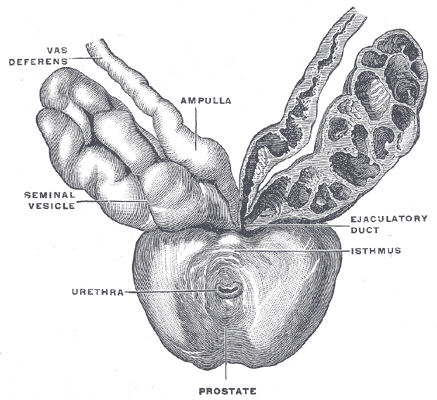
Semen is a mix of sperm from the testicles and fluid made mainly by the seminal vesicles and the prostate. These glands sit just below the bladder and drain into the urethra through the ejaculatory ducts, so bleeding anywhere along this path, from the testicle and epididymis to the prostate and urethra, can color the ejaculate.
Sources: Translational Andrology and Urology (PMC) — Suh et al. 2017 — Etiologic classification, evaluation, and management of hematospermia; Annals of the Royal College of Surgeons of England (PMC) — Kumar et al. 2006 — Haematospermia: A Systematic Review
Before blaming the semen, doctors check that the blood really comes from the ejaculate. Blood in the urine (hematuria) or blood from a sexual partner, for example during menstruation, can look identical. Ejaculating into a condom (the “condom test”) is a simple way to confirm true hematospermia.
Sources: American Family Physician (AAFP) — Stefanovic et al. 2009 — Evaluation and Treatment of Hematospermia; Annals of the Royal College of Surgeons of England (PMC) — Kumar et al. 2006 — Haematospermia: A Systematic Review
How common and serious is hematospermia?
Nobody knows exactly how common blood in semen is, because most men rarely look at their ejaculate and many never mention it to a doctor. One review estimates it accounts for about 1% of urological symptoms. In a screening program of 26,126 men with a median age of 61, about 0.5% reported it. It can happen at any age but is seen most often in men in their 30s and under 40.
Sources: Deutsches Ärzteblatt International (PMC) — Mathers et al. 2017 — Hematospermia: a Symptom With Many Possible Causes; Cleveland Clinic — Blood in Semen (Hematospermia)
The reassuring part is that most cases are benign. Blood in semen is typically painless and self-limiting, and Cleveland Clinic notes that seeing blood once is usually not a sign of cancer. In a prospective study of men without inflammation, infection or cancer, about 88% of cases settled without treatment, with an average duration of about 1.5 months. Bleeding was more likely to persist in men over 50 and in those with seminal vesicle bleeding, a midline cyst or dilated seminal vesicles.
Sources: Translational Andrology and Urology (PMC) — Suh et al. 2017 — Etiologic classification, evaluation, and management of hematospermia; Cleveland Clinic — Blood in Semen (Hematospermia)
The figure that matters most for older men is the cancer risk. The European Association of Urology (EAU) guideline estimates the risk of any malignancy in men presenting with blood in semen at about 3.5%, with reported figures ranging from 0 to 13.1%. In one cohort of 342 patients, inflammation or infection explained 49.4% of cases and genitourinary cancers only 3.2%. Prostate cancer is the main concern, and it is found almost exclusively in men over 40.
Sources: EAU Guidelines — Sexual and Reproductive Health — Disorders of Ejaculation (Haemospermia); Deutsches Ärzteblatt International (PMC) — Mathers et al. 2017 — Hematospermia: a Symptom With Many Possible Causes
Common causes of blood in semen
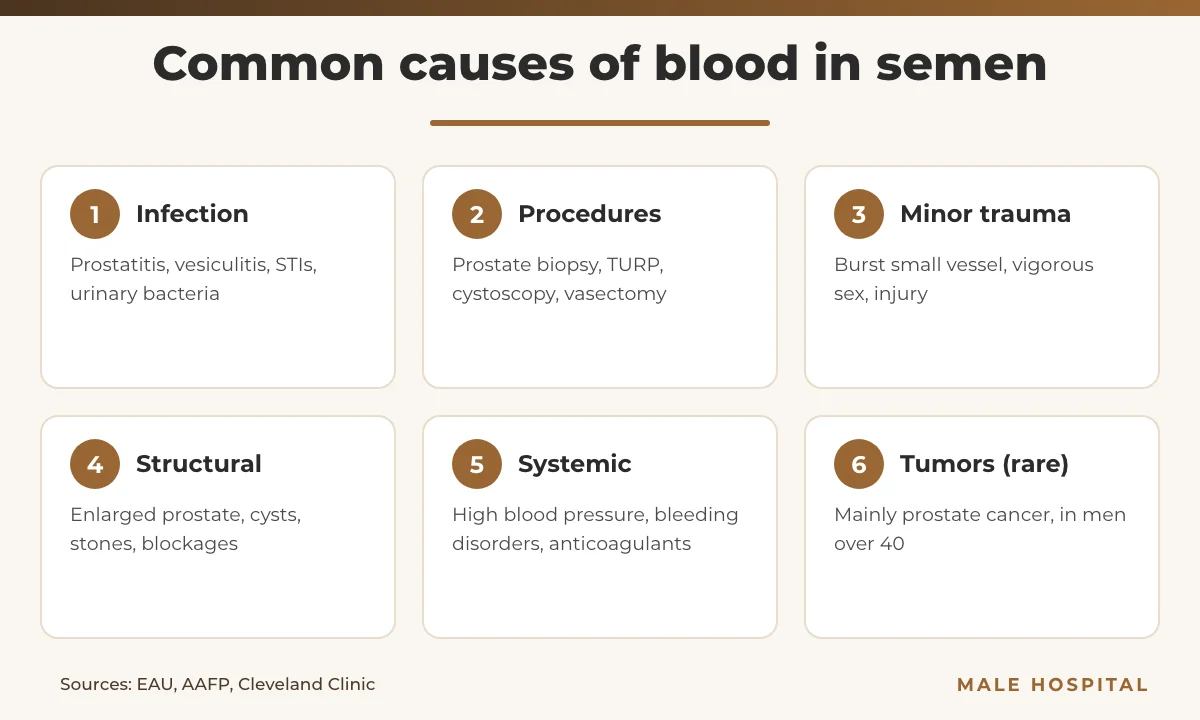
Doctors group the causes of blood in semen into inflammatory, infectious, obstructive, cystic, stone-related, tumoral, vascular, traumatic, iatrogenic (caused by medical procedures) and systemic categories. In about 10–20% of men no cause is found even after thorough tests. These idiopathic cases tend to behave benignly.
Sources: Translational Andrology and Urology (PMC) — Suh et al. 2017 — Etiologic classification, evaluation, and management of hematospermia; Deutsches Ärzteblatt International (PMC) — Mathers et al. 2017 — Hematospermia: a Symptom With Many Possible Causes
Inflammation and infection
Infection or inflammation of the prostate (prostatitis), seminal vesicles (seminal vesiculitis), epididymis or urethra is the most common cause found. Sexually transmitted infections such as chlamydia, gonorrhea and herpes simplex can be responsible, as can ordinary urinary bacteria such as E. coli. Rarer infections include tuberculosis and schistosomiasis, which is why doctors ask about travel. If you have pelvic pain or burning when you urinate as well, our guide to prostatitis symptoms and treatment explains that condition in detail.
Sources: American Family Physician (AAFP) — Stefanovic et al. 2009 — Evaluation and Treatment of Hematospermia; Deutsches Ärzteblatt International (PMC) — Mathers et al. 2017 — Hematospermia: a Symptom With Many Possible Causes
Minor trauma and sexual habits
A small blood vessel can burst during ejaculation, and very vigorous or prolonged sex or masturbation, interrupted intercourse and long periods of abstinence have all been linked to a brief episode of blood in semen. Injury to the genitals or pelvis can also cause it. These episodes usually stop on their own.
Sources: Cleveland Clinic — Blood in Semen (Hematospermia); American Family Physician (AAFP) — Stefanovic et al. 2009 — Evaluation and Treatment of Hematospermia
Medical procedures
In men over 40, procedures are the most common cause of blood in semen overall. Prostate biopsy tops the list, followed by prostate surgery, cystoscopy and other urological instruments, radiotherapy or brachytherapy for prostate cancer, and vasectomy.
Prostate enlargement, cysts, stones and blockages
Benign prostatic hyperplasia (an enlarged prostate) has fragile surface blood vessels that can bleed. Cysts, stones (calcifications), polyps and blockage of the ejaculatory ducts are other structural causes. If you are also trying to conceive, our guide to male infertility explains how blockages and infections are assessed.
Sources: American Family Physician (AAFP) — Stefanovic et al. 2009 — Evaluation and Treatment of Hematospermia; Cleveland Clinic — Blood in Semen (Hematospermia)
Systemic conditions and medicines
Severe uncontrolled high blood pressure, bleeding disorders, chronic liver disease and blood thinners such as warfarin can all cause or worsen bleeding into the semen. A review also linked hematospermia with higher blood pressure in general, so a blood pressure check is part of every assessment.
Sources: American Family Physician (AAFP) — Stefanovic et al. 2009 — Evaluation and Treatment of Hematospermia; Translational Andrology and Urology (PMC) — Suh et al. 2017 — Etiologic classification, evaluation, and management of hematospermia
Cancer (uncommon)
Rarely, blood in semen is linked to cancer of the prostate, bladder, seminal vesicles, urethra or testicle, or to blood cancers such as leukemia and lymphoma. Hematospermia is rarely the first symptom of these cancers, and in older men prostate cancer is the one that matters most.
Sources: Annals of the Royal College of Surgeons of England (PMC) — Kumar et al. 2006 — Haematospermia: A Systematic Review; Cleveland Clinic — Blood in Semen (Hematospermia)
| Cause group | Examples | Typical clues |
|---|---|---|
| Inflammation / infection | Prostatitis, seminal vesiculitis, epididymitis, STIs, urinary infection | Burning urination, pelvic or testicular pain, discharge, fever |
| Procedures (iatrogenic) | Prostate biopsy, TURP, cystoscopy, vasectomy, radiotherapy | Recent urological procedure; resolves over weeks |
| Minor trauma / behavior | Burst small vessel, vigorous sex, long abstinence | Single painless episode in a younger man |
| Structural | Enlarged prostate, cysts, stones, duct obstruction | Urinary symptoms, recurrent episodes |
| Systemic | Uncontrolled hypertension, bleeding disorders, liver disease, blood thinners | High blood pressure, easy bruising, other bleeding |
| Tumors (rare) | Prostate, bladder, testicular cancer; leukemia, lymphoma | Age over 40, persistent bleeding, raised PSA, abnormal rectal exam |
Sources: American Family Physician (AAFP) — Stefanovic et al. 2009 — Evaluation and Treatment of Hematospermia; EAU Guidelines — Sexual and Reproductive Health — Disorders of Ejaculation (Haemospermia)
Blood in semen after a prostate biopsy or vasectomy
Blood in semen after a prostate biopsy is expected and is not usually a sign that anything went wrong. In two prospective studies more than 80% of men reported it after a transrectal ultrasound-guided biopsy, lasting up to about four weeks. Across studies the reported rate ranges widely, from about 5% to 89%, and the average time to clear on its own was about 3.5 weeks.
Sources: Deutsches Ärzteblatt International (PMC) — Mathers et al. 2017 — Hematospermia: a Symptom With Many Possible Causes; Translational Andrology and Urology (PMC) — Suh et al. 2017 — Etiologic classification, evaluation, and management of hematospermia
The American Academy of Family Physicians review notes that bleeding after a procedure usually settles within a few weeks or about 10 ejaculations, and that observation is usually all that is needed. After a vasectomy, blood may appear in the semen for more than a week. Brachytherapy (internal radiotherapy) for prostate cancer has also been linked to hematospermia.
Sources: American Family Physician (AAFP) — Stefanovic et al. 2009 — Evaluation and Treatment of Hematospermia; Cleveland Clinic — Blood in Semen (Hematospermia)
Let your urologist know if the bleeding is heavy, goes on much longer than expected, or comes with fever, chills, burning urination or difficulty passing urine, because these can signal an infection after the procedure.
When to see a doctor: red flags
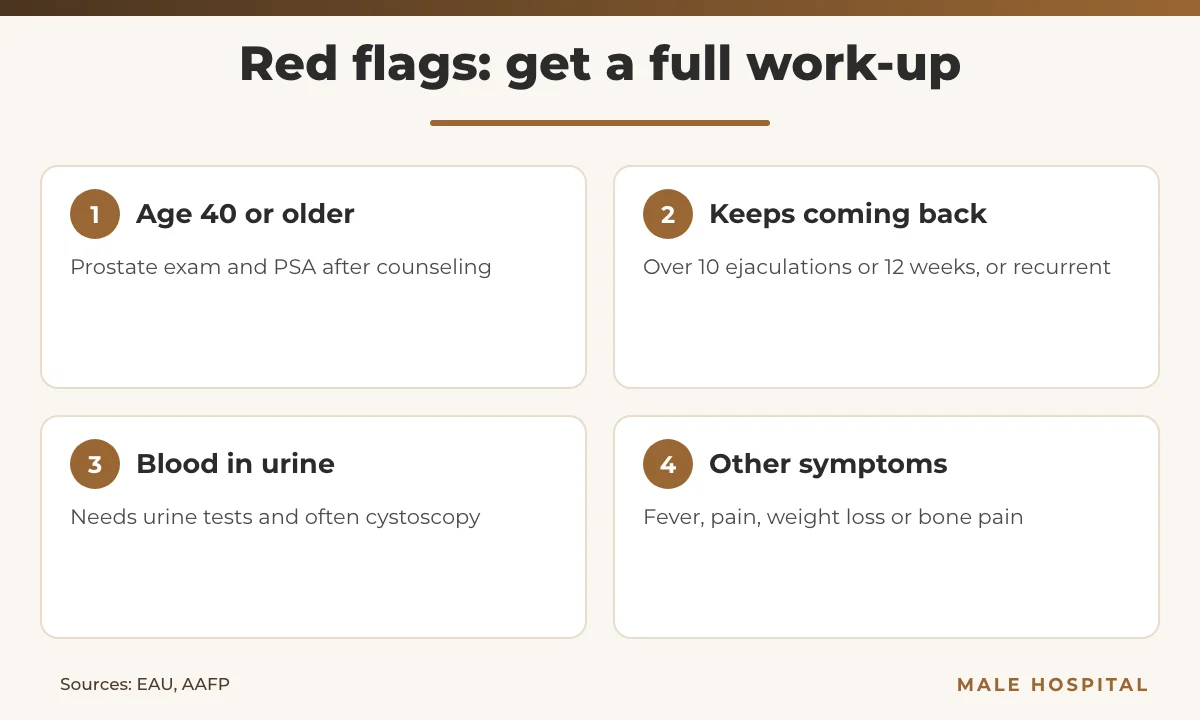
Seeing blood in the ejaculate is not normal, so it is reasonable to mention it to a doctor even after a single episode, especially if it happens more than once or comes with any new symptom. These features call for a fuller investigation:
Sources: Cleveland Clinic — Blood in Semen (Hematospermia); MedlinePlus (NIH) — Semen – bloody
- Age 40 or older: the chance of prostate cancer and structural causes is higher, so a prostate check and PSA test are offered after counseling.
- Persistent or recurrent bleeding: blood in more than about 10 ejaculations, for longer than about 12 weeks, or episodes that keep coming back.
- Blood in the urine as well as in the semen.
- Urinary or pain symptoms: burning, frequent urination, weak stream, pain on ejaculation, pain between the scrotum and anus, or scrotal swelling.
- General symptoms: fever, chills, night sweats, unexplained weight loss or bone pain.
- Other bleeding such as easy bruising or nosebleeds, very high blood pressure, or use of blood thinners.
- Family history of prostate cancer, a previously raised PSA or an abnormal rectal examination.
Sources: American Family Physician (AAFP) — Stefanovic et al. 2009 — Evaluation and Treatment of Hematospermia; Deutsches Ärzteblatt International (PMC) — Mathers et al. 2017 — Hematospermia: a Symptom With Many Possible Causes; EAU Guidelines — Sexual and Reproductive Health — Disorders of Ejaculation (Haemospermia)
Fever, chills and painful urination together need prompt medical review because they can point to an infection that needs treatment. If none of these red flags apply, there is no need to panic, but booking a routine appointment is still sensible.
Sources: MedlinePlus (NIH) — Semen – bloody; American Family Physician (AAFP) — Stefanovic et al. 2009 — Evaluation and Treatment of Hematospermia
How doctors investigate hematospermia
The EAU makes a strong recommendation that every man with blood in semen has a full medical and sexual history and a detailed physical examination, and it supports using a risk-stratification approach. In practice, the extent of testing depends on your age, whether the bleeding is a one-off, and any other symptoms.
Source: EAU Guidelines — Sexual and Reproductive Health — Disorders of Ejaculation (Haemospermia)
History and examination
Your doctor will ask how long the bleeding has lasted, how many episodes you have had, whether you recently had a procedure, about sexual partners and STI risk, travel, medicines and bleeding problems. The examination includes blood pressure, the abdomen, penis and scrotum, and a digital rectal examination (DRE) to feel the prostate for tenderness, enlargement or firm nodules.
Sources: American Family Physician (AAFP) — Stefanovic et al. 2009 — Evaluation and Treatment of Hematospermia; EAU Guidelines — Sexual and Reproductive Health — Disorders of Ejaculation (Haemospermia)
First-line tests
- Urine tests: urinalysis and urine culture to look for infection and hidden blood in the urine.
- STI testing for chlamydia and gonorrhea, and other infections when relevant.
- PSA blood test: offered to men over 40 after counseling, or earlier with risk factors.
- Semen tests: semen culture, and sometimes a semen analysis, particularly if fertility is also a question.
- Blood tests such as a blood count and clotting profile when a bleeding problem is suspected.
Sources: MedlinePlus (NIH) — Semen – bloody; EAU Guidelines — Sexual and Reproductive Health — Disorders of Ejaculation (Haemospermia); Annals of the Royal College of Surgeons of England (PMC) — Kumar et al. 2006 — Haematospermia: A Systematic Review
Imaging and endoscopy
If bleeding persists or risk is higher, imaging comes next. Transrectal ultrasound (TRUS) is the most widely used scan and is suggested when blood in semen lasts more than about a month. MRI of the prostate and seminal vesicles is increasingly used because it shows bleeding, cysts and obstruction in detail. Cystoscopy (a camera into the urethra and bladder) is reserved for higher-risk cases, such as men who also have blood in the urine or who do not respond to conservative care.
Sources: Translational Andrology and Urology (PMC) — Suh et al. 2017 — Etiologic classification, evaluation, and management of hematospermia; EAU Guidelines — Sexual and Reproductive Health — Disorders of Ejaculation (Haemospermia)
Combining tests improves the yield. In 106 men with persistent symptoms, TRUS found a cause in 45.3%, transurethral seminal vesiculoscopy in 74.5%, and the two together in 87.7%. In a series of 300 consecutive cases, prostate cancer was the cause in 5.7%, and every one of those men had either a PSA above 3.0 ng/mL or an abnormal rectal examination, which is why these two simple checks are central for older men.
| Situation | Usual approach |
|---|---|
| Under 40, single episode, no other symptoms | History, exam, blood pressure, urine and STI tests; reassurance if normal |
| Recent prostate biopsy or other procedure | Observation; review if heavy, prolonged or with fever |
| Age 40 or older | Add digital rectal exam and PSA after counseling |
| Persistent, recurrent or with red flags | Full urological work-up: TRUS and/or MRI, cystoscopy when indicated |
Sources: EAU Guidelines — Sexual and Reproductive Health — Disorders of Ejaculation (Haemospermia); American Family Physician (AAFP) — Stefanovic et al. 2009 — Evaluation and Treatment of Hematospermia
How hematospermia is treated
Many men with blood in semen need no treatment at all. Cleveland Clinic notes that treatment is often unnecessary if you are under 40, have no urinary symptoms or risk factors, and the bleeding happened only once. The EAU likewise lists conservative management and reassurance as the main option for men under 40 with a single episode when no disease is found.
Sources: Cleveland Clinic — Blood in Semen (Hematospermia); EAU Guidelines — Sexual and Reproductive Health — Disorders of Ejaculation (Haemospermia)
When a cause is found, treatment targets it:
- Infection: antibiotics for a confirmed urinary, prostate or sexually transmitted infection. When infection is strongly suspected but not proven, some doctors give a course of an antibiotic that penetrates the prostate; in one uncontrolled retrospective series of 165 men treated with an antibiotic plus an anti-inflammatory, bleeding stopped in 96%.
- Inflammation and discomfort: anti-inflammatory painkillers such as ibuprofen or naproxen, plenty of fluids and a high-fiber diet to ease bowel movements.
- Fragile prostate blood vessels: finasteride, a prostate-shrinking medicine, is used for bleeding from benign prostatic enlargement and for stubborn idiopathic cases.
- Systemic causes: controlling high blood pressure and reviewing anticoagulant medicines and clotting problems with your doctor.
- Structural causes: a urologist may aspirate a cyst under ultrasound guidance, treat bleeding vessels with fulguration, open blocked ejaculatory ducts by transurethral incision, or use seminal vesiculoscopy, which can both diagnose and treat.
Sources: American Family Physician (AAFP) — Stefanovic et al. 2009 — Evaluation and Treatment of Hematospermia; Deutsches Ärzteblatt International (PMC) — Mathers et al. 2017 — Hematospermia: a Symptom With Many Possible Causes; Cleveland Clinic — Blood in Semen (Hematospermia); EAU Guidelines — Sexual and Reproductive Health — Disorders of Ejaculation (Haemospermia); Translational Andrology and Urology (PMC) — Suh et al. 2017 — Etiologic classification, evaluation, and management of hematospermia
There is no good evidence for estrogens or steroids in hematospermia. Never stop a prescribed blood thinner on your own; any change must be agreed with the doctor who prescribed it.
Sex, partners and outlook
Blood in semen often causes anxiety, and studies show it can lower quality of life, especially when it is linked to chronic prostatitis. Some men also notice a change in how ejaculation feels; if semen volume seems low or absent, our article on retrograde ejaculation explains another possible cause.
If the bleeding followed an injury, Cleveland Clinic suggests waiting a few days before having sex or masturbating again. Because sexually transmitted infections are among the possible causes, it makes sense to use condoms until an STI has been excluded or treated, and partners may need testing and treatment too if an STI is confirmed.
Sources: Cleveland Clinic — Blood in Semen (Hematospermia); American Family Physician (AAFP) — Stefanovic et al. 2009 — Evaluation and Treatment of Hematospermia
The outlook is very good. Most men with a treatable cause need no follow-up. Doctors usually reassess men with recurrent or unexplained bleeding after 3 to 6 months and refer to a urologist when symptoms are troublesome, treatment fails or test results are abnormal. Men at higher risk may continue PSA surveillance.
Sources: American Family Physician (AAFP) — Stefanovic et al. 2009 — Evaluation and Treatment of Hematospermia; Annals of the Royal College of Surgeons of England (PMC) — Kumar et al. 2006 — Haematospermia: A Systematic Review
If you have noticed blood in semen and want a discreet specialist opinion, you can book a confidential consultation with our urologist-andrologist, Assoc. Prof. Dr. Zülfü Sertkaya, by WhatsApp. He can review your symptoms and previous test results and advise whether any further tests are needed.
FAQs about blood in semen
Is blood in semen a sign of cancer?
Usually not. Most cases are caused by inflammation, infection, minor bleeding or a recent procedure, and a single episode is rarely due to cancer. The EAU estimates the risk of any cancer at about 3.5% in men presenting with hematospermia, and prostate cancer is found almost only in men over 40, which is why they are offered a prostate exam and PSA test.
Sources: EAU Guidelines — Sexual and Reproductive Health — Disorders of Ejaculation (Haemospermia); Cleveland Clinic — Blood in Semen (Hematospermia)
How long does hematospermia last?
Blood in semen often clears within a few days or weeks. After a prostate biopsy it can last up to about four weeks, and after a vasectomy for more than a week. In one study of men without an underlying disease, the average duration was about 1.5 months. Bleeding beyond about 12 weeks or 10 ejaculations deserves medical review.
Sources: NHS — Blood in semen; Cleveland Clinic — Blood in Semen (Hematospermia); Translational Andrology and Urology (PMC) — Suh et al. 2017 — Etiologic classification, evaluation, and management of hematospermia
Can frequent ejaculation cause bleeding?
Very vigorous or prolonged sex or masturbation, interrupted intercourse and long abstinence have been linked to brief bleeding, probably from small vessels bursting. Bleeding linked to excessive masturbation usually resolves within one to two months. Anxiety about the bleeding is common and understandable.
Sources: American Family Physician (AAFP) — Stefanovic et al. 2009 — Evaluation and Treatment of Hematospermia; Translational Andrology and Urology (PMC) — Suh et al. 2017 — Etiologic classification, evaluation, and management of hematospermia
Does brown semen mean old blood?
Yes, usually. Brown or reddish-brown semen typically contains older blood that is still clearing from the seminal vesicles or prostate, while bright red semen means more recent bleeding. Small clots may also appear. Brown color after a known episode of bleeding is often part of normal healing, but persistent discoloration should be checked.
Source: NHS — Blood in semen
Can an STI cause hematospermia?
Yes. Sexually transmitted infections such as chlamydia, gonorrhea and herpes simplex are recognized causes, so STI testing is part of the standard work-up, especially in younger men. A confirmed infection is treated with the appropriate medication, and sexual partners may also need testing and treatment.
Sources: American Family Physician (AAFP) — Stefanovic et al. 2009 — Evaluation and Treatment of Hematospermia; EAU Guidelines — Sexual and Reproductive Health — Disorders of Ejaculation (Haemospermia)
Should I stop having sex if I see blood?
Not necessarily. If an injury caused it, waiting a few days is sensible, and condoms are wise until an infection has been ruled out. Normal sexual activity can usually continue while you wait for the bleeding to settle or for your test results.
Sources: Cleveland Clinic — Blood in Semen (Hematospermia); American Family Physician (AAFP) — Stefanovic et al. 2009 — Evaluation and Treatment of Hematospermia
Can high blood pressure cause bloody semen?
It can. Severe uncontrolled hypertension is a recognized systemic cause, and hematospermia has also been associated with higher blood pressure more generally. That is why blood pressure is measured at every assessment. Bleeding disorders, liver disease and blood-thinning medicines can contribute as well.
Sources: American Family Physician (AAFP) — Stefanovic et al. 2009 — Evaluation and Treatment of Hematospermia; Translational Andrology and Urology (PMC) — Suh et al. 2017 — Etiologic classification, evaluation, and management of hematospermia
Is blood in semen after 40 more worrying?
It deserves more attention, but it is still usually benign. In men 40 and older, recent procedures remain the most common cause, yet prostate cancer becomes a real possibility, especially with recurrent or persistent bleeding. A digital rectal exam and PSA test pick up most of these cases, and imaging is added when results or symptoms suggest it.
Sources: American Family Physician (AAFP) — Stefanovic et al. 2009 — Evaluation and Treatment of Hematospermia; Deutsches Ärzteblatt International (PMC) — Mathers et al. 2017 — Hematospermia: a Symptom With Many Possible Causes
Medically reviewed by Assoc. Prof. Dr. Zülfü Sertkaya, urologist and andrologist (FEBU), Istanbul. Last reviewed: November 2026.
This article is for general information and does not replace an individual consultation with a qualified doctor.
- NHS — Blood in semen
- MedlinePlus (NIH) — Semen – bloody
- Cleveland Clinic — Blood in Semen (Hematospermia)
- American Family Physician (AAFP) — Stefanovic et al. 2009 — Evaluation and Treatment of Hematospermia
- EAU Guidelines — Sexual and Reproductive Health — Disorders of Ejaculation (Haemospermia)
- Deutsches Ärzteblatt International (PMC) — Mathers et al. 2017 — Hematospermia: a Symptom With Many Possible Causes
- Translational Andrology and Urology (PMC) — Suh et al. 2017 — Etiologic classification, evaluation, and management of hematospermia
- Annals of the Royal College of Surgeons of England (PMC) — Kumar et al. 2006 — Haematospermia: A Systematic Review