Penile implant cost varies widely by country, device and setting: Cleveland Clinic puts the usual US price at about $12,000 to $20,000 (2022), and an Italian study reported about €9,000 to €15,000 per inflatable implant (2014). The final bill depends mostly on the device type, the surgeon and center, the length of the hospital stay and what insurance covers, so any quote should list exactly what it includes. If you are still weighing whether surgery is right for you, start with our overview of penile prosthesis surgery.
Source: Cleveland Clinic — Penile Implant: Purpose, Procedure, Risks & Recovery; Arch Ital Urol Androl — Mondaini et al. 2014, Penile prosthesis surgery in out-patient setting
- Published figures range from about $9,300 (US claims data, 2014) to $12,000–$20,000 (Cleveland Clinic, 2022) in the United States, and €9,000–€15,000 in Italy (2014).
- The device is a large share of the penile implant cost; inflatable implants cost much more than malleable (bendable) ones.
- Outpatient surgery was 17% cheaper than a 1–3 day stay in an Italian series, and cheaper in US data too, with similar complication rates.
- In the US, Medicare approved about 99% of implant requests in a 2019–2021 database, while about 1 in 4 commercially insured men lacked coverage; in England the NHS funds implants only for end-stage ED after other treatments fail.
- At Male Hospital in Istanbul, the penile implant cost is quoted after a free assessment, because it depends on the device and the surgical plan.
- How much does a penile implant cost? Published figures
- What a price quote should include
- Penile implant cost drivers: device, surgeon and hospital stay
- Insurance coverage: Medicare, Medicaid, private plans and the NHS
- Penile implant cost over 10 years vs other ED treatments
- Comparing prices abroad, including Turkey
- Penile implant cost at Male Hospital, Istanbul
- When to see a doctor
- FAQs about penile implant cost
How much does a penile implant cost? Published figures
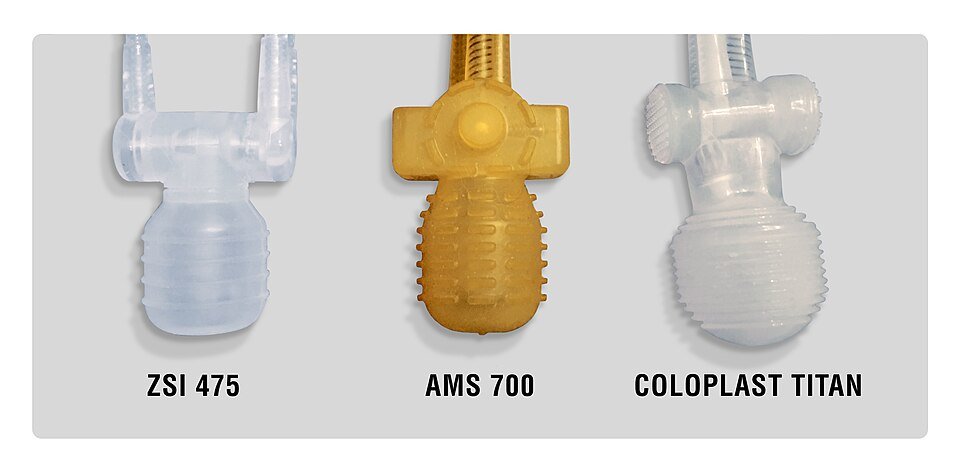
A penile implant (penile prosthesis) is a medical device placed inside the two erectile chambers of the penis to treat erectile dysfunction (ED) that has not responded to other treatment. Because it combines a manufactured device, an operation and aftercare, the penile implant cost is far higher than the cost of tablets or injections in the first year.
Very few trustworthy sources publish actual penile implant cost figures. The figures below come from a major US hospital and from peer-reviewed studies. Each was measured in a specific country and year, used a different method, and is not a quote for any clinic today.
| Source (country, year of data) | What was measured | Figure |
|---|---|---|
| Cleveland Clinic (USA, page updated 2022) | Usual price of a penile implant | $12,000–$20,000 |
| Berger et al. (USA, Florida and New York claims, 2014) | Adjusted cost of the index implant surgery | $9,320 outpatient vs $10,191 inpatient |
| Moses et al. (USA academic center, published 2019) | Reimbursed perioperative cost of inflatable implant placement | $13,437 |
| Mondaini et al. (Italy, 2014) | Total cost of an inflatable implant, all-inclusive | €9,000–€15,000 |
| Mondaini et al. (Italy, 2009–2014 series) | Three-piece implant, 1–3 night stay vs day surgery | €11,240 vs €9,308 |
Sources: Cleveland Clinic — Penile Implant; J Sex Med — Berger et al. 2019; Transl Androl Urol — Moses et al. 2019; Arch Ital Urol Androl — Mondaini et al. 2014
Even within one country the penile implant cost figures differ by thousands, because some are hospital prices, some insurer payments and some internal costs. A 2021 systematic review in European Urology Focus found that the price of the prosthesis device itself has roughly tracked inflation, while the inclusive surgical cost has risen much faster than inflation. That means the hospital and operating-room part of the bill is the part most likely to have grown since these studies.
What a price quote should include
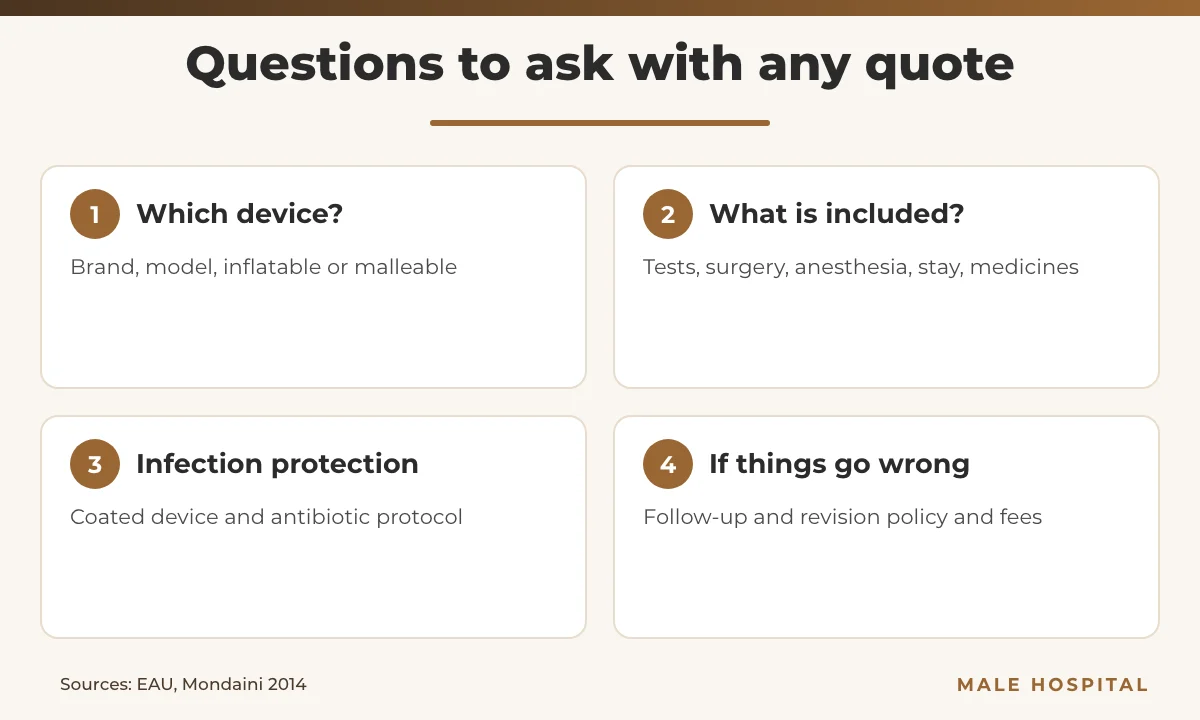
A penile implant cost quote is only meaningful when you know what sits inside it. In the Italian study, the all-inclusive price covered pre-operative tests, imaging, the prosthesis, the surgeon, the anesthesiologist, the hospital stay and medicines. A quote that leaves out one of these can look cheaper while the final bill is not.
When you request a penile implant cost quote, ask the clinic to itemize:
- Assessment and tests: consultation, blood tests (for example blood sugar control in men with diabetes) and any imaging.
- The device: brand, model and whether it is inflatable (two- or three-piece) or malleable.
- Surgical fees: surgeon, anesthesia and operating room.
- Stay: day surgery or the number of nights in hospital.
- Medicines and follow-up: antibiotics, pain relief, the activation visit and later check-ups.
Antibiotic protection is part of standard care, not an optional extra in the penile implant cost: the European Association of Urology (EAU) reports infection rates of 2–3% for first implants in low-risk men at high-volume centers, falling to 1–2% with antibiotic-impregnated or hydrophilic-coated devices.
Sources: Arch Ital Urol Androl — Mondaini et al. 2014; EAU Guidelines — Management of erectile dysfunction
Penile implant cost drivers: device, surgeon and hospital stay
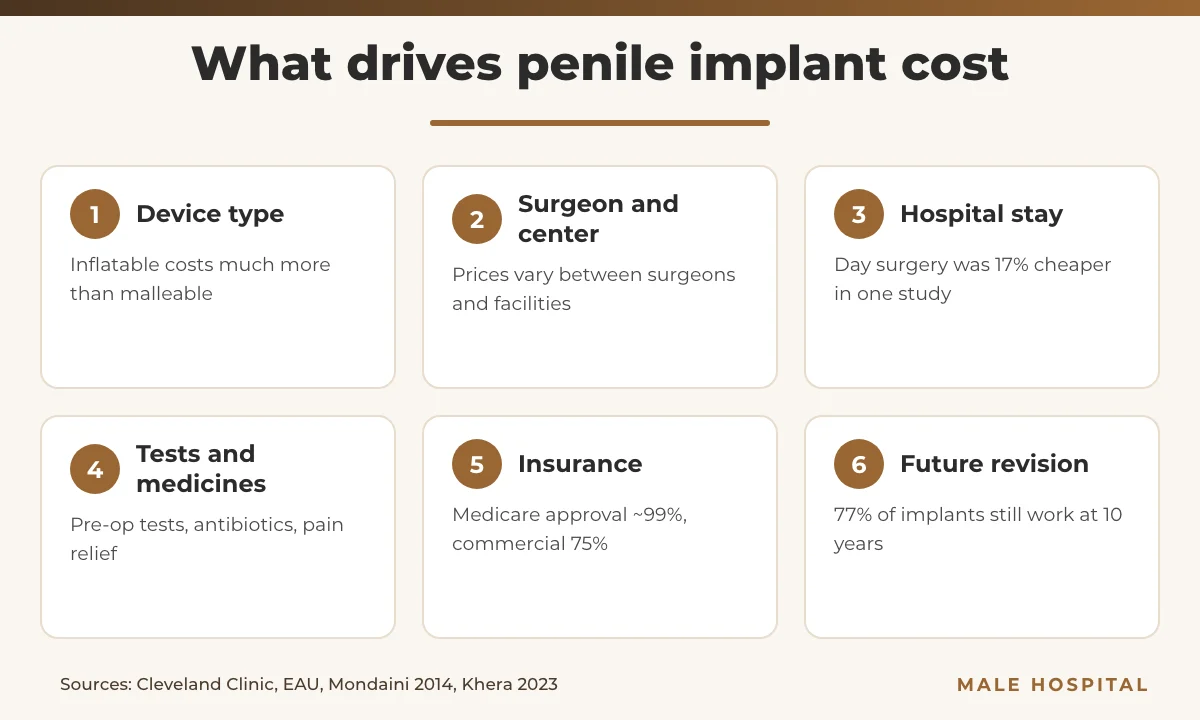
1. Device type
There are two families of implants, and the choice shapes the penile implant cost. Inflatable implants use fluid-filled cylinders and a pump hidden in the scrotum; three-piece models add a separate reservoir in the lower abdomen, while two-piece models keep the fluid in the pump. Semi-rigid (malleable) implants are bendable rods with no pump. The Italian authors note that inflatable devices are preferred by most patients but are much more expensive than malleable ones.
The EAU says there are no head-to-head trials showing that one manufacturer or device type is superior. Three-piece devices give a more natural erection; two-piece devices suit men at higher risk of reservoir problems, such as those with previous abdominal surgery; and malleable devices are simpler and easier for men with limited hand dexterity, but are harder to conceal. The right device is a medical choice first and a price choice second. Our guide to the inflatable penile prosthesis explains the options in more detail.
Sources: EAU Guidelines — Management of erectile dysfunction; Arch Ital Urol Androl — Mondaini et al. 2014
2. Surgeon and center
Cleveland Clinic notes that penile implant cost varies between surgeons and medical facilities. Experience matters for more than price: the EAU links the lowest infection rates to careful technique at high-volume centers. An infection or early revision means a second surgery and a second device.
The surgeon’s own fee is often a small part of the total penile implant cost. In a 2021 analysis of US Medicaid fee schedules, the mean physician payment for placing an inflatable implant was $691.76, and $477.15 for a malleable implant; most of the remaining cost sits with the device and the facility.
Sources: Cleveland Clinic — Penile Implant; J Sex Med — Barnard et al. 2021, Does Medicaid cover penile prosthesis surgery?
3. Hospital stay and care setting
Cleveland Clinic describes implant surgery as an outpatient procedure that usually takes one to two hours. In the Italian series, day surgery cost €9,308 versus €11,240 for a stay of up to three nights, a 17% saving, with no complications in the outpatient group. In US claims data from 2014, ambulatory surgery cost about $9,320 versus $10,191 for inpatient care, with similar 30-day readmission rates.
Sources: J Sex Med — Berger et al. 2019; Arch Ital Urol Androl — Mondaini et al. 2014
4. Your health and time off work
Men with diabetes, spinal cord injury or previous implant surgery carry a higher infection risk, which can mean extra preparation, closer follow-up and sometimes a more complex operation. Time away from work is a hidden part of penile implant cost too: Cleveland Clinic advises at least a week off for desk jobs and two to four weeks for physical work. What to expect week by week is covered in our penile implant recovery guide.
Sources: EAU Guidelines — Management of erectile dysfunction; Cleveland Clinic — Penile Implant
Insurance coverage: Medicare, Medicaid, private plans and the NHS
Whether you pay the full penile implant cost yourself depends mostly on where you live and how you are insured. Implants treat diagnosed ED and are not cosmetic, but coverage has conditions.
United States
Cleveland Clinic states that many major insurers, Medicare and Medicaid cover the surgery for eligible patients with an ED diagnosis. A manufacturer’s benefit-verification database (2019–2021, about 3,000 patients a year) found that roughly 80% of patients had coverage. Approval was 98.7% for Medicare and 97.1% for Medicare Advantage, but 75.0% for commercial insurance. The most common reason for no coverage was an employer exclusion, which rose from 13.5% of patients in 2019 to 17.5% in 2021. That study was funded by a device maker, so the figures may not represent every plan.
At one Miami tertiary center (2016–2017), Medicare was the largest insurer for inflatable implants, and 48% of commercially insured men who wanted the device could not get it because of exclusions or denials. Medicaid is patchy: only 28 of 49 states with accessible fee schedules listed coverage in 2021, and 11 of those documented prior-authorization requirements.
Sources: Urol Pract — Khera et al. 2023, Insurance coverage in the United States; Urol Pract — Masterson et al. 2019, Commercial insurance coverage for inflatable penile prosthesis; J Sex Med — Barnard et al. 2021
England (NHS)
NHS England’s clinical commissioning policy (first published 2016) routinely funds a first penile prosthesis only for men with end-stage ED of any cause, after lifestyle changes, tablets, counseling, alprostadil and vacuum devices have failed, and after risk assessment by a specialist andrology team. The surgery is done in specialist implant centers. Men who do not meet these criteria may need to pay the penile implant cost privately.
Penile implant cost over 10 years vs other ED treatments
Compared with a one-time penile implant cost, tablets and injections look cheap per month, but they are paid for as long as you need them. A US cost-effectiveness model for men in whom a first ED tablet had failed compared total 10-year costs. It used reimbursed costs from a high-volume academic center and manufacturer data.
| Treatment path (US model, 2019) | Modeled 10-year cost |
|---|---|
| Inflatable penile implant | $22,009 |
| Injections with trimix | $48,617 |
| Switching to another ED tablet | $52,883 |
| Injections with alprostadil | $62,890 |
In that model the implant was the most cost-effective option per quality-adjusted life year, mainly because the penile implant cost is paid once. Results depend on local drug prices: where generic tablets are inexpensive, the balance is different, and the model did not include vacuum devices. Our article on penile injections for erectile dysfunction covers the main non-surgical alternative.
Device lifespan also affects the long-term penile implant cost. The EAU reports implant survival of 87.2% at 5 years, 76.8% at 10 years and 52.9% at 20 years, and mechanical failure below 5% at five years for modern three-piece devices. Plan for the possibility of a replacement operation later in life, and ask what a clinic charges for revision. Reasons for revision are explained in our guide to penile implant complications.
Source: EAU Guidelines — Management of erectile dysfunction
Comparing prices abroad, including Turkey
Many men look abroad because the penile implant cost at home is high or not covered. We could not find a peer-reviewed study or official source that publishes current implant prices in Turkey, so we do not quote a Turkish price range here. Prices advertised online differ in what they include, such as the device brand, nights in hospital, hotel and transfers, which makes headline numbers hard to compare.
A fair penile implant cost comparison looks at the same things you would check at home: the exact device and model, whether antibiotic-coated or hydrophilic-coated devices are used, the surgeon’s implant experience, the length of stay, what follow-up is included after you fly home, and the policy if an infection or mechanical failure needs further surgery. The EAU also stresses full counseling about benefits and harms before implantation, which a clinic should provide whatever its price.
Source: EAU Guidelines — Management of erectile dysfunction
Penile implant cost at Male Hospital, Istanbul
We do not publish a fixed penile implant cost, because the right device and plan differ from man to man. After a free assessment of your medical history, previous ED treatments and expectations, you receive a written price for your specific plan. Implant surgery is performed by Assoc. Prof. Dr. Zülfü Sertkaya, a urologist and andrologist (FEBU) whose focus includes penile prosthesis surgery and who holds a Titan® Inflatable Penile Prosthesis Center of Excellence certificate from Coloplast (2024). His research includes penile prosthesis infection risk.
Implants are not the first step for most men. The NIDDK notes that most people with ED do not need surgery and that it is considered when other options have failed, so the assessment also checks whether a non-surgical erectile dysfunction treatment could still work for you.
Source: NIDDK — Treatment for Erectile Dysfunction
When to see a doctor
See a urologist if ED persists despite tablets or other treatments, if you are considering an implant, or if you have ED with diabetes, heart disease or after prostate cancer treatment. If you already have an implant, get urgent care for:
- Fever, increasing pain, redness, swelling or discharge around the scrotum or penis.
- Thinning skin or a device part that can be felt pushing through the skin (possible erosion).
- Dark or cold skin on the head of the penis.
- Blood in the urine or trouble passing urine after surgery (possible urethral injury).
- A pump that suddenly stops working (possible mechanical failure).
Sources: Cleveland Clinic — Penile Implant; EAU Guidelines — Management of erectile dysfunction
If you would like a confidential assessment and a written penile implant cost quote for your situation, message our urologist-andrologist on WhatsApp. You can also read how the operation works on our penile prosthesis page.
FAQs about penile implant cost
How much does a penile implant cost in the US?
Cleveland Clinic gives a usual range of $12,000 to $20,000 (page updated 2022), and notes that prices vary between surgeons and facilities. Claims data from Florida and New York in 2014 showed adjusted surgical costs of about $9,320 for outpatient and $10,191 for inpatient surgery. Your out-of-pocket share of the penile implant cost depends on your insurance plan and deductible.
Sources: Cleveland Clinic — Penile Implant; J Sex Med — Berger et al. 2019
Does Medicare cover a penile implant?
Medicare generally covers implant surgery for men with diagnosed erectile dysfunction who are eligible. In a 2019–2021 benefit-verification database, 98.7% of Medicare patients and 97.1% of Medicare Advantage patients were approved or verified for coverage. You may still owe deductibles and copayments, so confirm your share of the penile implant cost with the hospital before surgery.
Source: Urol Pract — Khera et al. 2023
Is a penile implant free on the NHS?
NHS England funds a first implant for men with end-stage ED when lifestyle changes, tablets, counseling, alprostadil and vacuum devices have not worked, and after a specialist team has assessed risks such as diabetes and body weight. It is done in specialist centers. Men outside these criteria may need to pay privately.
Source: NHS England — Penile prosthesis surgery policy 16059/P
Is an inflatable implant more expensive than a malleable one?
Yes. Inflatable implants have more parts (cylinders, a pump and often a reservoir) and are much more expensive than malleable rods. Even the surgeon’s fee differs: US Medicaid paid an average of $691.76 for inflatable versus $477.15 for malleable placement in 2021. Choose the device for medical fit first, then compare penile implant cost.
Sources: Arch Ital Urol Androl — Mondaini et al. 2014; J Sex Med — Barnard et al. 2021
Why are some private insurance claims denied?
The most common reason is an employer exclusion in the plan, which affected 17.5% of patients in a 2021 US database. At one Miami center, 48% of commercially insured men seeking an inflatable implant could not obtain it because of exclusions or denials. The study authors suggest that prior authorization and help with benefit verification may improve the chance of approval.
Sources: Urol Pract — Khera et al. 2023; Urol Pract — Masterson et al. 2019
Is outpatient implant surgery cheaper and still safe?
Studies suggest so. An Italian series found day surgery 17% cheaper than a one- to three-night stay with no complications in the day-surgery group, and US claims data showed lower costs for ambulatory surgery with similar 30-day revisit rates. Whether you can go home the same day depends on your health and the surgeon’s protocol.
Sources: Arch Ital Urol Androl — Mondaini et al. 2014; J Sex Med — Berger et al. 2019
How long does a penile implant last before it needs replacing?
According to EAU data, about 87% of implants are still working at 5 years, 77% at 10 years and 53% at 20 years. Infection, erosion or mechanical failure can mean earlier revision. Because replacement is a second operation with a new device, ask any clinic what it charges if a revision becomes necessary.
Source: EAU Guidelines — Management of erectile dysfunction
How can I get a price for a penile implant at Male Hospital?
Send a message on WhatsApp for a free, confidential assessment with our urologist-andrologist. After reviewing your history, previous treatments and goals, we recommend a device and surgical plan and then give you a written price for that plan. We do not quote a fixed price in advance because the device and plan differ between patients.
Medically reviewed by Assoc. Prof. Dr. Zülfü Sertkaya, urologist and andrologist (FEBU), Istanbul. Last reviewed: November 2026.
This article is for general information and does not replace an individual consultation with a qualified doctor.
- Cleveland Clinic — Penile Implant: Purpose, Procedure, Risks & Recovery
- EAU — Sexual and Reproductive Health Guidelines — Management of erectile dysfunction
- NHS England — Clinical Commissioning Policy: Penile prosthesis surgery for end-stage erectile dysfunction (16059/P)
- NIDDK — Treatment for Erectile Dysfunction
- Arch Ital Urol Androl 2014 — Mondaini et al. Penile prosthesis surgery in out-patient setting: effectiveness and costs in the spending review era
- J Sex Med 2019 (PubMed) — Berger et al. Impact of index surgical care setting on perioperative outcomes and cost following penile prosthesis surgery
- Transl Androl Urol 2019 (PMC) — Moses et al. Erectile dysfunction management after failed phosphodiesterase-5-inhibitor trial: a cost-effectiveness analysis
- Eur Urol Focus 2022 (PubMed) — Kohn et al. Global trends in prevalence, treatments, and costs of penile prosthesis for erectile dysfunction in men
- J Sex Med 2021 (PubMed) — Barnard et al. Does Medicaid cover penile prosthesis surgery? A state-by-state analysis
- Urol Pract 2023 (PMC) — Khera et al. Implantable penile prosthesis for erectile dysfunction: insurance coverage in the United States
- Urol Pract 2019 (PMC) — Masterson et al. Commercial insurance coverage for inflatable penile prosthesis at a tertiary care center