Dapoxetine (brand name Priligy) is a short-acting selective serotonin reuptake inhibitor (SSRI) and the first drug approved for on-demand treatment of premature ejaculation. You take it 1 to 3 hours before sex, and in large trials it roughly doubled to tripled the average time to ejaculation. It is licensed in the UK, much of Europe and many other countries, but it is not approved by the US FDA. It is one of several options covered on our premature ejaculation treatment page.
Sources: EAU — Guidelines on Sexual and Reproductive Health: Disorders of Ejaculation; NHS — Ejaculation problems; PubMed — The PAUSE study (Mirone et al., Eur Urol, 2014)
- The tablet is taken only when needed, 1 to 3 hours before sex, starting at 30 mg and never more than once every 24 hours.
- Across five phase 3 trials with 6,081 men, average latency rose from about 0.9 minutes to 3.1 minutes (30 mg) and 3.6 minutes (60 mg).
- Nausea, dizziness and headache are the most common side effects; fainting (vasovagal syncope) occurred in about 0.1% of men in phase 3 studies.
- It must not be used with heart failure or heart rhythm problems, a history of fainting, mania or severe depression, moderate or severe liver disease, or with many other serotonin drugs.
- The EAU lists this drug as a first-line option for lifelong premature ejaculation, yet the FDA has never approved it in the United States.
- What is dapoxetine?
- How dapoxetine works in the body
- Dapoxetine dosage: how to take it safely
- How well does dapoxetine work? The trial data
- Dapoxetine side effects and the risk of fainting
- Who should not take dapoxetine: contraindications and interactions
- Is dapoxetine FDA-approved? Status by region
- Dapoxetine vs other premature ejaculation treatments
- When to see a doctor
- FAQs about dapoxetine
What is dapoxetine?
Dapoxetine hydrochloride belongs to the same drug family as common antidepressants such as sertraline and paroxetine, but it was designed with a very different goal. Instead of building up in the body over weeks, it is absorbed quickly and cleared quickly, so it can be used “on demand” before planned sex rather than every day.
It is sold as 30 mg and 60 mg film-coated tablets. In the European product information it is indicated for premature ejaculation (PE) in men aged 18 to 64, and the leaflet describes its purpose plainly: to lengthen the time it takes to ejaculate, improve control and reduce the frustration or worry that comes with fast ejaculation.
Sources: EMA — Priligy Article 29 referral, Annex III: product information; EMA — Priligy referral
Premature ejaculation itself, including how lifelong and acquired PE are defined and diagnosed, is explained in our full guide to premature ejaculation. This article focuses only on the medicine: how dapoxetine works, how it is dosed, what the evidence shows and who should avoid it.
How dapoxetine works in the body
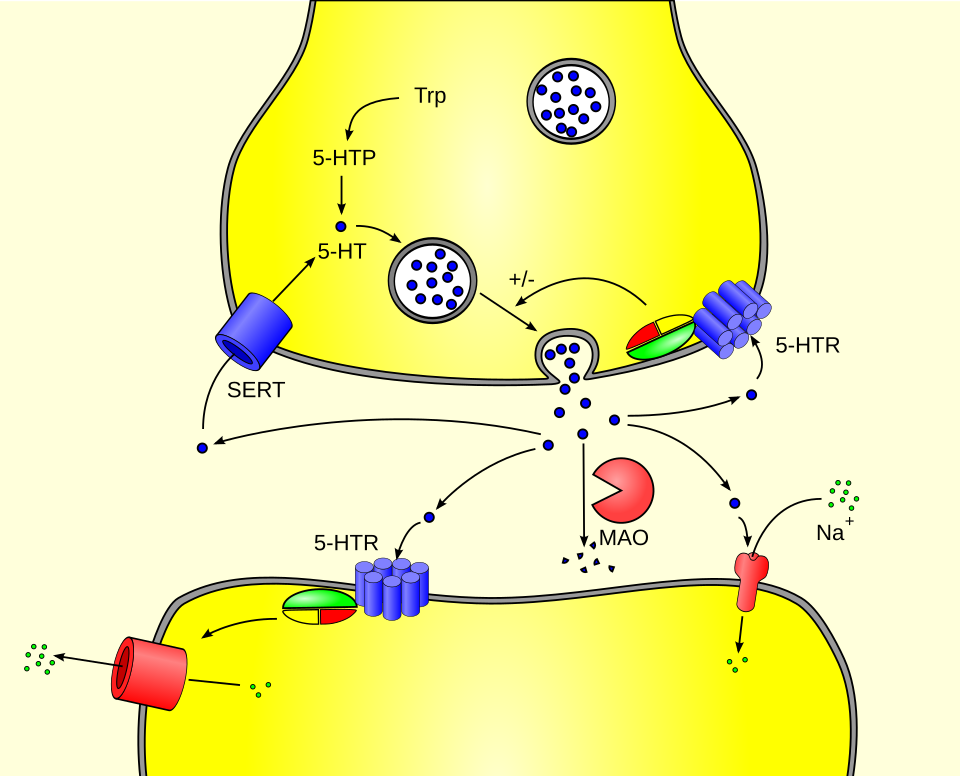
Ejaculation is a reflex coordinated by a spinal “ejaculation generator” in the lower spinal cord (around the L3 to L5 levels) under the control of several brain areas. Serotonin (5-HT) is one of the main brake signals in this system. Stimulating 5-HT2C receptors delays ejaculation, while stimulating 5-HT1A receptors shortens it.
Like other SSRIs, it blocks the serotonin transporter, the pump that pulls serotonin back into nerve endings. More serotonin stays in the synapse, which strengthens the braking signal on the ejaculatory reflex. It has minimal effect on the reuptake of noradrenaline and dopamine.
Source: PMC — Dapoxetine and premature ejaculation (Vieiralves & Favorito, Int Braz J Urol, 2023)
Why the short half-life matters
What makes it different is its timing. It reaches its peak blood level about 1.3 hours after a dose, and about 95% has been cleared after 24 hours. Its initial half-life is roughly 1.3 to 1.4 hours, with a longer terminal phase of around 21 hours. It is broken down in the liver by cytochrome P450 enzymes, which explains several of its drug interactions.
This fast-in, fast-out profile is why it can be taken a few hours before sex, while ordinary SSRIs used off-label for PE usually need daily dosing for 1 to 2 weeks before the full effect appears.
Sources: EAU — Guidelines on Sexual and Reproductive Health: Disorders of Ejaculation; PMC — Dapoxetine and premature ejaculation (2023); NHS — Ejaculation problems
Dapoxetine dosage: how to take it safely
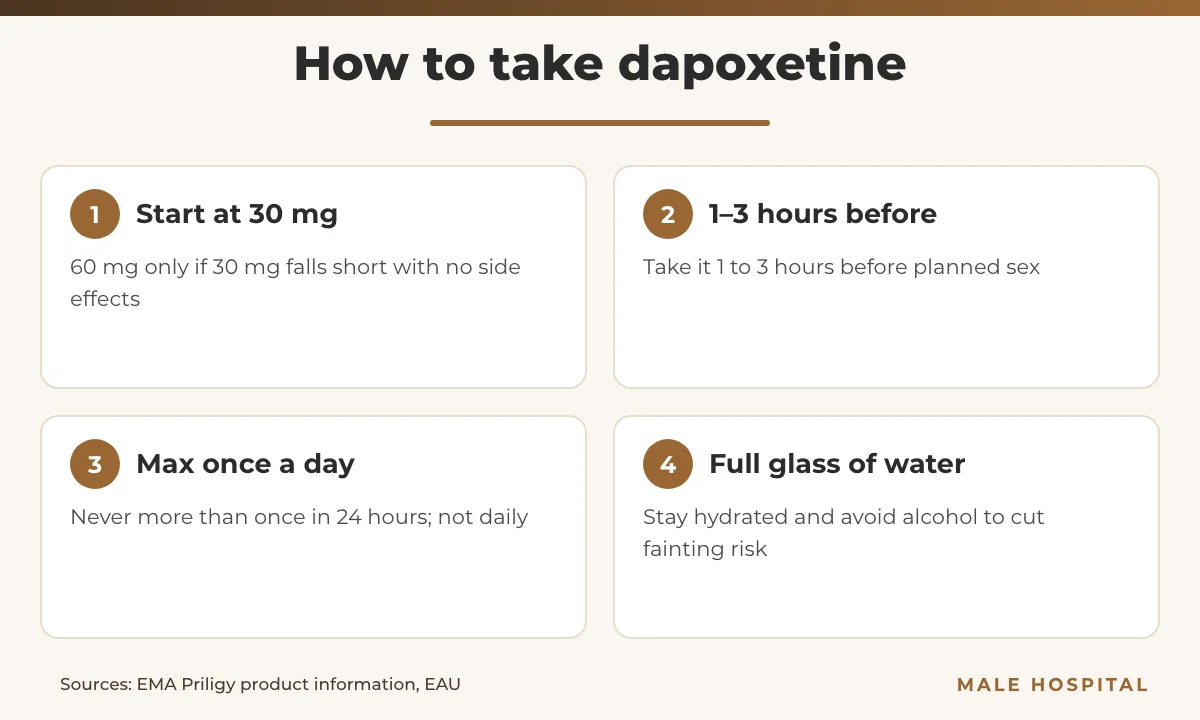
The dosing rules are stricter than for many other tablets, mainly because of the small risk of fainting. According to the European product information:
- Starting dose: 30 mg. Treatment should not be started at 60 mg.
- Timing: take it 1 to 3 hours before sexual activity is expected.
- Maximum frequency: no more than once every 24 hours, and it is not meant for daily use.
- How to swallow: whole, with at least one full glass of water, with or without food.
- Age: not for men under 18 or aged 65 and over.
Source: EMA — Priligy Article 29 referral, Annex III: product information
When the dose can go up to 60 mg
The European Medicines Agency reviewed the drug in 2011 because some countries felt the extra benefit of 60 mg was too small given its higher risk of severe fainting. The agency concluded that the benefits outweigh the risks, but only with restrictions: a man may move up to 60 mg only if 30 mg was not effective enough and he has had no moderate or severe side effects and no warning signs of fainting.
Source: EMA — Priligy referral
Checks before and during treatment
Before the first prescription, the doctor should check blood pressure and heart rate, including a test for a drop in blood pressure on standing up (an orthostatic test). The leaflet advises reviewing treatment after the first 4 weeks or 6 doses, and at least every six months if you continue.
Sources: EMA — Priligy Article 29 referral, Annex III: product information; EAU — Disorders of Ejaculation
How well does dapoxetine work? The trial data
This medicine has one of the largest evidence bases of any PE treatment. Researchers measure success mainly with the intravaginal ejaculatory latency time (IELT): the time from penetration to ejaculation, recorded with a stopwatch by the couple.
The two US phase 3 trials
The first major results came from two identical 12-week, placebo-controlled trials at 121 US sites, analyzed together and published in The Lancet in 2006. Men with moderate-to-severe PE took placebo (870 men), 30 mg (874) or 60 mg (870) of dapoxetine 1 to 3 hours before sex. Average IELT at the start was about 0.9 minutes in every group. By week 12 it had reached 1.75 minutes with placebo, 2.78 minutes with 30 mg and 3.32 minutes with 60 mg. Both doses worked from the first dose.
Five trials, 6,081 men, more than 25 countries
A later analysis pooled five randomized phase 3 trials in more than 25 countries. Average IELT rose from 0.9 minutes at baseline to 3.1 minutes with 30 mg and 3.6 minutes with 60 mg, compared with 1.9 minutes on placebo. Using geometric means, that is a 2.5-fold increase on 30 mg, a 3.0-fold increase on 60 mg and a 1.6-fold increase on placebo. Men also reported better control, higher satisfaction and less distress, and validated questionnaires showed no anxiety, mood change or suicidality signal and no withdrawal syndrome after stopping abruptly.
Source: PubMed — Integrated analysis of five phase 3 trials (McMahon et al., J Sex Med, 2011)
| Measure (week 12) | Placebo | 30 mg | 60 mg |
|---|---|---|---|
| Average IELT, 2 US trials (from about 0.9 min) | 1.75 min | 2.78 min | 3.32 min |
| Average IELT, 5 phase 3 trials (from 0.9 min) | 1.9 min | 3.1 min | 3.6 min |
| Fold increase in IELT (geometric mean) | 1.6× | 2.5× | 3.0× |
| Fold increase if baseline IELT under 30 seconds | — | 3.4× | 4.3× |
| Stopped because of side effects | — | 4% | 10% |
Sources: PubMed — Pryor et al., Lancet, 2006; PubMed — McMahon et al., J Sex Med, 2011; EAU — Disorders of Ejaculation
What the numbers mean in real life
The drug does not cure PE. It works on the days you take it, and the gains are measured in minutes rather than a complete change. Efficacy was similar in lifelong and acquired PE. Men who also had mild erectile dysfunction reported a more modest benefit in control and satisfaction, which is one reason doctors check erections before prescribing.
Real-world persistence is low. The EAU notes that cumulative discontinuation reaches about 90% at two years, and an ISSM-cited clinic series found 90% of men refused or stopped it within 12 months, citing cost, not wanting an antidepressant, side effects, disappointment that PE is not cured, or results below expectations.
Sources: PubMed — Outcomes in acquired or lifelong PE with mild or no ED (Porst et al., 2010); PMC — ISSM Guidelines for the Diagnosis and Treatment of Premature Ejaculation (Althof et al., 2014); EAU — Disorders of Ejaculation
Dapoxetine side effects and the risk of fainting
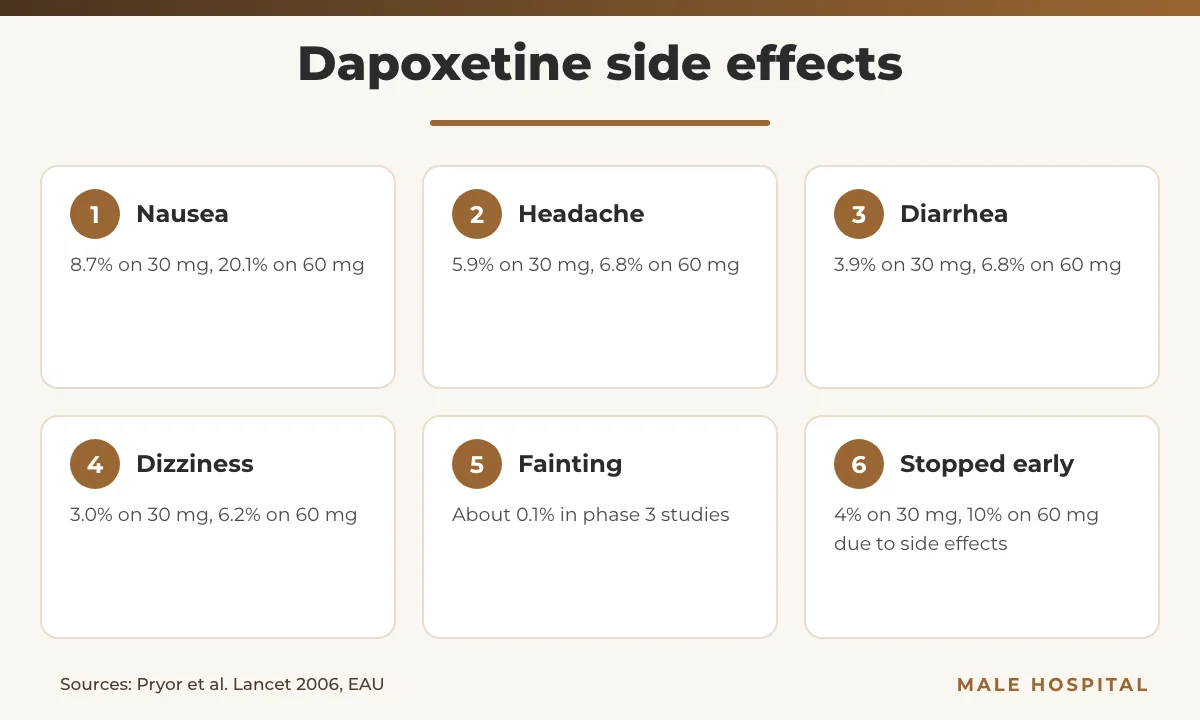
Most side effects are dose-related, which is why treatment starts at 30 mg. In the two US trials, the most common were nausea (8.7% on 30 mg and 20.1% on 60 mg), headache (5.9% and 6.8%), diarrhea (3.9% and 6.8%) and dizziness (3.0% and 6.2%).
Source: PubMed — Pryor et al., Lancet, 2006
The product leaflet lists dizziness, headache and nausea as very common. Common effects include anxiety or restlessness, tingling, difficulty getting or keeping an erection, sweating or flushing, bowel upset, sleep problems, tiredness, a blocked nose, blurred vision, dry mouth, ringing in the ears and lower interest in sex. After stopping, some men have trouble sleeping or feel dizzy, even if they did not take it daily.
Source: EMA — Priligy Article 29 referral, Annex III: product information
Syncope: what it is and how to lower the risk
The side effect that shapes all the prescribing rules is syncope, a brief loss of consciousness caused by a sudden drop in blood pressure or heart rate. The EAU reports vasovagal syncope in about 0.1% of patients in phase 3 studies. Fainting or dizziness on standing is listed as uncommon (1 to 10 in 1,000 users).
The leaflet’s practical advice is simple: take the tablet with a full glass of water, do not take it when dehydrated (for example after 4 to 6 hours without drinking, heavy sweating, fever, vomiting or diarrhea), avoid alcohol, and do not stand up quickly after sitting or lying for a long time. If you feel faint, lie down with your head lower than your body or sit with your head between your knees, and do not drive.
Sources: EAU — Disorders of Ejaculation; EMA — Priligy Article 29 referral, Annex III: product information
What happens in everyday practice
Screening seems to work. In the PAUSE study, a 12-week observational study of 10,028 men in routine care, 6,712 took the drug (93% starting on 30 mg). Side effects were reported by 12.0% of them, most often nausea (3.1%), headache (2.6%) and vertigo (1.0%), and none fainted. A further analysis found fewer mood and neurocognitive side effects than with alternative oral treatments, although 10.9% of users stopped during the study.
Sources: PubMed — The PAUSE study (Mirone et al., Eur Urol, 2014); PubMed — Adverse events vs alternative oral treatments (Verze et al., J Sex Med, 2016)
Who should not take dapoxetine: contraindications and interactions
The European product information says not to take dapoxetine if you:
- are allergic to the active substance or any tablet ingredient (the tablets contain lactose);
- have heart problems such as heart failure or heart rhythm problems;
- have a history of fainting;
- have ever had mania or severe depression;
- have moderate or severe liver problems.
Source: EMA — Priligy Article 29 referral, Annex III: product information
Medicines that must not be combined
Because of the risk of serotonin toxicity, it must not be taken with MAO inhibitors, thioridazine, other antidepressants, lithium, linezolid, tryptophan, St John’s wort, tramadol or migraine medicines. You need to wait 14 days after stopping any of these before starting, and 7 days after your last dose before starting one of them.
Strong blockers of the liver enzyme CYP3A4 are also contraindicated, including ketoconazole, itraconazole, ritonavir, saquinavir, nelfinavir, atazanavir, telithromycin and nefazodone. Tell your doctor about moderate CYP3A4 inhibitors (such as fluconazole, erythromycin, clarithromycin, verapamil, diltiazem or aprepitant), blood thinners such as warfarin, anti-inflammatory painkillers, and medicines for blood pressure or an enlarged prostate.
Source: EMA — Priligy Article 29 referral, Annex III: product information
Alcohol, recreational drugs and erection pills
Alcohol increases the risk of fainting and injury and adds to dizziness and sleepiness, so the label advises avoiding it. Caution is also needed with recreational drugs such as ecstasy, LSD, narcotics or benzodiazepines, and in men with epilepsy, bleeding disorders, kidney problems, low blood pressure or a past mental health condition.
Erection medicines such as sildenafil, tadalafil and vardenafil can lower blood pressure on standing, so the leaflet asks you to tell your doctor if you use them. In phase 1 studies the EAU notes no pharmacokinetic interaction with tadalafil 20 mg or sildenafil 100 mg, and the combination was well tolerated. If you use an erection pill, our article on sildenafil side effects covers its own blood pressure effects.
Sources: EMA — Priligy Article 29 referral, Annex III: product information; EAU — Disorders of Ejaculation
Is dapoxetine FDA-approved? Status by region
No. Dapoxetine is not approved by the US Food and Drug Administration, and no such product is listed in the FDA’s approved-drug database. The FDA has repeatedly warned that “sexual enhancement” supplements sold online contained it as a hidden ingredient, stating that it is an active ingredient not approved by the FDA, so its safety and efficacy have not been established. In the US, antidepressants prescribed for PE are used off-label.
Sources: FDA — Public notification: Extreme Diamond 3000 contains hidden drug ingredient (2015); Cleveland Clinic — Premature Ejaculation
Elsewhere the picture is very different. Sweden granted the first authorization on 6 February 2009. After an EMA arbitration, the European Commission decided on 20 January 2012 that the 30 mg and 60 mg tablets should be authorized in 22 more countries, including France, the Netherlands, Poland, Ireland, Norway and the UK. The NHS confirms dapoxetine (Priligy) is licensed in the UK, and the EAU describes it as approved in many countries except the USA. The 2014 ISSM guideline put the total at more than 50 countries.
Sources: EMA — Priligy referral; NHS — Ejaculation problems; PMC — ISSM PE Guidelines (2014)
| Region | Status |
|---|---|
| United States | Not FDA-approved; found as a hidden ingredient in illegal supplements |
| European Union / EEA | Authorized nationally: Sweden 2009, then 22 further countries after the 2012 EU decision |
| United Kingdom | Licensed (Priligy), per the NHS |
| Worldwide | Approved in more than 50 countries (ISSM, 2014); availability varies by country |
Sources: EMA — Priligy referral; EAU — Disorders of Ejaculation
Avoid online “PE pills” without a prescription
Because the drug is popular and unavailable in some markets, it turns up in counterfeit tablets and supplements, often combined with undeclared sildenafil or tadalafil. Products like these skip the heart and blood pressure screening that makes dapoxetine safe, so use it only with a prescription from a pharmacy where it is licensed.
Source: FDA — Public notification: Extreme Diamond 3000 contains hidden drug ingredient
Dapoxetine vs other premature ejaculation treatments
The EAU guideline gives a strong recommendation for either dapoxetine or a lidocaine/prilocaine spray as first-line drug treatment for lifelong PE. In acquired PE, the first step is treating any cause, such as erectile dysfunction. Daily SSRIs and clomipramine are effective but off-label, take 1 to 2 weeks to work and carry the usual daily-SSRI side effects. Behavioral methods such as stop-start training help too, and combining them with medicine often works better than either alone; see how to last longer in bed for the techniques with evidence.
For men who also have erectile dysfunction, PDE5 inhibitors are part of treatment. In one randomized trial in men with PE but no ED, dapoxetine plus sildenafil improved latency and patient-reported outcomes more than either drug alone. If you are choosing between erection pills, see our comparison of Viagra vs Cialis.
Sources: EAU — Disorders of Ejaculation; NHS — Ejaculation problems; Cleveland Clinic — Premature Ejaculation
When to see a doctor
See a doctor before trying it at all: the medicine is meant only for men with a confirmed diagnosis of PE, after a blood pressure and orthostatic check and a review of your other medicines. The NHS also notes that it is not suitable for every man with PE.
While taking it, stop and get medical help straight away if you:
- faint, or feel light-headed when you stand up;
- have a seizure (fit);
- notice any change in mood, or have thoughts of suicide or self-harm;
- develop a slow, fast or irregular heartbeat, confusion or a cold sweat.
Sources: EMA — Priligy Article 29 referral, Annex III: product information; NHS — Ejaculation problems
If you would like to know which approach suits you, you can arrange a confidential consultation with our urologist-andrologist via WhatsApp. You can also read about the full range of options on our premature ejaculation treatment page.
FAQs about dapoxetine
How long before sex should I take dapoxetine?
Take it 1 to 3 hours before you expect to have sex. It reaches its peak level about 1.3 hours after a dose, so taking it immediately before sex is too late for the full effect. Swallow it whole with a full glass of water; food does not matter. Never take more than one dose in 24 hours.
Sources: EMA — Priligy product information; EAU — Disorders of Ejaculation
Can I drink alcohol with dapoxetine?
The label says to avoid alcohol. Together they increase dizziness, sleepiness and slowed reactions, and alcohol raises the chance of fainting and getting hurt in a fall. If you choose to drink on a night you planned to take it, the safer decision is to skip the tablet that day and talk to your doctor about other options.
Source: EMA — Priligy product information
Can dapoxetine be taken every day?
No. It is licensed only for on-demand use, no more than once every 24 hours and not daily. Men who want continuous treatment are sometimes prescribed a daily SSRI or clomipramine instead, but that is off-label and works differently. Your doctor should review treatment after 4 weeks or 6 doses and then at least every six months.
Sources: EMA — Priligy product information; EAU — Disorders of Ejaculation
Is dapoxetine available in the United States?
Not legally as an approved medicine. The FDA has never approved it, and it has warned that the drug found inside online supplements is an unapproved ingredient whose safety and efficacy have not been established. In the US, SSRIs prescribed for premature ejaculation are an off-label use instead.
Sources: FDA — Public notification (2015); Cleveland Clinic — Premature Ejaculation
Does dapoxetine work the first time?
Often, yes. In the large US trials, both the 30 mg and 60 mg doses lengthened ejaculation time from the very first dose, unlike daily SSRIs, which need one to two weeks. Results still vary between men, and those with mild erectile dysfunction tend to notice a smaller improvement in control and satisfaction.
Sources: PubMed — Pryor et al., 2006; PubMed — Porst et al., 2010
Can I take dapoxetine with Viagra or Cialis?
Sometimes, under medical supervision. Studies found no pharmacokinetic interaction with sildenafil 100 mg or tadalafil 20 mg, and the combination was well tolerated. Both drugs can lower blood pressure on standing, though, so the leaflet asks you to tell your doctor first, and the risk of dizziness or fainting has to be considered.
Sources: EAU — Disorders of Ejaculation; EMA — Priligy product information
Is dapoxetine an antidepressant?
It is an SSRI, the same chemical class as many antidepressants, but it was developed and licensed only for premature ejaculation, not depression. Its short action means it does not build up like daily antidepressants. Pooled trial data showed no signal of anxiety, mood change or suicidality, although men with a history of mania or severe depression must not take it.
Sources: PubMed — McMahon et al., 2011; EMA — Priligy product information
What happens when you stop taking dapoxetine?
Ejaculation time returns to your usual pattern because the effect lasts only for the day of the dose; the drug does not cure PE. In pooled trials there was no discontinuation syndrome after abrupt withdrawal, although the leaflet notes some men have trouble sleeping or feel dizzy after stopping, so mention any such symptoms to your doctor.
Sources: PubMed — McMahon et al., 2011; EMA — Priligy product information
Medically reviewed by Assoc. Prof. Dr. Zülfü Sertkaya, urologist and andrologist (FEBU), Istanbul. Last reviewed: October 2026.
This article is for general information and does not replace an individual consultation with a qualified doctor.
- EAU — Guidelines on Sexual and Reproductive Health: Disorders of Ejaculation
- EMA — Priligy: Article 29(4) referral
- EMA — Priligy Article 29 referral, Annex III: summary of product characteristics, labelling and package leaflet
- NHS — Ejaculation problems
- FDA — Public Notification: Extreme Diamond 3000 contains hidden drug ingredient (2015)
- Cleveland Clinic — Premature Ejaculation: Causes, Diagnosis & Treatment
- Sexual Medicine (PMC) — An Update of the ISSM Guidelines for the Diagnosis and Treatment of Premature Ejaculation (Althof et al., 2014)
- Int Braz J Urol (PMC) — Dapoxetine and premature ejaculation (Vieiralves & Favorito, 2023)
- Lancet (PubMed) — Efficacy and tolerability of dapoxetine in treatment of premature ejaculation: integrated analysis of two RCTs (Pryor et al., 2006)
- J Sex Med (PubMed) — Efficacy and safety of dapoxetine for premature ejaculation: integrated analysis of five phase 3 trials (McMahon et al., 2011)
- J Sex Med (PubMed) — Outcomes in acquired or lifelong PE with mild or no ED: integrated analyses of two phase 3 dapoxetine trials (Porst et al., 2010)
- Eur Urol (PubMed) — The PAUSE study: men with PE treated with dapoxetine or alternative care (Mirone et al., 2014)
- J Sex Med (PubMed) — Treatment-emergent adverse events with dapoxetine vs alternate oral treatments (Verze et al., 2016)