Testosterone replacement therapy (TRT) restores testosterone in men whose bodies no longer make enough of it, and it is only appropriate when low testosterone is confirmed by repeated morning blood tests and causes symptoms. When those conditions are met, it can improve sex drive, erections, mood and bone density, but it switches off sperm production, raises red blood cell counts and needs regular monitoring for as long as it is used.
Source: EAU — Sexual and Reproductive Health Guidelines: Male Hypogonadism; AUA — Evaluation and Management of Testosterone Deficiency
- TRT is for men with symptoms plus consistently low morning testosterone, not for men with normal levels or for normal ageing alone.
- Gels, injections, long-acting testosterone undecanoate, patches, pellets, nasal gel and oral capsules all work; they differ in convenience, level swings and side effects.
- Sexual symptoms usually improve first (within about 3 months); if nothing improves after 3–6 months, guidelines advise stopping.
- The large TRAVERSE trial (2023) found no increase in heart attacks or strokes, and in 2025 the FDA removed the cardiovascular boxed warning, but blood-pressure and other warnings remain.
- TRT suppresses sperm production, so men who want children should not use it and may be offered fertility-sparing alternatives instead.
- What is testosterone replacement therapy?
- Who qualifies for testosterone replacement therapy?
- Forms of TRT compared: gels, injections, pellets and more
- Benefits and timeline: what the evidence shows
- Risks and side effects of testosterone replacement therapy
- Heart safety: TRAVERSE and the 2025 FDA label change
- Monitoring schedule on TRT
- Wanting children? Alternatives to TRT
- TRT vs anabolic steroid misuse
- When to stop TRT and when to see a doctor
- FAQs about testosterone replacement therapy
What is testosterone replacement therapy?
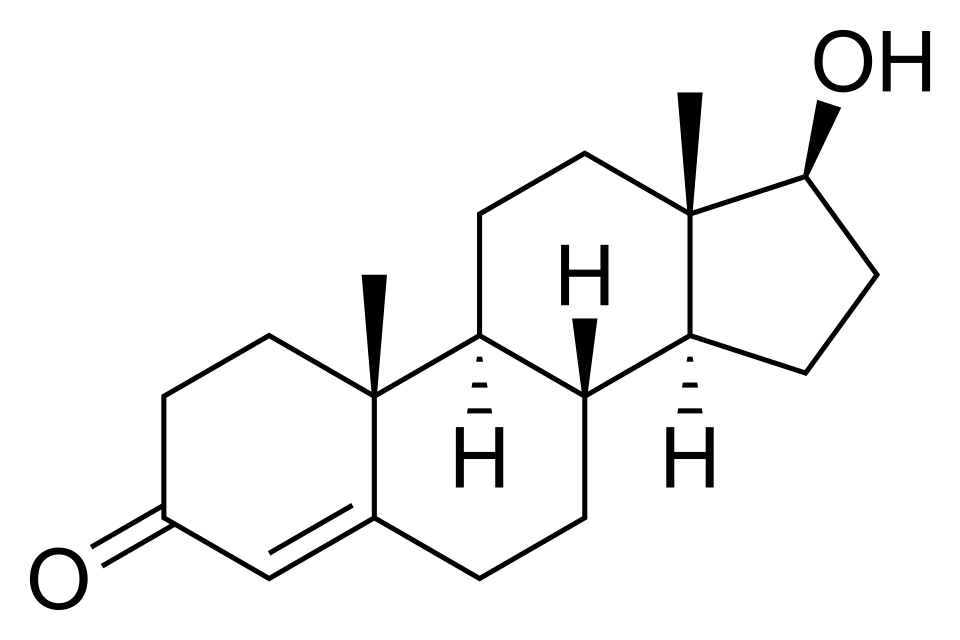
Testosterone is the main male sex hormone. It supports sex drive, erections, muscle and bone strength, red blood cell production and mood. When the testicles (primary hypogonadism) or the brain’s hormone signals (secondary hypogonadism) fail, levels fall and symptoms can follow. Testosterone replacement therapy gives back the missing hormone from outside the body, as a gel, injection, patch, pellet, nasal gel or capsule.
TRT treats the hormone deficiency; it does not cure the underlying cause. Doctors therefore measure luteinizing hormone (LH) and follicle-stimulating hormone (FSH) to tell primary from secondary hypogonadism, because the cause changes both the work-up and, for men who want children, the choice of treatment.
Source: Endocrine Society — Testosterone Therapy for Hypogonadism Guideline; Cleveland Clinic — TRT: What It Is
In the United States, the FDA approves testosterone for men whose low testosterone is caused by a known medical condition. Its labeling keeps a “limitation of use” for age-related low testosterone, which means the products are not approved simply to counter the gradual decline that comes with getting older.
Source: FDA — FDA issues class-wide labeling changes for testosterone products; Cleveland Clinic — TRT: What It Is
Who qualifies for testosterone replacement therapy?
All major guidelines agree on two requirements. First, a man must have symptoms or signs that fit testosterone deficiency, such as low libido, fewer morning erections, erectile dysfunction, fatigue or loss of muscle. Second, low testosterone must be confirmed with at least two early-morning, fasting blood tests on separate days. A single low result, or symptoms alone, is not enough. You can read more about the warning signs in our guide to low testosterone symptoms.
- AUA (American Urological Association): uses total testosterone below 300 ng/dL as a reasonable cut-off, together with symptoms or signs.
- EAU (European Association of Urology): treats symptomatic men with total testosterone below 12 nmol/L (about 3.5 ng/mL) who have no contraindications, and advises against testosterone in men with normal levels.
- Endocrine Society: requires “unequivocally and consistently low” testosterone plus symptoms, and advises against screening the general population.
Source: Urology Times — Testosterone deficiency FAQs from the AUA guideline; EAU — Sexual and Reproductive Health Guidelines: Male Hypogonadism; Endocrine Society — Testosterone Therapy for Hypogonadism Guideline
Who should not start TRT
The EAU lists absolute contraindications: locally advanced or metastatic prostate cancer, male breast cancer, an active wish to have children, a haematocrit (the share of blood made up of red cells) of 54% or more, and uncontrolled congestive heart failure. Severe urinary symptoms (IPSS above 19), a baseline haematocrit of 48–50% and a family history of blood clots are relative contraindications that need extra assessment first.
The Endocrine Society adds a palpable prostate nodule, a PSA above 4 ng/mL (or above 3 ng/mL in men at high risk of prostate cancer) without urological evaluation, untreated severe obstructive sleep apnea, a heart attack or stroke within the last 6 months, and thrombophilia (an inherited tendency to clot). It also advises against routinely prescribing testosterone to every man aged 65 or older with low levels, and against using it to improve blood sugar control in type 2 diabetes.
Source: EAU — Sexual and Reproductive Health Guidelines: Male Hypogonadism; Endocrine Society — Testosterone Therapy for Hypogonadism Guideline
Forms of TRT compared: gels, injections, pellets and more
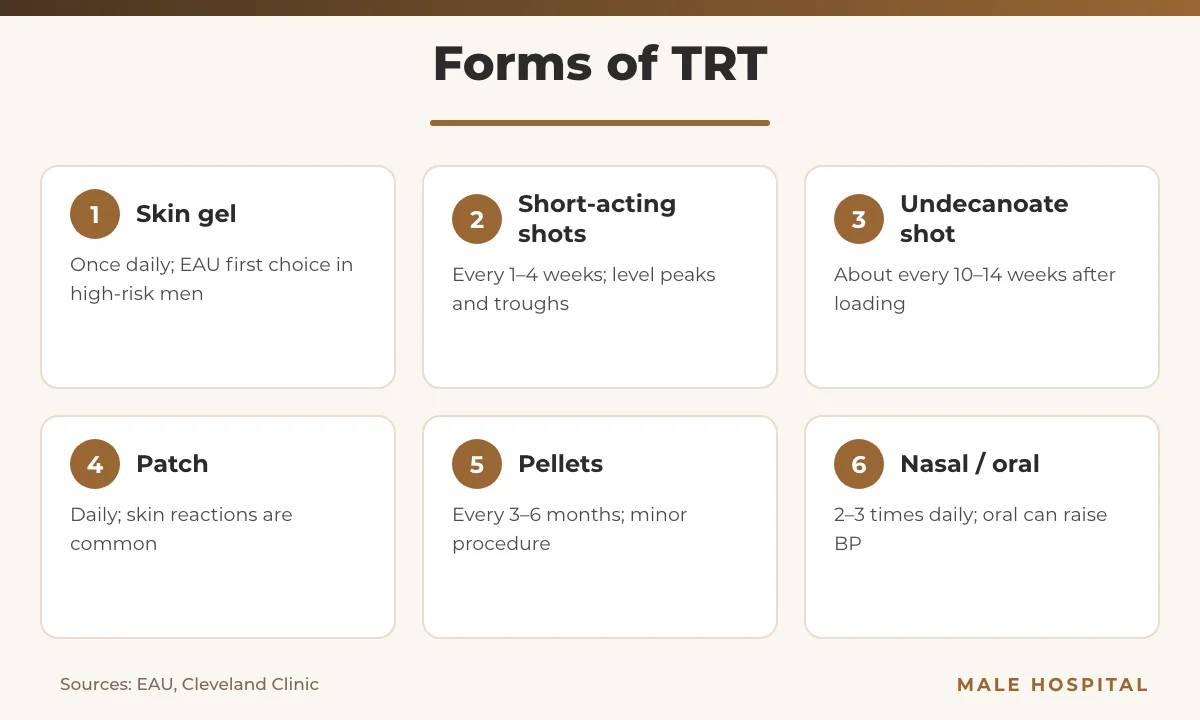
No single form of testosterone is best for everyone. The choice depends on how often you are willing to apply or inject it, how steady you want blood levels to be, cost and availability in your country, and your personal risk profile. The EAU suggests gels as the first choice for men at higher risk of side effects.
| Form | How often | Advantages | Drawbacks |
|---|---|---|---|
| Skin gel | Once daily | Daily, adjustable dosing; EAU first choice in high-risk men | Daily routine; skin irritation; blood test best 2–4 hours after applying |
| Short-acting injections (enanthate, cypionate) | Every 1–4 weeks (intramuscular); weekly under-the-skin options exist | Inexpensive, widely available | Peaks and troughs in levels and symptoms |
| Long-acting testosterone undecanoate injection | About every 10–14 weeks after loading doses | Few injections a year; stable trough levels | Given as an intramuscular injection in clinic |
| Patch | Daily, rotating sites | No injections | Skin reactions are common |
| Pellets under the skin | Every 3–6 months (EAU: lasts 4–7 months) | No daily dosing | Invasive: a minor procedure each time |
| Nasal gel | 2–3 times daily | No injections or skin gel | Frequent dosing |
| Oral testosterone undecanoate / buccal tablets | Twice daily | No needles or gels | Oral absorption depends on dietary fat; newer capsules can raise blood pressure (FDA boxed warning) |
Source: EAU — Sexual and Reproductive Health Guidelines: Male Hypogonadism; Cleveland Clinic — TRT: What It Is
For injectable testosterone undecanoate, the EAU describes 1,000 mg every 12 weeks after a 6-week loading dose, adjustable to 10–14 weeks, aiming for a trough level above 12 and below 18 nmol/L. Mesterolone, an older oral androgen, cannot be converted to estrogen and is reserved for special situations such as painful breast enlargement.
Source: EAU — Sexual and Reproductive Health Guidelines: Male Hypogonadism
Benefits and timeline: what the evidence shows
The strongest evidence on the benefits of testosterone replacement therapy comes from the Testosterone Trials (T Trials), published in the New England Journal of Medicine in 2016. They enrolled 790 men aged 65 or older with testosterone below 275 ng/dL and relevant symptoms, who used testosterone gel or placebo gel for one year.
- Sexual function: testosterone significantly improved sexual activity, sexual desire and erectile function.
- Mood: mood improved slightly and depressive symptoms were less severe.
- Walking: across all three trials, 20.5% of men on testosterone improved their 6-minute walk by at least 50 m, versus 12.6% on placebo, although the dedicated physical-function trial alone showed no significant difference.
- Energy: there was no benefit on the fatigue (vitality) scale.
Source: N Engl J Med (PubMed) — Effects of Testosterone Treatment in Older Men (T Trials, 2016)
The EAU notes that sexual symptoms improved as early as three months in the T Trials, and it plans the first review at three months, with further evaluation at 6 or 12 months. Cleveland Clinic explains that changes can take a few weeks to appear, that doctors usually wait about 30 days before re-checking testosterone, and that if symptoms have not improved after 3–6 months, low testosterone was probably not the cause.
Source: EAU — Sexual and Reproductive Health Guidelines: Male Hypogonadism; Cleveland Clinic — TRT: What It Is
Testosterone is not a fracture-prevention drug. In a TRAVERSE sub-study of 5,204 men followed for a median of 3.19 years, clinical fractures occurred in 3.50% of men on testosterone and 2.46% on placebo (hazard ratio 1.43), so testosterone did not lower fracture risk. Testosterone also should not be used as a weight-loss or diabetes treatment.
Source: N Engl J Med (PubMed) — Testosterone Treatment and Fractures in Men with Hypogonadism (2024); Endocrine Society — Testosterone Therapy for Hypogonadism Guideline
Risks and side effects of testosterone replacement therapy
Most side effects are predictable and can be managed with monitoring and dose changes. The common and important ones are:
- Erythrocytosis (too many red blood cells): testosterone stimulates red cell production, which thickens the blood. The EAU found no evidence of harm up to a haematocrit of 54%; above 54%, there is broad consensus to stop therapy and remove blood (phlebotomy), especially in high-risk men. In lower-risk men, reducing the dose, switching formulation and venesection are alternatives, then restarting at a lower dose, preferably a gel.
- Suppressed sperm production and smaller testicles: outside testosterone tells the brain to stop sending LH and FSH, so the testicles shrink and sperm counts fall.
- Acne and oily skin, fluid retention (ankle swelling), breast tenderness or enlargement.
- Prostate effects: PSA can rise and the prostate can be stimulated, causing urinary symptoms.
- Skin irritation with gels and especially patches.
Source: EAU — Sexual and Reproductive Health Guidelines: Male Hypogonadism; Cleveland Clinic — TRT: What It Is
Sleep apnea and prostate cancer: what guidelines actually say
Sleep apnea is often listed as a side effect, and the Endocrine Society advises against starting testosterone in men with untreated severe obstructive sleep apnea. The EAU, however, found no evidence that testosterone causes or worsens sleep apnea, and one trial found CPAP plus testosterone gel worked better than CPAP alone. In practice, men with loud snoring or daytime sleepiness should be assessed before starting.
For prostate cancer, testosterone is contraindicated in active advanced disease. The EAU allows carefully selected men treated for low-risk prostate cancer to be considered after at least one year of follow-up with PSA below 0.01 ng/mL and no recurrence, with closer PSA checks.
Source: EAU — Sexual and Reproductive Health Guidelines: Male Hypogonadism; Endocrine Society — Testosterone Therapy for Hypogonadism Guideline
Heart safety: TRAVERSE and the 2025 FDA label change
For years, the biggest worry about testosterone replacement therapy was the heart. The TRAVERSE trial, published in 2023, was designed to answer it. It randomized 5,246 men aged 45 to 80 with symptomatic hypogonadism who already had, or were at high risk of, cardiovascular disease, to 1.62% testosterone gel or placebo. Mean follow-up was 33 months.
Major adverse cardiac events (cardiovascular death, non-fatal heart attack or non-fatal stroke) occurred in 7.0% of the testosterone group and 7.3% of the placebo group (hazard ratio 0.96), so testosterone was “noninferior” to placebo. However, atrial fibrillation, acute kidney injury and pulmonary embolism (a blood clot in the lungs) were more common in men on testosterone.
Source: N Engl J Med (PubMed) — Cardiovascular Safety of Testosterone-Replacement Therapy (TRAVERSE, 2023)
Based on TRAVERSE, the FDA announced class-wide labeling changes on February 28, 2025. It removed the boxed-warning language about an increased risk of adverse cardiovascular outcomes, added the TRAVERSE results to all labels, and kept the limitation of use for age-related hypogonadism. At the same time, it required a new or product-specific warning about increased blood pressure based on ambulatory blood-pressure studies.
Source: FDA — FDA issues class-wide labeling changes for testosterone products
The EAU summarizes the evidence as supporting safety for at least three years of therapy, says longer-term effects cannot yet be excluded, and strongly recommends assessing cardiovascular risk before starting. Reassuring heart data are not a reason to prescribe testosterone to men who do not need it.
Source: EAU — Sexual and Reproductive Health Guidelines: Male Hypogonadism
Monitoring schedule on TRT
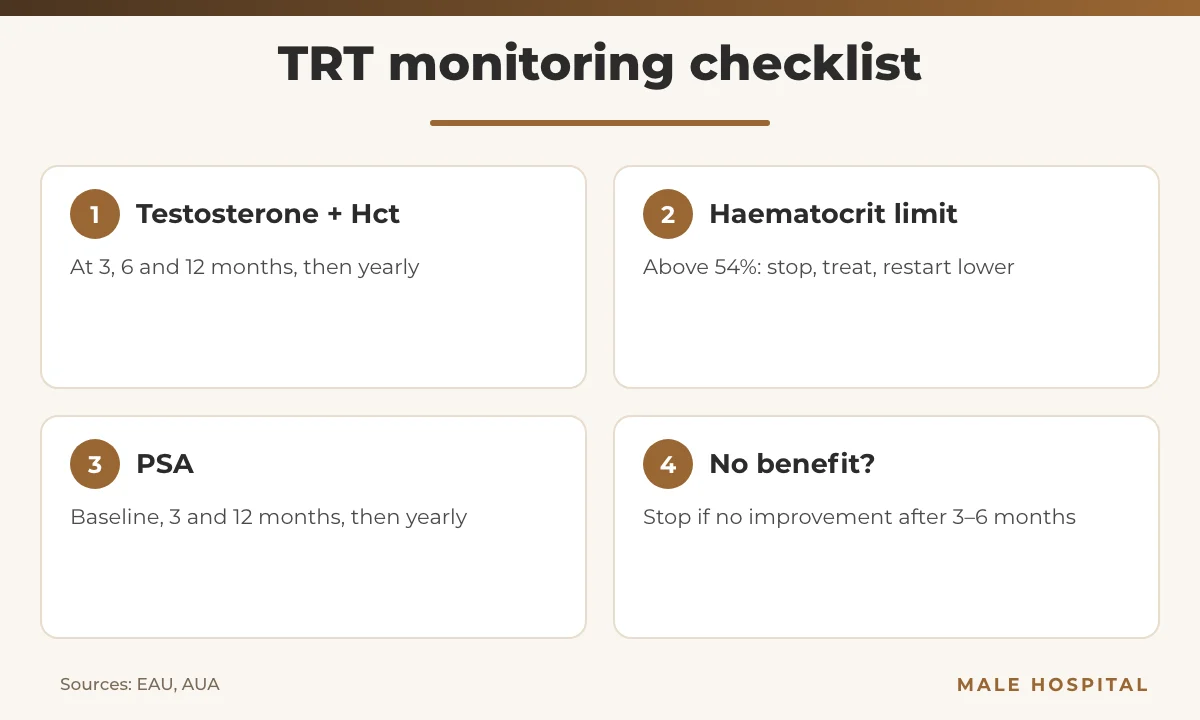
Monitoring is what keeps testosterone replacement therapy safe. The EAU schedule below is the most detailed; the AUA similarly recommends checking PSA (in men over 40), hemoglobin/hematocrit and fertility goals before starting, dosing to reach the middle third of the normal range, and re-checking testosterone every 6–12 months once stable.
| Test | When (EAU) | Why |
|---|---|---|
| Testosterone + haematocrit | Baseline, 3, 6 and 12 months, then yearly | Check dose and red cell count |
| Haematocrit (high-risk men) | Every 3 months in year one, then at least every 6 months | Sleep apnea, obesity, heavy smoking, COPD raise the risk |
| PSA | Baseline, 3 and 12 months, then yearly | Prostate monitoring |
| Digital rectal exam | Baseline, then at least yearly | Prostate nodules |
| Lipids and blood sugar | Baseline, then yearly | Metabolic health |
| Bone density (DEXA) | Baseline and 18–24 months | Men with osteoporosis risk |
Source: EAU — Sexual and Reproductive Health Guidelines: Male Hypogonadism; Urology Times — Testosterone deficiency FAQs from the AUA guideline
During the first year, the Endocrine Society advises urological referral if PSA rises by more than 1.4 ng/mL above baseline, if PSA is confirmed above 4.0 ng/mL, or if a prostate abnormality is found on examination. After the first year, standard prostate screening applies.
Source: Endocrine Society — Testosterone Therapy for Hypogonadism Guideline
Wanting children? Alternatives to TRT
Testosterone replacement therapy lowers sperm production, which matters for any man trying to conceive. The EAU lists an active desire to have children as an absolute contraindication and states that testosterone is contraindicated in men with secondary hypogonadism who desire fertility. Cleveland Clinic adds that restoring fertility after TRT can be costly and slow. If you are planning a family, see our guide to male infertility before any hormone treatment.
Options that raise testosterone while protecting sperm production include:
- Gonadotropin therapy (hCG, with FSH when needed): the EAU’s standard treatment for men with secondary hypogonadism who want to father a child. hCG acts like LH and makes the testicles produce their own testosterone.
- Selective estrogen receptor modulators (SERMs) such as clomiphene, and aromatase inhibitors: these are off-label for men. They only work when the brain–testis axis is intact, so they do not help primary testicular failure, and SERMs may increase the risk of blood clots.
Source: EAU — Sexual and Reproductive Health Guidelines: Male Hypogonadism; Cleveland Clinic — TRT: What It Is
TRT vs anabolic steroid misuse
Medical TRT aims to bring testosterone back into the normal range and is monitored with blood tests. Anabolic steroid misuse, common among bodybuilders and some athletes, uses much higher doses, often combined with other steroids, to build muscle. The NHS lists the harms of misuse as reduced sperm count, infertility, shrunken testicles, breast development, hair loss, severe acne and erectile dysfunction, plus heart attack, stroke, high blood pressure, deep vein thrombosis, liver and kidney damage, aggression, mood swings and paranoia.
Anabolic steroids can also be addictive. Stopping suddenly can cause depression, extreme tiredness, insomnia, low sex drive and headaches, so doctors may recommend tapering under supervision. If you have used steroids and now have low testosterone or fertility problems, tell your doctor honestly; it changes the treatment plan.
Source: NHS — Anabolic steroid misuse
When to stop TRT and when to see a doctor
Testosterone therapy is not automatically lifelong. Guidelines and clinical sources point to clear reasons to stop or pause it:
- No meaningful improvement in symptoms after 3–6 months (AUA, Cleveland Clinic).
- Haematocrit above 54% (withdraw and treat, then restart at a lower dose once normal).
- A confirmed PSA rise or new prostate finding, pending urological assessment.
- A diagnosis of prostate or breast cancer.
- A new wish to father a child, so that fertility-sparing treatment can be started instead.
Source: Urology Times — Testosterone deficiency FAQs from the AUA guideline; EAU — Sexual and Reproductive Health Guidelines: Male Hypogonadism; Endocrine Society — Testosterone Therapy for Hypogonadism Guideline
Seek urgent medical care if you are on testosterone and develop chest pain, sudden shortness of breath, a painful swollen leg, sudden weakness or trouble speaking, or an irregular, racing heartbeat. These can be signs of a heart rhythm problem, blood clot or stroke; pulmonary embolism and atrial fibrillation were more common with testosterone in TRAVERSE. Also book a prompt review for difficulty passing urine, a breast lump, very high blood-pressure readings or marked mood changes.
Source: N Engl J Med (PubMed) — Cardiovascular Safety of Testosterone-Replacement Therapy (TRAVERSE, 2023); Cleveland Clinic — TRT: What It Is
If you are unsure whether your symptoms come from low testosterone, or whether TRT is right for you, you can arrange a confidential consultation with our urologist-andrologist, Assoc. Prof. Dr. Zülfü Sertkaya, via WhatsApp. Erection problems that persist despite normal hormones can be assessed separately through our erectile dysfunction treatment service.
FAQs about testosterone replacement therapy
How long does it take for TRT to work?
Some men notice changes within a few weeks, but improvements in libido and sexual function are usually assessed at about three months, when the EAU recommends the first review. If symptoms have not improved after 3–6 months, doctors usually recommend stopping, because low testosterone was probably not the main cause.
Source: EAU — Sexual and Reproductive Health Guidelines: Male Hypogonadism; Cleveland Clinic — TRT: What It Is
Is testosterone replacement therapy safe for the heart?
In TRAVERSE, men with or at high risk of heart disease had similar rates of heart attack, stroke and cardiovascular death on testosterone gel and placebo (7.0% vs 7.3%). Atrial fibrillation, kidney injury and lung clots were somewhat more common. The FDA removed its cardiovascular boxed warning in 2025 but added blood-pressure warnings.
Source: N Engl J Med (PubMed) — Cardiovascular Safety of Testosterone-Replacement Therapy (TRAVERSE, 2023); FDA — FDA issues class-wide labeling changes for testosterone products
Will TRT make me infertile?
It can. Outside testosterone suppresses the brain signals that drive sperm production, so sperm counts often fall sharply while you are on it. Cleveland Clinic notes that restoring fertility afterward can be slow and costly. Men who want children are usually offered hCG-based treatment or, off-label, clomiphene instead of TRT.
Source: EAU — Sexual and Reproductive Health Guidelines: Male Hypogonadism; Cleveland Clinic — TRT: What It Is
Can I stop TRT once I start?
Yes. TRT can be stopped, ideally with your doctor’s guidance. Because TRT replaces rather than repairs hormone production, symptoms can come back after stopping, so plan the next steps with your doctor. Stopping is recommended if there is no benefit after 3–6 months, if haematocrit rises above 54%, or if you plan a pregnancy.
Source: Urology Times — Testosterone deficiency FAQs from the AUA guideline; EAU — Sexual and Reproductive Health Guidelines: Male Hypogonadism
Which is better: testosterone gel or injections?
Neither is best for everyone. Gels are applied daily and the EAU prefers them as the first choice in higher-risk men. Short-acting injections are inexpensive but cause peaks and troughs, while long-acting undecanoate needs only a few clinic injections a year. Your health, lifestyle and budget guide the choice.
Source: EAU — Sexual and Reproductive Health Guidelines: Male Hypogonadism; Cleveland Clinic — TRT: What It Is
Is TRT approved for age-related low testosterone?
No. In the United States, testosterone products are approved for men with low testosterone caused by a specific medical condition, and the FDA kept the limitation of use for age-related hypogonadism in its 2025 update. The Endocrine Society advises an individual decision for symptomatic older men with consistently low levels, not routine prescribing.
Source: FDA — FDA issues class-wide labeling changes for testosterone products; Endocrine Society — Testosterone Therapy for Hypogonadism Guideline
Does TRT cause prostate cancer?
Testosterone is contraindicated in active advanced prostate cancer and requires PSA checks at baseline, 3 and 12 months, then yearly. The Endocrine Society advises referral if PSA rises more than 1.4 ng/mL in the first year or exceeds 4.0 ng/mL.
Source: EAU — Sexual and Reproductive Health Guidelines: Male Hypogonadism; Endocrine Society — Testosterone Therapy for Hypogonadism Guideline
What is the difference between TRT and steroids?
TRT uses prescribed doses to bring testosterone back into the normal range, with regular blood tests. Anabolic steroid misuse uses much higher doses, often several drugs at once, to build muscle. Misuse carries risks such as infertility, shrunken testicles, heart attack, stroke, liver damage, aggression and dependence, according to the NHS.
Source: NHS — Anabolic steroid misuse
Medically reviewed by Assoc. Prof. Dr. Zülfü Sertkaya, urologist and andrologist (FEBU), Istanbul. Last reviewed: October 2026.
This article is for general information and does not replace an individual consultation with a qualified doctor.
- EAU — Sexual and Reproductive Health Guidelines: Male Hypogonadism
- AUA — Evaluation and Management of Testosterone Deficiency
- Urology Times — Testosterone deficiency FAQs from the AUA guideline
- Endocrine Society — Testosterone Therapy for Hypogonadism Guideline
- FDA — FDA issues class-wide labeling changes for testosterone products
- N Engl J Med (PubMed) — Cardiovascular Safety of Testosterone-Replacement Therapy (TRAVERSE, 2023)
- N Engl J Med (PubMed) — Effects of Testosterone Treatment in Older Men (T Trials, 2016)
- N Engl J Med (PubMed) — Testosterone Treatment and Fractures in Men with Hypogonadism (2024)
- Cleveland Clinic — TRT: What It Is
- NHS — Anabolic steroid misuse