
Varicocele is a swelling of the veins inside the scrotum, much like varicose veins in the leg. It affects about 15% of men, is usually on the left side and often causes no symptoms, but it is the most common correctable finding in men with fertility problems. Treatment is only advised in specific situations, such as a palpable varicocele with abnormal semen and infertility, or a teenage testicle that stops growing.
Sources: Asian Journal of Andrology (PMC) — Alsaikhan et al. 2016 — Epidemiology of varicocele; MedlinePlus (NIH) — Varicocele
- A varicocele is an abnormal widening and twisting of the pampiniform plexus, the network of veins that drains each testicle.
- It is found in about 15% of men in general but in roughly 35–40% of men seen for infertility, and in up to 80% of men with secondary infertility.
- Most affected men are fertile; EAU and AUA/ASRM guidelines advise repair for infertile men with a palpable varicocele and abnormal semen, not for varicoceles seen only on ultrasound.
- Microsurgical subinguinal or inguinal repair has the lowest reported recurrence (about 0.4%) and hydrocele (about 0.44%) rates in the EAU guideline table.
- A varicocele that appears suddenly in an older man, or one only on the right side, needs prompt checks because it can rarely signal a kidney or abdominal tumor.
- What is a varicocele?
- How common is varicocele?
- Why a varicocele is usually on the left side
- Varicocele grades
- Varicocele symptoms
- How a varicocele affects fertility and testosterone
- How a varicocele is diagnosed
- When is varicocele treatment recommended?
- Varicocele treatment options compared
- Recovery after varicocele repair
- When to see a doctor
- FAQs about varicocele
What is a varicocele?
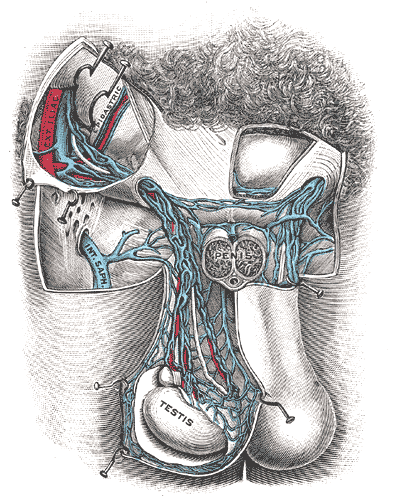
Each testicle is drained by a mesh of small veins called the pampiniform plexus, which runs up inside the spermatic cord. Medically, a varicocele is defined as an abnormal dilatation and/or tortuosity (twisting) of this pampiniform plexus in the scrotum. Damaged or missing valves let blood flow backward and pool, so the veins stretch, in the same way varicose veins form in the legs.
Sources: Asian Journal of Andrology (PMC) — Alsaikhan et al. 2016 — Epidemiology of varicocele; MedlinePlus (NIH) — Varicocele
The pampiniform plexus has a cooling job. Normal scrotal temperature is 1–2 °C below body temperature, partly because the veins wrap around the testicular artery and cool incoming blood through countercurrent heat exchange. When blood pools in a varicocele, this cooling system works less well, and the higher temperature is thought to be the main way a varicocele harms sperm production.
Source: Asian Journal of Andrology (PMC) — Pastuszak & Wang 2015 — Varicocele and testicular function
Varicoceles usually develop slowly and are most often noticed between the ages of 15 and 25.
Source: MedlinePlus (NIH) — Varicocele
How common is varicocele?
It is one of the most common findings in urology. Studies of healthy young men and military recruits put its prevalence at about 15% of the general male population. Cleveland Clinic gives a similar estimate of 15% to 20% of men, or about 1 in 5.
Sources: Asian Journal of Andrology (PMC) — Alsaikhan et al. 2016 — Epidemiology of varicocele; Cleveland Clinic — Varicocele: Symptoms & Treatment
The rate is much higher in men who are struggling to conceive. The EAU guideline finds it in 25% of men with an abnormal semen analysis and in 35–40% of men presenting with infertility. In men with secondary infertility (who fathered a child before but cannot now), studies report rates of 45% up to 81%. Some researchers see this as evidence that the condition can be progressive.
Sources: EAU — Sexual and Reproductive Health Guidelines (male infertility chapter, varicocele); Asian Journal of Andrology (PMC) — Alsaikhan et al. 2016 — Epidemiology of varicocele
Varicoceles start around puberty. In a study of 4,052 boys, the prevalence was under 1% at ages 2–10, 7.8% at 11–14 and 14.1% at 15–19. In adult men above 30, one study found that prevalence rose by about 10% for each decade of life. Still, about 80% of affected men have no evidence of infertility, which is why doctors do not treat every case.
Sources: Asian Journal of Andrology (PMC) — Alsaikhan et al. 2016 — Epidemiology of varicocele; Asian Journal of Andrology (PMC) — Pastuszak & Wang 2015 — Varicocele and testicular function
Why a varicocele is usually on the left side
Most varicoceles are on the left, and when both sides are affected the left is usually larger. The reason is anatomy. The left testicular vein is long and drains at a right angle into the left renal (kidney) vein, while the right testicular vein drains at an angle directly into the inferior vena cava, the large main vein.
Sources: Journal of Clinical Medicine (PMC) — Franco et al. 2023 — Varicocele: To Treat or Not to Treat?; Asian Journal of Andrology (PMC) — Halpern et al. 2016 — Percutaneous embolization of varicocele
Two further factors add pressure on the left. The left renal vein can be squeezed between the aorta and the superior mesenteric artery (the “nutcracker” effect), raising pressure that is passed back down the testicular vein. Valves are also absent more often on the left: one study found no valves in 40% of left spermatic veins compared with 23% on the right.
Sources: Journal of Clinical Medicine (PMC) — Franco et al. 2023 — Varicocele: To Treat or Not to Treat?; Asian Journal of Andrology (PMC) — Pastuszak & Wang 2015 — Varicocele and testicular function
Up to 50% of affected men actually have it on both sides. An isolated right-sided one, on the other hand, is rare and should be investigated, because it may be linked to unusual venous anatomy or, rarely, to a tumor in the back of the abdomen (retroperitoneum).
Source: Asian Journal of Andrology (PMC) — Alsaikhan et al. 2016 — Epidemiology of varicocele
Varicocele grades
Doctors grade it by how easy it is to feel or see while the man is standing. The Valsalva maneuver means bearing down as if straining, which increases pressure in the abdomen and fills the veins. The grade matters because guidelines recommend repair only for clinical (palpable) varicoceles, never for subclinical ones in infertile men.
Sources: EAU — Sexual and Reproductive Health Guidelines (male infertility chapter, varicocele); World Journal of Men’s Health (PMC) — Paick & Choi 2019 — Varicocele and Testicular Pain: A Review
| Varicocele grade | What the doctor finds | Treat for infertility? |
|---|---|---|
| Subclinical (grade 0) | Not felt or seen; shown only on Doppler ultrasound | No (EAU strong; AUA/ASRM strong) |
| Grade 1 | Felt only during the Valsalva maneuver | Consider if semen is abnormal and the couple is infertile |
| Grade 2 | Felt at rest, but not visible | Consider if semen is abnormal and the couple is infertile |
| Grade 3 | Visible through the scrotal skin and easily felt | Consider if semen is abnormal and the couple is infertile |
Sources: EAU — Sexual and Reproductive Health Guidelines (male infertility chapter, varicocele); AUA/ASRM — Diagnosis and Treatment of Infertility in Men: AUA/ASRM Guideline Part II
Varicocele symptoms
Many men have no symptoms at all. When symptoms happen, they include:
- a dull ache, heaviness or dragging feeling in the scrotum or groin, often worse after standing for a long time and better when lying down;
- a lump above the testicle that feels like a cluster of soft, twisted veins, which some people compare to a “bag of worms” or spaghetti;
- a testicle on the affected side that is smaller than the other;
- difficulty conceiving after at least a year of trying.
Sources: Healthdirect Australia — Varicocele; Cleveland Clinic — Varicocele: Symptoms & Treatment
Pain is less common than many men expect. Only about 2% to 10% of affected men report pain, which is usually described as dull, aching or throbbing, and rarely sharp. For mild discomfort, snug underwear or a jockstrap, short periods of cold packs wrapped in a towel and simple pain relievers can help. Surgery is considered when pain persists despite these measures.
Sources: World Journal of Men’s Health (PMC) — Paick & Choi 2019 — Varicocele and Testicular Pain: A Review; Cleveland Clinic — Varicocele: Symptoms & Treatment; MedlinePlus (NIH) — Varicocele
How a varicocele affects fertility and testosterone
The enlarged veins can affect the testicle in several ways. Pooled blood raises testicular temperature, and researchers also describe higher venous pressure, low oxygen, oxidative stress and backflow of substances from the kidney and adrenal gland. Affected men have higher levels of reactive oxygen species and sperm DNA fragmentation, both signs of lower sperm quality.
Sources: Asian Journal of Andrology (PMC) — Pastuszak & Wang 2015 — Varicocele and testicular function; World Journal of Men’s Health (PMC) — Paick & Choi 2019 — Varicocele and Testicular Pain: A Review
In terms of fertility, the condition is linked to lower sperm count, poorer motility and abnormal sperm shape. The EAU notes that in men with abnormal semen, repair improves semen parameters and was associated with higher pregnancy rates than observation (odds ratio 1.29). The guideline also reports that varicocelectomy lowered sperm DNA fragmentation by a mean of 7.23%, with a larger effect when fragmentation was 20% or more before surgery. For the full picture of other causes, see our guide to male infertility.
Source: EAU — Sexual and Reproductive Health Guidelines (male infertility chapter, varicocele)
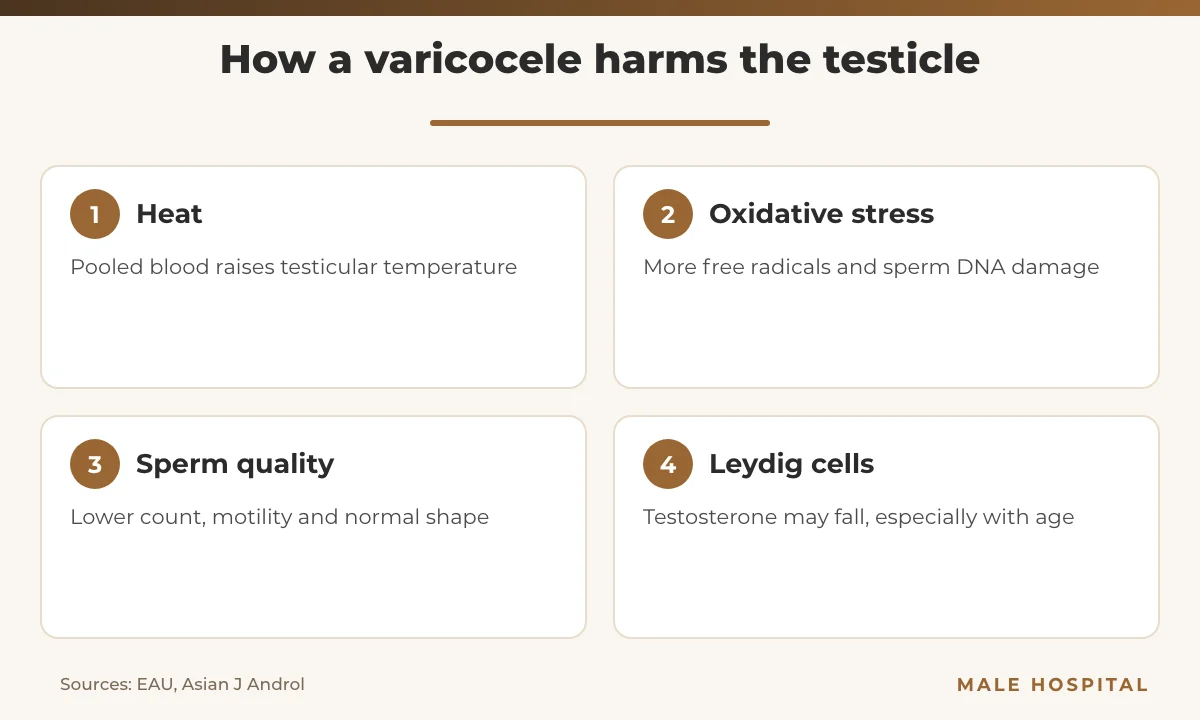
The link with testosterone is real but modest. The testosterone-producing Leydig cells can be damaged, and in a large WHO study affected men over 30 had lower testosterone than affected men under 30, a pattern not seen in men without the condition. In the EAU analysis of seven studies (712 men), mean testosterone rose by 34.3 ng/dL after surgery, and by more in men who were hypogonadal before, but the guideline says these results must be treated with caution. Repair is therefore not a standard treatment for low testosterone on its own; read about the symptoms of low testosterone if this is your main concern.
Sources: Asian Journal of Andrology (PMC) — Pastuszak & Wang 2015 — Varicocele and testicular function; EAU — Sexual and Reproductive Health Guidelines (male infertility chapter, varicocele)
How a varicocele is diagnosed
Diagnosis starts with a physical examination of the scrotum, ideally in a warm room, with the man standing and lying down, with and without the Valsalva maneuver. The swelling often shrinks or disappears when lying down. The doctor also compares the size of both testicles, because a smaller testicle on the affected side is an important finding.
Sources: World Journal of Men’s Health (PMC) — Paick & Choi 2019 — Varicocele and Testicular Pain: A Review; MedlinePlus (NIH) — Varicocele
Scrotal Doppler ultrasound is used when the examination is unclear, and to look for persistent or recurrent veins when semen does not improve after repair. According to the EAU, a maximum vein diameter above 3 mm while standing and during the Valsalva maneuver, together with venous backflow lasting more than two seconds, correlates with a clinically significant varicocele. Testicular volume can also be measured on ultrasound.
Source: EAU — Sexual and Reproductive Health Guidelines (male infertility chapter, varicocele)
For a man trying to conceive, the work-up usually includes a semen analysis and blood tests for FSH and testosterone. MedlinePlus notes that an ultrasound of the kidneys may also be done, which is important when a varicocele is new in an older man or found only on the right (see red flags below).
Sources: Cleveland Clinic — Varicocele: Symptoms & Treatment; MedlinePlus (NIH) — Varicocele
When is varicocele treatment recommended?
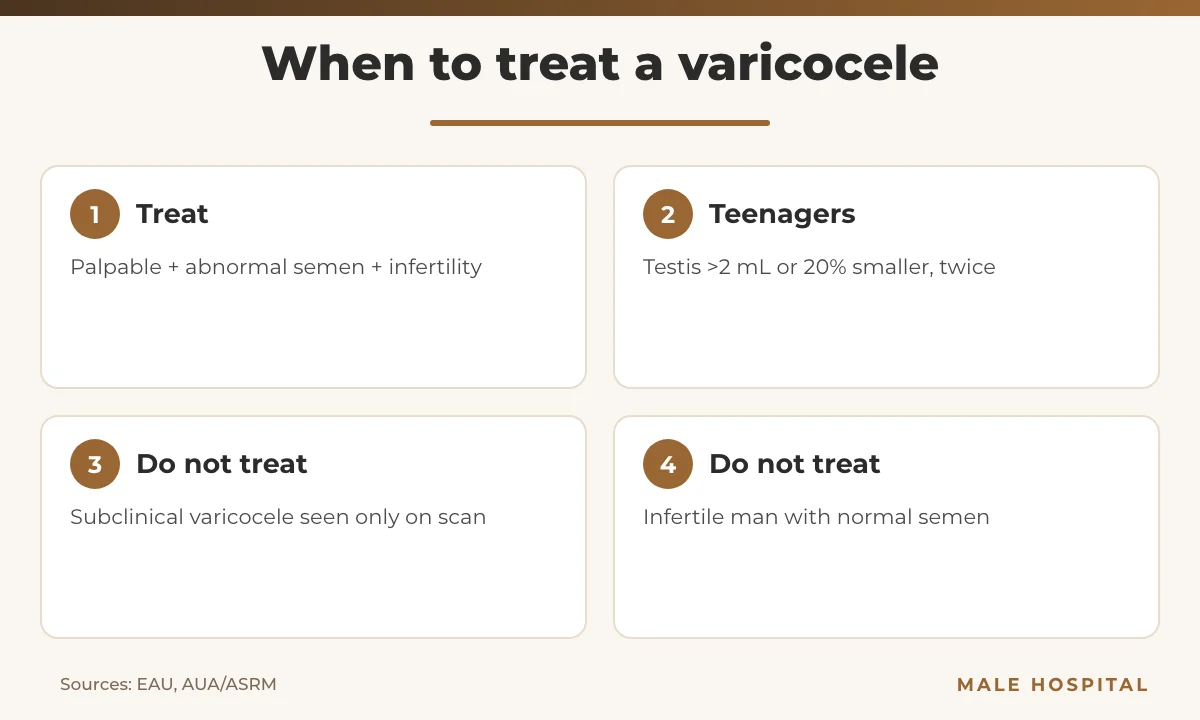
Most men with this finding do not need treatment. Both major urology guidelines limit repair for infertility to clear situations. The EAU strongly recommends treating infertile men who have a clinical varicocele, abnormal semen parameters and otherwise unexplained infertility, when the female partner has good ovarian reserve. It strongly advises against treating men with normal semen or a subclinical varicocele.
Source: EAU — Sexual and Reproductive Health Guidelines (male infertility chapter, varicocele)
The AUA/ASRM guideline is very similar. It states that surgical varicocelectomy should be considered in men attempting to conceive who have palpable varicoceles, infertility and abnormal semen parameters, except for men with no sperm at all (azoospermia), and it strongly recommends against repairing nonpalpable varicoceles seen only on imaging. For men with non-obstructive azoospermia, couples should be told there is no definitive evidence that repair before assisted reproduction helps, although the EAU reports that sperm reappeared in the ejaculate in 43.9% of such men in pooled studies (low-quality evidence).
Sources: AUA/ASRM — Diagnosis and Treatment of Infertility in Men: AUA/ASRM Guideline Part II; EAU — Sexual and Reproductive Health Guidelines (male infertility chapter, varicocele)
In adolescents the goal is to protect future testicular function. The EAU strongly recommends offering surgery to boys whose enlarged veins are associated with a persistently smaller testicle, defined as a size difference of more than 2 mL or 20%, confirmed on two visits six months apart. Most affected adolescents have no problem fathering children later, so watchful follow-up is common. Other reasons to treat include persistent pain that does not settle with simple measures.
Sources: EAU — Sexual and Reproductive Health Guidelines (male infertility chapter, varicocele); Cleveland Clinic — Varicocele: Symptoms & Treatment
Varicocele treatment options compared
All treatments aim to block the faulty veins so blood drains through healthy ones. The main options are surgery (open, microsurgical or laparoscopic) and embolization by an interventional radiologist.
Sources: MedlinePlus (NIH) — Varicocele; Cleveland Clinic — Varicocele: Symptoms & Treatment
Microsurgical subinguinal or inguinal varicocelectomy
The surgeon makes a small incision in the groin and uses an operating microscope to tie off the dilated veins while preserving the testicular artery and the lymph vessels. Sparing the lymphatics is what makes hydrocele (fluid around the testicle) rare after this approach. The EAU states that microsurgical repair results in fewer complications and lower recurrence rates than other techniques, though it requires microsurgical training. The subinguinal approach can often be done under local anesthesia.
Sources: EAU — Sexual and Reproductive Health Guidelines (male infertility chapter, varicocele); Journal of Clinical Medicine (PMC) — Franco et al. 2023 — Varicocele: To Treat or Not to Treat?; World Journal of Men’s Health (PMC) — Paick & Choi 2019 — Varicocele and Testicular Pain: A Review
Laparoscopic varicocelectomy
Keyhole surgery ties the veins higher up, inside the abdomen, under general anesthesia. It can be useful for bilateral varicoceles. The EAU table lists a recurrence rate of 3–6% but a hydrocele rate of 7–43%.
Sources: EAU — Sexual and Reproductive Health Guidelines (male infertility chapter, varicocele); Journal of Clinical Medicine (PMC) — Franco et al. 2023 — Varicocele: To Treat or Not to Treat?
Percutaneous embolization
A radiologist passes a thin catheter through a vein in the groin or neck, guided by X-rays, and blocks the faulty vein with coils or a sclerosing agent. No scrotal or groin incision is needed and recovery is fast. Recurrence after embolization has been reported from 0% to 24%, compared with 0–3% after microsurgery, and right-sided varicoceles are technically harder to embolize. Embolization is a good option for veins that come back after surgery.
Sources: Asian Journal of Andrology (PMC) — Halpern et al. 2016 — Percutaneous embolization of varicocele; MedlinePlus (NIH) — Varicocele
| Treatment | Recurrence / persistence | Hydrocele | Notes |
|---|---|---|---|
| Microsurgical inguinal/subinguinal | 0.4% | 0.44% | Lowest recurrence and complication rates; needs a microscope and training |
| Laparoscopic | 3–6% | 7–43% | Keyhole; general anesthesia; handy for both sides |
| Inguinal (non-microsurgical) | 2.6–13% | 7.3% | Open groin incision without a microscope |
| Open retroperitoneal high ligation | 15–29% | 5–10% | Older approach with higher recurrence |
| Retrograde embolization | 3–11% | 10% | Radiological, no incision; X-ray exposure |
| Retrograde sclerotherapy | 6–9.8% | 3.3% | Radiological, uses a sclerosing agent |
Source: EAU — Sexual and Reproductive Health Guidelines (male infertility chapter, varicocele)
Which technique leads to the most pregnancies? In a meta-analysis cited by the AUA/ASRM guideline, pregnancy rates were 42% after subinguinal microsurgical repair, 35–37% after other surgical approaches and about 17% in untreated men. The guideline cautions that confidence intervals overlap widely and that the data include non-randomized studies, so no single technique is proven superior for pregnancy.
Source: AUA/ASRM — Diagnosis and Treatment of Infertility in Men: AUA/ASRM Guideline Part II
Recovery after varicocele repair
Recovery depends on the method. After surgical ligation most men go home the same day, and Healthdirect notes that full recovery usually takes about a week; Cleveland Clinic says most people recover fully within six weeks. Ice packs during the first 24 hours and a scrotal support help reduce swelling. After embolization, most men return to routine activities within 24–48 hours and are advised to avoid heavy lifting and contact sports for 5–7 days.
Sources: Healthdirect Australia — Varicocele; Cleveland Clinic — Varicocele: Symptoms & Treatment; MedlinePlus (NIH) — Varicocele; Asian Journal of Andrology (PMC) — Halpern et al. 2016 — Percutaneous embolization of varicocele
Possible complications include hydrocele, recurrence, infection, bleeding, injury to nearby vessels and, rarely, testicular shrinkage (atrophy). Embolization carries small risks such as coil migration and inflammation of the testicle and epididymis. The EAU notes hydrocele is more common after surgical ligation, while orchiepididymitis is more common after radiological techniques.
Sources: MedlinePlus (NIH) — Varicocele; EAU — Sexual and Reproductive Health Guidelines (male infertility chapter, varicocele); Asian Journal of Andrology (PMC) — Halpern et al. 2016 — Percutaneous embolization of varicocele
Sperm improvements are not immediate. The AUA/ASRM guideline points out that choosing varicocele repair delays assisted reproduction such as IVF by at least six months, which matters when the female partner is older. Semen analysis is repeated after surgery to check the effect, and a Doppler ultrasound is done if results stay poor.
Sources: AUA/ASRM — Diagnosis and Treatment of Infertility in Men: AUA/ASRM Guideline Part II; EAU — Sexual and Reproductive Health Guidelines (male infertility chapter, varicocele)
When to see a doctor
See a doctor if you notice a new lump or swelling in the scrotum, a dull ache that does not go away, a change in the size or shape of a testicle, or if you and your partner have not conceived after a year of trying. Teenage boys with enlarged scrotal veins should be followed to check that both testicles grow normally.
Sources: Healthdirect Australia — Varicocele; Cleveland Clinic — Varicocele: Symptoms & Treatment; EAU — Sexual and Reproductive Health Guidelines (male infertility chapter, varicocele)
Some situations are red flags and need prompt assessment:
- A varicocele that appears suddenly in an older man. MedlinePlus warns it may be caused by a kidney tumor blocking blood flow from the vein.
- A varicocele only on the right side. This is rare and should prompt imaging, because it can be linked to retroperitoneal tumors or abnormal anatomy.
- Any new lump, change in testicle shape or ache that will not go away, which should be examined rather than assumed to be a varicocele.
Sources: MedlinePlus (NIH) — Varicocele; Asian Journal of Andrology (PMC) — Alsaikhan et al. 2016 — Epidemiology of varicocele; Healthdirect Australia — Varicocele
If you would like a confidential assessment, our urologist-andrologist Assoc. Prof. Dr. Zülfü Sertkaya, who has a special interest in male infertility, can review your examination, ultrasound and semen results and explain whether repair would help. You can reach us for a free first consultation on WhatsApp.
FAQs about varicocele
Can a varicocele go away on its own?
It does not usually disappear by itself, because the damaged vein valves do not heal. It may become less noticeable when lying down, and many stay small and harmless for life. Most affected men never need treatment; repair is considered only if it causes infertility with abnormal semen, persistent pain or, in teenagers, a testicle that stops growing.
Sources: MedlinePlus (NIH) — Varicocele; EAU — Sexual and Reproductive Health Guidelines (male infertility chapter, varicocele)
Is a varicocele dangerous?
In most men it is harmless and causes no symptoms. Its main risks are reduced sperm quality, a smaller testicle and, in some men, lower testosterone. One that appears suddenly in an older man or only on the right side is different: it needs prompt imaging because, rarely, it can be caused by a kidney or abdominal tumor.
Sources: MedlinePlus (NIH) — Varicocele; Cleveland Clinic — Varicocele: Symptoms & Treatment; Asian Journal of Andrology (PMC) — Alsaikhan et al. 2016 — Epidemiology of varicocele
Can I get my partner pregnant with a varicocele?
Yes, very often. About 80% of affected men show no evidence of infertility. If a couple has not conceived after a year, the man should have a semen analysis. Repair is advised only when the varicocele can be felt on examination, semen results are abnormal and no other cause explains the infertility.
Sources: Asian Journal of Andrology (PMC) — Pastuszak & Wang 2015 — Varicocele and testicular function; AUA/ASRM — Diagnosis and Treatment of Infertility in Men: AUA/ASRM Guideline Part II
Does varicocele surgery increase testosterone?
It can, modestly. In the EAU guideline analysis of seven studies with 712 men, mean testosterone rose by 34.3 ng/dL after varicocelectomy, with larger gains in men who were hypogonadal before surgery. The guideline says these results must be treated with caution, so surgery is not a routine treatment for low testosterone alone.
Source: EAU — Sexual and Reproductive Health Guidelines (male infertility chapter, varicocele)
Which is better, varicocele surgery or embolization?
Both block the faulty veins. Microsurgical subinguinal or inguinal repair has the lowest reported recurrence and hydrocele rates in the EAU table. Embolization avoids an incision and allows a very quick return to normal activity, but recurrence ranges more widely and right-sided cases are harder. It is especially useful for a recurrence after surgery.
Sources: EAU — Sexual and Reproductive Health Guidelines (male infertility chapter, varicocele); Asian Journal of Andrology (PMC) — Halpern et al. 2016 — Percutaneous embolization of varicocele
How long after varicocele surgery will sperm improve?
Improvement is gradual rather than immediate. The AUA/ASRM guideline notes that choosing repair delays assisted reproduction by at least six months, so couples with an older female partner may prefer to discuss IVF or ICSI first. A repeat semen analysis after surgery shows whether count, motility and DNA quality have improved.
Source: AUA/ASRM — Diagnosis and Treatment of Infertility in Men: AUA/ASRM Guideline Part II
Should a subclinical varicocele be treated?
No, not for infertility. A subclinical varicocele is seen only on ultrasound and cannot be felt. Both the EAU and the AUA/ASRM guidelines give a strong recommendation against repairing it, because randomized trials showed no improvement in the chance of spontaneous pregnancy. Treatment decisions are based on examination findings plus semen results.
Sources: EAU — Sexual and Reproductive Health Guidelines (male infertility chapter, varicocele); AUA/ASRM — Diagnosis and Treatment of Infertility in Men: AUA/ASRM Guideline Part II
Medically reviewed by Assoc. Prof. Dr. Zülfü Sertkaya, urologist and andrologist (FEBU), Istanbul. Last reviewed: October 2026.
This article is for general information and does not replace an individual consultation with a qualified doctor.
- EAU — Sexual and Reproductive Health Guidelines (male infertility chapter, varicocele)
- AUA/ASRM — Diagnosis and Treatment of Infertility in Men: AUA/ASRM Guideline Part II
- Cleveland Clinic — Varicocele: Symptoms & Treatment
- MedlinePlus (NIH) — Varicocele
- Healthdirect Australia — Varicocele
- Asian Journal of Andrology (PMC) — Alsaikhan et al. 2016 — Epidemiology of varicocele
- Asian Journal of Andrology (PMC) — Pastuszak & Wang 2015 — Varicocele and testicular function
- Journal of Clinical Medicine (PMC) — Franco et al. 2023 — Varicocele: To Treat or Not to Treat?
- World Journal of Men's Health (PMC) — Paick & Choi 2019 — Varicocele and Testicular Pain: A Review
- Asian Journal of Andrology (PMC) — Halpern et al. 2016 — Percutaneous embolization of varicocele