DNA fragmentation sperm testing measures how many sperm in a semen sample carry broken or damaged DNA strands, reported as a DNA fragmentation index (DFI). High fragmentation can lower the chance of natural pregnancy and IUI success, and it has been linked to miscarriage, even when a standard semen analysis looks normal. It is not a routine test: the European Association of Urology (EAU) recommends it for couples with recurrent pregnancy loss, failed IVF or ICSI, or unexplained infertility, and many causes, such as varicocele, infection, smoking and long abstinence, can be corrected.
Sources: EAU — Sexual and Reproductive Health Guidelines (male infertility chapter); HFEA — Sperm DNA fragmentation
- Sperm DNA damage comes from faulty chromatin packaging or abortive apoptosis in the testis, and from oxidative stress during transit through the epididymis.
- Four laboratory tests are in use: SCSA, TUNEL, SCD and the Comet assay. A result around 20% to 30% is the usual dividing line between fertile and infertile ranges, but there is no single agreed cut-off.
- The EAU recommends testing for recurrent pregnancy loss, failed assisted reproduction and unexplained infertility; the UK regulator HFEA rates it “grey” because high-quality evidence that testing changes outcomes is still missing.
- Varicocele repair, treating genital infection, stopping smoking, losing excess weight and ejaculating more often can all lower fragmentation; antioxidants have weak, low-certainty evidence.
- When fragmentation stays high, ICSI with sperm selection or with testicular sperm may help, but these are experimental options that need careful counseling.
- What is DNA fragmentation in sperm?
- Why sperm DNA damage matters for pregnancy
- Causes of DNA fragmentation in sperm
- DNA fragmentation sperm test: SCSA, TUNEL, SCD and Comet
- Understanding your DNA fragmentation sperm results
- Who should have a DNA fragmentation sperm test?
- How to reduce DNA fragmentation in sperm
- Options when fragmentation stays high
- When to see a doctor
- FAQs about DNA fragmentation sperm testing
What is DNA fragmentation in sperm?
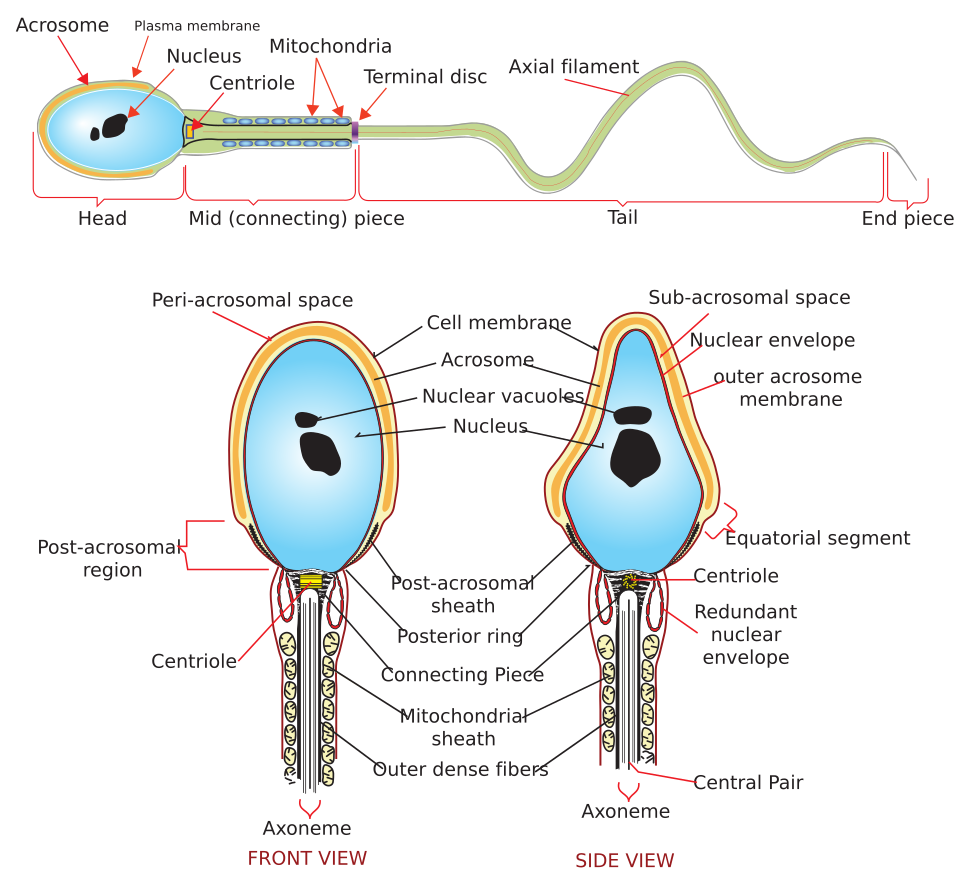
Every sperm carries half of the genetic code for a future child, packed tightly inside its head. During the final stages of sperm production, the DNA is wound around small proteins called protamines so it fits into a space far smaller than the nucleus of any other cell. This compaction protects the DNA. When the packaging is incomplete, or when the sperm is attacked by reactive oxygen molecules on its way through the epididymis, the DNA strands develop breaks. The share of sperm with such breaks is what a DNA fragmentation sperm test measures.
Researchers describe two origins of the damage. Testicular causes include defective chromatin maturation and “abortive apoptosis”, in which sperm marked for programmed cell death escape and are released anyway. Post-testicular causes are dominated by oxidative stress, where unstable oxygen molecules outnumber the antioxidant defenses in semen and oxidize DNA bases or cut the strands. Both single-strand and double-strand breaks occur, and double-strand breaks are harder for the egg to repair after fertilization.
A standard semen analysis counts sperm and checks how they move and look, but says nothing about the integrity of their DNA. That is why a man can have a normal semen report and a high fragmentation index, and why the test is usually a second step in a male infertility work-up.
Sources: World Journal of Men’s Health (PMC) — Agarwal et al. 2020, Sperm DNA Fragmentation: A New Guideline for Clinicians; MedlinePlus — Semen Analysis
Why sperm DNA damage matters for pregnancy
Sperm with damaged DNA can still swim, bind to an egg and fertilize it. The problem shows up later. The egg has some capacity to repair paternal DNA, but when the damage is extensive the embryo may stop developing, fail to implant, or be lost as an early miscarriage. The EAU guideline notes that a DFI of 25% or more is associated with lower pregnancy rates with natural conception and intrauterine insemination (IUI), and that a DFI above 50% is associated with poorer IVF outcomes.
The link with pregnancy loss is one of the strongest reasons the test exists. A meta-analysis cited by the EAU associated higher fragmentation with recurrent pregnancy loss, and the guideline describes fragmentation as a possibly correctable marker of the father’s contribution to miscarriage. The evidence is limited by small studies and differing definitions, so a high result should be read as a risk factor, not a verdict.
ICSI, where a single sperm is injected directly into the egg, bypasses the need to swim and penetrate, so fertilization rates are usually unaffected. Even so, the EAU notes that current assays still do not reliably predict assisted reproduction outcomes, which is why professional bodies hesitate to order the test for everyone.
Source: EAU — Sexual and Reproductive Health Guidelines (male infertility chapter)
Causes of DNA fragmentation in sperm
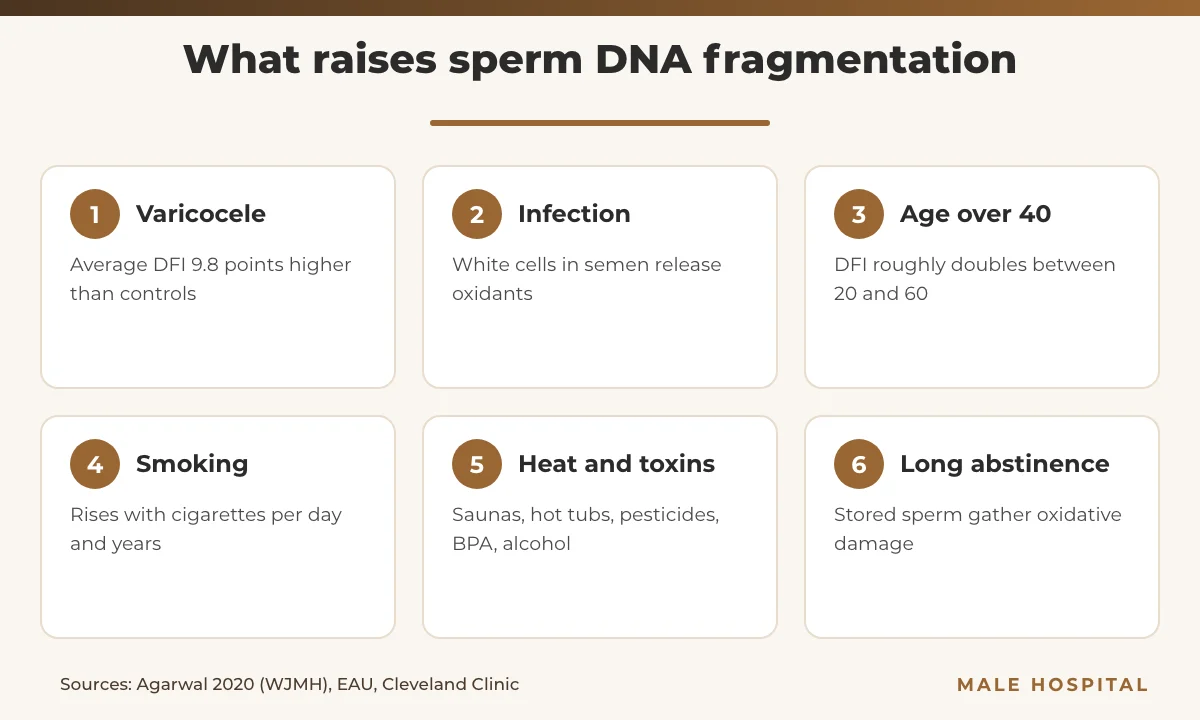
Most men with high fragmentation have at least one identifiable risk factor, and several of them can be treated. The 2020 clinical guideline by Agarwal and colleagues groups the causes into intrinsic (within the testis), clinical and environmental categories.
Medical causes
- Varicocele. Enlarged veins around the testicle raise scrotal temperature and oxidative stress. A meta-analysis of 12 studies found fragmentation on average 9.84 percentage points higher in men with varicocele than in controls.
- Genital tract infection and inflammation. White blood cells in semen (leukocytospermia) release reactive oxygen species that damage sperm DNA. Prostatitis and epididymitis are typical sources.
- Older age. Fragmentation increases steadily with age, roughly doubling between the ages of 20 and 60, and men over 40 have measurably higher levels than younger men.
- Obesity and diabetes. Men with a BMI of 30 or above show higher oxidative stress and fragmentation in several studies, although not all studies agree.
- Cancer and its treatment. Cancer itself, chemotherapy and radiation are all associated with higher fragmentation.
Lifestyle and environmental causes
- Smoking. Cigarette smoke delivers oxidants and heavy metals directly into semen; several studies found fragmentation rising with the number of cigarettes per day and years of smoking.
- Heat. Saunas, hot tubs and other prolonged heat around the testicles raise scrotal temperature.
- Alcohol, pesticides, heavy metals, bisphenol A and other pollutants are all associated with higher fragmentation in the published literature.
- Long abstinence. Sperm stored for days in the epididymis accumulate oxidative damage, so a long gap before a sample or before intercourse raises the DFI (see treatment below).
Sources: World Journal of Men’s Health (PMC) — Agarwal et al. 2020, Sperm DNA Fragmentation: A New Guideline for Clinicians; Cleveland Clinic — Male Infertility
DNA fragmentation sperm test: SCSA, TUNEL, SCD and Comet
A DNA fragmentation sperm test is done on an ordinary semen sample, usually produced after two to five days of abstinence and processed within 30 to 60 minutes of liquefaction, or immediately after thawing if the sample was frozen. The test adds no risk compared with a routine semen analysis. Four assays are accepted as valid, and each measures the damage in a slightly different way, so results from different laboratories are not interchangeable.
| Test | How it works | Direct or indirect | Usual abnormal threshold |
|---|---|---|---|
| SCSA (sperm chromatin structure assay) | Acid exposure then a fluorescent dye; flow cytometry counts sperm whose DNA unwinds (the DFI) | Indirect | About 20–30% DFI; EAU cites 25% for natural conception and IUI |
| TUNEL | An enzyme labels the free ends of broken DNA strands, which are then counted under a microscope or by flow cytometry | Direct | About 20%, varies by laboratory |
| SCD (sperm chromatin dispersion, “Halo” test) | Intact DNA forms a halo around the sperm head after acid treatment; fragmented DNA does not | Indirect | About 20%; 30% has been used for unexplained infertility |
| Comet assay | Single sperm run through a gel; broken DNA migrates to form a “comet tail” | Direct | About 26%; the alkaline version can predict IVF and ICSI live birth |
SCSA and SCD are indirect because they measure how easily the chromatin unwinds rather than counting breaks; TUNEL and Comet count the breaks directly, and only the two-tailed Comet assay separates single-strand from double-strand breaks. The sixth edition of the WHO laboratory manual (2021) lists these among optional and research examinations rather than the basic semen analysis.
Sources: World Journal of Men’s Health (PMC) — Farkouh et al. 2021, Sperm DNA Fragmentation: A Critical Assessment of Clinical Practice Guidelines; WHO — Laboratory manual for the examination and processing of human semen, 6th edition; World Journal of Men’s Health (PMC) — Agarwal et al. 2020, Sperm DNA Fragmentation: A New Guideline for Clinicians; EAU — Sexual and Reproductive Health Guidelines (male infertility chapter)
Understanding your DNA fragmentation sperm results
Your report will show a percentage: the proportion of sperm with fragmented DNA. Laboratories label it DFI, SDF or “% fragmentation”. Because the assays differ, always read the result against the reference range printed by the laboratory that ran it, and repeat the test in the same laboratory if you want to track change over time.
| DFI range | What it generally means | Typical next step |
|---|---|---|
| Below 20% | Within the range seen in fertile men; a 20% threshold separates fertile from infertile men with about 79% sensitivity and 86% specificity | No action for fragmentation; look elsewhere if infertility persists |
| 20–30% | Borderline to raised; higher likelihood of adverse reproductive outcomes begins in this band | Correct risk factors, shorten abstinence, repeat in 3 months |
| Above 25–30% | High; lower natural and IUI pregnancy rates; associated with miscarriage | Urologist-andrologist review for varicocele, infection, lifestyle; consider ICSI |
| Above 50% | Very high; associated with poorer IVF outcomes | ICSI with sperm selection; testicular sperm discussed if other causes excluded |
Two cautions apply. The HFEA, which regulates UK fertility clinics, states that there is no standardization of sperm DNA fragmentation testing, so the same man can get different numbers from different laboratories. And a single high reading after illness or a long abstinence may not reflect your baseline; a repeat test after about three months, one sperm production cycle, gives a clearer picture.
Sources: World Journal of Men’s Health (PMC) — Agarwal et al. 2020, Sperm DNA Fragmentation: A New Guideline for Clinicians; HFEA — Sperm DNA fragmentation
Who should have a DNA fragmentation sperm test?
Professional bodies agree that the test is not for every man with a fertility concern. The EAU gives a strong recommendation to perform sperm DNA fragmentation testing in three situations: couples with recurrent pregnancy loss after natural conception, couples whose assisted reproduction cycles have failed, and men with unexplained infertility. The clinician-led guideline by Agarwal and colleagues extends the list to men with a clinical varicocele, men with modifiable lifestyle risk factors, and couples planning IUI or IVF.
The counter-argument is important and honest. The HFEA rates sperm DNA fragmentation testing “grey”, meaning there is not enough moderate or high quality evidence to rate its effectiveness, and states that the result is unlikely to change the management of fertility treatment. In practice the test is most useful when a high result would trigger a specific action: repairing a varicocele, treating an infection, changing lifestyle, or choosing a different sperm source for ICSI.
Testing for a subclinical varicocele (one found only on ultrasound) is not recommended, and routine testing of reactive oxygen species in semen is also not recommended by the EAU because standardized methods are not yet available.
Sources: EAU — Sexual and Reproductive Health Guidelines (male infertility chapter); HFEA — Sperm DNA fragmentation; World Journal of Men’s Health (PMC) — Farkouh et al. 2021, Sperm DNA Fragmentation: A Critical Assessment of Clinical Practice Guidelines
How to reduce DNA fragmentation in sperm
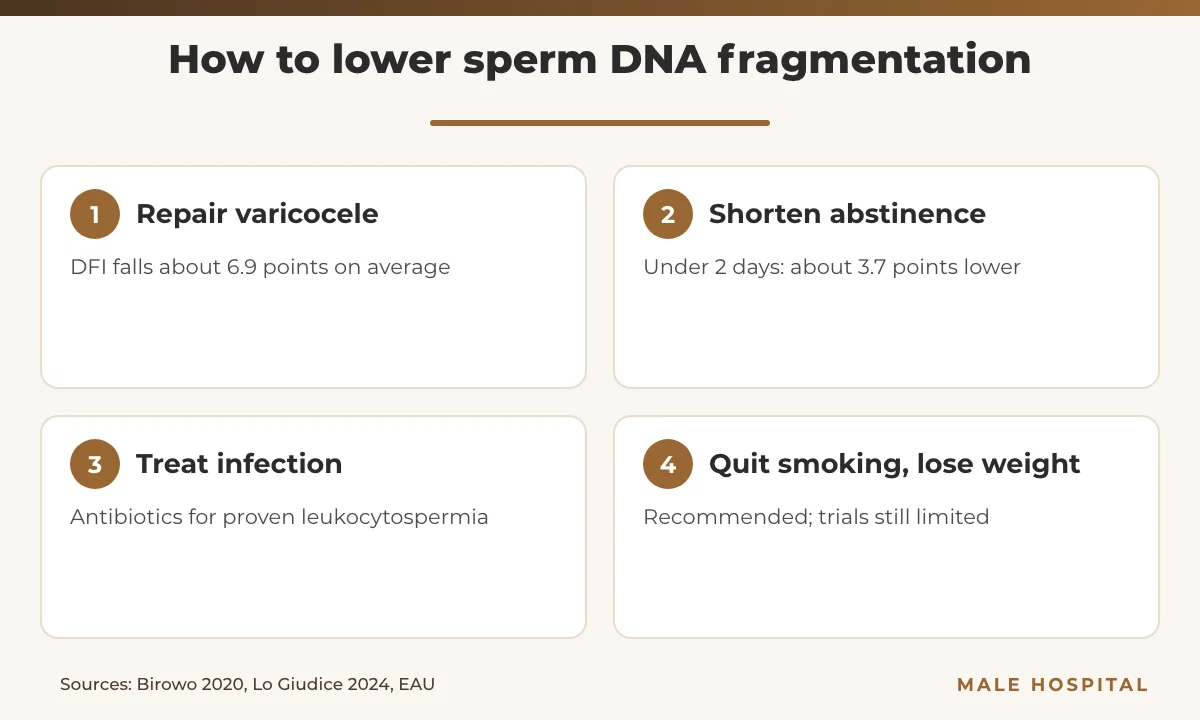
Sperm take about three months to form and mature, so any change needs that long to show in a repeat test. The measures below run from the best supported to the least.
1. Repair a clinical varicocele
Varicocele is the most common correctable cause. A meta-analysis of seven prospective studies (289 men) found that varicocelectomy lowered the DFI by an average of 6.86 percentage points and also raised sperm concentration and progressive motility. The EAU says varicocelectomy may be considered in men with raised fragmentation and otherwise unexplained infertility or failed assisted reproduction, after a discussion that includes the partner’s ovarian reserve. Our guide to microsurgical varicocele surgery explains what the operation involves.
Sources: Basic and Clinical Andrology (PMC) — Birowo et al. 2020, The effects of varicocelectomy on the DNA fragmentation index: a meta-analysis; EAU — Sexual and Reproductive Health Guidelines (male infertility chapter)
2. Shorten abstinence and ejaculate more often
This is the simplest change and one of the most consistent. A 2024 meta-analysis of 13 randomized trials (2,315 men) found fragmentation about 3.7 percentage points higher after three or more days of abstinence than after less than two days, although volume and concentration were higher with the longer gap. The EAU also notes that repeated ejaculation separated by a three-hour interval has been reported to significantly reduce fragmentation. For an IVF cycle, ask the laboratory whether a short-abstinence sample is appropriate.
Sources: Frontiers in Endocrinology (PMC) — Lo Giudice et al. 2024, Effects of long and short ejaculatory abstinence on sperm parameters: a meta-analysis of RCTs; EAU — Sexual and Reproductive Health Guidelines (male infertility chapter)
3. Treat infection and inflammation
When semen contains white blood cells or a culture grows bacteria, antibiotic treatment of the underlying prostatitis or epididymitis may reduce infection-related fragmentation. Chronic genital infection is one of the “common associations” that the EAU asks doctors to exclude before moving on to more invasive options.
4. Stop smoking, lose excess weight, avoid heat
Smoking cessation, weight loss and dietary change are recommended in the Agarwal guideline, with the honest caveat that the evidence is limited; the EAU says lifestyle interventions may reduce fragmentation but randomized trials have not yet proved it. They cost nothing and are a sensible first step for every man with a high result. Practical advice is in our guide on how to increase sperm count.
5. Antioxidant supplements: modest, uncertain evidence
Oxidative stress is the main post-testicular cause of fragmentation, so antioxidants such as vitamins C and E, coenzyme Q10, L-carnitine and zinc are widely sold for it. The 2022 Cochrane review of 67 randomized trials found that antioxidants may increase live birth (odds ratio 1.43) but graded the evidence very low certainty, and the benefit disappeared when high-risk-of-bias studies were removed; mild stomach upset was more common. The Agarwal guideline says antioxidants “may be considered” (grade C) but warns against taking them without evidence of oxidative stress, because excess antioxidants can cause reductive stress. The HFEA rates them “grey”.
Sources: Cochrane Database of Systematic Reviews (PubMed) — de Ligny et al. 2022, Antioxidants for male subfertility; World Journal of Men’s Health (PMC) — Agarwal et al. 2020, Sperm DNA Fragmentation: A New Guideline for Clinicians; HFEA — Sperm DNA fragmentation
Options when fragmentation stays high
If the DFI remains high after three to six months of correcting what can be corrected, the conversation shifts to achieving a pregnancy despite it. None of the options below is a guideline-endorsed standard, so your fertility specialist should explain the evidence before you pay for them.
ICSI with sperm selection
Both major clinical guidelines suggest ICSI for persistently high fragmentation. Laboratories can add selection steps that favor sperm with intact DNA: density-gradient centrifugation and swim-up, magnetic-activated cell sorting (MACS), high-magnification selection (IMSI) and hyaluronan binding (PICSI). The Agarwal guideline recommends these as a less invasive option before testicular sperm. The HFEA is more cautious: the three moderate or high quality studies of sperm sorting showed no significant effect on the chance of a baby, so it is rated “grey”.
Testicular sperm for ICSI (Testi-ICSI)
Because most oxidative damage happens after sperm leave the testis, sperm retrieved directly from testicular tissue carry less fragmentation. A 2017 meta-analysis of five studies (143 men) found fragmentation 24.6 percentage points lower in testicular than in ejaculated sperm from the same men. A 2025 meta-analysis of 13 studies reported mean fragmentation of 14.9% in testicular versus 39.6% in ejaculated sperm, with live birth of 45.2% versus 25.2% and miscarriage of 9.0% versus 25.9% in the cycles studied, but the authors caution that the studies were small and at moderate to serious risk of bias.
The EAU therefore gives only a weak recommendation to consider testicular sperm for ICSI, calls it experimental, and states that it should be used only after varicocele, infection, lifestyle factors and abstinence time have been addressed. The retrieval itself is a minor sperm retrieval surgery with small risks of bleeding, infection and testicular injury, and there is an unresolved question about chromosomal abnormalities in testicular sperm. The HFEA rates TESE or TESA with ICSI for male factor infertility “red”: evidence of benefit is insufficient and the procedure carries risk.
Sources: Fertility and Sterility (PubMed) — Esteves et al. 2017, Reproductive outcomes of testicular versus ejaculated sperm for ICSI among men with high DNA fragmentation; Biology (PMC) — Cano-Extremera et al. 2025, Testicular versus ejaculated sperm in ICSI cycles from couples with high SDF: systematic review and meta-analysis; EAU — Sexual and Reproductive Health Guidelines (male infertility chapter); HFEA — Sperm DNA fragmentation
When to see a doctor
See a urologist-andrologist, together with your partner’s fertility specialist, if any of the following applies:
- You have been trying to conceive for 12 months without success.
- Your partner has had two or more miscarriages, especially if her own tests are normal.
- One or more IVF or ICSI cycles have failed with good-quality eggs and a normal uterus.
- You have a palpable varicocele, a history of chemotherapy or radiation, or a chronic genital infection.
- You are over 40, smoke, or have a BMI above 30 and want to optimize fertility before treatment.
Red flags that need prompt review regardless of fertility plans are a new testicular lump, sudden testicular pain or swelling, blood in the semen, or painful ejaculation.
At Male Hospital, Assoc. Prof. Dr. Zülfü Sertkaya, a urologist-andrologist whose research includes male infertility, micro-TESE and semen parameters, can review your semen and fragmentation results, examine you for varicocele and plan the next step; you can arrange a confidential consultation on WhatsApp or read more about our male infertility treatment options.
Sources: Cleveland Clinic — Male Infertility; EAU — Sexual and Reproductive Health Guidelines (male infertility chapter)
FAQs about DNA fragmentation sperm testing
What is a normal DNA fragmentation sperm result?
Most laboratories consider a DFI below about 20% normal and above 25% to 30% high, with the band between borderline. A pooled analysis across the four main assays found that a 20% threshold separates fertile from infertile men with about 79% sensitivity and 86% specificity. Always use the reference range of the laboratory that ran your test.
Can I have a normal semen analysis and high DNA fragmentation?
Yes. Count, motility and morphology describe how many sperm there are and how they move and look, not whether their DNA is intact. A man with normal numbers can still have a high fragmentation index, which is why the test is suggested for unexplained infertility and recurrent miscarriage when the routine report looks fine.
Source: EAU — Sexual and Reproductive Health Guidelines (male infertility chapter); MedlinePlus — Semen Analysis
Does high sperm DNA fragmentation cause miscarriage?
It is associated with a higher risk. A meta-analysis cited by the EAU linked raised fragmentation with recurrent pregnancy loss, and the 2025 meta-analysis of ICSI cycles found miscarriage in 25.9% with ejaculated sperm versus 9.0% with testicular sperm in couples with high fragmentation. The studies are small, so fragmentation is treated as a contributing factor rather than the sole cause.
Does varicocele surgery fix DNA fragmentation?
It lowers it in most studies. Pooled data from seven prospective studies showed an average fall in DFI of about 6.9 percentage points after varicocelectomy, with better concentration and motility. It does not bring every man into the normal range, and the EAU grades the recommendation as weak, so the decision is made case by case.
Do antioxidants reduce DNA fragmentation in sperm?
Possibly, but the evidence is weak. The Cochrane review found low- to very-low-certainty evidence that antioxidants may improve pregnancy and live birth rates, with more mild stomach upset, and the HFEA rates them “grey” for high fragmentation. They are reasonable for a man with proven oxidative stress, but not a substitute for treating a varicocele or infection.
Source: Cochrane Database of Systematic Reviews (PubMed) — de Ligny et al. 2022, Antioxidants for male subfertility; HFEA — Sperm DNA fragmentation
Is a DNA fragmentation sperm test worth it before IVF?
It depends on what you would do with the result. The EAU recommends it after failed cycles, for recurrent pregnancy loss and for unexplained infertility, while the HFEA notes that the result rarely changes treatment. It is most worthwhile when a high result would prompt a concrete step such as varicocele repair or a different sperm source for ICSI.
Source: HFEA — Sperm DNA fragmentation; EAU — Sexual and Reproductive Health Guidelines (male infertility chapter)
How much does a DNA fragmentation sperm test cost?
Prices vary widely between countries and laboratories, and the guidelines and regulator pages cited here list no figure. The cost of testing and of any treatment that follows depends on your assessment, so the practical route is a free consultation to decide whether the test would change your plan before paying for it.
Source: HFEA — Sperm DNA fragmentation
Medically reviewed by Assoc. Prof. Dr. Zülfü Sertkaya, urologist and andrologist (FEBU), Istanbul. Last reviewed: November 2026.
This article is for general information and does not replace an individual consultation with a qualified doctor.
- EAU — Sexual and Reproductive Health Guidelines (male infertility chapter)
- HFEA — Sperm DNA fragmentation (treatment add-ons)
- World Journal of Men's Health (PMC) — Agarwal et al. 2020, Sperm DNA Fragmentation: A New Guideline for Clinicians
- World Journal of Men's Health (PMC) — Farkouh et al. 2021, Sperm DNA Fragmentation: A Critical Assessment of Clinical Practice Guidelines
- Basic and Clinical Andrology (PMC) — Birowo et al. 2020, The effects of varicocelectomy on the DNA fragmentation index and other sperm parameters: a meta-analysis
- Frontiers in Endocrinology (PMC) — Lo Giudice et al. 2024, Effects of long and short ejaculatory abstinence on sperm parameters: a meta-analysis of randomized-controlled trials
- Biology (PMC) — Cano-Extremera et al. 2025, Testicular versus ejaculated sperm in ICSI cycles from couples with high SDF: a systematic review and meta-analysis
- Fertility and Sterility (PubMed) — Esteves et al. 2017, Reproductive outcomes of testicular versus ejaculated sperm for ICSI among men with high levels of DNA fragmentation in semen
- Cochrane Database of Systematic Reviews (PubMed) — de Ligny et al. 2022, Antioxidants for male subfertility
- Cleveland Clinic — Male Infertility
- MedlinePlus — Semen Analysis
- WHO — Laboratory manual for the examination and processing of human semen, 6th edition (2021)