
Selective Dorsal Neurectomy: 7 Honest Facts and Best Options
Selective dorsal neurectomy is an operation that cuts some branches of the dorsal nerve of the penis to reduce glans sensitivity in men with lifelong premature ejaculation (PE). It is not a standard treatment: the European Association of Urology (EAU) advises against dorsal neurectomy, the American Urological Association (AUA) calls surgery for PE experimental, and the International Society for Sexual Medicine (ISSM) warns it may cause permanent loss of sexual function. A newer, non-cutting alternative, selective dorsal cryoneurolysis, is still investigational. For almost every man, the right first step is behavioral techniques plus medication.
Sources: EAU — Sexual and Reproductive Health Guidelines: Disorders of Ejaculation; AUA/SMSNA — Disorders of Ejaculation Guideline
- The EAU gives a clear recommendation: do not perform dorsal neurectomy, because it is irreversible and more safety data are needed.
- The AUA/SMSNA guideline says surgical management of PE should be considered experimental and used only within an ethics-approved clinical trial.
- Reported risks include numbness or altered glans sensation, pain, wound problems, recurrence and, rarely, erectile dysfunction; nerve cutting in selective dorsal neurectomy cannot be undone.
- Selective dorsal cryoneurolysis freezes rather than cuts the nerve; a 2026 cohort of 108 men co-authored by Dr. Zülfü Sertkaya reported encouraging results, but the authors call it investigational.
- First-line treatment is dapoxetine or a lidocaine-prilocaine spray, with behavioral techniques and therapy alongside.
Not sure whether your premature ejaculation needs more than medication? Ask our urologist-andrologist in confidence.
- What is selective dorsal neurectomy?
- What EAU, AUA and ISSM guidelines say
- Who might consider a procedure
- Treatment options compared
- Evaluation before any procedure
- The procedure step by step
- Recovery and follow-up
- Risks of selective dorsal neurectomy
- Results and the evidence table
- Treatment with Dr. Zülfü Sertkaya in Istanbul
- How to start
- When to see a doctor
- FAQs about dorsal nerve procedures
What is selective dorsal neurectomy?
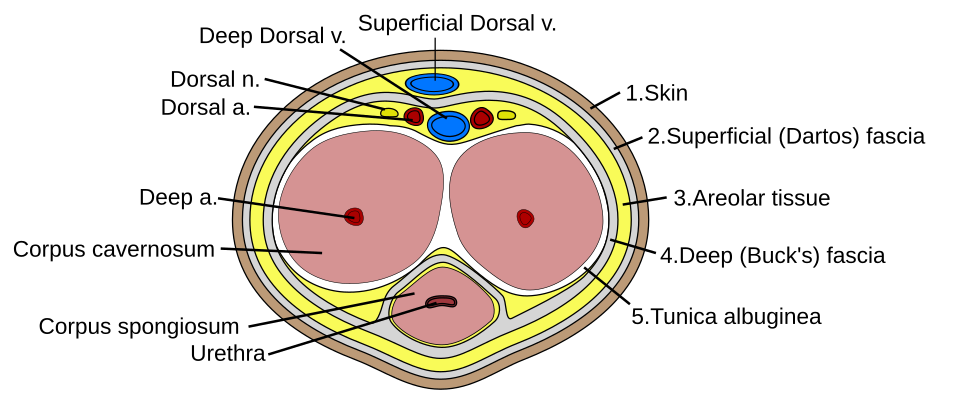
The dorsal nerve of the penis carries touch and pleasure signals from the glans (the head of the penis) to the spinal cord. The idea behind selective dorsal neurectomy is simple: if some of these sensory branches are cut, fewer signals reach the ejaculation reflex, and a man may last longer. The word “selective” in selective dorsal neurectomy means the surgeon cuts only some branches and preserves the main trunks.
The EAU notes that dorsal neurectomy, including selective dorsal neurectomy, has been suggested for PE mainly by Asian researchers. A 2016 review in Translational Andrology and Urology explains that Korean surgeons usually cut lateral branches, while Chinese surgeons often resect more branches near the coronal sulcus (the groove behind the glans). The review stresses that there is no standard technique, so the number of branches cut varies widely between surgeons.
Sources: EAU — Sexual and Reproductive Health Guidelines: Disorders of Ejaculation; Transl Androl Urol (PMC) — Is there a place for surgical treatment of premature ejaculation? (2016)
Selective dorsal cryoneurolysis: freezing instead of cutting
Cryoneurolysis applies targeted cold to the dorsal nerve branches to interrupt nerve conduction for a period, rather than dividing the nerve. Its authors describe it as potentially reversible and place it between medication and permanent nerve surgery such as selective dorsal neurectomy. Related techniques such as CT-guided cryoablation have only small, non-randomized studies.
Sources: J Sex Med (PubMed) — Selective dorsal cryoneurolysis in lifelong premature ejaculation: a cohort of 108 men (2026); Transl Androl Urol — The role of surgical therapy in the management of premature ejaculation (2023)
Selective dorsal neurectomy: what EAU, AUA and ISSM guidelines say
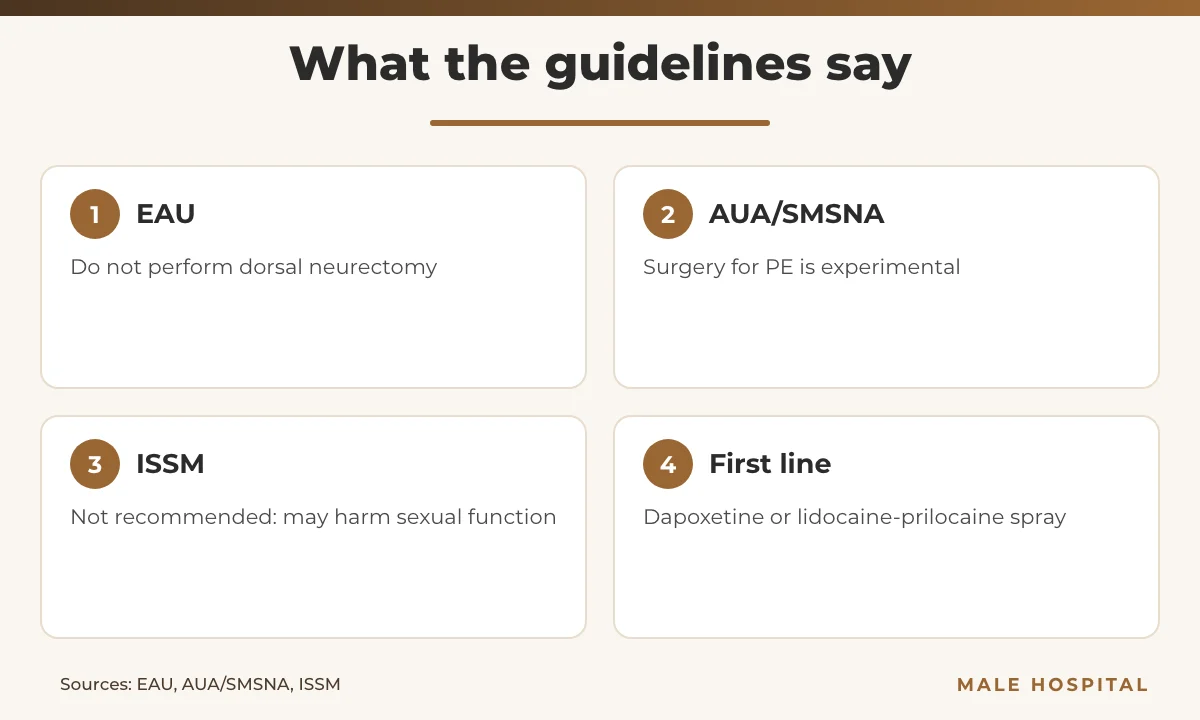
All three major guideline bodies are cautious, and none recommends selective dorsal neurectomy or other nerve surgery as a standard treatment:
- EAU: “Do not perform dorsal neurectomy as more safety data are warranted” (weak recommendation), citing the irreversible nature of the procedure. Cryoneurolysis is not addressed in the current guideline.
- AUA/SMSNA: surgical management of PE, including bulking-agent injections, should be considered experimental and used only in an ethics-board-approved clinical trial (expert opinion).
- ISSM: selective dorsal nerve neurotomy or glans augmentation with hyaluronic acid may be associated with permanent loss of sexual function and is not recommended. The ISSM adds that ablation or modulation of the dorsal nerve needs larger trials before it can be recommended.
In practice, this means selective dorsal neurectomy is never a shortcut. It is, at most, an option discussed with men whose lifelong PE has not responded to properly tried first-line care, with full disclosure that guidelines do not support it.
Sources: EAU — Sexual and Reproductive Health Guidelines: Disorders of Ejaculation; AUA/SMSNA — Disorders of Ejaculation Guideline; Sex Med (PMC) — Update of the ISSM guidelines for the diagnosis and treatment of PE (2014)
Who might consider a procedure
Most men with PE should not consider selective dorsal neurectomy or any other nerve procedure. The EAU states that pharmacotherapy must be the first-line treatment for lifelong PE, and it recommends either dapoxetine or a lidocaine-prilocaine spray first. Men with acquired PE need the underlying cause, such as erectile dysfunction or prostatitis, treated first. Our premature ejaculation treatment page explains this full pathway.
The men described in published procedure studies share a narrow profile:
- Lifelong PE (since first sexual experiences), not acquired or “subjective” PE.
- A very short, measured intravaginal ejaculatory latency time (IELT); the 2026 cryoneurolysis cohort required a stopwatch IELT under 1 minute.
- Normal erectile function.
- An inadequate response to drug and behavioral treatment, properly dosed and tried.
- Clear understanding that the evidence is limited and that guidelines do not endorse surgery.
Men with erectile dysfunction, reduced penile sensation or unrealistic expectations are poor candidates for selective dorsal neurectomy or any procedure that further reduces sensation.
Sources: EAU — Sexual and Reproductive Health Guidelines: Disorders of Ejaculation; J Sex Med (PubMed) — Selective dorsal cryoneurolysis cohort (2026)
Treatment options compared
| Option | Guideline status | Reversible? | Main drawback |
|---|---|---|---|
| Behavioral techniques and psychosexual therapy | Recommended, best combined with medication | Yes | Needs regular practice |
| Dapoxetine (on demand) | EAU first line | Yes | Works only while taken; not approved in the USA |
| Lidocaine-prilocaine spray | EAU first line | Yes | Possible numbness for you or a partner |
| Daily SSRIs or clomipramine (off-label) | EAU second line; AUA first line | Yes | Daily tablets, side effects |
| Glans hyaluronic acid injection | EAU: use with caution | Partly (filler can be dissolved) | Effect fades; retreatment needed |
| Selective dorsal cryoneurolysis | Investigational; not in EAU guideline | Described as potentially reversible | Limited data; repeat sessions common |
| Selective dorsal neurectomy | EAU: do not perform; AUA: experimental; ISSM: not recommended | No | Risk of lasting sensory loss |
Sources: EAU — Sexual and Reproductive Health Guidelines: Disorders of Ejaculation; AUA/SMSNA — Disorders of Ejaculation Guideline; Transl Androl Urol (PMC) — Surgical treatment of premature ejaculation review (2016)
Behavioral methods such as the stop-start and squeeze techniques, numbing sprays and medication are explained on the Cleveland Clinic and NHS pages, and in our guide to premature ejaculation causes and symptoms. The hyaluronic acid option is covered on our glans filler page.
Sources: Cleveland Clinic — Premature Ejaculation; NHS — Ejaculation problems
Evaluation before any procedure
A careful assessment is what separates men who need better first-line care from the small group in whom selective dorsal neurectomy or cryoneurolysis might be discussed. A thorough evaluation usually covers:
- Sexual history: whether PE is lifelong or acquired, how long you last, your sense of control and how much distress it causes you and your partner.
- Measured latency and questionnaires: a stopwatch IELT and scores such as the Premature Ejaculation Diagnostic Tool (PEDT) and Premature Ejaculation Profile (PEP), which the 2026 cohort used.
- Erectile function check: erection problems can drive PE and must be treated first; see our erectile dysfunction treatment page.
- Physical examination: genital and focused general exam, looking for prostatitis, thyroid symptoms or other contributors.
- Review of past treatment: which medicines and techniques you tried, at what dose, for how long, and why they stopped.
Sources: EAU — Sexual and Reproductive Health Guidelines: Disorders of Ejaculation; J Sex Med (PubMed) — Selective dorsal cryoneurolysis cohort (2026)
The procedure step by step
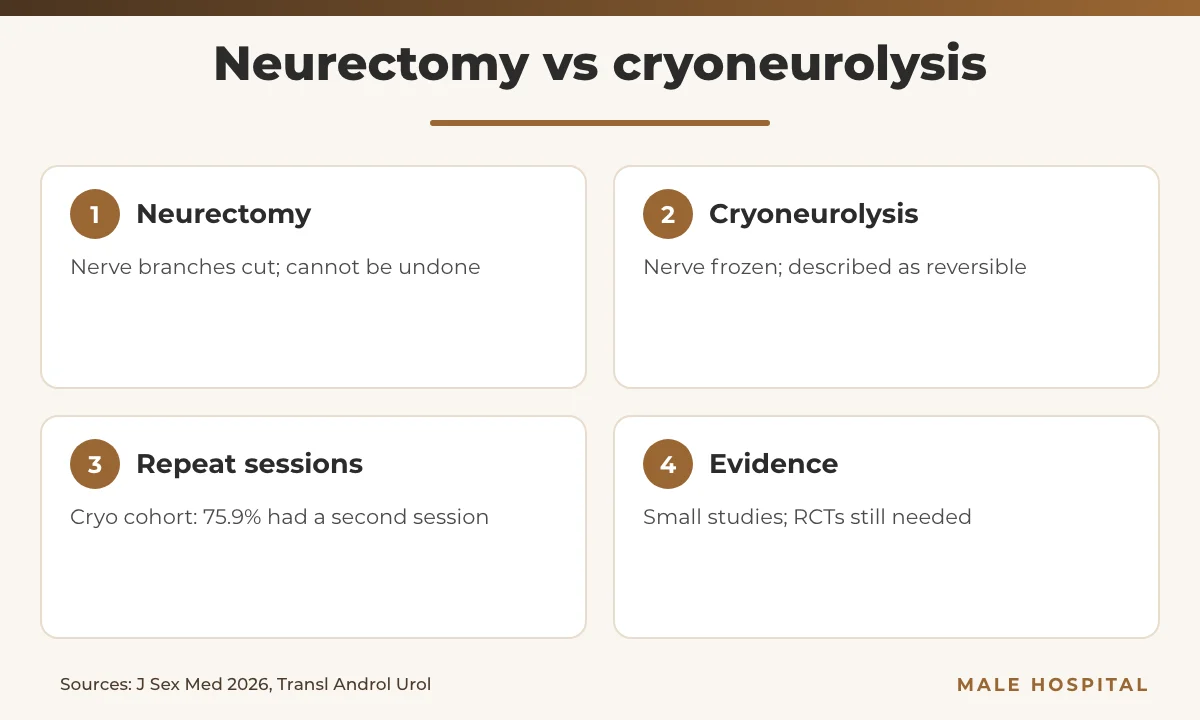
Because there is no standardized technique, the steps below describe what published studies report in general terms. Details of selective dorsal neurectomy differ between surgeons.
Selective dorsal neurectomy
- The surgeon exposes the dorsal nerve branches on the top of the penis, often near the coronal sulcus.
- Selected branches are identified and divided or resected. Published series range from cutting 2 to 3 lateral branches on each side to cutting 3 to 10 branches while leaving two main branches intact.
- Some recent trials use intraoperative neurophysiological monitoring to choose which branches to cut; a 2023 review reported better results with monitoring than without.
- The wound is closed and a dressing applied.
Selective dorsal cryoneurolysis
- The target dorsal nerve branches are located.
- A cold probe freezes the nerve to interrupt conduction without cutting it.
- Further sessions may be planned depending on response; in the 2026 cohort, most men had a second session.
Sources: Transl Androl Urol (PMC) — Surgical treatment of premature ejaculation review (2016); Transl Androl Urol — The role of surgical therapy in the management of premature ejaculation (2023); J Sex Med (PubMed) — Selective dorsal cryoneurolysis cohort (2026)
Recovery and follow-up
No guideline publishes a standard recovery timeline after selective dorsal neurectomy or cryoneurolysis, and the reviews we checked do not report details such as when to resume sex. Your surgeon gives individual instructions. The table summarizes what studies do report over time.
| Period | Neurectomy (reported) | Cryoneurolysis (2026 cohort) |
|---|---|---|
| Early days and weeks | Glans pain or discomfort (4.9%), penile swelling (4.2%) and wound separation (2.1%) in one series | Mild, self-limiting discomfort in 7.4% |
| First 3 months | Latency gains reported in several series | Peak improvement in IELT first reached by month 3 |
| Repeat treatment | Not designed to be repeated; recurrence about 10% in a national survey | 75.9% had a second session and 20.4% a third |
| 12 months | Long-term data limited and mostly from small studies | IELT gain maintained; 10.2% still had PE |
Sources: Transl Androl Urol (PMC) — Surgical treatment of premature ejaculation review (2016); J Sex Med (PubMed) — Selective dorsal cryoneurolysis cohort (2026)
Risks of selective dorsal neurectomy and cryoneurolysis
The central problem is that the goal of selective dorsal neurectomy, less sensation, is also its main risk. The ISSM warns that selective dorsal nerve surgery may cause permanent loss of sexual function, and the EAU’s concern is that cutting nerves cannot be reversed. A 2024 narrative review lists irreversible complications such as penile deformity, sensory loss and erectile dysfunction.
Reported rates after selective dorsal neurectomy vary because studies are small and technique differs:
- Numbness or abnormal glans sensation: about 5% in one series and 8.1% in another; a 2023 trial reported sensory abnormalities in both monitored and unmonitored groups.
- Glans pain or paresthesia: 3.8% in a Korean survey of about 4,400 cases; painful neuroma is also described.
- Recurrence of PE: about 10%.
- Erectile dysfunction: 0.4% in the same survey; 3 men in the unmonitored group of a 2023 trial had mild ED.
- Delayed ejaculation, swelling and wound problems: reported in single-center series.
Some Chinese selective dorsal neurectomy reports did not measure sensory function at all, so lasting sensory loss cannot be excluded from their results. For cryoneurolysis, the 2026 cohort reported no erectile dysfunction, anorgasmia, persistent numbness or infection, but it was retrospective and uncontrolled.
Sources: Int J Impot Res (PubMed) — Surgical treatment of premature ejaculation: a narrative review (2024); Transl Androl Urol (PMC) — Surgical treatment of premature ejaculation review (2016); Transl Androl Urol — The role of surgical therapy in PE (2023)
Selective dorsal neurectomy results and the evidence table
Published results for selective dorsal neurectomy and cryoneurolysis look encouraging on paper, but the studies are small, mostly from single centers, use different techniques and rarely follow men for long. Here are the main data points we could verify:
| Study | Design and size | Reported result |
|---|---|---|
| Zhang et al., 2012 | Randomized, 32 neurectomy vs 46 circumcision | IELT about 1.1 to 3.8 minutes; no change with circumcision |
| Liu et al., 2019 | Randomized, 48 neurectomy | IELT about 0.65 to 4.29 minutes |
| Tang et al., 2023 | Randomized, 120 men, with vs without nerve monitoring | IELT of 300 s or more in 63.6% vs 34.0% |
| Korean survey, 2012 | 527 urologists, about 4,400 cases | 56% satisfied, 3.4% dissatisfied |
| Prologo et al., 2013 | CT-guided cryoablation, 24 men, non-randomized | IELT 256 s at day 7, 141 s at 1 year |
| Basaga, Albayrak, Sertkaya, Serefoğlu, 2026 | Retrospective cryoneurolysis cohort, 108 men, 12 months | Geometric mean IELT 54.4 s to 231.3 s; PEDT 14.3 to 8.4 |
Sources: Transl Androl Urol — The role of surgical therapy in the management of premature ejaculation (2023); Transl Androl Urol (PMC) — Surgical treatment of premature ejaculation review (2016); J Sex Med (PubMed) — Selective dorsal cryoneurolysis cohort (2026)
Realistic expectations
Even in favorable studies, average latency rose to a few minutes, not to “unlimited” control, and about 1 in 10 men still had PE. The 2026 cryoneurolysis authors describe their technique as safe and effective in their cohort but state clearly that it remains investigational and needs randomized controlled trials. They also note there were no partner-reported outcomes. For selective dorsal neurectomy, the 2024 review concludes that more clinical data are needed before surgery can be recommended to men with PE.
Sources: J Sex Med (PubMed) — Selective dorsal cryoneurolysis cohort (2026); Int J Impot Res (PubMed) — Surgical treatment of premature ejaculation: a narrative review (2024)
Treatment with Dr. Zülfü Sertkaya in Istanbul
Assoc. Prof. Dr. Zülfü Sertkaya is a urologist and andrologist in Istanbul, a Fellow of the European Board of Urology (FEBU, 2017) and Associate Professor of Urology since 2020. Premature ejaculation is one of his focus areas, and his research includes selective dorsal cryoneurolysis and anogenital distance in PE. He co-authored the 2026 Journal of Sexual Medicine cohort of 108 men (PMID 42747863). He is a member of the EAU, ESSM and ISSM.
Our approach follows EAU guidance, which advises against dorsal neurectomy, including selective dorsal neurectomy. Your assessment starts with confirming the type of PE and optimizing first-line care. If you ask about cryoneurolysis, he can explain what the published data show, what they do not show, and why the technique is still considered investigational. Pricing for any treatment is given only after a free assessment, because it depends on your history and the approach chosen.
For international patients, our support services include reception and transport, translation, trip planning, hotel accommodation, medical consultation and aftercare.
How to start
Send us a confidential WhatsApp message with a short history: how long you usually last, whether PE has been present since your first experiences, any erection problems, and which treatments you have tried, at what dose and for how long. Our team reviews it and replies with a personalized plan, which for most men begins with first-line treatment rather than selective dorsal neurectomy or any other procedure.
When to see a doctor
See a doctor if premature ejaculation happens most of the time and causes distress, or if it started suddenly after years of normal control. The NHS advises seeing a GP for persistent problems and for blood in the semen, which can signal infection. After any penile procedure, seek urgent care for:
- Increasing pain, redness, swelling, pus or fever.
- Bleeding that does not stop or a rapidly enlarging bruise.
- New loss of erections, or numbness that spreads or does not improve.
- Wound edges that open.
Sources: NHS — Ejaculation problems; Transl Androl Urol (PMC) — Surgical treatment of premature ejaculation review (2016)
Get an honest, confidential opinion on your premature ejaculation options from our urologist-andrologist.
Related men’s health guides
- Premature Ejaculation: 4 Types, Causes & Diagnosis
- Premature Ejaculation Pills: 5 Options and the Evidence
- Dapoxetine: 7 Facts on Dosing, Results and Safety
- How to Last Longer in Bed: 7 Evidence-Based Methods
- Numbing Spray for Premature Ejaculation: 6 Key Safety Facts
- Sexual Performance Anxiety: 6 Practical Steps That Help
FAQs about dorsal nerve procedures
Is selective dorsal neurectomy safe?
It is not considered established or proven safe. The EAU recommends not performing dorsal neurectomy because it is irreversible and safety data are lacking. Reported problems include numbness, glans pain, recurrence and, rarely, erectile dysfunction. Small selective dorsal neurectomy studies report low complication rates, but they used different techniques and short follow-up.
Source: EAU — Sexual and Reproductive Health Guidelines: Disorders of Ejaculation
Can the numbness after nerve surgery be permanent?
Yes, it can. Once nerve branches are cut in selective dorsal neurectomy they cannot be reconnected by simply stopping treatment, which is why the ISSM warns about possible permanent loss of sexual function. Some studies that reported good results did not formally test sensation afterward, so the true rate of lasting sensory loss is uncertain.
Source: Sex Med (PMC) — Update of the ISSM guidelines for the diagnosis and treatment of PE (2014)
How is cryoneurolysis different from neurectomy?
Cryoneurolysis freezes the dorsal nerve branches to interrupt signals instead of cutting them, so its authors describe it as potentially reversible. In the 2026 cohort, most men needed a second session and about one in five a third. It is still investigational, and the current EAU guideline does not address it.
Source: J Sex Med (PubMed) — Selective dorsal cryoneurolysis cohort (2026)
Does the AUA approve surgery for premature ejaculation?
No. The AUA/SMSNA guideline on disorders of ejaculation states that surgical management of PE, including injection of bulking agents, should be considered experimental and used only within an ethics-board-approved clinical trial. Its first-line recommendations are daily SSRIs, on-demand clomipramine or dapoxetine where available, and topical anesthetics.
Source: AUA/SMSNA — Disorders of Ejaculation Guideline
What should I try before thinking about a procedure?
Long before selective dorsal neurectomy is discussed, start with an assessment, then first-line treatment: dapoxetine or a lidocaine-prilocaine spray according to the EAU, with daily SSRIs or clomipramine as alternatives. Add behavioral techniques such as stop-start or squeeze, and counseling where stress or relationship issues play a role. Treat any erection problem first.
Sources: EAU — Sexual and Reproductive Health Guidelines: Disorders of Ejaculation; Cleveland Clinic — Premature Ejaculation
How long do results last?
Long-term data are limited. In the 2026 cryoneurolysis cohort, latency gains were maintained at 12 months, though often after repeat sessions. For selective dorsal neurectomy, a Korean survey reported recurrence in about 10% of cases, and most published series are small with short follow-up, so durability beyond a few years is not well established.
Source: Transl Androl Urol (PMC) — Surgical treatment of premature ejaculation review (2016)
How much does a selective dorsal neurectomy cost?
We do not publish prices for selective dorsal neurectomy or other procedures that guidelines do not recommend as standard, and costs elsewhere vary with technique and setting. At Male Hospital, any pricing is given only after a free, confidential assessment, which for most men leads to a first-line medical plan rather than surgery.
Is a selective dorsal neurectomy available in Europe or the USA?
Selective dorsal neurectomy is described mainly in Asian studies. European and North American guideline bodies advise against it or consider it experimental, so it is not part of standard care there. A 2023 review notes that North American and European associations were against the operation.
Source: Transl Androl Urol — The role of surgical therapy in the management of premature ejaculation (2023)
Medically reviewed by Assoc. Prof. Dr. Zülfü Sertkaya, urologist and andrologist (FEBU), Istanbul. Last reviewed: October 2026.
This article is for general information and does not replace an individual consultation with a qualified doctor.
- EAU — Sexual and Reproductive Health Guidelines: Disorders of Ejaculation
- AUA/SMSNA — Disorders of Ejaculation: AUA/SMSNA Guideline
- Sex Med (PMC) — An update of the ISSM guidelines for the diagnosis and treatment of premature ejaculation (2014)
- J Sex Med (PubMed) — Clinical outcomes of selective dorsal cryoneurolysis in patients with lifelong premature ejaculation: a retrospective cohort of 108 men (2026)
- Int J Impot Res (PubMed) — Surgical treatment of premature ejaculation: a narrative review (2024)
- Transl Androl Urol (PMC) — Is there a place for surgical treatment of premature ejaculation? (2016)
- Transl Androl Urol — The role of surgical therapy in the management of premature ejaculation: a narrative review (2023)
- NHS — Ejaculation problems
- Cleveland Clinic — Premature Ejaculation