Vasectomy is a short operation under local anesthetic that cuts or seals the two tubes (vas deferens) carrying sperm from the testicles, so the semen no longer contains sperm. It is one of the most effective forms of contraception, but it does not work straight away: you need a semen test, usually 8 to 12 weeks later, before you stop other birth control. It does not change testosterone, erections or how ejaculation feels. Because it is meant to be permanent, think of it as a lifelong decision. Reversal is possible, but it does not always work, as our guide to vasectomy reversal explains.
Source: AUA — Clinical guideline; NHS — Male sterilisation overview
- The operation blocks the sperm ducts. You still ejaculate a normal-looking amount of semen, just without sperm.
- The procedure usually takes 15 to 30 minutes under local anesthetic. Most men return to desk work within a day or two.
- It is not effective right away. Use other contraception until a semen analysis, done no earlier than 8 weeks, shows no sperm.
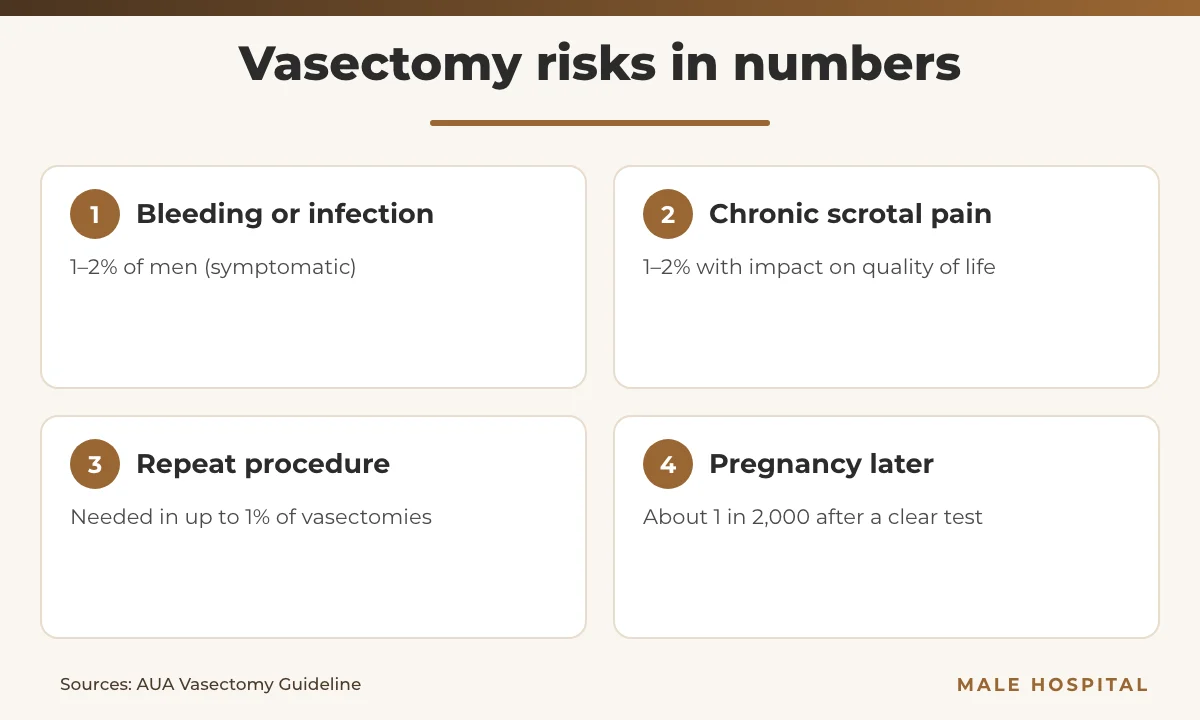
- Once the test is clear, the pregnancy risk is about 1 in 2,000. Bleeding or infection affects 1–2% of men, and chronic scrotal pain that affects quality of life also affects 1–2%.
- It does not affect testosterone, sex drive or erections. It also does not protect against sexually transmitted infections.
- What is a vasectomy?
- How a vasectomy is done: conventional vs no-scalpel
- Vasectomy recovery: what to expect
- When does a vasectomy start working?
- How effective is vasectomy?
- Vasectomy risks and side effects
- Vasectomy myths: testosterone, sex and cancer
- Is a vasectomy right for you?
- When to see a doctor
- FAQs about vasectomy
What is a vasectomy?
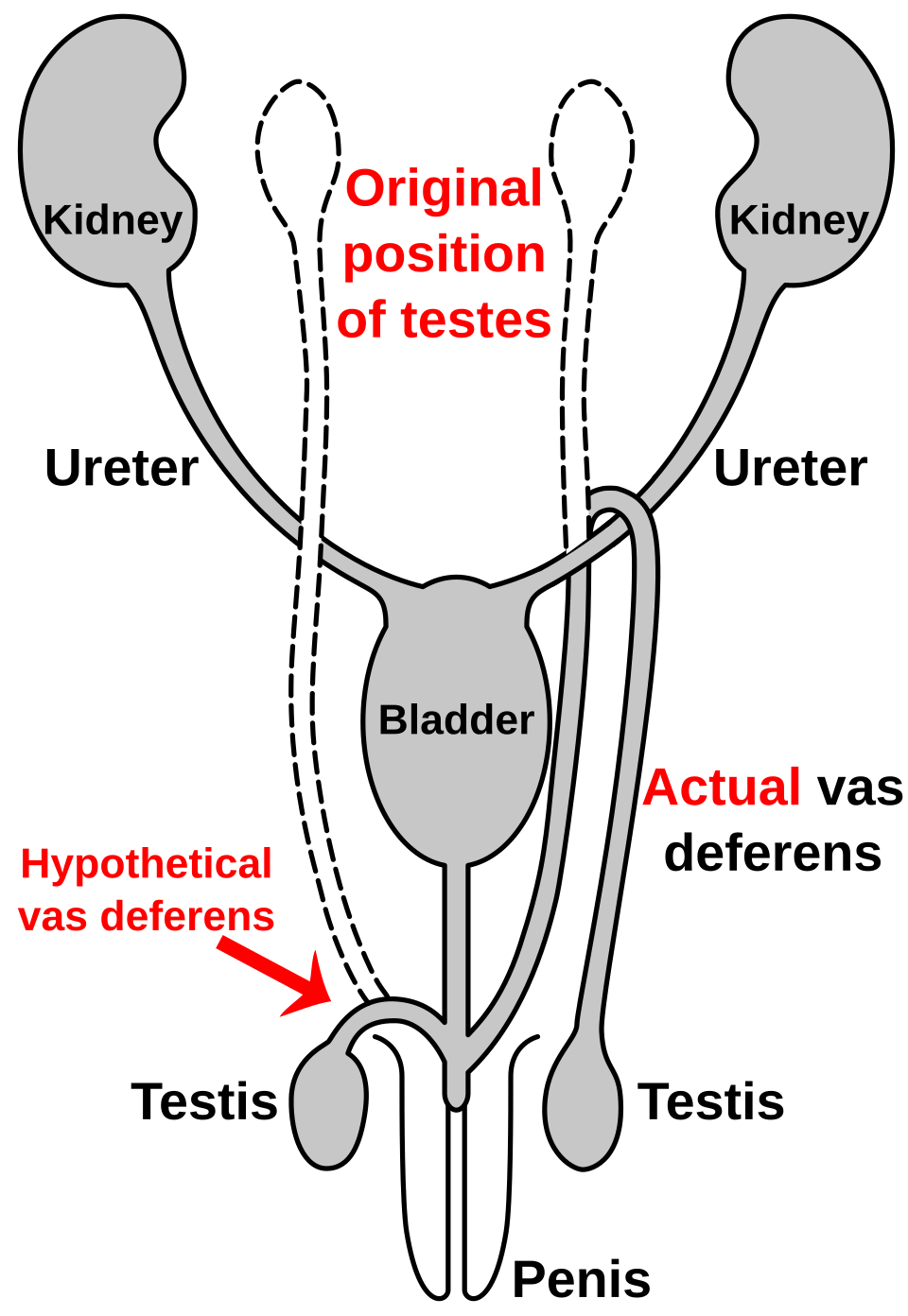
Sperm are made in the testicles and stored in the epididymis, a coiled tube behind each testicle. During ejaculation they travel up the vas deferens, a firm tube that runs from the scrotum into the pelvis, and mix with fluid from the prostate and seminal vesicles to form semen. The operation interrupts both of these tubes inside the scrotum, so sperm can no longer reach the semen.
The testicles keep making sperm after the operation. The sperm stay in the epididymis and the body breaks them down and absorbs them, which is a normal process. Because sperm make up only a small part of semen, ejaculation looks and feels the same. Cleveland Clinic notes that the amount, appearance and taste of semen do not change.
The procedure is also called male sterilisation. It is widely used: Cleveland Clinic reports that more than 500,000 people in the United States have one each year.
Source: MedlinePlus — Medical encyclopedia; Cleveland Clinic — Procedure, recovery and effectiveness
How a vasectomy is done: conventional vs no-scalpel
The procedure is normally done as an outpatient procedure in a clinic or doctor’s office, under local anesthetic. You stay awake but should not feel pain once the area is numb. The NHS says the procedure itself usually takes 15 to 20 minutes, and Cleveland Clinic gives a range of about 15 to 30 minutes.
The steps are simple. The skin is cleaned, the surgeon numbs the scrotum, and then reaches each vas deferens through one or two small openings. Each tube is cut and sealed with heat (cautery), ties or clips, and the opening is closed with dissolvable stitches or surgical glue, or left to heal on its own.
Source: NHS — What happens on the day; MedlinePlus — Medical encyclopedia
No-scalpel vasectomy
In the no-scalpel method (NSV), the surgeon finds each vas by feel, holds it with a small clamp and makes one tiny puncture with a pointed instrument instead of a cut. The puncture is then gently widened to reach the tubes. The American Urological Association (AUA) recommends a minimally invasive approach such as NSV. In randomized trials it led to fewer bruises and blood collections than the incision method.
How the tubes are sealed matters
The AUA recommends sealing the inner lining of the vas with cautery and placing a layer of tissue (fascia) between the two cut ends. Cutting and tying alone is not recommended, because it has a much higher risk that the tubes rejoin. In the studies the AUA reviewed, presumed failure was 13–25% with tying and cutting alone, compared with 0–0.5% with cautery plus fascial interposition.
| Feature | Conventional (incision) | No-scalpel |
|---|---|---|
| Access to the vas | One or two small skin cuts | One tiny puncture, gently widened |
| Anesthesia | Local | Local |
| Hematoma (blood collection) in trials | 12.2% and 11.9% | 1.8% and 1.1% |
| Infection in one trial | 14.3% | 3.3% |
| AUA position | Acceptable, but less preferred | Recommended minimally invasive approach |
Source: AUA — Clinical guideline; Cleveland Clinic — Procedure, recovery and effectiveness
Pain control during and after
The AUA advises local anesthetic given with the finest needle possible. A numbing cream can be applied an hour before, but not used on its own. After the procedure, acetaminophen (paracetamol) or anti-inflammatory painkillers such as ibuprofen are usually enough, and routine opioids are not recommended. Antibiotics are not needed for most men, only for those at higher risk of infection.
Source: AUA — Clinical guideline
Vasectomy recovery: what to expect
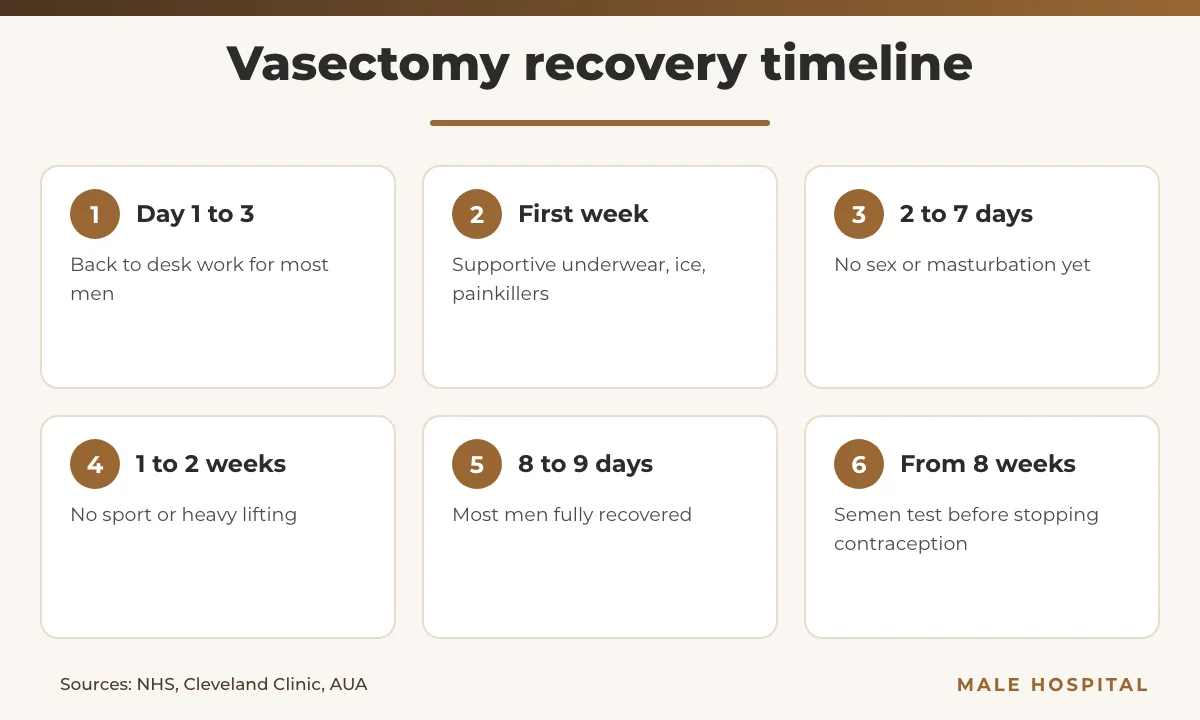
Most men go home shortly after the procedure. Some testicular pain, bruising and swelling are normal for about a week. Supportive underwear or a scrotal support, ice packs and simple painkillers help. At first an erection may feel sore, and there may be a little blood in the semen. The NHS says both usually pass quickly; our article on blood in semen covers when it needs checking.
- Work: the NHS says most men can return to work within 24 hours. MedlinePlus says 2 to 3 days, and longer if your job involves heavy physical labor.
- Sex and masturbation: avoid them for at least 2 to 7 days (NHS). Cleveland Clinic advises at least 7 days.
- Exercise and lifting: avoid sport and heavy lifting for 1 to 2 weeks or as advised. Cleveland Clinic suggests avoiding lifting over 10 pounds (4.5 kg) and strenuous exercise for about a month.
- Driving: wait until you can do an emergency stop safely.
- Full recovery: Cleveland Clinic says most people recover fully in 8 to 9 days.
Source: NHS — Recovering after the procedure; Cleveland Clinic — Procedure, recovery and effectiveness; MedlinePlus — Medical encyclopedia
When does a vasectomy start working?
This is the most important practical point. Sperm that were already beyond the cut stay in the tubes above it for weeks or months. Until they are cleared, you can still cause a pregnancy. The AUA notes that early failures from leftover sperm happen in the first 3 to 4 weeks.
NICHD says it usually takes 15 to 20 ejaculations, or about 3 months, to clear the remaining sperm, and that about 1 in 5 men still has sperm after that and needs longer. Cleveland Clinic notes that ejaculating regularly from about a week after the procedure may help clear the tubes.
Source: NICHD (NIH) — How effective is it?; AUA — Clinical guideline
The post-vasectomy semen analysis
This semen analysis (PVSA) confirms that the operation has worked. Under the AUA guideline:
- At least one sample is needed, and it can be given from 8 weeks after surgery. The NHS says confirmation usually takes around 12 weeks.
- You can stop other contraception when the sample shows no sperm at all, or only rare non-moving sperm (100,000 per mL or fewer) in a fresh sample examined within 2 hours.
- If moving sperm are still present 6 months after the procedure, the operation is considered to have failed, and a repeat procedure is discussed.
Many men skip this test, and this is a common reason for unexpected pregnancies after the operation. For more on how semen samples are collected and read, see our guide to semen analysis.
Source: AUA — Clinical guideline; NHS — Recovering after the procedure
How effective is vasectomy?
Once a semen test has confirmed that no sperm (or only rare non-moving sperm) are present, the AUA puts the risk of pregnancy at about 1 in 2,000. Across large studies, pregnancy rates after the procedure were 0.1–1.1% at 2 to 5 years, and 0.58% in a review of more than 400,000 procedures. Very rarely, the cut tubes rejoin on their own (recanalization), so no method can promise zero risk.
The AUA also notes that up to 1% of vasectomies done with a low-failure technique fail to block the tubes and need to be repeated. Cleveland Clinic reports that sperm are still found 3 to 6 months after the procedure in 0.3% to 9% of cases, and that failure falls below 1% after that period.
| Method | Reported pregnancy or failure rate | Notes |
|---|---|---|
| Vasectomy (after a clear semen test) | About 1 in 2,000 | Requires a semen analysis confirming no sperm |
| Vasectomy (population studies) | 0.1–1.1% at 2–5 years | Includes men who never had the semen test |
| Female tubal sterilization | 2.9% at 1 year, 8.4% at 10 years | Figures cited in the AUA guideline |
| Condoms | About 2% | Also protects against STIs |
Source: AUA — Clinical guideline; Cleveland Clinic — Procedure, recovery and effectiveness
Vasectomy risks and side effects
The NHS describes it as a very safe type of surgery in which serious side effects are rare. Most problems are minor and settle with time, rest and painkillers.
Bleeding, bruising and infection
Mild bruising and swelling are expected. The AUA puts symptomatic hematoma (a collection of blood in the scrotum) and infection at 1–2%. A review in the World Journal of Men’s Health found that hematoma is less common when surgeons do more vasectomies: 4.6% for surgeons doing 1 to 10 a year, compared with 1.6% for those doing more than 50. An infection is treated with antibiotics.
Sperm granuloma
A sperm granuloma is a small lump that forms where sperm leak from the cut end of the vas and the body reacts to them. It is usually harmless, often causes no symptoms, and usually goes away on its own. Anti-inflammatory painkillers help if it is tender.
Source: NHS — Complications; AUA — Clinical guideline; World Journal of Men’s Health (PMC) — Yang et al. 2021, complications and safety review
Post-vasectomy pain syndrome
A minority of men develop long-term pain in the testicles or scrotum, called post-vasectomy pain syndrome (PVPS). The AUA states that chronic scrotal pain severe enough to affect quality of life occurs in 1–2% of men. A 2020 meta-analysis found that some degree of lasting pain was reported by 15% of men overall, but only 5% had pain that significantly interfered with daily activities. Pain was reported less often after the no-scalpel technique (7%) than after the scalpel technique (24%).
PVPS is usually treated first with anti-inflammatory medicines or medicines for nerve pain. A few men need surgery to remove some of the nerves that cause the pain. Our guide to testicular pain covers other causes that should be ruled out.
Source: AUA — Clinical guideline; Int J Environ Res Public Health (PMC) — Auyeung et al. 2020, pain meta-analysis; NHS — Complications
Vasectomy myths: testosterone, sex and cancer
Testosterone and sex drive
The operation does not touch the testicles’ hormone-producing cells or their blood supply. Cleveland Clinic states that it does not change how the body makes or releases testosterone. The AUA guideline says it does not affect sexual function or ejaculation, and the NHS says there is no evidence that it affects long-term sexual performance or enjoyment.
Prostate cancer
Some studies from the 1990s raised concern about prostate cancer. NICHD now states that men who have the procedure are no more likely to get prostate cancer than other men, and that the procedure does not raise the risk of testicular cancer. The AUA notes that the small statistical link seen in some data is likely due to PSA screening: there was no association with high-grade disease (odds ratio 1.01) or with death from prostate cancer (odds ratio 0.99).
A 2022 meta-analysis of 37 studies found a very small association that weakened in the highest-quality studies. It found no link with fatal prostate cancer, and no link with advanced disease after adjusting for PSA screening. The authors concluded that the data do not prove cause and effect.
Heart disease and other conditions
The AUA found no link between the procedure and heart attack, stroke or coronary artery disease, and considers a causal link with kidney stones unlikely. Many men also develop antibodies against sperm: a review in the World Journal of Men’s Health reports this in more than 60% of men within 6 to 8 weeks.
Source: NICHD (NIH) — Other FAQs; European Urology Open Science (PMC) — Baboudjian et al. 2022, prostate cancer meta-analysis; World Journal of Men’s Health (PMC) — Yang et al. 2021, complications and safety review; AUA — Clinical guideline; Cleveland Clinic — Procedure, recovery and effectiveness
Is a vasectomy right for you?
The procedure suits men who are sure they do not want any (more) biological children, whatever happens in future relationships or family life. A good consultation covers the questions below.
- How certain are you? The AUA describes it as permanent contraception, so think about how you would feel if your circumstances changed.
- Should you bank sperm? The AUA advises discussing sperm freezing, especially for men without children or younger men. Cleveland Clinic notes that frozen sperm can be used later without a reversal.
- What are the alternatives? These include condoms and long-acting methods for a partner. Female tubal sterilization has a higher reported failure rate in the AUA guideline.
- Is the timing right? Plan a few quiet days, and remember that you will still need contraception for about 3 months.
If you change your mind, there are two options. Microsurgical reversal rejoins the tubes. Sperm retrieval from the testicle or epididymis can be combined with IVF/ICSI. NICHD notes that almost all vasectomies can be reversed. However, the chances of restoring fertility fall as more time passes since the original operation, and it takes about a year on average to achieve a pregnancy after a reversal. For the fertility side of this decision, see our guide to male infertility.
Source: AUA — Clinical guideline; NICHD (NIH) — Other FAQs; Cleveland Clinic — Procedure, recovery and effectiveness
When to see a doctor
Some discomfort is normal after the procedure. Contact a doctor urgently if you notice any of the following:
- Pain and swelling in the scrotum that suddenly get worse, or show no sign of improving after a few days
- A fever or high temperature
- Blood, pus or fluid leaking from the wound
- A lump inside the scrotum that keeps getting bigger
- Testicular pain that does not settle, which may be chronic scrotal pain (PVPS)
- A semen test that still shows moving sperm, or a pregnancy in your partner
Source: NHS — Complications; AUA — Clinical guideline
If you are considering the operation, planning sperm banking first, or dealing with pain or fertility questions afterwards, you can book a confidential consultation with Assoc. Prof. Dr. Zülfü Sertkaya, a urologist-andrologist whose focus includes male infertility. Message us on WhatsApp for a free first evaluation; costs depend on your assessment.
FAQs about vasectomy
Does a vasectomy hurt?
You should not feel pain during the procedure once the local anesthetic works, although you may feel some pulling. Afterwards, the NHS says it is common to feel some pain for 1 to 2 weeks, and testicular pain and swelling usually last about a week. Ibuprofen or paracetamol, supportive underwear and ice packs usually control it well.
Source: NHS — Male sterilisation overview; NHS — Recovering after the procedure
How long after a vasectomy are you sterile?
Not until a semen test proves it. Clearing the sperm left in the tubes usually takes about 3 months or 15 to 20 ejaculations, and about 1 in 5 men need longer. The AUA allows the first test from 8 weeks. Keep using contraception until your doctor confirms that no sperm, or only rare non-moving sperm, remain.
Source: NICHD (NIH) — How effective is it?; AUA — Clinical guideline
Will I still ejaculate after a vasectomy?
Yes. Most semen is fluid from the prostate and seminal vesicles, which the operation does not affect. You will still ejaculate, and the amount, appearance and taste of semen stay the same; only the sperm are missing. Orgasm and erections are unchanged.
Source: Cleveland Clinic — Procedure, recovery and effectiveness
Does a vasectomy lower testosterone?
No. Testosterone is made by cells in the testicles and released straight into the bloodstream, not through the vas deferens. Cleveland Clinic states that the procedure does not change how the body produces or releases testosterone. NICHD likewise confirms that it does not affect sex drive, erections or ejaculation, so any new symptoms of low testosterone need their own assessment.
Source: Cleveland Clinic — Procedure, recovery and effectiveness; NICHD (NIH) — How effective is it?
Can a vasectomy fail years later?
Rarely. Even after a clear semen test, the cut ends can very occasionally rejoin. This is called late recanalization, and the AUA puts the pregnancy risk at about 1 in 2,000. If your partner becomes pregnant or you have any doubt, a repeat semen analysis will show whether sperm have returned.
Source: AUA — Clinical guideline; MedlinePlus — Medical encyclopedia
Does a vasectomy protect against STIs?
No. The operation only stops sperm from entering the semen. Semen and other body fluids are still present, so infections can still pass between partners. The NHS advises using a condom every time you have sex to protect you and your partner against sexually transmitted infections, including HIV, even after sterility has been confirmed.
Source: NHS — Male sterilisation overview
How soon can I have sex after a vasectomy?
The NHS advises no sexual activity, including masturbation, for at least 2 to 7 days, and Cleveland Clinic advises at least 7 days. MedlinePlus notes that most men resume sex after about a week. When you do, use another method of contraception until a semen test confirms the operation has worked.
Source: NHS — Recovering after the procedure; MedlinePlus — Medical encyclopedia
Is a vasectomy reversible?
Often, but not reliably. NICHD notes that almost all vasectomies can be reversed with microsurgery. A successful operation does not guarantee a pregnancy, though, and the chances fall as the years since the original operation increase. MedlinePlus calls reversal a much more complicated operation that may not work. Sperm banking before the procedure is the simplest backup.
Source: NICHD (NIH) — Other FAQs; MedlinePlus — Medical encyclopedia
Medically reviewed by Assoc. Prof. Dr. Zülfü Sertkaya, urologist and andrologist (FEBU), Istanbul. Last reviewed: November 2026.
This article is for general information and does not replace an individual consultation with a qualified doctor.
- AUA — Vasectomy: AUA Guideline
- NHS — What is a vasectomy?
- NHS — What happens during a vasectomy
- NHS — Recovering after a vasectomy
- NHS — Complications of a vasectomy
- Cleveland Clinic — Vasectomy: Procedure, Recovery & Effectiveness
- MedlinePlus — Vasectomy
- NICHD (NIH) — How effective is vasectomy?
- NICHD (NIH) — Vasectomy: other FAQs
- World Journal of Men's Health (PMC) — Yang et al. 2021, Review of Vasectomy Complications and Safety Concerns
- Int J Environ Res Public Health (PMC) — Auyeung et al. 2020, Incidence of Post-Vasectomy Pain: Systematic Review and Meta-Analysis
- European Urology Open Science (PMC) — Baboudjian et al. 2022, Vasectomy and Risk of Prostate Cancer: A Systematic Review and Meta-analysis