Pearly penile papules are tiny, smooth, skin-colored or pearly-white bumps that sit in one or more neat rows around the rim of the head of the penis. They are a normal variation of male anatomy: they are not a sexually transmitted infection, not contagious, not caused by poor hygiene and not linked to cancer. Most men need nothing more than a correct diagnosis and reassurance, although safe removal options exist if the bumps cause real distress.
Sources: Cleveland Clinic — PPP overview; DermNet — PPP
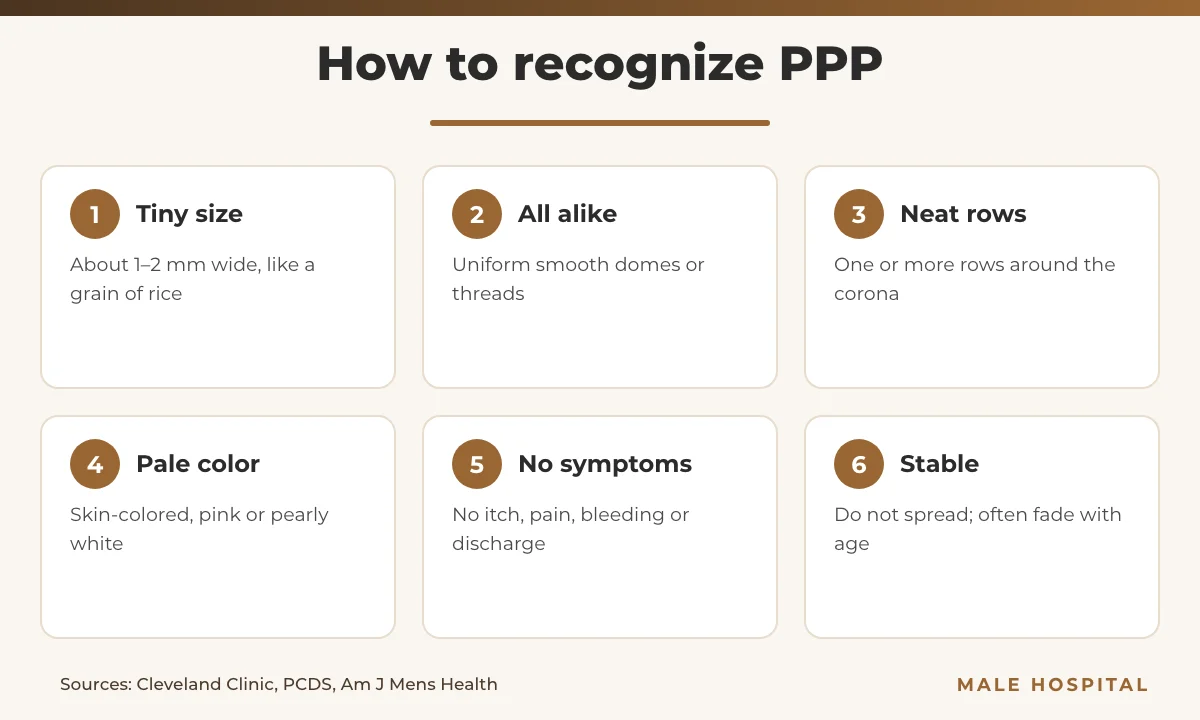
- The bumps are uniform, dome-shaped or thread-like, about 1–2 mm wide, and line up in rows around the corona (the ridge of the glans).
- Studies find them in roughly 14% to 48% of men; they usually appear in late puberty or early adulthood and tend to fade with age.
- They contain no human papillomavirus (HPV), cannot be passed to a partner and do not need treatment.
- Genital warts, molluscum contagiosum and syphilis look and behave differently; a doctor can usually tell them apart by eye or with a dermatoscope.
- Never use wart creams, acids, toothpaste or blades at home. If removal is wanted, a doctor can use laser, freezing or electrosurgery.
- What are pearly penile papules?
- What pearly penile papules look like
- How common are they and who gets them?
- What causes PPP (and what does not)
- Pearly penile papules vs warts and STIs
- How a doctor confirms the diagnosis
- Treatment and removal options
- Why home remedies are a bad idea
- Anxiety, partners and sex
- When to see a doctor
- FAQs about pearly penile papules
What are pearly penile papules?
Doctors often shorten the name pearly penile papules to PPP. These are small, benign growths of skin found on the corona, the raised ridge where the head of the penis (glans) meets the shaft. Doctors have described them for centuries under other names, such as hirsutoid papillomas or papillomatosis corona penis. The term used today was introduced in 1964.
Pearly penile papules are painless and cause no physical symptoms. The main problem they create is worry: many young men notice them for the first time in their late teens or twenties, assume they have caught an infection, and spend weeks anxious before anyone examines them. Knowing what normal looks like is the fastest way to end that worry.
Sources: American Journal of Men’s Health (PMC) — Diagnosis and management of PPP; Cleveland Clinic — PPP overview
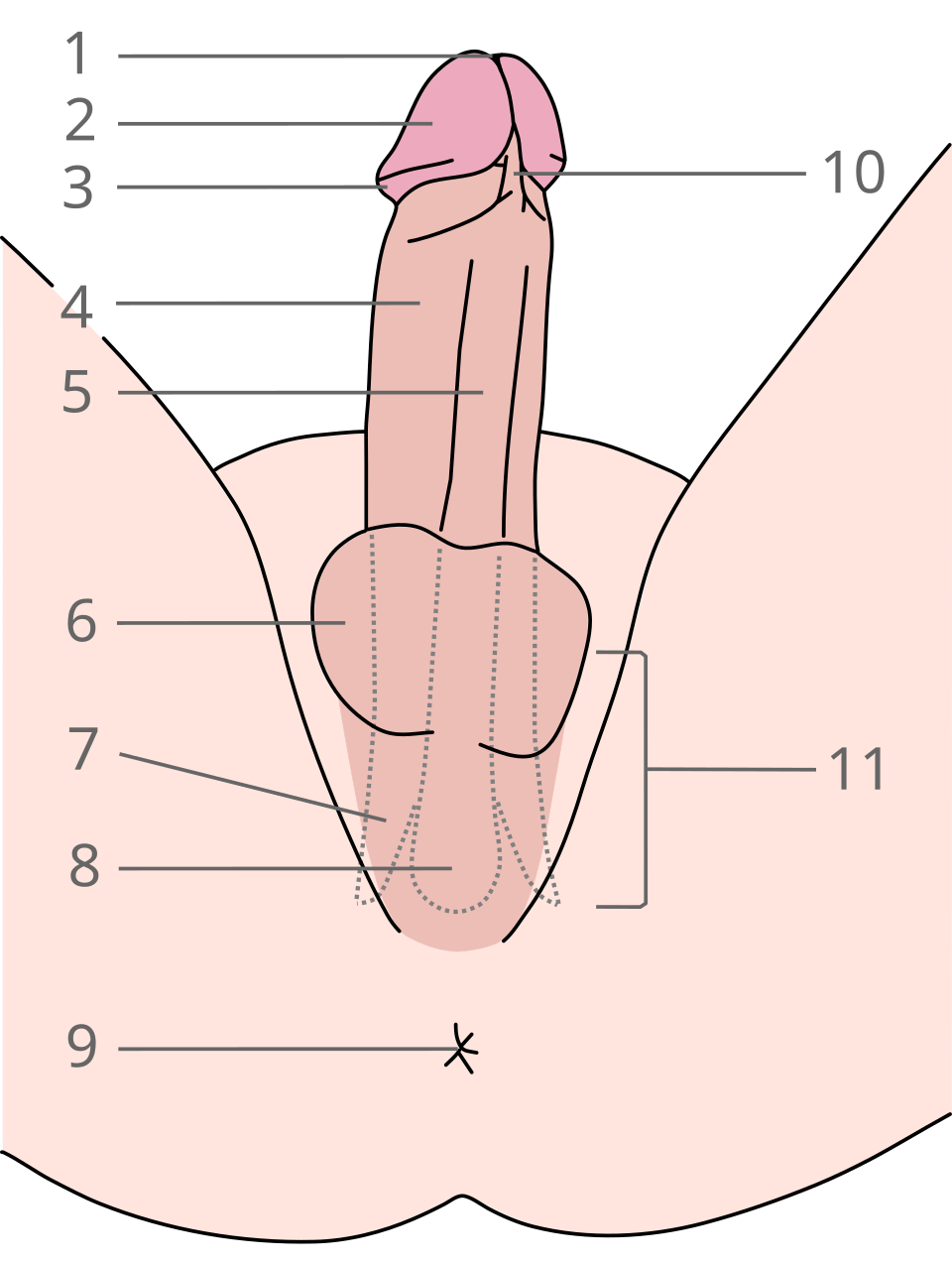
It helps to know the basic anatomy. The glans is the sensitive, cone-shaped head of the penis. Its wider back edge is the corona, and the shallow groove just behind it is the coronal sulcus. On the underside, a small fold of skin called the frenulum joins the glans to the foreskin or shaft. Pearly penile papules sit mainly along the corona and sometimes in the sulcus; the frenulum area is more typical for a different normal finding called Tyson glands.
Sources: DermNet — PPP; American Journal of Men’s Health (PMC) — Diagnosis and management of PPP
What pearly penile papules look like
The appearance of pearly penile papules is usually very regular, and that regularity is one of the strongest clues to the diagnosis. The bumps are:
- Small: about 1–2 mm wide and up to about 4 mm long, often compared to a grain of rice or smaller.
- Uniform: dome-shaped or slightly finger-like (filiform), and all roughly the same size and shape.
- Arranged in rows: one or two rows (sometimes more) that follow the curve of the corona, often most visible on the upper side; in some men they circle the whole glans.
- Pale: skin-colored, pink, white or slightly yellowish, with a smooth, pearly surface.
- Symptom-free: they do not itch, hurt, bleed or produce discharge.
They do not spread across the genitals over weeks, merge into cauliflower-like clusters or change suddenly. Rarely, similar papules are reported on the shaft or around the frenulum, and some men have unusually dense papules covering much of the glans; these atypical forms are still benign but are worth showing to a doctor.
Sources: American Journal of Men’s Health (PMC) — Diagnosis and management of PPP; Cleveland Clinic — PPP overview; Primary Care Dermatology Society — PPP guidance
How common are they and who gets them?
Pearly penile papules are common. Reviews put the prevalence at roughly 14% to 48% of men, and dermatology references give ranges from about 8% up to 50%, depending on the population studied and how carefully men were examined. In other words, if you have them, a large share of men around you do too.
Sources: American Journal of Men’s Health (PMC) — Diagnosis and management of PPP; DermNet — PPP; Primary Care Dermatology Society — PPP guidance
A few patterns are consistent across studies:
- Age: they are rare before puberty, usually appear in late adolescence or early adulthood, and become less noticeable with age. A UK study found them in 38.3% of men under 25 but only 11.4% of men over 50, and papules in the older group were less marked.
- Circumcision: they are more common in uncircumcised men. In the same UK study, 42.4% of uncircumcised young men had them compared with 26.5% of circumcised young men. Constant friction on an exposed corona may help them flatten over time.
- Circumcised men still get them: a study of 2,613 circumcised young men (aged 18–24) in Eskişehir, Turkey, found PPP in 17.18%. All of them had papules on the corona, and some also on the sulcus or frenulum.
- Sexual activity: the UK study found no link with how often men had sex or how long they had been sexually active.
Sources: International Journal of STD & AIDS (PubMed) — PPP regress with age and circumcision; Acta Dermatovenerologica Croatica (PubMed) — PPP prevalence among young men
What causes PPP (and what does not)
The exact cause is unknown. The most widely accepted view is that pearly penile papules are a normal anatomical variant, possibly a leftover (vestigial) structure, because similar small projections occur in the same location in other mammals. Under the microscope they look like a tiny angiofibroma: a small knot of thin-walled blood vessels and fibrous tissue covered by normal skin.
Sources: American Journal of Men’s Health (PMC) — Diagnosis and management of PPP; DermNet — PPP
Just as important is what does not cause them:
- Not an infection: laboratory studies have found no HPV inside them, and there is no association between having PPP and having genital warts.
- Not contagious: you cannot catch them from a partner or pass them on.
- Not hygiene or sex: they are not caused by sexual activity, masturbation or poor washing.
- Not cancer or pre-cancer: they are benign and do not turn malignant.
Sources: American Journal of Men’s Health (PMC) — Diagnosis and management of PPP; DermNet — PPP; Cleveland Clinic — PPP overview
Pearly penile papules vs warts and STIs
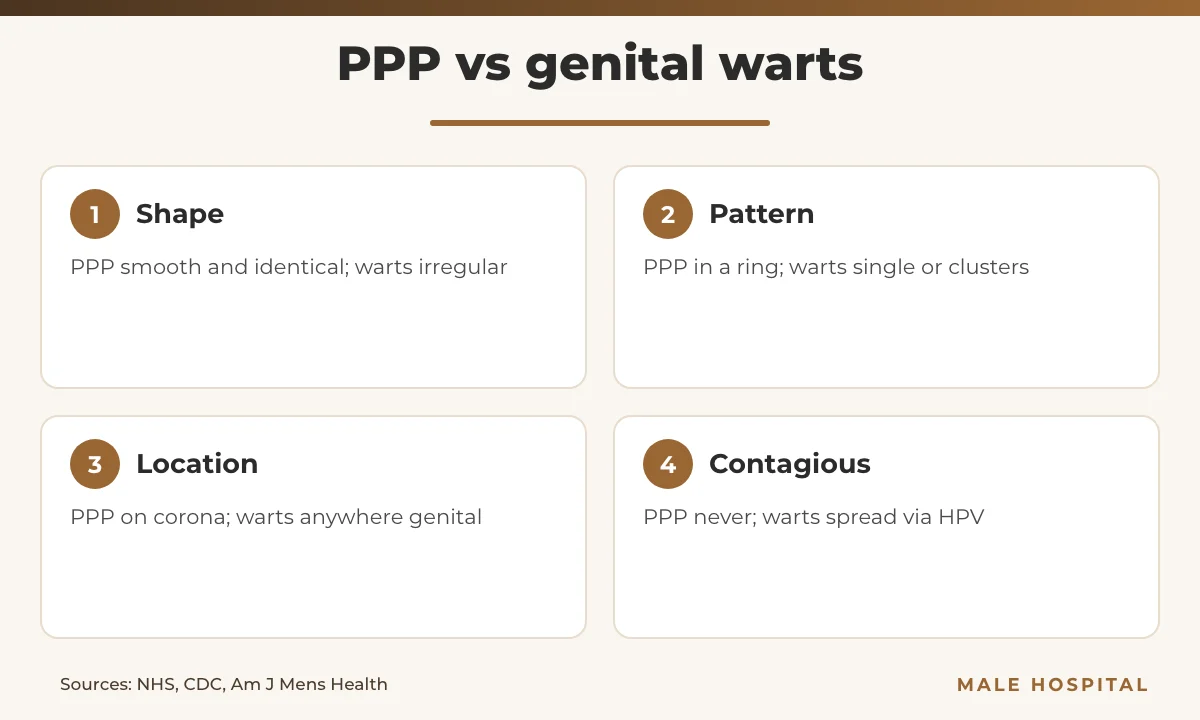
The main reason men search for this topic is the fear that the bumps are genital warts or another sexually transmitted infection (STI). Several differences usually make the distinction clear. Genital warts are caused by HPV, which spreads mainly through vaginal and anal sex and close skin-to-skin contact. Warts can be single or clustered, can look rough or cauliflower-like, vary in size, and can appear anywhere on the genitals or around the anus, not just in a tidy ring on the corona.
Sources: CDC — About Genital HPV Infection; NHS — Genital warts
| Condition | Typical look | Where | Infectious? |
|---|---|---|---|
| PPP | Tiny, smooth, identical domes or threads, 1–2 mm, in neat rows | Corona of the glans, sometimes the sulcus | No |
| Genital warts (HPV) | Irregular, often rough or cauliflower-like; single or clustered; varied sizes; may itch or bleed | Anywhere on the penis, scrotum, groin or anus | Yes, by skin-to-skin contact |
| Molluscum contagiosum | Shiny domes 2–5 mm with a central dimple | Genitals, lower tummy, thighs | Yes |
| Fordyce spots / Tyson glands | Slightly raised yellow-white dots, 1–5 mm, clearer when skin is stretched | Shaft or glans; Tyson glands beside the frenulum | No |
| Syphilis chancre | Usually one firm, round, painless sore or ulcer that heals in 3–6 weeks | Penis, anus, mouth or lips | Yes, needs a blood test and treatment |
Sources: NHS — Genital warts; NHS — Molluscum contagiosum; DermNet — Fordyce spots; CDC — About Syphilis
Three quick clues favor pearly penile papules: the bumps are all the same size, they follow the rim of the glans in a symmetric ring, and they have been stable for months. Warts are usually more irregular and can grow or multiply. Molluscum spots are larger and have a central dimple. A syphilis sore is usually a single ulcer rather than a row of bumps. These clues are helpful, but they are not a substitute for an examination, especially if you have had a new partner or any unprotected sex.
Sources: American Journal of Men’s Health (PMC) — Diagnosis and management of PPP; CDC — About Syphilis
How a doctor confirms the diagnosis
In most men the diagnosis is made simply by looking. A urologist, dermatologist or sexual health doctor recognizes the classic rows of uniform papules on the corona within seconds. No blood test or swab is needed for pearly penile papules themselves, although a doctor may still recommend routine STI testing if you have risk factors or other symptoms.
Sources: DermNet — PPP; Cleveland Clinic — PPP overview
When there is any doubt, a dermatoscope (a handheld magnifying light) helps. Through it, pearly penile papules look like a cobblestone or grape-like pattern of pink-white bumps, each with a central dotted or comma-shaped blood vessel. Warts can show similar vessels, but they usually have a rough, scaly surface that PPP lack. A small skin sample (biopsy) is rarely needed and is reserved for atypical cases where warts, molluscum or another condition cannot be excluded.
Sources: American Journal of Men’s Health (PMC) — Diagnosis and management of PPP; DermNet — PPP
Before your appointment, avoid applying any creams to the area, so the doctor sees the papules in their natural state. Note when you first noticed them and whether they have changed. If a tight foreskin makes it hard to retract and examine the glans, mention this too, since phimosis can be assessed in the same visit.
Treatment and removal options
For most men with pearly penile papules, the right treatment is no treatment. The papules are harmless, do not affect sexual function or fertility, and tend to fade with age. Primary care and dermatology references describe reassurance as the first-line approach.
Sources: Primary Care Dermatology Society — PPP guidance; DermNet — PPP; Journal of Cutaneous Medicine and Surgery (PubMed) — Management of PPP: a review
Removal is a cosmetic choice for men who remain distressed after a clear diagnosis. Options reported in the medical literature include:
- Carbon dioxide (CO2) laser: the most frequently reported method. It vaporizes the papules under local anesthetic. The skin usually re-covers in about 5–7 days, but there is a risk of bleeding during the procedure, wound care afterward, and a small risk of scarring, infection or color change in darker skin.
- Erbium:YAG laser and other ablative lasers: in one series of 45 men treated in one to six sessions, lesions cleared with no recurrence after a year.
- Non-ablative lasers: fractional 1550-nm and pulsed dye lasers have been tried in single cases or very small series with little discomfort and no open wound.
- Cryotherapy (freezing with liquid nitrogen): small reports describe 80–90% clearance after two sessions.
- Electrosurgery (electrodesiccation) or excision: effective, but with a recognized risk of scarring.
Sources: American Journal of Men’s Health (PMC) — Diagnosis and management of PPP; Cleveland Clinic — PPP overview; Primary Care Dermatology Society — PPP guidance
Be realistic about the evidence. A 2025 systematic review found only 17 publications covering 142 patients, all of them retrospective case reports or case series; no randomized trials compare one method with another. Most reports described complete clearance and high satisfaction without infection or scarring, but the authors noted publication bias and inconsistent reporting of side effects. Any removal should be done by an experienced doctor, because the glans is sensitive tissue and scarring is permanent.
Sources: Journal of Clinical and Aesthetic Dermatology (PubMed) — Systematic review of PPP treatments; Journal of Cutaneous Medicine and Surgery (PubMed) — Management of PPP: a review
| Option | Main advantage | Main drawback |
|---|---|---|
| Reassurance only | No risk; papules often fade with age | Papules remain visible for now |
| CO2 / Er:YAG laser | Most-reported method, high clearance in case series | Local anesthetic, wound care, small risk of scarring or pigment change |
| Cryotherapy | Quick, widely available | May need repeat sessions; limited data |
| Electrosurgery / excision | Simple equipment | Higher risk of scarring |
Sources: American Journal of Men’s Health (PMC) — Diagnosis and management of PPP; Primary Care Dermatology Society — PPP guidance; Journal of Clinical and Aesthetic Dermatology (PubMed) — Systematic review of PPP treatments
Why home remedies are a bad idea
Online forums promote toothpaste, lemon juice, castor oil, tea tree oil, “PPP removal creams” and even cutting the bumps off with a blade or tying them off with thread. None of these is proven to work, and specialists specifically advise against using toothpaste, castor oil or acids such as lemon juice, or trying to cut the papules off yourself. The glans is thin, sensitive skin; chemical burns, bleeding, infection and permanent scars are far worse than the harmless papules they aim to remove.
Source: Cleveland Clinic — PPP overview
Over-the-counter wart treatments are another trap. The NHS advises against using pharmacy wart treatments on the genitals because they are not made for genital warts. Because pearly penile papules are not warts, these products cannot work on them anyway. Researchers in Turkey have warned that the resemblance to genital warts can create a false fear of an STI and lead men to unwanted and hazardous treatments.
Sources: NHS — Genital warts; Acta Dermatovenerologica Croatica (PubMed) — PPP prevalence among young men
Anxiety, partners and sex
The emotional side of pearly penile papules is real. In one questionnaire study, 38% of affected men said they were worried about the bumps, and worry rose to 63% among men with moderate or large papules. A study from an STI clinic in Singapore found that more than 14% of men who came in fearing an infection had only PPP. Fear of an STI can also strain relationships when a partner notices the bumps.
Source: American Journal of Men’s Health (PMC) — Diagnosis and management of PPP
The facts are reassuring: pearly penile papules do not spread to partners, do not affect erections or ejaculation, and sex is completely fine. If a partner asks, it is accurate to say they are a common normal skin feature that a doctor can confirm. If the worry is affecting your confidence in bed, our guide to sexual performance anxiety explains how anxiety itself can disrupt arousal and what helps.
Sources: Cleveland Clinic — PPP overview; DermNet — PPP
Some men consider circumcision because pearly penile papules are less common in circumcised men. Circumcision is not a treatment for PPP and is not recommended for that reason alone; it is a surgical decision with its own indications, discussed in our article on adult circumcision.
When to see a doctor
It is always reasonable to have new bumps on the penis checked once, so a doctor can confirm the diagnosis and you can stop worrying. Arrange a prompt appointment with a doctor or sexual health clinic if you notice:
- Bumps that are irregular, rough, cauliflower-like or growing and multiplying.
- Lumps on the shaft, scrotum, groin or around the anus.
- Any sore, ulcer or open area, even if it is painless.
- Itching, bleeding, discharge, or pain or burning when urinating.
- Redness, swelling or soreness of the glans or foreskin, which may point to balanitis.
- A partner who has been diagnosed with genital warts or another STI.
- Bumps that started after a new sexual partner or unprotected sex.
- Distress about the papules that is affecting your mood, relationship or sex life.
Sources: Cleveland Clinic — PPP overview; NHS — Genital warts; CDC — About Syphilis
If you would like a discreet examination or want to discuss whether removal makes sense for you, you can arrange a confidential consultation with our urologist-andrologist, Assoc. Prof. Dr. Zülfü Sertkaya, via WhatsApp. Many men need only a short visit to hear that what they see is normal.
FAQs about pearly penile papules
Are pearly penile papules an STD?
No. They are a normal anatomical variant, not a sexually transmitted infection. Tests have found no HPV in the papules, and there is no link between having them and having genital warts. They are also not caused by sexual activity, so having them says nothing about your or your partner’s sexual history.
Sources: American Journal of Men’s Health (PMC) — Diagnosis and management of PPP; DermNet — PPP
Can I pass PPP to my partner?
No. The papules are part of your own skin and are not infectious or contagious. You cannot catch them from someone, you cannot give them to anyone, and sex is completely fine. Condoms are still sensible for general STI protection, but they are not needed because of PPP.
Sources: Cleveland Clinic — PPP overview; DermNet — PPP
Do pearly penile papules go away on their own?
Often pearly penile papules become less visible over the years. A UK study found them in 38.3% of men under 25 but in only 11.4% of men over 50, and papules in older men were less prominent. There is no way to predict exactly when, or whether, they will fade completely in an individual man.
Source: International Journal of STD & AIDS (PubMed) — PPP regress with age and circumcision
How can I tell PPP from genital warts at home?
Pearly penile papules are tiny, smooth, identical bumps in neat rows around the rim of the glans and stay stable. Warts tend to be irregular, can look rough or cauliflower-like, vary in size, and can appear anywhere on the genitals. Self-checks can mislead, so the safest answer comes from a quick examination by a doctor.
Sources: NHS — Genital warts; American Journal of Men’s Health (PMC) — Diagnosis and management of PPP
Is PPP removal permanent?
Laser treatment usually clears the treated papules, and published case series report low recurrence, including no recurrence after one year in an erbium laser series. However, the evidence comes only from small, retrospective reports, so long-term results are not well studied. Any removal carries a small risk of scarring.
Sources: American Journal of Men’s Health (PMC) — Diagnosis and management of PPP; Journal of Clinical and Aesthetic Dermatology (PubMed) — Systematic review of PPP treatments
Can toothpaste or lemon juice remove pearly penile papules?
No. There is no evidence that toothpaste, lemon juice, castor oil or other home remedies work, and specialists advise against them. These substances can irritate or burn the delicate skin of the glans. Cutting or tying off the bumps yourself risks bleeding, infection and scarring.
Source: Cleveland Clinic — PPP overview
Do PPP affect erections, sensation or fertility?
No. Pearly penile papules are small, benign bumps on the skin surface of the glans with no known health risks. They do not involve the erectile tissue or the testes, so they are not linked to problems with erections, orgasm or fertility. For most men their only impact is cosmetic and emotional.
Sources: DermNet — PPP; Cleveland Clinic — PPP overview
Can circumcised men get pearly penile papules?
Yes. They are less common after circumcision, but a study of 2,613 circumcised young men in Turkey found them in 17.18%. In a UK study, 26.5% of circumcised young men had them, compared with 42.4% of uncircumcised young men.
Sources: Acta Dermatovenerologica Croatica (PubMed) — PPP prevalence among young men; International Journal of STD & AIDS (PubMed) — PPP regress with age and circumcision
Medically reviewed by Assoc. Prof. Dr. Zülfü Sertkaya, urologist and andrologist (FEBU), Istanbul. Last reviewed: November 2026.
This article is for general information and does not replace an individual consultation with a qualified doctor.
- Cleveland Clinic — Pearly Penile Papules
- DermNet — Pearly penile papules
- DermNet — Fordyce spots
- Primary Care Dermatology Society — Pearly penile papules
- NHS — Genital warts
- NHS — Molluscum contagiosum
- CDC — About Genital HPV Infection
- CDC — About Syphilis
- American Journal of Men's Health (PMC) — Diagnosis and Management of Pearly Penile Papules
- Journal of Cutaneous Medicine and Surgery (PubMed) — Management of Pearly Penile Papules: A Review
- Journal of Clinical and Aesthetic Dermatology (PubMed) — Systematic Review of Treatment Modalities
- Acta Dermatovenerologica Croatica (PubMed) — Prevalence of Penile Pearly Papules among Young Men
- International Journal of STD & AIDS (PubMed) — Pearly penile papules regress in older patients and with circumcision