Vardenafil is a prescription PDE5 inhibitor for erectile dysfunction (ED), sold as Levitra film-coated tablets (2.5, 5, 10 and 20 mg) and Staxyn 10 mg orally disintegrating tablets, plus generic versions. Most men start with 10 mg taken about 60 minutes before sex, no more than once a day, and it only works with sexual stimulation. It is one of several first-line erectile dysfunction treatment options, and this guide focuses on what makes vardenafil different.
Sources: FDA — LEVITRA prescribing information; FDA — STAXYN prescribing information
- The usual starting dose of Levitra is 10 mg about 60 minutes before sex; it can be lowered to 5 mg or raised to 20 mg, at most once a day.
- Staxyn is a 10 mg tablet that melts on the tongue without water. It gives higher drug levels than a 10 mg Levitra tablet, so the two are not interchangeable.
- Its half-life is about 4–5 hours, similar to sildenafil and much shorter than tadalafil.
- The European Association of Urology finds no proven difference in effectiveness between PDE5 inhibitors; the choice depends on timing, side effects and your other medicines.
- Never combine it with nitrates or riociguat, and avoid it if you have congenital long QT syndrome or take class IA or III antiarrhythmics.
- What is vardenafil (Levitra and Staxyn)?
- How vardenafil works
- Vardenafil dosage: from 2.5 mg to 20 mg
- Levitra vs Staxyn: film-coated vs melt-in-the-mouth
- How well vardenafil works: clinical trial results
- Vardenafil vs sildenafil, tadalafil and avanafil
- Vardenafil side effects
- Interactions and who should not take vardenafil
- How to take it for the best result
- When to see a doctor
- FAQs about vardenafil
What is vardenafil (Levitra and Staxyn)?

Vardenafil hydrochloride is a phosphodiesterase type 5 (PDE5) inhibitor, the same drug class as sildenafil (Viagra), tadalafil (Cialis) and avanafil (Stendra). The FDA first approved it in 2003 under the brand name Levitra, with one indication: the treatment of erectile dysfunction in men. It is not approved for women, children, or for improving erections in men who do not have ED.
Two brand formulations exist. Levitra is an orange, round, film-coated tablet in 2.5 mg, 5 mg, 10 mg and 20 mg strengths. Staxyn is a white, 10 mg orally disintegrating tablet (ODT) that dissolves on the tongue. Generic film-coated tablets and generic 10 mg ODTs are now marketed by several manufacturers and carry the same prescribing information.
Sources: FDA — LEVITRA prescribing information; DailyMed — generic film-coated tablet label; DailyMed — generic orally disintegrating tablet label
Like every PDE5 inhibitor, it treats the symptom rather than the cause. ED is often an early sign of blood vessel disease, diabetes, hormone problems or medication side effects, so the EAU recommends a medical assessment before treatment and lists PDE5 inhibitors as first-line therapy (strong recommendation).
Source: EAU Guidelines — Management of Erectile Dysfunction
How vardenafil works
An erection starts when sexual stimulation releases nitric oxide in the erectile tissue (corpus cavernosum). Nitric oxide raises a messenger molecule called cyclic GMP (cGMP), which relaxes smooth muscle so blood can flow into the penis. The enzyme PDE5 breaks cGMP down. By blocking PDE5, the medicine lets cGMP build up, so the erection is easier to get and keep.
Because the process begins with nitric oxide released during arousal, the drug has no effect without sexual stimulation. It does not cause an erection on its own and does not increase desire. In laboratory studies it was highly selective for PDE5: more than 15 times more selective than for PDE6 (an enzyme in the retina) and more than 300 times more than for PDE11.
Source: FDA — LEVITRA prescribing information
Absorption and half-life
After a 20 mg film-coated tablet, peak blood levels are reached between 30 minutes and 2 hours (median 60 minutes) on an empty stomach. Only about 15% of the dose reaches the circulation (absolute bioavailability). The drug and its main active metabolite have a terminal half-life of about 4–5 hours, and the liver enzyme CYP3A4 does most of the breakdown. That liver pathway is why so many drug interactions matter. High-fat meals lowered peak levels by 18–50% in food-effect studies.
Source: FDA — LEVITRA prescribing information
Vardenafil dosage: from 2.5 mg to 20 mg
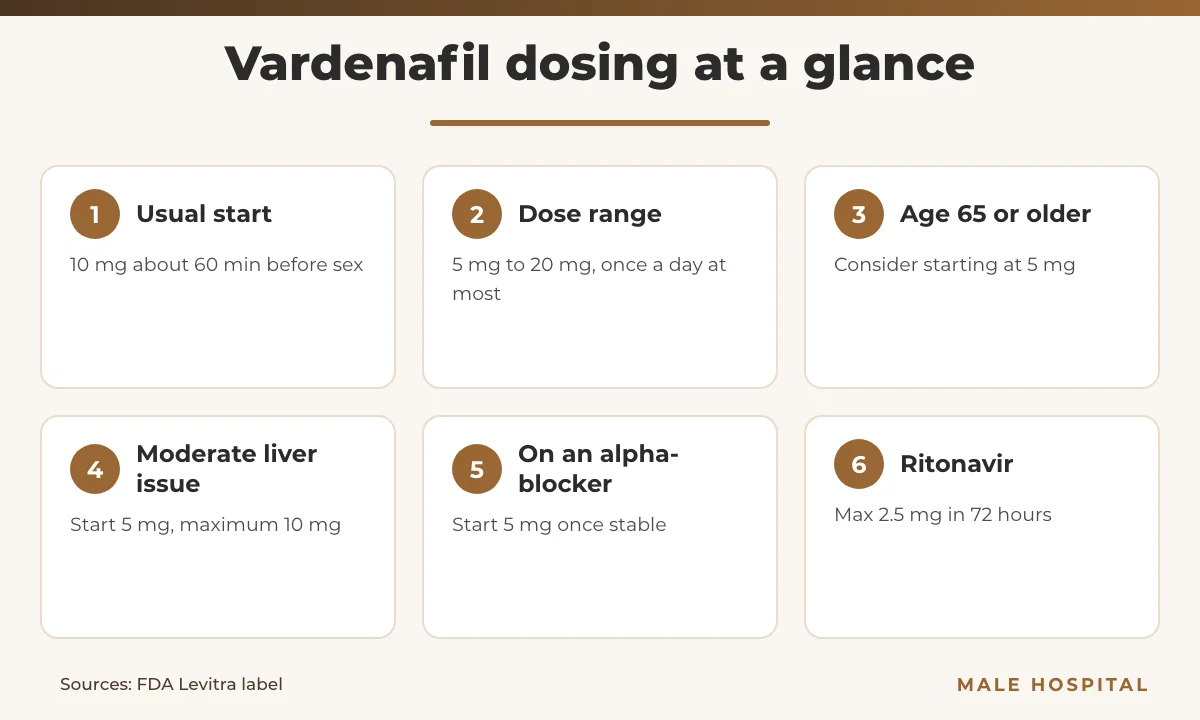
For most men, the FDA label recommends a starting dose of 10 mg taken as needed, about 60 minutes before sexual activity, with or without food. Depending on how well it works and how well you tolerate it, your doctor may raise the dose to the 20 mg maximum or lower it to 5 mg. The maximum frequency is one dose per day. If you want to compare this with sildenafil, see our guide to Viagra dosage.
Dose adjustments in the FDA label
- Age 65 or older: consider a 5 mg starting dose, because older men had 34% higher peak levels and 52% higher total exposure.
- Moderate liver impairment (Child-Pugh B): start at 5 mg and do not exceed 10 mg. Do not use it with severe liver impairment (Child-Pugh C).
- Kidney dialysis: do not use, because it has not been studied in this group.
- Stable on an alpha-blocker (for example, for an enlarged prostate): start at 5 mg, or 2.5 mg if you also take certain CYP3A4 inhibitors.
- Ritonavir or cobicistat: no more than 2.5 mg in 72 hours.
- Indinavir, saquinavir, atazanavir, clarithromycin, ketoconazole or itraconazole 400 mg daily: no more than 2.5 mg in 24 hours.
- Erythromycin, ketoconazole or itraconazole 200 mg daily: no more than 5 mg in 24 hours.
Sources: FDA — LEVITRA prescribing information; DailyMed — generic film-coated tablet label
Levitra vs Staxyn: film-coated vs melt-in-the-mouth
Staxyn and generic vardenafil ODTs come in one strength, 10 mg. The tablet is placed on the tongue straight after it is taken out of the blister and allowed to dissolve, without water or any other liquid. It can be taken with or without food, about 60 minutes before sex, once a day at most.
The key point on the Staxyn label is that it is not interchangeable with a 10 mg Levitra tablet. In healthy volunteers, the ODT produced 44% higher total exposure (AUC) and 15% higher peak levels than the 10 mg film-coated tablet. Swallowing it with water cut exposure by 29%, which is why it must be taken dry. Men who need 5 mg or 20 mg must use the film-coated tablets.
| Feature | Levitra (film-coated) | Staxyn (ODT) |
|---|---|---|
| Strengths | 2.5, 5, 10, 20 mg | 10 mg only |
| How to take | Swallow, with or without food | Dissolve on the tongue, no liquid |
| Median time to peak level | About 1 hour (20 mg, fasting) | 1.5 hours (fasting) |
| Strong or moderate CYP3A4 inhibitors | Allowed at reduced dose | Do not use |
| Moderate liver impairment | Start 5 mg, maximum 10 mg | Do not use |
| Starting while on an alpha-blocker | Start at 5 mg | Do not start treatment with the ODT |
| Phenylalanine | No warning | Contains phenylalanine; caution in phenylketonuria |
Sources: FDA — STAXYN prescribing information; DailyMed — generic orally disintegrating tablet label
The ODT can suit men who dislike swallowing tablets or want something discreet. The EAU notes that in several randomized trials its effectiveness did not seem to differ from the regular tablet.
Source: EAU Guidelines — Management of Erectile Dysfunction
How well vardenafil works: clinical trial results
In the main North American fixed-dose trial of 762 men, the drug improved the ability to achieve an erection firm enough for penetration in 65% (5 mg), 75% (10 mg) and 80% (20 mg) of attempts, compared with 52% on placebo at 3 months. Successful intercourse rates were 51%, 64% and 65% on the three doses, compared with 32% on placebo. A European trial of 803 men confirmed these results, and the benefit held at 6 months.
Men with diabetes or after prostate surgery
Some groups are harder to treat. In a trial of 439 men with diabetes, successful intercourse rates were 49% on 10 mg and 54% on 20 mg, compared with 23% on placebo. In 427 men after radical prostatectomy, rates were 37% on 10 mg and 34% on 20 mg, compared with 10% on placebo. These results are lower than in the general ED population, which matches what we see with the other PDE5 inhibitors. For background, read our article on erectile dysfunction and diabetes.
Source: FDA — LEVITRA prescribing information
How quickly does it start working?
The EAU guideline reports that vardenafil is effective from 30 minutes after a dose, and that about one in three men achieved a satisfactory erection within 15 minutes. In a 12-week dose-response study, improved erections were reported by 66%, 76% and 80% of men on 5, 10 and 20 mg, compared with 30% on placebo.
Source: EAU Guidelines — Management of Erectile Dysfunction
Vardenafil vs sildenafil, tadalafil and avanafil
All four PDE5 inhibitors work in the same way. The EAU states there are no demonstrated differences in effectiveness between them (level 1a evidence), so the choice comes down to how often you have sex, how quickly you need it to work, how long you want it to last, and which side effects you tolerate best. The table below uses the EAU figures for the higher approved dose of each drug on an empty stomach.
| Feature | Vardenafil | Sildenafil | Tadalafil | Avanafil |
|---|---|---|---|---|
| On-demand doses | 5, 10, 20 mg | 25, 50, 100 mg | 10, 20 mg (or 5 mg daily) | 50, 100, 200 mg |
| Usual starting dose | 10 mg | 50 mg | 10 mg | 100 mg |
| Median time to peak | 0.9 h | 0.8–1 h | 2 h | 0.5–0.75 h |
| Half-life | 3.9 h | 2.6–3.7 h | 17.5 h | 6–17 h |
| Window of effect (EAU) | From 30 minutes | 30–60 minutes up to 12 hours | 30 minutes up to 36 hours | Taken 15–30 minutes before sex |
| High-fat meal | Can delay absorption | Can delay absorption | No food warning in EAU text | Can delay absorption |
| Headache / flushing (EMA data) | 16% / 12% | 12.8% / 10.4% | 14.5% / 4.1% | 9.3% / 3.7% |
| Nasal congestion | 10% | 1.1% | 4.3% | 1.9% |
| Back pain / muscle aches | Not listed as common | Not listed as common | 6.5% / 5.7% | Under 2% |
Source: EAU Guidelines — Management of Erectile Dysfunction
A 2015 network meta-analysis of 82 trials (47,626 men) compared starting doses. Sildenafil 50 mg had the greatest efficacy but also the highest overall rate of side effects. Tadalafil 10 mg had intermediate efficacy and the lowest side-effect rate. Vardenafil 10 mg and avanafil 100 mg had side-effect rates similar to sildenafil 50 mg but lower overall efficacy in that analysis. Indirect comparisons like this have limits, which is why the EAU still treats the four drugs as equally effective in practice.
Sources: PubMed — Chen et al., PDE5 inhibitors for ED: a trade-off network meta-analysis (Eur Urol 2015); EAU Guidelines — Management of Erectile Dysfunction
In practical terms, vardenafil behaves much like sildenafil: a short-acting tablet taken before planned sex. Men who want a longer window or a daily option usually do better with tadalafil; see our guide to the tadalafil daily dose. Some men who do not tolerate one PDE5 inhibitor do better on another, so a switch is worth discussing with your doctor before giving up on tablets.
Vardenafil side effects
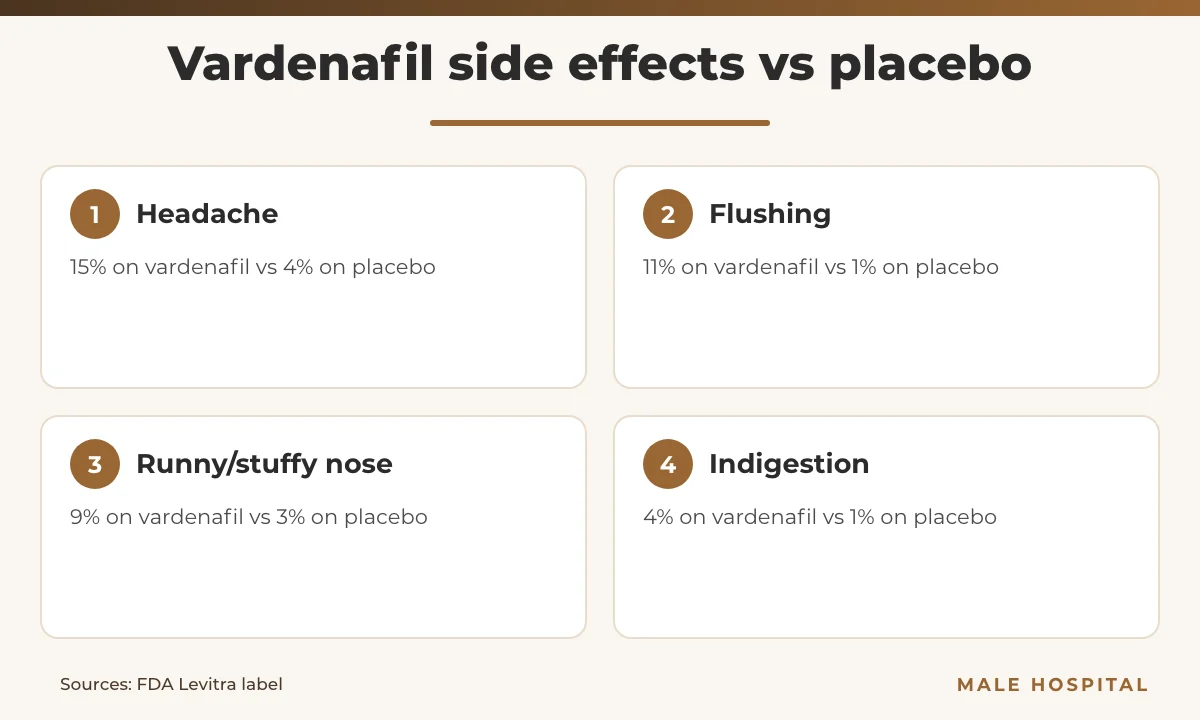
Most side effects are mild and come from blood vessels widening in places other than the penis. In placebo-controlled Levitra trials (5–20 mg), the most common were headache (15% vs 4% on placebo), flushing (11% vs 1%), runny or stuffy nose (9% vs 3%), indigestion (4% vs 1%), sinusitis (3% vs 1%), flu-like symptoms (3% vs 2%), and dizziness, raised creatine kinase and nausea (2% each vs 1%). Several of these became more common as the dose went up. Only 3.4% of men stopped Levitra because of side effects, compared with 1.1% on placebo.
With Staxyn, the pattern was similar: headache 14.4%, flushing 7.6%, nasal congestion 3.1%, indigestion 2.8%, dizziness 2.3% and back pain 2%.
Sources: FDA — LEVITRA prescribing information; FDA — STAXYN prescribing information
Rare but serious effects
- Priapism: an erection lasting more than 4 hours needs emergency care, because untreated priapism can permanently damage erectile tissue.
- Sudden vision loss: may signal non-arteritic anterior ischemic optic neuropathy (NAION). Observational studies suggest about a 2-fold higher risk shortly after PDE5 inhibitor use, though a causal link is not proven. Men with a previous NAION are at higher risk.
- Sudden hearing loss, sometimes with ringing in the ears or dizziness.
- Fainting or severe dizziness from low blood pressure, especially with alpha-blockers or other blood pressure drugs.
- Allergic reactions such as swelling of the face, lips or throat, hives, or trouble breathing.
Sources: FDA — LEVITRA prescribing information; MedlinePlus — Vardenafil
Many of these effects are shared across the class. For a closer look at the sildenafil profile, see our article on sildenafil side effects.
Interactions and who should not take vardenafil
Absolute contraindications
Do not take it with nitrates in any form, taken regularly or occasionally. This includes nitroglycerin, isosorbide and nitric oxide donors such as recreational “poppers”, because the combination can drop blood pressure to dangerous levels. A safe time gap between a dose and a nitrate has not been established. Riociguat, a guanylate cyclase stimulator used for pulmonary hypertension, is also contraindicated. Cleveland Clinic advises anyone who has chest pain within 24 hours of any PDE5 inhibitor to go to the emergency room and tell staff which drug they took.
Sources: FDA — LEVITRA prescribing information; Cleveland Clinic — Phosphodiesterase Inhibitors
The QT warning that sets vardenafil apart
Vardenafil’s label carries a specific heart-rhythm warning. In a study of 59 healthy men, therapeutic (10 mg) and supratherapeutic (80 mg) doses lengthened the QTc interval to a similar degree as the antibiotic moxifloxacin. Men with congenital long QT syndrome, and men taking class IA antiarrhythmics (such as quinidine or procainamide) or class III antiarrhythmics (such as amiodarone or sotalol), should avoid it. If you have a history of QT prolongation or take other QT-prolonging drugs, your doctor needs to weigh this carefully, and a different PDE5 inhibitor may be preferred.
Heart disease and other cautions
Sex itself puts some strain on the heart, so it should not be used by men advised against sexual activity. There are no controlled data in men with unstable angina, low resting blood pressure, uncontrolled high blood pressure, a recent stroke, heart attack or life-threatening arrhythmia, or severe heart failure, so use is not recommended in these groups. It has also not been evaluated in men with inherited degenerative retinal disorders such as retinitis pigmentosa. Use caution with a penile deformity (such as Peyronie’s disease) or conditions that raise priapism risk (sickle cell anemia, multiple myeloma, leukemia). Read more in erectile dysfunction and heart disease.
Source: FDA — LEVITRA prescribing information
Other interactions to know
- Some HIV drugs, azole antifungals and macrolide antibiotics need the dose limits listed in the dosage section above; the ODT should not be used with them at all.
- Grapefruit juice would likely raise drug levels; ask your doctor before having grapefruit.
- Other ED treatments: combinations have not been studied and are not recommended.
- St. John’s wort and other supplements: tell your doctor about everything you take.
Sources: FDA — LEVITRA prescribing information; MedlinePlus — Vardenafil
How to take it for the best result
- Time it: take the dose about 60 minutes before sex. Effects can start earlier for some men, but planning for an hour is the label instruction.
- Allow for arousal: nothing happens without sexual stimulation, so foreplay matters.
- Watch heavy meals: a high-fat meal can delay absorption of the film-coated tablet.
- ODT users: keep the tablet in its blister until use, put it on the tongue and let it dissolve with no water.
- One dose per day: never take a second tablet the same day, and never combine it with another PDE5 inhibitor.
- Give it a fair trial: the EAU reports that many apparent “non-responders” were using the tablet incorrectly; retrying with the right dose, timing and stimulation often restores erections.
Sources: MedlinePlus — Vardenafil; EAU Guidelines — Management of Erectile Dysfunction
Vardenafil does not protect against sexually transmitted infections, including HIV. If tablets fail despite correct use, other options include penile injections, vacuum devices and, for severe ED, a penile prosthesis.
Source: MedlinePlus — Vardenafil
When to see a doctor
Because vardenafil is a prescription medicine, a doctor should check your heart health, blood pressure, medicines and the likely cause of ED before you start. Seek emergency care right away if you notice any of these:
- An erection that lasts longer than 4 hours.
- Sudden loss or blurring of vision in one or both eyes.
- Sudden decrease or loss of hearing, or new ringing in the ears.
- Chest pain, fainting, or a fast or irregular heartbeat during or after sex.
- Swelling of the face, lips or throat, or difficulty breathing.
Book a routine review if the tablets do not work after several correct attempts, if side effects bother you, or if you start a new medicine, especially an antibiotic, antifungal, HIV drug, heart-rhythm drug or blood pressure drug.
Sources: MedlinePlus — Vardenafil; Cleveland Clinic — Phosphodiesterase Inhibitors
If you would like to know whether vardenafil or another option suits you, you can arrange a confidential consultation with our urologist-andrologist on WhatsApp. When tablets are not enough, we can also explain every step of erectile dysfunction treatment, from injections to implants.
FAQs about vardenafil
How long does vardenafil last?
Its half-life is about 4–5 hours, so the effect window is similar to sildenafil rather than tadalafil. The EAU reports it is effective from about 30 minutes after a dose, and the FDA label advises taking it about 60 minutes before sex. It helps you respond to arousal during that window; it does not keep an erection going for hours by itself.
Sources: FDA — LEVITRA prescribing information; EAU Guidelines — Management of Erectile Dysfunction
Is vardenafil stronger than Viagra?
Not in a meaningful clinical sense. A 10 mg vardenafil dose and a 50 mg sildenafil dose are both standard starting doses; milligrams are not comparable between drugs. The EAU finds no demonstrated difference in effectiveness among PDE5 inhibitors. One network meta-analysis ranked sildenafil 50 mg higher for efficacy, but individual response varies, and some men respond better to one drug than another.
Sources: EAU Guidelines — Management of Erectile Dysfunction; PubMed — Chen et al. (Eur Urol 2015)
Can I take vardenafil with food or alcohol?
Both Levitra and Staxyn can be taken with or without food, but a high-fat meal lowered peak levels of the film-coated tablet by 18–50%, which may delay the effect. In a study of healthy volunteers, 20 mg did not increase the blood pressure-lowering effect of a moderate amount of alcohol (about 40 mL of pure alcohol), and neither drug changed the other’s blood levels. Heavier drinking was not tested, so moderation is sensible.
Source: FDA — LEVITRA prescribing information
What is the difference between Levitra and Staxyn?
Levitra is a film-coated tablet in four strengths that you swallow. Staxyn is a single-strength 10 mg tablet that dissolves on the tongue without water. Staxyn gives higher drug exposure than a 10 mg Levitra tablet, so they cannot be swapped one for one. It also cannot be used with strong or moderate CYP3A4 inhibitors or with moderate liver impairment.
Source: FDA — STAXYN prescribing information
Can I take 40 mg of vardenafil if 20 mg does not work?
No. The maximum recommended dose is 20 mg, once a day. Placebo-controlled trials showed that some side effects, such as headache, flushing and indigestion, became more frequent as the dose rose from 5 to 20 mg, and doses above 20 mg are not recommended. If 20 mg taken correctly does not work, talk to your doctor about switching to another PDE5 inhibitor or moving to second-line treatments such as injections.
Source: DailyMed — generic film-coated tablet label
Is generic vardenafil the same as Levitra?
Yes. Generic vardenafil hydrochloride tablets contain the same active ingredient in the same 2.5, 5, 10 and 20 mg strengths, with the same dosing, warnings and interactions as Levitra. Generic 10 mg orally disintegrating tablets follow the Staxyn rules, including taking them without liquid and avoiding strong or moderate CYP3A4 inhibitors.
Sources: DailyMed — generic film-coated tablet label; DailyMed — generic orally disintegrating tablet label
Does vardenafil affect the heart rhythm?
It can slightly prolong the QTc interval on an ECG; in a study of healthy men the effect of 10 mg and 80 mg was similar to that of moxifloxacin. This matters mainly for men with congenital long QT syndrome or those on class IA or III antiarrhythmics, who should avoid it. Single doses of 20 mg also lowered blood pressure by about 7/8 mmHg on average.
Source: FDA — LEVITRA prescribing information
Medically reviewed by Assoc. Prof. Dr. Zülfü Sertkaya, urologist and andrologist (FEBU), Istanbul. Last reviewed: October 2026.
This article is for general information and does not replace an individual consultation with a qualified doctor.
- FDA — LEVITRA (vardenafil hydrochloride) tablets — prescribing information (2023)
- FDA — STAXYN (vardenafil hydrochloride) orally disintegrating tablets — prescribing information (2023)
- DailyMed (NLM) — Vardenafil hydrochloride tablets — label
- DailyMed (NLM) — Vardenafil orally disintegrating tablets — label
- EAU — Sexual and Reproductive Health Guidelines — Management of Erectile Dysfunction
- MedlinePlus — Vardenafil
- Cleveland Clinic — Phosphodiesterase Inhibitors
- European Urology (PubMed) — Phosphodiesterase 5 inhibitors for the treatment of erectile dysfunction: a trade-off network meta-analysis (Chen et al., 2015)