A vacuum erection device (VED), often called a medical penis pump, is a clear plastic cylinder and pump that creates suction around the penis to draw blood in and produce an erection, which a constriction ring at the base then holds for up to 30 minutes. It is a drug-free, non-invasive treatment for erectile dysfunction (ED) that works for most men regardless of the cause, and it is also used for penile rehabilitation after prostate surgery. Bruising, numbness and a blocked ejaculation are common, and men with bleeding disorders or on blood thinners should not use one.
Source: EAU Guidelines — Management of erectile dysfunction; NIDDK — Treatment for Erectile Dysfunction
- A vacuum erection device has three parts: a plastic cylinder, a hand or battery pump, and an elastic constriction ring that keeps blood in the penis.
- The European Association of Urology (EAU) reports erections good enough for intercourse in up to 90% of users, but satisfaction varies widely (27% to 94%) and many men stop within two years.
- The ring must come off within 30 minutes to avoid tissue damage; never sleep with it on.
- Bleeding disorders and anticoagulant (blood-thinner) therapy are contraindications.
- Choose a medical device with a vacuum limiter and quick-release valve rather than an “enlargement” or novelty pump.
- What is a vacuum erection device and how does it work?
- How to use a vacuum erection device, step by step
- The constriction ring and the 30-minute rule
- How effective is a vacuum erection device?
- Side effects and who should not use a VED
- Penile rehabilitation and Peyronie’s disease
- Medical vacuum erection device vs novelty penis pump
- When to see a doctor
- FAQs about vacuum erection devices
What is a vacuum erection device and how does it work?
A vacuum erection device is an external mechanical aid for erectile dysfunction. It is made of a plastic tube that fits over the penis, a pump that removes air from the tube, and an elastic ring that helps you keep the erection once it forms. Pumps can be squeezed by hand or run on batteries.
Source: NIDDK — Treatment for Erectile Dysfunction; Cleveland Clinic — Vacuum Constriction Devices (VCDs)
The physiology in plain terms
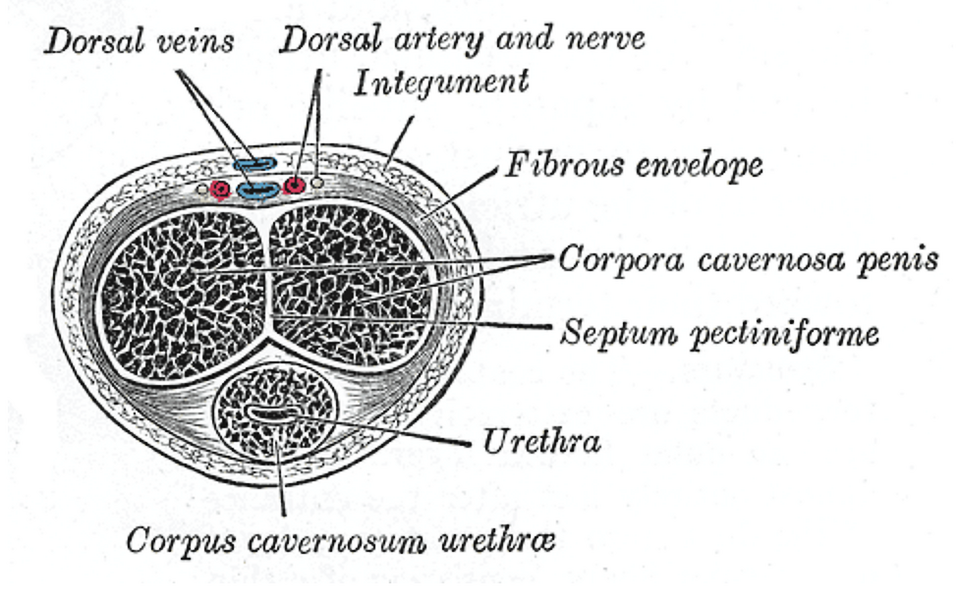
The penis contains two sponge-like erectile bodies, the corpora cavernosa. When the pump removes air from the sealed cylinder, the negative pressure stretches the spaces (sinusoids) inside these bodies and pulls blood into them, so the penis swells and stiffens. The EAU describes the effect as dilating the cavernous sinuses, reducing backward venous flow and increasing arterial inflow. Because the suction does the work, a vacuum erection device does not need intact nerves or a working response to medication.
The constriction ring of a vacuum erection device then slows blood from draining out. This is why the erection looks and feels different from a natural one: it can look purplish or bluish and feel cooler, and it is rigid only above the ring, so the penis may pivot at the base.
Source: EAU Guidelines — Penile curvature (Peyronie’s disease); Rev Urol 2013 (PMC) — Hoyland et al. Vacuum erection devices after radical prostatectomy
Who it is designed for
Cleveland Clinic notes that VEDs are mostly used for physical causes of ED, such as poor blood flow into the penis, excess blood leaking out during erection, or nerve damage, and are sometimes suggested for anxiety-related ED. The NHS says vacuum pumps work for most men and can be used when medicine is not suitable or has not worked. The EAU adds that a vacuum erection device may be the treatment of choice for well-informed older men who have sex infrequently, have other health problems and want a non-invasive, drug-free option.
Source: Cleveland Clinic — Vacuum Constriction Devices (VCDs); NHS — Erectile dysfunction: treatment
How to use a vacuum erection device, step by step
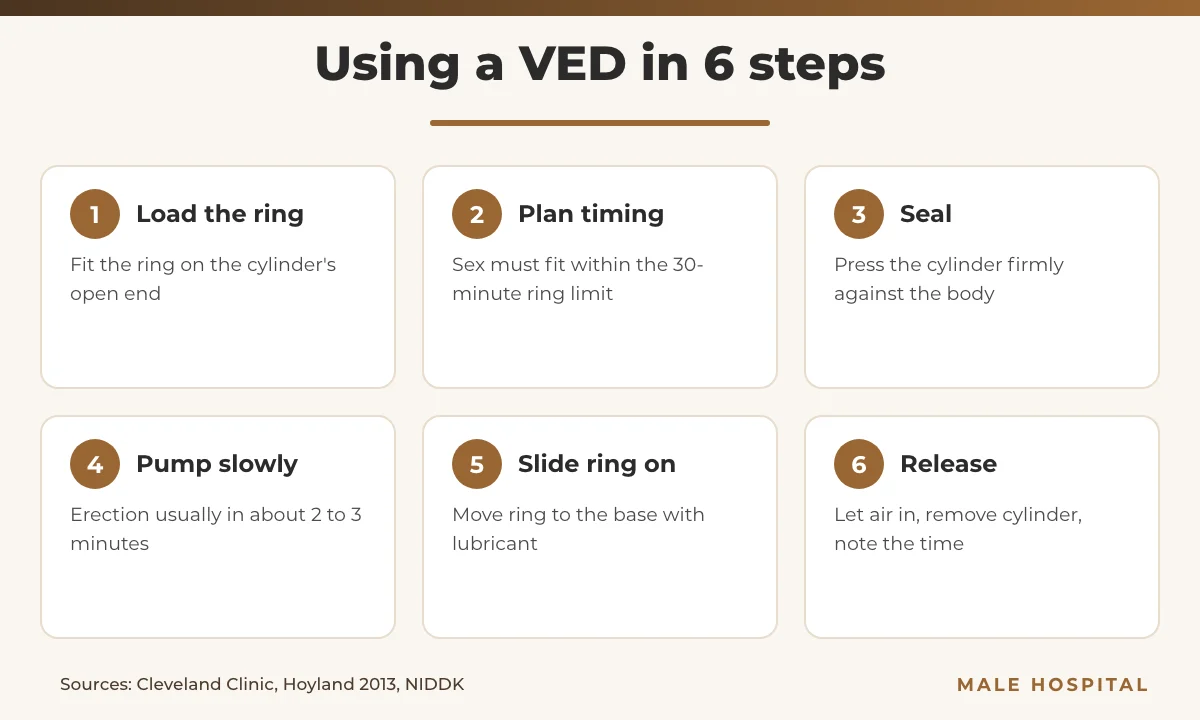
Your doctor or nurse should show you how to use the specific model you buy, because cylinder size, ring tension and pump type differ. NIDDK points out that most men need some practice and adjustment before a vacuum erection device works well. The basic sequence is the same for most devices:
- Load the ring. Fit the constriction ring onto the open end of the cylinder, as your device instructions show, and have lubricant ready.
- Check the timing. Plan so that intercourse can happen within the 30 minutes the ring may stay on.
- Position the cylinder. Place the flaccid penis inside the cylinder and press the open end firmly against the body to make an airtight seal.
- Pump. Pump air out of the cylinder slowly. The vacuum draws blood into the shaft and the penis becomes erect, usually within about 2 to 3 minutes (reported range 30 seconds to 7 minutes). Stop if it hurts.
- Slide the ring on. Once the erection is firm, use the lubricant to slide the ring off the cylinder onto the base of the penis.
- Release and remove. Use the release valve to let air back in, then remove the cylinder. Note the time: the ring must come off within 30 minutes.
Cleveland Clinic suggests a warm compress before sex if the penis feels cold. After intercourse, or by the 30-minute mark at the latest, pull the ring off using its tabs or loop.
Source: Cleveland Clinic — Vacuum Constriction Devices (VCDs); Rev Urol 2013 (PMC) — Hoyland et al.; NIDDK — Treatment for Erectile Dysfunction
The constriction ring and the 30-minute rule
The ring traps blood in the penis, and blood that cannot circulate gradually runs short of oxygen. The EAU states that serious adverse events, specifically skin necrosis (tissue death), can be avoided if the ring is removed within 30 minutes. A 2013 review explains that the ring causes ischemia (lack of oxygen) after 30 minutes, which is why a vacuum erection device used for rehabilitation is often used without a ring.
The US Food and Drug Administration (FDA) guidance for these devices goes further. It says rings should not be designed to encourage use beyond 30 minutes and that labeling should warn users:
- not to wear a ring for more than 30 minutes per use;
- not to fall asleep while wearing a ring;
- not to put a ring back on within 60 minutes of taking it off.
The FDA also asks for rings with a tab or loop wide enough to release pressure quickly. With any vacuum erection device, use only rings made for the purpose, with a tab or loop you can grip quickly.
Source: EAU Guidelines — Management of erectile dysfunction; FDA — External Penile Rigidity Devices: Class II Special Controls Guidance
How effective is a vacuum erection device?
Effectiveness depends on what you measure. In terms of producing an erection firm enough for intercourse, the EAU puts the success rate as high as 90%, whatever the cause of ED. Satisfaction is a different story: reported satisfaction ranges from 27% to 94%, and long-term use drops to 50% to 64% after two years. The EAU rates the evidence as level 2b and gives a weak recommendation to use VEDs in well-informed men who want non-invasive, drug-free treatment.
Why the gap? Men and partners often dislike the preparation time, the bulk of the vacuum erection device, the cooler and darker erection, and the loss of spontaneity. On the other hand, a 2013 review reported that adherence to VEDs can reach 80%, compared with about 40% for penile injections for erectile dysfunction, and that a VED and rings cost the UK NHS roughly £228 over about five years.
Source: EAU Guidelines — Management of erectile dysfunction; Rev Urol 2013 (PMC) — Hoyland et al.
| Question | What the evidence shows | Source |
|---|---|---|
| Erection firm enough for sex | Up to 90%, regardless of ED cause | EAU |
| User satisfaction | Wide range, 27% to 94% | EAU |
| Still using after 2 years | 50% to 64% | EAU |
| After prostatectomy (6 RCTs, 273 men) | IIEF-5 score about 4.8 points higher than controls; less penile shrinkage | Qin et al. 2018 |
| Peyronie’s curvature (small retrospective study) | Average 23° improvement vs 3.6° without a VED | MacDonald et al. 2020 |
| Guideline recommendation | Weak, for well-informed men wanting drug-free care | EAU |
Sources: Am J Mens Health 2018 (PMC) — Qin et al. Early vacuum therapy after radical prostatectomy: meta-analysis; Can Urol Assoc J 2020 (PMC) — MacDonald et al. VED therapy in Peyronie’s disease
Combining a VED with tablets
A vacuum erection device can be combined with PDE5 inhibitor tablets such as sildenafil or tadalafil (compare them in our Viagra vs Cialis guide). The EAU states that combining a VED with a PDE5 inhibitor offers clear advantages over either treatment alone, including after radical prostatectomy. If neither approach is enough, the next options include injections and, for lasting results, a penile prosthesis.
Source: EAU Guidelines — Management of erectile dysfunction
Side effects and who should not use a VED
Most side effects of a vacuum erection device are mild and temporary. The EAU lists the most common as pain, inability to ejaculate, petechiae (tiny red or purple dots from burst capillaries), bruising and numbness. In studies summarized in a 2013 review, inability to ejaculate affected 12% to 30% of users and petechiae 25% to 39%.
- Color and temperature: the penis may look purple and feel cold or numb.
- Bruising: usually painless and gone within a few days, according to NIDDK.
- Ejaculation: the ring can trap semen or weaken ejaculation; NIDDK notes this does not affect the pleasure of orgasm, although Cleveland Clinic lists difficulty reaching orgasm as a possible effect.
- Swelling and pivoting: some swelling is possible, and the erection can pivot at the base because the area below the ring stays soft.
Source: EAU Guidelines — Management of erectile dysfunction; NIDDK — Treatment for Erectile Dysfunction; Cleveland Clinic — Vacuum Constriction Devices (VCDs)
Contraindications and cautions
The EAU is clear that a vacuum erection device is contraindicated in men with bleeding disorders or on anticoagulant therapy, because suction can cause bruising and bleeding under the skin. FDA guidance tells manufacturers to warn against use by people with sickle cell disease, a history of prolonged erections (priapism), or heavy use of aspirin or other blood thinners. It also lists cautions for men with reduced pain sensation (for example from nerve damage), weak hands, or who have been drinking or using drugs, since these make it harder to notice injury or remove the ring.
The FDA also warns that using a vacuum erection device for ED should not delay diagnosis of an underlying condition such as diabetes. A medical assessment before you start helps find the cause of your ED.
Source: EAU Guidelines — Management of erectile dysfunction; FDA — External Penile Rigidity Devices: Class II Special Controls Guidance
Penile rehabilitation and Peyronie’s disease
After radical prostatectomy
Erections often fail for months after prostate cancer surgery, and the erectile tissue can lose oxygen and shrink in the meantime. “Penile rehabilitation” means stimulating blood flow early to protect that tissue. Because a vacuum erection device pulls blood in without needing intact nerves, it is well suited to this role, and in rehabilitation it is usually used without a ring. The EAU says early VED use has an excellent therapeutic effect after radical prostatectomy and should be considered.
A 2018 meta-analysis of six randomized trials (273 men) found that early vacuum therapy improved IIEF-5 erectile function scores compared with no treatment (mean difference 4.76 points) and, added to PDE5 inhibitors, beat tablets alone (3.84 points). It also reduced penile shrinkage and preserved about 1.26 cm more length when combined with tablets. No serious side effects were reported, but the trials were small, unblinded and of low to moderate quality.
Source: Am J Mens Health 2018 (PMC) — Qin et al.; EAU Guidelines — Management of erectile dysfunction
In Peyronie’s disease
In Peyronie’s disease, scar tissue (plaque) in the penis causes curvature and sometimes shortening. A vacuum erection device can be used as a gentle stretching (“traction”) tool. In a 2020 Canadian study, 20 men who used a VED for 10 minutes twice a day improved their curvature by an average of 23°, compared with 3.6° in 33 untreated men, with no complications. The study was retrospective and small, and curvature was measured from home photos.
The EAU notes that only two retrospective studies have assessed VED therapy for Peyronie’s and more research is needed. Even so, it gives a weak recommendation to offer traction and vacuum devices to reduce deformity or as part of multimodal treatment, and mentions VED and traction after lengthening surgery to help prevent length loss. FDA guidance, meanwhile, lists worsening of Peyronie’s disease as a potential risk of these devices, so use one only under a urologist’s guidance.
Source: Can Urol Assoc J 2020 (PMC) — MacDonald et al.; EAU Guidelines — Penile curvature (Peyronie’s disease); FDA — External Penile Rigidity Devices guidance
Medical vacuum erection device vs novelty penis pump
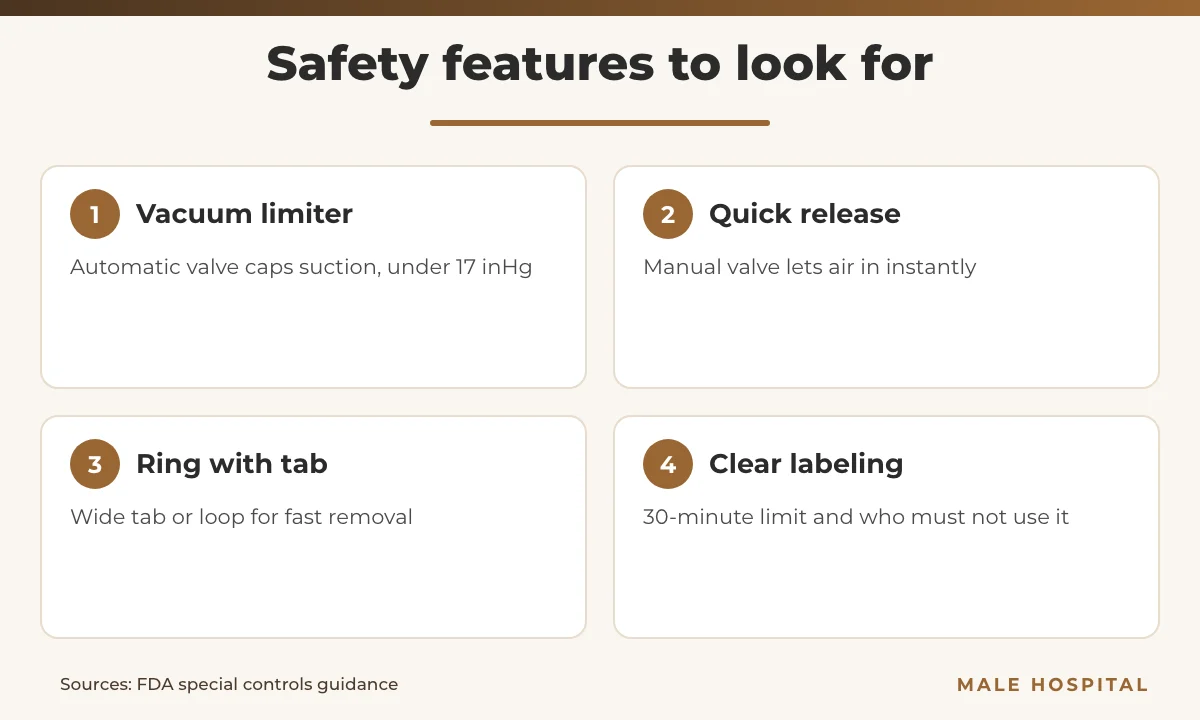
In the United States, the FDA classifies external penile rigidity devices, including vacuum pumps and constriction rings intended to create or keep an erection for intercourse, as Class II medical devices under 21 CFR 876.5020. They are exempt from premarket notification only if they follow the FDA’s special controls. These controls include:
- an automatic safety valve and verified maximum vacuum (typical pumps draw under 17 inches of mercury);
- a manual way to release the vacuum quickly;
- rings with a wide tab or loop for fast removal and labeling for the 30-minute limit;
- warnings about who should not use the device.
A medical vacuum erection device and its rings can be sold over the counter, but they are often used under a doctor’s guidance and may be prescribed. The FDA guidance explicitly does not cover devices marketed for penile enlargement or for treating curvature, which means pumps sold for “enlargement” or as adult novelties are outside this category, and there is no assurance they include a vacuum limiter or quick release. For treating ED, choose a medical device recommended by your urologist and ask for a demonstration.
Source: FDA — External Penile Rigidity Devices: Class II Special Controls Guidance; NHS — Erectile dysfunction: treatment
When to see a doctor
See a urologist before buying a vacuum erection device, so the cause of your ED can be checked and the right device size chosen. Remove the ring and seek urgent medical care if you notice:
- a ring that is stuck and will not come off;
- severe pain, or a penis that stays cold, pale, dark blue or numb after the ring is removed;
- skin breakdown, blisters or wounds on the penis;
- an erection that does not go down after the ring is removed;
- a large, painful swelling or heavy bruising;
- a new or worsening bend in the penis.
Source: FDA — External Penile Rigidity Devices guidance (risks: tissue injury, priapism, worsening Peyronie’s); EAU Guidelines — Management of erectile dysfunction
If you are unsure whether a vacuum erection device, tablets, injections or an implant suits you, you can book a confidential consultation with our urologist-andrologist on WhatsApp. You can also read about all options on our erectile dysfunction treatment page.
FAQs about vacuum erection devices
Do vacuum erection devices really work?
Yes, for producing an erection. The EAU reports erections satisfactory for intercourse in up to 90% of men, whatever the cause of their ED. However, satisfaction varies from 27% to 94%, and only about half to two-thirds of men are still using the vacuum erection device after two years, often because of bulk, preparation time or the feel of the erection.
Source: EAU Guidelines — Management of erectile dysfunction
How long can you keep the ring on?
No more than 30 minutes. Cleveland Clinic says the band can safely stay on for up to 30 minutes, and the EAU links skin necrosis to longer use. FDA labeling guidance also warns never to sleep with a ring on and to wait at least 60 minutes before putting a ring on again.
Source: Cleveland Clinic — Vacuum Constriction Devices (VCDs); FDA — External Penile Rigidity Devices guidance
How long does it take to get an erection with a VED?
Usually a few minutes. A 2013 review reported that an erection is typically reached in about 2 to 3 minutes, with a range of roughly 30 seconds to 7 minutes. Most men get faster with practice, and NIDDK notes that some adjustment of the vacuum erection device and technique is often needed at first.
Source: Rev Urol 2013 (PMC) — Hoyland et al.; NIDDK — Treatment for Erectile Dysfunction
Can I ejaculate while using a vacuum pump?
Often not normally. Because the ring compresses the urethra, semen may be trapped or ejaculation weakened; inability to ejaculate was reported in 12% to 30% of users in studies reviewed in 2013. NIDDK notes that weaker ejaculation does not reduce the pleasure of orgasm, and semen usually comes out once the ring is removed.
Source: NIDDK — Treatment for Erectile Dysfunction; Rev Urol 2013 (PMC) — Hoyland et al.
Can I use a vacuum erection device if I take blood thinners?
Generally no. The EAU lists bleeding disorders and anticoagulant therapy as contraindications, and FDA guidance warns against use with heavy aspirin or other blood-thinner use because of the risk of bruising and blood collecting under the skin. Never stop a blood thinner on your own; ask your doctor about safer ED options.
Source: EAU Guidelines — Management of erectile dysfunction; FDA — External Penile Rigidity Devices guidance
Is a VED useful after prostate cancer surgery?
It can be. A 2018 meta-analysis of six small randomized trials found that starting vacuum therapy early after radical prostatectomy improved erectile function scores and reduced penile shrinkage, especially combined with PDE5 inhibitors. The authors called the evidence low to moderate quality. The EAU also supports early vacuum erection device use in this setting.
Source: Am J Mens Health 2018 (PMC) — Qin et al.
Can a vacuum device straighten a curved penis?
It may help a little in Peyronie’s disease, but evidence is limited. One small retrospective study found an average 23° improvement with 10 minutes of use twice daily. The EAU gives only a weak recommendation for vacuum and traction devices, and the FDA lists worsening of Peyronie’s as a possible risk, so use a vacuum erection device only with medical supervision.
Source: Can Urol Assoc J 2020 (PMC) — MacDonald et al.; EAU Guidelines — Penile curvature
Do I need a prescription for a penis pump?
Not always. FDA guidance treats these devices as over-the-counter products that are often used under a doctor’s guidance and can be prescribed. In the UK, the NHS says vacuum pumps are not always provided on the NHS and suggests asking your doctor where to get one. A medical assessment first is still wise.
Source: FDA — External Penile Rigidity Devices guidance; NHS — Erectile dysfunction: treatment
Medically reviewed by Assoc. Prof. Dr. Zülfü Sertkaya, urologist and andrologist (FEBU), Istanbul. Last reviewed: October 2026.
This article is for general information and does not replace an individual consultation with a qualified doctor.
- EAU — Sexual and Reproductive Health Guidelines — Management of erectile dysfunction
- EAU — Sexual and Reproductive Health Guidelines — Penile curvature (Peyronie's disease)
- FDA — External Penile Rigidity Devices — Class II Special Controls Guidance Document
- NIDDK — Treatment for Erectile Dysfunction
- Cleveland Clinic — Vacuum Constriction Devices (VCDs)
- NHS — Erectile dysfunction (impotence) — Treatment
- Rev Urol 2013 (PMC) — Hoyland et al. The use of vacuum erection devices in erectile dysfunction after radical prostatectomy
- Am J Mens Health 2018 (PMC) — Qin et al. The early use of vacuum therapy for penile rehabilitation after radical prostatectomy: systematic review and meta-analysis
- Can Urol Assoc J 2020 (PMC) — MacDonald et al. Outcome analysis of patients with Peyronie's disease who elect for vacuum erection device therapy