
Erectile Dysfunction Treatment: 9 Proven Options in Istanbul
Erectile dysfunction treatment works best as a step-by-step ladder: correct the risk factors first, then use tablets (PDE5 inhibitors), and move to vacuum devices, alprostadil injections or a penile implant only if needed. European (EAU) guidelines rate lifestyle change, PDE5 inhibitors, penile injections, penile prosthesis and psychosexual therapy as strong recommendations, so almost every man has an effective option.
Source: EAU — Sexual and Reproductive Health Guidelines: Management of Erectile Dysfunction
- Erection problems can be an early warning sign of heart disease, so a medical check comes before any prescription.
- PDE5 inhibitors (sildenafil, tadalafil, vardenafil, avanafil) are the first-line medicines; they need sexual stimulation to work.
- If tablets fail or are unsafe, alprostadil injections, intraurethral alprostadil and vacuum devices are proven alternatives.
- Shockwave therapy has only modest, weak-grade evidence; PRP and stem cells remain experimental.
- A penile prosthesis is the definitive solution for ED that does not respond to other treatment.
Share your history and test results privately and get a personalised treatment plan from our urologist-andrologist.
- What is erectile dysfunction treatment?
- Diagnosis before treatment: the work-up
- Who is a good candidate for each option
- Erectile dysfunction treatment options compared
- The treatment ladder step by step
- Shockwave, PRP and stem cells: what the evidence says
- Timeline: how fast each treatment works
- Risks and side effects
- Results and realistic expectations
- Erectile dysfunction treatment with Dr. Zülfü Sertkaya in Istanbul
- When to see a doctor
- FAQs about erectile dysfunction treatment
What is erectile dysfunction treatment?
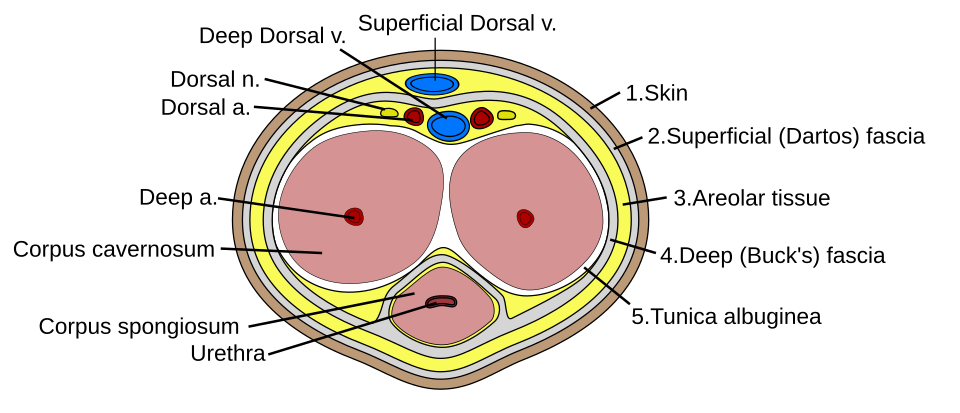
Erectile dysfunction (ED) means you regularly cannot get or keep an erection firm enough for satisfying sex. An erection depends on healthy blood vessels, nerves and hormones filling the two spongy chambers of the penis (the corpora cavernosa) with blood, so anything that damages those systems can cause ED.
Treatment therefore has two goals: restore erections that work for you and your partner, and find and treat the underlying cause. Vascular problems are the most common physical cause, and conditions such as high blood pressure, high cholesterol, diabetes and atherosclerosis are shared risk factors with heart disease. In many men, ED is the first sign of one of these problems.
Source: Cleveland Clinic — Erectile Dysfunction (ED)
Modern guidelines no longer force every man through a rigid sequence. The American Urological Association (AUA) guideline was written as a clinical strategy for both diagnosis and treatment, and the EAU guideline lets well-informed men choose some second-line options, such as penile injections, as an alternative first step. What matters is a shared decision based on your health, preferences and how well each method fits your sex life.
Sources: AUA — Erectile Dysfunction: AUA Guideline; EAU — Management of Erectile Dysfunction
Diagnosis before treatment: the work-up
A proper assessment avoids missing a serious condition and points to the right treatment. It usually has four parts.
- Medical and sexual history: your medicines (including over-the-counter drugs and supplements), desire, erections, ejaculation and orgasm, mood and stress, and, if you wish, your partner’s view of the relationship.
- Physical examination: checks for blood-vessel and nerve problems, hormonal signs, penile injury and conditions such as Peyronie’s disease.
- Blood tests: these can include thyroid and prostate tests alongside checks for diabetes, cholesterol and hormones as your doctor judges necessary.
- Specialised tests when needed: penile ultrasound to show blood flow, a nocturnal erection test to see whether erections occur during sleep, and an in-office injection test to judge how full and lasting an erection becomes.
Source: NIDDK (NIH) — Diagnosis of Erectile Dysfunction
If a hormone problem shows up, treating it becomes part of the plan; if the problem is mainly psychological, counselling may be the key step.
Sources: NIDDK — Diagnosis of Erectile Dysfunction; NHS — Erectile dysfunction: Treatment
Who is a good candidate for each option
The best match depends on the cause, your other illnesses and your priorities.
- Tablets: suitable for most men, but never for men who take nitrate medicines for chest pain or use “poppers”, because the combination can cause a dangerous drop in blood pressure.
- Vacuum devices: for men who want a drug-free, non-invasive method; not for men with bleeding disorders or on blood thinners.
- Injections or intraurethral alprostadil: for men in whom tablets fail, are unsafe or cause side effects, or who simply prefer them.
- Penile prosthesis: for men whose ED does not respond to other treatment or who prefer a permanent solution after full counselling.
- Testosterone: only when blood tests confirm low or low-normal testosterone along with sexual symptoms.
Sources: MedlinePlus — Sildenafil; EAU — Management of Erectile Dysfunction
Erectile dysfunction treatment options compared
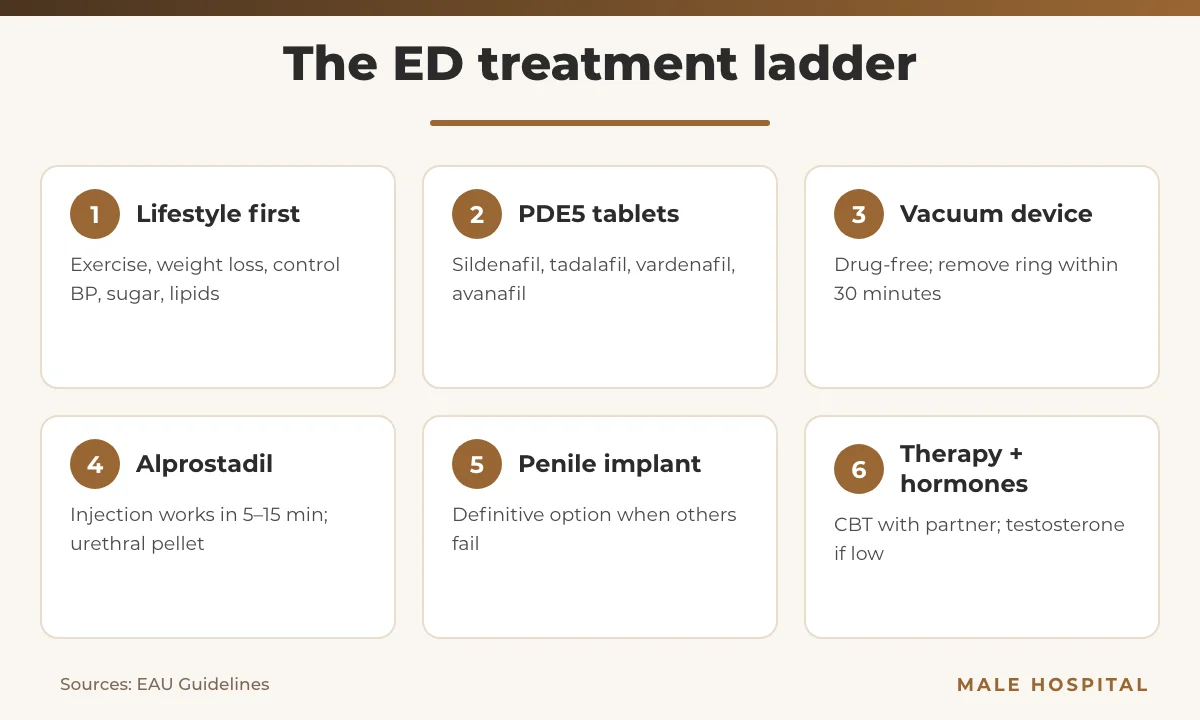
The table summarises how each erectile dysfunction treatment works, how fast it acts and how strongly the EAU guideline supports it.
| Treatment | How it works | Onset | EAU strength |
|---|---|---|---|
| Lifestyle and risk-factor control | Exercise, weight loss, treating blood pressure, sugar and cholesterol | Months | Strong |
| PDE5 inhibitor tablets | Boost blood flow into the penis during arousal | 15–60 min | Strong (first-line) |
| Vacuum erection device | Pump draws blood in; ring holds it | Minutes | Weak |
| Intracavernosal alprostadil | Self-injection into the side of the penis | 5–15 min | Strong |
| Intraurethral alprostadil | Small pellet or cream placed in the urethra opening | Minutes | Weak |
| Low-intensity shockwave | Sound waves applied to the penis over several sessions | 1–3 months | Weak (mild vascular ED) |
| PRP / stem cells | Injected blood or cell products | Unproven | Clinical trials only |
| Penile prosthesis | Surgically implanted inflatable or malleable cylinders | After healing | Strong |
| Psychosexual therapy | Cognitive behavioural therapy, ideally with the partner | Weeks | Strong |
Source: EAU — Management of Erectile Dysfunction
The treatment ladder step by step
Step 1: Lifestyle and risk-factor control
The EAU makes a strong recommendation to start lifestyle changes and risk-factor control before, or alongside, any ED medicine. Regular aerobic exercise, weight loss and treatment of cardiovascular risk factors can improve sexual function, and statins have shown improvements in erectile function in pooled studies.
Practical steps include stopping smoking, eating a healthy diet, managing stress and keeping alcohol to 14 units a week or less. Your doctor may also review medicines that can contribute to ED and treat high blood pressure, cholesterol or hormone problems. Vigorous cardiovascular exercise may even reverse some mild cases.
Sources: EAU — Management of Erectile Dysfunction; NHS — Erectile dysfunction: Treatment
Step 2: PDE5 inhibitor tablets
Phosphodiesterase-5 (PDE5) inhibitors are the first-line medical erectile dysfunction treatment. They increase blood flow to the penis but only work with sexual stimulation; they do not create desire on their own.
- Sildenafil (Viagra): 25, 50 or 100 mg, usually starting at 50 mg; works in 30–60 minutes and is effective for up to 12 hours. Best taken about an hour before sex, and a high-fat meal can delay it.
- Tadalafil (Cialis): 10 or 20 mg on demand, or 5 mg daily; works from 30 minutes and lasts up to 36 hours. Daily use suits men who prefer spontaneity.
- Vardenafil: 5, 10 or 20 mg, usually starting at 10 mg; works from 30 minutes, and in about one in three men within 15 minutes.
- Avanafil: 50, 100 or 200 mg, usually starting at 100 mg; taken 15–30 minutes before sex.
Sources: EAU — Management of Erectile Dysfunction; MedlinePlus — Sildenafil
In 24-week dose-response trials, sildenafil produced erections firm enough for intercourse in 56–84% of men depending on dose, versus 25% on placebo. The EAU suggests sildenafil 50 mg when efficacy is the priority and tadalafil 10 mg when tolerability matters most. In the UK, tadalafil, vardenafil and avanafil need a prescription, and buying ED medicines online carries a real risk of fake or unregulated products.
Sources: EAU — Management of Erectile Dysfunction; NHS — Erectile dysfunction: Treatment
Step 3: Vacuum erection devices
A vacuum device is a clear cylinder placed over the penis; a pump draws blood in, and a constriction ring at the base holds the erection. The EAU gives it a weak recommendation for well-informed men who want non-invasive, drug-free management. Efficacy is reported up to 90%, but only 50–64% of men are still using it after two years. The ring must come off within 30 minutes to avoid skin damage.
Source: EAU — Management of Erectile Dysfunction
Step 4: Alprostadil injections and intraurethral alprostadil
Intracavernosal injection means using a very fine needle to inject alprostadil into the side of the penis. You are taught to do it yourself in the clinic. Doses range from 5 to 40 micrograms, an erection follows in 5–15 minutes, and efficacy is above 70%. The EAU rates it a strong recommendation, either as an alternative first-line option or as second-line therapy. Other injectable drugs, such as papaverine and phentolamine, are also used.
Intraurethral alprostadil (MUSE) is a small pellet inserted into the tip of the urethra, typically starting at 500 micrograms. It produces erections sufficient for intercourse in 30–65.9% of men, so it is less effective than injections, and long-term use is about 30%. It suits men who refuse needles or cannot use tablets.
Sources: EAU — Management of Erectile Dysfunction; Cleveland Clinic — Erectile Dysfunction (ED)
Step 5: Penile prosthesis for refractory ED
When other options fail or are not acceptable, a penile prosthesis (penile implant) is the definitive solution. The EAU makes a strong recommendation for implantation in these men after full counselling. Satisfaction is reported in at least 92% of patients and 91–95% of partners, and device survival is 87.2% at five years. An implant does not change sensation, urination or orgasm. Read more about what actually happens to size and performance after penile implant surgery.
Sources: EAU — Management of Erectile Dysfunction; Cleveland Clinic — Erectile Dysfunction (ED)
Alongside every step: psychosexual therapy and testosterone
Anxiety, depression and relationship stress can cause ED or keep it going even after a physical cause is treated. The EAU strongly recommends referral for cognitive behavioural therapy when indicated, including the partner and combined with medical treatment. Group, couple and online formats are all supported.
Testosterone is considered when blood tests show low or low-normal levels together with problems with desire, erections or satisfaction. Hypogonadal men who do not respond to PDE5 inhibitors may respond better after testosterone is corrected. Testosterone is not an ED treatment for men with normal levels.
Source: EAU — Management of Erectile Dysfunction
Shockwave, PRP and stem cells: what the evidence says
Low-intensity shockwave therapy (Li-SWT). The EAU gives it only a weak recommendation, for men with mild vascular ED, as an alternative for those who cannot take tablets, or for poor responders to PDE5 inhibitors. Pooled studies (level 1a evidence) show a mild improvement in erectile function, with effects starting 1–3 months after treatment. The AUA 2018 guideline is more cautious: it classifies shockwave therapy as investigational because the evidence was insufficient to recommend for or against it.
Platelet-rich plasma (PRP). The EAU says PRP should be used only within a clinical trial; one randomised trial was positive but a 2023 trial found no difference from placebo. The AUA says PRP should not be offered outside an approved research protocol.
Stem cells. Early studies suggest acceptable safety, but efficacy is unproven and the data are insufficient for any clinical recommendation. Be wary of any clinic that sells PRP or stem cells as a proven erectile dysfunction treatment.
Sources: EAU — Management of Erectile Dysfunction; Therapeutic Advances in Urology (PMC) — Reviewing the evidence for shockwave- and cell-based regenerative therapies in ED
Timeline: how fast each treatment works
Most ED treatments need no recovery time; they differ in how quickly they act.
| Treatment | When it starts working |
|---|---|
| Vacuum device | Almost immediately |
| Penile injections | About 10 minutes |
| Oral tablets | Within about an hour |
| Testosterone replacement (if deficient) | About four weeks |
| Shockwave therapy | About two months |
| Quitting smoking (mild ED) | Several months |
Source: Cleveland Clinic — Erectile Dysfunction (ED)
A penile implant is the exception: it is an operation, and the device is used only after the surgical area has healed and your surgeon has shown you how to use it. Our penile prosthesis page explains the recovery in detail.
Risks and side effects
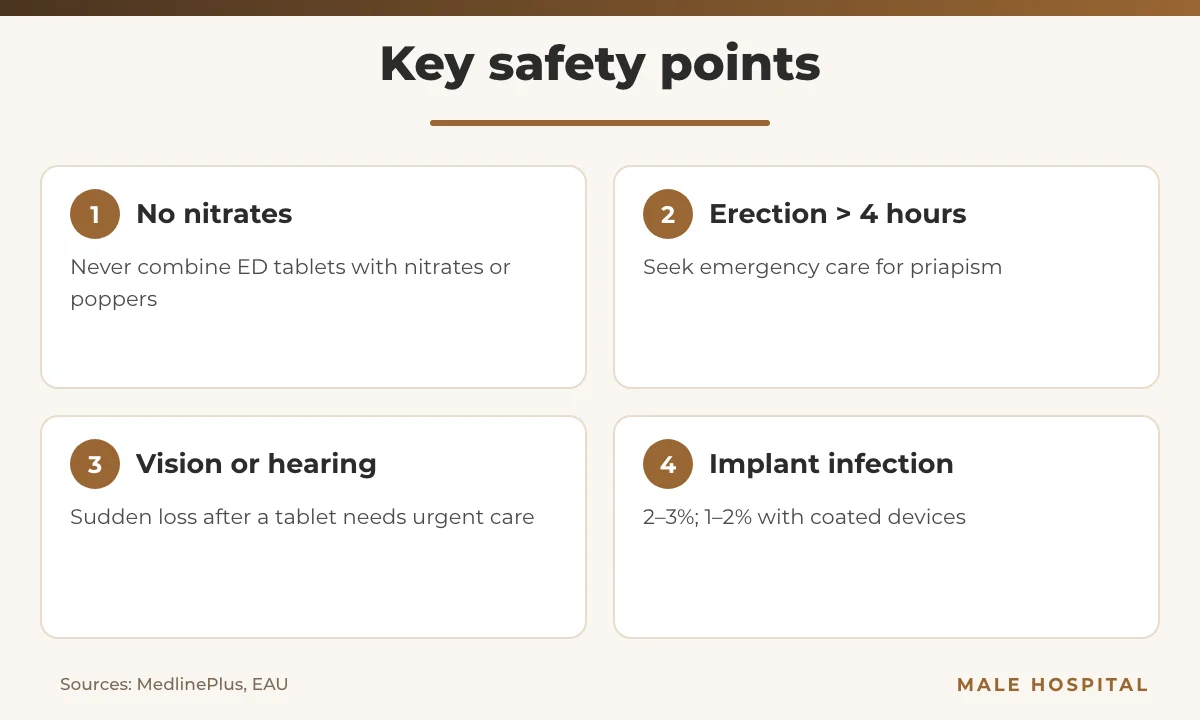
- PDE5 inhibitors: headache, flushing, heartburn, nasal congestion, back or muscle pain and changes in color vision are common. Seek urgent help for sudden vision or hearing loss, chest pain, fainting, or an erection lasting more than 4 hours. Never combine with nitrates or poppers.
- Vacuum devices: bruising and skin damage if the ring is left on more than 30 minutes; not suitable with bleeding disorders or blood thinners.
- Alprostadil injections: drop-out rates of 41–68%, mostly in the first 2–3 months; prolonged erection (priapism) in about 1% and scarring (fibrosis) in about 2%.
- Intraurethral alprostadil: local pain in 29–41% of men.
- Penile prosthesis: infection in 2–3% of cases, falling to 1–2% with coated or antibiotic-impregnated devices; mechanical failure over time.
Sources: MedlinePlus — Sildenafil; EAU — Management of Erectile Dysfunction
Results and realistic expectations
Most men with ED can return to satisfying sex with the right treatment, though it may not be the first one tried. Whether ED can be cured depends on the cause: correcting risk factors, hormones or psychological triggers can restore natural erections in some men, while others will rely on a treatment each time they have sex.
Long-term success also depends on staying with a method. Drop-out is common with injections, intraurethral therapy and vacuum devices, often because the method interrupts intimacy. Men who also have curvature can explore Peyronie’s disease treatment, since the two problems are often linked.
Source: EAU — Management of Erectile Dysfunction
Erectile dysfunction treatment with Dr. Zülfü Sertkaya in Istanbul
Your care is led by Assoc. Prof. Dr. Zülfü Sertkaya, a urologist and andrologist in Istanbul. He is a Fellow of the European Board of Urology (FEBU, 2017), became Associate Professor of Urology in 2020 and has been a urology specialist since 2014. His clinical focus includes penile prosthesis surgery, Peyronie’s disease, premature ejaculation and male infertility, and he holds the Coloplast Titan® Inflatable Penile Prosthesis Center of Excellence certificate (2024). He is a member of the EAU, ESSM and ISSM.
For international patients, our team arranges reception and transport, translation, trip planning, hotel accommodation, the medical consultation and aftercare. Pricing is given after a free assessment, because it depends on the tests you need and the treatment or device chosen.
How to start
- Send us a confidential WhatsApp message with your age, symptoms, medicines and any recent test results.
- Our urologist-andrologist reviews your history and suggests whether more tests are needed.
- You receive a personalised plan, from medical therapy to surgery if appropriate, and we help organise your visit.
When to see a doctor
See a doctor if erection problems last more than a few weeks or are affecting your relationship or confidence. Because ED can be the first symptom of heart disease, it is worth a check-up even if you feel otherwise well. Seek urgent or emergency care if:
- you have an erection that is painful or lasts longer than 4 hours after using an ED medicine or injection;
- you develop chest pain, fainting or shortness of breath during sex or after taking a tablet;
- you notice sudden loss of vision or hearing after taking a PDE5 inhibitor.
Sources: MedlinePlus — Sildenafil; Cleveland Clinic — Erectile Dysfunction (ED)
Ready to talk? Get a confidential consultation with our urologist-andrologist in Istanbul.
FAQs about erectile dysfunction treatment
What is the most effective erectile dysfunction treatment?
For severe ED that has not responded to anything else, a penile prosthesis is the most reliable option, the option with the highest reported satisfaction. For most men, though, tablets or injections work well. The most effective choice for you depends on the cause, your health and how you want treatment to fit into your sex life.
Source: EAU — Management of Erectile Dysfunction
Which is better, sildenafil or tadalafil?
Neither is better for everyone. The EAU suggests sildenafil 50 mg for men who prioritise effectiveness and tadalafil 10 mg for men who prioritise fewer side effects. Tadalafil lasts up to 36 hours and can be taken as a low daily dose, which suits men who want spontaneity; sildenafil lasts up to about 12 hours.
Source: EAU — Management of Erectile Dysfunction
What if Viagra does not work for me?
First check that you took it correctly: about an hour before sex, not after a heavy fatty meal, and with sexual stimulation. If it still fails, options include another PDE5 inhibitor, correcting low testosterone if present, alprostadil injections or intraurethral therapy, a vacuum device, or ultimately a penile implant.
Sources: MedlinePlus — Sildenafil; EAU — Management of Erectile Dysfunction
Does shockwave therapy cure ED?
No treatment should be sold as a cure. Shockwave therapy has a weak EAU recommendation for mild vascular ED, with modest improvements appearing 1–3 months after treatment. The AUA guideline classifies it as investigational. It is not suitable as the main treatment for moderate or severe ED.
Sources: EAU — Management of Erectile Dysfunction; Therapeutic Advances in Urology (PMC) — Regenerative therapies in ED
Are PRP injections (P-shot) recommended for ED?
Not outside research. The EAU states PRP should be used only in a clinical trial, and the AUA says it should not be offered except under an approved research protocol. Trial results are conflicting, with a 2023 randomised trial showing no benefit over placebo. Stem cell therapy is also experimental.
Sources: EAU — Management of Erectile Dysfunction; Therapeutic Advances in Urology (PMC) — Regenerative therapies in ED
Are penile injections painful?
A very fine needle is used, and you are trained in the clinic before injecting at home, which helps with technique and confidence.
Source: EAU — Management of Erectile Dysfunction
Can testosterone fix erectile dysfunction?
Only if your testosterone is actually low or low-normal and you also have sexual symptoms. In these men, correcting the hormone can improve desire and erections and may help tablets work better. If your testosterone is normal, extra testosterone will not treat ED and has its own risks.
Source: EAU — Management of Erectile Dysfunction
Can ED caused by anxiety be treated?
Yes. Psychosexual counselling or cognitive behavioural therapy, ideally involving your partner, is strongly recommended by the EAU and is often combined with tablets at first to break the cycle of performance anxiety. Counselling can be done individually, as a couple, in groups or online.
Sources: EAU — Management of Erectile Dysfunction; NHS — Erectile dysfunction: Treatment
How much does erectile dysfunction treatment cost in Istanbul?
The cost depends on the tests you need and the treatment chosen, from medication to an implant, so we do not quote a fixed price. Send your history and results via WhatsApp for a free assessment, and you will receive a personalised plan with a clear quote.
Medically reviewed by Assoc. Prof. Dr. Zülfü Sertkaya, urologist and andrologist (FEBU), Istanbul. Last reviewed: October 2026.
This article is for general information and does not replace an individual consultation with a qualified doctor.
- EAU — Sexual and Reproductive Health Guidelines — Management of Erectile Dysfunction
- AUA — Erectile Dysfunction: AUA Guideline (2018)
- NIDDK (NIH) — Diagnosis of Erectile Dysfunction
- NHS — Erectile dysfunction: Treatment
- Cleveland Clinic — Erectile Dysfunction (ED)
- MedlinePlus — Sildenafil
- Therapeutic Advances in Urology (PMC) — Reviewing the evidence for shockwave- and cell-based regenerative therapies in the treatment of erectile dysfunction